Page 1 of 2
1 2

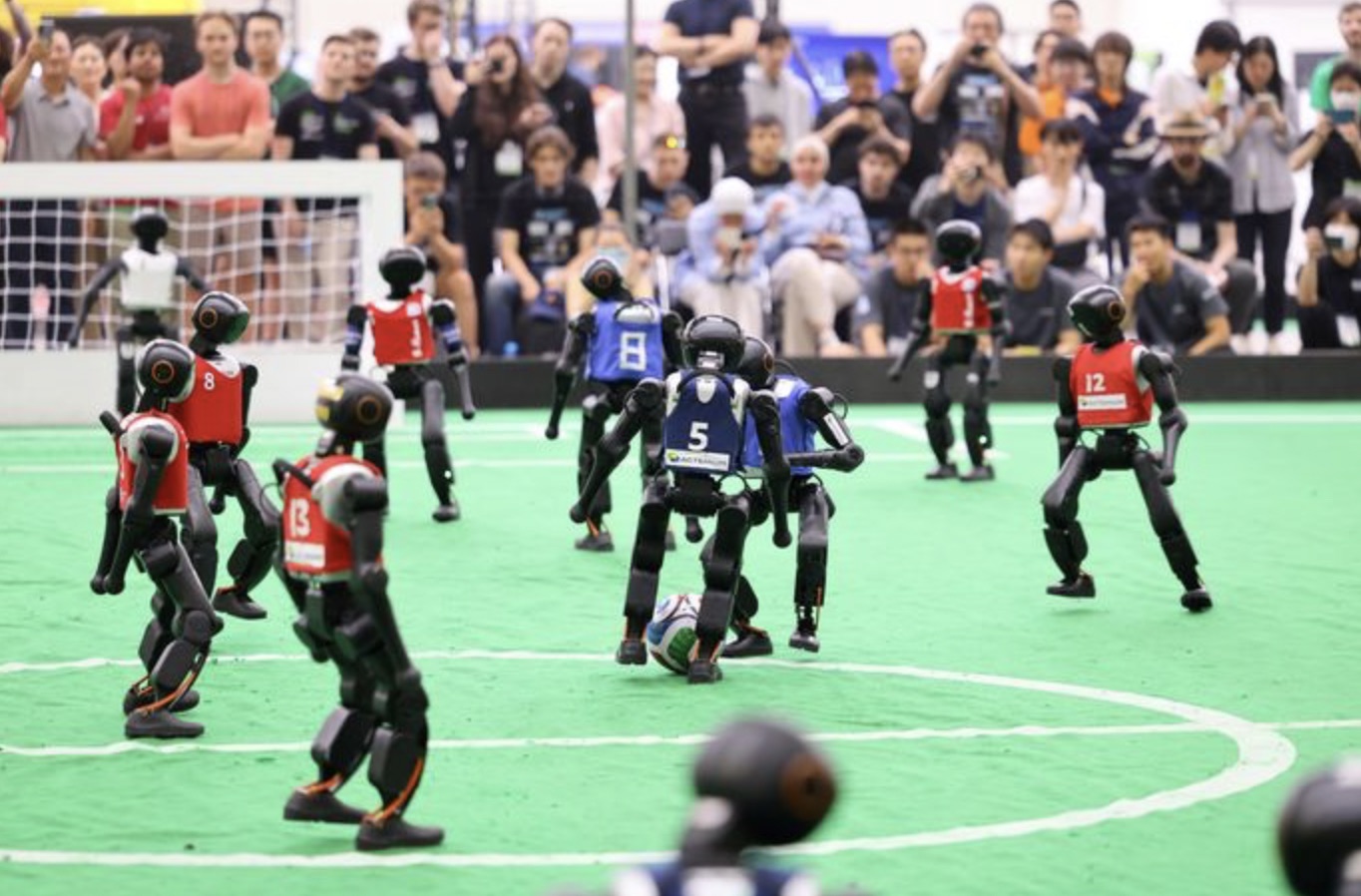
First 11 vs 11 humanoid soccer game played at RoboCup 2026

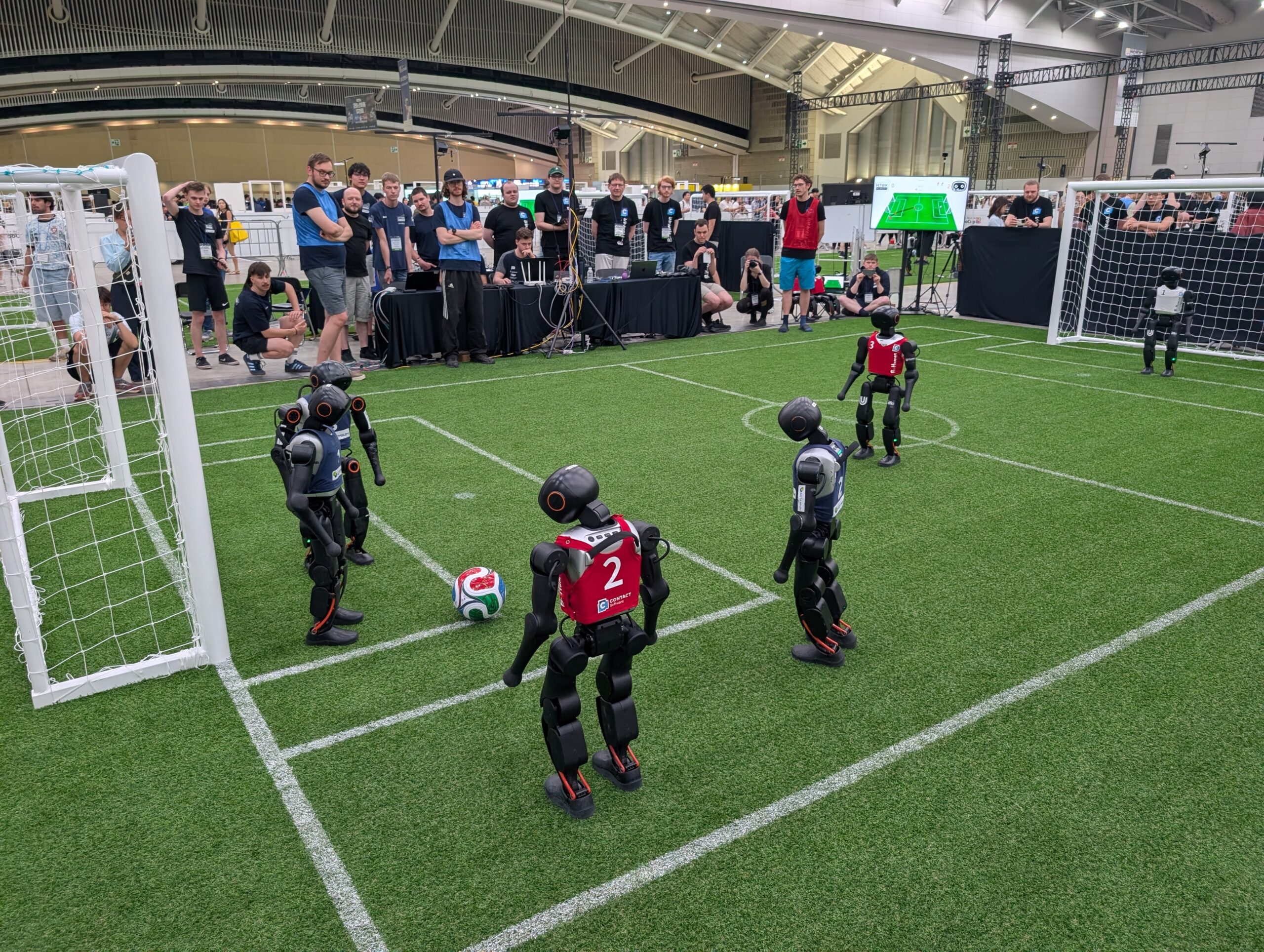
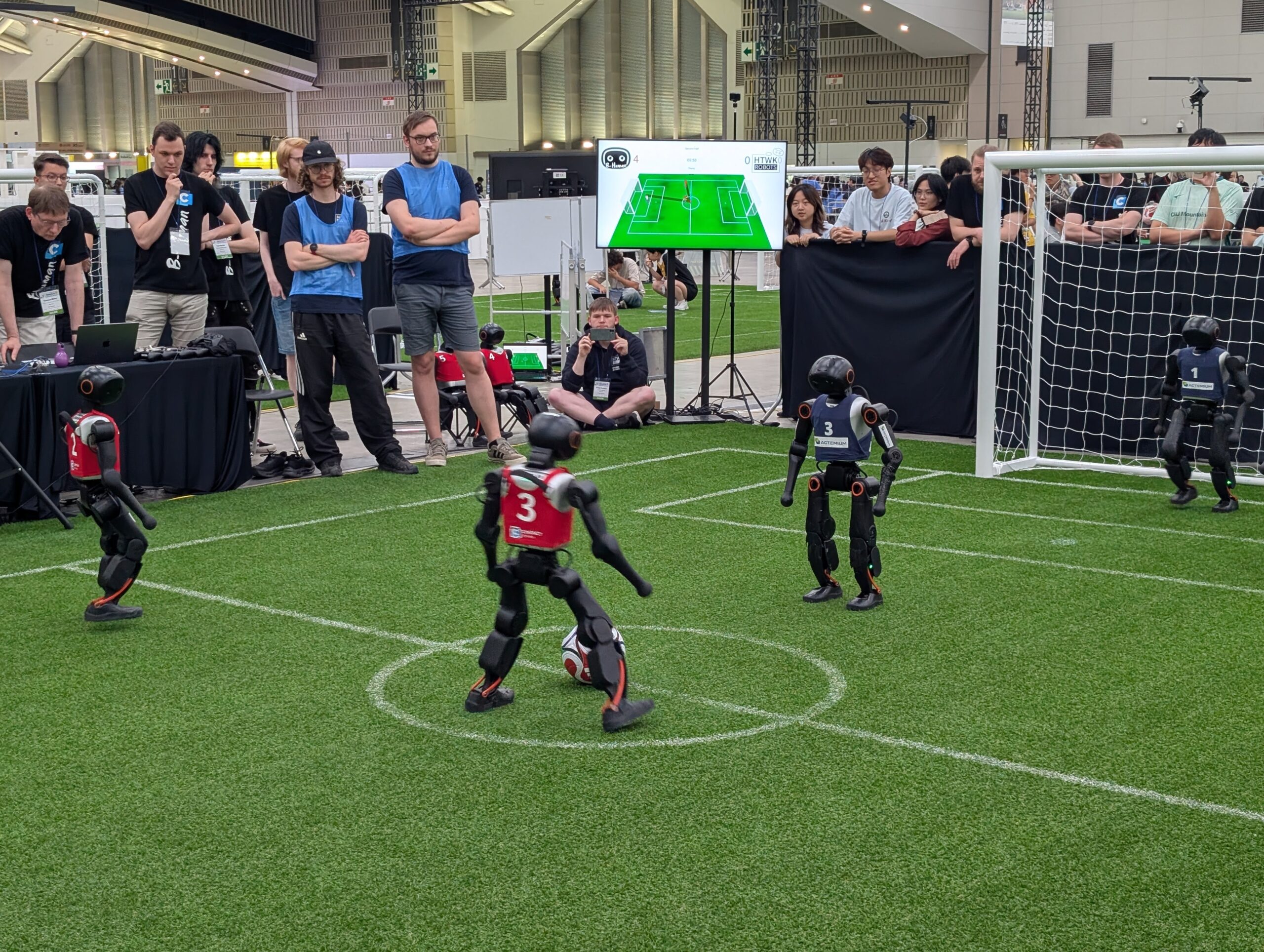
Action from the 11 vs 11 humanoid match at RoboCup 2026. Photo credit: RoboCup Federation.

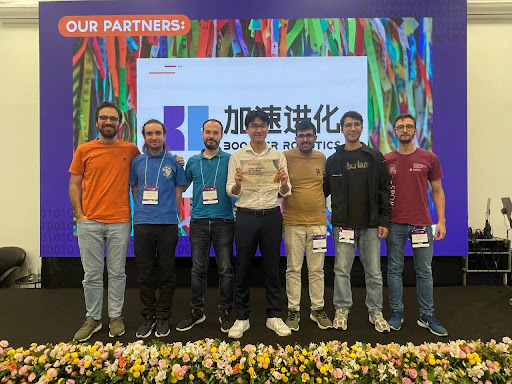
RoboCup 2026 saw history made, as two teams of 11 humanoids took to the soccer field, the first time a full complement of robots has competed. The game saw B-Human (Bremen, Germany) take on HTWK Robots (Leipzig, Germany), with both sides using machines designed by Booster Robotics.

You can watch highlights of the match below:

Back in 1997, RoboCup’s founders set the lofty goal of developing a team of autonomous robots that could beat the human World Cup champions by 2050. There has been significant progress since those early days, and this match saw another step towards that ambition.

“This match shows how far humanoid robotics has come,” said Ubbo Visser, President of the RoboCup Federation. “We have seen increased teamwork and advanced skills over the years already, but the new humanoid hardware paired with the new level of intelligence provided by AI puts humanoid robot soccer on another level.”

Find out more:

First 11 vs 11 humanoid soccer game played at RoboCup 2026

Action from the 11 vs 11 humanoid match at RoboCup 2026. Photo credit: RoboCup Federation.

RoboCup 2026 saw history made, as two teams of 11 humanoids took to the soccer field, the first time a full complement of robots has competed. The game saw B-Human (Bremen, Germany) take on HTWK Robots (Leipzig, Germany), with both sides using machines designed by Booster Robotics.

You can watch highlights of the match below:

Back in 1997, RoboCup’s founders set the lofty goal of developing a team of autonomous robots that could beat the human World Cup champions by 2050. There has been significant progress since those early days, and this match saw another step towards that ambition.

“This match shows how far humanoid robotics has come,” said Ubbo Visser, President of the RoboCup Federation. “We have seen increased teamwork and advanced skills over the years already, but the new humanoid hardware paired with the new level of intelligence provided by AI puts humanoid robot soccer on another level.”

Find out more:

#RoboCup2026 social media round-up

This year, RoboCup took place in Incheon, South Korea, from 2-6 July. The event saw teams take part in competitions, training sessions, and a symposium. Take a look at what the participants got up to in our round up from social media.

Little Booster K1, trying to get up after falling mid football game!
#robocup2026

[image or embed]

— Raghav Arora (@ra-aurora.bsky.social) 6 July 2026 at 05:05

Straight from RoboCup 2026, at Incheon, Korea.
We added an external lidar, and a literal backpack to the booster T1 to achieve accurate indoor localisation and navigation.
@texasrobotics.bsky.social #Robocup2026

[image or embed]

— Raghav Arora (@ra-aurora.bsky.social) 6 July 2026 at 05:01

#RoboCup2026 – humanoid league knockout stages

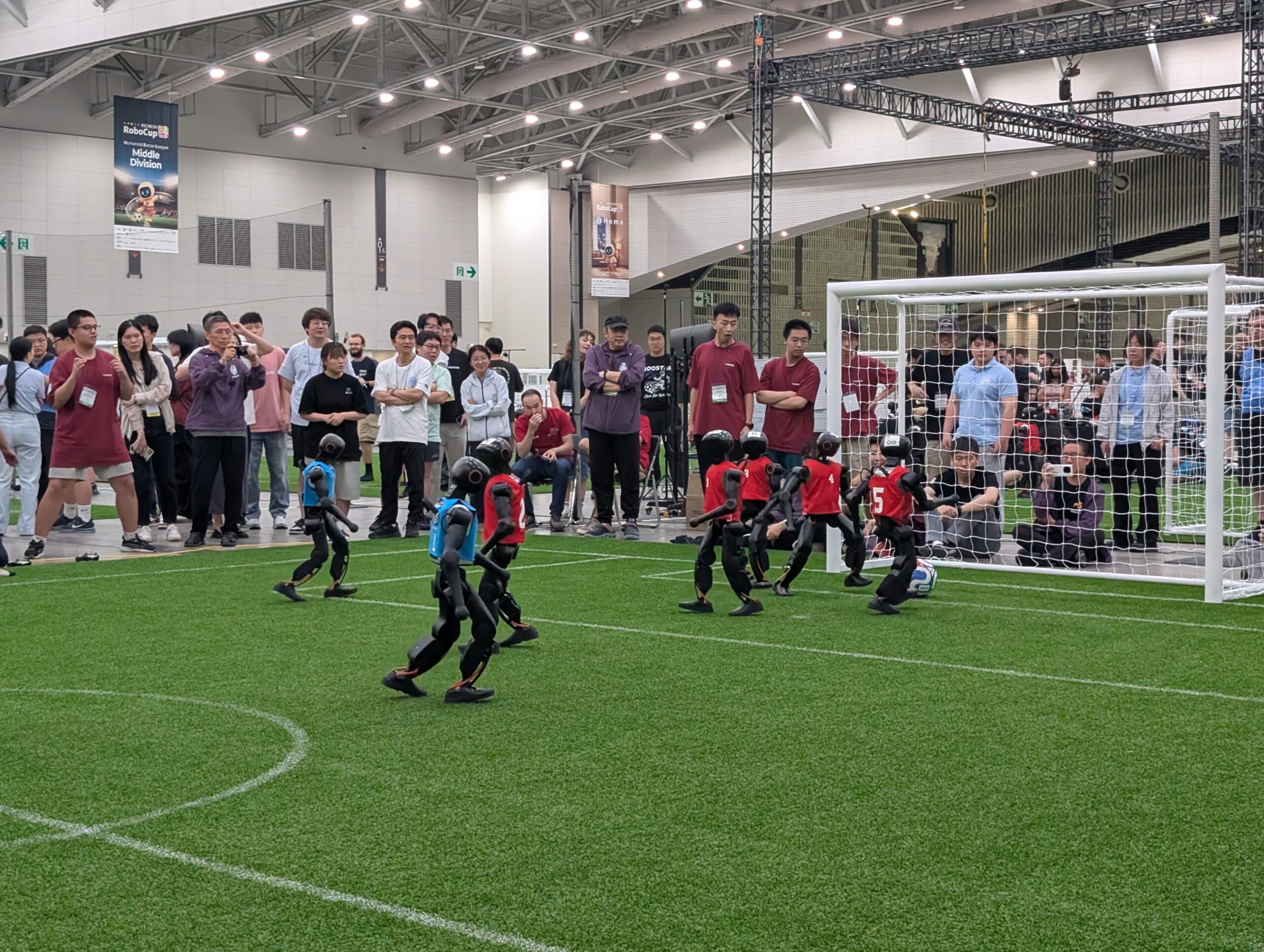
This weekend saw the finale of the league competitions at RoboCup 2026 in Incheon, South Korea, with the winners in the small, middle, and large humanoid divisions decided. Congratulations to the following teams, who finished in the top three positions in each size class:

Small division

  1. Invic, Wuhan University, China
  2. Hamburg Bit-Bots, Universität Hamburg, Germany
  3. GeoHBots, School of Artificial Intelligence, China University of Geosciences, China

Middle division

  1. B-Human, Universität Bremen and German Research Center for Artificial Intelligence (DFKI), Germany
  2. HTWK Robots, Leipzig University of Applied Sciences, Germany
  3. Rhoban, University of Bordeaux, France

Large division

  1. Tsinghua Hephaestus, Tsinghua University, China
  2. CAU Mountain&Sea, China Agricultural University, China
  3. Water, Beijing Information Science & Technology University, China

You can watch the action from one of the semi-finals in the middle division, which saw HTWK take on Rhoban.

In the final of the middle division, HTWK took on B-Human:

In addition to the main competitions, there were five league-wide awards:

  • Best Customized Humanoid Award: HERoEHS (ALICE 4th version)
  • Best Humanoid Software Award: B-Human (Game Controller)
  • Open Research Challenge: Ruhrbot Devils (AI Camera Platform for Embedded 2D/3D Game Analysis in RoboCup HSL)
  • Best Innovation Award: Bahia Robotics Team
  • Best Referee Award: Anastasia Prisacaru (Berlin United)

Hear from Team Hephaestus of Tsinghua University, who won the large division:

Although the competitions have drawn to a close, RoboCup 2026 continues today with a symposium, which brings together researchers and practitioners from around the world to present and discuss innovative research in robotics and artificial intelligence. You can find out more here.

#RoboCup2026 – humanoid league day 2

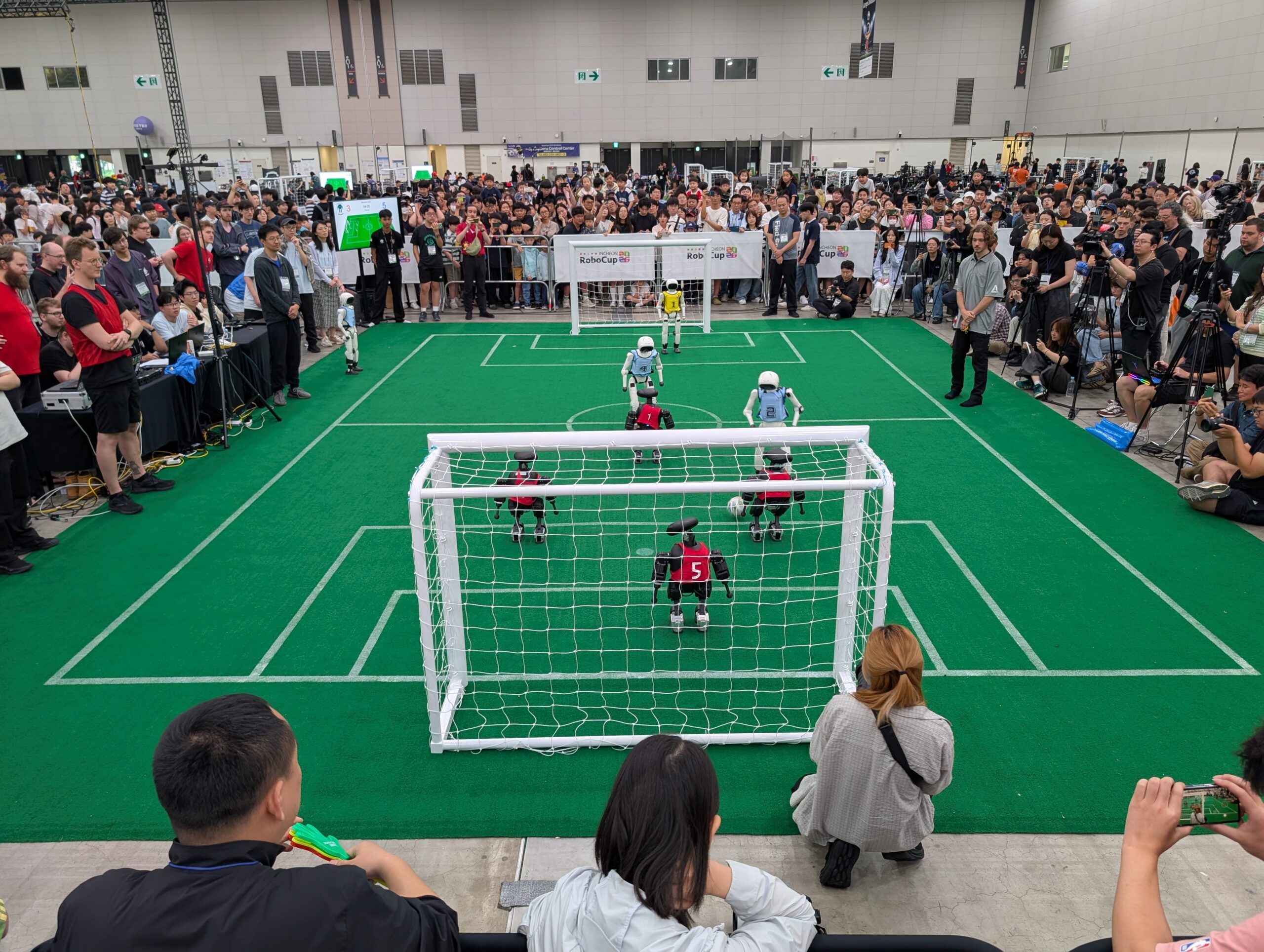
The second day’s play at RoboCup 2026 has drawn to a close with another bumper set of matches. Teams have come from far and wide to take part in the humanoid soccer competition this year, with 17 different countries represented. China is the most represented country, boasting 15 teams across the three divisions. Other countries taking part are geographically widespread, ranging from Colombia to Malaysia, from Germany to Australia.

In advance of the competition, all applying teams provided a video, team description paper, and information about the robots and software that they use. You can see the complete set of these here. As a taster, here is the qualification video from team CAU Mountain&Sea (from China Agricultural University) who are currently leading the small division competition, and are in fourth place in the large division.

Yesterday’s play saw the first issuing of a red card. The robot received two yellow cards for unsafe challenges and was removed from play on safety grounds. You can see a clip of the second foul in question here.

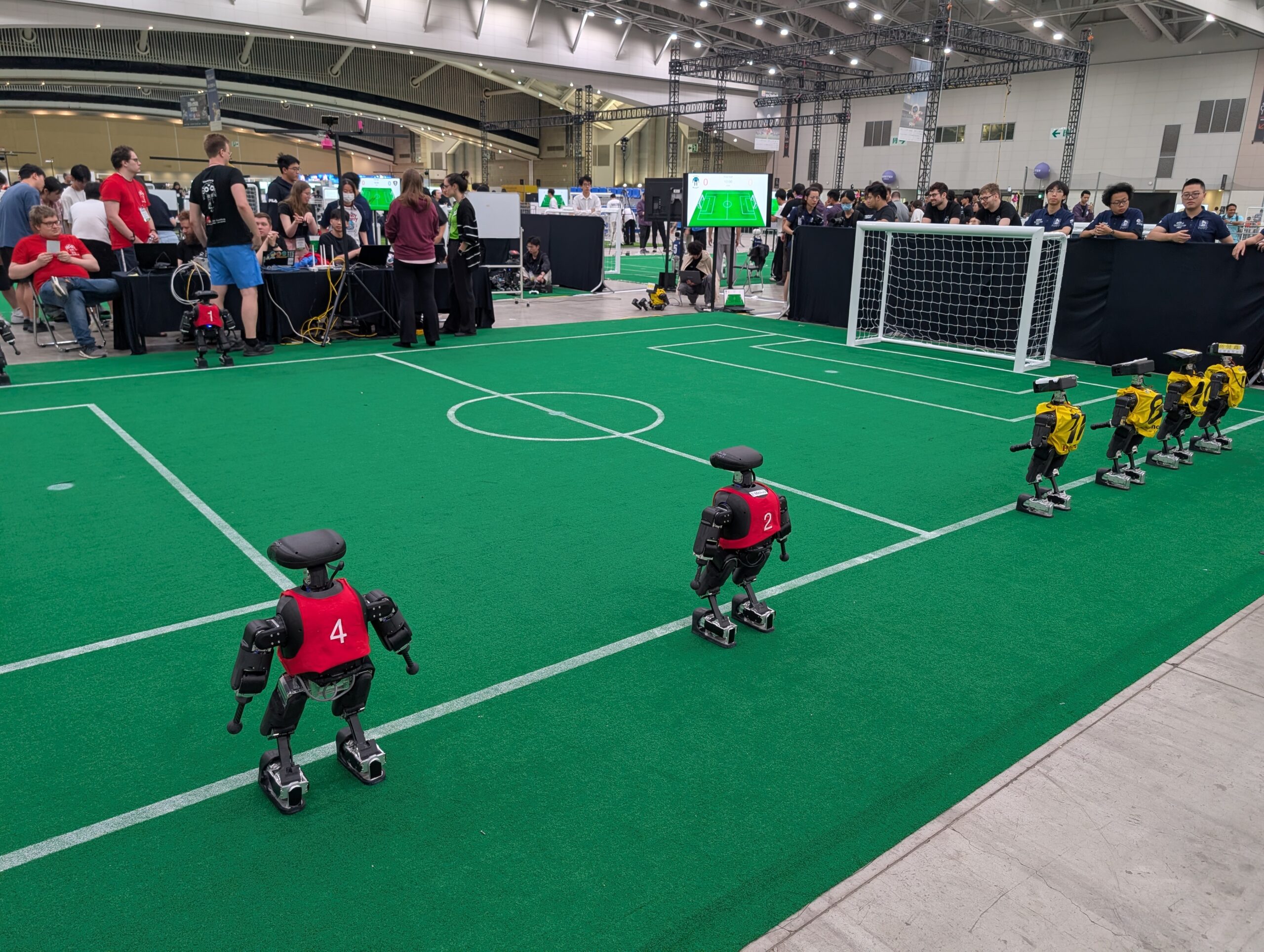
In terms of the vital statistics of the robots, the heaviest and tallest robot is HERoEHS’s ALICE 4 robot, weighing in at 48kg and measuring 160cm tall. There is a big jump down in weight to the second heaviest bot, which is team BigHeroX’s Z4 bipedal humanoid, at 37kg. A number of teams are using the 35kg Unitree G1. At the other end of the spectrum, the lightest and shortest robot is ITAndroids’ Chape, at just 3.8kg and 53cm tall.

With the seeding rounds almost complete (the knockout rounds start tomorrow) the competitions are hotting up nicely. After four competed rounds in the small division, CAU Mountain&Sea is the only team to win all four matches, and sits atop the table with 12 points, and impressively only conceding one goal. Hamburg Bit-Bots and GeoHBots are in second and third place respectively, having both won three games and lost one.

The middle division has fast established itself as one of the most compelling competitions. B-Human has taken a commanding lead, winning all four matches so far with a +35 goal difference. Behind them, there are four teams on nine points: HTWK Robots, Rhoban, whIRLwind Amsterdam, and THMOS.

Over in the large division, teams have completed three rounds of seeding, with just one further round to come tomorrow. At this stage Tsinghua Hephaestus is the only perfect team, sitting on nine points. Behind them, two teams have each won two matches and drawn the third: PCMS-HRG and Robo-Erectus.

Once the seeding rounds have been completed, 12 teams from each division will make it forward to the knockout stages, with the quarter finals taking place in the evening.


Many thanks to JT Genter for providing the photos, videos, and facts for this article.

What’s coming up at #RoboCup2026?

This year, RoboCup will be held in Incheon, South Korea, from 2-6 July. The event will see teams take part in competitions, training sessions, and a symposium.

It’s an exciting time for RoboCup, as there have been some updates to the leagues and competition format. Most prominently, the soccer leagues will have a primary focus on humanoid robots.

The leagues and their competitions

You can find out more about the different leagues and the competition schedules and details at these links:

WEROB

A workshop focused on sharing projects, experiences, and innovations in educational robotics. This session is geared towards students, mentors, and educators. Find out more here.

Symposium

The RoboCup symposium will take place on 6 July. More information can be found here.

There will be two keynote talks:

  • Hyun Myung, Spatial Intelligence for Autonomous Robot Navigation in the Wild
  • Gentiane Venture, From function to meaning: Making robots that understand and belong

Find out more at the event website.

Congratulations to the #AAMAS2026 best paper award winners

The AAMAS 2026 best paper awards were presented at the 25th International Conference on Autonomous Agents and Multiagent Systems, which took place from 25-29 May 2025 in Paphos, Cyprus. The winners and nominees in the three categories (best paper, best student paper, best blue sky paper) are as follows:


Best Paper Award

Winner

  • Developing Guidelines for Human-LLM Agent Teams: A Multi-Stakeholder Lens, Mireia Yurrita, Davide Dell’Anna, Pradeep K. Murukannaiah, Catholijn M Jonker, and Pinar Yolum

Nominees

  • UNCAP: Uncertainty-Guided Neurosymbolic Planning Using Natural Language Communication for Cooperative Autonomous Vehicles, Neel P. Bhatt, Po-han Li, Kushagra Gupta, Rohan Siva, Daniel Milan, Alexander Todd Hogue, Sandeep P. Chinchali, David Fridovich-Keil, Zhangyang Wang, and Ufuk Topcu
  • Ratio-Based Signaling for Source-Victim Separation in Swarm Fault Detection, Longyin Cui
  • The Impossibility of Strategyproof Rank Aggregation, Manuel Eberl and Patrick Lederer
  • Generalized Per-Agent Advantage Estimation for Multi-Agent Policy Optimization, Seongmin Kim, Giseung Park, Woojun Kim, Jiwon Jeon, Seungyul Han, and Youngchul Sung
  • R-Debater: Retrieval-Augmented Debate Generation through Argumentative Memory, Maoyuan Li, Zhongsheng Wang, Haoyuan Li, and Jiamou Liu
  • Defection at First Sight: Learning Partner Selection in Optional Social Dilemmas without Prior Information, Benedict Russell, Chin-wing Leung, and Paolo Turrini
  • Characterizing Consensuses in Belief Flow Networks, Nicolas Schwind, Gauvain Bourgne, and Katsumi Inoue
  • Grassroots Federation: Fair Democratic Governance at Scale, Nimrod Talmon and Ehud Shapiro
  • Health Facility Location in Ethiopia: Leveraging LLMs to Integrate Expert Knowledge into Algorithmic Planning, Yohai Trabelsi, Guojun Xiong, Fentabil Getnet, Stéphane Verguet, and Milind Tambe
  • MeCo: Enhancing LLM-Empowered Multi-Robot Collaboration via Similar Task Memoization, Baiqing Wang, Helei Cui, Bo Zhang, Xiaolong Zheng, Bin Guo, and Zhiwen Yu

Pragnesh Jay Modi Best Student Paper Award

Winner

  • Planning Ahead with RSA: Efficient Signalling in Dynamic Environments by Projecting User Awareness across Future Timesteps, Anwesha Das, John Duff, Jörg Hoffmann, and Vera Demberg

Nominees

  • Efficiently Computing Equilibria in Budget-Aggregation Games, Patrick Becker, Alexander Fries, Matthias Greger, and Erel Segal-Halevi
  • Building Large-Scale Drone Defenses from Small-Team Strategies, Grant Douglas, Stephen Franklin, Claudia Szabo, and Mingyu Guo
  • Robust Counterfactual Inference in Markov Decision Processes, Jessica Lally, Milad Kazemi, and Nicola Paoletti
  • Flow-Based Task Assignment for Large-Scale Online Multi-Agent Pickup and Delivery, Yue Zhang, Zhe Chen, Daniel Harabor, Pierre Le Bodic, and Peter J. Stuckey
  • Reputation as a Solution to Cooperation Collapse in LLM-based MASs, Siyue Ren, Wanli Fu, Xinkun Zou, Chen Shen, Yi Cai, Chu Chen, Zhen Wang, and Shuyue Hu

Blue Sky Ideas Award

Winner

  • Foundation World Models for Agents that Learn, Verify, and Adapt Reliably Beyond Static Environments, Florent Delgrange

Nominees

  • Guiding Sociotechnical Systems toward Value-Norm Equilibrium, Nirav Ajmeri, Marina De Vos, Davide Dell’Anna, Pradeep K. Murukannaiah, Vivek Nallur, Luis Gustavo Nardin, and Munindar P. Singh
  • The Dynamic Turn in Strategy Logics, Rustam Galimullin, Maksim Gladyshev, Munyque Mittelmann, and Nima Motamed

Global robotics technology roadmap

A repeating pattern of a photograph of a silicon chip, recoloured so that it is multi-coloured, in the style of pop art.Deborah Lupton / Pop Chips / Licenced by CC-BY 4.0.

Henrik I Christensen, Professor of Computer Science & Engineering at University of California San Diego, has recently released a global robotics technology roadmap. This position paper focuses on Asia, Europe, and America and outlines the current state-of-the-art in robotics, and highlights the main opportunities.

The roadmap draws on robotics research and industry data to identify a global technology trajectory for the decade 2025–2035. It integrates findings from leading robotics conferences (such as ICRA, IROS, RSS, CoRL), machine-learning venues (including NeurIPS, ICML), and journal publications, combined with market intelligence from trade organizations and regional government strategies. The document is structured for use by policymakers, technology strategists, research agencies, and industrial research and development leaders. It is based on a review of present research, industry statistics and numerous visits by Henrik to research labs across three continents.

Key headline findings of this roadmap are:

  • The global robotics market reached $53.2B in 2024 and is on a trajectory to $178.7B by 2033.
  • Asia dominates industrial deployment (74% of global installations in 2024; China alone 54%), while Europe leads in safety-critical regulation and collaborative cobots, and the United States leads in AI-powered autonomy and defense robotics.
  • Vision-Language-Action (VLA) models are the most consequential algorithmic development of the current period, enabling cross-embodiment generalization for the first time.
  • Soft robotics and compliant mechanisms, enabled by liquid crystal elastomers (LCEs), electroactive polymers (EAPs), and self-healing hydrogels, are bridging the gap between rigid industrial systems and bio-compatible medical devices.
  • The humanoid robot segment, currently $370M in 2025, is projected to reach $6.5B by 2030 , with Chinese original equipment manufacturers (OEMs) and US technology companies racing to scale production.
  • Regulatory asymmetry is a critical geopolitical variable: the EU AI Act, the first comprehensive legal framework for high-risk AI systems, is reshaping humanoid robot design globally.

The 52-page comprehensive document covers the following sub-topics:

  • Introduction and scope. Motivation and methodology.
  • Global market baseline.
  • State of the art: academic research landscape. Embodied AI, foundation models, reinforcement learning, navigation, manipulation and sensing, bio-inspired locomotion, multi-robot systems, and human-robot collaboration.
  • Enabling technologies: cross-cutting advances. Materials science and soft robotics, computing infrastructure, perception and sensing.
  • Regional technology strategies. Europe, Asia, USA.
  • Technology roadmap 2025–2035. Algorithms and AI, hardware and actuation, materials and manufacturing, and systems, safety and deployment.
  • Sector-specific analysis, observations, and recommendations. Manufacturing, logistics, healthcare, agriculture, mining, construction, service robots.
  • Cross-cutting strategic themes. The humanoid convergence race, sustainability, workforce and societal impacts, geopolitical technology risks.
  • Recommended research priorities by region. Covering Europe, USA and Asia.

You can read the roadmap in full here.

Robotics Café brings together autonomous robot practitioners

The recently launched Robotics Café is a weekly online seminar series to bring together researchers, students and industry practitioners working in the field of autonomous robotics. One of the key aims of the initiative is to provide a dedicated platform for students to present and disseminate their work, enabling broader visibility and impact across academia and industry.

Organised by P.B. Sujit (IISER Bhopal), Sandeep Manjanna (Plaksha University) and Aditya Paranjape (Monash University), the talks take place every Thursday from 17:00-18:00 Indian Standard Time. The link to watch the presentations live via Google Meet is here. Alternatively, you can catch the recordings on the Robotics Café YouTube channel.

The series kicked off with a talk from Professor Debasish Ghose (Indian Institute of Science) entitled: AERObotics: The Art of Catching Objects in the Air. The presentation explored the fascinating intersection of guidance theory and aerial robotics.

In the second lecture, Professor Arun Kumar Singh (University of Tartu) spoke about leveraging predictive uncertainty for model-based planning and control.

Find out more:

A multi-armed robot for assisting with agricultural tasks

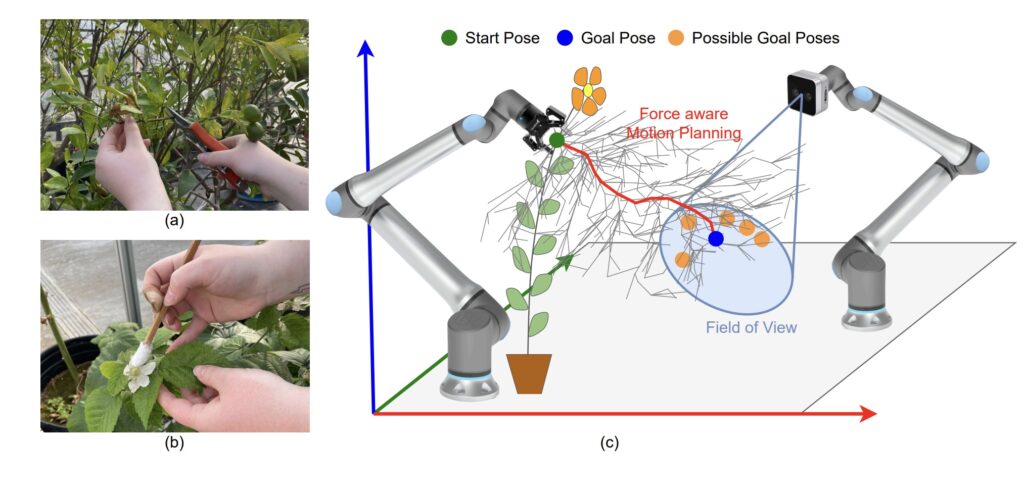
Humans often use one hand to grasp the branch for better accessibility, while the other hand is used to perform primary tasks like (a) branch pruning and (b) hand pollination of the flower. (c) An overview of the approach used by Madhav and colleagues, where one robot manipulates the branch to move the flower to the field of view of another robot by planning a force-aware path. Figure from Force Aware Branch Manipulation To Assist Agricultural Tasks.

In their paper Force Aware Branch Manipulation To Assist Agricultural Tasks, which was presented at IROS 2025, Madhav Rijal, Rashik Shrestha, Trevor Smith, and Yu Gu proposed a methodology to safely manipulate branches to aid various agricultural tasks. We interviewed Madhav to find out more.

Could you give us an overview of the problem you were addressing in the paper?

Madhav Rijal (MR): Our work is motivated by StickBug [1], a multi-armed robotic system for precision pollination in greenhouse environments. One of the main challenges StickBug faces is that many flowers are partially or fully hidden within the plant canopy, making them difficult to detect and reach directly for pollination. This challenge also arises in other agricultural tasks, such as fruit harvesting, where target fruits may be occluded by surrounding branches and foliage.

To address this, we study how one robot arm can safely manipulate branches so that these occluded flowers can be brought into the field of view or reachable workspace of another robot arm. This is a challenging manipulation problem because plant branches are deformable, fragile, and vary significantly from one branch to another. In addition, unlike pick-and-place tasks, where objects move freely in space, branches remain attached to the plant, which imposes additional motion constraints during manipulation. If the robot moves a branch without accounting for these constraints and safety limits, it can apply excessive force and damage the branch.

So, the core problem we addressed in this paper is: how can a robot safely manipulate branches to reveal hidden flowers while remaining aware of interaction forces and minimizing damage?

How did your approach go about tackling the problem?

MR: Our approach [2] combines motion planning that accounts for branch constraints with real-time force feedback.

First, we generate a feasible manipulation path using an RRT* (rapidly exploring random tree) algorithm-based planner in the workspace. The planner respects the geometric constraints of the branch and the task requirements. We model branches as deformable linear objects and use a geometric heuristic to identify configurations that are safer to manipulate.

Then, during execution, we monitor the interaction force using a force sensor mounted on the manipulator. If the measured force exceeds a predefined safe threshold, the system does not continue along the same path. Instead, it re-plans the motion online and searches for an alternative path or goal configuration that can reduce branch stress while still achieving the task.

So, the key idea is that the robot does not plan only for reachability. It also adapts its motion based on the physical response of the branch during manipulation.
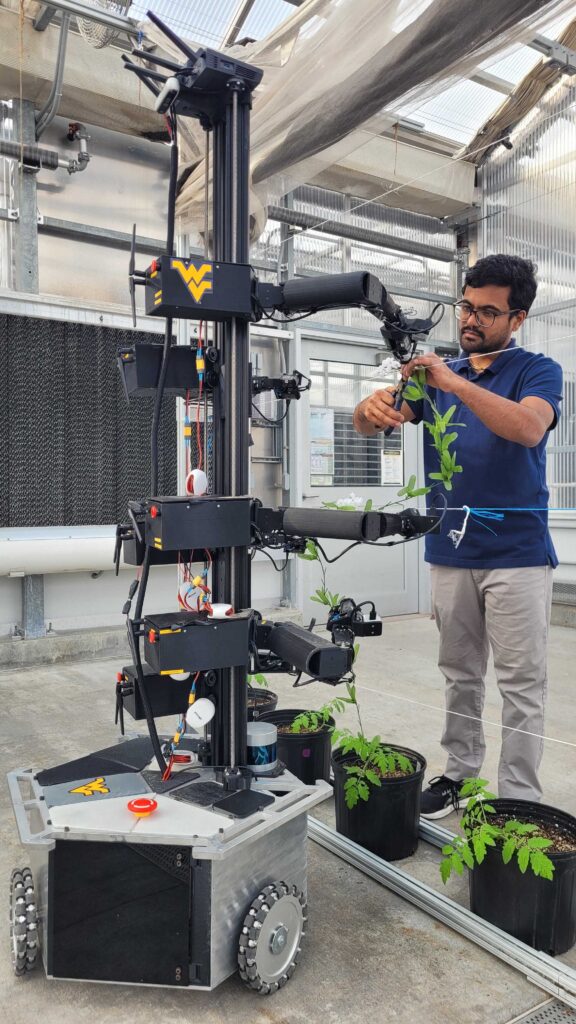
Madhav with the multi-armed pollination robot, StickBug.

What are the main contributions of your work?

MR: The main contributions of our work are:

  1. A geometric heuristic model for branch manipulation that does not require branch-specific parameter tuning or physical probing.
  2. A motion planning strategy for branch manipulation that respects both workspace and branch constraints, using the geometric heuristic to guide RRT* and incorporating online replanning based on force feedback.
  3. An experimental demonstration showing that force feedback-based motion planning can protect branches from excessive force during manipulation.
  4. Generalization across different branch types, since the method relies primarily on branch geometry and can adapt online to compensate for model inaccuracies.

Could you talk about the experiments that you carried out to test the approach?

MR: We evaluated the proposed method through a set of branch manipulation experiments using five different starting poses, all targeting a common goal region. Each configuration was tested 10 times, resulting in a total of 50 trials. A trial was considered successful if the robot brought the grasp point to within 5 cm of the goal point. For all trials, the planning time limit was set to 400 seconds, and the allowable interaction force range was −40 N to 40 N. Across the 50 trials, 39 were successful and 11 failed, corresponding to a success rate of about 78%. The average number of replanning attempts across all scenarios was 20.

In terms of force reduction, the results show a clear progression in safety. Constraint-aware planning reduced the manipulation force from above 100 N to below 60 N. Building on this, online force-aware replanning further reduced the force from about 60 N to below the desired 40 N threshold. This indicates that safety awareness through geometric heuristics, which model branches as deformable linear objects, together with force-aware online replanning, can effectively lower interaction forces during manipulation.

Overall, the experiments demonstrate that the proposed framework enables safer branch manipulation while maintaining task feasibility. By combining branch-constraint-aware planning with real-time force feedback, the robot can adapt its motion to reduce excessive force and minimize the risk of branch damage. These findings highlight the value of force-aware planning for practical robotic manipulation in agricultural environments.

Do you have plans to further extend this work?

MR: Yes, there are several directions for extending this work.

One current limitation is the need to define a safe force threshold in advance. In practice, different types of branches require different force limits for safe manipulation. A key direction for future work is to learn or estimate safe force thresholds automatically from branch geometry or visual cues.

Another extension is to improve grasp-point selection. Instead of only replanning after grasping, the system could also reason about the most suitable grasp point beforehand so that the required manipulation force is reduced from the start.

We are also interested in designing a compliant gripper with integrated force sensing that is better suited for manipulating delicate branches. In the longer term, we plan to integrate this method into a multi-arm agricultural robot, where one arm manipulates the branch and another performs pollination, pruning, or harvesting.

Overall, this work advances the development of agricultural robots that can actively manipulate branches to support tasks such as harvesting, pruning, and pollination. By exposing fruits, cut points, and hidden flowers within the canopy, this capability can help overcome key barriers to the broader adoption of robot-assisted agricultural technologies.

References

[1] Smith, Trevor, Madhav Rijal, Christopher Tatsch, R. Michael Butts, Jared Beard, R. Tyler Cook, Andy Chu, Jason Gross, and Yu Gu. Design of Stickbug: a six-armed precision pollination robot. In 2024 IEEE/RSJ International Conference on Intelligent Robots and Systems (IROS), pp. 69-75. IEEE, 2024.
[2] Rijal, Madhav, Rashik Shrestha, Trevor Smith, and Yu Gu, Force Aware Branch Manipulation To Assist Agricultural Tasks. In 2025 IEEE/RSJ International Conference on Intelligent Robots and Systems (IROS), pp. 1217-1222. IEEE, 2025.

About Madhav

Madhav Rijal is a Ph.D. candidate in Mechanical Engineering at West Virginia University working in agricultural robotics. His research combines motion planning, optimization, multi-agent collaboration and distributed decision making to develop robotic systems for precision pollination and other plant-interaction tasks. His current work focuses on branch manipulation and safe robot operation in agricultural environments.

Robohub highlights 2025

Over the course of the year, we’ve had the pleasure of working with many talented researchers from across the globe. As 2025 draws to a close, we take a look back at some of the excellent blog posts, interviews and podcasts from our contributors.


Teaching robot policies without new demonstrations: interview with Jiahui Zhang and Jesse Zhang

Jiahui Zhang and Jesse Zhang to tell us about their framework for learning robot manipulation tasks solely from language instructions without per-task demonstrations.


CoRL2025 – RobustDexGrasp: dexterous robot hand grasping of nearly any object

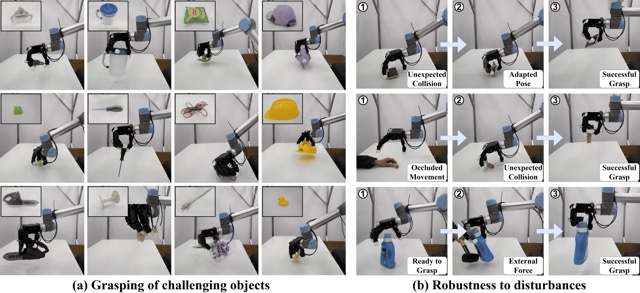
Hui Zhang writes about work presented at CoRL2025 on RobustDexGrasp, a novel framework that tackles different grasping challenges with targeted solutions.


Robot Talk Episode 133 – Creating sociable robot collaborators, with Heather Knight

Robot Talk host Claire Asher chatted to Heather Knight from Oregon State University about applying methods from the performing arts to robotics.


Generations in Dialogue: Human-robot interactions and social robotics with Professor Marynel Vasquez

In this podcast from AAAI, host Ella Lan asked Professor Marynel Vázquez about what inspired her research direction, how her perspective on human-robot interactions has changed over time, robots navigating the social world, and more.


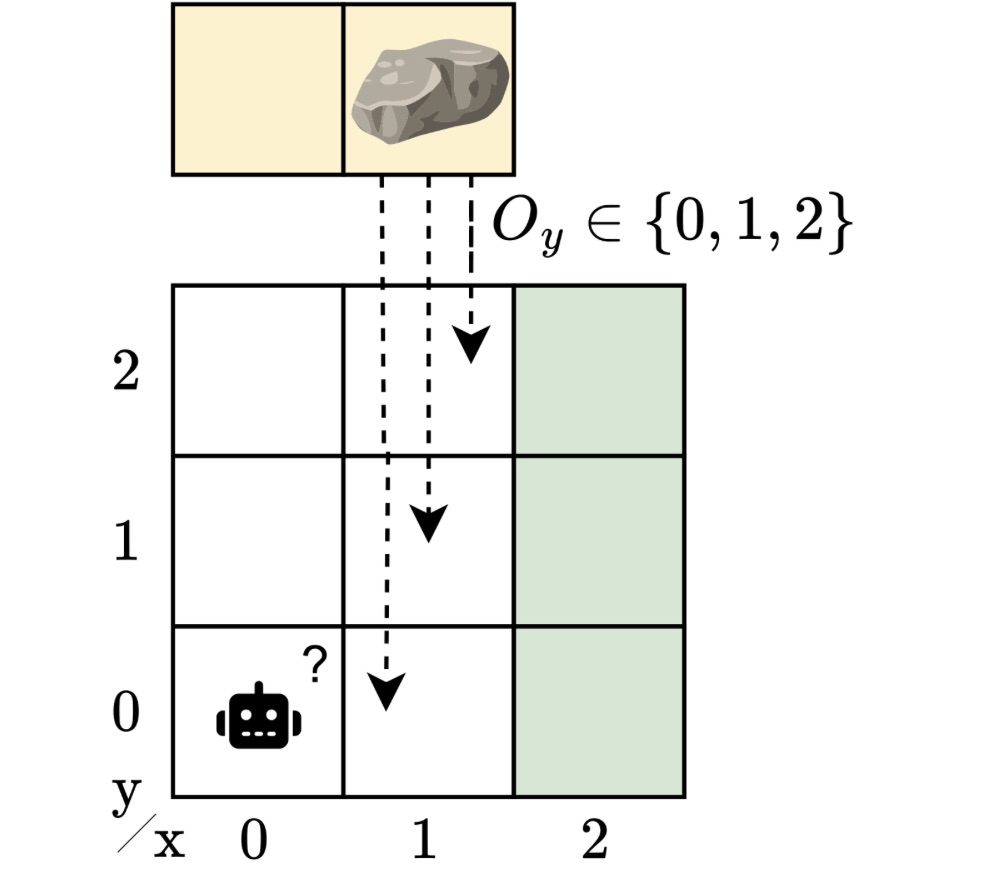
Learning robust controllers that work across many partially observable environments

In this blog post, Maris Galesloot summarizes work presented at IJCAI 2025, which explores designing controllers that perform reliably even when the environment may not be precisely known.


Robot Talk Episode 130 – Robots learning from humans, with Chad Jenkins

Claire Asher chatted to Chad Jenkins from University of Michigan about how robots can learn from people and assist us in our daily lives.


Interview with Zahra Ghorrati: developing frameworks for human activity recognition using wearable sensors

Zahra Ghorrati is pursuing her PhD at Purdue University, where her dissertation focuses on developing scalable and adaptive deep learning frameworks for human activity recognition (HAR) using wearable sensors.


Self-supervised learning for soccer ball detection and beyond: interview with winners of the RoboCup 2025 best paper award

We caught up with some of the authors of the RoboCup 2025 best paper award to find out more about the work, how their method can be transferred to applications beyond RoboCup, and their future plans for the competition.


#IJCAI2025 distinguished paper: Combining MORL with restraining bolts to learn normative behaviour

Agata Ciabattoni and Emery Neufeld introduce a framework for guiding reinforcement learning agents to comply with social, legal, and ethical norms.


Robot Talk Episode 114 – Reducing waste with robotics, with Josie Gotz

Claire Asher chatted to Josie Gotz from the Manufacturing Technology Centre about robotics for material recovery, reuse and recycling.


Multi-agent path finding in continuous environments

Kristýna Janovská and Pavel Surynek write about how can a group of agents minimise their journey length whilst avoiding collisions.


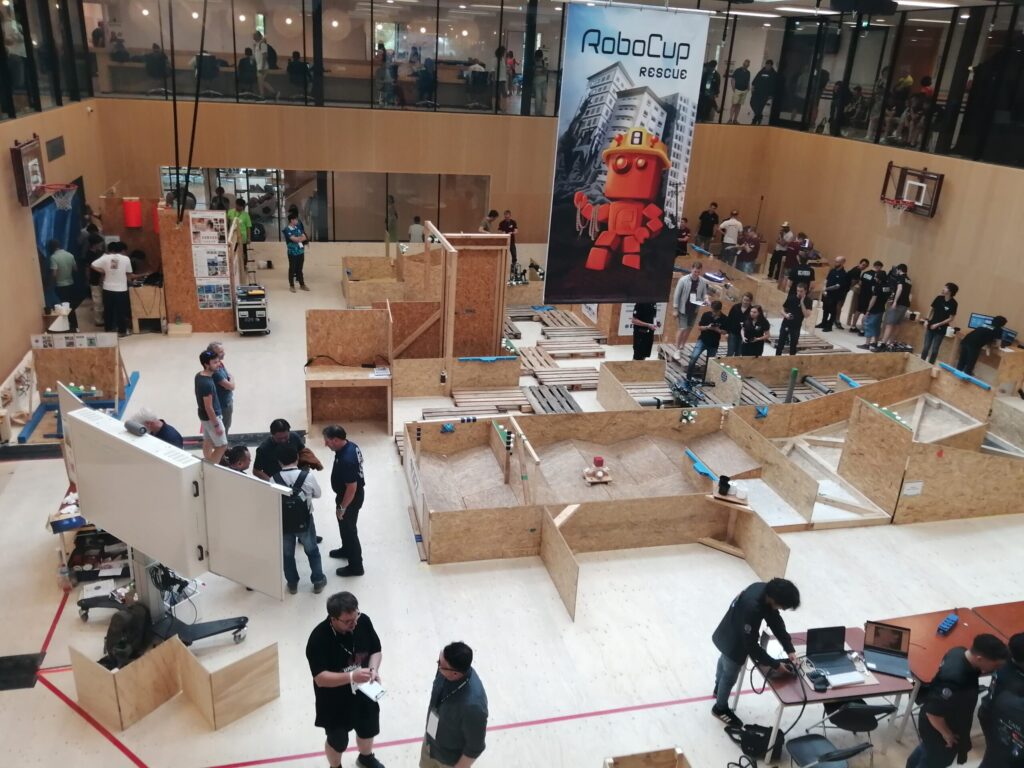
RoboCupRescue: an interview with Adam Jacoff

Find out what’s new in the RoboCupRescue League this year.


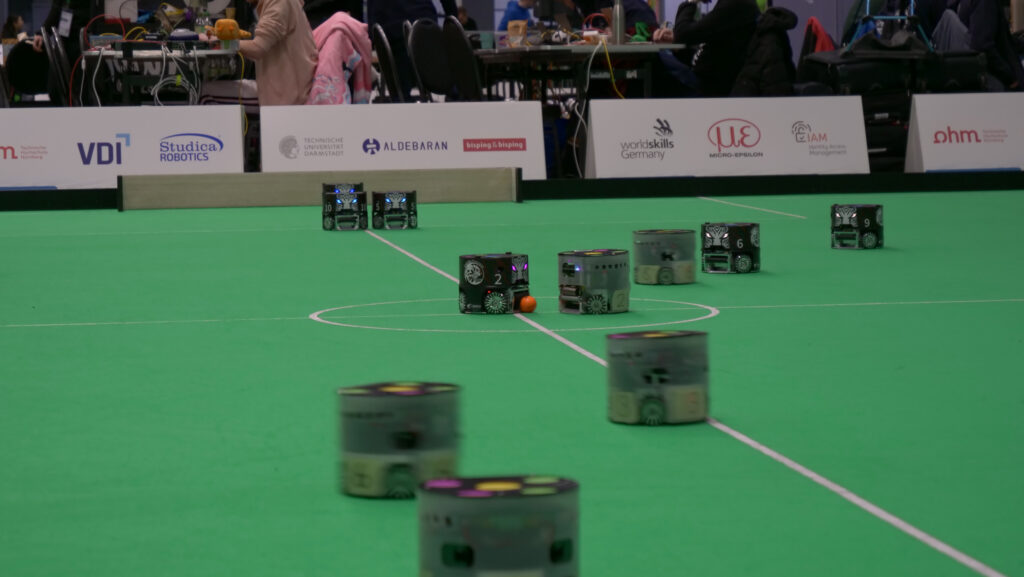
An interview with Nicolai Ommer: the RoboCup Soccer Small Size League

We caught up with Nicolai to find out more about the Small Size League, how the auto referees work, and how teams use AI.


Interview with Kate Candon: Leveraging explicit and implicit feedback in human-robot interactions

Hear from PhD student Kate about her work on human-robot interactions.


AIhub coffee corner: Agentic AI

The AIhub coffee corner captures the musings of AI experts over a short conversation.


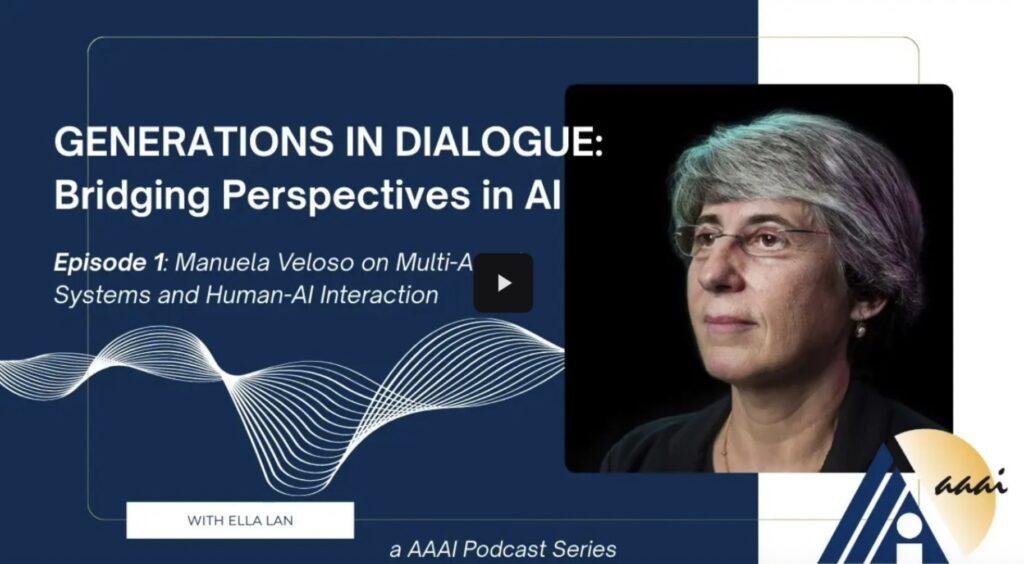
Generations in Dialogue: Multi-agent systems and human-AI interaction with Professor Manuela Veloso

Host Ella Lan chats to Professor Manuela Veloso about her research journey and path into AI, the history and evolution of AI research, inter-generational collaborations, and more.


Preparing for kick-off at RoboCup2025: an interview with General Chair Marco Simões

We spoke to Marco Simões, one of the General Chairs of RoboCup 2025 and President of RoboCup Brazil.


Gearing up for RoboCupJunior: Interview with Ana Patrícia Magalhães

RoboCup Junior Rescue @ WK RoboCup 2024. Photo: RoboCup/Bart van Overbeeke


We heard from the organiser of RoboCupJunior 2025 and find out more about the event.

Teaching robot policies without new demonstrations: interview with Jiahui Zhang and Jesse Zhang

The ReWiND method, which consists of three phases: learning a reward function, pre-training, and using the reward function and pre-trained policy to learn a new language-specified task online.

In their paper ReWiND: Language-Guided Rewards Teach Robot Policies without New Demonstrations, which was presented at CoRL 2025, Jiahui Zhang, Yusen Luo, Abrar Anwar, Sumedh A. Sontakke, Joseph J. Lim, Jesse Thomason, Erdem Bıyık and Jesse Zhang introduce a framework for learning robot manipulation tasks solely from language instructions without per-task demonstrations. We asked Jiahui Zhang and Jesse Zhang to tell us more.

What is the topic of the research in your paper, and what problem were you aiming to solve?

Our research addresses the problem of enabling robot manipulation policies to solve novel, language-conditioned tasks without collecting new demonstrations for each task. We begin with a small set of demonstrations in the deployment environment, train a language-conditioned reward model on them, and then use that learned reward function to fine-tune the policy on unseen tasks, with no additional demonstrations required.

Tell us about ReWiND – what are the main features and contributions of this framework?

ReWiND is a simple and effective three-stage framework designed to adapt robot policies to new, language-conditioned tasks without collecting new demonstrations. Its main features and contributions are:

  1. Reward function learning in the deployment environment
    We first learn a reward function using only five demonstrations per task from the deployment environment.

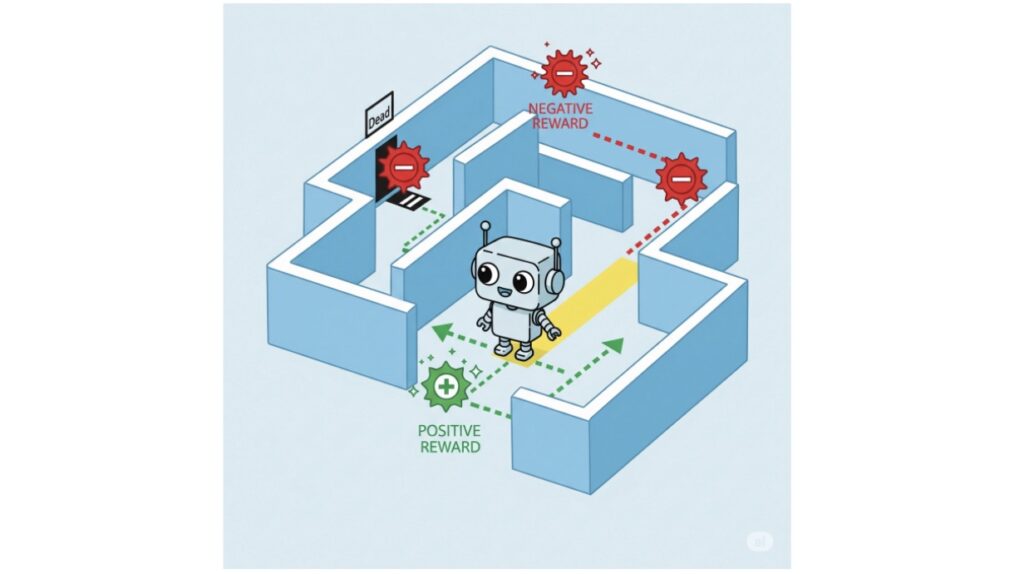
    • The reward model takes a sequence of images and a language instruction, and predicts per-frame progress from 0 to 1, giving us a dense reward signal instead of sparse success/failure.
    • To expose the model to both successful and failed behaviors without having to collect failed behavior demonstrations, we introduce a video rewind augmentation: For a video segmentation V(1:t), we choose an intermediate point t1. We reverse the segment V(t1:t) to create V(t:t1) and append it back to the original sequence. This generates a synthetic sequence that resembles “making progress then undoing progress,” effectively simulating failed attempts.
    • This allows the reward model to learn a smoother and more accurate dense reward signal, improving generalization and stability during policy learning.
  2. Policy pre-training with offline RL
    Once we have the learned reward function, we use it to relabel the small demonstration dataset with dense progress rewards. We then train a policy offline using these relabeled trajectories.
  3. Policy fine-tuning in the deployment environment
    Finally, we adapt the pre-trained policy to new, unseen tasks in the deployment environment. We freeze the reward function and use it as the feedback for online reinforcement learning. After each episode, the newly collected trajectory is relabeled with dense rewards from the reward model and added to the replay buffer. This iterative loop allows the policy to continually improve and adapt to new tasks without requiring any additional demonstrations.

Could you talk about the experiments you carried out to test the framework?

We evaluate ReWiND in both the MetaWorld simulation environment and the Koch real-world setup. Our analysis focuses on two aspects: the generalization ability of the reward model and the effectiveness of policy learning. We also compare how well different policies adapt to new tasks under our framework, demonstrating significant improvements over state-of-the-art methods.

(Q1) Reward generalization – MetaWorld analysis
We collect a metaworld dataset in 20 training tasks, each task include 5 demos, and 17 related but unseen tasks for evaluation. We train the reward function with the metaworld dataset and a subset of the OpenX dataset.

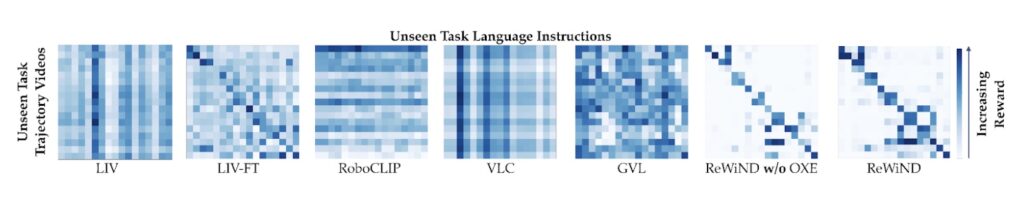
We compare ReWiND to LIV[1], LIV-FT, RoboCLIP[2], VLC[3], and GVL[4]. For generalization to unseen tasks, we use video–language confusion matrices. We feed the reward model video sequences paired with different language instructions and expect the correctly matched video–instruction pairs to receive the highest predicted rewards. In the confusion matrix, this corresponds to the diagonal entries having the strongest (darkest) values, indicating that the reward function reliably identifies the correct task description even for unseen tasks.

Video-language reward confusion matrix. See the paper for more information.

For demo alignment, we measure the correlation between the reward model’s predicted progress and the actual time steps in successful trajectories using Pearson r and Spearman ρ. For policy rollout ranking, we evaluate whether the reward function correctly ranks failed, near-success, and successful rollouts. Across these metrics, ReWiND significantly outperforms all baselines—for example, it achieves 30% higher Pearson correlation and 27% higher Spearman correlation than VLC on demo alignment, and delivers about 74% relative improvement in reward separation between success categories compared with the strongest baseline LIV-FT.

(Q2) Policy learning in simulation (MetaWorld)
We pre-train on the same 20 tasks and then evaluate RL on 8 unseen MetaWorld tasks for 100k environment steps.

Using ReWiND rewards, the policy achieves an interquartile mean (IQM) success rate of approximately 79%, representing a ~97.5% improvement over the best baseline. It also demonstrates substantially better sample efficiency, achieving higher success rates much earlier in training.

(Q3) Policy learning in real robot (Koch bimanual arms)
Setup: a real-world tabletop bimanual Koch v1.1 system with five tasks, including in-distribution, visually cluttered, and spatial-language generalization tasks.
We use 5 demos for the reward model and 10 demos for the policy in this more challenging setting. With about 1 hour of real-world RL (~50k env steps), ReWiND improves average success from 12% → 68% (≈5× improvement), while VLC only goes from 8% → 10%.

Are you planning future work to further improve the ReWiND framework?

Yes, we plan to extend ReWiND to larger models and further improve the accuracy and generalization of the reward function across a broader range of tasks. In fact, we already have a workshop paper extending ReWiND to larger-scale models.

In addition, we aim to make the reward model capable of directly predicting success or failure, without relying on the environment’s success signal during policy fine-tuning. Currently, even though ReWiND provides dense rewards, we still rely on the environment to indicate whether an episode has been successful. Our goal is to develop a fully generalizable reward model that can provide both accurate dense rewards and reliable success detection on its own.

References

[1] Yecheng Jason Ma et al. “Liv: Language-image representations and rewards for robotic control.” International Conference on Machine Learning. PMLR, 2023.
[2] Sumedh Sontakke et al. “Roboclip: One demonstration is enough to learn robot policies.” Advances in Neural Information Processing Systems 36 (2023): 55681-55693.
[3] Minttu Alakuijala et al. “Video-language critic: Transferable reward functions for language-conditioned robotics.” arXiv:2405.19988 (2024).
[4] Yecheng Jason Ma et al. “Vision language models are in-context value learners.” The Thirteenth International Conference on Learning Representations. 2024.

About the authors

Jiahui Zhang is a Ph.D. student in Computer Science at the University of Texas at Dallas, advised by Prof. Yu Xiang. He received his M.S. degree from the University of Southern California, where he worked with Prof. Joseph Lim and Prof. Erdem Bıyık.

Jesse Zhang is a postdoctoral researcher at the University of Washington, advised by Prof. Dieter Fox and Prof. Abhishek Gupta. He completed his Ph.D. at the University of Southern California, advised by Prof. Jesse Thomason and Prof. Erdem Bıyık at USC, and Prof. Joseph J. Lim at KAIST.

Human-robot interaction design retreat

Seventeen multicoloured post-it notes are roughly positioned in a strip shape on a white board. Each one of them has a hand drawn sketch in pen on them, answering the prompt on one of the post-it notes "AI is...." The sketches are all very different, some are patterns representing data, some are cartoons, some show drawings of things like data centres, or stick figure drawings of the people involved.Rick Payne and team / Ai is… Banner / Licenced by CC-BY 4.0.

Earlier this year, the HRI Design Retreat brought together experts from academia and industry in the field of design for human-robot interaction (HRI). During the two-day event, which featured hands-on interactive activities, participants explored the future of design for HRI, how this could be shaped, and worked on a roadmap for the next five-ten years.

The retreat was organised by Patrícia Alves-Oliveira and Anastasia Kouvaras Ostrowski, and you can see a short documentary about it below:

Find out more about the retreat here.

Social media round-up from #IROS2025

The 2025 IEEE/RSJ International Conference on Intelligent Robots and Systems (IROS 2025) took place from October 19 to 25, 2025 in Hangzhou, China. The programme included plenary and keynote talks, workshops, tutorials, forums, competitions, and a debate. There was also an exhibition where companies and institutions were able to showcase their latest hardware and software.

We cast an eye over the social media platforms to see what participants got up to during the week.

📢 This week, we are participating in the IEEE/RSJ International Conference on Intelligent Robots and Systems #IROS2025 in Hangzhou #China

📸 (IRI researchers right-left): @juliaborrassol.bsky.social, David Blanco-Mulero and Anais Garrell

#IRI #IROSHangzho

[image or embed]

— IRI-Institut de Robòtica i Informàtica Industrial (@iri-robotics.bsky.social) 24 October 2025 at 01:33

Truly enjoyed discussing the consolidation of specialist and generalist approaches to physical AI at #IROS2025.

Hoping to visit Hangzhou in physical rather than digital form myself in the not too distant future – second IROS AC dinner missed in a row.

#Robotics #physicalAI

[image or embed]

— Markus Wulfmeier (@mwulfmeier.bsky.social) 20 October 2025 at 11:25

At #IROS2025 General Chair Professor Hesheng Wang and Program Chair Professor Yi Guo share what makes this year’s conference unique, from the inspiring location to the latest research shaping the future of intelligent robotics. youtu.be/_JzGoH7wilU

[image or embed]

— WebsEdge Science (@websedgescience.bsky.social) 23 October 2025 at 21:32

From Hangzhou, #IROS2025 unites the brightest minds in #Robotics, #AI & intelligent systems to explore the Human–Robotics Frontier. Watch IROS TV for highlights, interviews, and a behind-the-scenes look at the labs shaping our robotic future. youtu.be/SojyPncpH1g

[image or embed]

— WebsEdge Science (@websedgescience.bsky.social) 23 October 2025 at 21:25

Impressive live demonstration by @unitreerobotics.bsky.social #G1 at the #IROS2025 conference! It really works!

[image or embed]

— Davide Scaramuzza (@davidescaramuzza.bsky.social) 23 October 2025 at 15:26

What’s coming up at #IROS2025?

The 2025 IEEE/RSJ International Conference on Intelligent Robots and Systems (IROS 2025) will be held from 19-25 October in Hangzhou, China. The programme includes plenary and keynote talks, workshops, tutorials, forums, competitions, and a debate.

Plenary talks

There are three plenary talks on the programme this year, with one per day on Tuesday 21, Wednesday 22, and Thursday 23 October.

  • Marco HutterThe New Era of Mobility: Humanoids and Quadrupeds Enter the Real World
  • Hyoun Jin KimAutonomous Aerial Manipulation: Toward Physically Intelligent Robots in Flight
  • Song-Chun ZhuTongBrain: Bridging Physical Robots and AGI Agents

Keynote talks

The keynotes this year fall under eleven umbrella topics:

  • Rehabilitation & Physically Assistive Systems
    • Patrick WensingFrom Controlled Tests to Open Worlds: Advancing Legged Robots and Lower-Limb Prostheses
    • Hao SuAI-Powered Wearable and Surgical Robots for Human Augmentation
    • Lorenzo MasiaWearable Robots and AI for Rehabilitation and Human Augmentation
    • Shingo ShimodaScience of Awareness: Toward a New Paradigm for Brain-Generated Disorders
  • Bio-inspired Robotics
    • Kevin ChenAgile and robust micro-aerial-robots driven by soft artificial muscles
    • Josie HughesBioinspired Robots: Building Embodied Intelligence
    • Jee-Hwan RyuSoft Growing Robots: From Disaster Response to Colonoscopy
    • Lei RenLayagrity robotics: inspiration from the human musculoskeletal system
  • Soft Robotics
    • Bram VanderborghtSelf healing materials for sustainable soft robots”
    • Cecilia LaschiFrom AI Scaling to Embodied Control: Toward Energy-Frugal Soft Robotics
    • Kyu-Jin ChoSoft Wearable Robots: Navigating the Challenges of Building Technology for the Human Body
    • Li WenMultimodal Soft Robots: Elevating Interaction in Complex and Diverse Environments
  • Al and Robot Learning
    • Fei MiaoFrom Uncertainty to Action: Robust and Safe Multi-Agent Reinforcement Learning for Embodied AI
    • Xifeng YanAdaptive Inference in Transformers
    • Long ChengLearning from Demonstrations by the Dynamical System Approach
    • Karinne Ramírez-AmaroTransparent Robot Decision-Making with Interpretable & Explainable Methods
  • Perception and Sensors
    • Davide ScaramuzzaLow-latency Robotics with Event Cameras
    • Kris DorseySensor design for soft robotic proprioception
    • Perla MaiolinoShaping Intelligence: Soft Bodies, Sensors, and Experience
    • Roberto CalandraDigitizing Touch and its Importance in Robotics
  • Human Robot Interaction
    • Javier Alonso-MoraMulti-Agent Autonomy: from Interaction-Aware Navigation to Coordinated Mobile Manipulation
    • Jing XiaoRobotic Manipulation in Unknown and Uncertain Environments
    • Dongheui LeeFrom Passive Learner to Pro-Active and Inter-Active Learner with Reasoning Capabilities
    • Ya-Jun PanIntelligent Adaptive Robot Interacting with Unknown Environment and Human
  • Embodied Intelligence
    • Fumiya IidaInformatizing Soft Robots for Super Embodied Intelligence
    • Nidhi SeethapathiPredictive Principles of Locomotion
    • Cewu LuDigital Gene: An Analytical Universal Embodied Manipulation Ideology
    • Long ChengLearning from Demonstrations by the Dynamical System Approach
  • Medical Robots
    • Kenji SuzukiSmall-data Deep Learning for AI Doctor and Smart Medical Imaging
    • Li ZhangMagnetic Microrobots for Translational Biomedicine: From Individual and Modular Designs to Microswarms
    • Kanako HaradaCo-evolution of Human and AI-Robots to Expand Science Frontiers
    • Loredana ZolloTowards Synergistic Human–Machine Interaction in Assistive and Rehabilitation Robotics: Multimodal Interfaces, Sensory Feedback, and Future Perspectives
  • Field Robotics
    • Matteo MatteucciRobotics Meets Agriculture: SLAM and Perception for Crop Monitoring and Precision Farming
    • Brendan EnglotSituational Awareness and Decision-Making Under Uncertainty for Marine Robots
    • Abhinav ValadaOpen World Embodied Intelligence: Learning from Perception to Action in the Wild
    • Timothy H. ChungCatalyzing the Future of Human, Robot, and AI Agent Teams in the Physical World
  • Humanoid Robot Systems
    • Kei OkadaTransforming Humanoid Robot Intelligence: From Reconfigurable Hardware to Human-Centric Applications
    • Xingxing WangA New Era of Global Collaboration in Intelligent Robotics
    • Wei ZhangTowards Physical Intelligence in Humanoid Robotics
    • Dennis HongStaging the Machine: Not Built for Work, Built for Wonder
  • Mechanisms and Controls
    • Kenjiro TadakumaTopological Robotic Mechanisms
    • Angela P. SchoelligAI-Powered Robotics: From Semantic Understanding to Safe Autonomy
    • Lu LiuSafety-Aware Multi-Agent Self-Deployment: Integrating Cybersecurity and Constrained Coordination
    • Fuchun SunKnowledge-Guided Tactile VLA: Bridging the Sim-to-Real Gap with Physics and Geometry Awareness

Debate

On Wednesday, a debate will be held on the following topic: “Humanoids Will Soon Replace Most Human Workers: True or False?” The participants will be: XingXing Wang (Unitree Robotics), Jun-Oh Ho (Samsung and Rainbow Robotics), Hong Qiao (Chinese Academy of Sciences), Andra Keay, (Silicon Valley Robotics), Yu Sun (EiC, IEEE Trans on Automation Science and Engineering), Tamim Asfour (Professor of Humanoid Robotics, Karlsruhe Institute of Technology), Ken Goldberg (UC Berkeley, Moderator).

Tutorials

There are three tutorials planned, taking place on Monday 20 and Friday 24 October.

Workshops

You can find a list of the workshops here. These will take place on Monday 20 and Friday 24 October.There are 83 to choose from this year.

Find out more

Page 1 of 2
1 2