Moving AI agents from experimental pilots to a full-scale enterprise workforce requires more than just a model; it requires a hardware foundation that balances high-performance inference with industry-leading cost and power performance.
DataRobot has technically validated the NVIDIA RTX PRO 4500 as an inference engine with a Blackwell architecture for the DataRobot Agent Workforce Platform. This combination provides the compute power and control necessary for mission-critical autonomous agents.
Performance without over-provisioning
For the modern AI Factory, the NVIDIA RTX PRO 4500 occupies a strategic middle ground in the NVIDIA lineup. With 32GB of high-speed GDDR7 memory, 800 GB/s bandwidth, FP4 precision, and a 2nd-Gen Transformer Engine it sits between the entry-level L4 (24GB) and the high-end L40S (48GB).
This 32GB VRAM buffer is specifically optimized for agentic workflows:
Local Execution: Enough headroom to host sophisticated LLMs alongside multi-agent orchestration layers.
Low Latency: Reduces the delay in complex reasoning tasks, essential for real-time applications.
Data Privacy: Supports on-premises deployment for sensitive enterprise data.
Validated use cases for the enterprise
The price-to-performance ratio of the NVIDIA RTX PRO 4500 excels in two high-impact areas:
1. Real-time logistics and business planning: By leveraging NVIDIA cuOpt, agents can solve complex routing and scheduling problems. The NVIDIA RTX PRO 4500 provides the parallel processing power to run these heavy optimization engines in concert with the agent’s reasoning LLM on a single node.
2. Production-grade RAG pipelines: Retrieval-Augmented Generation (RAG) is the backbone of reliable agents. Combined with NeMo Retriever NIM, including multimodal document understanding models that extract structured content from tables, charts, and complex page elements, this hardware excels at the embedding, indexing, and retrieval steps, ensuring agents maintain context across diverse data formats without performance bottlenecks.
From infrastructure to orchestration
Hardware provides the raw horsepower, but the DataRobot Agent Workforce Platform provides the ability to leverage that compute to build useful customer applications in a secure, governed manner. As organizations transition to autonomous agents, DR provides a runtime and build environments to fully utilize the GPU power.
Runtime
1/ Seamless scalable and cost effective inferencing
2/ Embedded governance and monitoring in agents and apps
3/ Out-of-the-box security and identity
Build
1/ Comprehensive set of builder tools
2/ Extensive evaluation
3/ Embedded hooks to make deployment easy
Completing the stack with dataRobot
Hardware is the engine, and DataRobot’s Agent Workforce Platform makes it work for the business. While the NVIDIA RTX PRO 4500 provides the compute, DataRobot provides the platform to build and manage mission-critical agents with guardrails, observability, and governance.
By combining NVIDIA’s market-leading hardware with DataRobot’s end-to-step platform, organizations can finally transition from experimental AI to a governed, scalable agent workforce. Whether you are running on-premises today or looking toward a hybrid cloud future, this stack is the definitive blueprint for the AI-driven enterprise.
The shift from prototyping to having agents in production is the challenge for AI teams as we look toward 2026 and beyond. Building a cool prototype is easy: hook up an LLM, give it some tools, see if it looks like it’s working. The production system, now that’s hard. Brittle integrations. Governance nightmares. Infrastructure wasn’t built for the complexities and nuances of agents.
For AI developers, the challenge has shifted from building an agent to orchestrating, governing, and scaling it in a production environment. DataRobot’s latest release introduces a robust suite of tools designed to streamline this lifecycle, offering granular control without sacrificing speed.
New capabilities accelerating AI agent production with DataRobot
New features in DataRobot 11.2 and 11.3 help you close the gap with dozens of updates spanning observability, developer experience, and infrastructure integrations.
Together, these updates focus on one goal: reducing the friction between building AI agents and running them reliably in production.
The most impactful areas of these updates include:
Standardized connectivity through MCP on DataRobot
Secure agentic retrieval through Talk to My Docs (TTMDocs)
Streamlined agent build and deploy through CLI tooling
Prompt version control through Prompt Management Studio
Enterprise governance and observability through resource monitoring
Multi-model access through the expanded LLM Gateway
Expanded ecosystem integrations for enterprise agents
The sections that follow focus on these capabilities in detail, starting with standardized connectivity, which underpins every production-grade agent system.
MCP on DataRobot: standardizing agent connectivity
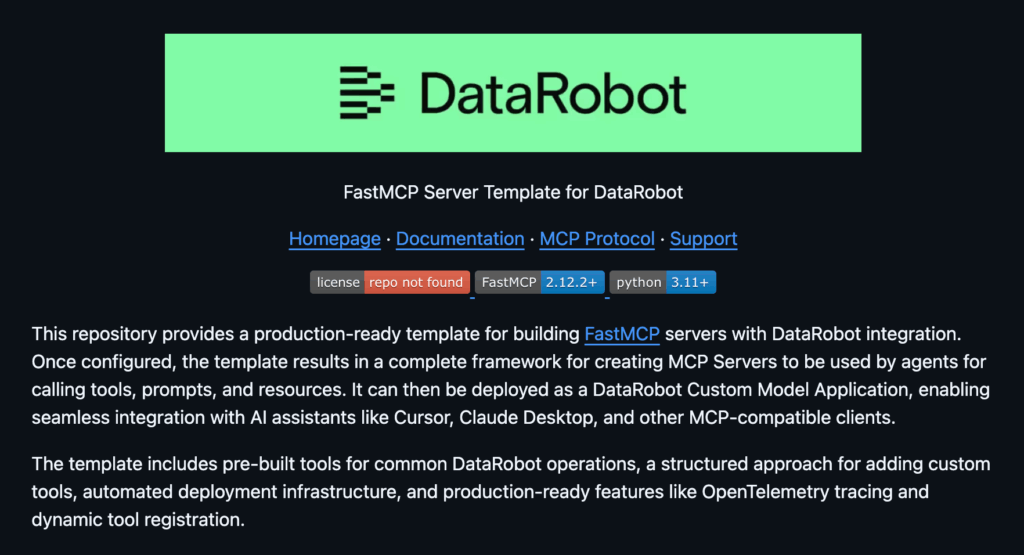
Agents break when tools change. Custom integrations become technical debt. The Model Context Protocol (MCP) is emerging as the standard to solve this, and we’re making it production-ready.
What’s new: An MCP server template you can clone, test locally, and deploy directly to your DataRobot cluster. Your agents get reliable access to tools, prompts, and resources without reinventing the integration layer every time. Easily convert your predictive models as tools that are discoverable by agents.
Why it matters: With our MCP template, we’re giving you the open standard with enterprise guardrails already built in. Test on your laptop in the morning, deploy to production by afternoon.
Talk to My Docs: Secure, agentic knowledge retrieval
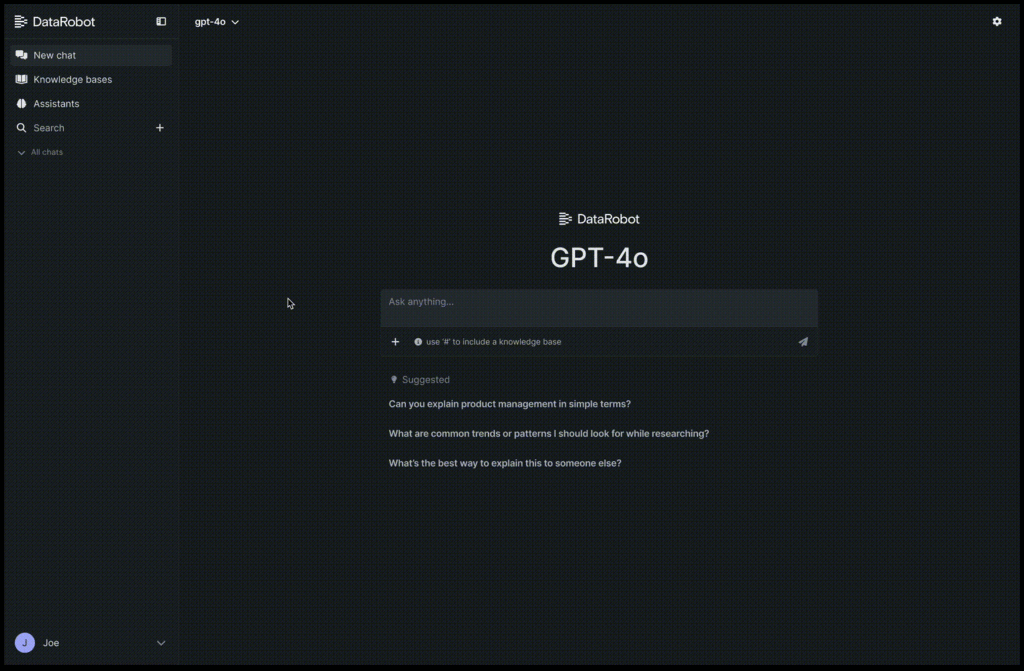
Everyone is building RAG. Almost nobody is building RAG with RBAC, audit trails, and the ability to swap models without rewriting code.
The “Talk to My Docs” application template brings natural language chat-style productivity across all your documents and is secured and governed for the enterprise.
What’s new: A secure, governed chat interface that connects to Google Drive, Box, SharePoint, and local files. Unlike basic RAG, it handles complex formats from tables, spreadsheets, multi-doc synthesis while maintaining enterprise-grade access control.
Why it matters: Your team needs ChatGPT-style productivity. Your security team needs proof that sensitive documents stay restricted. This does both, out of the box.
Agentic application starter template and CLI: Streamlined build and deployment
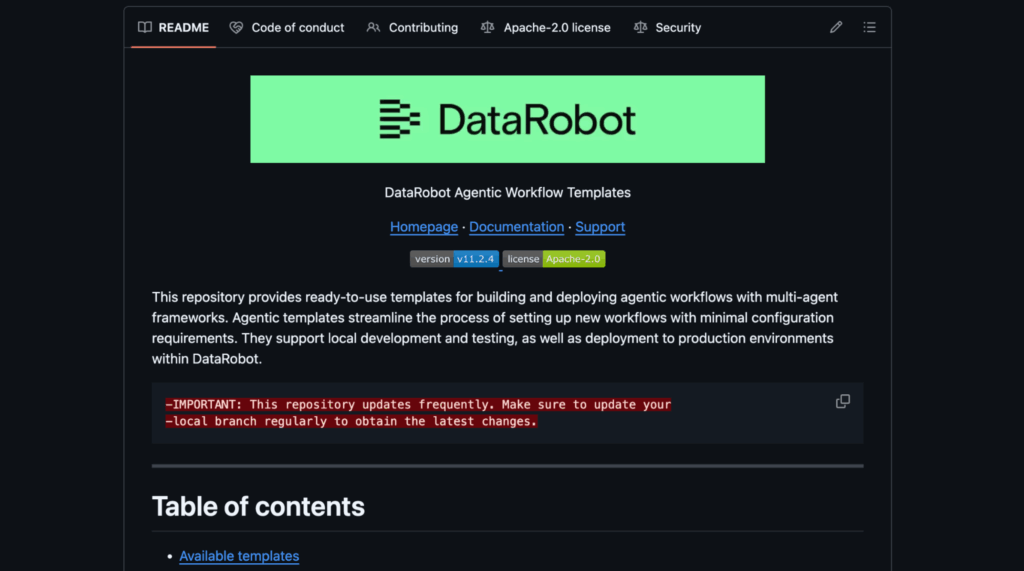
Getting an agent into production should not require days of scaffolding, wiring services together, or rebuilding containers for every small change. Setup friction slows experimentation and turns simple iterations into heavyweight engineering work.
To address this, DataRobot is introducing an agentic application starter template and CLI, both designed to reduce setup overhead across both code-first and low-code workflows.
What’s new: An agentic application starter template and CLI that let developers configure agent components through a single interactive command. Out-of-the-box components include an MCP server, a FastAPI backend, and a React frontend. For teams that prefer a low-code approach, integration with NVIDIA’s NeMo Agent Toolkit enables agent logic and tools to be defined entirely through YAML. Runtime dependencies can now be added dynamically, eliminating the need to rebuild Docker images during iteration.
Why it matters: By minimizing setup and rebuild friction, teams can iterate faster and move agents into production more reliably. Developers can focus on agent logic rather than infrastructure, while platform teams maintain consistent, production-ready deployment patterns.
Prompt management studio: DevOps for prompts
As prompts move from experiments to production assets, ad hoc editing quickly becomes a liability. Without versioning and traceability, teams struggle to reproduce results or safely iterate.
To address this, DataRobot introduces the Prompt Management Studio, bringing software-style discipline to prompt engineering.
What’s new: A centralized registry that treats prompts as version-controlled assets. Teams can track changes, compare implementations, and revert to stable versions as prompts move through development and deployment.
Why it matters: By applying DevOps practices to prompts, teams gain reproducibility and control, making it easier to transition from prototyping to production without introducing hidden risk.
Multi-tenant governance and resource monitoring: Operational control at scale
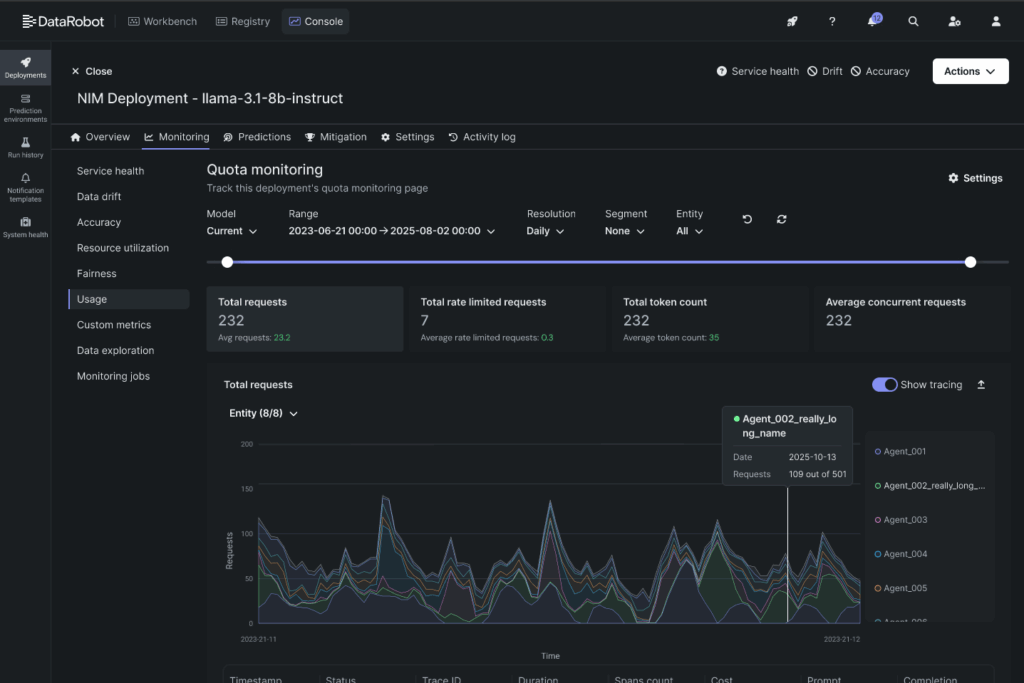
As AI agents scale across teams and workloads, visibility and control become non-negotiable. Without clear insight into resource usage and enforceable limits, performance bottlenecks and cost overruns quickly follow.
What’s new: The enhanced Resource Monitoring tab provides detailed visibility into CPU and memory utilization, helping teams identify bottlenecks and manage trade-offs between performance and cost. In parallel, Multi-tenant AI Governance introduces token-based access with configurable rate limits to ensure fair resource consumption across users and agents.
Why it matters: Developers gain clear insight into how agent workloads behave in production, while platform teams can enforce guardrails that prevent noisy neighbors and uncontrolled resource usage as systems scale.
Expanded LLM Gateway: Multi-model access without credential sprawl
As teams experiment with agent behavior and reasoning, access to multiple foundation models becomes essential. Managing separate credentials, rate limits, and integrations across providers quickly introduces operational overhead.
What’s new: The expanded LLM Gateway adds support for Cerebras and Together AI alongside Anthropic, providing access to models such as Gemma, Mistral, Qwen, and others through a single, governed interface. All models are accessed using DataRobot-managed credentials, eliminating the need to manage individual API keys.
Why it matters: Teams can evaluate and deploy agents across multiple model providers without increasing security risk or operational complexity. Platform teams maintain centralized control, while developers gain flexibility to choose the right model for each workload.
New supporting ecosystem integrations
Jira and Confluence connectors: To power your vector databases, DataRobot provides a cohesive ecosystem for building enterprise-ready, knowledge-aware agents.
NVIDIA NIM Integration: Deploy Llama 4, Nemotron, GPT-OSS, and 50+ GPU-optimized models without the MLOps complexity. Pre-built containers, production-ready from day one.
Milvus Vector Database: Direct integration with the leading open-source VDB, plus the ability to select distance metrics that actually matter for your classification and clustering tasks.
Azure Repos & Git Integration: Seamless version control for Codespaces development with Azure Repos or self-hosted Git providers. No manual authentication required. Your code stays centralized where your team already works.
Get hands-on with DataRobot’s Agentic AI
If you’re already a customer, you can spin up the GenAI Test Drive in seconds. No new account. No sales call. Just 14 days of full access inside your existing SaaS environment to test these features with your actual data.
Not a customer yet? Start a 14-day free trial and explore the full platform.
For more information, please visit our Version 11.2 and Version 11.3 release notes in the DataRobot docs.