Page 1 of 7
1 2 3 7

Robot Talk Episode 162 – The robot doctor will see you now

Since the first robot-assisted surgery was performed, over 40 years ago, major advances in robotics, computer vision and artificial intelligence have fundamentally changed medicine and healthcare. Innovative new technologies are already aiding skilled medical professionals in diagnosis, surgery, rehabilitation and beyond. But many questions remain: What ethical issues arise as medical tools become increasingly autonomous? How do we regulate technologies that can learn and change over time? And how can we ensure that cutting-edge medical devices are accessible to all?

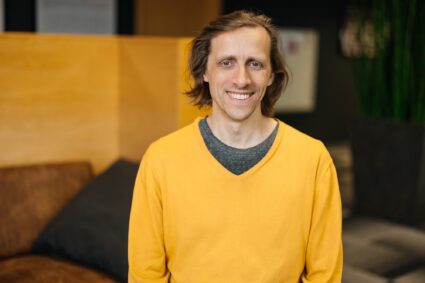
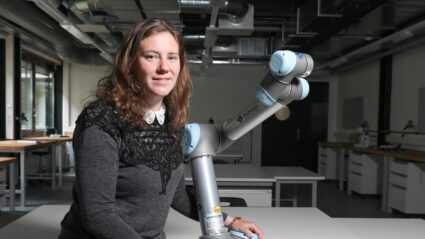
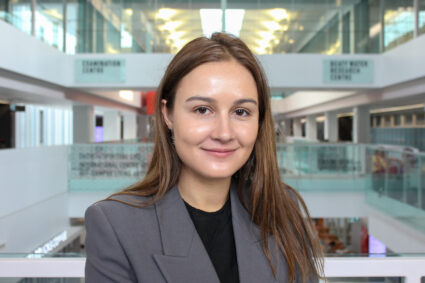
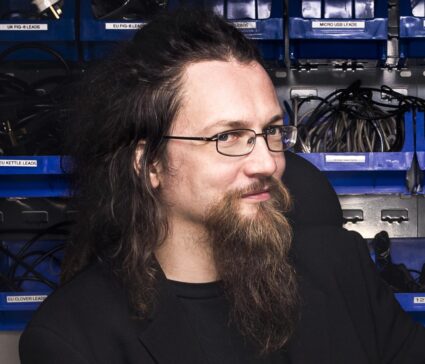
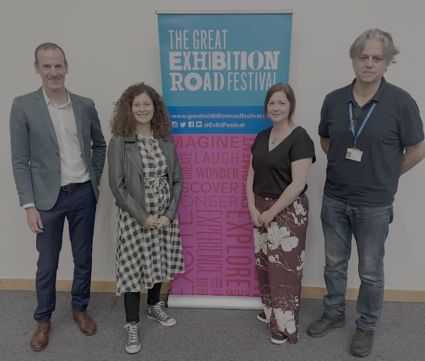
In this special live recording at the Great Exhibition Road Festival in London, Claire chatted to George Mylonas (Imperial College London), Antonia Tzemanaki (University of Bristol) and Tom Vercauteren (King’s College London) about robotics and AI in medicine and healthcare.

George Mylonas is an Associate Professor in Robotics and Technology in Cancer at Imperial College London, and the director of the Human-centred Automation, Robotics and Monitoring in Surgery lab at The Hamlyn Centre, Institute of Global Health Innovation and the Department of Surgery & Cancer, Faculty of Medicine. He is leading research in the areas of surgical robotics, soft robotics, minimal access surgical technology, perceptual human-robot and human-computer interfaces, and smart data-driven operating theatres. He is a member of the European Association of Endoscopic Surgery Technology Committee.

Antonia Tzemanaki is a Senior Lecturer in Robotics at the University of Bristol and a core member of the Bristol Robotics Laboratory. She leads the Dexterous Manipulation and Wearable Robotics group which develops robotic simulators and interventions, including robotic needle steering, abdominal, urology, skull and hand models, for surgical and physical therapy treatments of disease including cancers, neurological, prostate and urinary disorders. The group provides wide expertise in precision manipulation, robot hands, hand exoskeletons, kinematics, haptics and wearable robotics, especially with applications in surgery, preventative medicine, rehabilitation, physiotherapy and dexterous tele-operation.

Tom Vercauteren is a Professor of Interventional Image Computing at King’s College London, where he leads the Contextual Artificial Intelligence for Computer Assisted Interventions research group. His research focuses on medical image computing, machine learning and imaging for surgery and interventional sciences. He is also co-founder and Chief Scientific Officer of Hypervision Surgical, a spin-out company developing safe, non-invasive optical imaging for use during surgery. His work is now used in hundreds of hospitals worldwide. Tom is also a supporter of open-source software and patient involvement.
 

Robot Talk Episode 161 – Collaborative haptic systems, with Allison Okamura

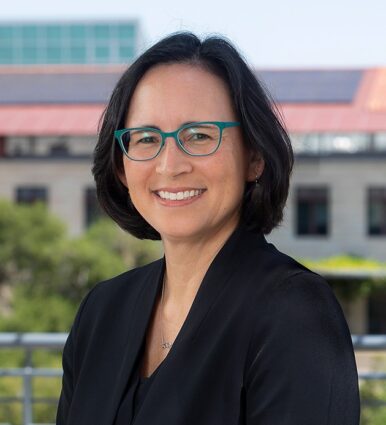
Claire chatted to Allison Okamura from Stanford University about developing advanced robotic systems for haptic (touch) interaction.

Allison Okamura is the Richard W. Weiland Professor of Engineering at Stanford University. Her academic interests include haptics, teleoperation, virtual reality, medical robotics, soft robotics, rehabilitation, and education. Allison is Director of Graduate Studies for Mechanical Engineering at Stanford University, a deputy director of the Wu Tsai Stanford Neurosciences Institute, a Science Fellow of the Hoover Institution and a founding faculty member and executive committee member of the Stanford Robotics Center.

Robot Talk Episode 160 – Robotic blacksmiths, with Edward Mehr

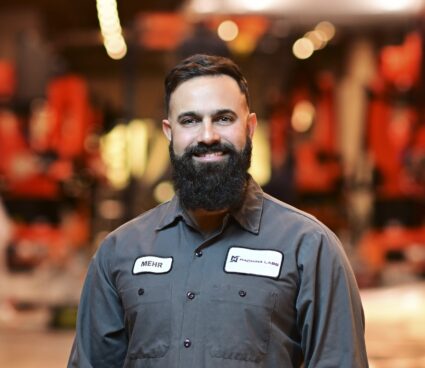
Claire chatted to Edward Mehr from Machina Labs about their RoboCraftsman that shapes complex metal parts for the aerospace, defence, and automotive industries.

Edward Mehr is an entrepreneur and engineer specializing in advanced manufacturing, robotics, and artificial intelligence. As the Co-Founder and CEO of Machina Labs, he leads efforts to integrate AI-driven robotics into flexible, on-demand production systems. Under his leadership, Machina Labs is reshaping how industries such as aerospace, defence, and automotive approach metal forming and modern manufacturing. Before founding Machina Labs, Ed worked at leading technology companies, including Relativity Space, Averon, SpaceX, Google, and Microsoft.

Robot Talk Episode 160 – Robotic blacksmiths, with Edward Mehr

Claire chatted to Edward Mehr from Machina Labs about their RoboCraftsman that shapes complex metal parts for the aerospace, defence, and automotive industries.

Edward Mehr is an entrepreneur and engineer specializing in advanced manufacturing, robotics, and artificial intelligence. As the Co-Founder and CEO of Machina Labs, he leads efforts to integrate AI-driven robotics into flexible, on-demand production systems. Under his leadership, Machina Labs is reshaping how industries such as aerospace, defence, and automotive approach metal forming and modern manufacturing. Before founding Machina Labs, Ed worked at leading technology companies, including Relativity Space, Averon, SpaceX, Google, and Microsoft.

Robot Talk Episode 159 – Robot sensing and manipulation, with Maria Koskinopoulou

Claire chatted to Maria Koskinopoulou from Heriot-Watt University about autonomous robotic manipulators for surgery, industry, and beyond.

Maria Koskinopoulou is an Assistant Professor in Robotics and Computer Vision at Heriot-Watt University. She co-leads the ARM²Lab – Autonomous Robotic Manipulation & Multi-Agent Systems Lab at Heriot-Watt and the National Robotarium, alongside Ignacio Carlucho. Her research interests include robotic manipulation, perception, robot vision, medical robotics, human-robot interaction, and machine learning. She is involved in major UKRI and EU-funded research projects advancing robotic manipulation, surgical and underwater robotics, autonomous assembly, and waste sorting.

Robot Talk Episode 158 – Autonomous robot deliveries, with Ahti Heinla

Claire chatted to Ahti Heinla from Starship Technologies about their AI-powered delivery robots that operate independently on streets and pavements.

Ahti Heinla is the co-founder and CEO of Starship Technologies, the world’s leading autonomous delivery company building AI-powered robots that operate fully independently in real-world environments. One of the original engineers behind Skype’s billion-dollar success, Ahti later made a quiet pivot into robotics, spending the past decade advancing practical, consumer-facing AI. Under his leadership, Starship has completed more than 10 million autonomous deliveries with a fleet of over 2,700 robots navigating streets, pavements, weather, and people, without human intervention.

Robot Talk Episode 157 – Generating new robot designs, with Josie Hughes

Claire chatted to Josie Hughes from École Polytechnique Fédérale de Lausanne about using AI to develop new designs for robotic manipulators.

Josie Hughes is an Assistant Professor at EPFL, where she established the CREATE Lab in 2021. She completed her PhD in the Bio-inspired Robotics Lab at the University of Cambridge, examining the role of passivity in bio-inspired manipulators. Her research focuses on developing novel design paradigms for designing robot structures that exploit their physicality and interactions with the environment. This includes the development of robotic hands, soft manipulators, and automation systems for applications focused on sustainability and science.

Robot Talk Episode 156 – Rugged robots for dangerous missions, with Gavin Kenneally

Claire chatted to Gavin Kenneally from Ghost Robotics about robot dogs for defence, security, and public safety.

Gavin Kenneally is the Co-Founder and CEO of Ghost Robotics, a company that has gained a reputation for pushing the boundaries of legged robotics technology. In his current role, Gavin spearheads a team of highly skilled engineers and researchers who share his passion for creating advanced robotics systems. Previously, he was Head of Product at Ghost Robotics, responsible for the mechanical design of the company’s flagship product: the Vision 60 Q-UGV. Gavin has a PhD in Mechanical Engineering from the University of Pennsylvania and has authored six academic papers.

Robot Talk Episode 155 – Making aerial robots smarter, with Melissa Greeff

Claire chatted to Melissa Greeff from Queen’s University about autonomous navigation and learning for drones.

Melissa Greeff is an Assistant Professor in Electrical and Computer Engineering at Queen’s University. She leads Robora Lab and is also an Ingenuity Labs Robotics and AI Institute member. Her research interests include aerial robots, vision-based navigation, and safe learning-based control. Melissa’s expertise is in building autonomous aerial systems including previous experience in conducting field trials at various locations across Canada. She was listed as one of 50 women in robotics you need to know about in 2023 by the Women in Robotics organization.

Robot Talk Episode 154 – Visual navigation in insects and robots, with Andrew Philippides

Claire chatted to Andrew Philippides from the University of Sussex about what we can learn from ants and bees to improve robot navigation.

Andrew Philippides is a Professor of Biorobotics at the University of Sussex, where he co-directs the Centre for Computational Neuroscience and Robotics and the be.AI Leverhulme Doctoral centre for Biomimetic Embodied AI. His research combines biological experiments with robotics, modelling, and machine learning to understand how intelligent behaviour emerges from the interaction of body and brain acting in an environment. Focussing on visual navigation, he aims to understand the navigation and learning abilities of ants and bees to develop novel AI and biorobotic algorithms.

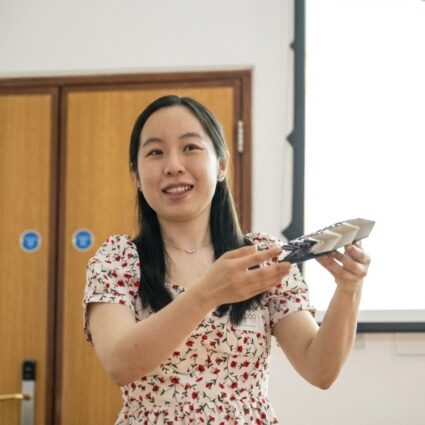
Robot Talk Episode 153 – Origami-inspired robots, with Chenying Liu

Claire chatted to Chenying Liu from University of Oxford about how a robot’s physical form can actively contribute to sensing, processing, decision-making, and movement.

Chenying Liu is a Junior Research Fellow and an Associate Member of Faculty in the Department of Engineering Science at the University of Oxford. She leads an independent research programme focused on embodied physical intelligence, exploring how robot design can integrate geometry, materials, and control to enhance autonomy and robustness. Her work aims to develop more efficient and resilient robotic systems by embedding intelligence directly into their physical structures.

Robot Talk Episode 152 – Dexterous robot hands, with Rich Walker

Claire chatted to Rich Walker from Shadow Robot Company about their advanced robotic hands for research and industry.

Rich Walker has been at Shadow Robot since long before it was a company, working initially on software and systems engineering before “jumping the fence” into management. He led Shadow Robot’s engagement with a number of R&D initiatives in UK and across Europe, as well as developing proof-of-concept projects for dexterous robotics with a number of commercial organisations. Rich represents robotics SMEs at the European level as one of the Directors of euRobotics, as well as maintaining Shadow Robot’s research engagements and policy programme.

Robot Talk Episode 151 – Robots to study the ocean, with Simona Aracri

Claire chatted to Simona Aracri from National Research Council of Italy about innovative robot designs for oceanography and environmental monitoring.

Simona Aracri is a researcher in the Institute of Marine Engineering at the National Research Council of Italy. Previously, she was a Post Doctoral Research Associate at the University of Edinburgh, working on the award winning project ORCA Hub and focusing on offshore robotic sensors. Her research uses innovative sensors and robotic platforms to push the boundaries of observational oceanography and environmental monitoring. She has spent more than 6 months at sea on oceanographic sampling campaigns, in the Mediterranean Sea, Pacific Ocean and the North Sea.

Robot Talk Episode 150 – House building robots, with Vikas Enti

Claire chatted to Vikas Enti from Reframe Systems about using robotics and automation to build climate-resilient, high-performance homes.

Vikas Enti is the co-founder and CEO of Reframe Systems, a physical AI company rethinking how homes are built through automation and localized fabrication. He previously spent more than a decade at Amazon Robotics, where he helped scale advanced robotics systems across global logistics networks. Today, he is applying those same principles of systems design and repeatable production to address the housing shortage. Vikas focuses on building climate-resilient, high-performance homes faster and more predictably than traditional methods.

Robot Talk Episode 149 – Robot safety and security, with Krystal Mattich

Claire chatted to Krystal Mattich from Brain Corp about trustworthy autonomous robots in public spaces.

Krystal Mattich leads global data governance, system security, and privacy compliance for Brain Corp: the world’s leading autonomy platform for commercial robotics. As Senior Director of Security, Privacy, and Risk, she is the architect of the privacy-first infrastructure that powers over 40,000 BrainOS®-enabled robots across retail, airports, education and logistics. Krystal played a central role in launching Brain Corp’s public-facing Trust Center, reinforcing the company’s commitment to data transparency, GDPR compliance, and responsible AI.

Page 1 of 7
1 2 3 7