All posts by The Berkeley Artificial Intelligence Research Blog

Page 2 of 2
1 2

Ghostbuster: Detecting Text Ghostwritten by Large Language Models


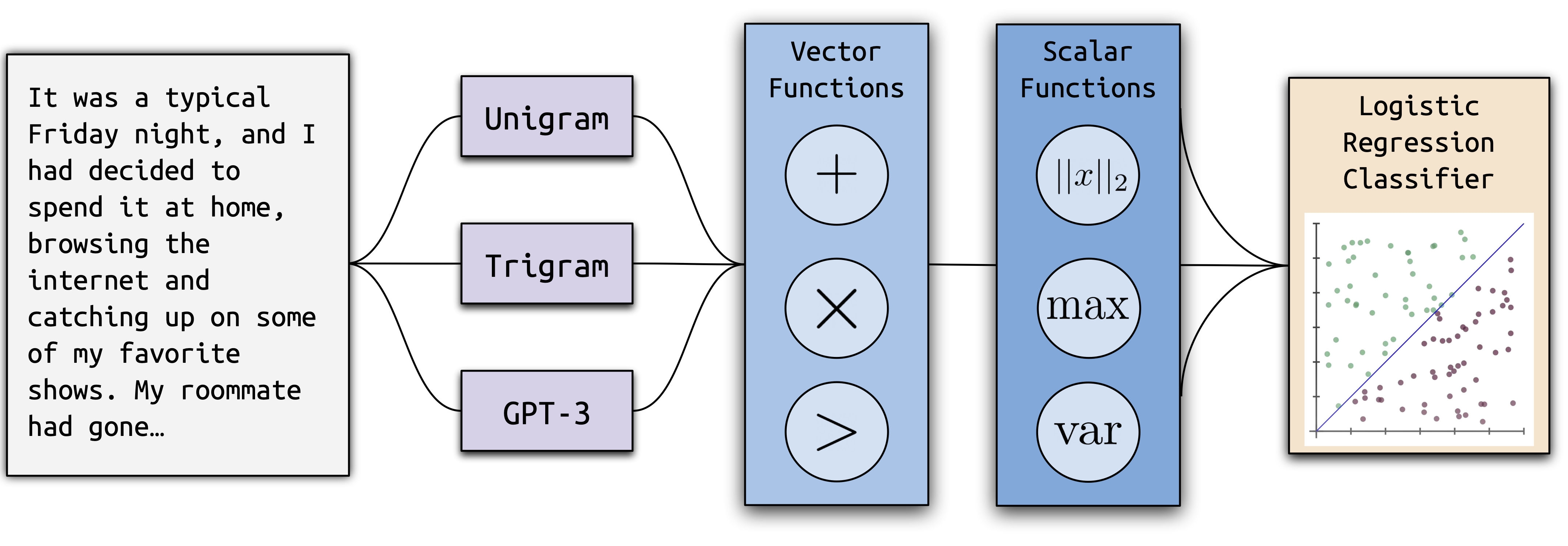
The structure of Ghostbuster, our new state-of-the-art method for detecting AI-generated text.

Large language models like ChatGPT write impressively well—so well, in fact, that they’ve become a problem. Students have begun using these models to ghostwrite assignments, leading some schools to ban ChatGPT. In addition, these models are also prone to producing text with factual errors, so wary readers may want to know if generative AI tools have been used to ghostwrite news articles or other sources before trusting them.

What can teachers and consumers do? Existing tools to detect AI-generated text sometimes do poorly on data that differs from what they were trained on. In addition, if these models falsely classify real human writing as AI-generated, they can jeopardize students whose genuine work is called into question.

Our recent paper introduces Ghostbuster, a state-of-the-art method for detecting AI-generated text. Ghostbuster works by finding the probability of generating each token in a document under several weaker language models, then combining functions based on these probabilities as input to a final classifier. Ghostbuster doesn’t need to know what model was used to generate a document, nor the probability of generating the document under that specific model. This property makes Ghostbuster particularly useful for detecting text potentially generated by an unknown model or a black-box model, such as the popular commercial models ChatGPT and Claude, for which probabilities aren’t available. We’re particularly interested in ensuring that Ghostbuster generalizes well, so we evaluated across a range of ways that text could be generated, including different domains (using newly collected datasets of essays, news, and stories), language models, or prompts.

Read More

Asymmetric Certified Robustness via Feature-Convex Neural Networks

Asymmetric Certified Robustness via Feature-Convex Neural Networks

TLDR: We propose the asymmetric certified robustness problem, which requires certified robustness for only one class and reflects real-world adversarial scenarios. This focused setting allows us to introduce feature-convex classifiers, which produce closed-form and deterministic certified radii on the order of milliseconds.

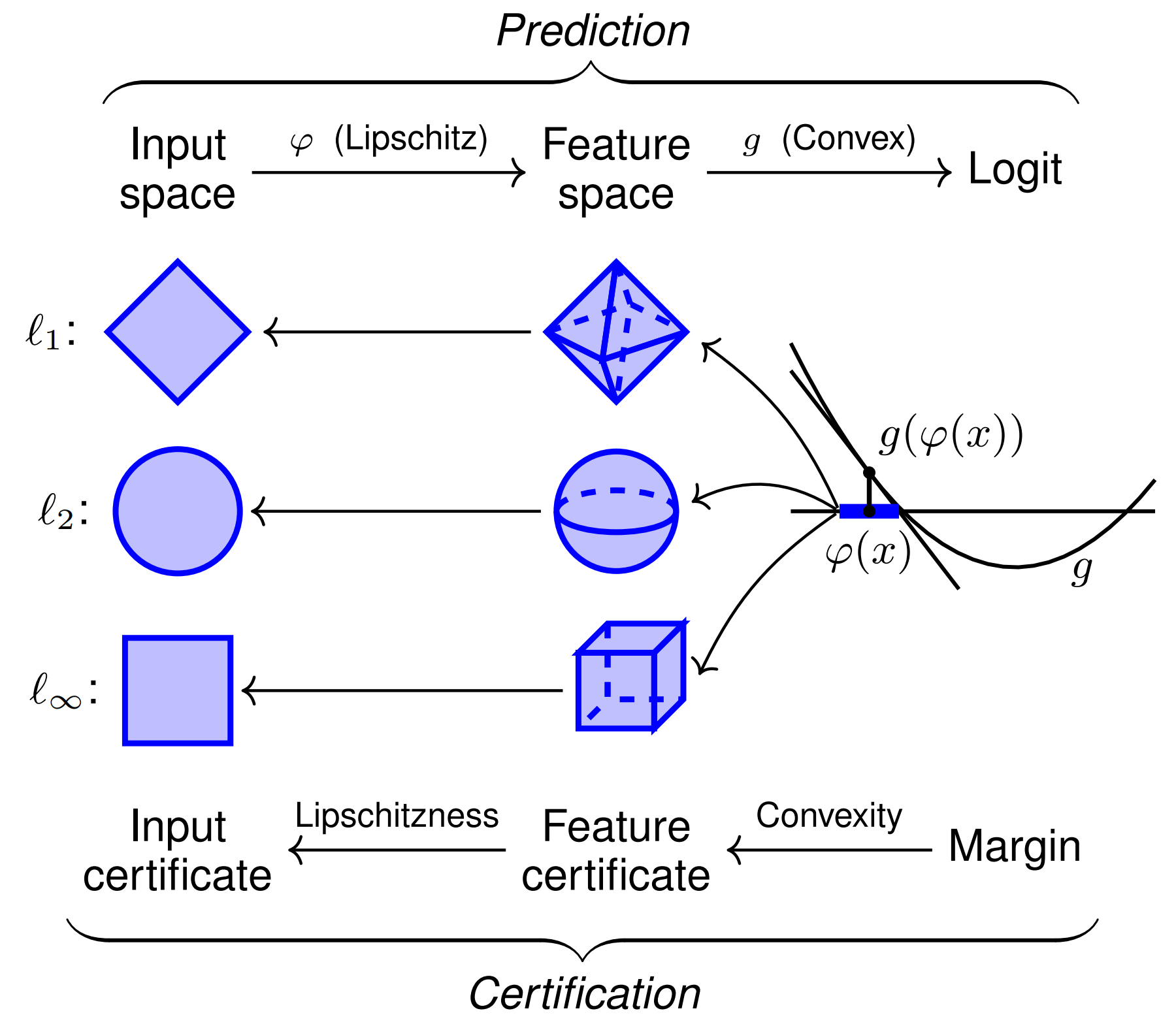
diagram illustrating the FCNN architecture

Figure 1. Illustration of feature-convex classifiers and their certification for sensitive-class inputs. This architecture composes a Lipschitz-continuous feature map $\varphi$ with a learned convex function $g$. Since $g$ is convex, it is globally underapproximated by its tangent plane at $\varphi(x)$, yielding certified norm balls in the feature space. Lipschitzness of $\varphi$ then yields appropriately scaled certificates in the original input space.

Despite their widespread usage, deep learning classifiers are acutely vulnerable to adversarial examples: small, human-imperceptible image perturbations that fool machine learning models into misclassifying the modified input. This weakness severely undermines the reliability of safety-critical processes that incorporate machine learning. Many empirical defenses against adversarial perturbations have been proposed—often only to be later defeated by stronger attack strategies. We therefore focus on certifiably robust classifiers, which provide a mathematical guarantee that their prediction will remain constant for an $\ell_p$-norm ball around an input.

Conventional certified robustness methods incur a range of drawbacks, including nondeterminism, slow execution, poor scaling, and certification against only one attack norm. We argue that these issues can be addressed by refining the certified robustness problem to be more aligned with practical adversarial settings.

Read More

Rethinking the Role of PPO in RLHF

Rethinking the Role of PPO in RLHF

TL;DR: In RLHF, there’s tension between the reward learning phase, which uses human preference in the form of comparisons, and the RL fine-tuning phase, which optimizes a single, non-comparative reward. What if we performed RL in a comparative way?


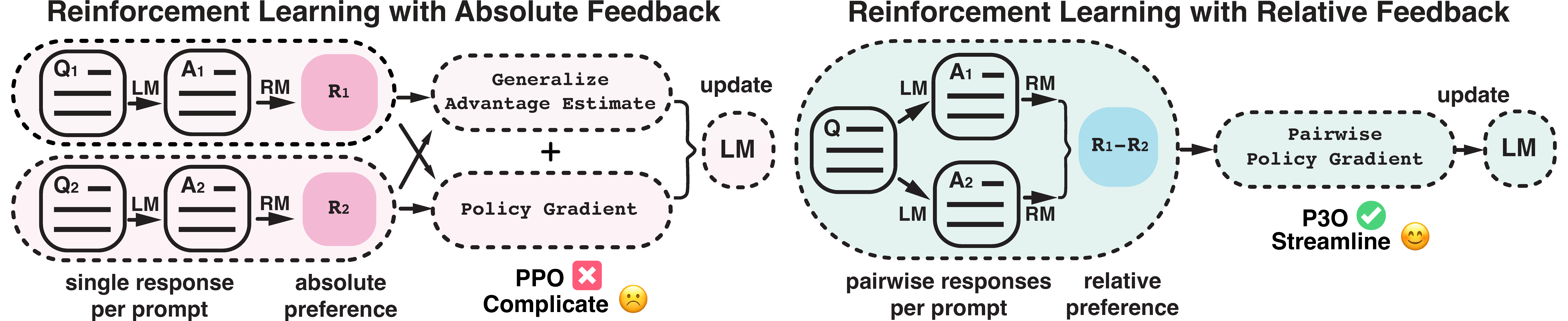
Figure 1: This diagram illustrates the difference between reinforcement learning from absolute feedback and relative feedback. By incorporating a new component - pairwise policy gradient, we can unify the reward modeling stage and RL stage, enabling direct updates based on pairwise responses.

Large Language Models (LLMs) have powered increasingly capable virtual assistants, such as GPT-4, Claude-2, Bard and Bing Chat. These systems can respond to complex user queries, write code, and even produce poetry. The technique underlying these amazing virtual assistants is Reinforcement Learning with Human Feedback (RLHF). RLHF aims to align the model with human values and eliminate unintended behaviors, which can often arise due to the model being exposed to a large quantity of low-quality data during its pretraining phase.

Proximal Policy Optimization (PPO), the dominant RL optimizer in this process, has been reported to exhibit instability and implementation complications. More importantly, there’s a persistent discrepancy in the RLHF process: despite the reward model being trained using comparisons between various responses, the RL fine-tuning stage works on individual responses without making any comparisons. This inconsistency can exacerbate issues, especially in the challenging language generation domain.

Given this backdrop, an intriguing question arises: Is it possible to design an RL algorithm that learns in a comparative manner? To explore this, we introduce Pairwise Proximal Policy Optimization (P3O), a method that harmonizes the training processes in both the reward learning stage and RL fine-tuning stage of RLHF, providing a satisfactory solution to this issue. Read More

Training Diffusion Models with <br> Reinforcement Learning

Training Diffusion Models with Reinforcement Learning

Diffusion models have recently emerged as the de facto standard for generating complex, high-dimensional outputs. You may know them for their ability to produce stunning AI art and hyper-realistic synthetic images, but they have also found success in other applications such as drug design and continuous control. The key idea behind diffusion models is to iteratively transform random noise into a sample, such as an image or protein structure. This is typically motivated as a maximum likelihood estimation problem, where the model is trained to generate samples that match the training data as closely as possible.

However, most use cases of diffusion models are not directly concerned with matching the training data, but instead with a downstream objective. We don’t just want an image that looks like existing images, but one that has a specific type of appearance; we don’t just want a drug molecule that is physically plausible, but one that is as effective as possible. In this post, we show how diffusion models can be trained on these downstream objectives directly using reinforcement learning (RL). To do this, we finetune Stable Diffusion on a variety of objectives, including image compressibility, human-perceived aesthetic quality, and prompt-image alignment. The last of these objectives uses feedback from a large vision-language model to improve the model’s performance on unusual prompts, demonstrating how powerful AI models can be used to improve each other without any humans in the loop.

Read More

On the Stepwise Nature of <br> Self-Supervised Learning

Figure 1: stepwise behavior in self-supervised learning. When training common SSL algorithms, we find that the loss descends in a stepwise fashion (top left) and the learned embeddings iteratively increase in dimensionality (bottom left). Direct visualization of embeddings (right; top three PCA directions shown) confirms that embeddings are initially collapsed to a point, which then expands to a 1D manifold, a 2D manifold, and beyond concurrently with steps in the loss.

It is widely believed that deep learning’s stunning success is due in part to its ability to discover and extract useful representations of complex data. Self-supervised learning (SSL) has emerged as a leading framework for learning these representations for images directly from unlabeled data, similar to how LLMs learn representations for language directly from web-scraped text. Yet despite SSL’s key role in state-of-the-art models such as CLIP and MidJourney, fundamental questions like “what are self-supervised image systems really learning?” and “how does that learning actually occur?” lack basic answers.

Our recent paper (to appear at ICML 2023) presents what we suggest is the first compelling mathematical picture of the training process of large-scale SSL methods. Our simplified theoretical model, which we solve exactly, learns aspects of the data in a series of discrete, well-separated steps. We then demonstrate that this behavior can be observed in the wild across many current state-of-the-art systems. This discovery opens new avenues for improving SSL methods, and enables a whole range of new scientific questions that, when answered, will provide a powerful lens for understanding some of today’s most important deep learning systems.

Read More
Page 2 of 2
1 2