Page 1 of 3
1 2 3

Could robots help tackle loneliness? BBC’s Ann Droid raises questions about the future of care

By Maria Jose Galvez Trigo, Cardiff University and Paul Willis, Cardiff University

New BBC sitcom Ann Droid imagines a near future in which robots provide care and companionship to older people at home.

The series centres on Sue, a recent widow played by Sue Johnston, her hapless son Michael and Linda, an assistive care robot played by Diane Morgan. Linda is designed to provide daily support and companionship, with predictably comic results.

As researchers in social care, ageing and human-centred robotics, we obviously watched Ann Droid with a keen eye. Beneath the jokes are questions that researchers are already tackling.

Could robots help address loneliness among older people? Can a machine provide companionship without replacing human connection? While the series exaggerates what robots can currently do, some of the technology it depicts is already being tested.

The BBC’s Ann Droid sitcom.

A social enterprise in south-west England has been piloting Comfort Companions in partnership with Age UK South Gloucestershire. AI-generated personas offer conversation and guidance to older people living alone and at risk of loneliness.

It runs alongside Age UK’s volunteer programme, with befrienders helping older people learn how to use the app. The AI companions are intended to supplement the waiting list for human befrienders rather than replacing them.

Physical robots are being tested too. West Berkshire Council has been running a trial using robotic pets in its care homes.

Neither scheme offers robots who look like Linda. Current systems tend to be AI avatars on a screen or robotic cats or dogs, or speakers that provide a voice in the room. They do much less than Linda too. They can’t help someone up after a fall, wash them or get them dressed.

What technology does currently do best is monitoring and prompting. Systems that can detect a fall and alert another person are far more mature, while technology can also encourage someone to contact friends, make a phone call, or get out of the house.

Can a machine make you less lonely?

It’s worth considering this distinction because loneliness is not simply the same as being alone. It’s a personal feeling that our relationships are insufficient, accompanied by a desire for more or better social contact.

A robot companion, therefore, is unlikely to solve loneliness simply by being present. What matters is the quality of the interaction and whether technology can help someone maintain relationships with the people who matter to them.

This is one of the more interesting ideas in Ann Droid. Linda can sometimes strengthen Sue’s existing relationships rather than replace them, encouraging her to meet friends and plan activities outside the home. That’s potentially a more useful way to think about companion technology. The goal need not be to create an artificial friend who substitutes for a human one, but to help people remain connected to others.

The barriers are still substantial. Battery life is a limitation. Most humanoid robots manage between 90 minutes and five hours per charge when new. This is why an overnight camping trip featured in the sitcom is a fair test on the fantasy.

Robots are much better at some tasks than others. A machine may be able to play chess, for example, but picking up an unfamiliar household object in the real world remains surprisingly difficult.

The social barriers are even harder. Robots struggle with the social subtleties that people take for granted. Systems that learn by copying human behaviour can reproduce an action without understanding its intention. They also cannot reliably interpret facial expressions.

A review of systems designed to detect emotion from faces found that they performed worst when interpreting older faces, with anger and neutral expressions among the least reliably identified. This is important in care because recognising how someone is feeling can be crucial.

Would we trust a robot carer?

Ann Droid also plays on a more instinctive discomfort: should we trust a machine that’s designed to look after us? The sitcom playfully touches on public worries about interacting with robotic companions, including people’s distrust and worries about potential harms. For example, in one episode two robots enjoy a joke together about killing their human companions.

Research suggests that older people can see value in companion robots. But acceptance depends partly on whether people feel they remain in control. And appearance is a factor too.

In 1970, the roboticist Masahiro Mori proposed the idea of the “uncanny valley”. As machines become more human-like, we initially respond more positively to them. But when they look almost human without quite getting there, that warmth can turn into discomfort.

Ann Droid – dinner with the robot-in-law.

Robots have some obvious advantages. They don’t get bored, tired or impatient. They can handle dangerous tasks and they’re available at 3am. But they can’t provide something fundamental to care: a relationship in which both people choose to be there.

That’s the bond that no machine can supply. Robots may have a useful role in social care, but they’re worth having only when people want them, alongside human care and companionship. Otherwise, we risk finding an expensive technological answer to a much harder question: why do some older people have so little human contact in the first place?The Conversation

Maria Jose Galvez Trigo, Senior Lecturer (Associate Professor) in Human-Centred Robotics and AI, Cardiff University and Paul Willis, Professor of Social Care, Cardiff University

This article is republished from The Conversation under a Creative Commons license. Read the original article.

Exploring the Moon will require rovers that can think for themselves – an upcoming NASA mission will test whether they can

By Wanjiku Chebet Kanjumba, University of Florida

NASA is planning to send three small rovers to the Moon with a single instruction: Work out among yourselves how to explore a patch of ground.

The Cooperative Autonomous Distributed Robotic Exploration mission, or CADRE, will land on the side of the Moon facing Earth as part of NASA’s IM-3 launch, planned for late 2026. These rovers will spend roughly two weeks mapping the terrain as a self-guided team. No joystick will control them, and no human will approve each turn.

Three small robotic rovers drive across a sterile warehouse floor.Engineers test whether the CADRE rovers can drive and coordinate on their own at NASA’s Jet Propulsion Laboratory in Pasadena, Calif. NASA/JPL-Caltech.

The rovers will elect a leader among themselves, assign their own tasks and redraw their plans as a group when one of them runs low on charge. If it succeeds, CADRE will be the first time NASA has operated multiple rovers beyond Earth as a single autonomous system.

That achievement will matter well beyond this mission, because NASA is scoping out future missions to the lunar South Pole, where water in the form of ice sits locked in craters that haven’t seen sunlight in billions of years. If researchers can chemically split that ice apart and turn it into propellant and breathable air, it could become the feedstock for a lunar economy built around fuel depots and life support made on the Moon.

Right now, the only demand for that ice comes from government contracts. And an operation that must be babysat from 239,000 miles (384,000 kilometers) away will not easily scale into a market. So, while a full-blown lunar economy is still far off, CADRE is testing whether robots can work unsupervised long enough, and in enough numbers, to keep a lunar operation running month after month.

I’m an aerospace engineering Ph.D. candidate researching guidance, navigation and control for spacecraft in-orbit servicing and active debris removal. I work on the same problem these rovers face: how a machine decides what to do next when it cannot call home for instructions.

Why Earth cannot drive

At the Moon’s South Pole, the terrain itself can cause communication disruptions. Commands reach a rover by way of relay satellites, and crater rims can block the line of sight to those relays. A rover that ventures down into a shadowed crater may lose contact for its entire trip.

Spotty communication doesn’t just make trying to drive annoying. It can cost the rover power it cannot recover.

A polar rover runs on a finite illumination budget. Solar panels charge the battery only while the Sun is up, and on the Moon sunrise is not a daily event. Night lasts about two Earth weeks, and at the poles, only a few ridges stay lit for long stretches. So for every minute a rover spends idle, awaiting new instructions, it is spending stored energy it cannot replace until the Sun comes back.

Two graphs sharing one time axis that spans a single surface trip. The top graph, stored energy, rises while the rover recharges in sunlight at the start, then falls in a straight line at a constant rate for the rest of the trip. The bottom graph, tasks completed, has two step lines: the autonomous team's keeps stepping up through the shaded communication blackouts, while the ground-commanded team's stays flat through each one, so the gap between the two widens.In the top image, a rover’s stored energy climbs while it charges in sunlight, then falls at the same rate whether it is working or waiting idly. In the bottom image, the gray bands are communication blackouts. A team waiting on commands from Earth stops until the link returns, while an autonomous team keeps assigning itself work, and the gap that opens between the two lines is work recovered from what would otherwise be dead time. Credit: Wanjiku Chebet Kanjumba.

Why the pole is the hard case

The lunar poles also come with unique challenges. Sunlight can swing from direct glare to absolute shadow as a rover drives down from a sunlit crater rim to the shadowed floor below, so a camera that worked at the top could go blind at the bottom.

The Moon also doesn’t have GPS satellites like Earth does, so rovers can’t know exactly where they are. They need to build their own maps from what their cameras and sensors see.

Temperatures inside permanently shadowed regions drop below minus 274 degrees Fahrenheit (minus 170 degrees Celsius). And the Moon’s dust is more dangerous than it sounds. An electric charge lifts it off the ground, and billions of years of tiny meteorite strikes have left every grain sharp and jagged.

That dust grinds at the wheel bearings and works past the seals. Keeping it out of the rover’s moving parts is still an unsolved problem. The dust can also film over the camera lenses that navigation depends on, leaving a rover unable to see where it is going or move safely.

Why one rover is not enough

Sending a single rover to check out a crater on the Moon is a risky mission. If it gets stuck, the campaign ends. If its instruments fail, no second machine can take the measurements. Multirobot teams distribute that risk and split up the jobs. One rover might carry the sensors and another the drill, while a lander positioned on a sunlit ridge acts as the power and communications hub.

Under a communications blackout, a rover team that waits for its commands from Earth has to stop. An autonomous team reassigns tasks among itself, selecting the next objective that it can reach and complete with the amount of power it has left. Dead time becomes work time.

In ground testing at NASA’s Jet Propulsion Laboratory, the CADRE rovers achieved this coordination. Faced with unexpected obstacles, they replanned paths as a group, and when one rover’s battery ran low, the whole team paused so they could continue together.

A diagram showing how different rovers and a lander communicate and work together on the lunar surfaceA prospecting team splits the work. A lander on the sunlit rim supplies power and relays communications, while a rover and a drill work the permanently shadowed crater floor below, where water ice may be trapped and no sunlight reaches. Once they drop past the rim’s radio horizon, they are out of contact and have to divide the tasks and manage their own power. Credit: Wanjiku Chebet Kanjumba.

What remains uncertain

A campaign at the lunar South Pole would need to run for months, and no robot team has yet worked that hard, for that long, that far from help. Engineers are developing ways for rovers to navigate without satellite positioning and to make decisions onboard, but that software still has to be tested on the surface.

Meanwhile, as of mid-August 2026, China’s Chang’e-7 mission is waiting at Wenchang, the launch site on Hainan Island in China, with liftoff expected by the end of the year. Its lander, rover and hopping probe are meant to work at the pole as a team, with the probe built to leap into permanently shadowed craters. If the U.S. wants to keep pace, it will need its own robots that coordinate without supervision.

Finally, there is no agreed way for a rover built by one company to hand a task to a tool built by another, or to decide which one works the crater floor first. As autonomous rover teams improve, the groups building them will have to work out those rules.

CADRE will tell scientists whether three small rovers can reason together on the Moon. The harder question is whether a dozen different machines from different builders can do the same thing, reliably, for years.The Conversation

Wanjiku Chebet Kanjumba, Ph.D. Candidate in Aerospace Engineering, University of Florida

This article is republished from The Conversation under a Creative Commons license. Read the original article.

When expressive humanoid robots are awkward, people become wary – new brain study

Photo by Alex Knight on Unsplash.

By Hasan Ayaz, Drexel University; Ewart J. de Visser, United States Air Force Academy; Frank Krueger, George Mason University, and Yigit Topoglu, United States Air Force Academy

People become more suspicious of a humanoid robot that makes errors, especially when the robot is an expressive conversation partner.

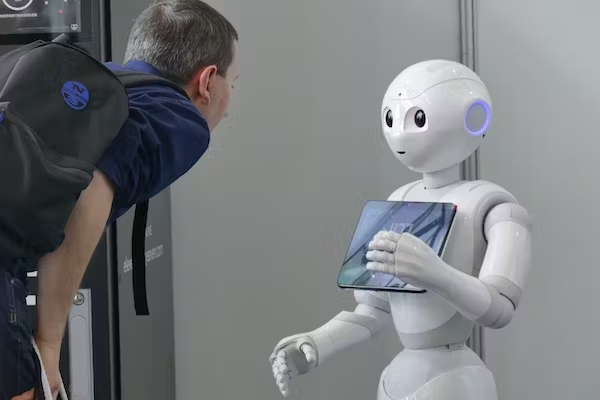
In our new study published in the journal Science Robotics, we had 50 people hold conversations and make joint decisions with the commercial humanoid robot Pepper, which is designed to be expressive and recognize emotions. Sometimes we had the robot give sound advice. Sometimes we had it make conversational mistakes, interrupting people or pushing illogical suggestions.

For some participants, the robot was animated, using gestures, eye contact and nods. For others, it stayed motionless.

We measured four things: brain activity, levels of the hormone oxytocin, self-reported trust and our observations of the robot’s influence on participants’ decisions.

We found that when people interacted with an expressive robot that violated interaction norms, their oxytocin levels increased. Oxytocin is popularly known as the “love hormone” for its role in social bonding, so the straightforward prediction is that it declines when a partner disappoints you.

Instead, the higher a person’s oxytocin during an expressive robot’s errors, the less they trusted the robot and the less often they took its advice. It turns out that the hormone was tracking with suspicion, not affection.

Errors damaged trust and diminished influence whether or not the robot was expressive. What expressiveness in the robot changed in participants was how their brains handled the moment.

Reading someone’s brain during a real conversation is hard because the conventional method requires lying motionless inside an MRI scanner. Instead, we used functional near-infrared spectroscopy, a portable sensor worn on the forehead that tracks oxygen levels in the brain while people move and talk normally.

The two brain regions we closely watched were the dorsolateral prefrontal cortex and the medial prefrontal cortex. The dorsolateral prefrontal cortex monitors uncertainty and flags when expectations or norms get broken. The medial prefrontal cortex supports “mentalizing,” the everyday work of inferring what another party intends.

When an animated robot erred, people seemed caught off guard and had to work harder to make sense of an awkward social situation. Activity rose in the two brain regions, and the two started working together more closely. That closer teamwork predicted the rise in oxytocin levels, which itself predicted falling trust and less influence on participants’ behavior. In contrast, this coordinated brain activity was absent in participants who interacted with expressionless robots.

Why it matters

Robots are moving into homes, hospitals and workplaces, where trust in robots determines whether people use them at all. A common design assumption has been that lifelike, socially expressive robots earn more trust, which protects a robot’s “reputation” even when it makes mistakes.

However, research is beginning to show that that assumption is faulty. Our work shows that expressive cues appear to shift how people perceive a mistake out of the category of technical malfunction and into the category of social violation, like those that happen between people.

A motionless robot’s error looks mechanical, while the same error from an animated robot engages the machinery you use to judge people.

What other research is being done

Researchers increasingly treat trust as a multilevel phenomenon – spanning individuals, relationships, networks of people and societies – rather than a single attitude.

Much research on oxytocin involves humans interacting with humans, where the hormone is tied to bonding, though a growing body of work shows that those effects depend on the context, uncertainty and perceived threat.

Others are using wearable brain imaging systems to study social cognition in natural encounters between people, which isn’t possible when subjects are in scanners like MRI machines.

What’s next

The participants in this study were all young men, and we used one robot design. A key next step is testing whether the same oxytocin-linked vigilance appears in women, mixed groups, other cultures and other robot designs. Our brain sensor also reached only the front of the brain, leaving deeper regions involved in social processing unmeasured.

We also want to examine whether robots can repair trust after a mistake by acknowledging the error, apologizing or signaling good intent, the way that people do after awkward or uncomfortable interactions.

The Research Brief is a short take about interesting academic work.The Conversation

Hasan Ayaz, Professor of Biomedical Engineering, Science and Health Systems, Drexel University; Ewart J. de Visser, Technical Director, Warfighter Effectiveness Research Center, United States Air Force Academy; Frank Krueger, Professor of Systems Social Neuroscience, George Mason University, and Yigit Topoglu, Research Scientist, Warfighter Effectiveness Research Center, United States Air Force Academy

This article is republished from The Conversation under a Creative Commons license. Read the original article.

Table tennis robot defeats some of world’s best players – why this has major implications for robotics

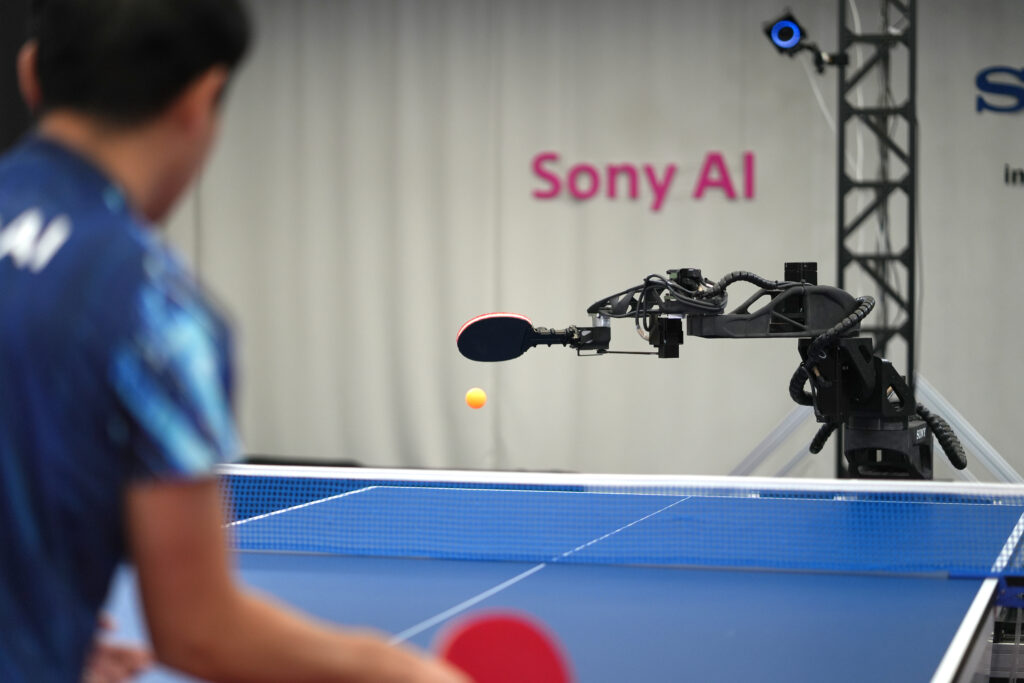
Ace rotates its paddle as it prepares to return the ball back to its human opponent, Yamato Kawamata, during a match in December 2025. Credit: Sony AI.

By Kartikeya Walia, Nottingham Trent University

A table tennis robot has outperformed elite players in recent evaluations. The robot, called Ace, marks a significant step toward artificial intelligence (AI) systems that can operate in fast, uncertain, real-world environments.

In the tests, the autonomous robot won three out of five matches against elite players – competitive athletes with over ten years’ experience and an average of 20 hours weekly training. The robot, developed by Sony AI, lost both matches against players in professional Japanese leagues, but did win a game against one of them. The system is described in detail in a recent paper published in Nature.

AI has spent decades mastering games. It has repeatedly outperformed the best humans in everything from complex video games like StarCraft II to chess – where modern programs now far exceed human ratings.

Landmark systems such as Deep Blue and AlphaGo have confirmed that, given clear rules and enough data, AI can achieve superhuman performance. But these victories all shared one key feature: they happened in controlled, digital environments.

At first glance, table tennis might seem like an unusual benchmark for artificial intelligence. In reality, it is one of the most demanding imaginable. The ball can travel faster than 20 metres per second, giving players less than half a second to react.

On top of that, spin introduces enormous complexity. A ball rotating at extreme speeds can curve mid-air and rebound unpredictably off the table. For humans, interpreting spin is largely intuitive. For robots, it has been a longstanding obstacle.

This robot can beat you at table tennis (Nature).

Earlier table tennis robotic systems such as Forpheus, developed by Japanese company Omron, addressed this by simplifying the game – using controlled ball launchers, limiting movement, or ignoring spin altogether. More recent iterations have aimed for interaction, but still operate under constrained conditions.

Ace does none of this. It plays with standard equipment, on a regulation table,
against human opponents who are free to use the full range of shots.

How Ace works

Ace’s performance relies on three key innovations: how it sees the world, how it
decides what to do, and how it carries out those actions. First, let’s deal with how Ace sees the world. Traditional cameras struggle with fast motion, often producing a blur or missing critical details.

Ace instead uses three “event-based” vision sensors, which detect changes in light rather than capturing full images at fixed intervals. These are complemented by nine high-speed cameras that track the environment, including the opponent and their racket.

Together, these systems enable high-speed gaze control (the technology that enables a robot to direct its sensors to focus on specific things) and allow the robot to follow the ball with exceptional real-time precision.

By tracking markings on the ball, where professional players can generate spin approaching 9,000 revolutions per minute (rpm), the system can estimate spin in real time, something that has long challenged robotic systems.

How Ace’s gaze control system works (Sony AI and Nature).

The second important innovation is how Ace decides what to do. Knowing where the ball is going is only half the problem; the robot must also respond instantly. Ace uses deep reinforcement learning, trained in simulation over millions of virtual rallies, including self-play.

It continuously generates movement commands for its multi-jointed robotic arm, recalculating trajectories every few tens of milliseconds while avoiding collisions with the table or itself.

The third innovation is how Ace carries out its actions. To match the speed of human elite players, the robot is built around a high-performance arm combining two prismatic (sliding) and six revolute (rotational) joints. This enables rapid sideways motion and precise striking. There is both a table tennis racket and a mechanism for ball handling, allowing one-armed serves.

Crucially, the system is engineered for high-speed interaction: lightweight structures and optimised actuation (the mechanisms in a robot that convert energy into mechanical force) allow Ace to return balls at speeds approaching 20 metres per second. This enables sustained, competitive rallies with skilled human players.

Ace makes a split section change when the ball hits the net (Sony AI and Nature).

What makes this particularly notable is the transition from simulation to reality. Many AI systems perform well in virtual environments but fail when exposed to real-world noise and uncertainty. Ace demonstrates that this “sim-to-real” gap can be meaningfully reduced.

One moment during a rally with an elite player illustrates the way that Ace has leapt over this gap. When a predicted ball trajectory suddenly changed after clipping the net, Ace reacted almost instantly, returning the shot and winning the point. What makes Ace particularly significant is therefore not just its performance, but its ability to operate reliably under real-world uncertainty.

Why this matters beyond sport

A robot returning high-speed topspin shots may be entertaining, but the implications go far beyond table tennis. In manufacturing, for example, robots are typically confined to highly structured tasks.

The real challenge is adaptability, handling irregular objects, responding to variation. This is particularly relevant for next-generation robots operating in unstructured environments.

To function effectively in homes, hospitals or construction sites, robots must be able to predict, adapt and respond to constantly changing conditions. The same predictive and control capabilities that allow Ace to respond to unpredictable shots could enable more flexible, responsive automation.

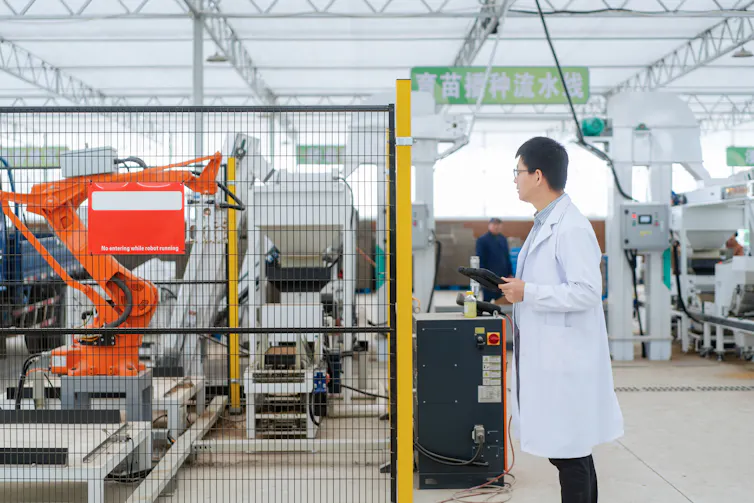
Industrial robotMost industrial robots are kept behind safety barriers because they cannot respond to unexpected human behaviour. Zhu Difeng

There are also implications for human–robot interaction. Most industrial robots are kept behind safety barriers because they cannot react quickly or reliably enough to unexpected human behaviour. Ace operates at the edge of human reaction time, suggesting a future where robots can safely collaborate with people in shared spaces.

More broadly, this work represents a shift in what AI is expected to do. The next frontier is not just intelligence in abstract problem-solving, but intelligence embedded in the physical world. The gap between simulations and reality needs filling, and this is a big step forward.

What humans still do better

Professional players were still able to exploit Ace’s limitations – particularly in reach, speed, and the ability to handle extreme or highly deceptive shots. This highlights that intelligence is not just about prediction and control, but also about physical embodiment. Humans combine perception, movement and strategy in ways that remain difficult to replicate.

Interestingly, systems like Ace may end up enhancing human performance rather
than replacing it. As one former Olympic player observed after facing the robot,
seeing it return seemingly impossible shots suggests humans might be capable of more than previously thought.The Conversation

Kartikeya Walia, Senior Lecturer, Department of Engineering, Nottingham Trent University

This article is republished from The Conversation under a Creative Commons license. Read the original article.

Ultralightweight sonar plus AI lets tiny drones navigate like bats

This small drone is using sonar, similar to bats’ echolocation, to navigate through a grove of trees. Image credit: Nitin Sanket.

By Nitin Sanket, Worcester Polytechnic Institute

To help small aerial robots navigate in the dark and other low-visibility environments, my colleagues and I developed an ultrasound-based perception system inspired by bat echolocation.

Current robots rely heavily on cameras or light detection and ranging, known as lidar, or both. But these sensors fail in visually challenging conditions, such as smoke, fog, dust, snow or complete darkness.

I’m a scientific engineer who develops bio-inspired microrobots. To solve this challenge, my research team looked at nature’s experts at navigating in poor visibility: bats. They thrive in dark, damp and dusty caves and can detect obstacles as thin as a human hair using echolocation while weighing as little as two paper clips. They emit sound waves and listen to weak echoes reflected from objects.

However, enabling this sensing on aerial robots is extremely challenging because propellers generate a lot of noise. It is a bit like trying to listen to your friend while a jet engine is taking off next to you.

To overcome this issue, we present two key ideas. First, a physical acoustic shield inspired by bat’s ear cartilage reduces propeller noise around the acoustic sensors, which act like the robot’s ears. Second, a neural network called Saranga recovers weak echo signals from very noisy measurements by learning patterns over time, inspired by how bats process sound.

Together, these enable the robot to estimate obstacle locations in 3D and navigate safely using milliwatt-level sensing power.

a small boxy device with lights surrounded by small white particles
The drone navigates around an obstacle in a test with simulated snowfall. Image credit: Nitin Sanket.

Why it matters

These types of drones are very useful for search and rescue, especially in confined, dynamic and dangerous environments, because they are small and inexpensive. Search-and-rescue operations often happen in environments where visibility is very poor, such as forest fires, collapsed buildings, caves or dusty outdoor conditions. In these scenarios, traditional sensors like cameras and lidar often become unreliable.

Bats do not rely only on vision and instead use echolocation to perceive the world. Ultrasound sensing doesn’t depend on lighting conditions and works in smoke, dust and darkness.

Our work shows that it is possible to bring this capability to aerial robots despite strong onboard propeller noise. Sonar boosted by noise shielding and machine learning promises to enable a new class of small, low-cost robots that can operate in environments where current systems fail.

This research can enable highly functional, autonomous, tiny aerial robots for critical humanitarian applications, such as search and rescue, combating poaching and cave exploration. AI-enabled sonar navigation could lead to safer, faster and more cost-effective robots for time-sensitive operations where human or larger helicopter access is limited. This is a step toward being able to deploy swarms of aerial robots, much like groups of bats, to explore hazardous environments and search for survivors.

Breakthroughs in mathematical modeling, neural network design and sensor characterization will enable other low-power applications for these drones, such as environmental monitoring. Our work can reduce power by 1,000 times, weight by 10 times and cost by 100 times compared to current solutions.

What other research is being done

Most aerial navigation systems rely on cameras, depth sensors or lidar, which degrade in low visibility. Radar works in these conditions but is power-intensive for small drones. Prior work has explored ultrasound sensing mainly on ground robots, but applying it to aerial robots has been difficult due to propeller noise and weak signals.

What’s next

We are working on improving flying speed, sensing range and system size. We are also exploring new bio-inspired designs and combining ultrasound with other types of sensing.

Ultimately, our goal is to build reliable, low-power aerial robots that can operate reliably in dynamic environments and enable real-world deployment in search and rescue.

The Research Brief is a short take on interesting academic work.The Conversation

Nitin Sanket, Assistant Professor of Robotics Engineering, Worcester Polytechnic Institute

This article is republished from The Conversation under a Creative Commons license. Read the original article.
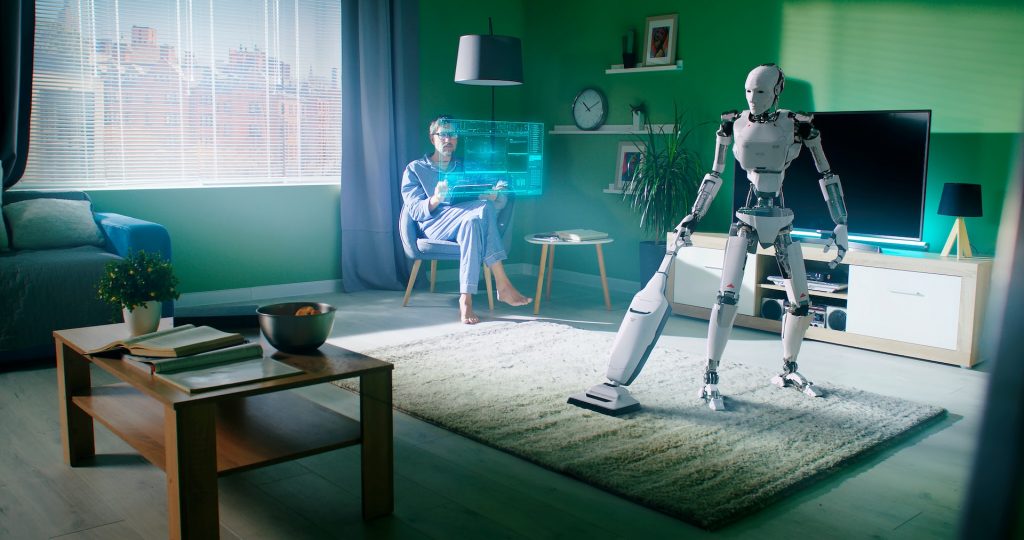
Humanoid home robots are on the market – but do we really want them?

Courtesy of 1X.

By Eduardo B. Sandoval, UNSW Sydney

Last year, Norwegian-US tech company 1X announced a strange new product: “the world’s first consumer-ready humanoid robot designed to transform life at home”.

Standing 168 centimetres tall and weighing in at 30 kilograms, the US$20,000 Neo bot promises to automate common household chores such as folding laundry and loading the dishwasher.

Neo has a built-in artificial intelligence (AI) system, but for tricky tasks it requires a 1X employee wearing a virtual reality helmet to remotely take over the robot. The operator can see whatever the bot does inside your house, and the process is recorded for future learning.

Other household androids are expected to hit the market this year. But Neo shows the issues at play, which will be familiar to anyone who has watched the AI boom of the past few years: products launched with great fanfare and limited capabilities, concealed privacy risks, and invisible remote workers behind the scenes.

The dream of human-like robots

Machines made in the human likeness have figured in mythology and history for millennia.

But the idea they might realistically be practical consumer products is more recent. Yet it’s a popular one: more than 50 companies around the world are developing this type of robot.

Why now? The past few years have seen improvements in hardware such as batteries, motors and sensors – many thanks to the burgeoning electric vehicle industry. At the same time, the AI systems to control the hardware have also become far more capable.

Hurdles remain

Despite huge technical progress, these robots are still clumsy at handling everyday tasks in homes or hospitals or other uncontrolled environments. While specialised bots such as vacuum cleaners have become a familiar sight, the fact remains that human homes aren’t designed for robots.

And for many fiddly tasks, such as folding laundry, more specialised machines do a better job.

To improve performance, the robots will need a lot of real-world data. The best way to gather that data is by putting these mechanical servants to work in actual homes. And the data in question will include a lot of intimate detail about the lives of specific people – which raises big questions about privacy.

And behind the scenes, at least for now, will be humans. Remote online labour in the tech industry is a growing phenomenon that can increase socioeconomic inequality and have a negative impact on people in developing countries working long hours for low pay, often exposed to disturbing scenes and content.

Other uses for humanoid bots

According to the International Federation of Robotics, useful and widely accepted home androids may still be 20 years away.

But there are other reasons we might want to make artificial humanoids. Japanese researcher Hiroshi Ishiguro has been making human-like “geminoids” for decades with quite different motivations.

My motivation for making humanoid robots stems from an interest in understanding what makes us human, and what it means to be human.

From this perspective, humanoid robots can serve the philosophical exploration of human identity, rather than making life more convenient or generating profits.

What’s ahead

Autonomous humanoid robots will undoubtedly improve as products with the integration of large language models and other generative AI systems.

In the long term, dexterity, navigation, learning and autonomy will get better – but that will require years of research and investment. Humanoid robots will not be immediately available as convincing and useful commercial products.

Concerns around remote work may fade, too. Just last week, 1X announced a software update for its robots that it says will mean less human involvement behind the scenes.

Privacy concerns seem an inherent risk of the technology. An incredibly sophisticated robot in your home will inevitably collect intimate data about your life, opening a new frontier for data exploitation and potential breaches.

Despite these issues, humanoid robots will keep inspiring scientists, engineers and designers. By all means let them inspire us – but we should think twice before letting them stack our dishwashers.The Conversation

Eduardo B. Sandoval, Scientia Researcher, Social Robotics, UNSW Sydney

This article is republished from The Conversation under a Creative Commons license. Read the original article.

I developed an app that uses drone footage to track plastic litter on beaches

By Gerard Dooly, University of Limerick

Plastic pollution is one of those problems everyone can see, yet few know how to tackle it effectively. I grew up walking the beaches around Tramore in County Waterford, Ireland, where plastic debris has always been part of the coastline, including bottles, fragments of fishing gear and food packaging.

According to the UN, every year 19-23 million tonnes of plastic lands up in lakes, rivers and seas, and it has a huge impact on ecosystems, creating pollution and damaging animal habitats.

Community groups do tremendous work cleaning these beaches, but they’re essentially walking blind, guessing where plastic accumulates, missing hot spots, repeating the same stretches while problem areas may go untouched.

Years later, working in marine robotics at the University of Limerick, I began developing tools to support marine clean-up and help communities find plastic pollution along our coastline.

The question seemed straightforward: could we use drones to show people exactly where the plastic is? And could we turn finding the plastic littered on beaches and cleaning it up into something people enjoy – in other words, “gamify” it? Could we also build on other ways that drones have been used previously such as tracking wildfires or identifying shipwrecks.

Building the technology

At the University of Limerick’s Centre for Robotics and Intelligent Systems, my team combined drone-based aerial surveillance work with machine-learning algorithms (a type of artificial intelligence) to map where plastic was being littered, and this paired with a free mobile app that provides volunteers with precise GPS coordinates for targeted clean-up.

The technical challenge was more complex than it appeared. Training computer vision models to detect a bottle cap from 30 metres altitude, while distinguishing it from similar objects like seaweed, driftwood, shells and weathered rocks, required extensive field testing and checks of the accuracy of the detection system.

The development hasn’t been straightforward. Early versions of the algorithm struggled with shadows and confused driftwood for plastic bottles. We spent months refining the system through trial and error on beaches around Clare and Galway so the system can now spot plastic as small as 1cm.

We conducted hundreds of test flights across Irish coastlines under varying environmental conditions, different lighting, tidal states, weather patterns, building a robust training dataset.

Ireland’s plastic problem

The urgency of this work becomes clear when you look at the Marine Institute’s work. Ireland’s 3,172 kilometres of coastline, the longest per capita in Europe, faces a deepening crisis.

A 2018 study found that 73% of deep-sea fish in Irish waters had ingested plastic particles. More than 250 species, including seabirds, fish, marine turtles and mammals have all been reported to ingest large items of plastics.

The costs go beyond harming wildlife, and the economic impact can be significant.

Our drone surveys revealed that some stretches of coast accumulate plastic at rates five to ten times higher than neighbouring areas, driven by ocean currents and river mouths. Without systematic monitoring, these hotspots go unaddressed.

Making the technology accessible

The plastic detection platform accepts drone imagery from any source, such as ordinary people flying their own drones.

Processing requires only standard laptop software. Users upload footage and receive GPS coordinates showing detected plastic locations. The mobile app, available free on iOS and Android, displays these locations as an interactive map.

A piece of plastic litter on a beach.
Plastic is regularly found on beaches around Europe. Author’s own image.

Community groups, schools and individuals can see nearby plastic pollution and find it, saving a lot of time.

It has already been tested with five community groups around Ireland with positive results, averaging 30 plastics spotted per ten-minute drone flight, varying by location.

Working through the EU-funded BluePoint project, which is tackling plastic pollution of coastlines around Europe, we’ve distributed over 30 drones to partners across Ireland and Europe, including county councils and environmental organisations.

The technology has been deployed in areas including Spanish Point in County Clare, where the local Tidy Towns group (litter-picking volunteers), were named joint Clean Coast Community Group of the Year 2024.

Organising a litter pick. Video by Propeller BIC (Waterford).

The wider waste story

This is part of a broader European effort to address plastic pollution. Partners such as the sports store Decathlon are exploring how to transform recovered beach plastics into new consumer products – sports equipment, textiles and components.

The challenge isn’t just collection. Beach plastics arrive contaminated with sand and salt, in mixed types and grades. Our ongoing research characterises what’s actually found on Irish coastlines, providing manufacturers with data to design appropriate sorting and recycling processes.

The open source software platforms and the drone technology have already been used in nine countries, engaging more than 2,000 people. Pilot programmes are running in France, Spain, Portugal, Brazil and the UK. What began as a question about making beach clean-ups more effective has evolved into a practical system connecting citizen action to environmental outcomes.

Community feedback from pilots has been overwhelmingly positive. Groups report that the drone-derived GPS coordinates transform clean-up work. One participating Tidy Towns group said that volunteers now head straight to flagged locations.

Groups have also reported increased participation, the gamification aspect appeals to families and participants who might not volunteer otherwise. Additionally, the data we’ve gathered so far is being used by local authorities to understand litter patterns and inform policy decisions around waste management and coastal protection.The Conversation

Gerard Dooly, Assistant Professor in Engineering, University of Limerick

This article is republished from The Conversation under a Creative Commons license. Read the original article.

The science of human touch – and why it’s so hard to replicate in robots

By Perla Maiolino, University of Oxford

Robots now see the world with an ease that once belonged only to science fiction. They can recognise objects, navigate cluttered spaces and sort thousands of parcels an hour. But ask a robot to touch something gently, safely or meaningfully, and the limits appear instantly.

As a researcher in soft robotics working on artificial skin and sensorised bodies, I’ve found that trying to give robots a sense of touch forces us to confront just how astonishingly sophisticated human touch really is.

My work began with the seemingly simple question of how robots might sense the world through their bodies. Develop tactile sensors, fully cover a machine with them, process the signals and, at first glance, you should get something like touch.

Except that human touch is nothing like a simple pressure map. Our skin contains several distinct types of mechanoreceptor, each tuned to different stimuli such as vibration, stretch or texture. Our spatial resolution is remarkably fine and, crucially, touch is active: we press, slide and adjust constantly, turning raw sensation into perception through dynamic interaction.

Engineers can sometimes mimic a fingertip-scale version of this, but reproducing it across an entire soft body, and giving a robot the ability to interpret this rich sensory flow, is a challenge of a completely different order.

Working on artificial skin also quickly reveals another insight: much of what we call “intelligence” doesn’t live solely in the brain. Biology offers striking examples – most famously, the octopus.

Octopuses distribute most of their neurons throughout their limbs. Studies of their motor behaviour show an octopus arm can generate and adapt movement patterns locally based on sensory input, with limited input from the brain.

Their soft, compliant bodies contribute directly to how they act in the world. And this kind of distributed, embodied intelligence, where behaviour emerges from the interplay of body, material and environment, is increasingly influential in robotics.

Touch also happens to be the first sense that humans develop in the womb. Developmental neuroscience shows tactile sensitivity emerging from around eight weeks of gestation, then spreading across the body during the second trimester. Long before sight or hearing function reliably, the foetus explores its surroundings through touch. This is thought to help shape how infants begin forming an understanding of weight, resistance and support – the basic physics of the world.

This distinction matters for robotics too. For decades, robots have relied heavily on cameras and lidars (a sensing method that uses pulses of light to measure distance) while avoiding physical contact. But we cannot expect machines to achieve human-level competence in the physical world if they rarely experience it through touch.

Simulation can teach a robot useful behaviour, but without real physical exploration, it risks merely deploying intelligence rather than developing it. To learn in the way humans do, robots need bodies that feel.

A ‘soft’ robot hand with tactile sensors, developed by the University of Oxford’s Soft Robotics Lab, gets to grips with an apple. Video: Oxford Robotics Institute.

One approach my group is exploring is giving robots a degree of “local intelligence” in their sensorised bodies. Humans benefit from the compliance of soft tissues: skin deforms in ways that increase grip, enhance friction and filter sensory signals before they even reach the brain. This is a form of intelligence embedded directly in the anatomy.

Research in soft robotics and morphological computation argues that the body can offload some of the brain’s workload. By building robots with soft structures and low-level processing, so they can adjust grip or posture based on tactile feedback without waiting for central commands, we hope to create machines that interact more safely and naturally with the physical world.

Occupational therapist Ruth Alecock uses the training robot 'Mona'
Occupational therapist Ruth Alecock uses the training robot ‘Mona’. Perla Maiolino/Oxford Robotics Institute, CC BY-NC-SA

Healthcare is one area where this capability could make a profound difference. My group recently developed a robotic patient simulator for training occupational therapists (OTs). Students often practise on one another, which makes it difficult to learn the nuanced tactile skills involved in supporting someone safely. With real patients, trainees must balance functional and affective touch, respect personal boundaries and recognise subtle cues of pain or discomfort. Research on social and affective touch shows how important these cues are to human wellbeing.

To help trainees understand these interactions, our simulator, known as Mona, produces practical behavioural responses. For example, when an OT presses on a simulated pain point in the artificial skin, the robot reacts verbally and with a small physical “hitch” of the body to mimic discomfort.

Similarly, if the trainee tries to move a limb beyond what the simulated patient can tolerate, the robot tightens or resists, offering a realistic cue that the motion should stop. By capturing tactile interaction through artificial skin, our simulator provides feedback that has never previously been available in OT training.

Robots that care

In the future, robots with safe, sensitive bodies could help address growing pressures in social care. As populations age, many families suddenly find themselves lifting, repositioning or supporting relatives without formal training. “Care robots” would help with this, potentially meaning the family member could be cared for at home longer.

Surprisingly, progress in developing this type of robot has been much slower than early expectations suggested – even in Japan, which introduced some of the first care robot prototypes. One of the most advanced examples is Airec, a humanoid robot developed as part of the Japanese government’s Moonshot programme to assist in nursing and elderly-care tasks. This multifaceted programme, launched in 2019, seeks “ambitious R&D based on daring ideas” in order to build a “society in which human beings can be free from limitations of body, brain, space and time by 2050”.

Japan’s Airec care robot is one of the most advanced in development. Video by Global Update.

Throughout the world, though, translating research prototypes into regulated robots remains difficult. High development costs, strict safety requirements, and the absence of a clear commercial market have all slowed progress. But while the technical and regulatory barriers are substantial, they are steadily being addressed.

Robots that can safely share close physical space with people need to feel and modulate how they touch anything that comes into contact with their bodies. This whole-body sensitivity is what will distinguish the next generation of soft robots from today’s rigid machines.

We are still far from robots that can handle these intimate tasks independently. But building touch-enabled machines is already reshaping our understanding of touch. Every step toward robotic tactile intelligence highlights the extraordinary sophistication of our own bodies – and the deep connection between sensation, movement and what we call intelligence.

This article was commissioned in conjunction with the Professors’ Programme, part of Prototypes for Humanity, a global initiative that showcases and accelerates academic innovation to solve social and environmental challenges. The Conversation is the media partner of Prototypes for Humanity 2025.The Conversation

Perla Maiolino, Associate Professor of Engineering Science, member of the Oxford Robotics Institute, University of Oxford

This article is republished from The Conversation under a Creative Commons license. Read the original article.

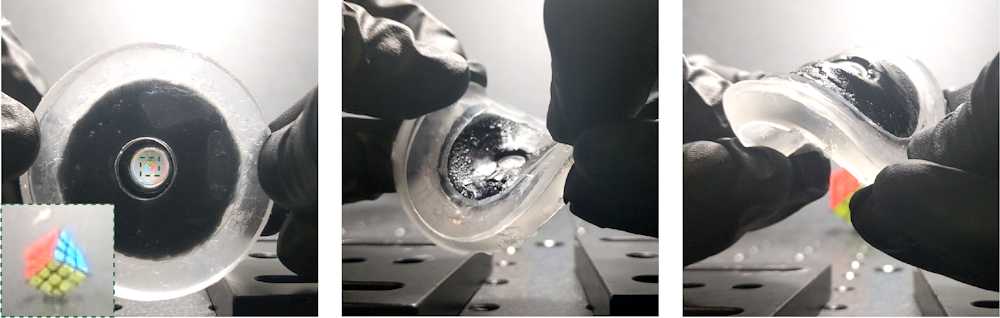
A flexible lens controlled by light-activated artificial muscles promises to let soft machines see

This rubbery disc is an artificial eye that could give soft robots vision. Image credit: Corey Zheng/Georgia Institute of Technology.
By Corey Zheng, Georgia Institute of Technology and Shu Jia, Georgia Institute of Technology

Inspired by the human eye, our biomedical engineering lab at Georgia Tech has designed an adaptive lens made of soft, light-responsive, tissuelike materials.

Adjustable camera systems usually require a set of bulky, moving, solid lenses and a pupil in front of a camera chip to adjust focus and intensity. In contrast, human eyes perform these same functions using soft, flexible tissues in a highly compact form.

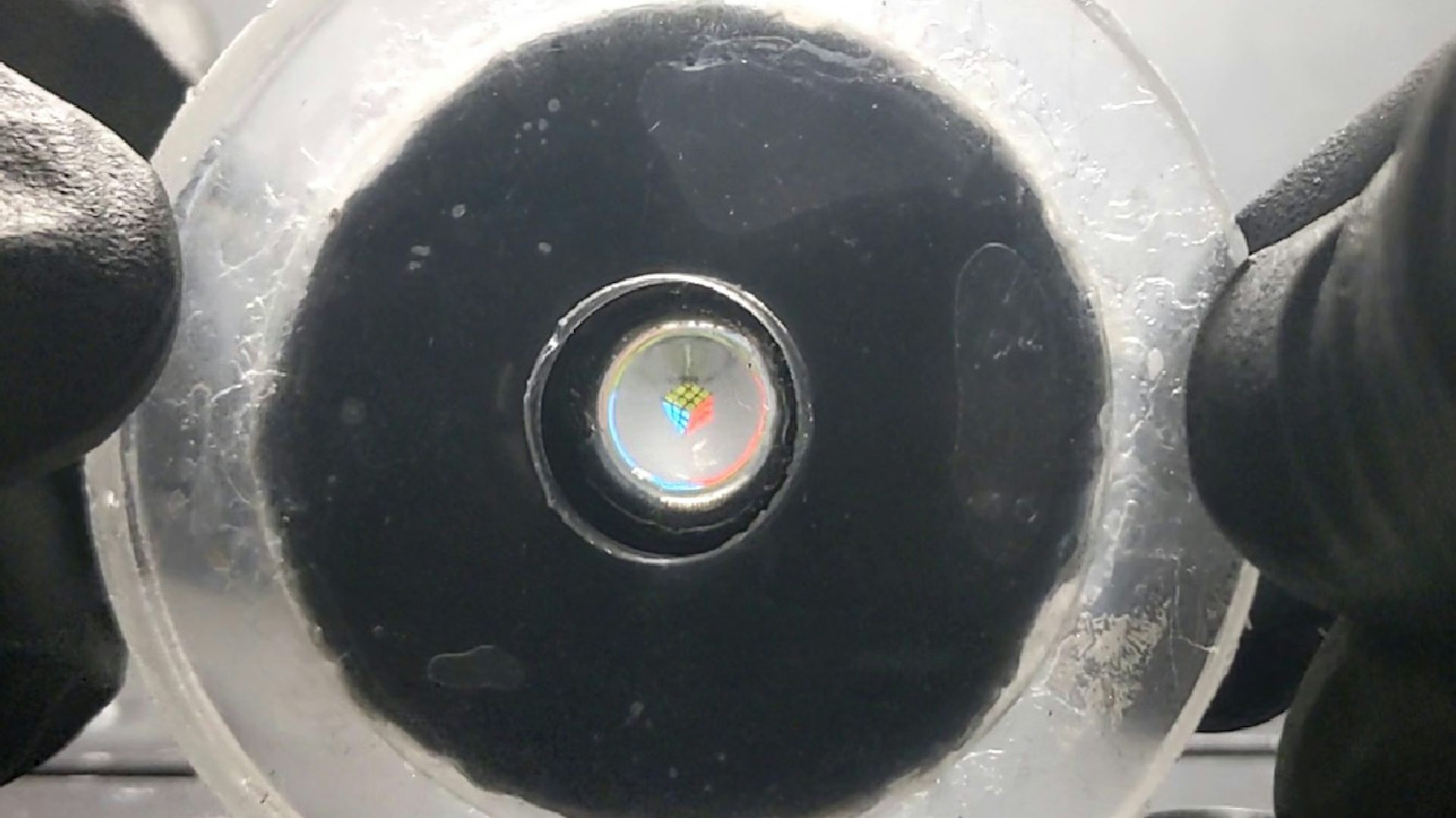
Our lens, called the photo-responsive hydrogel soft lens, or PHySL, replaces rigid components with soft polymers acting as artificial muscles. The polymers are composed of a hydrogel − a water-based polymer material. This hydrogel muscle changes the shape of a soft lens to alter the lens’s focal length, a mechanism analogous to the ciliary muscles in the human eye.

The hydrogel material contracts in response to light, allowing us to control the lens without touching it by projecting light onto its surface. This property also allows us to finely control the shape of the lens by selectively illuminating different parts of the hydrogel. By eliminating rigid optics and structures, our system is flexible and compliant, making it more durable and safer in contact with the body.

Why it matters

Artificial vision using cameras is commonplace in a variety of technological systems, including robots and medical tools. The optics needed to form a visual system are still typically restricted to rigid materials using electric power. This limitation presents a challenge for emerging fields, including soft robotics and biomedical tools that integrate soft materials into flexible, low-power and autonomous systems. Our soft lens is particularly suitable for this task.

Soft robots are machines made with compliant materials and structures, taking inspiration from animals. This additional flexibility makes them more durable and adaptive. Researchers are using the technology to develop surgical endoscopes, grippers for handling delicate objects and robots for navigating environments that are difficult for rigid robots.

The same principles apply to biomedical tools. Tissuelike materials can soften the interface between body and machine, making biomedical tools safer by making them move with the body. These include skinlike wearable sensors and hydrogel-coated implants.

three photos showing a rubbery disk held between two hands
This variable-focus soft lens, shown viewing a Rubik’s Cube, can flex and twist without being damaged. Image credit: Corey Zheng/Georgia Institute of Technology.

What other research is being done in this field

This work merges concepts from tunable optics and soft “smart” materials. While these materials are often used to create soft actuators – parts of machines that move – such as grippers or propulsors, their application in optical systems has faced challenges.

Many existing soft lens designs depend on liquid-filled pouches or actuators requiring electronics. These factors can increase complexity or limit their use in delicate or untethered systems. Our light-activated design offers a simpler, electronics-free alternative.

What’s next

We aim to improve the performance of the system using advances in hydrogel materials. New research has yielded several types of stimuli-responsive hydrogels with faster and more powerful contraction abilities. We aim to incorporate the latest material developments to improve the physical capabilities of the photo-responsive hydrogel soft lens.

We also aim to show its practical use in new types of camera systems. In our current work, we developed a proof-of-concept, electronics-free camera using our soft lens and a custom light-activated, microfluidic chip. We plan to incorporate this system into a soft robot to give it electronics-free vision. This system would be a significant demonstration for the potential of our design to enable new types of soft visual sensing.

The Research Brief is a short take on interesting academic work.The Conversation

Corey Zheng, PhD Student in Biomedical Engineering, Georgia Institute of Technology and Shu Jia, Assistant Professor of Biomedical Engineering, Georgia Institute of Technology

This article is republished from The Conversation under a Creative Commons license. Read the original article.

Mars rovers serve as scientists’ eyes and ears from millions of miles away – here are the tools Perseverance used to spot a potential sign of ancient life

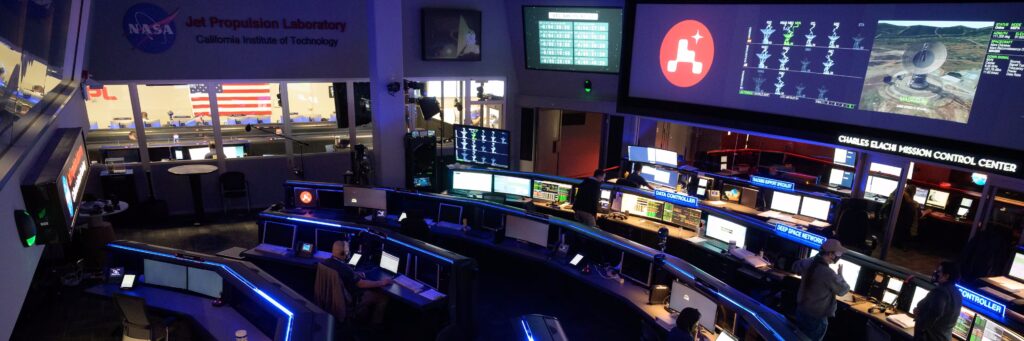
Scientists absorb data on monitors in mission control for NASA’s Perseverance Mars rover. NASA/Bill Ingalls, CC BY-NC-ND.
By Ari Koeppel, Dartmouth College

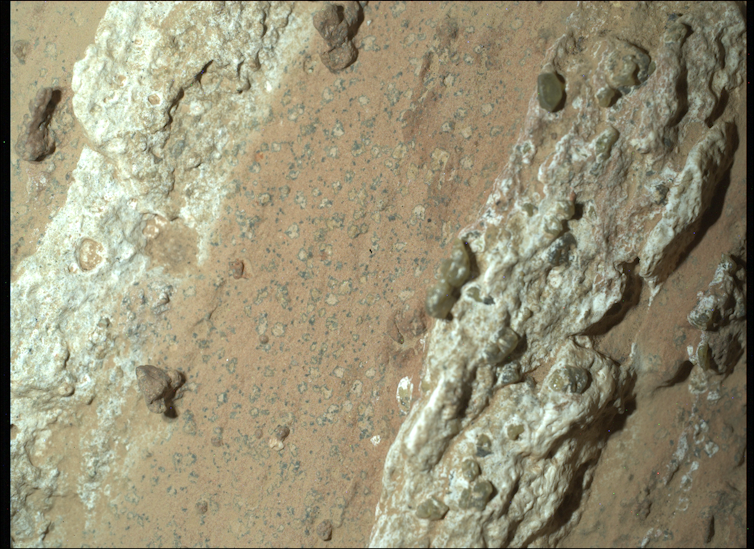
NASA’s search for evidence of past life on Mars just produced an exciting update. On Sept. 10, 2025, a team of scientists published a paper detailing the Perseverance rover’s investigation of a distinctive rock outcrop called Bright Angel on the edge of Mars’ Jezero Crater. This outcrop is notable for its light-toned rocks with striking mineral nodules and multicolored, leopard print-like splotches.

By combining data from five scientific instruments, the team determined that these nodules formed through processes that could have involved microorganisms. While this finding is not direct evidence of life, it’s a compelling discovery that planetary scientists hope to look into more closely.

A streaked and spotted rock surfaceBright Angel rock surface at the Beaver Falls site on Mars shows nodules on the right and a leopard-like pattern at the center. NASA/JPL-Caltech/MSSS
To appreciate how discoveries like this one come about, it’s helpful to understand how scientists engage with rover data — that is, how planetary scientists like me use robots like Perseverance on Mars as extensions of our own senses.

Experiencing Mars through data

When you strap on a virtual reality headset, you suddenly lose your orientation to the immediate surroundings, and your awareness is transported by light and sound to a fabricated environment. For Mars scientists working on rover mission teams, something very similar occurs when rovers send back their daily downlinks of data.

Several developers, including MarsVR, Planetary Visor and Access Mars, have actually worked to build virtual Mars environments for viewing with a virtual reality headset. However, much of Mars scientists’ daily work instead involves analyzing numerical data visualized in graphs and plots. These datasets, produced by state-of-the-art sensors on Mars rovers, extend far beyond human vision and hearing.

A virtual Mars environment developed by Planetary Visor incorporates both 3D landscape data and rover instrument data as pop-up plots. Scientists typically access data without entering a virtual reality space. However, tools like this give the public a sense for how mission scientists experience their work.

Developing an intuition for interpreting these complex datasets takes years, if not entire careers. It is through this “mind-data connection” that scientists build mental models of Martian landscapes – models they then communicate to the world through scientific publications.

The robots’ tool kit: Sensors and instruments

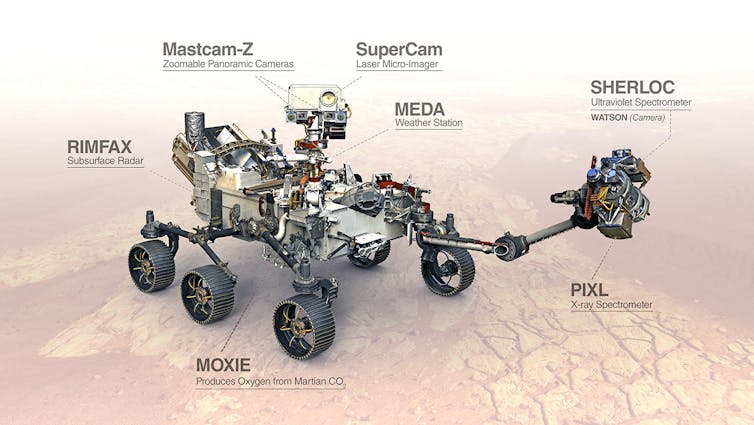
Five primary instruments on Perseverance, aided by machine learning algorithms, helped describe the unusual rock formations at a site called Beaver Falls and the past they record.

Robotic hands: Mounted on the rover’s robotic arm are tools for blowing dust aside and abrading rock surfaces. These ensure the rover analyzes clean samples.

Cameras: Perseverance hosts 19 cameras for navigation, self-inspection and science. Five science-focused cameras played a key role in this study. These cameras captured details unseeable by human eyes, including magnified mineral textures and light in infrared wavelengths. Their images revealed that Bright Angel is a mudstone, a type of sedimentary rock formed from fine sediments deposited in water.

Spectrometers: Instruments such as SuperCam and SHERLOC – scanning habitable environments with Raman and luminescence for organics and chemicals – analyze how rocks reflect or emit light across a range of wavelengths. Think of this as taking hundreds of flash photographs of the same tiny spot, all in different “colors.” These datasets, called spectra, revealed signs of water integrated into mineral structures in the rock and traces of organic molecules: the basic building blocks of life.

Subsurface radar: RIMFAX, the radar imager for Mars subsurface experiment, uses radio waves to peer beneath Mars’ surface and map rock layers. At Beaver Falls, this showed the rocks were layered over other ancient terrains, likely due to the activity of a flowing river. Areas with persistently present water are better habitats for microbes than dry or intermittently wet locations.

X-ray chemistry: PIXL, the planetary instrument for X-ray lithochemistry, bombards rock surfaces with X-rays and observes how the rock glows or reflects them. This technique can tell researchers which elements and minerals the rock contains at a fine scale. PIXL revealed that the leopard-like spots found at Beaver Falls differed chemically from the surrounding rock. The spots resembled patterns on Earth formed by chemical reactions that are mediated by microbes underwater.

A diagram of the Perseverance rover with lines pointing to its instrumentsKey Perseverance Mars Rover instruments used in this analysis. NASA
Together, these instruments produce a multifaceted picture of the Martian environment. Some datasets require significant processing, and refined machine learning algorithms help the mission teams turn that information into a more intuitive description of the Jezero Crater’s setting, past and present.

The challenge of uncertainty

Despite Perseverance’s remarkable tools and processing software, uncertainty remains in the results. Science, especially when conducted remotely on another planet, is rarely black and white. In this case, the chemical signatures and mineral formations at Beaver Falls are suggestive – but not conclusive – of past life on Mars.

There actually are tools, such as mass spectrometers, that can show definitively whether a rock sample contains evidence of biological activity. However, these instruments are currently too fragile, heavy and power-intensive for Mars missions.

Fortunately, Perseverance has collected and sealed rock core samples from Beaver Falls and other promising sites in Jezero Crater with the goal of sending them back to Earth. If the current Mars sample return plan can retrieve these samples, laboratories on Earth can scrutinize them far more thoroughly than the rover was able to.

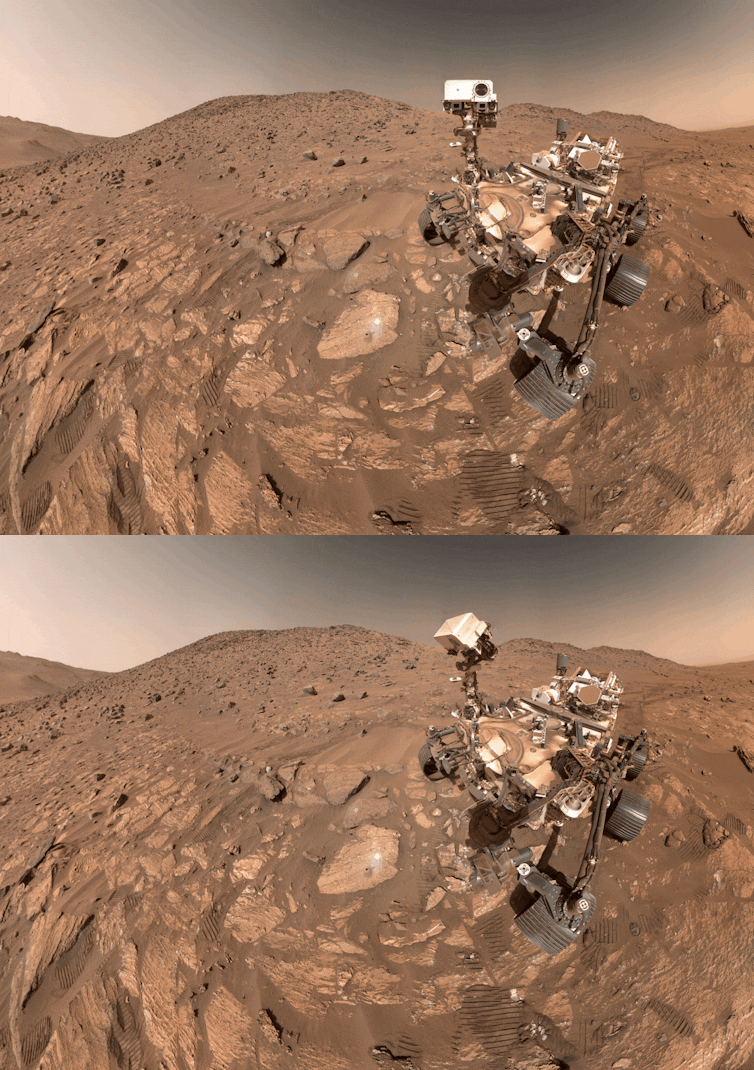
The Perseverance rover on the dusty, rocky Martian surfacePerseverance selfie at Cheyava Falls sampling site in the Beaver Falls location. NASA/JPL-Caltech/MSSS

Investing in our robotic senses

This discovery is a testament to decades of NASA’s sustained investment in Mars exploration and the work of engineering teams that developed these instruments. Yet these investments face an uncertain future.

The White House’s budget office recently proposed cutting 47% of NASA’s science funding. Such reductions could curtail ongoing missions, including Perseverance’s continued operations, which are targeted for a 23% cut, and jeopardize future plans such as the Mars sample return campaign, among many other missions.

Perseverance represents more than a machine. It is a proxy extending humanity’s senses across millions of miles to an alien world. These robotic explorers and the NASA science programs behind them are a key part of the United States’ collective quest to answer profound questions about the universe and life beyond Earth.The Conversation

Ari Koeppel, Earth Sciences Postdoctoral Scientist and Adjunct Associate, Dartmouth College

This article is republished from The Conversation under a Creative Commons license. Read the original article.

AI can be a powerful tool for scientists. But it can also fuel research misconduct

An Escher-like structure depicting the concept of AI model collapse. The image features a swirling, labyrinthine design, representing a recursive loop where algorithms feed on their own generated synthetic data. Elements of digital clutter and noise are interwoven throughout, highlighting the chaotic nature of the internet increasingly populated by AI-generated content. The visual metaphor of a Uroboros, a snake eating its own tail, symbolizes the self-referential cycle of AI training on its own outputs.Nadia Piet & Archival Images of AI + AIxDESIGN / Model Collapse / Licenced by CC-BY 4.0

By Jon Whittle, CSIRO and Stefan Harrer, CSIRO

In February this year, Google announced it was launching “a new AI system for scientists”. It said this system was a collaborative tool designed to help scientists “in creating novel hypotheses and research plans”.

It’s too early to tell just how useful this particular tool will be to scientists. But what is clear is that artificial intelligence (AI) more generally is already transforming science.

Last year for example, computer scientists won the Nobel Prize for Chemistry for developing an AI model to predict the shape of every protein known to mankind. Chair of the Nobel Committee, Heiner Linke, described the AI system as the achievement of a “50-year-old dream” that solved a notoriously difficult problem eluding scientists since the 1970s.

But while AI is allowing scientists to make technological breakthroughs that are otherwise decades away or out of reach entirely, there’s also a darker side to the use of AI in science: scientific misconduct is on the rise.

AI makes it easy to fabricate research

Academic papers can be retracted if their data or findings are found to no longer valid. This can happen because of data fabrication, plagiarism or human error.

Paper retractions are increasing exponentially, passing 10,000 in 2023. These retracted papers were cited over 35,000 times.

One study found 8% of Dutch scientists admitted to serious research fraud, double the rate previously reported. Biomedical paper retractions have quadrupled in the past 20 years, the majority due to misconduct.

AI has the potential to make this problem even worse.

For example, the availability and increasing capability of generative AI programs such as ChatGPT makes it easy to fabricate research.

This was clearly demonstrated by two researchers who used AI to generate 288 complete fake academic finance papers predicting stock returns.

While this was an experiment to show what’s possible, it’s not hard to imagine how the technology could be used to generate fictitious clinical trial data, modify gene editing experimental data to conceal adverse results or for other malicious purposes.

Fake references and fabricated data

There are already many reported cases of AI-generated papers passing peer-review and reaching publication – only to be retracted later on the grounds of undisclosed use of AI, some including serious flaws such as fake references and purposely fabricated data.

Some researchers are also using AI to review their peers’ work. Peer review of scientific papers is one of the fundamentals of scientific integrity. But it’s also incredibly time-consuming, with some scientists devoting hundreds of hours a year of unpaid labour. A Stanford-led study found that up to 17% of peer reviews for top AI conferences were written at least in part by AI.

In the extreme case, AI may end up writing research papers, which are then reviewed by another AI.

This risk is worsening the already problematic trend of an exponential increase in scientific publishing, while the average amount of genuinely new and interesting material in each paper has been declining.

AI can also lead to unintentional fabrication of scientific results.

A well-known problem of generative AI systems is when they make up an answer rather than saying they don’t know. This is known as “hallucination”.

We don’t know the extent to which AI hallucinations end up as errors in scientific papers. But a recent study on computer programming found that 52% of AI-generated answers to coding questions contained errors, and human oversight failed to correct them 39% of the time.

Maximising the benefits, minimising the risks

Despite these worrying developments, we shouldn’t get carried away and discourage or even chastise the use of AI by scientists.

AI offers significant benefits to science. Researchers have used specialised AI models to solve scientific problems for many years. And generative AI models such as ChatGPT offer the promise of general-purpose AI scientific assistants that can carry out a range of tasks, working collaboratively with the scientist.

These AI models can be powerful lab assistants. For example, researchers at CSIRO are already developing AI lab robots that scientists can speak with and instruct like a human assistant to automate repetitive tasks.

A disruptive new technology will always have benefits and drawbacks. The challenge of the science community is to put appropriate policies and guardrails in place to ensure we maximise the benefits and minimise the risks.

AI’s potential to change the world of science and to help science make the world a better place is already proven. We now have a choice.

Do we embrace AI by advocating for and developing an AI code of conduct that enforces ethical and responsible use of AI in science? Or do we take a backseat and let a relatively small number of rogue actors discredit our fields and make us miss the opportunity?The Conversation

Jon Whittle, Director, Data61, CSIRO and Stefan Harrer, Director, AI for Science, CSIRO

This article is republished from The Conversation under a Creative Commons license. Read the original article.

Faced with dwindling bee colonies, scientists are arming queens with robots and smart hives

By Farshad Arvin, Martin Stefanec, and Tomas Krajnik

Be it the news or the dwindling number of creatures hitting your windscreens, it will not have evaded you that the insect world in bad shape.

In the last three decades, the global biomass of flying insects has shrunk by 75%. Among the trend’s most notables victims is the world’s most important pollinator, the honeybee. In the United States, 48% of honeybee colonies died in 2023 alone, making it the second deadliest year on record. This significant loss is due in part to colony collapse disorder (CCD), the sudden disappearance of bees. In contrast, European countries report lower but still worrisome rates of colony losses, ranging from 6% to 32%.

This decline causes many of our essential food crops to be under-pollinated, a phenomenon that threatens our society’s food security.

Debunking the sci-fi myth of robotic bees

So, what can be done? Given pesticides’ role in the decline of bee colonies, commonly proposed solutions include a shift away from industrial farming and toward less pesticide-intensive, more sustainable forms of agriculture.

Others tend to look toward the sci-fi end of things, with some scientists imagining that we could eventually replace live honeybees with robotic ones. Such artificial bees could interact with flowers like natural insects, maintaining pollination levels despite the declining numbers of natural pollinators. The vision of artificial pollinators contributed to ingenious designs of insect-sized robots capable of flying.

In reality, such inventions are more effective at educating us over engineers’ fantasies than they are at reviving bee colonies, so slim are their prospects of materialising. First, these artificial pollinators would have to be equipped for much more more than just flying. Daily tasks carried out by the common bee include searching for plants, identifying flowers, unobtrusively interacting with them, locating energy sources, ducking potential predators, and dealing with adverse weather conditions. Robots would have to perform all of these in the wild with a very high degree of reliability since any broken-down or lost robot can cause damage and spread pollution. Second, it remains to be seen whether our technological knowledge would be even capable of manufacturing such inventions. This is without even mentioning the price tag of a swarm of robots capable of substituting pollination provided by a single honeybee colony.

Inside a smart hive

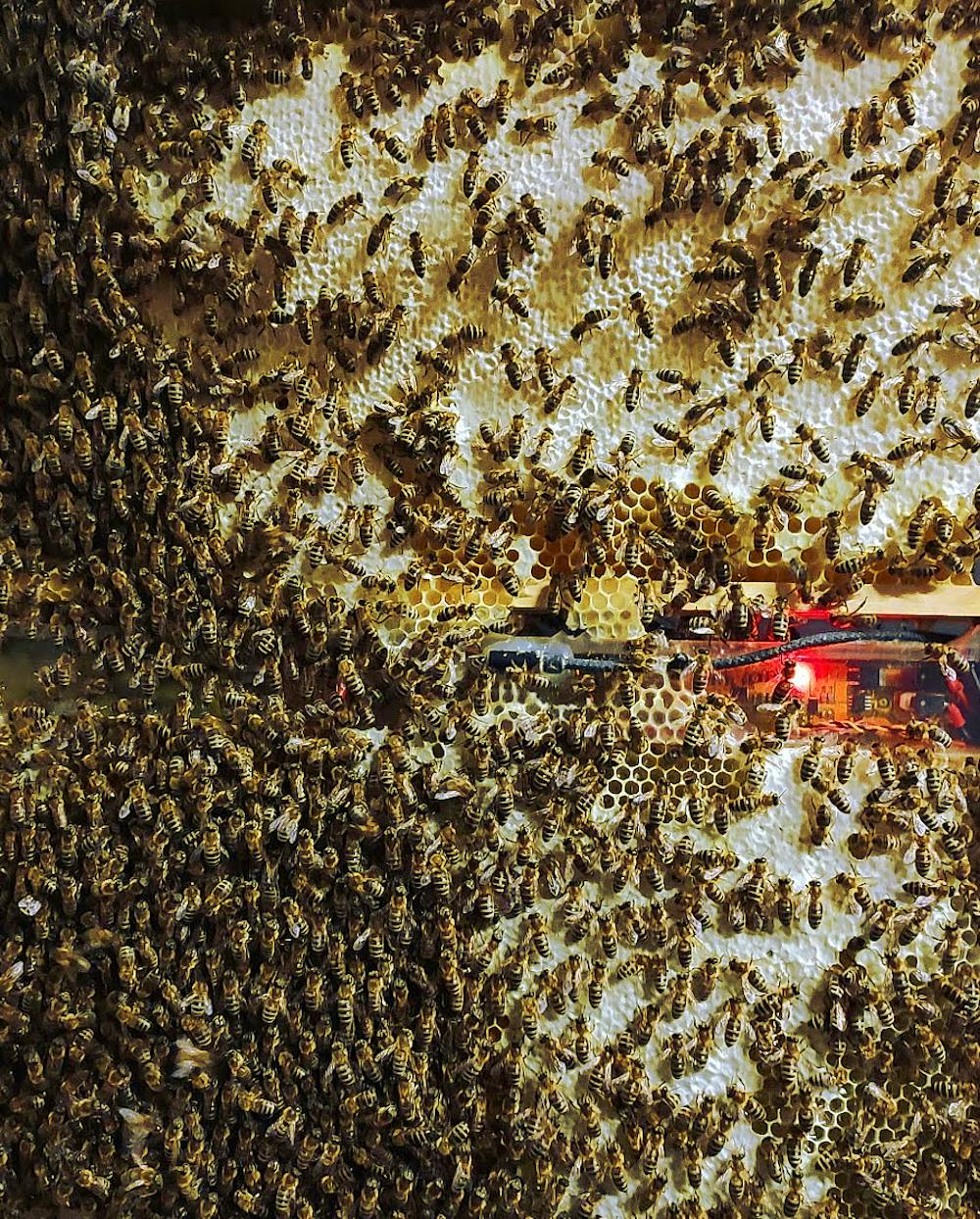
Bees on one of Hiveopolis’s augmented hives.
Hiveopolis, Fourni par l’auteur

Rather than trying to replace honeybees with robots, our two latest projects funded by the European Union propose that the robots and honeybees actually team up. Were these to succeed, struggling honeybee colonies could be transformed into bio-hybrid entities consisting of biological and technological components with complementary skills. This would hopefully boost and secure the colonies’ population growth as more bees survive over harsh winters and yield more foragers to pollinate surrounding ecosystems.

The first of these projects, Hiveopolis, investigates how the complex decentralised decision-making mechanism in a honeybee colony can be nudged by digital technology. Begun in 2019 and set to end in March 2024, the experiment introduces technology into three observation hives each containing 4,000 bees, by contrast to 40,000 bees for a normal colony.

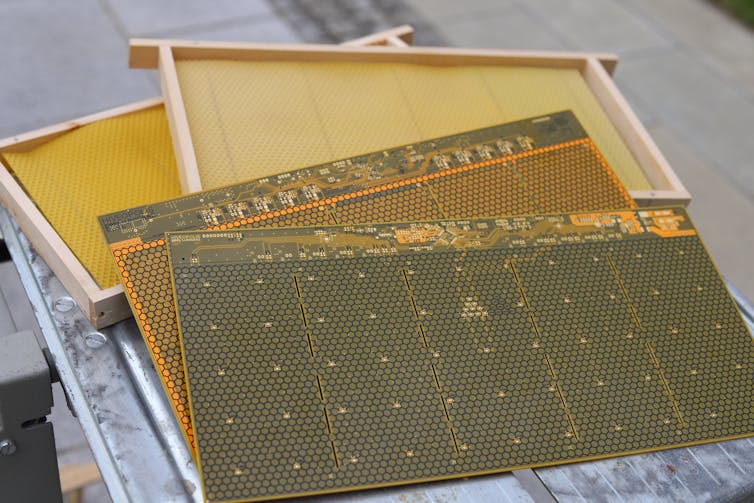
The foundation of an augmented honeycomb.
Hiveopolis, Fourni par l’auteur

Within this honeybee smart home, combs have integrated temperature sensors and heating devices, allowing the bees to enjoy optimal conditions inside the colony. Since bees tend to snuggle up to warmer locations, the combs also enables us to direct them toward different areas of the hive. And as if that control weren’t enough, the hives are also equipped with a system of electronic gates that monitors the insects movements. Both technologies allow us to decide where the bees store honey and pollen, but also when they vacate the combs so as to enable us to harvest honey. Last but not least, the smart hive contains a robotic dancing bee that can direct foraging bees toward areas with plants to be pollinated.

Due to the experiment’s small scale, it is impossible to draw conclusions on the extent to which our technologies may have prevented bee losses. However, there is little doubt what we have seen thus far give reasons to be hopeful. We can confidently assert that our smart beehives allowed colonies to survive extreme cold during the winter in a way that wouldn’t otherwise be possible. To precisely assess how many bees these technologies have saved would require upscaling the experiment to hundreds of colonies.

Pampering the queen bee

Our second EU-funded project, RoboRoyale, focuses on the honeybee queen and her courtyard bees, with robots in this instance continuously monitoring and interacting with her Royal Highness.

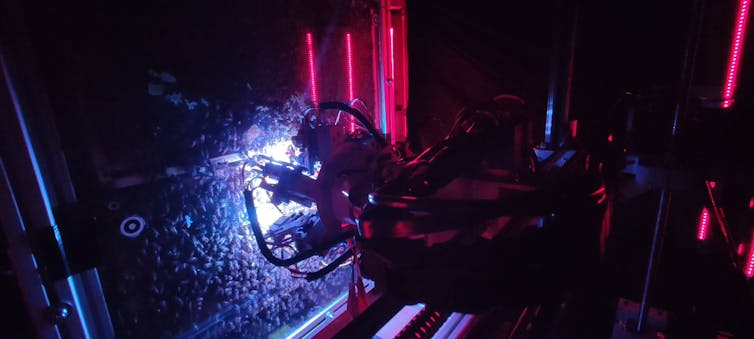
Come 2024, we will equip each hive with a group of six bee-sized robots, which will groom and feed the honeybee queen to affect the number of eggs she lays. Some of these robots will be equipped with royal jelly micro-pumps to feed her, while others will feature compliant micro-actuators to groom her. These robots will then be connected to a larger robotic arm with infrared cameras, that will continuously monitor the queen and her vicinity.

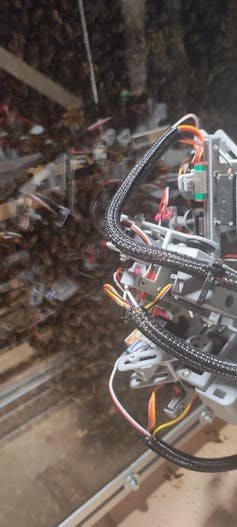
A RoboRoyale robot arm susses out a honeybee colony.
RoboRoyale, Fourni par l’auteur

As witnessed by the photo to the right and also below, we have already been able to successfully introduce the robotic arm within a living colony. There it continuously monitored the queen and determined her whereabouts through light stimuli.

Emulating the worker bees

In a second phase, it is hoped the bee-sized robots and robotic arm will be able to emulate the behaviour of the workers, the female bees lacking reproductive capacity who attend to the queen and feed her royal jelly. Rich in water, proteins, carbohydrates, lipids, vitamins and minerals, this nutritious substance secreted by the glands of the worker bees enables the queen to lay up to thousands of eggs a day.

Worker bees also engage in cleaning the queen, which involves licking her. During such interactions, they collect some of the queen’s pheromones and disperse them throughout the colony as they move across the hive. The presence of these pheromones controls many of the colony’s behaviours and notifies the colony of a queen’s presence. For example, in the event of the queen’s demise, a new queen must be quickly reared from an egg laid by the late queen, leaving only a narrow time window for the colony to react.

One of RoboRoyale’s first experiments has consisted in simple interactions with the queen bee through light stimulus. The next months will then see the robotic arm stretch out to physically touch and groom her.
RoboRoyale, Fourni par l’auteur

Finally, it is believed worker bees may also act as the queen’s guides, leading her to laying eggs in specific comb cells. The size of these cells can determine if the queen lays a diploid or haploid egg, resulting in the bee developing into either into drone (male) or worker (female) bee. Taking over these guiding duties could affect no less than the rate’s entire reproductive rate.

How robots can prevent bee cannibalism

This could have another virtuous effect: preventing cannibalism.

During tough times, such as long periods of rain, bees have to make do with little pollen intake. This forces them to feed young larvae to older ones so that at least the older larvae has a chance to survive. Through RoboRoyale, we will look not only to reduce chances of this behaviour occurring, but also quantify to what extent it occurs under normal conditions.

Ultimately, our robots will enable us to deepen our understanding of the very complex regulation processes inside honeybee colonies through novel experimental procedures. The insights gained from these new research tracks will be necessary to better protect these valuable social insects and ensure sufficient pollination in the future – a high stakes enterprise for food security.


This article is the result of The Conversation’s collaboration with Horizon, the EU research and innovation magazine.

The Conversation

Farshad Arvin is a member of the Department of Computer Science at Durham University in the UK. The research of Farshad Arvin is primarily funded by the EU H2020 and Horizon Europe programmes.

Martin Stefanec is a member of the Institute of Biology at the University of Graz. He has received funding from the EU programs H2020 and Horizon Europe.

Tomas Krajnik is member of the Institute of Electrical and Electronics Engineers (IEEE). The research of Tomas Krajnik is primarily funded by EU H2020 Horizon programme and Czech National Science Foundation.

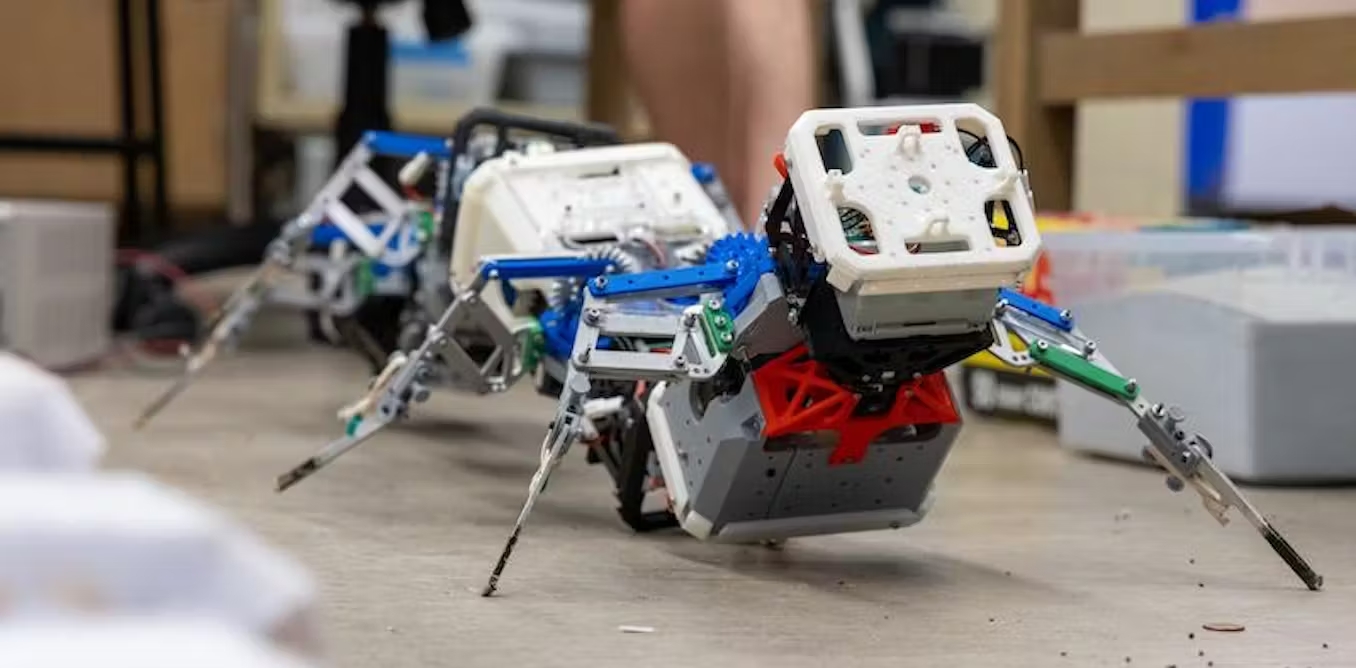
Mobile robots get a leg up from a more-is-better communications principle

Getting a leg up from mobile robots comes down to getting a bunch of legs. Georgia Institute of Technology

By Baxi Chong (Postdoctoral Fellow, School of Physics, Georgia Institute of Technology)

Adding legs to robots that have minimal awareness of the environment around them can help the robots operate more effectively in difficult terrain, my colleagues and I found.

We were inspired by mathematician and engineer Claude Shannon’s communication theory about how to transmit signals over distance. Instead of spending a huge amount of money to build the perfect wire, Shannon illustrated that it is good enough to use redundancy to reliably convey information over noisy communication channels. We wondered if we could do the same thing for transporting cargo via robots. That is, if we want to transport cargo over “noisy” terrain, say fallen trees and large rocks, in a reasonable amount of time, could we do it by just adding legs to the robot carrying the cargo and do so without sensors and cameras on the robot?

Most mobile robots use inertial sensors to gain an awareness of how they are moving through space. Our key idea is to forget about inertia and replace it with the simple function of repeatedly making steps. In doing so, our theoretical analysis confirms our hypothesis of reliable and predictable robot locomotion – and hence cargo transport – without additional sensing and control.

To verify our hypothesis, we built robots inspired by centipedes. We discovered that the more legs we added, the better the robot could move across uneven surfaces without any additional sensing or control technology. Specifically, we conducted a series of experiments where we built terrain to mimic an inconsistent natural environment. We evaluated the robot locomotion performance by gradually increasing the number of legs in increments of two, beginning with six legs and eventually reaching a total of 16 legs.

Navigating rough terrain can be as simple as taking it a step at a time, at least if you have a lot of legs.

As the number of legs increased, we observed that the robot exhibited enhanced agility in traversing the terrain, even in the absence of sensors. To further assess its capabilities, we conducted outdoor tests on real terrain to evaluate its performance in more realistic conditions, where it performed just as well. There is potential to use many-legged robots for agriculture, space exploration and search and rescue.

Why it matters

Transporting things – food, fuel, building materials, medical supplies – is essential to modern societies, and effective goods exchange is the cornerstone of commercial activity. For centuries, transporting material on land has required building roads and tracks. However, roads and tracks are not available everywhere. Places such as hilly countryside have had limited access to cargo. Robots might be a way to transport payloads in these regions.

What other research is being done in this field

Other researchers have been developing humanoid robots and robot dogs, which have become increasingly agile in recent years. These robots rely on accurate sensors to know where they are and what is in front of them, and then make decisions on how to navigate.

However, their strong dependence on environmental awareness limits them in unpredictable environments. For example, in search-and-rescue tasks, sensors can be damaged and environments can change.

What’s next

My colleagues and I have taken valuable insights from our research and applied them to the field of crop farming. We have founded a company that uses these robots to efficiently weed farmland. As we continue to advance this technology, we are focused on refining the robot’s design and functionality.

While we understand the functional aspects of the centipede robot framework, our ongoing efforts are aimed at determining the optimal number of legs required for motion without relying on external sensing. Our goal is to strike a balance between cost-effectiveness and retaining the benefits of the system. Currently, we have shown that 12 is the minimum number of legs for these robots to be effective, but we are still investigating the ideal number.


The Research Brief is a short take on interesting academic work.

The Conversation

The authors has received funding from NSF-Simons Southeast Center for Mathematics and Biology (Simons Foundation SFARI 594594), Georgia Research Alliance (GRA.VL22.B12), Army Research Office (ARO) MURI program, Army Research Office Grant W911NF-11-1-0514 and a Dunn Family Professorship.

The author and his colleagues have one or more pending patent applications related to the research covered in this article.

The author and his colleagues have established a start-up company, Ground Control Robotics, Inc., partially based on this work.

This article is republished from The Conversation under a Creative Commons license. Read the original article.

Titan submersible disaster underscores dangers of deep-sea exploration – an engineer explains why most ocean science is conducted with crewless submarines

Researchers are increasingly using small, autonomous underwater robots to collect data in the world’s oceans. NOAA Teacher at Sea Program, NOAA Ship PISCES, CC BY-SA

By Nina Mahmoudian (Associate Professor of Mechanical Engineering, Purdue University)

Rescuers spotted debris from the tourist submarine Titan on the ocean floor near the wreck of the Titanic on June 22, 2023, indicating that the vessel suffered a catastrophic failure and the five people aboard were killed.

Bringing people to the bottom of the deep ocean is inherently dangerous. At the same time, climate change means collecting data from the world’s oceans is more vital than ever. Purdue University mechanical engineer Nina Mahmoudian explains how researchers reduce the risks and costs associated with deep-sea exploration: Send down subs, but keep people on the surface.

Why is most underwater research conducted with remotely operated and autonomous underwater vehicles?

When we talk about water studies, we’re talking about vast areas. And covering vast areas requires tools that can work for extended periods of time, sometimes months. Having people aboard underwater vehicles, especially for such long periods of time, is expensive and dangerous.

One of the tools researchers use is remotely operated vehicles, or ROVs. Basically, there is a cable between the vehicle and operator that allows the operator to command and move the vehicle, and the vehicle can relay data in real time. ROV technology has progressed a lot to be able to reach deep ocean – up to a depth of 6,000 meters (19,685 feet). It’s also better able to provide the mobility necessary for observing the sea bed and gathering data.

Autonomous underwater vehicles provide another opportunity for underwater exploration. They are usually not tethered to a ship. They are typically programmed ahead of time to do a specific mission. And while they are underwater they usually don’t have constant communication. At some interval, they surface, relay the whole amount of data that they have gathered, change the battery or recharge and receive renewed instructions before again submerging and continuing their mission.

What can remotely operated and autonomous underwater vehicles do that crewed submersibles can’t, and vice versa?

Crewed submersibles will be exciting for the public and those involved and helpful for the increased capabilities humans bring in operating instruments and making decisions, similar to crewed space exploration. However, it will be much more expensive compared with uncrewed explorations because of the required size of the platforms and the need for life-support systems and safety systems. Crewed submersibles today cost tens of thousands of dollars a day to operate.

Use of unmanned systems will provide better opportunities for exploration at less cost and risk in operating over vast areas and in inhospitable locations. Using remotely operated and autonomous underwater vehicles gives operators the opportunity to perform tasks that are dangerous for humans, like observing under ice and detecting underwater mines.

Remotely operated vehicles can operate under Antarctic ice and other dangerous places.

How has the technology for deep ocean research evolved?

The technology has advanced dramatically in recent years due to progress in sensors and computation. There has been great progress in miniaturization of acoustic sensors and sonars for use underwater. Computers have also become more miniaturized, capable and power efficient. There has been a lot of work on battery technology and connectors that are watertight. Additive manufacturing and 3D printing also help build hulls and components that can withstand the high pressures at depth at much lower costs.

There has also been great progress toward increasing autonomy using more advanced algorithms, in addition to traditional methods for navigation, localization and detection. For example, machine learning algorithms can help a vehicle detect and classify objects, whether stationary like a pipeline or mobile like schools of fish.

What kinds of discoveries have been made using remotely operated and autonomous underwater vehicles?

One example is underwater gliders. These are buoyancy-driven autonomous underwater vehicles. They can stay in water for months. They can collect data on pressure, temperature and salinity as they go up and down in water. All of these are very helpful for researchers to have an understanding of changes that are happening in oceans.

One of these platforms traveled across the North Atlantic Ocean from the coast of Massachusetts to Ireland for nearly a year in 2016 and 2017. The amount of data that was captured in that amount of time was unprecedented. To put it in perspective, a vehicle like that costs about $200,000. The operators were remote. Every eight hours the glider came to the surface, got connected to GPS and said, “Hey, I am here,” and the crew basically gave it the plan for the next leg of the mission. If a crewed ship was sent to gather that amount of data for that long it would cost in the millions.

In 2019, researchers used an autonomous underwater vehicle to collect invaluable data about the seabed beneath the Thwaites glacier in Antarctica.

Energy companies are also using remotely operated and autonomous underwater vehicles for inspecting and monitoring offshore renewable energy and oil and gas infrastructure on the seabed.

Where is the technology headed?

Underwater systems are slow-moving platforms, and if researchers can deploy them in large numbers that would give them an advantage for covering large areas of ocean. A great deal of effort is being put into coordination and fleet-oriented autonomy of these platforms, as well as into advancing data gathering using onboard sensors such as cameras, sonars and dissolved oxygen sensors. Another aspect of advancing vehicle autonomy is real-time underwater decision-making and data analysis.

What is the focus of your research on these submersibles?

My team and I focus on developing navigational and mission-planning algorithms for persistent operations, meaning long-term missions with minimal human oversight. The goal is to respond to two of the main constraints in the deployment of autonomous systems. One is battery life. The other is unknown situations.

The author’s research includes a project to allow autonomous underwater vehicles to recharge their batteries without human intervention.

For battery life, we work on at-sea recharging, both underwater and surface water. We are developing tools for autonomous deployment, recovery, recharging and data transfer for longer missions at sea. For unknown situations, we are working on recognizing and avoiding obstacles and adapting to different ocean currents – basically allowing a vehicle to navigate in rough conditions on its own.

To adapt to changing dynamics and component failures, we are working on methodologies to help the vehicle detect the change and compensate to be able to continue and finish the mission.

These efforts will enable long-term ocean studies including observing environmental conditions and mapping uncharted areas.

The Conversation

Nina Mahmoudian receives funding from National Science Foundation and Office of Naval Research.

This article is republished from The Conversation under a Creative Commons license. Read the original article.

We need to discuss what jobs robots should do, before the decision is made for us

By Thusha Rajendran (Professor of Psychology, The National Robotarium, Heriot-Watt University)

The social separation imposed by the pandemic led us to rely on technology to an extent we might never have imagined – from Teams and Zoom to online banking and vaccine status apps.

Now, society faces an increasing number of decisions about our relationship with technology. For example, do we want our workforce needs fulfilled by automation, migrant workers, or an increased birth rate?

In the coming years, we will also need to balance technological innovation with people’s wellbeing – both in terms of the work they do and the social support they receive.

And there is the question of trust. When humans should trust robots, and vice versa, is a question our Trust Node team is researching as part of the UKRI Trustworthy Autonomous Systems hub. We want to better understand human-robot interactions – based on an individual’s propensity to trust others, the type of robot, and the nature of the task. This, and projects like it, could ultimately help inform robot design.

This is an important time to discuss what roles we want robots and AI to take in our collective future – before decisions are taken that may prove hard to reverse. One way to frame this dialogue is to think about the various roles robots can fulfill.

Robots as our servants

The word “robot” was first used by the Czech writer, Karel Čapek, in his 1920 sci-fi play Rossum’s Universal Robots. It comes from the word “robota”, meaning to do the drudgery or donkey work. This etymology suggests robots exist to do work that humans would rather not. And there should be no obvious controversy, for example, in tasking robots to maintain nuclear power plants or repair offshore wind farms.

The more human a robot looks, the more we trust it. Antonello Marangi/Shutterstock

However, some service tasks assigned to robots are more controversial, because they could be seen as taking jobs from humans.

For example, studies show that people who have lost movement in their upper limbs could benefit from robot-assisted dressing. But this could be seen as automating tasks that nurses currently perform. Equally, it could free up time for nurses and careworkers – currently sectors that are very short-staffed – to focus on other tasks that require more sophisticated human input.

Authority figures

The dystopian 1987 film Robocop imagined the future of law enforcement as autonomous, privatised, and delegated to cyborgs or robots.

Today, some elements of this vision are not so far away: the San Francisco Police Department has considered deploying robots – albeit under direct human control – to kill dangerous suspects.

This US military robot is fitted with a machine gun to turn it into a remote weapons platform. US Army

But having robots as authority figures needs careful consideration, as research has shown that humans can place excessive trust in them.

In one experiment, a “fire robot” was assigned to evacuate people from a building during a simulated blaze. All 26 participants dutifully followed the robot, even though half had previously seen the robot perform poorly in a navigation task.

Robots as our companions

It might be difficult to imagine that a human-robot attachment would have the same quality as that between humans or with a pet. However, increasing levels of loneliness in society might mean that for some people, having a non-human companion is better than nothing.

The Paro Robot is one of the most commercially successful companion robots to date – and is designed to look like a baby harp seal. Yet research suggests that the more human a robot looks, the more we trust it.

The Paro companion robot is designed to look like a baby seal. Angela Ostafichuk / Shutterstock

A study has also shown that different areas of the brain are activated when humans interact with either another human or a robot. This suggests our brains may recognise interactions with a robot differently from human ones.

Creating useful robot companions involves a complex interplay of computer science, engineering and psychology. A robot pet might be ideal for someone who is not physically able to take a dog for its exercise. It might also be able to detect falls and remind someone to take their medication.

How we tackle social isolation, however, raises questions for us as a society. Some might regard efforts to “solve” loneliness with technology as the wrong solution for this pervasive problem.

What can robotics and AI teach us?

Music is a source of interesting observations about the differences between human and robotic talents. Committing errors in the way humans do all the time, but robots might not, appears to be a vital component of creativity.

A study by Adrian Hazzard and colleagues pitted professional pianists against an autonomous disklavier (an automated piano with keys that move as if played by an invisible pianist). The researchers discovered that, eventually, the pianists made mistakes. But they did so in ways that were interesting to humans listening to the performance.

This concept of “aesthetic failure” can also be applied to how we live our lives. It offers a powerful counter-narrative to the idealistic and perfectionist messages we constantly receive through television and social media – on everything from physical appearance to career and relationships.

As a species, we are approaching many crossroads, including how to respond to climate change, gene editing, and the role of robotics and AI. However, these dilemmas are also opportunities. AI and robotics can mirror our less-appealing characteristics, such as gender and racial biases. But they can also free us from drudgery and highlight unique and appealing qualities, such as our creativity.

We are in the driving seat when it comes to our relationship with robots – nothing is set in stone, yet. But to make educated, informed choices, we need to learn to ask the right questions, starting with: what do we actually want robots to do for us?

The Conversation

Thusha Rajendran receives funding from the UKRI and EU. He would like to acknowledge evolutionary anthropologist Anna Machin’s contribution to this article through her book Why We Love, personal communications and draft review.

This article is republished from The Conversation under a Creative Commons license. Read the original article.

Page 1 of 3
1 2 3