Category robots in business

Page 7 of 648
1 5 6 7 8 9 648

Bee-inspired algorithm helps robot swarms reach consensus

From searching disaster zones and responding to chemical spills to monitoring fragile ecosystems, future robot swarms may have to act in places where direct human control is difficult or dangerous. To operate autonomously, the robots must be able to decide together which problem to address and where to go next. But collective decision-making creates its own vulnerability: Robots improve their decisions by sharing information, yet faulty machines, inaccurate observations or manipulated messages can mislead the entire swarm.

Stop Managing Infrastructure: A New Way to Deploy AI Agents and Models

Standing up an agent as a production service on Kubernetes means five YAML files, a few hundred lines between them, and (in most enterprises) a ticket in someone else’s queue. On the Workload API it means one spec file, one command, and about five minutes to a live URL. No manifests, no kubectl, no namespace, nobody else in the loop.

AI workloads increasingly look like long-running services, not request/response models. Agents are the clearest example: they hold state, call tools, wait on LLM responses, and run for minutes or hours at a time. The same is true of inference servers, RAG pipelines, and the frontends that sit on top of them. In most enterprises, turning any of these into a production service means Kubernetes: namespaces, Deployments, Ingress rules, autoscaling policies, health probes, and a platform team in the loop for every change.

Today we’re announcing the general availability of the Workload API: a single layer for deploying and governing AI services on DataRobot. Bring a container image that serves HTTP; you get a stable URL with autoscaling, monitoring, and sharing, with a lifecycle you drive end to end through one API. For you, that means no Kubernetes manifests, no kubectl, and no platform ticket. The governance underneath is what buys you that: because every workload is a governed object by default, your platform team never has to choose between reviewing your deployment and handing you cluster credentials.

What stands between a working service and a production one

Shipping a long-running AI service on self-managed infrastructure typically requires:

  • A cluster, a namespace, and permissions to use them
  • Deployment manifests, Services, and Ingress configuration
  • Autoscaler tuning and node pool planning for GPUs
  • Liveness and readiness probes, wired up correctly
  • Log aggregation, metrics, and tracing, assembled from separate tools
  • A platform engineer involved in every version rollout

None of this is the service itself, and every item lands on someone. Either the AI developer learns Kubernetes, or a platform team fields the ticket. At enterprise scale, IT ends up choosing between two bad options: become the bottleneck for every AI deployment in the organization, or hand out cluster permissions to teams whose job is building agents, not operating infrastructure.

Generic serverless container platforms remove part of the setup, but they stop at the URL. What they don’t hand you is an identity: a governed object that carries sharing, monitoring, and an immutable production version, and that survives the trip from the thing you were iterating on to the thing your company depends on. They also don’t give you AI-native observability, an answer when a compliance team asks who can invoke a service and what it has been doing, or an autoscaler that understands KV-cache pressure instead of CPU. The Workload API keeps the one-command experience and adds the part that makes a service shippable inside a company.

Artifacts, workloads, and protons

A deployment layer is only useful if its model is small enough to hold in your head. The Workload API reduces the infrastructure surface to three objects:

  • Artifact   → what to run (image, port, entrypoint, env vars, probes)
  • Workload   → the governed identity (stable URL, sharing, monitoring)
  • Protons    → the running instance(s) backing the workload

The artifact describes what to run. The workload is the governed identity you hand to consumers. Protons are the execution. Scaling is a replica count. GPU selection is a bundle name rather than node pools and taints. The Workload concepts and Artifact concepts pages cover the full model.

The API is container-shaped by design. Agent services built on LangGraph, CrewAI, or custom orchestration run alongside model inference servers (NVIDIA NIM, vLLM), RAG pipelines, MCP servers, vector databases, and Streamlit or Gradio frontends. Any service that listens on HTTP fits, so an application and the services it depends on can run on one platform with one lifecycle.

Deploy in one command

Describe the workload in a spec file (YAML or JSON), then create it with the DataRobot CLI. One command creates the workload, schedules the container, and returns a stable endpoint URL.

# spec.yaml
name: support-agent
artifact:
  name: support-agent-artifact
  type: service
  spec:
    containerGroups:
      - name: default
        containers:
          - name: agent
            imageUri: your-registry/support-agent:1.0.0
            port: 8080
            primary: true
            readinessProbe: {path: /health, port: 8080, initialDelaySeconds: 5}
            environmentVars:
              - name: LOG_LEVEL
                value: info
              - source: dr-credential      # injected from the DataRobot credential store
                name: OPENAI_API_KEY
                drCredentialId: <credential-id>
                key: apiToken
runtime:
  containerGroups:
    - name: default
      replicaCount: 1
      containers:
        - name: agent
          resourceAllocation: {cpu: 1, memory: "512MB"}

dr workload create --spec-file spec.yaml

The spec has two halves. The artifact half carries everything that travels with the image: port, entrypoint, environment variables, probes. The runtime half carries what varies per deployment: replicas, CPU, memory. Note the environmentVars block: plain values are passed as-is, and secrets are injected by reference from the DataRobot credential store. The API key never appears in the spec, the image, or version control. Check progress and grab the URL:

dr workload status ${WORKLOAD_ID}     # submitted → launching → running
dr workload endpoint ${WORKLOAD_ID}   # the stable URL
dr workload logs ${WORKLOAD_ID}       # container logs

Once the status reaches running, the service is live on a stable URL. What you’ve created is a draft workload: a real endpoint with full monitoring, free to iterate on, and cleaned up automatically after 8 hours of inactivity. Production is one call away and this is the part with no equivalent on a generic container platform: promoting doesn’t redeploy anything. The workload ID, the endpoint URL, and everyone you shared it with all stay exactly as they are, and the artifact locks so production runs the bytes you tested. The thing you iterate on and the thing your company depends on are the same object.

There are other ways to run the same flow. Everything the CLI does maps to REST calls, so plain curl works. The DataRobot Pulumi provider and Terraform provider expose artifacts and workloads as native resources, so workloads can be managed as code: diffable, reviewable, and reproducible across environments. Code-to-Workload builds the container from source, with no Dockerfile or registry push. And the DataRobot Agent Skills plugin lets you create, scale, and debug workloads conversationally from Claude Code and Cowork.

Serve the models behind your agents, too

An agent is only as good as the model endpoint it calls. The Workload API runs generative AI models alongside your agent through two primary paths: seamless integration with NVIDIA NIM, and deploying open models directly from Hugging Face.

For NVIDIA NIM, microservices deploy as a first-class artifact type using the NIM Operator (currently available on self-managed DataRobot on OpenShift). Any model in the NGC catalog—such as Nemotron 3 Nano Omni—can be served with optimized GPU performance and managed weight caching. Alternatively, you can host open-source models directly from Hugging Face using inference servers like vLLM. In both cases, model weights are cached efficiently on persistent volumes, credentials are injected securely from the DataRobot store, and models run on identical GPU bundles with full autoscaling.

The result: your agent and the models powering it run side by side as governed, independent endpoints with unified observability and security.

Day-two operations through the same API

Deployment is one command. The operations that usually require Kubernetes expertise go through the same API::

  • Promoting to production. The agent starts as a draft: iterate freely while it behaves like a real service. When it’s ready, one call promotes it: the artifact locks (immutable and versioned, so production runs exactly what you tested), the draft TTL is removed, and the workload ID, endpoint, and sharing all stay the same. No redeployment, no environment migration.
  • Diagnosing a workload that won’t start. Every workload exposes a lifecycle event log and per-replica status, including container readiness, restart counts, and a log tail. Image pull failures and crash loops are visible through the API and CLI.
  • Observing what the service is doing. Container logs are collected out of the box, with no instrumentation required. For traces and metrics, instrument the container with OpenTelemetry: standard OTel instrumentation ships traces, metrics, and structured logs to DataRobot. For an agent, that means seeing individual LLM calls and tool invocations inside each request. 
  • Monitoring health and utilization. Service health, resource utilization, and quota consumption are tracked per workload with no instrumentation, in the same panes as the rest of the platform. In practice: you can see whether a replica is saturated or idle, whether a restart count is climbing, and whether you are about to hit an org-level scaling cap — before any of it becomes an incident.
  • Moderating traffic in real time. Guards from the DataRobot evaluation and moderation library attach to a workload and run in the request path, scoring quality, tracking token cost per call, and blocking unsafe or non-compliant responses before they reach a user. Same configuration surface as the guards on a DataRobot deployment, so an agent running as a workload is governed the same way a model is.
  • Shipping a new version. Replacing the artifact in a running workload rolls out the new container without dropping the endpoint. The URL stays the same.
  • Controlling access. Sharing is a property of the workload. Services deployed through the Workload API appear in the same governance and monitoring plane as an organization’s models and applications, and the platform runs wherever DataRobot runs, including VPC and on-premise environments. That’s the trade the Workload API makes possible: IT gets one governed surface for every AI service in the organization, and developers never touch a namespace.

Get started

A first workload takes about five minutes: one spec file, one command, and your container is live. Start with Tutorial: Hello, Workload!, then take a real service to production with sharing and monitoring.

The post Stop Managing Infrastructure: A New Way to Deploy AI Agents and Models appeared first on DataRobot.

Intermittent swimming promotes the energy efficiency of fish-like robot movements


Image credits: Xiangxiao Liu, Francois A. Longchamp, and Louis GeverBiorobotics Laboratory, EPFL

Improving energy performance can effectively extend the time a robot can operate and reduce battery load, enabling lighter, more flexible, and more durable robotic systems. Nature has evolved optimal energy-saving locomotion strategies through billions of years of natural selection, providing unparalleled blueprints for robotic optimization. Among diverse modes of aquatic locomotion, intermittent swimming, also called bout-and-glide swimming, is a widespread adaptive behavior in aquatic organisms of a wide range of sizes, including larval zebrafish, red-nose tetra, koi carp, and even whales.

This natural bout-and-glide gait features alternating motion phases: short periods of active body and tail undulation for propulsion, followed by passive gliding with a streamlined, straight body posture. It is widely recognized that this intermittent swimming gait is closely associated with optimizing biological energy, making it of great research value to transplant and explore such natural motion mechanisms into robotic control systems.

In this study, an international joint team comprising researchers from EPFL (Switzerland), Duke University (USA), and Instituto Superior Tecnico (Portugal) developed a larval zebrafish-inspired robotic platform (ZBot) to systematically investigate the intrinsic characteristics and performance advantages of bout-and-glide intermittent swimming compared to continuous swimming.

This research focused on four scientific questions:

1. Which neural control mechanism underlies intermittent swimming locomotion?
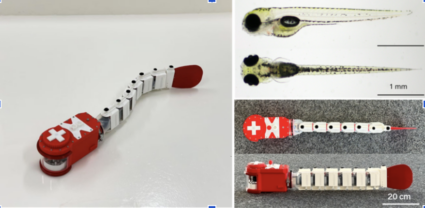
To validate the bioinspired energy-saving mechanism of fish intermittent swimming, the team developed a biomimetic robot, ZBot (Figure 1), scaled up 200 times from a larval zebrafish, with a body length of 80 cm and a weight of 2.8 kg. The ZBot replicates the larval zebrafish’s morphological features, segmented body structure, and center-of-mass distribution. Its flexible tail consists of six servomotor-driven segments to simulate natural fish undulation, while the head integrates core devices, including a central controller that serves as its nervous system, high-precision cameras, and real-time power meters. Equipped with expandable sensor interfaces, ZBot supports diverse experimental needs, including visual-motor processing [2] and vestibular system research.


Figure 1. ZBot and real larval zebrafish.

2. Can intermittent bout-and-glide swimming achieve higher energy efficiency than continuous tail-beating swimming, and if so, under which conditions?

The team from EPFL and Duke University collaborated to build a neurocomputational model simulating zebrafish neural circuits, centered on Central Pattern Generators (CPGs), bout-gate modules, and ventral spinal projection neurons (vSPNs). The CPGs generate continuous rhythmic oscillation signals to generate basic swimming undulations, with the bout gate acting as a core switching unit: it accumulates input signals via a leaky integrator and triggers CPG-driven tail undulation only when reaching a fixed threshold, forming the natural intermittent “active bout + passive glide” swimming rhythm. The simulated vSPNs further adjust tail deflection angle, enabling flexible maneuver swimming direction..

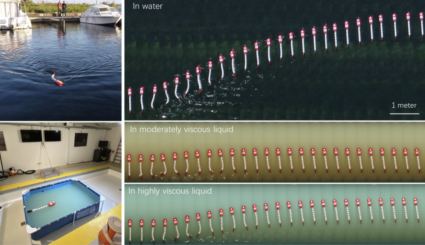
By adjusting parameters such as tail oscillation frequency, amplitude, and bout gate threshold, ZBot can accurately replicate multiple swimming gaits of larval zebrafish, including slow straight swims, routine turns, and J-turns (Figure 2). The EPFL-Duke team extended the model to construct an end-to-end framework for the larval zebrafish’s visually guided optomotor response, transforming the retinal input into motor output. This framework successfully reproduced the optomotor response in both ZBot and a digital twin simulation, simZFish.


Figure 2. Top view of ZBot bout-and-glide swimming in water (1 cP, 64000 ≤ Re ≤160000), moderately viscous liquid (213.9 cP, 37.4 ≤ Re ≤ 448.8, intermediate flow regime), and highly viscous liquids (457.0 cP, 1.0 ≤ Re ≤ 87.5, close to viscous flow regime). Recorded at 5 frames per second.

3. Are the energy-saving advantages of intermittent swimming constant in viscous fluid regimes, e.g., with low Reynolds number, as seen for tiny larval zebrafish and microbionic swimming robots?

Reynolds number is a dimensionless quantity that quantifies the relative magnitude of inertial forces and viscous forces acting on a fluid flow or a solid object moving through fluid. A lower Reynold number (<1000) indicates the fluid dynamics in viscous regime, where the moving object experiences the viscous force to a high degree. A higher Reynolds number (>1000) indicates the fluid dynamics in inertial-dominated regime, where inertial forces overwhelm viscous forces.

Large creatures, such as whales, swim in turbulent flow regimes with a high Reynolds (Re) number. Small creatures, such as tiny larval zebrafish, swim in an intermediate flow regime that is more strongly influenced by viscous drag. Thus, it is interesting to examine the effects of different flow regimes on dynamic behavior during intermittent swimming gaits. Leveraging the inverse relationship between Reynolds number (Re) and fluid viscosity, the team changed the fluid environments to mimic aquatic organisms of varying sizes by adjusting liquid viscosity (Figure 2 and Video 1). The moderately viscous fluid has a viscosity of 213.9 cP, comparable to fruit topping syrup; the highly viscous liquid has a viscosity of 457.0 cP, comparable to the standard makeup cleansing oil. Increased viscosity significantly shortens ZBot’s traveling distance, with the displacement in highly viscous fluid (473.0 cP, 1.0 < Re < 87.5) only 1/30 of that in normal water (1 CP, 64000 < Re < 16000. Intriguingly, viscosity has minimal impact on turning performance: ZBot’s turning angle per bout is approximately 60 degrees in normal water and remains at 45 degrees in highly viscous fluid.

Video 1. ZBot was tested in fluids of different viscosities (by mixing water with carboxymethyl cellulose sodium salt)

4. What mechanisms lead to the energy efficiency of intermittent swimming?

A well-known hypothesis on the benefits of intermittent swimming is that it improves energy efficiency during swimming. Through experiments, the team confirmed that intermittent swimming reduces energy consumption across all achievable velocities compared to continuous tail-beating swimming, in both high- and low-Reynolds-number regimes. However, due to the limited bout and glide cycle, the maximum velocity when using intermittent swimming is only about 60% of that when using continuous tail-beating swimming.

A popular reason for this energy saving is that intermittent swimming enhances the transfer of energy from kinematic tail movements to the body’s dynamic displacement in the liquid. This “fluid dynamics” hypothesis has several variants, but essentially proposes that the straight-tail posture during gliding phases reduces drag force and thus saves energy. In this study, the team proposed and explored another hypothesis, the “actuator efficiency” hypothesis. Bout-and-glide swimming enhances the transfer of energy from electricity (or chemical energy in fishes) to kinematic tail movements. In other words, intermittent swimming allows the robot (or fish) to use their actuators (or muscles) in more energy-efficient regimes than continuous swimming.

Both robotic servomotors and biological fish muscles follow an inverted U-shaped efficiency curve, achieving optimal energy conversion only under moderate load conditions. At lower swimming velocities, where intermittent swimming occurs, continuous tail-beating causes actuators to operate persistently in underloaded, inefficient states, resulting in wasted energy. In contrast, the bout-glide cycle modulates actuator working conditions: the short bout phase keeps motors within the high-efficiency load range, and the glide phase minimizes the inefficient operation. This cyclic regulation promotes the overall actuator energy conversion efficiency.

Importance of this research

This study takes natural animal movement as its core inspiration, successfully translating evolutionary biological advantages into improvements in robotic engineering performance, with value in both the life sciences and robotic engineering. For biological research, the bioinspired robot platform enables mechanistic decoding of neural-motor-energy correlations, shifting biological observation from correlational observations to causal verification and providing a new tool for vertebrate neural circuit research. For the robotics industry, this research verifies and provides a strategy for robotic control to lower energy consumption.

By learning from natural intermittent locomotion strategies, underwater robots can adopt adaptive gait switching, intermittent bout-and-glide mode for improved energy-saving endurance during low- and medium-speed cruising, and continuous driving mode for high-speed emergency maneuvering.

How AI Consulting Can Help You Identify Opportunities for Automation?

How AI Consulting Can Help You Identify Opportunities for Automation?

With the age of fast-paced technology development and decision-making based on data, automation is arguably the most essential driver of operational scalability, efficiency, and innovation. Figuring out what to automate and how to do it right requires skills that most organizations may not have. It is where AI consulting shines through.

AI consultants offer not only technology recommendations but also strategic recommendations on how artificial intelligence can be leveraged to automate, reduce costs, and generate new revenue streams. In this article, we will describe how AI development companies allow organizations to unlock unseen opportunities in automation, how it is done by AI consultants, and what real benefits are achieved.

What Is AI Consulting and What It Covers?

AI consulting assists organizations in assessing, designing, and implementing artificial intelligence technology suitable for their requirements. It would typically involve

  • Audit of current workflows and data pipeline
  • Automating repetitive and rule-based tasks
  • Suggesting AI-powered tools and platforms
  • Creating proof of concepts (PoCs)
  • Successful AI solutions scaled across departments

The AI consulting companies typically employ data scientists, Machine Learning engineers, business analysts, and process optimization experts who collaborate to deliver customized automation solutions. 

Why Businesses Struggle to Identify Automation Opportunities?

Prior to proceeding with what an AI development company does, it is important to know why companies often overlook automation opportunities:

  • Insufficiency of AI talent: Most organizations are deficient in-house AI talent.
  • Limited visibility: Teams are often separated and ignorant of duplicate manual tasks.
  • Fear of disruption: People are afraid to disturb existing processes.
  • Cost issues: Companies feel that AI is too costly or difficult to adopt.

But, AI development companies can bridge the gaps by bringing in an outside-in perspective and the capability to discover the hidden inefficiencies. 

How AI Consulting Identifies Automation Opportunities?

The below is a step-by-step process on how AI consultants establish where automation will be of greatest benefit:

  1. Business Process Evaluation

AI app development companies start with a thorough examination of your existing procedures. Consultants trace flows to trace:

  • Repetitive work
  • Low-complexity, high-frequency tasks
  • Inefficient hand movements

With the help of stakeholder interviews and process mining software, they can view where automation will provide the most ROI

  1. Data Audit and Readiness Check 

AI automation depends on information. AI consultants consider

  • Availability and nature of unstructured and structured data
  • System integration points (ERP, CRM, HRMS, etc.)
  • Data privacy and data governance law

A readiness audit ensures the business is prepared to automate efficiently and safely.

  1. Use Case Identification 

From facts, there are specific applications where automation is preferable in terms of cost, speed, and accuracy. Common locations are

  • Customer service bots
  • Invoice processing
  • Inventory control
  • Predictive maintenance
  • HR onboarding
  • Targeted marketing

All the application areas are prioritized based on impact and feasibility. This helps AI application development companies analyze your industry and build tailored solutions.

  1. Technology Recommendation 

AI software development consultants evaluate and suggest the most suitable tool and platform. They can be:

This process guarantees that chosen technologies are in line with business goals and meets IT infrastructure automation needs.

  1. Proof of Concept (PoC) and Pilots

AI solution experts create pilot rollouts, or PoCs, prior to mass rollout, ensuring the project meets industry standards as well as ensures security and innovation across organization. Experts assist companies to:

  • Test pilots in a low-risk environment
  • Report on KPIs
  • Gain internal stakeholders’ support.

It is an important stage of risk management and strategy formulation prior to mass rollouts.

  1. Change Management and Training

Change management in IT is common. AI development companies build solutions that can scale with your future business needs. Automating is not a technology revolution it’s culture. Consultants help company businesses:

  • Trained staff for new workflow
  • Provide training in AI tools.
  • Oversee job loss fears
  • Develop an innovation culture.

Successful change management creates future success.


Real-World Applications of AI-Based Automation

  1. Customer Support Automation

One major e-commerce company retained an artificial intelligence consulting firm to lower the call center volumes.

  • Employed AI chatbots for FAQs
  • Applied NLP for distribution of tickets wisely.
  • Employed sentiment analysis for angry customer labelling

Outcome: 40% reduction in response time and 30% fewer support tickets.

  1. Accounts Payable Automation

The accounts receivable of a manufacturing firm can be automated with AI software solutions. Manufacturing units can reduce invoice processing by 70% and achieve accuracy up to 90% with AI automation. AI applications in manufacturing are

  • Digitalized and scanned paper bills
  • Imported relevant domains through ML
  • Used by ERP to facilitate automated approval cycles
  1. HR and Recruitment Optimization

AI recruitment solutions help organizations completely automate hiring processes, from resume screening to interview scheduling and grade analysis.

Implementation of an AI-powered recruitment platform and HR processes automating solutions can decrease 50% of process times and improve operational efficiencies of the departments. AI can automate:

  • Parsing of resumes by NLP.
  • List the candidates’ work availability in order
  • Bot is scheduling interviews 

Top Benefits of AI Consulting for Automation 

  • Objective Assessment

AI consultants offer a fresh perspective that identifies inefficiencies that homegrown teams might miss.

  • Faster ROI

Concentrating on high-impact opportunities through automation offers quicker value realization.

  • Custom Solutions

AI development companies in India and USA can create automation plans tailored to your business, company size, and objectives, ensuring that the custom AI solutions meet your future needs.

  • Technology Skills

They stay up to date with all the new trends, hardware, and platforms that AI is using in an attempt to provide the best possible suggestions that they can.

  • Risk Mitigation

With rollouts sequenced and pilots to showcase applications, implementation risk decreases by consultants.

How to Choose the Right AI Consulting Firm? 

To achieve the best possible automation, choose AI consultancy services that:

  • Is solidly based in your field
  • Provides turnkey solutions from design to installation
  • acquainted with business processes and AI technologies
  • Provides training and change management assistance
  • Departmental and geographic scalability solutions
  • Verify AI partner environment (i.e., Microsoft, AWS, Google Cloud), customer success stories, and case studies.

Future-Proofing Your Business Through AI Automation

AI automation is no longer about saving human effort it’s a question of business model transformation, customer experience, and competitiveness. Your best guides on this transformation are AI consultants, who will guide you to unlock and capitalize on AI opportunities that help you drive automation and innovation across processes. Whether you are just starting to explore test automation or need to accelerate what you are already doing, AI consulting firms provides you with the strategy, tools, and confidence to make the transition.

What Could Be The cost of AI development in 2026?

The cost of AI development depends on the project’s size, complexity, and specific technology and integration requirements. Basic projects, such as AI chatbots or simple automation tools that use standard AI models and limited integration, typically range from $10,000 to $50,000.

On the other side, mid-level AI projects, like fraud detection systems or AI recommendation engines, cost between $50,000 and $250,000. These AI initiatives involve more sophisticated algorithms, data, cloud deployment, and multiple integrations.

Enterprise-level AI solutions, such as generative AI models, large-scale predictive analytics, or computer vision systems, can cost anywhere from $250,000 to over $2 million. Because, these AI projects needs custom development, data infrastructure, and continuous monitoring and updates.

Other factors that influence overall costs include data acquisition and cleaning, the use of cloud platforms like AWS or Azure, the availability and cost of experienced AI developers and data scientists, regulatory compliance needs, and long-term maintenance and model retraining.


AI consulting helps organizations identify where automation will have the greatest impact by combining process analysis, data readiness assessment, and technology recommendations. Rather than starting with a tool, consultants start by auditing existing workflows and data pipelines to find repetitive, rule-based tasks that are good automation candidates.

Why businesses miss automation opportunities on their own:

  • Lack of in-house AI talent
  • Siloed teams unaware of duplicate manual work across departments
  • Fear of disrupting existing processes
  • Perception that AI is too costly or complex to adopt

How AI consultants identify opportunities — a typical process:

  1. Business process evaluation — mapping workflows to find repetitive, high-frequency, low-complexity tasks
  2. Data audit and readiness check — assessing data quality, system integrations, and governance/privacy requirements
  3. Use case identification — prioritizing candidates like customer service bots, invoice processing, inventory control, predictive maintenance, and HR onboarding by impact and feasibility
  4. Technology recommendation — matching use cases to RPA, NLP, machine learning, or computer vision as appropriate
  5. Proof of concept and pilots — testing in a low-risk environment before full rollout
  6. Change management and training — preparing staff and addressing concerns about job impact

Example outcomes cited: a 40% cut in response time and 30% fewer support tickets from AI-driven customer support; up to 70% faster invoice processing with 90% accuracy in accounts payable automation; and roughly 50% faster hiring cycles through AI-assisted recruitment.

Typical costs (2026): basic automation projects run $10K–$50K; mid-complexity projects (e.g., fraud detection, recommendation engines) run $50K–$250K; enterprise-scale AI (generative AI, large predictive systems) can exceed $250K–$2M+.

Conclusion

Artificial intelligencebased automation is changing how companies operate but unlocking its full value is about something more than tech. It is a thoughtful, evidence-based response that AI consultants are best placed to give. Through identifying the appropriate opportunities, developing intelligent workflows, and pushing organizational change, AI consulting allows you not only to improve operations but also to build enduring strategic value.

Get in touch.


[contact-form-7]

Scientists turn DNA into a memory device that uses 100x less power

Researchers combined synthetic DNA with a semiconductor to create an ultra-low-power memory device capable of storing and processing information in the same place. The bio-hybrid technology could eventually help make AI systems and next-generation computers far more energy efficient.

Scientists tracked kids for 8 years — the screen time result was unexpected

An eight-year Finnish study found that children who spent more time on screens tended to show better cognitive processing as teenagers, challenging common assumptions about screen use. Researchers say the key may be balancing physical activity with screen activities that encourage learning, creativity, and active thinking.

Popularity of Chinese AI Worries White House

Hugging Face — a key repository that offers AI free for download — reports that 41% of all free AI models are now from Chinese AI labs, a widespread adoption that concerns U.S. leaders

Observes Clement Delangue, CEO, Hugging Face: “They’re clearly dominating on open models right now — and I wouldn’t be surprised if they start dominating at the frontier either by the end of this year or next year at the rate of progress.”

That rapid adoption of Chinese-generated AI concerns the Trump Administration, which is dead-set on ensuring American AI remains the number one choice for AI in the world.

In other news and analysis on AI writing:

*Alternative Prompting: Sometimes, Simply ‘Talking At’ ChatGPT Works Best: Writer Eric Hal Schwartz has discovered that simply talking to ChatGPT for several minutes using ChatGPT Voice sometimes beats trying to prompt the AI with a highly edited written prompt.

Observes Schwartz: “The biggest lesson for me was that my carefully written prompts may have been removing useful information all along. When I edit myself before asking ChatGPT something, I naturally cut out the contradictions or any unfinished thoughts.

“Those are often exactly the details that explain what I really want.”

*AI-Generated Books Wreaking Havoc on Publishing Industry: Scores of major book deals – sometimes in the multimillions – are being killed after it’s discovered that AI was used to write at least some of the prose.

Observes writer Anna Silman: “The spectacular implosions of big book deals over suspected AI use—and fears about who might be next—are forcing a reckoning over the nature of authorship, the relationship between writers and publishers and the industry’s long-term survival.

“But nobody can seem to agree who exactly is responsible for solving this problem, or even how much of a problem it actually is.”

*These Days, U.S. Laws Are Often Written By AI: Writer Victor Tangermann reports that Congressional staffers are increasingly leaning on AI to write laws that are often ultimately signed by President Donald Trump.

Observes Tangermann: “Employees in both the House and the Senate are making liberal use of the tools, a terrifying new reality that could result in nonsensical language and hallucinations to slip into anything from congressional speeches to emails to laws themselves.”

*ChatGPT Rolls-Out ‘Premium Business Tier’ for Heavy Users at $125/Month: Business users who spend a great deal of time working with ChatGPT may want to check-out ChatGPT’s new Premium Business tier, which eliminates the five-hour usage limit currently in place for ChatGPT Plus users.

Observes writer Vlad Schepkov: “OpenAI said the new tier responds to requests from ChatGPT Business customers seeking expanded capacity for tasks including inventory management, marketing campaign development, business performance analysis, customer experience improvements, and product development.”

*New AI Agent Workspace Designed for Marketing Writers: Ahrefs has launched a new AI agent-powered workspace for writers –- dubbed Letaido — designed to handle research, reporting and monitoring for busy marketing departments.

Observes writer Duncan Riley: “Teams can hand agents multi-step jobs, schedule recurring workflows, build dashboards and reports and set up continuous monitoring of their own sites and their competitors.

“A visual interface shows outputs as agents produce them, so more than one person can review and refine the same piece of work.”

*U.S. AI Titans Release Open Source AI Models to Compete with China: Stock market darling Nvidia and Facebook parent Meta have both released new AI models that any company or organization can run for free on their own computers.

Observes writer Jonathan Vanian: “Both companies still have to prove there’s an audience for their offerings in a market featuring popular models from Chinese AI labs like Moonshot AI and DeepSeek, as well as Alibaba’s Qwen.”

Meta’s free AI model is dubbed ‘Muse Glimmer.’ Nvidia’s alternative is Nemotron 3.5 Lightning.

*Key Player in Chinese AI – DeepSeek – Jacks-Up Prices: One of the most prominent players in Chinese AI has increased prices by 50% for businesses looking to work with that AI be linking to the provider’s AI computer network.

Specifically, that price hike is limited to use of DeepSeek’s most advanced AI models – DeepSeek V4-Pro and DeepSeek V4-Flash.

Also part of the pricing change will be peak pricing and off-peak pricing.

*Elon Musk’s SpaceXAI Rolls-Out Formidable Grok 4.6: Determined to remain a serious contender in U.S. bleeding edge or ‘frontier AI,’ Elon Musk is out with an upgrade to his Grok AI model.

Benchmark tests of the AI confirm that Grok 4.6 beats a top Chinese AI model – Kimi K3 – and ties OpenAI’s GPT-5.6 Sol in performance, according to writer Carl Franzen.

Adds Franzen: “SpaceXAI describes Grok 4.6 as being built specifically to stay on task across longer sequences of work, including researching unfamiliar topics, analyzing information, navigating code-bases and converting product ideas into working applications.”

*New AI Auto-Generates Highly Personalized Business Emails: Seamless.AI is out with an auto-email generator that draws on a number of company databases to write highly personalized emails.

Key features of the app include the ability to:

–Research hard-to-find contact data
–Automatically reveal the most important information to break into any company
–Write personalized emails, calls, and social messages to millions of records
–Identify likely business challenges based on company size, industry, and other attributes
–Score contacts and companies against an ideal customer profile
–Categorize accounts by market segment, vertical, use case, or internal criteria
–Execute contact and company research across thousands of records at once

Share a Link:  Please consider sharing a link to https://RobotWritersAI.com from your blog, social media post, publication or emails. More links leading to RobotWritersAI.com helps everyone interested in AI-generated writing.

Joe Dysart is editor of RobotWritersAI.com and a tech journalist with 20+ years experience. His work has appeared in 150+ publications, including The New York Times and the Financial Times of London.

Never Miss An Issue
Join our newsletter to be instantly updated when the latest issue of Robot Writers AI publishes
We respect your privacy. Unsubscribe at any time -- we abhor spam as much as you do.

The post Popularity of Chinese AI Worries White House appeared first on Robot Writers AI.

Better communication could improve human-robot teamwork across real-world tasks

A new paper from Monash University and Australia's national science agency, CSIRO, argues that effective human–robot teams depend on alignment: a shared and up-to-date understanding of each teammate's capabilities and limitations, the task and situation, and their respective roles and timing.

World’s first superconducting quantum heat engine could help unlock massive quantum computers

A tiny superconducting engine has successfully converted heat near absolute zero into useful work, demonstrating the first cyclic quantum heat engine of its kind. Future versions could operate autonomously inside quantum computers, potentially eliminating huge numbers of costly, noise-producing microwave cables.

What does it take for a robot to hold a conversation with a room, not just a person?

By Umar Farooq

That was one of the questions at the heart of my last week (20th-24th July) at the Imperial Robotics Summer School, hosted at Imperial College, London; a week that sharpened my thinking and pushed me to look at robotics problems from angles I don’t usually get to in my day-to-day work.

The summer school brought together emerging researchers, academics, and industry professionals from across the robotics community for an intensive, hands-on programme. I came away having learned a huge amount, from expert-led lectures on robot kinematics, dynamics, sensing and control, and robot learning, through to specialised sessions on aerial robotics, robot intelligence, surgical robot vision, bio-inspired sensing and control, and personal assistive robotics.

One of the standout parts of the week was getting into Imperial’s robotics labs themselves, seeing research up close across adaptive and intelligent robotics, aerial robotics, robotic surgery, manipulation and touch, and assistive robotics. Alongside researchers from across the UK and beyond, we dug into real-world robotics challenges spanning quadruped locomotion, vision-based robot learning, tactile sensing, and healthcare applications.

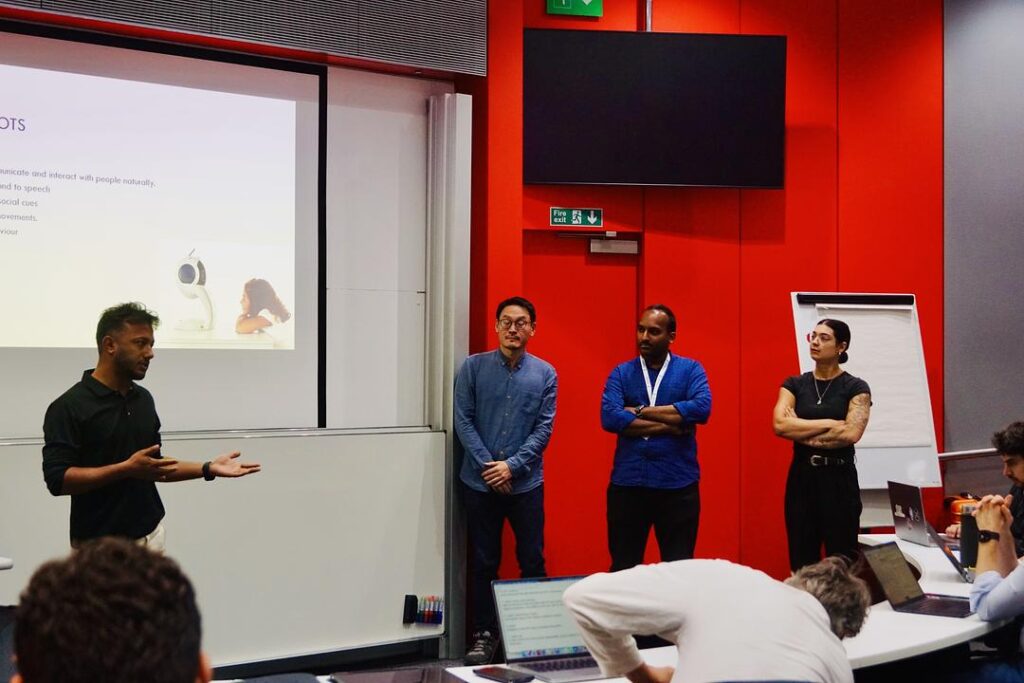
Our group project focused on enabling a robot to interact with several people at once, rather than the typical one-to-one interaction most social robots are designed around. We worked on detecting the active speaker in real time, tracking each person’s identity through the interaction, and generating natural gaze and head-turn behaviour so the robot felt genuinely attentive to the whole group rather than just one person. Along the way, I got a much clearer picture of the full pipeline from language to motion, how an LLM translates natural intent into structured commands, how those get mapped to high-level robot functions, how inverse kinematics turns that into joint trajectories, and how it all finally reaches the actuators through the robot’s control stack. It was a great, hands-on introduction to just how hard multi-party human-robot interaction really is. and I came away with a much deeper appreciation for the interdisciplinary side of robotics research.

None of this would have been possible without UK RAS STEPS, who funded my place as one of five RTPs selected to attend. Beyond this summer school, UK RAS STEPS has been really helpful for my development, with different workshops along the way that I’ve learned a lot from. A special thank you also to Marie Daniels for her support and guidance throughout the application process.

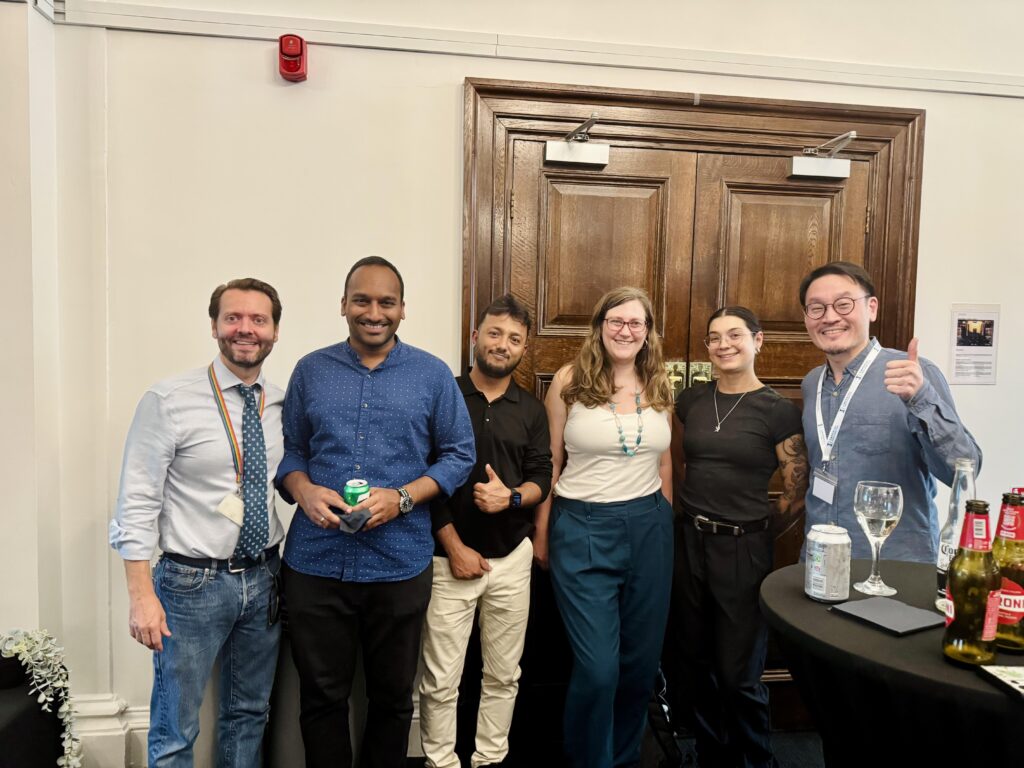
Thanks as well to the wider Imperial College, London team, the lecturers, researchers, and fellow participants, for a week full of great conversations and a real learning environment.

Page 7 of 648
1 5 6 7 8 9 648