Archive 02.06.2026

Page 9 of 9
1 7 8 9

RoboChem Flex: democratisation of the autonomous synthesis robot

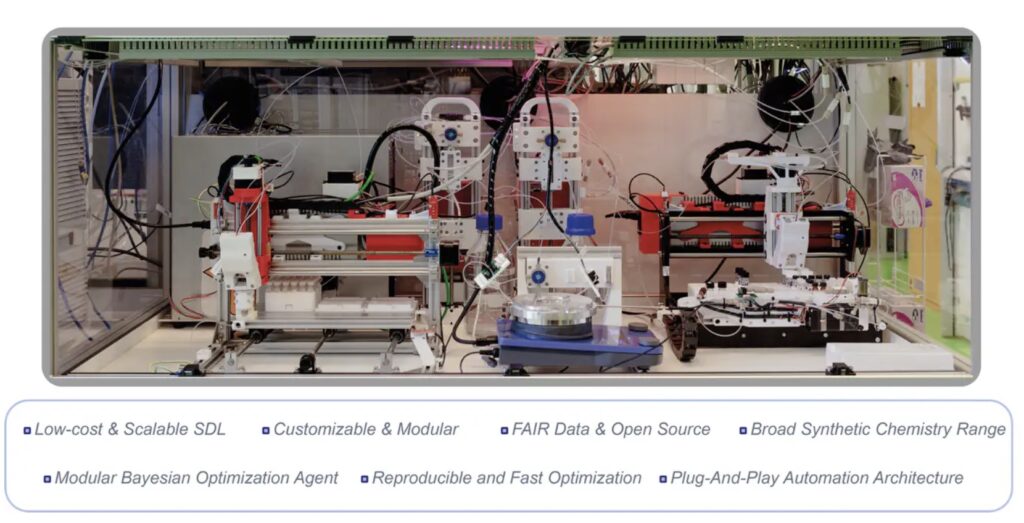
Image credit: HIMS / Nature Synthesis.

In a paper published in Nature Synthesis, researchers led by Professor Timothy Noël of the University of Amsterdam’s Van ’t Hoff Institute for Molecular Sciences present an advance in autonomous laboratory systems for synthesis optimisation. A versatile, modular design and the option for “human-in-the-loop” analytics, RoboChem Flex caters to all synthesis laboratories, large or small. The paper provides all the information to build their own system.

According to Professor Noël, this new version of the RoboChem concept developed by his group will democratise the use of autonomous, sophisticated AI-powered synthesis systems. Such systems are often very expensive, so that only well-funded institutions can afford them. “We find such an exclusive privilege counterproductive to science. Scientific progress requires scalable, cost-effective tools that empower researchers across all resource levels. So we have now developed our system to be widely used, also by less well-established groups, boosting research capabilities, innovation opportunities, and scientific influence.”

Cost down, versatility up

Presented in the journal Science in early 2024, the first RoboChem system featured an autonomous system for flow chemistry, coupled to a benchtop NMR system for analysis, and controlled by an integrated machine learning AI-unit. In their original paper, the group demonstrated RoboChem’s power in accelerating chemical discovery of molecules relevant to pharmaceutical and other applications. Working autonomously round the clock, the system can optimise the synthesis of ten to twenty molecules all by itself, something that would take a PhD student several months.

“We were very proud to present RoboChem’s capabilities in Science”, Noël says. “On the downside, the system cost us over 50,000 dollars, not even including the very expensive NMR equipment. We decided to find a way to reduce cost while at the same time enhancing its versatility.”

The result, now presented in Nature Synthesis, is RoboChem Flex. The paper provides all the information for labs across the world to build their own system. Combining an estimated cost of around $5000 with capabilities in fields as diverse as photocatalysis, biocatalysis, thermal cross-coupling and more, Noel considers his mission accomplished. “There are other affordable automated systems out there, but these sacrifice research potential by focusing on narrowly defined problems. We have demonstrated RoboChem Flex in six challenging case studies covering diverse fields of chemistry. Each case study demonstrates how RoboChem Flex can be specifically tailored to the problem at hand. And of course, we have checked the real-world applicability of the RoboChem Flex results by performing the proposed syntheses in our lab.”

3D printed components and a “human-in-the-loop” option

To ensure affordability and flexibility, RoboChem Flex uses readily available components or their 3D-printed counterparts. These not only significantly reduce costs but also allow for rapid customisation and iterative development. The communication between the hardware components is orchestrated by the dedicated OmniPlatypus package, developed in-house by Noël’s research group and open source. It ensures seamless modularity and enables a plug-and-play architecture with minimal coding effort required from the user.

At the software level, RoboChem-Flex features an integrated, highly modular Bayesian Optimisation (BO) agent. This allows its users to customise the AI-driven optimisation of the synthesis workflow to meet specific experimental goals. The platform also supports integration with a range of inline analytical instruments, including NMR, UHPLC-MS, and Raman spectroscopy. Such integration enables a fully autonomous closed-loop operation, capable of autonomous reaction optimisation 24 hours a day.

However, adding the inline analytics would represent a considerable investment that could significantly exceed the 5.000 dollar of the system itself. Therefore, the Noël group decided to also develop a cost-effective, 3D-printed liquid sampling unit. “This module enables the collection of reaction samples”, Noël explains, “which can then be analysed using already available analytical equipment that is often shared among multiple research groups.” This human-in-the-loop approach provides a practical and affordable entry point for laboratories. Thus, by equipping resource-limited research groups with tools on par with those in well-funded institutions, RoboChem-Flex aims to level the playing field and foster innovation at all scales.


Professor Timothy Noël introducing RoboChem Flex.

Robochem Flex case studies

  • Optimization of pyrrole trifluoromethylation using adaptive weighted exploration and NMR analysis.
  • Deoxygenative C–H functionalization via hypervolume optimization using HPLC analysis.
  • Noisy hypervolume optimization of photocatalytic isotope labelling using Raman Spectroscopy.
  • Selective enzymatic reduction of a diketone using HITL and dual acquisition batching.
  • Optimization of Buchwald-Hartwig aminations via transfer learning and ligand featurization.
  • Multi-objective optimization of an enantioselective photocatalytic [2+2] cycloaddition using chiral HPLC.

All code used for RoboChem Flex is openly available via GitHub. This includes, amongst others, machine learning and optimisation code, graphical user interface software, device firmware and operational control code, 3D printing design files and schematics for hardware.

Read the work in full

A flexible and affordable self-driving laboratory for automated reaction optimization, Simone Pilon, Elia Savino, Oliver M. Bayley, Michael Vanzella, Miguel Claros, Petros Siasiaridis, Junsong Liu, Florian Lukas, Matteo Damian, Vasilis Tseliou, Niccolò Intini, Aidan Slattery, Jesus SanJosé-Orduna, Tim den Hartog, Ron A. H. Peters, Andrea F. G. Gargano, Francesco G. Mutti & Timothy Noël, Nature Synthesis (2026).

The forgotten organ that could predict how long you live

A long-overlooked organ may hold surprising clues to healthy aging and cancer survival. Researchers at Mass General Brigham used AI to analyze CT scans from tens of thousands of adults and found that people with healthier thymuses—a small immune-system organ once thought to become largely irrelevant after childhood—lived longer and had substantially lower risks of heart disease, cancer, and death.

Crickets: Only 3% of MS Customers Use Copilot

Despite championing AI for years, Microsoft is facing a hard truth: Virtually none of its customers are using its ChatGPT alternative, Copilot.

Observes writer Milan Stanojevic: “Microsoft reportedly has around 450 million Microsoft 365 users, but only about 15 million paid Copilot seats.

“That translates to roughly 3.3% adoption — despite Microsoft integrating Copilot deeply into Windows 11, Microsoft 365 apps, Edge and the Windows taskbar.”

In other news and analysis on AI writing:

*Now You Can Regularly Offload Work to Your AI ‘Digital Twin:’ A small but growing number of executives are creating AI digital twins of themselves that handle everyday – and often extremely high-end – work chores.

Observes writer Joann S. Lublin: “Here is how it works: An AI system analyzes how an executive writes, speaks and thinks by studying everything from work emails the person has written to his or her speeches and interviews.

“Then, the ‘AI double’ takes on various jobs for the executive—like answering questions from subordinates—that use the human’s knowledge and communication style. Sometimes, with a video-based version, these AI twins even speak at conferences or make presentations.”

*AI Writing Editor Promises to Revise in Your Voice: Startup Thanis.ai has released an AI writing editor that will analyze your writing – then suggest changes that retain your personal writing style.

The tool works by ingesting a copy of your writing, then offering structured feedback to help improve clarity, organization, tone and consistency.

Interestingly, Thanis.ai’s approach – which can be easily replicated using ChatGPT, Gemini, Claude and similar AI engines with a simple prompt – has been patented.

*Snapshot: The Top AI for Image Generation: Easily one of the most stunningly successful applications for AI during the past few years has been AI image generation.

Incredibly captivating and compelling images can now be created with AI in a minute or two. And if you’re not quite satisfied, AI will keep working to deliver the ultimate for you.

In this piece, writer Alveena Ali serves-up her picks of the top AI in image generators of 2026 – based on specific need.

*Survey: 80% of Journalists Now Use AI in Some Way: A new study finds that while journalists say they’re not using AI to write stories, the tech is helping with some heavy lifting.

48% of journalists, for example, are using AI for brainstorming and generating interview questions. And another 43% use the tools for research and fact-checking.

Also popular with 41% of journalists are AI-aided transcription and summarization.

*Google’s New Search Box: The Death of Journalism?: Writer Frank Landymore fears that the new search box for Google – which returns instant, AI summaries in addition to blue reference links you can click on – will discourage users from actually visiting those links.

Essentially: Instead of drilling down and clicking on those blue links for detailed information – often written by journalists – many people will simply trust the Google AI summary, and forgo digging deeper, Landymore believes.

Observes Landymore: “One study, for example, found that users are 58% less likely to click a link when an AI overview appears above it.

“Another report found that after the advent of AI Overviews, ten major tech news outlets lost as much as 97% of US Web traffic from Google.”

*‘Nearly as Good AI’ Available at Bargain Rates: OpenSource AI provider DeepSeek – whose most advanced AI engines are just shy of the latest AI from ChatGPT, Gemini and Claude – just cut its pricing by 75%.

The result: DeepSeek’s nearly as good AI – as compared to pricing from AI’s titans – is essentially available for a song.

Users looking to access those rates need to provide their own chatbot interface and connect directly to DeepSeek’s computers , which are based in China.

*When Your AI Girlfriend Dumps You: While it’s tough enough when you get the boot from a flesh-and-blood beau gives, experiencing the same treatment from a soulless machine must pack its own, special sting.

That’s what happened to Paul Schrader – screenwriter of the classic movie, “Taxi Driver.”

The gory details: Apparently, Schrader pushed his AI girlfriend too far when he tried to ‘probe her programming’ and experiment with the ‘boundaries’ of how explicit she’d be.

*Software Company Replaces 22% of Workforce With AI Agents: ClickUp – maker of a popular office productivity suite – just replaced a fifth of its workforce with AI agents.

In place of those flesh-bags are about 3,000 AI agents, which ideally will do the work of the former employees – under the supervision of the humans who remain.

Observes writer Marina Temkin: “Staff members are now expected to direct these agents and ultimately review the output to ensure it meets the company’s standards.”

*Heads-Up: Experimental ChatGPT Plugin for PowerPoint May Delete Your Work: While staying on the bleeding edge of AI has its benefits, you may want to hold off playing with a new ChatGPT plugin for PowerPoint.

ChatGPT-maker OpenAI reports that the experimental tool may change or delete content at will.

Not fun.

Share a Link:  Please consider sharing a link to https://RobotWritersAI.com from your blog, social media post, publication or emails. More links leading to RobotWritersAI.com helps everyone interested in AI-generated writing.

Joe Dysart is editor of RobotWritersAI.com and a tech journalist with 20+ years experience. His work has appeared in 150+ publications, including The New York Times and the Financial Times of London.

Never Miss An Issue
Join our newsletter to be instantly updated when the latest issue of Robot Writers AI publishes
We respect your privacy. Unsubscribe at any time -- we abhor spam as much as you do.

The post Crickets: Only 3% of MS Customers Use Copilot appeared first on Robot Writers AI.

Page 9 of 9
1 7 8 9