 Illustration of the versatile nanorobot. It is 150 times smaller than the diameter of a human hair. (Illustration: Marina Bräm)
By Angelika Jacobs
Nanorobots sound like science fiction: tiny machines for medicine, the environment, or industry. In fact, nanorobotics has become a rapidly growing field of research. It is considered a promising approach, for example, for delivering active substances to specific locations in the body. Unlike their larger-scale counterparts, they are not made of electronics, computer chips, and software, but rather of biomolecules and nanoparticles.
Researchers led by Prof. Dr. Cornelia Palivan from the University of Basel are now reporting on a sophisticated modular nanorobot with greater functional flexibility than many existing systems. “Previous nanorobots are often designed for a specific task only,” says Cornelia Palivan. “Our modular system, on the other hand, can be adapted to different applications.” The technology could be used not only in medicine but also in industry and environmental technology.
Propulsion module and payload capsule
The nanorobot, which the team describes in the journal Advanced Functional Materials, resembles a lunar rocket with multiple modules. A magnetic propulsion module moves the nanorobot, while a second module serves as a payload capsule, safely transporting therapeutic agents or enzymes to their target location.
In previous work, Palivan’s team developed nanoscale polymer vesicles that protect encapsulated enzymes. Molecules can enter the vesicle through pores, be processed by the enzymes and then their products are released into the environment. The payload capsule of the nanorobot contains four such enzyme-loaded polymer vesicles, providing the desired functionality. Depending on the design, the vesicles inside the payload capsule can also be selectively opened, for example to release bioactive compounds.
A DNA-based molecular Velcro system
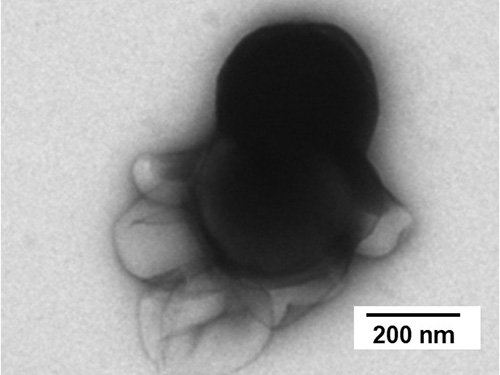 One of the nanorobots, imaged with a Transmission Electron Microscope. (Image: Voichita Mihali).
The two modules are connected by a DNA-based “Velcro fastener”: complementary DNA strands on both modules ensure that the propulsion module and the payload capsule self-assemble in a programable manner and remain stably coupled.
To enable the nanorobot to dock onto specific cells or materials, the payload capsule is also equipped with additional biomolecules that facilitate docking. In the lab, the team tested this using a human cancer cell line known as HeLa cells. They loaded the nanorobots with fluorescent molecules and observed under the microscope that they accumulated on the surface of the cells.
Targeted attack on cancer cells and other applications
Equipped with the necessary enzymes, the nanorobots successfully produced an anticancer drug which reduced the viability of the HeLa cells to 16 percent within 72 hours. “The drug can have a concentrated local effect if we use our nanorobot to specifically target it to the cancer cells,” explains Dr. Voichita Mihali, the first author of the study.
 Illustration of the nanorobot sitting on a surface. The enzymes in its payload capsule catalyze reactions, converting molexules from the environment into the desired product.
The nanorobot can attach itself to specific surfaces and carry out enzymatic reactions there. The enzymes (purple) inside the payload capsule convert molecules from the surrounding environment (left, dark gray) into the desired product (right, light gray). (Illustration: Marina Bräm).
For other applications outside the medical domain, for example catalysis, another feature might prove particularly valuable: Since the propulsion module is magnetic, the nanorobots can be retrieved and reused after their task is completed. The researchers were also able to separate the two modules, refill the payload capsules, and recombine them with the propulsion modules.
The modular nanorobot represents an important step toward a multifunctional tool for a wide range of applications. Although its use in humans remains a long-term goal, the system can be readily adapted for other domains simply by modifying the payload capsule.
The work was conducted within the framework of the National Center of Competence in Research – Molecular Systems Engineering and the Swiss Nanoscience Institute. The University of Basel team collaborated with researchers from Heidelberg University.
Reference
Multiplex Modular Nanorobotic Systems with Catalytic Activity under Magnetic Navigation, Voichita Mihali et al., Advanced Functional Materials (2026).
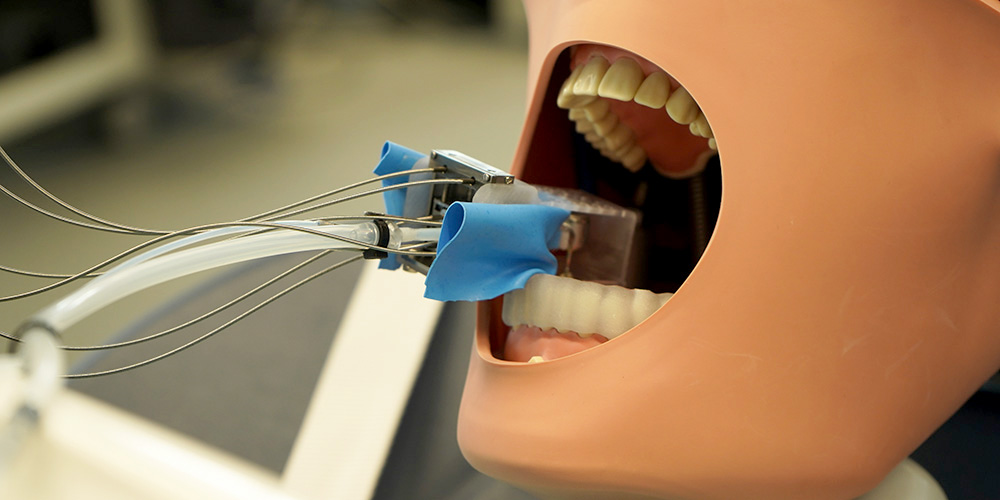 A miniature robot developed at the University of Basel could help prepare teeth for a crown. Photo: University of Basel, Catherine Weyer.
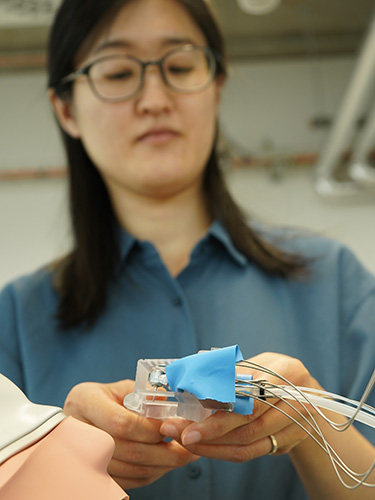 Dr Yukiko Tomooka mounting the dental robot on a model patient. Photo: University of Basel, Catherine Weyer.