The Consumer Electronics Show (CES) is one of the largest trade events in the world. Every year, thousands of companies showcase their state-of-the-art technologies to over 100k attendees. It brings together global industry leaders, startups, and media, and is used to launch products and signal future tech trends.
Henry Hickson, a Research Associate at the Hauert Lab, attended CES 2026. In this article he reports on the highlights of the show, exploring how physical AI is moving from experimental labs into consumer technology, and what this shift reveals about the future of robotics, autonomy, and real-world deployment.
All photos and videos in this article are credited to Henry Hickson.
CES 2026: Consumer Electronics Meets Physical AI
It doesn’t take long after landing in Las Vegas to see the signs of CES 2026. Within minutes, gleaming LED screens announce the show’s presence, and those ubiquitous two letters: AI. One flavour of AI dominated the show, from Jensen Huang’s keynote speech to even the smallest booths on the show floor: physical AI.
While I went there looking for robotics, the phrase ‘physical AI’ was reaching the ears of even the most casual visitor. Brands best known for televisions, laptops, and home appliances were talking confidently about embodied intelligence. At CES 2026, physical AI – in practice, robots – was no longer niche.
As a first-time CES attendee, the sheer scale of the event was overwhelming. Even with ruthless efficiency, it would have been impossible to speak to every robotics exhibitor at the Vegas mega-show. What follows, then, is not a comprehensive survey, but a set of themes that emerged repeatedly over the week – reinforced by either repetition or hype surrounding the exhibits. Together, they offer a snapshot of where consumer-facing robotics stands today, and where it appears to be heading next.
A quick caveat for seasoned roboticists: this consumer space is a far-cry from our daily interactions with lab-based robotics. Much of what’s on display is not state of the art by academic standards – but it is innovative in a different way, shaped by consumer expectations and manufacturability.
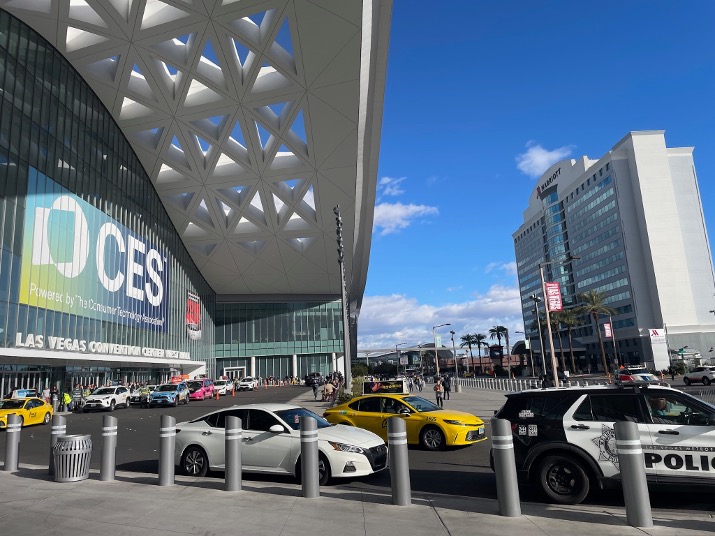
Outside CES at the Las Vegas Convention Center.
Theme 1: Humanoids
It would be impossible to feature robotics at CES and not expect a wave of the biggest trend in recent robotics history: the rise of the humanoid. What once felt like a sci-fi dream is now a serious commercial and research focus, attracting intense interest from investors, companies, and the public. In some circles, the debate is whether humanoids are necessary at all, given the efficiency of other forms. At CES, however, they were possibly the most widespread and discussed representation of physical AI.
The range on display was vast. Booster showcased child-sized humanoids which deliver an education program on robotics. These were lined up in what resembled a classroom and were available to buy then and there – many of the classroom robots had bold red ‘SOLD’ signs attached. One Booster would set you back $10k.
Booster’s silicon class-bots wave in unison.
Unitree drew crowds with a non-stop show of boxing, dancing, and acrobatics. While lacking in real-world application and still largely remote controlled, their rapid progress in motion capability is impressive. Unitree has achieved this with improved actuators and reinforcement learning. Their team stated that they added instabilities to their simulations, which makes the system more adaptable and gives confidence that each trick will run smoothly during demos. These boxing bots retail for $6k+ and are customisable for user needs.
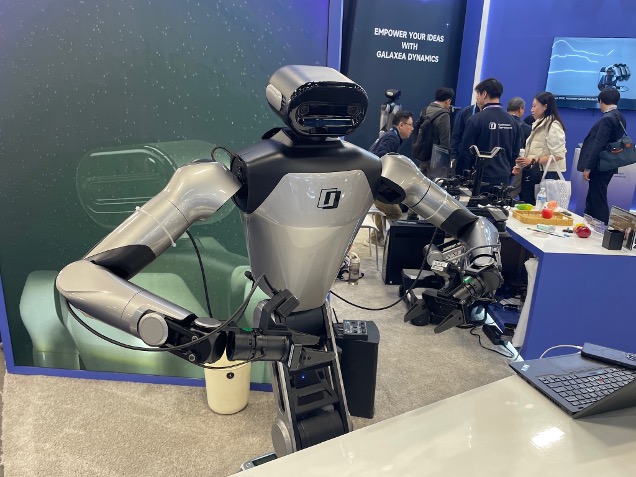
Beijing-based Galaxea Dynamics are targeting research labs with a high-precision platform for foundation model development. Beginning with a simple robot arm with a camera and pincer gripper, they now offer a humanoid with inbuild height adjustment for $70k. In addition, they are developing an open-source VLA as a starting point for users developing their own, task-specific setups. The result is an out-the box VLA system, reducing the barrier to entry for universities or R&D companies to develop their own twin armed VLA systems. Galaxea are proving especially popular with US institutions.
Galaxea Dynamics’ humanoid with pincer grippers.
Home robots were one of the most popular categories at CES. SwitchBot presented H1, a wheeled humanoid with arms that slide up and down. At this stage it is likely becoming clear that the definition of a humanoid is becoming somewhat blurry – aside from the friendly face and human-dimensioned arms, the H1 isn’t exactly a human form. Trained by observing humans completing household tasks, the H1 has so far mastered tidying around the house and loading the washing machine – if still at a slower pace than a human. Release dates are uncertain, but the company is aiming to undercut the competition by reaching a $10k price point. It’ll be interesting to see how this develops.
SwitchBot’s H1 Humanoid, ready to do your chores (very slowly).
The GR-3 humanoid by Shanghai-based Fourier caught my eye – its turtle-neck styled torso, emotive LED eyes and automotive-upholstered soft skin makes for a standout aesthetic. Its dextrous hands were shown off in close interactions with visitors via tic-tac-toe games, where it never lost. I was happy to pull off a tie. The reason for these close interactions is that GR-3 is targeted for healthcare providers, for social interaction and physical tasks around care homes and hospitals. Retailing at $100k, the primary customers are still research labs.
Fourier’s tic-tac-toe playing humanoid, GR3.
An unexpected development for many was the entrance of large consumer brands into the humanoid space. LG’s CLOiD, integrated with its smart home ecosystem, embodied the idea of a “zero-labour home.” The CLOiD is a wheeled humanoid with a friendly LED face. Somewhat tentative in its movements, it was able to retrieve items from the fridge and fold a towel. This is still very much in development, but watch this space.
LG’s wheeled humanoid, CLOiD.
Paxini’s offerings sit exactly in the popular intersection between humanoid and wheeled robots, with an adjustable wheeled base, a floating torso adjustable up and down by rotating joints, and a humanoid upper body. Utilising VTLA models, they are targeted to move crates in warehouses or parts on factory floors, with several units already deployed.
GalBot presented another wheeled, VLA-focused platform, with demonstrations of crate stacking in a warehouse-style environment and customer service tasks in a mini convenience store setup. The platform features an adjustable torso with attached arms and head. The company has invested heavily in VLA development for manipulation, navigation, following, and dancing. They highlighted the challenge of tuning models for each platform, again pointing to data collection as a key bottleneck. Despite this, the team is pushing toward near-term deployment.
The aptly named company Humanoid, representing the UK contingent of roboticists, showcased a deployment-focused wheeled system in the form of the HMND 01 Alpha Wheeled platform. The large rectangular industrial base clearly signals a platform designed for real-world factory work rather than show-floor demos. This focus was reinforced by Humanoid’s recently announced partnership with Schaeffler, with whom they were exhibiting at CES. A smooth demo showed the height-variable robot moving metal rings between bins. While near-term efforts are firmly industrial, the team stated that a legged version better suited to home environments remains part of their longer-term roadmap.
Schaeffler’s second humanoid partner at CES, Agility Robotics, is also focused on production-ready systems for the factory floor – this time, to a fully legged platform. Their distinctive backward-knee design has been under development for many years, and the full-height robot on show was clearly built for industrial environments, with exposed metal structures and hard casing. Agility has no plans to enter consumer home robotics.
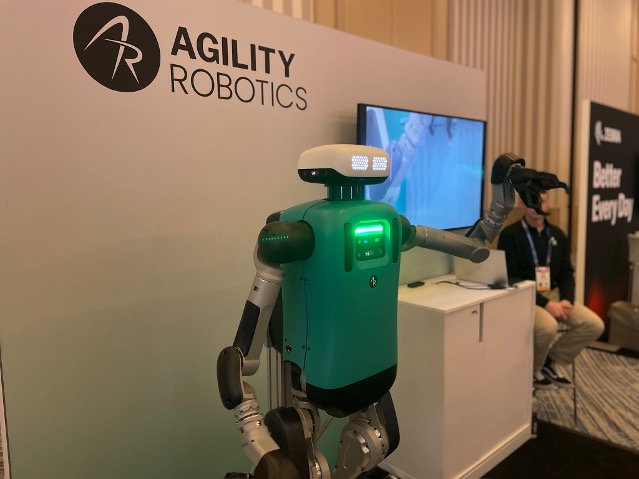
Agility’s humanoid.
Perhaps most notable at CES was Boston Dynamic’s Atlas humanoid. It saw 4-5 row deep crowds for the entire show, as well as hitting global headlines. Atlas has been in development for over a decade and has become widely known through videos openly showing both successes and failures. The latest version was unveiled during the opening day. It performed an agile sequence of crouching, sweeping, and pointing motions. For the rest of the show, it performed regular pick-and-place demonstrations in a mock factory environment. The team openly discussed current limitations, noting that much of the system was teleoperated during the show, highlighting that the software stack is still under development.
Standing 1.9 metres tall with a lifting capacity of 50 kg, it is designed for heavy-duty work. Hyundai plans to focus production capacity on internal deployments through 2026, with broader manufacturing customers expected later. Long-term plans include scaling production to tens of thousands of units per year, signalling what may be one of the first large-scale deployments of humanoid robots with real industrial value.
The headline-grabbing Atlas humanoid demonstrates its impressive range of mobility.
Theme 2: Companion Robots
Being consumer focused, it is perhaps unsurprising that a standout theme was so consumer oriented, but I was surprised by the sheer number of newly released robots in this space. The strength of this theme lies in human–robot interaction, and in how consumer technology is being reshaped by robotics and AI.
One example was Loona, built by Beijing-based KEYi Tech. This pint-sized, four-wheeled robot pet was surprisingly insistent, identifying potential playmates through an onboard camera and bumping clumsily into their feet to ask for attention. Designed for all ages, the team reported strong interest from adults buying Loona as company for elderly parents. With some life-like qualities, Loona manages to evoke some of the emotional response of a household pet.
Loona’s adorable robotic pet.
KEYi also previewed a desktop robot concept that integrates with a smartphone, which provides access to cloud tools like ChatGPT and acts as a screen for expressive robotic eyes. Positioned as an assistant, the demo showed agentic capabilities, such as booking meetings and analysing screenshots. Its long-term usefulness remains unclear, but the slick interface was fun to interact with.
Next up was an unreleased robotic pet from OlloBot – two-wheeled, dog-sized robot pets with tablet-based faces that reminded me of Sid the Sloth from Ice Age. These child-friendly bots had ChatGPT integration as well as camera modes and learning programs.
Ollobots – your child’s new playmate or favourite toy?
Fourier presented a small, customisable desktop robot with wide digital eyes and head tracking that gave an eerie, Labubu-esque aesthetic.
Fourier’s cute desktop robot is watching you. Photo credit: Henry Hickson
Ludens AI offered INU, a fluffy desk robot. Marketed as a ‘desktop alien’, INU has come to Earth to remind users to take breaks and not work too hard. How could you say no to that? Alongside the cute rocking movements and occasional squeak, it was hard not to feel some attachment to this little robotic being.
The INU desktop alien robots waving hello. Credit: Henry Hickson
Rounding out the category was Sentigent’s DuoRover, a rugged, follow-me robot for outdoor adventures. Using a two-wheeled balancing design and vision-based following, it is intended to provide conversation, photos, and video recording on family outings.
Companion robotics is clearly a rapidly growing space. The open question is longevity: will these robots remain companions, or be relegated to people’s cupboards once the novelty wears off? Companies are betting that continual feature expansion, fuelled by LLMs, will help them endure – but only time will tell.
Theme 3: Task-Driven, Non-Humanoid Robotics
While less prevalent at a consumer-focused show like CES, task-driven robots still made a strong impression. Typically found at trade shows, these more industry focused robots are used for warehouse / factory automation, or in hospitality. However, there was an interesting sprinkling at CES too and some great innovations in this space.
One of the most notable examples was from the Hyundai Motor Group, whose acquisition of Boston Dynamics made them one of the most popular exhibitors. Their MobED robot is a modular wheeled platform with four independently controlled wheels that can perform tight manoeuvres and can traverse varied terrain whilst maintaining a perfectly level loading bed. The modular approach means this can be used for a variety of uses cases, from delivery carts to ride-on vehicles. What stood out most was the build quality, which felt more akin to a luxury car than a typical robotics module. It will be interesting to see how this does against its lower cost competition – is there an appetite for luxury robotics platforms yet?
Hyundai’s 4-wheeled modular platforms greet the crowd by waving their wheels.
At the other end of the spectrum was Nexus Patio Tech from Bolivia, showcasing delivery robots designed for simplicity and rapid route-to-market. With 20+ robots already operating on Bolivian streets, and many more in malls and restaurants, it was great to see a deployment first approach – although this may partly be thanks to a different regulatory landscape.
China’s Neolix demonstrated logistics at scale, with over 15,000 autonomous vehicles deployed across three sizes. By focusing exclusively on logistics, the team has simplified decision-making and accelerated deployment. For example, if there is a choice between crashing into a wall or a pedestrian, in logistics only you always choose the wall, as there is no passenger onboard to account for. This makes for a unique approach compared to some of the other, albeit highly sophisticated offerings on show at CES, such as passenger focused Waymo, Zoox, and NVIDIA. Pilots in Portugal are scheduled for the first half of 2026, which is a promising step – being able to comply with stringent EU regulations would unlock deployments in several other regions.
Neolix’s autonomous robot.
Construction logistics were addressed by Gole Robotics from South Korea, who are tackling point-to-point material transport on construction sites – a use case so far relatively untouched by autonomous robotics due to its complexity. Their large material-carrying robot is designed to move pallets overnight in apartment buildings, allowing human workers to focus on skilled labour during the day. Here, the innovation lies as much in the redesigned workflow as in the robot itself.
Finally, USX Robotics showcased a modular indoor delivery platform for hotels and events, notable for having been developed from concept to production-ready system in just over a year.
This was not the only robot to be market-ready in lightning-fast time. With the availability of affordable and specific robotics focused components, open-source baseline libraries and easier access to manufacturing services from abroad, both the cost and complexity of building a new robotic system seems to be decreasing, enabling a host of new players into the industry. This raises interesting questions about how the market will evolve in the future. Differentiation may increasingly lie in identifying the right use cases and routes to market.
Summary
CES 2026 showed that humanoid and embodied AI systems still have a long way to go before delivering real-world value, particularly in homes. At the same time, there is a growing sense that the path to deployment is becoming clearer. A consensus has emerged across platforms: multi-camera perception, often wrist-mounted, paired with VLA models, is sufficient for most tasks. Increasingly, tactile hands and VTLA software are added.
There was a clear split between industrial and home-care humanoids. The most convincing offerings with the most deployments were in industry, with the firm favourite being logistics tasks in the manufacturing sector. With highly developed platforms like Atlas leading the charge, this industrial humanoid push feels closer than ever. Another general trend here was reaching the market via industry, followed by a longer-term goal of reaching people’s homes in some unspecified time frame. It was sometimes hard to tell whether that home-ready goal is genuine or to please the likes of investors and the excitable general public.
One interesting question for me is capability – at what point is a humanoid considered useful enough for the time-constrained consumer to buy it, not just for an early adopter? Currently, these platforms feel too slow to be useful enough for the average buyer. As development continues, I hope we begin to see more adaptive systems that provide genuine value.
What has changed is momentum. A spark of excitement has captured the imagination of so many at CES, now that what once seemed impossible is for sale, right in front of you. With greater access to compute, the development of foundation models like VLAS and VTLAs, a roadmap is emerging. The race now is for data, data, and more data –it’ll be a fascinating one to follow over the coming years. I left CES with the sense that the future is happening now.


