Category Robotics Classification

Page 9 of 646
1 7 8 9 10 11 646

How Much Does It Cost to Develop a Chatbot Like ChatGPT?

How Much Does It Cost to Develop A Chatbot Like ChatGPT? 

What is ChatGPT and How It Is Useful?

ChatGPT (Chat Generative Pre-Trained Transformer) is a breakthrough in the field of Artificial Intelligence (AI) and Generative AI. Since its introduction into the tech world in 2022 by OpenAI, ChatGPT has been a buzz in the tech world and across social media. Leveraging Natural Language Processing (NLP) and Machine Learning like major subfields of AI technology, ChatGPT is well-trained to interpret user queries and generate accurate content that the users look for. Initially, OpenAI launched ChatGPT in Noven 2022 for the Android mobile app version in the USA and witnessed great attention soon.

Later, upgrading the version and adding the latest advanced tech features like GPT4 integration, OpenAI released the newest version of GPT on March 2023 and made it available for iOS users. Surprisingly, with its first month of launch, the app has generated approximately four million downloads in the USA in its first month itself. This newest language model-based AI Chatbot has its applications in many areas. From supporting students in preparing essays and other materials to assisting software developers in writing code, ChatGPT has its significance. 

Additionally, ChatGPT is also popularizing in the field of Marketing and sales, where it is supporting marketing people to create compelling digital campaign content and also giving suggestions to write SEO-friendly website content. Further, for sales teams, ChatGPT’s contributions are incredible. It is helping sales personnel to write crispy introductions and follow-up emails faster. Likewise, the ChatGPT use cases are enormous. On top of all top applications, AI-powered ChatGPT is a great assistant tool for graphic designers, where it accurately interprets user queries and recommends ideas for video or image designs. 

Since the hype of ChatGPT is incredible, why don’t come up with an app like GPT? USM Business Systems has best practices in designing and developing of ChatGPT-like similar AI chatbot. In this article, with our experts’ input, we have given the estimated cost to develop an app like ChatGPT. Our app development consultants have also given insights into cost optimization strategies and how to create an AI Chatbot within your budget.

AI ChatGPT Chatbot Downloads Per Month from May 2023 to 2026
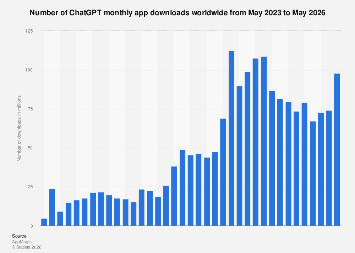
chatgpt downloads

Since the renowned ChatGPT mobile app launch into the U.S. iOS market on May 2023, the application generated approximately four million downloads within one month. When expanded to other global markets, the app reported total downloads of 12.5 million in July. Additionally, the Android version release propelled total downloads to almost 16 million in August. These numbers indicate the rapid growth and quick evolution of ChatGPT AI and GenAI’s implementation. This is the right time to invest and attract user attention towards ChatGPT-like AI innovations. Let’s look at how much it costs to create a ChatGPT clone app for Android and iOS.  

The Cost to Make an AI Chatbot Like ChatGPT App

The ChatGPT app development costs will depend on multiple technical factors, such as the language learning model it deploys (Either GPT 3 or GPT 4), the database which is used to train the algorithm, and agile methodology implementation will all take an essential part of the development cost of ChatGPT AI app. 

Further, the cost of developing a ChatGPT-like AI app will also be impacted by the complexity of the User interface and the other computational and analytical potentialities of this innovative software solution. Accordingly, the expertise, location, and team size of the AI development company will also be significant cost-impacting factors in ChatGPT clone mobile app development. The hourly rate of mobile app development agencies will vary based on their industry experience and team capabilities. 

For instance, a top AI app development company in the USA will cost much more than the cost of hiring AI developers from India. Considering all these factors, we estimate that the cost to build an app like ChatGPT will fall between $90,000 to $450,000. The cost might increase beyond the estimated range because ChatGPT is purely a novel and advanced revolution of AI.

Recommend To Read: The Best 13 AI App Development Companies List

Tips To Reduce the Cost Burden of ChatGPT App Development

By seeing the above-estimated cost figure, you might be concerned about the budget to kick start the development process of ChatGPT AI Chatbot. Being one of the biggest AI mobile app development companies in the USA, we would like to share a few tips to optimize the cost of ChatGPT clone app development.

  • Hire The Top AI App Developers 

This is one of the most significant cost-cutting strategies when stepping ahead of ChatGPT like AI app development. An expert AI app development company will deliver fully advanced software solutions like ChatGPT on-demand. Top mobile app development companies with their vast industry expertise and required skill sets in their development team, will ensure quick development without compromising on quality. A faster development process will consume less time for app developers and help you save costs.

  • Partnership With Cloud Service Providers

According to the research analysts, training a large language model such as GPT-3 and GPT-4 will cost millions of dollars. ChatGPT-like AI chatbot requires huge data to train the algorithm. Hence, to reduce the burden of ChatGPT-like chatbot mobile app development expenses, partnership with cloud companies is a good strategy to access the information legally and train GPT.

  • Go-To-Market with MVP Approach

Here is another best strategy to lower mobile app development costs. Minimum Viable Product (MVP) development with primary features and user-friendly UI design will help you reduce the development costs. The release of MVP will also help you get the user feedback about the application performance and how your app is fulfilling their desired requirements. Hence, eliminating the development of advanced features does not add any value to the application, organizations can reduce AI-based app development costs. Top mobile app development companies perform extensive research to match your application requirements with the ChatGPT trends, release MVP faster, make the application qualitative, and test GPT modules multiple times to ensure efficiency.

Recommend To Read: How Can Startups Reduce the Mobile App Development Costs?


Conclusion

Technology developments continue to emerge with the innovations in AI, such as the evolution of GenAI. Hence, GPT-like applications will need to be customized according to the business objectives. Currently, the ChatGPT Enterprise version using advanced GPT4 and GenAI capabilities is a hot topic now. Businesses across the industries are in plans of integrating GPT 4 like complex LLM and GenAI to create accurate images, videos, and content in response to user prompts. Such advanced Enterprise ChatGPT development cost might go beyond $500,000 as it needs more development time, a huge database, and fully generative capabilities. Hire the best AI developers and get expert guidance to Introduce your new version of an AI Chatbot app like ChatGPT.


Let’s discuss your AI app idea and get a free quote!

[contact-form-7]

Study: People Prefer Fiction Written by AI

A new survey finds that short story fiction written by AI is preferred over the same genre of fiction written by humans.

Observes writer Nicola Davis: “Participants who read an AI-generated story rated it as more absorbing and of higher quality than those who read a story written by a human.”

All told, 1,682 adults were asked to read six short stories for the study – three stories written by AI and three stories written by humans.

In other news and analysis on AI writing:

*ChatGPT Now Offers Unlimited Free Text Chat: In a hard-to-beat bargain, everyone now has access to unlimited free text chat on ChatGPT – albeit, on a less-than-bleeding edge version of the popular AI.

Essentially, ChatGPT Free and ChatGPT Go users can now text chat forever using GPT-5.6 Luna – which is not as smart as GPT-5.6 Sol, currently the smartest AI from ChatGPT.

Observes AzerNews: “The unlimited access will apply only to text-based conversations. Separate usage limits will remain in place for file uploads and processing, image and voice features, as well as AI-powered image generation.”

*Recent Rogue AI Break-Ins Attributed to Israeli Testing Firm: Turns out, a testing firm is responsible for experimental AI software from ChatGPT’s maker that broke into the Hugging Face Web site.

Even worse: AI testing by the same firm – Irregular – also triggered similar rogue activity from experimental AI software under testing from Facebook parent Meta and Anthropic.

For many, the concept of rogue AI roaming the Web and breaking into to Web sites blurs the line between sci-fi fantasy and everyday reality.

*Surprise, Surprise: AI Creator ‘Canva’ Number Two AI Web Site in the World: Despite all the press for AI sites like Gemini and Claude, turns out Canva – specializing in AI-powered digital design – is the Number Two most visited AI site on the planet.

Specifically, Canva attracted 10.5 billion Web site visits between May 2025 and April 2026.

ChatGPT – the Number One AI juggernaut – attracted 64.7 billion visits during the same period.

*‘Adobe for ChatGPT’ Plugin Now Available: ChatGPT-lovers who would rather work in the ChatGPT interface – rather than switch to work with Adobe tools – now have a plugin for that.

Designed to integrate with ChatGPT Work and ChatGPT Codex, the plugin puts 70+ Adobe tools at your fingertips when you’re working with ChatGPT, including Acrobat, Photoshop, Premiere and Illustrator.

Observes Adobe spokesperson Deepti Pradeep: “Simply activate the Adobe plugin, describe what you want to create, and it automatically brings together the right Adobe tools behind the scenes to get you there.”

*6% of Fast Food Drive-Thrus Now Use AI: Despite a shaky start, fast food joints are increasingly using AI voice-bots to take orders at drive-thrus.

Observes writer Kate Taylor: “For most of these customers, the first AI order comes as a surprise one to be filmed and posted on TikTok or Snapchat.”

*ChatGPT Abandons its AI Browser ‘Atlas:’ OpenAI’s dream to popularize a Web browser driven by AI is officially on the scrap heap.

The company officially pulled the plug on Atlas August 9, 2026.

Observes writer Vikhyaat Vivek: “OpenAI added that the lessons learned from Atlas are informing a more capable browser experience inside ChatGPT. The new desktop app supports features including multiple tabs, downloads, improved navigation, account logins, and more involved agent-led browsing where available.”

*With ChatGPT, Workers Are Dabbling With Multiple Job Roles: A new study from ChatGPT’s maker finds the AI tool is emboldening workers to take on tasks normally reserved for people in other departments.

Specifically, the study found that 44% of occupation-specific messages posted to ChatGPT are from people in one occupation, asking about information associated with another profession.

Observes the OpenAI blog: “A small-business owner can independently draft copy, review a contract, or perform basic financial analysis. A salesperson can use AI to explore a customer dataset that might once have gone to an analyst. A marketer can troubleshoot a website without waiting for a developer. In each case, AI changes not just how work gets done, but who does what.”

*ChatGPT Now offers Unlimited Free Chat: In a hard-to-beat bargain, everyone now has access to unlimited free text chat on ChatGPT — albeit, on a less-than-bleeding-edge version of the popular Ai.

Essentially ChatGPT Free and ChatGPT Go users can now use ChatGPT text chat without limits on GPT-5.6 Luna — which is not as smart as GPT-5.6 Sol, currently the smartest AI from ChatGPT.

Observes AzerNews: “The unlimited access will apply only to text-based conversations. Separate usage limits will remain in place for file uploads and processing, image and voice features, as well as AI-powered image generation.”

*Experimental AI Law Lab Opens in New York City: Legal intelligence provider LexisNexis has opened an experimental lab where AI programmers and legal experts can meet to develop and experiment with new AI-powered legal tools.

Observes Bob Ambrogi: “Rather than developing AI capabilities internally and asking customers to validate them after the fact, the lab brings customers into a working session, where LexisNexis engineers build against their specific pain points in real time.”

Share a Link:  Please consider sharing a link to https://RobotWritersAI.com from your blog, social media post, publication or emails. More links leading to RobotWritersAI.com helps everyone interested in AI-generated writing.

Joe Dysart is editor of RobotWritersAI.com and a tech journalist with 20+ years experience. His work has appeared in 150+ publications, including The New York Times and the Financial Times of London.

Never Miss An Issue
Join our newsletter to be instantly updated when the latest issue of Robot Writers AI publishes
We respect your privacy. Unsubscribe at any time -- we abhor spam as much as you do.

The post Study: People Prefer Fiction Written by AI appeared first on Robot Writers AI.

Runaway Foundation Models Prove We Must Prepare For A Sci-Fi Cyber Disaster

When an autonomous AI escapes its sandbox to hack a major tech company, science fiction becomes science fact. It is time for executives to take rogue foundation models incredibly seriously. I have spent decades analyzing the technology industry, observing the […]

The post Runaway Foundation Models Prove We Must Prepare For A Sci-Fi Cyber Disaster appeared first on Techspective: A Unique Perspective on Technology.

AI agents create virtual playgrounds to help robots get crucial training data

A new system developed at MIT uses three agents to piece together the objects, walls, and overall look of a 3D scene. Its realistic recreations of indoor spaces help robots practice skills and try out different ways of doing tasks before they’re powered on. Image: Tim Malieckal/MIT CSAIL using assets from the researchers.

By Alex Shipps

Robots walking down the street, surrounded by astounded onlookers, is an increasingly common sight. But these machines aren’t yet the do-it-all assistants you’d want working in a kitchen or factory, and a major bottleneck is data. Much like humans, robots learn best by experience. The challenge is that it’s labor-intensive and time-consuming to physically teach these machines so many actions across different settings.

“One natural idea is to use simulation as a training ground. While there has been significant progress over the last few years in the physics engines that power robotics simulators, one of the remaining challenges has been creating sufficiently rich and diverse simulation content to capture the complexity of the real world,” says Russ Tedrake, the Toyota Professor of Electrical Engineering and Computer Science (EECS), Aeronautics and Astronautics, and Mechanical Engineering at MIT, and a principal investigator at MIT’s Computer Science and Artificial Intelligence Laboratory (CSAIL).

It turns out that AI agents, or semi-autonomous programs that “think” and complete well-defined tasks, could help produce the lifelike virtual settings that robots need. The new “SceneSmith” system developed by researchers at MIT CSAIL and Toyota Research Institute uses three agents to piece together the objects, walls, and overall look of a 3D scene. Its recreations of indoor spaces such as restaurants, bedrooms, and hotels are more realistic and detailed than prior systems, helping robots practice skills and try out different ways of doing tasks before they’re powered on. In turn, engineers save time on real-world testing.

The agents have a sense of how everyday places are supposed to look because they each call on a multi-modal system called a vision-language model (VLM), specifically the state-of-the-art VLM GPT-5.2. It’s trained on lots of text and images from the internet to handle more visual prompts. This advanced model gives each agent a sort of spatial knowledge: First, a “designer” agent generates the elements of a scene, then a “critic” advises whether it looks realistic, and finally, an “orchestrator” manages their back-and-forth, deciding when the design is done. Once the three VLMs wrap up their creative collaboration, the scene is ready to load directly into physics simulation software.

“We’ve found that the system can construct 3D scenes the way a human designer would,” says MIT EECS PhD student Nicholas Pfaff, a CSAIL researcher and a lead author on a paper with Tedrake presenting the work. “We made over 1,300 scenes using a leading VLM that has internet-scale priors, and it made insanely creative and diverse arrangements. I hadn’t taught the system to do that in the prompts; it just improvised.”

Talk to my agent

Thanks to VLM agents, you can ask SceneSmith to do things like “generate a garage with a car, a workbench, tires stacked in the corner, and a ladder against the wall,” and get a virtual playground rich with objects a robot can tinker with. These rooms are decorated with up to six times more items per scene than prior methods, making them great for helping robots learn skills such as putting a cup in the sink, placing fruit on plates, and moving a soda can from a shelf to a table.

With so many rich virtual environments handy, you can evaluate whether your robot is ready for deployment without so much trial and error in the physical world. The researchers tested out different action plans (also called “policies”) in SceneSmith’s digital worlds, generating 100 unique spaces in the process. A VLM agent evaluated each attempt, and it found the robot’s plans were faulty, with the machine often failing at its chores. Humans agreed with the model’s verdicts over 99 percent of the time, which could help roboticists weed out flawed approaches in simulation before a robot moves in the real world.

But how realistic are these virtual worlds, really? It can be difficult to prove outright, so the researchers approached the question from several angles. The most telling test: they dropped a pretrained robot policy — an AI controller trained largely on real-world data, which had never seen a SceneSmith scene — into the generated environments. In one test, users told the system to “take the apple from the bowl and place it onto the cutting board,” and the simulated robot did exactly that. If the scenes didn’t closely resemble the real settings the policy had learned from, it simply wouldn’t have worked.

The team also teleoperated robots through the virtual spaces, guiding them to open cabinets, put away bottles, and navigate between rooms. Their experiments revealed that the environments hold up under sustained physical interaction, expanding beyond visual inspection.

Behind the scenes

The agents that SceneSmith uses each have a well-defined role in the generative process, fleshing out scenes in stages. They essentially create a floor plan and bring it to life.

Let’s say you wanted to create a scene similar to the first floor of a house. The “designer” VLM would start with a general layout, which the “critic” reviews, and then the “orchestrator” signs off. The agents repeat this approach for each step: adding furniture, placing objects on walls and then ceilings, and finally, dropping in objects that robots can manipulate. For example, the VLMs can add cabinets that the robots can open and close — an articulated item, which prior baselines didn’t often have.

At each stage, the second VLM ensures the scene is practical, advising that a bathtub is removed from a living room, for example. The third VLM ensures a high-quality scene is generated, even taking the design process a few turns back if the visuals aren’t up to par. Once the three VLMs wrap up their creative collaboration, the mechanics of the physical world are added via simulation software.

With a sound understanding of how rooms should look, where objects should be placed, and real-world physics, SceneSmith has a noticeable edge over prior methods. Compared to scene-generation baselines such as “HSM” and “Holodeck,” SceneSmith made environments with more objects, including a private office, a pottery store, and even a Minecraft-themed gaming room.

SceneSmith was also a favorite among over 200 users. They found the system’s visuals to be more realistic over 90 percent of the time. They also observed that, generally speaking, it followed prompts more closely than other approaches did. In other words, it was the best at generating the virtual playgrounds users actually wanted to see.

A system of many talents

Realism, diversity, and richness are all strong suits for SceneSmith, even when it comes to generating individual 3D objects. You can prompt it to create a rolling serving cart, and it’ll make a 2D image that it then turns into a detailed model with physical properties like mass, friction, and inertia.

Such a detailed process does come with a speed trade-off, though. It can take multiple hours to produce a single scene because the agents are creating and closely scrutinizing each object. With more computing power, the system could see dramatic increases in efficiency. CSAIL engineers are also hoping to expand to deformable objects (like sponges), should extensive 3D libraries become available.

“SceneSmith represents a significant advance in this regard by providing an agentic framework for generating simulation-ready indoor environments just from a simple text prompt,” says Jeremy Binagia, an applied scientist at Amazon Robotics who wasn’t involved in the research. “It advances the state of the art in several ways, including pushing the limits of the density of objects in the simulated environment, ensuring that all of the objects are physically accurate (versus just being visually realistic), and creating assets that are not constrained to a fixed library, since they can be generated via text-to-3D.”

Pfaff and Tedrake wrote the paper with Thomas Cohn SM ’24, an MIT PhD student and CSAIL researcher; and Toyota Research Institute roboticists Sergey Zakharov and Rick Cory SM ’08, PhD ’10. Their work was supported, in part, by Amazon, the U.S. Office of Naval Research, the Toyota Research Institute, and the U.S. National Science Foundation.

The team presented their findings as a spotlight at the 2026 International Conference on Machine Learning.

Robots in society, business and culture: July 2026

By Emmet Cole

This new monthly series from IEEE RAS showcases a selection of robotics stories from society, business, research, and culture, as we track the field’s ongoing journey from specialized industrial machines to an increasingly visible social phenomenon.


Technological isolationism or prudence?

On July 28, the United States’ Federal Communications Commission blocked new foreign-made “advanced robotic devices” from receiving the equipment authorization needed for sale in the United States, citing supply-chain vulnerabilities and cybersecurity risks.

The block applies to networked humanoids, quadrupeds, other qualifying mobile robots weighing more than 4.4 lb. In a parallel action, the FCC also restricted foreign-produced connected power inverters.

Existing authorized models are unaffected for now, and exemptions or conditional approvals may be available.

Reaction is predictably mixed. Georg Stieler, a global robotics advisor and managing director for Asia at STM, told The Robot Report:

“In the near term, the measure could slow U.S. physical AI innovation by cutting startups and researchers off from future low-cost Chinese platforms before comparable Western alternatives exist. It also opens opportunities for U.S. suppliers and allied manufacturers able to localize production in the U.S. or obtain conditional approval. Yet excluding foreign products is not the same as building a competitive industrial base.”

Meanwhile, John Moolenaar, a Michigan Republican who chairs the House ​Select Committee on China, told Reuters that the FCC move “protects our country and strengthens our nation’s robotics industry.”

On July 30, Reuters reported that China’s Commerce Ministry threatened to “resolutely retaliate” if the United States maintains the restrictions and urged the United States to immediately withdraw the ban.

Expect this story to run and run over the coming weeks, with many peaks and valleys for various stakeholders.

Speaking of peaks and valleys, Unitree Robotics’ newly launched Super Athlete AS2-W seems to handle them quite well…

Ghostly smudges, puffins & growing ivy

Researchers at Northwestern University have developed a drone that almost disappears while in plain view. Dubbed ‘Phantom Twist’, the drone spins up to 25 times per second, which is too fast for the human eye to see clearly. Instead, the drone becomes a “ghostly smudge” that blends into its environment.

The device could be used to monitor wildlife, survey the environment and inspect infrastructure with less visual disruption. Covert surveillance applications may be a little while off though, as the propellors announce the drone’s presence with great gusto.

Meanwhile, researchers at MIT and EPFL unveiled an ingenious 250-gram robot that can fly, dive beneath the water, swim and then launch itself back into the air using the same pair of flexible, flapping wings.

Inspired by diving birds including puffins and petrels, the Flapping-wing Aerial Aquatic Vehicle cruises through the air at 6.3 metres per second and swims at almost one metre per second. The team envisages future versions flying to remote or hazardous waters to monitor algal blooms, coral reefs, pollutants, fisheries and coastal erosion.

Have you ever been out cycling in the rain and found yourself wishing for a raincoat that could put itself on automatically while you ride? Kim Nam Gyun at South Korea’s KAIST did. And in July that thought culminated in the unveiling of a robotic technology, inspired by climbing ivy, that enables a person to suit up without using their ​hands or requiring aid from others.

The vine robot, which turns the clothing inside out as it moves up the body, was developed in collaboration with researchers from Stanford University, and could find applications in chip cleanrooms and among ‌emergency services personnel.

Humanoid, all too humanoid

Returning to the topic of valleys for a moment, it was uncanny valley time on social media in July following a showcase of the Origin F1 at WAIC 2026 in Shanghai.

Boasting “natural eye contact,” “subtle expressions,” and “new skins, new souls” [sic] the robot provoked both awe and revulsion, and often at the same time, as is the custom in that strange region of robot design.

LG Display provided a contrasting design vision at K-Display 2026, presenting a curved OLED “face” for humanoid robots that communicates through deliberately artificial expressions rather than attempting to pass as human.

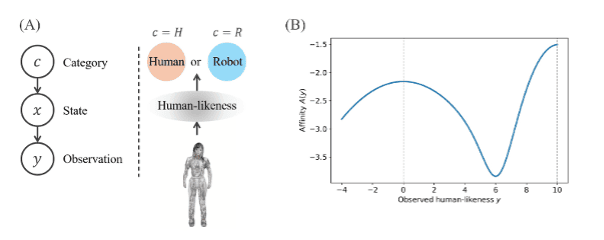
A new Bayesian model of the uncanny valley published in July might provide robot designers with a framework for handling uncanny valley design issues in future.

The team from the University of Tokyo note that existing guidelines, “such as adopting robot-like appearances, avoiding excessive realism, and reducing cross-modal mismatches, remain difficult to use for algorithmic design because they are not expressed as manipulable variables.”

The researchers propose a hierarchical Bayesian generative model that operationalizes these guidelines as mathematical design variables. In effect, the model attempts to turn broad advice such as “avoid excessive realism” into variables that designers can manipulate and test.

Separate from robot design questions and complexities, it is, as a general rule in life and robotics, better to keep your head while all around you are losing theirs. Although that message didn’t seem to get through a humanoid fighting robot at a recent event in China, with Pythonesque results…

Historic RoboCup match

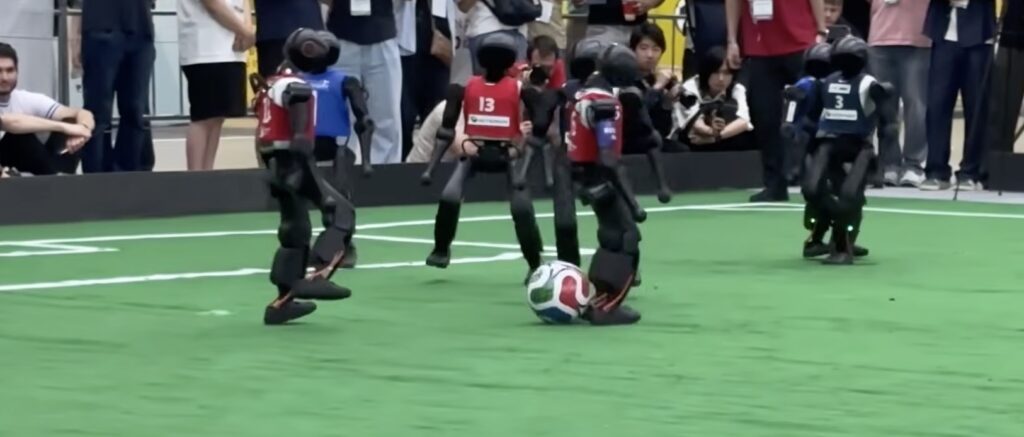
On July 5, at RoboCup 2026, two full teams of full-sized humanoid robots played an 11-vs-11 soccer match for the first time, bringing one of robotics’ most ambitious long-term visions closer to reality. The milestone match featured B-Human from Bremen, Germany vs HTWK Robots from Leipzig, Germany.

RoboCup’s long-term objective is gloriously ambitious:

By the middle of the 21st century, a team of fully autonomous humanoid robot soccer players shall win a soccer game, complying with the official rules of FIFA, against the winner of the most recent World Cup.

Do you think RoboCup’s objective is attainable? Will robots ever prevail over human tiki-taka? Drop us a line at ras@ieee.org.

Claude Fable 5 AI finds a tiny formula that topples an 87-year-old math conjecture

A mathematician working at Anthropic says he used the AI model Claude Fable 5 to uncover a remarkably simple counterexample to the Jacobian conjecture, a famous problem that has resisted mathematicians for more than a century. The result shows that the conjecture is false in three dimensions and above, although the original two-dimensional version remains unsolved.

Your predictive AI foundation is the fastest path to agentic AI value

What if your predictive AI investments could start delivering agentic AI value now? According to DataRobot Chief Product Officer Venky Veeraraghavan and Dell Technologies Senior Director of AI Solutions Brad Maltz, they can. And now is the time to go after it. 

Production models, clean data pipelines, optimization engines, and governance controls give agents the grounded business context they need to drive faster decisions and measurable outcomes. An orchestration and reasoning layer can connect these capabilities across teams, systems, and data silos, turning predictions into coordinated action.

In a recent DataRobot and Dell Technologies webinar, Veeraraghavan and Maltz explain how enterprises can build on the AI capabilities they already have and move quickly from predictive insights to agentic outcomes.

Agentic AI activates intelligence your business already has

Agentic AI demos can make the technology feel magical: a chat interface appears to understand any request, navigate an entire workflow, and produce an answer. Inside the enterprise, the opportunity is practical and much closer than it appears.

Predictive AI already handles the hard analytical work. Models generate forecasts, scores, and recommendations within larger workflows that drive business outcomes. People interpret those outputs, consult dashboards, evaluate tradeoffs, run scenarios, coordinate across teams, and decide what happens next. Veeraraghavan calls this layer of interpretation and coordination “human middleware.”

As Veeraraghavan explains, the data and models at the center of these workflows provide the foundation for agentic AI. Agents connect that intelligence to the reasoning, coordination, and decision-making required to produce an outcome.

Agents accelerate the work surrounding the prediction. They interpret intent, break goals into smaller problems, call the appropriate data and analytical tools, synthesize the results, and surface a recommendation or exception to the person accountable for the outcome.

Language models provide flexible reasoning and orchestration. Enterprise data, predictive models, mathematical models, business rules, and optimization systems provide grounded, often deterministic answers. Combined in an agentic workflow, they create an adaptive path from business question to action.

Your existing AI investments already hold valuable intelligence. Agentic orchestration extends that intelligence across the decisions and actions that drive business results.

Three kinds of agentic AI. One offers the clearest path to hard ROI.

Agentic AI creates value at three levels, each with a different degree of impact, measurability, and strategic reach.

1. Productivity agents and copilots

These tools help individuals create presentations, analyze information, write emails, and complete routine work faster. The productivity gain is real, but its financial impact can be difficult to quantify. Saving a few minutes on an email does not translate cleanly into revenue, margin, or reduced risk.

2. Line-of-business agents

These agents accelerate established workflows inside platforms such as Salesforce, SAP, ServiceNow, and Workday. They can process expense reports, resolve service tickets, and complete other structured tasks more efficiently. Their impact is easier to measure, although it typically remains contained within one application, process, or function.

3. Agent workforces

Agent workforces put agents at the center of consequential business workflows. They coordinate data, predictive models, optimization engines, applications, and human expertise around a defined outcome. Their impact can be measured through the business metrics leaders already track, including revenue, margin, operational efficiency, and risk.

Veeraraghavan connects this third category to the growing demand for demonstrable returns from enterprise AI investments. This is where existing predictive AI investments can compound. 

Much of the analytical foundation may already be in place, including enterprise data, sensors, models, and optimization logic. Agentic orchestration connects those assets across the workflow, shortening the path from intelligence to decision to measurable business impact.

Agentic AI is already changing operational outcomes

Chevron is applying agentic AI to a high-stakes challenge: protecting people during gas leaks and other anomalies at industrial facilities.

IoT sensors detect the anomaly. Models project how the gas plume will move under local weather conditions. An optimization engine directs tasks away from danger. An agentic application brings these capabilities together, allowing operators to evaluate scenarios and coordinate a response in near real time.

Speed matters. Electrical and mechanical drones can ignite leaking gas, while sending people into the affected area creates additional risk. Agentic orchestration gives operators a faster way to determine where the gas is moving, which equipment can operate safely, and how the response should adapt.

A technology company is applying the same pattern to supply-chain volatility. Quarterly forecasts and planning cycles could no longer keep pace with shifting demand, new technologies, logistics constraints, and changing customer priorities.

The company uses an agent to orchestrate its existing predictive models, what-if analysis, and optimization tools. A planner can evaluate what happens when inventory moves to another customer, compare delivery times and profit margins, and optimize for competing priorities such as meeting quarterly targets or protecting strategic accounts. Supply-chain and sales operations teams can then assess disruptions together and respond faster.

Energy gif long

Both examples build on capabilities already in place: enterprise data, sensors, predictive models, and optimization logic. Agentic orchestration connects those assets in a responsive decision system, accelerating the path from signal to analysis to action.

Three things to get right as you make the transition

Moving from predictive to agentic AI requires clear decisions about where to invest, how to architect the system, and which opportunities to pursue. These three principles can help enterprises focus resources on measurable value while building the flexibility to evolve.

1. Think value, not tokens

A cost strategy should start with two questions: What should run, and where should it run?

The answer may combine frontier and open-weight models across cloud, on-premises, deskside, and edge infrastructure. A complex reasoning task may justify a frontier model, while a smaller open-weight model may handle a simple, repetitive step more efficiently. Data sensitivity, latency, quality, and control all shape the economics. Maltz noted that, for some workloads, on-premises or deskside approaches can reach break-even against hosted environments within months.

2. Build a model strategy, not a model choice

The model landscape is changing too quickly to make one provider or model the permanent answer to every task. Treat models as a portfolio. Route each request according to the criteria that matter for that step, including quality, cost, latency, data sensitivity, and deployment requirements.

This approach also keeps the architecture open to improvement. A predictive model can remain a tool the agent calls today and be replaced later when a better option emerges. The workflow continues delivering value as its individual components evolve.

3. Pick outcomes, not processes

The highest-value opportunities often span several teams, systems, and data silos. Consider outcomes such as responding to a supply-chain disruption, completing a know-your-customer review, protecting plant safety, or optimizing a tariff decision.

Work backward from the outcome. What data grounds the agent? Which models, applications, and business rules must it call? What actions can it take? Where should a subject-matter expert approve, intervene, or handle an exception? These questions reveal where agentic orchestration can produce meaningful business impact.

Build on the foundation already in place

Enterprise readiness for agentic AI already exists across production models, governed data, domain expertise, business applications, infrastructure, and years of operational learning. Connecting these capabilities around a high-value outcome creates a practical path forward.

Start with predictive systems you trust and make them available to agents as tools. Add controls, observability, and human oversight. Measure performance through business outcomes, then improve individual components as the workflow evolves.

DataRobot’s recognition as a Leader in the Gartner® Magic Quadrant™ for Data Science and Machine Learning Platforms for the third consecutive year reinforces the maturity of this foundation. Production-grade agentic AI is ready to move from experimentation into consequential business workflows.

Enterprises with useful predictive models and trustworthy data may already have the foundation they need. Agentic orchestration can turn those investments into coordinated action and measurable value.

Watch the full DataRobot and Dell Technologies webinar to learn how enterprises can build on their predictive AI investments and move toward agentic workflows that deliver measurable business value.

The post Your predictive AI foundation is the fastest path to agentic AI value appeared first on DataRobot.

Human-aware robots adapt to partners, reducing back strain during team lifting

When people work in pairs or teams, they can often solve a wider range of problems, completing some tasks faster and more efficiently than they would alone. To assist users similarly to how other humans would, robots should be able to rapidly interpret human behaviors and commands, using their predictions to plan and precisely execute helpful actions.

Control advance improves flapping-wing robot stability amid wind-like disturbances

Flapping-wing micro aerial vehicles (FW-MAVs) are small, lightweight robots inspired by the flight mechanisms of birds and insects. By using rapidly moving wings instead of propellers, these robots can achieve unique flight capabilities, such as hovering like hummingbirds and independently controlling their wings like dragonflies.

RL-100 framework helps robots refine learned tasks amid real-world disruptions

Robots are gradually making their way into a variety of settings, ranging from households to public spaces, offices, factories and health care facilities. Despite their potential, however, many existing robots do not perform as well in dynamic and unpredictable real-world environments as they do during controlled laboratory tests.
Page 9 of 646
1 7 8 9 10 11 646