Category Robotics Classification

Page 10 of 646
1 8 9 10 11 12 646

AI Business Optimization

AI Advisory That Starts With Your Business — Not a Tool. Real IT Solutions helps small and midsize businesses across figure out where AI actually fits, deploy tools that work inside their existing environment, and build the internal capability to use them safely — without creating new risk along the way. Book a Consult.

The Cost of System Rigidity: How Legacy Automation Falters While Adaptive Robots Excel

Adaptive robotics give the flexibility to respond quickly to production requirements while improving productivity and long-term ROI. Although legacy automation remains effective for some repetitive applications, its limited adaptability restricts operational agility.

Simulated zebrafish and a vision-equipped robotic fish reveal how the body shapes brain circuits


Image credit: Olivier Porchet, Biorobotics Laboratory, EPFL

When a fish holds its position against a current in a river, its brain must figure out how fast to swim and how to steer to offset the water flow. Most fish use vision to register the world sliding past, detect optic flow speed and direction, and their brains turn these signals into compensatory swimming. Neuroscientists call this stabilizing reflex the optomotor response (OMR), from neural activity imaging. The retina captures signals of optic-flow direction, central pretectal neurons interpret direction, and spinal nerves drive muscle contractions.

The catch is that one cannot easily change the living brain to test how these circuits work. Although advances in imaging now allow detailed recording, and even manipulation, of neurons alongside behavior, rewiring connections to ask what a particular link actually does remains almost impossible in the living, complex animal.

A joint team from EPFL (Switzerland), Duke University (USA), and the Instituto Superior Técnico (Portugal) took on this challenge by creating a realistic larval zebrafish simulation and a biomimetic robot, published in Science Robotics. The team found a way to replicate the body and known neural circuit architectures of live zebrafish, first as a physics-based simulation, then as a free-swimming robot that autonomously navigates upstream using vision and these bio-inspired neural circuits.

The results revealed the minimal set of neural components needed for the OMR and, more interestingly, showed that this balanced neural circuit allows autonomous upstream navigation even in poor visibility. It also highlighted that the fish’s body and eyes are part of the neural computation.

A blueprint from the living fish brain
The starting point was work in the Naumann Lab at Duke, where detailed behavioral studies and whole-brain calcium imaging of larval zebrafish exposed to visual stimuli that mimicked riverbed optic flow, paired with circuit modeling, yielded a best-fit wiring diagram of the brain-scale OMR pathways.

Drawing on other insights about neural processing in the vertebrate retina and spinal cord, Dr. Xiangxiao Liu and Luca Zunino from the EPFL team used this neural circuit model to develop a neuromechanical simulation, simZFish, that not only recreates the larval fish body, complete with eyes and fins, but also takes this experimentally derived brain blueprint to be the simulation’s brain, opening new paths for neuroscience and brain-inspired robotics.

simZFish: a brain you can take apart
Built in the physics-based Webots simulator, simZFish reproduces a six-day-old larva at 1:1 scale: a tiny 4 mm body, weighing only 0.3 mg with seven segments, driven by six simulated motors, a head with two sideways-facing cameras for eyes, and realistic water fluid dynamics. With just the right head-to-tail weight balance, the simulated simZFish moves just like real larval zebrafish. Its artificial brain replicates the entire neural circuit found in fish, from light-changing pixels to muscle activation.

The pretectum is a visual brain region that contains neurons that receive direct input from the retina, computing motion directions. The artificial retina detects motion and feeds four types of direction-selective ganglion cells, which drive pretectal neurons that integrate and process visual information from both eyes, and downstream hindbrain motor command neurons that set how often the fish swims and which way it turns. Finally, to emulate how the real fish swims in intermittent bouts, a “bout gate” releases a burst of tail beats, producing the characteristic burst-and-glide swimming of real larval zebrafish.

Because every part is simulated, researchers can change any aspect of simZFish’s body or neural connection weights, delete or add neurons, or change the eye’s lens and see the consequences immediately. In contrast, with animal experiments, one can only record correlations of neural activation if the fish happens to execute the behavior in question, but cannot exclude that some other processing was going on or easily change or interact with the internal structure. simZFish turns that black box into an open, well-lit one with identified components, allowing the team to pinpoint the “minimal essential elements” for OMR behavior.


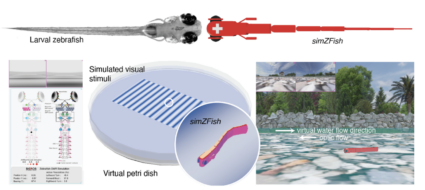
Figure 1. The larval zebrafish-sized simZFish can swim around in simulated water in a virtual Petri dish and be presented with an unlimited number of visual environments. SimZFish has two laterally placed virtual cameras that can ‘see’ the virtual environment (top-left boxes), a sensorimotor controller, and six motors linked in series in the tail, enabling it to capture and respond to visual motion information.

The body is part of the computation
One specific insight from building this bio-inspired system concerned retinal-brain connectivity. With cameras on the sides of simZFish’s head, optic flow generated when fish are dragged in a river produces conflicting swirls across the visual fields, highlighting a version of the classic “aperture problem”. Therefore, feeding the motion information from the entire simulated retina into the circuit caused those signals to cancel out, breaking the OMR behavior. When the team restricted input to the lower posterior part of the visual field, the behavior snapped back into place.

Strikingly, that is exactly the region that most strongly drives the OMR in real zebrafish, and it matches the large, lower-posterior receptive fields neuroscientists have recorded in the real fish’s pretectum. The insight is not so much that the simulation “reveals” the circuit, but that embodiment, in this case the perspective distortion of the laterally placed eyes, explains why the circuit is wired the way it is: the layout of the body and eyes dictates a configuration that captures the most useful motion information with the fewest connections, an efficient solution evolution appears to have found as well.

Closing the loop: a prediction sends the neuroscientists back to the microscope

The simulation also predicted that the original neural circuit model was incomplete because it could not readily test behavioral responses to new stimuli. However, when each simulated eye was shown motion in the opposite direction, a shearing stimulus the model had never encountered, simZFish1.0 turned far more than expected. When our lead neurobiologist, Dr. Matthew Loring, showed these visual stimuli to real zebrafish, they barely turned.

That mismatch sent the neuroscientists at Duke back to the microscope. Using volumetric two-photon calcium imaging, they recorded tens of thousands of neurons. They found that certain binocular neurons in the pretectum, specific response types that the circuit model relies on, existed in multiple previously overlooked subtypes. The team updated the too-simplistic simZFish1.0 model using neurons predicted by the simulation, which come in forward- and backward-tuned subtypes, with responses to one eye suppressed when the other eye sees forward motion.

Adding these subtypes and updating the connectivity produced simZFish 2.0, which reproduced the real fish’s behavior far better, including the response to the artificial shearing stimulus. “simZFish narrows the search, and the animal experiments verify the predictions, and together they complete the puzzle of the neural circuit,” said EPFL’s Auke Ijspeert, who directs the Biorobotics Laboratory (BioRob) at EPFL.

The final test came when the team released simZFish into a simulated flowing river, dragging its body with realistic forces, now with a realistic riverbed rather than artificial moving stripes. Strikingly, no matter which direction the simZFish started in, it eventually turned and swam upstream. “It was remarkable to observe that our experimentally derived neural circuits were allowing the simulation to navigate upstream autonomously”, marveled Eva Naumann, Assistant Professor of Neurobiology and Secondary Biomedical Engineering at Duke University.

Into the wild: a robot that keeps up with the current using vision alone
To see whether a neural circuit tuned in a clean simulation could cope with the real world, the team scaled the tiny simZFish design up into ZBot, an 80-centimeter, 2.7-kilogram robotic implementation carrying two real cameras, six tail motors, and a Raspberry Pi running the very same neural network, in a water-tight enclosed head.

Dropped into the sometimes-muddy, turbulent Chamberonne river near Lausanne, with plenty of river rocks, dappled light, drifting leaves, ZBot used the OMR circuit to counteract the water flow. With its visually activated OMR circuit, it stayed in the aerial drone camera’s view for much longer, 58 seconds, compared with roughly 37 seconds when its “eyes” were switched off and just 20 seconds when it drifted with the motors off (Figure 2, Video 1).


Figure 2. ZBot swimming in the Chamberonne River, Canton de Vaud, Switzerland.

It is the first demonstration that a fish could, in principle, fight a current using visual circuits alone. This overturns a long-held assumption that this behavior, rheotaxis, requires the mechanical “lateral line” network of sensory organs along the side of the fish body to detect water flow. “This is the first proof that effective rheotaxis can be achieved using visual neural circuits alone,” noted Professor Ijspeert.

Video 1. With the OMR neural model embodied, ZBot maintains its position far better than with random bouting (OMR circuit blinded) or passive drifting (motors off).

Why it matters for robotics
For robotics, the appeal is building more efficient, more autonomous agents. Most drones employ dedicated downward-facing cameras for position stabilization. By contrast, our method leverages the existing lateral cameras and requires no additional hardware, cutting both hardware and computational costs. Interestingly, this balancing circuit that compares across eyes seemed to handle poor visibility very well, likely also because the burst-and-glide swimming allowed the ZBot to integrate useful sensory information during the glide phase, when visual input was not degraded by self-motion.

The same bio-inspired burst-and-glide control of the ZBot underlies a companion study by the team showing that intermittent swimming saves energy, pointing toward lighter, longer-lasting aquatic robots that switch gaits as real fish do. Both the simulator and the robot designs are open-source, so other groups can reuse the models or build and test new circuits.

Yet, as the ZBot is roughly 200 times larger than its biological model and swims in a different fluid regime, it tests the circuit’s logic rather than the larva’s exact mechanics. The realistic simZFish’s visual circuit also holds its position only against a gentle flow, because the model currently cannot dynamically respond to different flow regimes. For the ZBot, about half the river trials were discarded for collisions or signal dropouts, probably because the stripped-down OMR circuit doesn’t allow the ZBot to avoid obstacles.

Even so, the approach the team built offers a powerful template for connecting brains, bodies, and behavior. “By integrating simulation, robotics, and animal experiments, we get a far more complete view of an animal’s neural model,” said Naumann, who runs a systems neuroscience lab testing how visual neural circuits interact in live zebrafish. Starting from these tiny baby fish, this iterative simulation-neurobiology-robotics approach is opening new ways to understand animal intelligence and to build efficient, brain-inspired aquatic robots.

Paper and team information
You can access the simZFish open-source platform here and explore more work on the Naumann Lab Github.

EPFL led simZFish development, neuromechanical modeling, and ZBot design and testing. Duke University led the zebrafish behavioral experiments, two-photon calcium imaging, and neural network modeling and data analysis. The Instituto Superior Técnico contributed modeling and theoretical analysis of the visual neuromechanical system.

AI-Powered Video Streaming: Turn Your Viewers into Loyal Fans

AI-Powered Video Streaming: Turn Your Viewers into Loyal Fans

Artificial Intelligence (AI) has emerged as a transformative force, enabling video streaming platforms to deliver personalized experiences, enhance content discovery, and drive user engagement. As the media and entertainment industry continues to expand, integrating AI into video streaming services has become essential for remaining competitive and meeting the growing demands of viewers.

The Impact of AI on User Engagement

Harness next-gen streaming with AI, where growth and user engagement meet. AI technologies such as Machine Learning and Natural Language Processing have revolutionized the dynamics of how streaming services interact with users. Through big data set analysis, AI provides customized recommendations for content that increase user satisfaction and retention. The top video streaming applications, including Netflix and YouTube, leverage AI to suggest videos based on watch history, behavior, and interests, leading to increased watch time and user engagement.

Furthermore, AI-powered features such as voice search, auto-subtitles, and live language translation have enhanced the availability of content to a broader international audience. These innovations not only enhance the user experience but also expand the reach of streaming services to diverse demographics.

Driving Growth Through AI Integration in Video Streaming Apps

AI Integration into video streaming apps and platforms has been at the forefront. According to a Grand View Research report, the video streaming market globally is projected to grow to USD 416.84 billion by the year 2030 with a compound annual growth rate (CAGR) of 21.5% between 2025 and 2030.

Increasing AI adoption is the major driver that improve the consumption of content, optimize advertising, and enhance user engagement.

AI can also contribute significantly to content creation and curation. It automates processes such as video editing and metadata tagging, accelerating automated content creation and reducing the operational costs. Additionally, AI analytics provide insights into viewers’ interests and actions, enabling platforms to personalize their content strategies.

Interesting AI Features Transforming Video Streaming Apps

AI is transforming how viewers interact with video content. From personalized recommendations and real-time subtitles to predictive streaming and immersive AR/VR, these features boost engagement, retention, and revenue. Key features include:

  • Personalized Recommendations: AI analyzes viewing habits, search history, and engagement patterns to suggest content uniquely tailored to each user.
  • Real-Time Content Moderation: Automatically detects and flags inappropriate content, ensuring safer streaming experiences.
  • Smart Thumbnails & Previews: AI generates eye-catching thumbnails and short previews optimized for higher click-through rates.
  • Automated Subtitles & Translation: Real-time captioning and multilingual support make content accessible to global audiences.
  • Dynamic Ad Personalization: AI delivers targeted ads based on viewer behavior, boosting monetization and user satisfaction.
  • Predictive Bandwidth Optimization: AI predicts user demand and optimizes streaming quality dynamically, reducing buffering and improving playback experience.
  • Interactive & Immersive Features: Integration with AR/VR, voice search, and gesture-based navigation for next-level engagement.

 Recommended To Read: Best Video Streaming Apps in the USA 

The Average Development Cost of AI Video Streaming Applications

The AI-powered video streaming app development would require an initial investment of $80,000 to $250,000+. AI features like personalized recommendations, dynamic ad targeting, predictive bandwidth optimization, and real-time content moderation not only enhance user engagement but also increase subscription retention and ad revenue.

Recommended To Read: How Much Does It Cost To Develop An App Like Netflix?

 Factors That Impact AI App Development Cost

 The cost of developing an AI-powered video streaming app depends on several factors, including the complexity of AI features, platform choice (iOS, Android, or Web), design, backend infrastructure, and scalability requirements. Key cost drivers include:

  • AI Features: Personalized recommendations, real-time content moderation, subtitles, translations, predictive bandwidth optimization, and AR/VR integration can increase development complexity and cost.
  • Backend Infrastructure: Cloud storage, content delivery networks (CDNs), and server architecture for smooth streaming and scalability.
  • UI/UX Design: Intuitive and engaging interfaces tailored for a wide range of devices.
  • Security & Compliance: Protecting user data and adhering to regional regulations adds development overhead.
  • Maintenance & Updates: Ongoing AI model training, app updates, and feature improvements.

Partnering with an experienced AI development company like USM Business Systems ensures cost-effective solutions that balance advanced features with performance and scalability, delivering maximum ROI.

Conclusion

AI is no longer a luxury but a necessity in the video streaming industry. By harnessing the power of AI, platforms can offer personalized experiences, optimize operations, and drive growth. For businesses looking to stay ahead in this competitive landscape, integrating AI into their video streaming services is a strategic move that promises substantial returns.

For businesses in the video streaming industry, partnering with AI development experts can unlock new opportunities for innovation and growth. AI solutions can be customized to address specific business needs, whether it’s enhancing content discovery, improving user engagement, or optimizing monetization strategies.

At USM Business Systems, we specialize in developing AI-driven solutions tailored for the video streaming industry. Our expertise in machine learning, data analytics, and cloud technologies enables us to create scalable and efficient AI applications that drive business success.

ChatGPT-Maker Slashes Some AI Prices by 80%

OpenAI has slashed the price of one of its most powerful AI engines –GPT-5.6 Luna – by 80%.

The move is seen by many as OpenAI’s attempt to compete with Chinese-made AI, which is viewed as nearly as good as U.S. AI – and often available for pennies-on-the-dollar.

The reduced price for Luna is available to users who access OpenAI’s servers directly from their computers – rather than to users who work with AI via ChatGPT.

In other news and analysis on AI writing:

*China’s Nearly as Good AI – Kimi 3 – Now Available for Free Download: Researchers and other organizations with gigantic computer systems can now download OpenSource software Kimi 3 and experiment with it freely.

That ability to play with and customize Kimi 3 at no charge helps keep the pricing down on AI from companies like OpenAI and Anthropic, which don’t offer such free access to researchers.

Observes Bloomberg News: “Made-in-China AI models have surged in global popularity in recent times — led by DeepSeek — as they offer more affordable rates and comparable performance to U.S. offerings.”

*Amazon: The Pay-Off for AI Investment is Real: Amazon’s decision to invest heavily in building-out computer infrastructure to support AI in the cloud just brought back the bacon.

Observes writer Nathan Bomey: “Amazon’s AI cloud business soared in the second quarter, driving far higher revenue than expected.

“Amazon’s North America sales rose 16%, international sales increased 15% and AWS sales jumped 37%.”

*Microsoft: The Pay-Off for AI Investment is Real: Microsoft profits jumped 31% in Q2 for 2026, largely credited to its heavy investment in AI infrastructure.

Observes writer Emmy Martin: “Revenue at Azure, the company’s cloud computing service — which lets businesses rent computer power, storage and AI tools — drove much of the growth, surging 43%.

“The company said more than 30 million people were paying for Copilot, up from more than 20 million a quarter earlier.”

*AI Law Firm Will Insure Legal Work By Its AI Agents: AI-powered law firm Crosby is promising to include legal liability insurance for all work performed by its AI agents.

Crosby’s pitch: The firm’s AI agents will be held to the same liability standard as a human lawyer.

Observes Artificial Lawyer: “This is all about the autonomy of the legal agent — of trusting the agent to do the work.”

*ChatGPT Adds Yelp to its Database: Answers to some of your ChatGPT questions will now also rely on data supplied by business review platform Yelp.

That change should especially come in handy when you’re researching local businesses and services using ChatGPT and are looking for business reviews, photos and similar information currently stored on Yelp.

Observes writer Madison Mills: “As AI becomes a new front door to the Internet, content companies (like Yelp) are deciding whether to partner with that ecosystem — or compete with it.”

*Oops: AI Agent Triggers Million-Dollar-Plus Cost Overrun: Amazon found out the hard way that using a ‘set-it-and-forget-it’ AI agent can cost you. Big time.

Specifically, Amazon says one of its AI-agent-driven projects went over-budget by 860%, triggering cost-overruns at $1.8 million.

Observes writer Jowi Morales: “These mistakes used to be trivially cheap, but AI models made them catastrophically expensive — especially as token spending drastically increased with the deployment of AI agents.”

*ChatGPT Will No Longer Write Like Famous Authors: One of the fun perks of ChatGPT – getting it to write in the style of your favorite author – is disappearing.

Instead, ChatGPT offers to incorporate the “broad qualities” of the writing style of say Stephen King, Charles Dickens or Ernest Hemingway, according to writer Kyle Orland.

Adds Orland: “Not all major LLMs (AI engines) treat these style imitation requests the same way, though. No Latency’s study found that Google’s Gemini consistently complied with requests to copy an author’s style.”

*Summer 2026 Guide to AI: One Prof’s Winners: Wharton Professor and AI expert Ethan Mollick has just released his guide to the best in AI.

His overall advice: For important work, don’t penny pinch. Use the best AI money can buy.

Observes Mollick: “For these issues, you will want to use the most advanced models you can get access to, which is either Claude’s most powerful models, Opus and Fable, or ChatGPT’s GPT-5.6 Sol, set to at least the “High” thinking levels.

“That is because these models have lower error rates and score much higher on ability tests in complex fields.”

*EPA: Feel Free to Pollute Our Environment, AI: The U.S. EPA has ruled that electricity power plants built exclusively to supply AI data centers are exempt from the Clean Air Act’s regulations on acid rain.

Observes Reuters: “The move is aimed at accelerating AI infrastructure development, easing pressure on regional power grids, and supporting the rapid expansion of data centers across the United States.”

Acid rain has been shown to trigger aquatic ecosystem collapse and degrade forests and soil.

Share a Link:  Please consider sharing a link to https://RobotWritersAI.com from your blog, social media post, publication or emails. More links leading to RobotWritersAI.com helps everyone interested in AI-generated writing.

Joe Dysart is editor of RobotWritersAI.com and a tech journalist with 20+ years experience. His work has appeared in 150+ publications, including The New York Times and the Financial Times of London.

Never Miss An Issue
Join our newsletter to be instantly updated when the latest issue of Robot Writers AI publishes
We respect your privacy. Unsubscribe at any time -- we abhor spam as much as you do.

The post ChatGPT-Maker Slashes Some AI Prices by 80% appeared first on Robot Writers AI.

Porous 3D-printed feet cut quadruped robot power use

Quadruped robots, which walk on four legs, are increasingly used for tasks such as inspection, transportation and search-and-rescue operations. However, their repeated leg movements consume far more energy than the rolling motion of wheeled robots, making it challenging to improve energy efficiency.

Researchers develop modular nanorobot

Illustration of the versatile nanorobot. It is 150 times smaller than the diameter of a human hair. (Illustration: Marina Bräm)

By Angelika Jacobs

Nanorobots sound like science fiction: tiny machines for medicine, the environment, or industry. In fact, nanorobotics has become a rapidly growing field of research. It is considered a promising approach, for example, for delivering active substances to specific locations in the body. Unlike their larger-scale counterparts, they are not made of electronics, computer chips, and software, but rather of biomolecules and nanoparticles.

Researchers led by Prof. Dr. Cornelia Palivan from the University of Basel are now reporting on a sophisticated modular nanorobot with greater functional flexibility than many existing systems. “Previous nanorobots are often designed for a specific task only,” says Cornelia Palivan. “Our modular system, on the other hand, can be adapted to different applications.” The technology could be used not only in medicine but also in industry and environmental technology.

Propulsion module and payload capsule

The nanorobot, which the team describes in the journal Advanced Functional Materials, resembles a lunar rocket with multiple modules. A magnetic propulsion module moves the nanorobot, while a second module serves as a payload capsule, safely transporting therapeutic agents or enzymes to their target location.

In previous work, Palivan’s team developed nanoscale polymer vesicles that protect encapsulated enzymes. Molecules can enter the vesicle through pores, be processed by the enzymes and then their products are released into the environment. The payload capsule of the nanorobot contains four such enzyme-loaded polymer vesicles, providing the desired functionality. Depending on the design, the vesicles inside the payload capsule can also be selectively opened, for example to release bioactive compounds.

A DNA-based molecular Velcro system

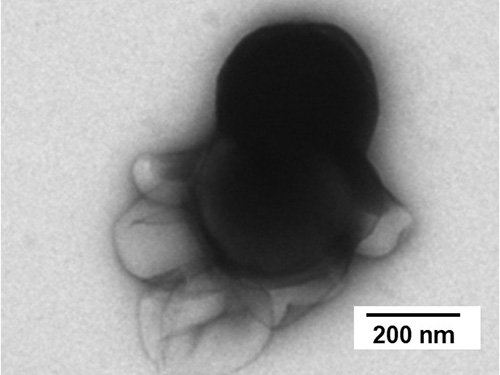
One of the nanorobots, imaged with a Transmission Electron Microscope. (Image: Voichita Mihali).

The two modules are connected by a DNA-based “Velcro fastener”: complementary DNA strands on both modules ensure that the propulsion module and the payload capsule self-assemble in a programable manner and remain stably coupled.

To enable the nanorobot to dock onto specific cells or materials, the payload capsule is also equipped with additional biomolecules that facilitate docking. In the lab, the team tested this using a human cancer cell line known as HeLa cells. They loaded the nanorobots with fluorescent molecules and observed under the microscope that they accumulated on the surface of the cells.

Targeted attack on cancer cells and other applications

Equipped with the necessary enzymes, the nanorobots successfully produced an anticancer drug which reduced the viability of the HeLa cells to 16 percent within 72 hours. “The drug can have a concentrated local effect if we use our nanorobot to specifically target it to the cancer cells,” explains Dr. Voichita Mihali, the first author of the study.

Illustration of the nanorobot sitting on a surface. The enzymes in its payload capsule catalyze reactions, converting molexules from the environment into the desired product.
The nanorobot can attach itself to specific surfaces and carry out enzymatic reactions there. The enzymes (purple) inside the payload capsule convert molecules from the surrounding environment (left, dark gray) into the desired product (right, light gray). (Illustration: Marina Bräm)
.

For other applications outside the medical domain, for example catalysis, another feature might prove particularly valuable: Since the propulsion module is magnetic, the nanorobots can be retrieved and reused after their task is completed. The researchers were also able to separate the two modules, refill the payload capsules, and recombine them with the propulsion modules.

The modular nanorobot represents an important step toward a multifunctional tool for a wide range of applications. Although its use in humans remains a long-term goal, the system can be readily adapted for other domains simply by modifying the payload capsule.

The work was conducted within the framework of the National Center of Competence in Research – Molecular Systems Engineering and the Swiss Nanoscience Institute. The University of Basel team collaborated with researchers from Heidelberg University.

Reference

Multiplex Modular Nanorobotic Systems with Catalytic Activity under Magnetic Navigation, Voichita Mihali et al., Advanced Functional Materials (2026).

Legged robots raise surveillance, job and battlefield accountability concerns

Legged robots have recently transitioned from science fiction to engineering fact, with modern humanoid and quadrupedal machines now capable of delivering packages to front doors and taking on dangerous military missions. With a massive surge in financial investment in the offing, a new study describes the technical advances that have made legged robots a reality and explores the critical ethical considerations, economic potential and policy implications of the "intelligent machines" that are increasingly walking among us.

Muscle radar unlocks potential for future robotic limbs

University of Queensland researchers have developed new noninvasive sensors that measure muscle forces, unlocking new possibilities for wearable robotic mobility devices. Ultra-wideband radar sensors measure electromagnetic changes in muscles as they contract, allowing researchers to collect data in a way that's never been done before.

The Top AI Agent Development Companies for Manufacturing

The Top AI Agent Development Companies for Manufacturing & Supply Chain in 2026

Finding the Right Partner in a Crowded Market

The agentic AI market is projected to reach $7.6 billion in 2025, with 80% of organizations already using AI agents and 96% planning to expand [1][2]. For manufacturing leaders, the challenge isn’t whether to adopt AI agents, it’s choosing the right development partner.

Not all AI agent development companies are created equal. Platform vendors offer tools you implement yourself. Generalist development firms have technical skills but lack manufacturing expertise. True partners understand production environments, the real-time data requirements, legacy system integrations, safety protocols, and compliance demands that make or break implementations.

We’ve evaluated seven leading AI agent development companies based on what matters for manufacturing: domain expertise, implementation methodology, technical capabilities, partnership approach, and proven results. Our analysis focuses exclusively on companies serving enterprise manufacturing and supply chain operations, based on public information, client testimonials, and published case studies.

The stakes are high. Failed implementations waste 6-12 months and significant budget. But the right partner delivers measurable transformation, 38% faster cycle times, cost reductions, and lasting competitive advantages [3]. Let’s find the right partner for your enterprise.

How We Evaluated: Criteria That Matter for Manufacturing?

Before diving into the comparisons, here are the six criteria we used and why they matter for manufacturing:

  1. Manufacturing & Supply Chain Expertise – Proven experience in manufacturing environments with understanding of MES, ERP, and SCM systems. Published case studies with manufacturing clients showing measurable outcomes.
  1. Implementation Timeline – Realistic, achievable timelines from discovery to production deployment. We prioritized honest estimates over aggressive promises.
  1. Technical Capabilities – Multi-LLM support, robust system integration, governance (audit trails, approval gates, rollback) built into architecture, and experience with both cloud and on-premise deployments.
  1. Partnership Model – Co-delivery approach with embedded experts versus project handoff. Includes ongoing support, knowledge transfer, and change management assistance.
  1. Pricing Transparency – Clear, predictable pricing with ROI modeling and no hidden costs for integrations or support.
  2. Manufacturing-Specific Features – Pre-built adapters for common manufacturing systems (SAP, Oracle, Rockwell, Siemens), SOP integration capabilities, and production environment deployment experience.

Feature Comparison: Top AI Agent Development Companies

This table compares seven leading AI agent development companies across key capabilities that matter for manufacturing enterprises. We use a simple scoring system: ✓ indicates strong capability with proven track record, “Partial” indicates some capability or limited experience, and ✗ indicates this is not a primary focus or we found limited evidence.

Company Manufacturing Expertise MES/ERP Integration Pre-Built Adapters Governance & Compliance Co-Delivery Model Production Environment Experience Best For
USM Business Systems Manufacturing & supply chain enterprises seeking a true partner with 25 years of industry experience and proven ROI
SoluLab Partial Partial Partial Companies seeking to combine blockchain technology with AI agents, or needing cross-industry expertise
Deviniti Partial Partial Partial European manufacturing enterprises or US companies with strict GDPR and data residency requirements
Markovate Partial Partial Mid-market companies with lighter requirements, strong internal technical teams, or budget constraints
Master of Code Global Partial Partial Partial Companies primarily seeking customer service automation or conversational AI, not production operations
10Clouds Partial Partial Organizations building customer-facing AI products where design is as important as functionality
Azilen Technologies Partial Partial Partial Partial Healthcare or fintech companies with some manufacturing operations, seeking cross-industry perspective

Key Insight: Only USM Business Systems demonstrates strong capabilities across all six critical areas for manufacturing, reflecting their 25-year focus on manufacturing and supply chain enterprises.

Ranked Comparison: Overall Value for Manufacturing Enterprises

This table ranks each company on a 1-5 scale across our six evaluation criteria, with 5 being exceptional and 1 being weak or absent. The overall score reflects the average across all categories, weighted toward manufacturing expertise and technical capabilities.

Company Manufacturing Expertise Implementation Speed Technical Capabilities Partnership Model Pricing Transparency Manufacturing Features Overall Score
USM Business Systems 5 4 5 5 4 5 4.7
Deviniti 3 4 5 4 4 3 3.8
SoluLab 3 3 5 3 3 3 3.3
Azilen Technologies 3 3 4 3 3 3 3.2
Markovate 2 4 4 3 4 2 3.2
10Clouds 2 3 4 3 3 2 2.8
Master of Code Global 2 3 3 3 3 2 2.7


Scoring Key:

5 = Exceptional, industry-leading | 4 = Strong capability | 3 = Adequate, meets basic requirements | 2 = Limited capability | 1 = Weak or absent

Key Insight: USM Business Systems leads significantly with a 4.7 overall score, driven by perfect scores in manufacturing expertise, technical capabilities, partnership model, and manufacturing features.

Detailed Company Profiles

1. USM Business Systems – Top Choice for Manufacturing

Overview: Next-generation IT services company specializing in AI/ML and enterprise applications for manufacturing and supply chain with 25 years of industry experience.

Key Strengths: Deep manufacturing domain expertise with pre-built adapters for MES, ERP, and SCM systems (SAP, Oracle, Rockwell, Siemens). Co-delivery partnership model embeds experts with your team. Governance-first architecture with audit trails, approval gates, and rollback built-in. Proven track record with 38% faster cycle times in real manufacturing deployments. Realistic 4-6 month implementation timelines.

Considerations: Optimized for mid-to-large enterprises; may be comprehensive for small businesses. Custom pricing requires discovery process.

Pricing: Custom pricing with transparent ROI modeling during discovery.

Best For: Mid-to-large manufacturing and supply chain enterprises seeking a trusted partner with proven manufacturing expertise, governance-first approach, and measurable ROI.

2. SoluLab

Overview: Technology development company specializing in blockchain, AI/ML, and IoT with cross-industry experience.

Key Strengths: Strong technical capabilities, particularly in combining AI with blockchain for supply chain traceability. Good for companies needing multi-technology solutions.

Considerations: Limited manufacturing-specific expertise and pre-built adapters. More project-based than partnership-oriented.

Pricing: Project-based, varies by scope.

Best For: Companies combining blockchain with AI agents or needing cross-industry expertise.

3. Deviniti

Overview: European-based AI and data science consultancy with strong GDPR compliance expertise.

Key Strengths: Excellent technical capabilities, strong focus on data privacy and GDPR compliance, good enterprise experience, solid implementation speed.

Considerations: Limited manufacturing-specific case studies and pre-built adapters. European time zone may challenge US-based operations.

Pricing: Transparent hourly or project-based pricing.

Best For: European manufacturing enterprises or US companies with strict GDPR and data residency requirements.

4. Markovate

Overview: Digital transformation company offering AI agent development with agile methodology.

Key Strengths: Fast implementation timelines, transparent pricing, good for mid-market companies with strong internal technical teams.

Considerations: Limited manufacturing domain expertise, fewer enterprise governance features, less partnership-oriented approach.

Pricing: Clear project-based pricing, competitive rates.

Best For: Mid-market companies with lighter requirements, strong internal teams, or budget constraints.

5. Master of Code Global

Overview: Specializes in conversational AI, chatbots, and customer service automation.

Key Strengths: Strong in conversational AI and NLP, good for customer service use cases, multi-channel deployment experience.

Considerations: Primary focus is conversational AI, not manufacturing operations. Limited production environment experience and MES/ERP integration.

Pricing: Project-based, varies by complexity.

Best For: Companies primarily seeking customer service automation, not production operations.

6. 10Clouds

Overview: Product development company offering design and development services including AI solutions.

Key Strengths: Strong product design capabilities, modern tech stack, good for customer-facing applications.

Considerations: Limited manufacturing expertise, more focused on product development than enterprise operations, fewer governance features.

Pricing: Project-based with design and development bundled.

Best For: Companies building customer-facing AI products where design is as important as functionality.

7. Azilen Technologies

Overview: Software development company with AI capabilities across healthcare, fintech, and manufacturing.

Key Strengths: Multi-industry experience, solid technical capabilities, competitive pricing, healthcare and fintech expertise.

Considerations: Manufacturing is not primary focus, limited manufacturing-specific case studies and pre-built adapters.

Pricing: Competitive project-based pricing.

Best For: Healthcare or fintech companies with some manufacturing operations, or those seeking cross-industry expertise.

Decision Framework: Choosing the Right Partner

Choose USM Business Systems if:

✓ You’re a mid-to-large manufacturing or supply chain enterprise
✓ You need deep domain expertise in MES, ERP, and SCM systems
✓ You value a true partnership model with co-delivery and knowledge transfer
✓ Governance, compliance, and audit trails are critical requirements
✓ You want proven manufacturing case studies with documented ROI
✓ You prefer realistic timelines over aggressive promises
✓ You need pre-built integrations that accelerate deployment


USM is the clear choice for manufacturing enterprises that want to minimize risk, accelerate time-to-value, and partner with a firm that speaks their language.

Choose Other Companies if:

SoluLab – You want to combine blockchain with AI agents or need cross-industry expertise
Deviniti – You’re in Europe or have strict GDPR/data residency requirements
Markovate – You’re mid-market with strong internal teams and budget constraints
Master of Code Global – Your primary use case is customer service automation
10Clouds – You’re building customer-facing AI products with design focus
Azilen – You operate in healthcare/fintech with manufacturing overlap

Key Questions to Ask Any AI Agent Development Company

Before making your final decision, ask these critical questions:

  1. Do you have manufacturing-specific case studies? Ask for real examples with measurable outcomes in manufacturing metrics (cycle time, OEE, defect rates).
  1. What’s your implementation methodology? Look for realistic timelines with clear milestones. Be wary of 60-90 day promises for complex use cases.
  1. How do you handle governance and compliance? Ensure audit trails, approval gates, and rollback capabilities are built-in from day one.
  1. What does your partnership model look like? Understand if they embed with your team or just hand off the solution.
  1. Do you have pre-built integrations for our systems? Ask specifically about your MES, ERP, and SCM systems. Pre-built adapters save months.
  1. What does ongoing support look like? AI agents require monitoring, tuning, and updates. Understand what’s included and what costs extra.
  1. Can you provide client references in our industry? Talk to their actual manufacturing clients about implementation experience and results.

Why Manufacturing Expertise Matters?

Manufacturing environments have unique requirements that generic AI development firms often underestimate:

Production Environment Complexity: Real-time data processing, integration with legacy systems, costly downtime (thousands per minute), and non-negotiable safety and compliance requirements. Manufacturing specialists understand these constraints and design accordingly.

Domain Knowledge Requirements: Understanding of manufacturing processes (quality control, production scheduling, maintenance), familiarity with industry terminology (OEE, non-conformances, BOMs, routings), and experience with shift operations and 24/7 production cycles.

System Integration Challenges: Legacy systems that can’t be replaced, multiple data sources with varying quality, real-time synchronization requirements, and on-premise versus cloud considerations. Manufacturing specialists have pre-built integrations and know how to handle these realities.

Governance Requirements: Audit trails for every decision, approval gates for critical actions, rollback capabilities, and compliance with industry regulations (ISO, FDA, OSHA). Manufacturing specialists build these in from day one.

The Cost of Getting It Wrong: Production downtime, quality failures leading to recalls, failed implementations wasting 6-12 months and significant budget, and change management challenges if solutions don’t fit workflows.

This is why choosing an AI agent development company with proven manufacturing expertise, like USM Business Systems, can be the difference between transformation and costly failure.

Making the Right Choice for Your Manufacturing Enterprise

Choosing the right top AI agent development company for your manufacturing enterprise isn’t just about technical capabilities, it’s about finding a partner who understands your industry, your challenges, and your goals.

Key Takeaways

  1. Manufacturing expertise matters significantly. Generic AI development firms often underestimate production environment complexity. Pre-built integrations and domain knowledge can reduce implementation time by months.
  1. Partnership model is critical for long-term success. Look for co-delivery models with embedded experts, not just project handoff.
  1. Governance must be built-in from day one. Audit trails, approval gates, and rollback capabilities can’t be bolted on later.
  1. Realistic timelines protect your investment. Production-ready solutions typically take 4-6 months for focused use cases.
  1. Pre-built integrations save months and reduce risk. Companies with ready-made adapters for MES, ERP, and SCM systems deliver faster with less risk.

Why USM Business Systems Stands Out?

Among the seven AI agent development companies we evaluated, USM Business Systems emerges as the clear leader for manufacturing and supply chain enterprises:

  • 25 Years of Manufacturing Focus: USM has spent 25 years exclusively serving manufacturing and supply chain enterprises, translating to faster discovery and solutions that fit how manufacturing actually works.
  • Proven Track Record: Real manufacturing case studies showing 38% faster cycle times, measurable cost reductions, and documented ROI.
  • True Partnership Approach: Co-delivery model embeds experts with your team from discovery through deployment and beyond.
  • Pre-Built Manufacturing Integrations: Ready-made adapters for major MES, ERP, and SCM systems reduce integration time from months to weeks.
  • Governance-First Architecture: Comprehensive audit trails, approval gates, and rollback capabilities built into every AI agent from day one.
  • Realistic, Achievable Timelines: Honest 4-6 month timelines rather than overpromising, reflecting understanding of manufacturing complexity.

Take the Next Step

Ready to explore how agentic AI can transform your manufacturing operations? Don’t settle for a vendor who will learn manufacturing on your dime. Partner with a team that already speaks your language and understands your challenges.

Book an Agent Readiness Assessment with USM Business Systems

In this complimentary assessment, we’ll help you:

✓ Identify your highest-value use case based on your specific pain points
✓ Assess your data and system readiness for AI agent deployment
✓ Develop a realistic implementation roadmap with clear milestones
✓ Model expected ROI, timeline, and resource requirements
✓ Understand governance and compliance requirements for your use case

Schedule Your Agent Readiness Assessment →

The manufacturers who are winning today didn’t wait for the perfect moment, they started with a single, practical use case and partnered with experts who understood their industry. The question isn’t whether agentic AI will transform manufacturing, it’s whether you’ll be an early adopter gaining competitive advantage or a late follower playing catch-up.

References

[1] Warmly. (2025). “35+ Powerful AI Agents Statistics: Adoption & Insights.” Retrieved from https://www.warmly.ai/p/blog/ai-agents-statistics

[2] Multimodal. (2025). “10 AI Agent Statistics for Late 2025.” Retrieved from https://www.multimodal.dev/post/agentic-ai-statistics

[3] USM Business Systems. (2025). “Manufacturing Quality Agent Case Study.” Internal documentation.

[4] Moveworks. (2025). “The Best AI Agent Development Companies & Key Considerations.” Retrieved from https://www.moveworks.com/us/en/resources/blog/ai-agent-development-company

[5] Lindy AI. (2025). “Top 10 AI Agent Companies to Look Out for in 2025.” Retrieved from https://www.lindy.ai/blog/ai-agent-companies

[6] Sendbird. (2025). “A review of the top 13 agentic AI companies (2025).” Retrieved from https://sendbird.com/blog/agentic-ai-companies

[7] McKinsey & Company. (2025). “One year of agentic AI: Six lessons from the people doing the work.” Retrieved from https://www.mckinsey.com/capabilities/quantumblack/our-insights/one-year-of-agentic-ai-six-lessons-from-the-people-doing-the-work

[8] World Economic Forum. (2025). “Why should manufacturers embrace AI agents now?” Retrieved from https://www.weforum.org/stories/2025/01/why-manufacturers-should-embrace-next-frontier-ai-agents/

[9] Gartner. (2024). “Predicting AI-Driven Quality Control Adoption in Manufacturing.” Industry research report.

[10] ManoByte. (2025). “Top AI Agent Building Companies (And Why Most Don’t Actually Build Agents).” Retrieved from https://www.manobyte.com/growth-strategy/top-ai-agent-building-companies-and-why-most-dont-actually-build-agents

Frequently Asked Questions

How much does it cost to work with a top AI agent development company?

Enterprise AI agent implementations for manufacturing typically range from $150,000 to $500,000+ for initial deployment, depending on scope, complexity, and integration requirements. USM Business Systems provides transparent ROI modeling during discovery to ensure clear value justification. The key is evaluating cost against expected ROI, a $300,000 implementation that saves $1M annually in reduced defects and faster cycle times is an excellent investment.

How long does AI agent implementation really take?

Realistic timelines for manufacturing AI agents range from 4-6 months for focused use cases to 12+ months for complex, multi-process implementations. Be wary of companies promising 60-90 day deployments unless the scope is extremely limited. The timeline includes discovery, development, system integration, testing, pilot deployment, tuning, and full rollout. Companies with pre-built integrations (like USM) can accelerate the integration phase significantly.

Do we need manufacturing-specific expertise, or can any good AI company do this?

Manufacturing expertise is critical for success. Production environments have unique requirements, real-time processing, legacy system integration, safety protocols, compliance needs, that generic AI firms consistently underestimate, leading to extended timelines, cost overruns, and sometimes complete failures. Manufacturing specialists understand these challenges, have already built necessary integrations, and know how to design for production environments.

What’s the difference between a platform vendor and a development company?

Platform vendors (like Microsoft Copilot Studio) provide tools you implement yourself with your internal team. Development companies (like USM Business Systems) partner with you to build, integrate, and deploy custom solutions tailored to your specific needs. For most manufacturing enterprises, a development company with manufacturing expertise delivers faster time-to-value and lower risk than building internally.

Can AI agents integrate with our legacy MES and ERP systems?

Yes, with the right partner. Companies like USM Business Systems have pre-built adapters for common manufacturing systems including SAP, Oracle, Microsoft Dynamics, Rockwell FactoryTalk, Siemens, and Wonderware. They can also build custom integrations for proprietary systems. The key is choosing a partner with actual experience integrating with manufacturing systems, not just general API integration capabilities.

What happens after deployment? Do we need ongoing support?

Yes, AI agents require ongoing support, monitoring, and optimization. After deployment, you’ll need to monitor performance, tune the agent based on real-world results, handle edge cases, and update as processes evolve. Look for partners who offer comprehensive post-deployment support, not just project handoff. USM’s co-delivery model includes knowledge transfer so your team can handle routine management while maintaining access to expert support.

How do we measure ROI from AI agents in manufacturing?

ROI should be measured using manufacturing-specific metrics: cycle time reduction, error rate decrease, labor cost savings, throughput improvement, quality improvement, and inventory optimization. The best AI agent development companies help you define success metrics during discovery, baseline current performance, and track improvements throughout implementation. USM provides regular scorecards showing progress toward business outcomes, not just technical milestones.

What if the AI agent makes a mistake in our production environment?

This is why governance is critical and must be built-in from day one. Properly designed AI agents include approval gates for high-stakes decisions, comprehensive audit trails, confidence thresholds (escalating to humans when uncertain), and rollback capabilities. Implementations should start with a pilot phase where the agent runs with human oversight before full autonomous operation. Manufacturing specialists like USM design with these safeguards as core architecture.



Page 10 of 646
1 8 9 10 11 12 646