Today, an intelligent robotic platform simultaneously has to run real-time multi-axis motion control, processes multiple data streams from various sensors including 2D and 3D vision cameras and/or LIDAR.
Researchers at Penn have created a hybrid light-matter particle that could dramatically speed up AI computing while using far less energy. The breakthrough may help replace some electronic computing processes with ultra-efficient light-based technology.
The race to production-ready agentic AI is on — but for most enterprises, the finish line keeps moving. Models get built, pilots get run, and then teams hit a wall: the infrastructure, security, governance, and operational requirements for running AI agents at enterprise scale are far more complex than any single tool or vendor anticipated. At Dell Technologies World, DataRobot and Dell are showing what it looks like when those pieces come together — on infrastructure you own, on your terms. Today, DataRobot is also announcing new capabilities for managing workloads, ACLs, and agent identity.
Who’s building the agentic AI factory — and what’s standing in their way
The core challenge isn’t building AI agents — it’s running them in production on your own infrastructure in a way that is secure, scalable, reliable, compliant, and cost-effective all at once. Today that requires stitching together a custom runtime from open-source tools and proprietary vendors — expensive, slow, and still leaving gaps in observability, governance, and cost control. Every team in IT has a distinct stake in how it gets solved:
IT Ops and ML Ops engineers need to ensure GPU and CPU resources are available on demand, that expensive compute resources aren’t idling between workloads, and that mission-critical agent systems stay resilient through infrastructure outages.
Data scientists and application developers need continuous visibility into behavioral metrics like accuracy and hallucination rates alongside operational metrics like latency and cost — plus real-time intervention for toxic content and PII, and the ability to connect agents to institutional knowledge across enterprise systems.
Security Ops teams must ensure agents access only what they’re authorized to — without becoming backdoors to restricted data — with approval workflows guarding against unauthorized deployments.
Enterprise CIOs have become de facto owners of the AI runtime itself, responsible for IT Ops, Security Ops, and compliance, while also providing centrally approved tooling to data scientists and developers across the business.
Four problems you have to solve to take agents to production
Getting from a working prototype of one agent to a governed production scale workforce of thousands of agents means solving four interconnected challenges that most organizations underestimate:
Scalable, reliable, cost-effective inference. Production agents need consistent latency, high availability, and efficient GPU utilization — without a team dedicated to managing the underlying infrastructure or absorbing unpredictable cloud billing.
Embedded governance and monitoring. Governance can’t be bolted on after deployment. Behavioral monitoring, real-time guardrails, automated compliance reporting, and full cost visibility need to be built into the runtime from day one.
Secure context, knowledge, and tools management. Agents need access to institutional knowledge across documents, emails, CRMs, and business systems — but that access must respect existing security controls and access policies, not route around them.
Security and identity management. Agents are the new workforce and need even more controls than employees. This introduces identity and access challenges that traditional IT controls weren’t designed for — requiring agent-specific permissions, approval workflows, and revocation capabilities that operate at the speed security incidents demand.
How DataRobot and Dell AI Factory solve it — together
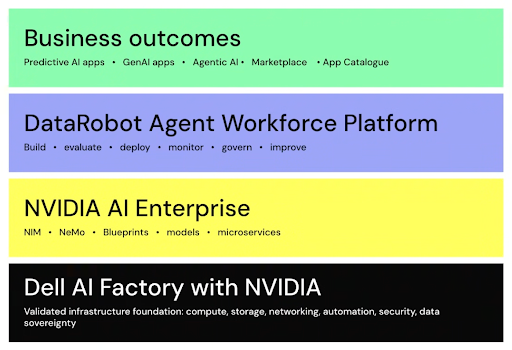
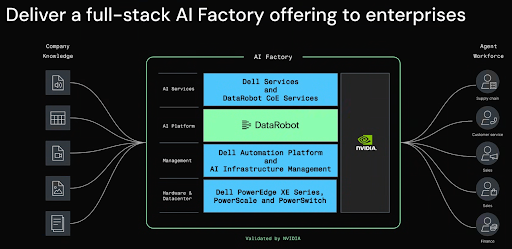
DataRobot on Dell AI Factory with NVIDIA is purpose-built to address every layer of the production challenge — delivered through a pre-validated DataRobot blueprint on the Dell Automation Platform that takes enterprises from bare metal to a running, governed agent workforce in hours, not months.
Scalable, reliable inference. Dell PowerEdge XE9680 and XE9780 servers with NVIDIA Blackwell GPUs, Dell PowerScale storage, and NVIDIA Spectrum-X networking provide the compute foundation. The runtime of the DataRobot Agent Workforce Platform, co-engineered with NVIDIA, includes NIM microservices and maximizes throughput and minimizes latency — with predictable on-premise economics replacing unpredictable cloud billing. DataRobot provides same region and cross-region high availability and multi-tenancy with token quota allocation and management for fair-sharing of LLM inference endpoints.
Embedded AI governance and monitoring. Real-time guardrails powered by NVIDIA NeMo Guardrails and other open source guardrails, continuous behavioral and operational monitoring with the broadest suite of out-of-the-box operational and behavioral metrics, automated compliance reporting, and full cost visibility come out of the box — keeping every agent audit-ready without additional integration work. DataRobot has a single pane of glass for observability into the entire AI ecosystem in an enterprise, or if you choose, you can export all metrics, logs and traces using our OTel collectors to your favorite dashboard. Built-in governance for models, agents and applications against security risks, compliance risks and operational risks, and approval workflows to guard against unauthorized deployments.
Secure context, knowledge, and tools management. DataRobot has everything you need for enterprise connectivity and access to both structured data and unstructured data. This includes managed RAG workflows with a choice of popular vector databases (VDBs), native context memory management, and MCP server support for tools and skills. You can use DataRobot-provided or your own MCP servers.
Security and identity management. The entire DataRobot Agent Workforce Platform runs within your own infrastructure perimeter, with existing enterprise Role Based Access Controls controls enforced at runtime. Integration with key IDPs like Okta. Along with the previous point, this helps to deliver comprehensive end-to-end governance across AI, IT, and infrastructure.
Build, deploy, and run on your terms
DataRobot on Dell AI Factory meets organizations where they are. Developers build using the frameworks they already know — LangChain, LlamaIndex, or any OSS tooling — and deploy from their preferred IDE with a single command. Agents connect to the data stores and enterprise systems already in use, with context and memory management built in. Workloads run wherever the business requires: on-premise, at the edge, in air-gapped or sovereign environments, or across hybrid cloud. The stack flexes to match your architecture — not the other way around. In addition, today DataRobot is announcing new capabilities to manage workloads, ACLs, and agent identity.
What’s new: capabilities we’re announcing at Dell Technologies World
Unified Workload API: one interface for every AI workload
The DataRobot Unified Workload API gives enterprises a single interface for deploying, managing, and governing every type of AI workload — from traditional models to complex multi-component agentic applications. Whether you’re deploying a containerized agent, an NVIDIA NIM microservice, an MCP server, or a full agentic application with front end, back end, tools, and guardrails, it all goes through one consistent interface. The platform automatically registers workloads as governed artifacts from creation — moving through draft, locked, and deployed states with full lineage tracking — eliminating the tradeoff between iteration speed and production compliance. IT administrators get unified visibility and governance across all workload types; developers go from code to a running, monitored agent in minutes.
ACL Hydration: enterprise knowledge without the security risk
Most RAG implementations ingest enterprise documents into a vector database with no record of who was authorized to see them — creating exactly the risk that causes security teams to block AI rollouts. ACL Hydration solves this by preserving ACLs (Access Control Lists) from docs in data sources (like SharePoint, Google Drive, Confluence, Jira, and Slack) when contents of those docs are stored in VDB of a RAG system at ingestion time. When the RAG vector database is accessed, this enforces the source ACLs, which are preserved alongside RAG. When permissions change in the source system, DataRobot refreshes the ACL graph automatically — so agents never operate on stale permissions, and when a user is removed from a source system, they get automatically removed in near-real time to protect against rogue activity. For Dell AI Factory customers running sensitive workloads on-premises, this give agents the full context of your enterprise without turning agents into a backdoor.
Identity-first AI governance: agents as first-class enterprise identities
Most enterprise AI agents today authenticate through static API keys or shared credentials — meaning their actions are logged against a developer key, not a distinct governed identity. In a non-deterministic system, that ambiguity is a real security liability: attribution breaks down, least privilege weakens, and containment requires rotating credentials instead of disabling a governed identity. The identity-first governance model from DataRobot, provisions agents as first-class identities directly inside the corporate identity provider — authenticated via short-lived, policy-controlled tokens, with every action attributed to a specific autonomous actor and permissions adjustable without touching code. Agents operate inside the same control plane that secures your workforce, with centralized revocation authority that works at the speed incidents actually require.
See it in action at Dell Technologies World
DataRobot and Dell will be together at Dell Technologies World, May 18-21 in Las Vegas. Come see the Agent Workforce Platform running live on Dell AI Factory with NVIDIA, and learn how organizations across financial services, healthcare, manufacturing, and the public sector are moving from AI experiments to production-grade agent workforces on infrastructure they own and control.
What if robots could not only perform experiments but also adapt and improve alongside human scientists? The goal is to create robots that can work alongside scientists in real lab environments and adjust to changing conditions.
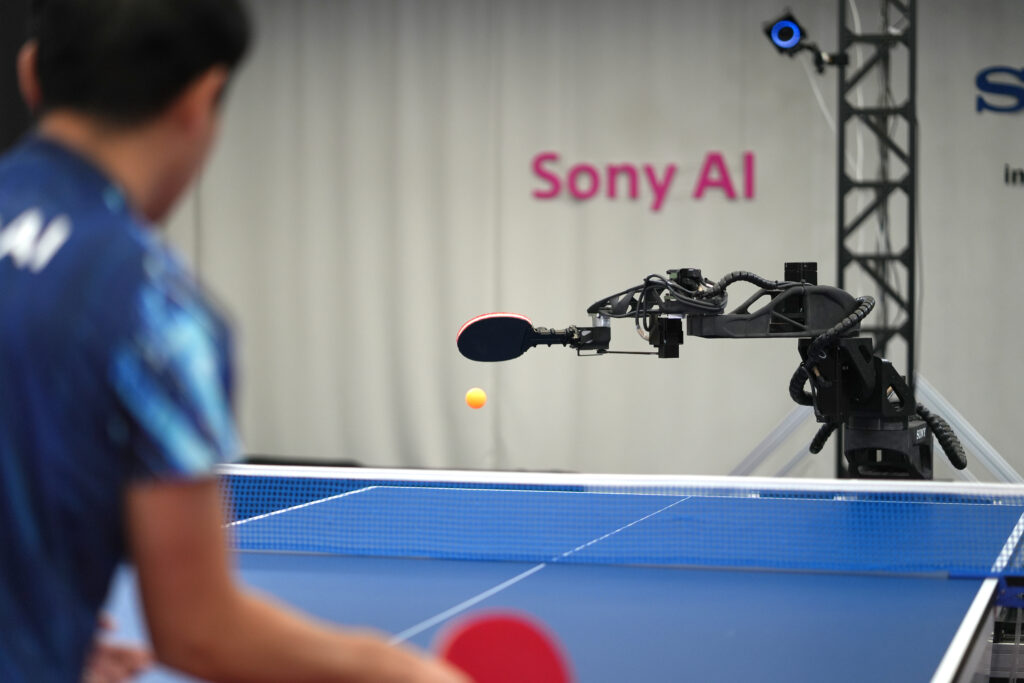
Ace rotates its paddle as it prepares to return the ball back to its human opponent, Yamato Kawamata, during a match in December 2025. Credit: Sony AI.
A table tennis robot has outperformed elite players in recent evaluations. The robot, called Ace, marks a significant step toward artificial intelligence (AI) systems that can operate in fast, uncertain, real-world environments.
In the tests, the autonomous robot won three out of five matches against elite players – competitive athletes with over ten years’ experience and an average of 20 hours weekly training. The robot, developed by Sony AI, lost both matches against players in professional Japanese leagues, but did win a game against one of them. The system is described in detail in a recent paper published in Nature.
AI has spent decades mastering games. It has repeatedly outperformed the best humans in everything from complex video games like StarCraft II to chess – where modern programs now far exceed human ratings.
Landmark systems such as Deep Blue and AlphaGo have confirmed that, given clear rules and enough data, AI can achieve superhuman performance. But these victories all shared one key feature: they happened in controlled, digital environments.
At first glance, table tennis might seem like an unusual benchmark for artificial intelligence. In reality, it is one of the most demanding imaginable. The ball can travel faster than 20 metres per second, giving players less than half a second to react.
On top of that, spin introduces enormous complexity. A ball rotating at extreme speeds can curve mid-air and rebound unpredictably off the table. For humans, interpreting spin is largely intuitive. For robots, it has been a longstanding obstacle.
This robot can beat you at table tennis (Nature).
Earlier table tennis robotic systems such as Forpheus, developed by Japanese company Omron, addressed this by simplifying the game – using controlled ball launchers, limiting movement, or ignoring spin altogether. More recent iterations have aimed for interaction, but still operate under constrained conditions.
Ace does none of this. It plays with standard equipment, on a regulation table,
against human opponents who are free to use the full range of shots.
How Ace works
Ace’s performance relies on three key innovations: how it sees the world, how it
decides what to do, and how it carries out those actions. First, let’s deal with how Ace sees the world. Traditional cameras struggle with fast motion, often producing a blur or missing critical details.
Ace instead uses three “event-based” vision sensors, which detect changes in light rather than capturing full images at fixed intervals. These are complemented by nine high-speed cameras that track the environment, including the opponent and their racket.
Together, these systems enable high-speed gaze control (the technology that enables a robot to direct its sensors to focus on specific things) and allow the robot to follow the ball with exceptional real-time precision.
By tracking markings on the ball, where professional players can generate spin approaching 9,000 revolutions per minute (rpm), the system can estimate spin in real time, something that has long challenged robotic systems.
How Ace’s gaze control system works (Sony AI and Nature).
The second important innovation is how Ace decides what to do. Knowing where the ball is going is only half the problem; the robot must also respond instantly. Ace uses deep reinforcement learning, trained in simulation over millions of virtual rallies, including self-play.
It continuously generates movement commands for its multi-jointed robotic arm, recalculating trajectories every few tens of milliseconds while avoiding collisions with the table or itself.
The third innovation is how Ace carries out its actions. To match the speed of human elite players, the robot is built around a high-performance arm combining two prismatic (sliding) and six revolute (rotational) joints. This enables rapid sideways motion and precise striking. There is both a table tennis racket and a mechanism for ball handling, allowing one-armed serves.
Crucially, the system is engineered for high-speed interaction: lightweight structures and optimised actuation (the mechanisms in a robot that convert energy into mechanical force) allow Ace to return balls at speeds approaching 20 metres per second. This enables sustained, competitive rallies with skilled human players.
Ace makes a split section change when the ball hits the net (Sony AI and Nature).
What makes this particularly notable is the transition from simulation to reality. Many AI systems perform well in virtual environments but fail when exposed to real-world noise and uncertainty. Ace demonstrates that this “sim-to-real” gap can be meaningfully reduced.
One moment during a rally with an elite player illustrates the way that Ace has leapt over this gap. When a predicted ball trajectory suddenly changed after clipping the net, Ace reacted almost instantly, returning the shot and winning the point. What makes Ace particularly significant is therefore not just its performance, but its ability to operate reliably under real-world uncertainty.
Why this matters beyond sport
A robot returning high-speed topspin shots may be entertaining, but the implications go far beyond table tennis. In manufacturing, for example, robots are typically confined to highly structured tasks.
The real challenge is adaptability, handling irregular objects, responding to variation. This is particularly relevant for next-generation robots operating in unstructured environments.
To function effectively in homes, hospitals or construction sites, robots must be able to predict, adapt and respond to constantly changing conditions. The same predictive and control capabilities that allow Ace to respond to unpredictable shots could enable more flexible, responsive automation.
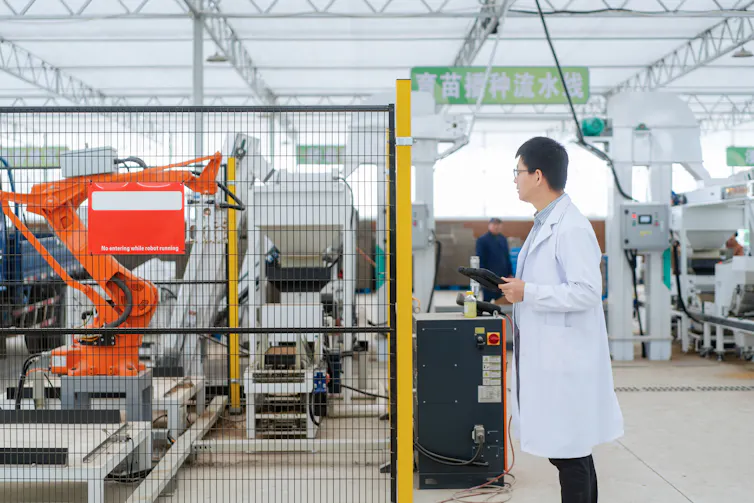
Most industrial robots are kept behind safety barriers because they cannot respond to unexpected human behaviour. Zhu Difeng
There are also implications for human–robot interaction. Most industrial robots are kept behind safety barriers because they cannot react quickly or reliably enough to unexpected human behaviour. Ace operates at the edge of human reaction time, suggesting a future where robots can safely collaborate with people in shared spaces.
More broadly, this work represents a shift in what AI is expected to do. The next frontier is not just intelligence in abstract problem-solving, but intelligence embedded in the physical world. The gap between simulations and reality needs filling, and this is a big step forward.
What humans still do better
Professional players were still able to exploit Ace’s limitations – particularly in reach, speed, and the ability to handle extreme or highly deceptive shots. This highlights that intelligence is not just about prediction and control, but also about physical embodiment. Humans combine perception, movement and strategy in ways that remain difficult to replicate.
Interestingly, systems like Ace may end up enhancing human performance rather
than replacing it. As one former Olympic player observed after facing the robot,
seeing it return seemingly impossible shots suggests humans might be capable of more than previously thought.
Electric vehicles are pushing scientists to tackle one of the biggest hidden energy drains inside electric motors: magnetic energy loss. Now, researchers in Japan have developed a powerful AI-driven physics model that can peer into the chaotic “maze-like” magnetic patterns inside motor materials and reveal how heat and microscopic magnetic structures trigger wasted energy.
Dubbed Rambler, the new dictation capability – which will be rolled out over many months — has been built into the widely used Android keyboard app Gboard.
Observes writer Ivan Mehta: “In the past few years, a host of dictation apps — Wispr Flow, Willow, Superwhisper, Monologue, Handy and Typeless — have cropped up. But until now, most of that activity has been on desktop and iOS, leaving Android relatively underserved.”
But the truth is, Google’s AI writing – along with AI writing from ChatGPT, Anthropic and others – has grown increasingly conservative and bland and often overrides prompt ‘fixes’ designed to overcome those limitations.
The straitjacket approach to writing has driven some creators — who demand the most flexible AI creative writing tools available — to seek Open Source AI solutions.
The factor that may be behind that ceiling on AI writing: Human-created writing seems to be doing better in search engine returns.
Observes writer Chloe Aiello: “According to the analysis (by digital marketing agency Graphite), 86% of articles appearing in Google Search — and 82% of those that appear on ChatGPT and Perplexity — were written by people.”
The AI-powered solution uses an ‘AI host’ to create a 30-minute, Q&A interview with you on your book – which it auto-posts to Spotify, Apple Podcasts and Amazon Music after your approval.
The platform also generates three vertical video clips per episode formatted for TikTok, Instagram Reels and YouTube Shorts — giving authors short-form promotional content.
*Getting Your Feet Wet in Vibe Coding: Writers interested in vibe-coding their own apps may want to check-out this quick primer from writer Nicole Nguyen.
In a perfect world, AI vibe-coding enables you to create a wide array of apps you can imagine simply by chatting with AI.
Observes Nguyen: “I will admit, at times I wanted to hurl my laptop into the Pacific. Resolving some issues took a lot of polite — and desperate — pleading with a machine. Again, all in plain English. But it worked.”
That’s the pitch from OpenAI – the maker of ChatGPT – which says that in exchange for your banking logon credentials, it will analyze and give you advice on your finances.
Observes writer Ivan Mehta: “OpenAI said its personal finance tools will be available on ChatGPT on the Web and on iOS for Pro users.”
Observes lead writer Aisvarya Chandrasekar: “AI platforms are releasing agentic tools like ChatGPT Pulse and Huxe, which generate personalized news briefings based on information the platforms have stored about us—our calendars, emails, interests and preferences.”
Adds Chandrasekar: More than 75% of news executives expect this new breed of agentic apps to have a ‘large’ or ‘very large’ impact on news publishers.”
Observes writer Sarah Sweeny: “Poynter has been helping newsrooms and their audiences navigate AI for several years, and the new hub centralizes Poynter’s services, training and resources.
“The aim is to help newsrooms use AI responsibly without losing audience trust, while helping audiences better understand how AI is shaping the information they consume.”
Share a Link: Please consider sharing a link to https://RobotWritersAI.com from your blog, social media post, publication or emails. More links leading to RobotWritersAI.com helps everyone interested in AI-generated writing.
–Joe Dysart is editor of RobotWritersAI.com and a tech journalist with 20+ years experience. His work has appeared in 150+ publications, including The New York Times and the Financial Times of London.
 Ace rotates its paddle as it prepares to return the ball back to its human opponent, Yamato Kawamata, during a match in December 2025. Credit: Sony AI.
 Most industrial robots are kept behind safety barriers because they cannot respond to unexpected human behaviour.


