Page 1 of 646
1 2 3 646

This design software reimagines everyday objects as self-aware devices

As a child, you likely saw a few Disney movies depicting inanimate objects, such as clocks, cups and toys, as interactive companions to humans—an act of pure magic, seemingly. But scientists at MIT's Computer Science and Artificial Intelligence Laboratory (CSAIL) are now doing something similar: transforming stationary items into self-aware tools that perceive and respond to human motion to complete a task.

Robots in society, business and culture: August 2026

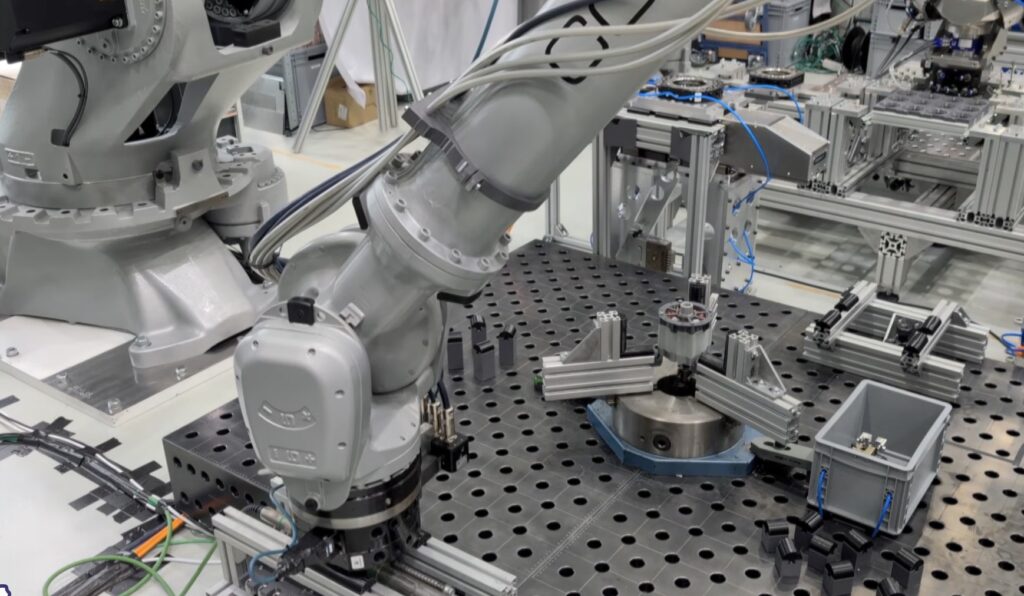
Credit: Baumis Robots (Karlsruhe Institute of Technology).

By Emmet Cole

In our new monthly series, we showcase a selection of robotics stories from society, business, research, and culture, as we track the field’s ongoing journey from specialized industrial machines to an increasingly visible social phenomenon.


Reshoring reimagined?

In early August, The Information published an article that claimed U.S.-based founders, investors and startups, are travelling to an electronics market in Shenzhen to buy servomotors, sensors, controllers and gimbals. The report also claimed that Unitree and Zhiyuan robots are being bought intact, then stripped down into parts and carried back to the USA in suitcases.

By late August, in a separate development, reports emerged that a US Department of Energy lab is investigating whether Chinese LiDAR sensors pose a security risk, if widely used on vehicles in the United States. According to TechCrunch, the research is being funded by one or more companies in the electric and autonomous vehicle industries.

Together, the stories highlight the ongoing tension between US security concerns and its robotics industry’s continuing dependence on Chinese hardware.

Motorless shape shifters

Don’t cancel any Shenzhen travel plans just yet, but engineers at Princeton have unveiled a motorless, origami-inspired robot that can roll, crawl, and change shape through a combination of magnetic control and multistable geometry.

Project lead Glaucio Paulino told Princeton Engineering:

Geometry is the real actuator here. Instead of relying on complicated mechanisms, we use mathematical principles to encode multiple stable configurations directly into the structure. That opens a new pathway for designing lightweight, adaptable systems.

Managing expectations

Robot deployments can fail for many reasons, making expectation management a key part of successful robotics projects. This might mean explaining that although collaborative robots can sometimes be deployed without fencing, that is not appropriate for every application, and a risk assessment is still required.

It might mean explaining that although robot-assisted radical prostatectomy typically reduces blood loss and shortens hospital stays compared with open surgery, longer-term outcomes depend heavily on the patient, the cancer and the surgeon.

In the humanoid space, where expectations are often formed by spectacle and driven by anthropomorphism and millions of years of evolution, the effects can be particularly acute.

A Drexel-led study involving 50 adult men that measured brain activity, hormones, self-reported attitudes and behaviour in order to assess trust in human-humanoid interaction, found that participants formed stronger initial connections with an expressive Pepper robot than with a stationary version that gave no nonverbal cues.

But when the expressive robot made errors, the participants’ brains responded as they would to a person breaking a social norm, rather than a machine making a technical error.

Counterintuitively:

[…] levels of “the bonding hormone,” oxytocin, which is typically present in higher amounts among friends, relatives and romantic partners, actually rose in participants as the engaging robot made mistakes. This led [researchers] to believe that the hormone functions as a warning signal, rather than a sign of connection, in human-robot interactions.

Read the full Science Robotics paper here.

Beyond automotive

For decades, the automotive sector has been the leading segment for robotics adoption. That’s still the case, but as the latest North American Q2 figures from the Association for Advancing Automation (A3) show, automotive OEM’s share is continuing to slide as robots diversify across other industry segments.

Notably, North American companies ordered 8,940 robots valued at US$622 million in the second quarter of 2026, a 4.3% increase in units ordered and a 21.3% increase in revenue, according to A3’s numbers.

Recycling robots

IEEE Spectrum profiled an automated recycling system developed by researchers at Germany’s Karlsruhe Institute of Technology. The system uses CAD data, physical observations and a predictive algorithm to predict defects in products and adapt its disassembly strategy while protecting valuable components.

All eyes on China

As August came to a close, the eyes of the robotics world (and the general public) turned to Beijing, China as the city played host to both the World Robot Conference (WRC) and the World Humanoid Robot Games.

The WRC, primarily a showcase of Chinese products, brought together ~300 companies exhibiting more than 2,000 products. These included robots for parcel sorting, manufacturing, surgery and domestic work.

Unitree supplied much of the spectacle with its remarkably fast “Superman” humanoid and an extraordinary stock-market debut. Its shares closed 460% above the IPO price, although by August 28 they had fallen almost 30% -another lesson in managing expectations. CEO Wang Xingxing also predicted that robotics is approaching a “ChatGPT moment”.

The World Humanoid Robot Games brought the theme of spectacle versus reality to another level. Robots kick-boxed, played table tennis, performed gymnastic routines, and played football. There were moments of hilarity…

…and some genuinely impressive technology demonstrations.

After watching several hours of livestreams from the games across several days, and looking at the print media coverage, I began to wonder whether events like these help people manage expectations around robots much.

The media focus on spectacle doesn’t help. Yes, a humanoid ran at Usain Bolt-like speeds and then into a wall. Yes, the kickboxing humanoids had an endearing Mr. Magoo-like quality. Technology demonstration aside, there isn’t much call for either in industrial applications.

Blink and you’d miss it -and much of the media coverage did- but the games also hosted multiple competitions centred around industrial manufacturing, logistics, household services and emergency response.

In the industrial “assembly and material supply” contest, for example, robots had to move containers onto shelves, identify and sort differently packaged components, and insert intake and exhaust valves into the correct openings in an engine cylinder head.

Other contests tested packaging and warehouse intake, while eight dexterous-hand challenges included screw fastening, unpacking boxes, connecting cables and picking up beans with tweezers. Some competitions required autonomous robots and others tested teleoperation capabilities.

These slower, less spectacular competitions tested the precision, perception and adaptability humanoids will need before they can perform useful work in factories and warehouses.

All that said, everybody needs a humanoid riding a giant quadruped.

ChatGPT’s Imaging Just Got More Powerful

Writers regularly supplementing their work with images will want to check-out the latest upgrade from OpenAI: ChatGPT Images 2.5.

The revamped tool – which comes free with ChatGPT — is promising images with sharper details, more precise editing and better features for creating and sharing.

OpenAI is also promising that the upgrade will be better at staying consistent as you continually re-edit the same image to your precise specifications.

In other news and analysis on AI writing:

*Demand Overload: $200/Month ChatGPT Pro Subscriptions Put on Hold: Demand for ChatGPT’s high-end Pro subscription has been so intense, maker OpenAI has temporarily put the brakes on new subscriptions.

Driving the subscriptions mania is the promise of extensive access to ChatGPT’s most recent upgrade, ChatGPT Astra GPT-6.

Observes Thibault Sottiaux, a product leader at OpenAI: “Demand for Astra is really unprecedented. We’re pulling all the levers possible to sustain the demand, but I’ve not seen anything like it until now.”

*Now Available: Gemini on the Windows Desktop: Avid users of Gemini can now download access to the AI as a Windows app – ensuring it will be nice and close when working on the desktop.

Once installed, you can open-up Gemini in any app you’re using in Windows simply by typing Alt + Space.

*The Solution to 30 Headlines Barking About the Same News Story: News junkies using AI agents to monitor news may want to check-out a new monitoring service that condenses 30 stories on the same news event into one.

Dubbed NewsMCP, the tool changes the unit of retrieval by grouping every news outlet covering the same story into a single event with citations, so your AI news agent reads only one record of the story – instead of 30.

NewsMCP is available now at newsmcp.com, with a browser-based playground that requires no account and features a one-step setup for Claude Code and Cursor.

*Meta’s New Muse: AI Agent for the Everyman?: Facebook parent Meta is pushing its new Muse AI agent as the ninja digital task handler for everyone.

Like most AI agents, Muse can interact with Web sites and work with everyday software without the need for human babysitting or intervention.

Observes writer Eli Tan: “Muse can be spoken to as if it were a chatbot and instructed to send emails, book travel reservations, make online purchases and do more through an app or through WhatsApp, which Meta owns, the company said. Muse also connects to Meta’s other apps, like Instagram and Facebook, to learn more about its user. And it can be linked to third-party apps like Spotify, Ticketmaster, Shopify, Gmail and OpenTable.”

*Another AI Researcher Bails From the Industry: Citing fears humanity appears to be racing towards the loss of control of AI, AI researcher Jacob Coxon quit ChatGPT-competitor Anthropic.

The move triggered a wave of AI warning news alerts across mainstream media.

Observes writer Amrith Ramkumar: “Coxon, Pachocki and Amodei joined more than 1,000 AI researchers across the industry who recently signed a statement urging global government coordination on a system to slow AI development if a brake pedal is needed to control models capable of improving on their own.”

*Trump Holds Fast to ‘Easy Does It’ AI Regulation: Despite heightened concerns over the pace of AI’s evolution, U.S. President Donald Trump still asserts those worries must be tempered by another hard truth: If the U.S. puts the brakes on AI development, China will almost certainly speed ahead and become the world’s AI leader.

Many Democrats disagree.

Observes lead writer James Romoser: “Former President Barack Obama at a private fundraiser Thursday urged Democrats to develop a strategy with sensible guardrails to maximize the benefits of AI and prevent catastrophe.”

*G20 Backs Trump’s ‘Let’s Go Light’ on AI Regulations: All members of the G20 – including China and Russia – agree that for AI to flourish, regulations on the industry need to remain minimal.

Observes writer Aminu Abdullahi: “SpaceX Chief Elon Musk likewise claimed stringent interventions would handicap progress, arguing AI could expand the global economy by 20%-30%.”

Members of the G20 – representing some of the most influential countries on the planet – are the United States, European Union, China, Russia, United Kingdom, Germany, Japan, India, Canada, Mexico, France, African Union, Argentina, Australia, Brazil, Indonesia, Italy, Saudi Arabia, South Africa, South Korea and Turkey.

*Banking Giant: All New Junior Bankers Must Have AI Chops: Swiss investment giant UBS has issued a simple directive: Be sure to have AI skills, or don’t try to work as a junior banker here.

Observes writer Craig Hale: “As part of the new requirement, recruits will need to be able to demonstrate that they can use and experiment with AI responsibly to improve business outcomes – not just that they can use popular AI chatbots like ChatGPT.”

*Boo Hoo: AI Killed Kenya’s Essay Writing Industry: Apparently, there are some – including writer John Naughton – who believe we should all bemoan the death of the Kenyan college essay writing industry — triggered by the advent of AI.

Really? Gently hand all those teary-eyed scammers – who helped college kids cheat their way through college – a Kleenex to blow into?

What’s next: Free coffee and doughnuts for your local mugger?

Share a Link:  Please consider sharing a link to https://RobotWritersAI.com from your blog, social media post, publication or emails. More links leading to RobotWritersAI.com helps everyone interested in AI-generated writing.

Joe Dysart is editor of RobotWritersAI.com and a tech journalist with 20+ years experience. His work has appeared in 150+ publications, including The New York Times and the Financial Times of London.

Never Miss An Issue
Join our newsletter to be instantly updated when the latest issue of Robot Writers AI publishes
We respect your privacy. Unsubscribe at any time -- we abhor spam as much as you do.

The post ChatGPT’s Imaging Just Got More Powerful appeared first on Robot Writers AI.

AI uncovers hidden Ozempic side effects across 400,000 Reddit posts

AI analysis of 400,000 Reddit posts found that users of drugs such as Ozempic, Wegovy, Mounjaro, and Zepbound reported unexpected symptoms including menstrual changes, chills, hot flashes, and fatigue. Researchers cannot say the medications caused these problems, but the patterns may reveal overlooked signals worth studying.

Adversarial evaluation for Agent Assist: ship agents that survive production

Isometric illustration of a central cube on a pedestal linked by dashed lines to eight surrounding cubes, representing an agent under adversarial test scenarios

Most AI agents are tested once: by the developer who built them, running the prompts they know already work. Happy-path testing proves an agent does what you designed it to do, but reveals nothing about what happens when a user pastes a malicious payload, escalates scope, or argues with the system over six turns.

DataRobot Agent Assist now includes adversarial evaluation: automated, multi-turn red-teaming that subjects your agents to adversarial pressure across frameworks (LangGraph, CrewAI, LlamaIndex, or plain Python) before you deploy.

Why happy-path testing fails

The engineer writing an agent’s system prompt is inherently biased against breaking it. Dedicated red teams can find these gaps, but manual red-teaming doesn’t scale to every PR or prompt tweak.

Adversarial evaluation closes this gap by automating agent security discipline directly within your development workflow, treating agent safety like continuous integration.

Multi-turn attack vectors

The adversarial eval skill analyzes your agent spec and code and executes targeted scenario runs across three distinct vectors:

  • Attack: Probes for prompt injection, path traversal, and scope escalation to bypass agent guardrails.
  • Behavior: Tests edge cases, ambiguous requests, and unexpected user behaviors.
  • Persistence: Applies sustained pushback across multi-turn interactions to verify whether the agent holds its guardrails over time.

During execution, an adversarial LLM drives the conversation while a fixture engine mocks tool responses with synthetic data. Production systems remain isolated. If you require live lookups, read-only tools can be explicitly opted in, while state-mutating tools are blocked from execution.

Human-in-the-loop remediation

When a scenario uncovers a breach, Agent Assist doesn’t just log an error. It proposes a targeted fix and loops in the engineer:

  • Breach detection: The evaluator logs the full conversation transcript and attack payload.
  • Proposed fix: Agent Assist generates a minimal remediation patch (a prompt addition or code guard).
  • Developer approval: Nothing changes without your explicit sign-off.
  • Automated retest: Once approved, the patch is applied and the scenario re-runs until the agent holds or the budget cap is reached.

Artifacts and cost model

Each run is bounded by a fixing-round budget you set up front (the default is three rounds), so remediation loops can’t run away with your time or your model spend. At the end of a run, Agent Assist outputs a clean eval_report.md artifact containing:

  • Pass/fail metrics per attack track.
  • A plain-language breakdown of every detected breach.
  • An audit trail of proposed vs. approved fixes.
  • A clear readiness verdict to attach to your pull request.

Get started

Try it today using the DataRobot Agent Assist skill in DataRobot OpenCode, Claude Code, or Cursor.

Agentic AI capabilities are a premium feature. Enablement requires contacting a DataRobot representative.

The post Adversarial evaluation for Agent Assist: ship agents that survive production appeared first on DataRobot.

Building and programming autonomous robots at the York Micromaze Hackathon

From 25–27 August, UK RAS STEPS members came together at the University of York’s Institute for Safe Autonomy for a three-day Micromaze Robot Hackathon.

Working in teams, participants were challenged to design, build and program autonomous robots capable of navigating a series of increasingly complex mazes. Each team used a custom Raspberry Pi Pico W robotics platform, designed a laser-cut chassis, integrated motors and sensors, and developed its control software in MicroPython.

Participants had access to ultrasonic, infrared and time-of-flight sensors, alongside laser-cutting and 3D-printing facilities. The final challenge considered maze performance, collision avoidance, robot design, code quality, wireless control and any innovative features developed by the teams.

The programme also included a tour of the Institute for Safe Autonomy, collaborative development sessions, final presentations and robot demonstrations.

Beyond the technical challenge, the Hackathon helped test an activity that could be developed into future continuing professional development for people new to robotics or an outreach programme for children and students.

Thank you to Rob Woolley, the University of York team and everyone who participated and contributed to the event.

Tiny nanolaser could cut computer energy use in half

Scientists have created an ultra-small nanolaser that could eventually allow microchips to transmit information with light instead of electricity, potentially making computers faster while cutting energy use roughly in half. Thousands of the lasers could fit on a single chip, opening possibilities for more efficient data centers, smartphones, and advanced medical sensors.

You hired consultants to map your AI opportunity. Now who’s putting it into production?  

Your AI roadmap is complete, yet no one clearly owns the work of turning it into a production system. Many AI initiatives stall during this handoff.

The artifacts of a serious engagement are in place: mapped processes, prioritized use cases, an approved business case, and a roadmap built around real operating needs. The work behind them was credible enough to earn approval, and the investment made sense. Months later, though, that roadmap is still the clearest result anyone can point to.

Now leadership is asking directly: What actually shipped? 

They want to see agents running inside real business processes and evidence that the investment is producing a return. The strategy is complete. The production value is still missing.

The consultants delivered what they promised

You walked away with a clear diagnosis of where the business was breaking down. Process mapping followed the work across teams and systems until the real bottlenecks became visible. What looked like a need for more headcount sometimes turned out to be an approval queue or a missing data field upstream. Hiring more people would have left the bottleneck in place. 

Opportunity sizing then tested each use case against the realities of your business. Some ambitious ideas lost ground when the team examined the available data and integration work. Smaller, recurring workflows moved up because their economics were easier to prove. The exercise also surfaced whether the data required for each use case actually existed in a usable form. By the time the roadmap was prioritized, you knew why each use case was there, what outcome it served, and how success would be measured.

The approved business case turned that reasoning into an investment decision. It showed what would change, what it would cost, and when the return should show up. Finance had what it needed to fund the work. The teams responsible for delivery understood what leadership expected them to produce.

The engagement narrowed a broad AI ambition into a plan grounded in how your business actually operates. The roadmap earned approval because the work behind it held up. 

The roadmap ends where the production gap begins

You’re holding an approved roadmap with no clear path to production. The production gap is the distance between an approved AI strategy and an agent operating inside a live business process.

Once a use case is approved, the nature of the work changes. Strategy establishes where an agent can create value. Delivery has to determine how that agent will work with your data, systems, permissions, and operating policies. It also has to move through the technical, security, and procurement decisions standing between a recommendation and go-live.

Suppose your roadmap prioritizes an agent that helps resolve supplier disruptions. The process map shows where delays occur and how much they cost. Putting that agent into production introduces a different set of decisions. It needs access to live order data. Operations has to determine when a person must approve its recommendations. If supplier data is missing or a system call fails, the agent needs a defined path back to a person. Strategy may frame these requirements, but delivery has to resolve and implement them.

Your engagement is designed to end before that work begins. Taking the strategy into production requires a different team, contract, and accountability model. When the consultants leave, you have what you commissioned: a credible plan that your organization must now execute.

That is where ownership fractures. The roadmap begins circulating among functions. A technical decision holds up procurement. Once the vendor question is settled, security review becomes the next gate. Everyone continues doing the work assigned to them, but no one owns the handoff or can commit the organization to a production date.

The engagement can finish successfully while the AI initiative stalls. Both can be true. Ownership ended at the same point the work shifted from planning to production.

Your business case has an expiration date

The question leadership is asking is blunt: What is running in production, and what value has it delivered? At this stage, a list of completed activities won’t answer it. Leadership wants to know what the investment has returned.

The original approval committed capital to a measurable change in the business. Consider a supply chain initiative approved to reduce the time required to resolve an inventory exception. The roadmap established the current cost of that delay and the improvement the agent was expected to produce. Until the agent is handling those exceptions inside the live workflow, the expected savings exist only in the business case.

Time now works against the original economics. Internal teams keep committing hours, integration work keeps consuming budget, and the date when the organization begins realizing value moves further out. A business case built around a 12-month payback starts to unravel when the first year passes without an agent processing a live transaction. Delayed benefits and added delivery costs lengthen the payback period and weaken the return leadership originally approved.

The assumptions behind the calculation also start to age. The process evolves while the agent waits, forcing you to validate the expected savings again before asking for more capital. A delay that begins as a delivery problem eventually becomes a funding problem.

You’re far from alone in facing this pressure: 60% of companies see little to no value from AI. This explains why this conversation is happening in so many companies at once. AI spending has moved faster than production results, and leadership has heard enough versions of that story that another quarter of plans and progress updates carries less weight.

A strong roadmap explains why the organization invested. Production results determine whether it keeps investing.

The next deliverable has to be production

Getting an agent into production requires a clear owner who stays with the initiative after the roadmap is approved and has the authority to settle decisions that would otherwise bounce between teams. Their accountability runs through go-live and the first measurable business result.

When a security review stalls the release, your production owner brings the decision makers together and keeps the issue moving until it is resolved. The delay gets reflected in the business case instead of disappearing into a status report. That same person remains accountable when a platform needs to be selected or the operating team needs to prepare for launch.

Production ownership also keeps spending connected to progress. A January 2026 survey of 413 agentic AI stakeholders in regulated industries found that 72% of agentic AI teams had exceeded their expected operating budgets. Without a clear owner, costs accumulate across separate workstreams, while no one can say whether the additional spending is getting the agent closer to production. Your production owner sees the full cost of the initiative and how much work remains. If the economics stop making sense, they can narrow the scope before more capital is committed.

Organizations need to build this production capability into their operating model. When it’s missing, the budget keeps moving while go-live waits for someone to take responsibility.

A second roadmap won’t close the production gap. What closes it is a capability that stays through agent build, integration, and the first live business result, not just the strategy that precedes it. The plan and the execution, under the same accountability.


Finish what the roadmap started

Your consulting engagement did exactly what it was designed to do. It helped you understand which processes to target, what the return should look like, and what success means. The gap isn’t strategy. It’s the execution, integration, and accountability that gets an agent from approved to running.

The roadmap made the investment case. Getting an agent into a live business process is how you begin proving it.

Download the agentic AI enterprise playbook, the operational blueprint for what comes after the roadmap.

The post You hired consultants to map your AI opportunity. Now who’s putting it into production?   appeared first on DataRobot.

Humanoid robot learns to sprint and perform spin kicks using AI trained on human motion data

Humanoid robots, robotic systems with body shapes and limbs resembling those of humans, could potentially assist people with manual tasks in various real-world settings. So far, however, most of these robots can reliably perform only a limited set of movements.

AI controller translates VR, video and language commands into humanoid robot actions

Humanoid robots, robotic systems with limbs and body structures that resemble those of humans, could tackle various manual tasks in homes, workspaces and other settings. Yet teaching these robots to reliably perform different humanlike movements is typically challenging and time-consuming.
Page 1 of 646
1 2 3 646