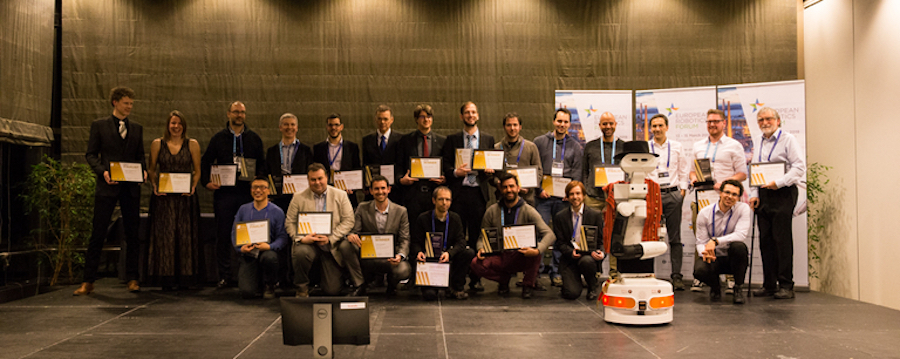
Award winners in robot competitions held by the were named on 14 March 2018, during this year’s European Robotics Forum (ERF), held in Tampere, Finland on 13–15 March.
Awards for the ERL’s 2017-18 season were presented at a Gala Dinner to winning teams that took part in all ERL competitions: Service Robots (ERL-SR), Industry Robots (ERL-IR) and Emergency Robots (ERL-ER).
ERL-SR is for robots that could provide assistance in homes, particularly for people with reduced mobility. ERL-ER is for robots in simulated emergency situations and ERL-IR tackles automation in industry.
Dozens of teams from around Europe took part in the 2017–18 ERL competitions, which stimulate innovation by and collaboration among robotics researchers by setting tasks in simulated real-life conditions, for completion against the clock.
The challenges include understanding natural speech, finding and retrieving objects, greeting visitors, supplying medical aid kits, and stopping simulated radioactive leaks. The teams’ technical approaches could find their way into future commercial robots and could be suitable for a wide range of non-robotics uses in all areas of life.
ERL teams are ranked on their end-of-year scores for various task and functionality challenges, using the best two participations in tournaments. The following teams were awarded on stage during the ERF2018 Awards Gala Dinner.
ERL Service Robots:
- homer@UniKoblenz, Germany, won the first prize for: Task Benchmark 1 “Getting to Know My Home”; Task Benchmark 2 “Welcoming Visitors”; Task Benchmark 3 “Catering for Granny Annie’s Comfort”; Task Benchmark 5 “General Purpose Service Robot (GPSR)”;
- HEARTS, Bristol, UK, won the first prize for: Task Benchmark 2 “Welcoming Visitors”; Functionality Benchmark 3 “Speech Recognition”;
- IRI@ERL, Barcelona, Spain, won the first prize for: Task Benchmark 2 “Welcoming Visitors”; Task Benchmark 3 “Catering for Granny Annie’s Comfort”;
- RoboticsLab UC3M, Madrid, Spain, won the first prize for Task Benchmark 4 “Visit My Home”;
- SocRob@Home, Lisbon, Portugal, won the first prize for: Task Benchmark 1 “Getting to Know My Home”.

European Robotics League Service Awardees 2017-2018 and Coordinators. Credits: Visual Outcasts
ERL Industry Robots:
- b-it-bots Bonn-Rhein-Sieg University, Bonn, Germany, won the first prize for: Functionality Benchmark 4 “Navigation Functionality”.

European Robotics League Industry Awardees 2017-2018 and Coordinators. Credits: Visual Outcasts
ERL Emergency Robots:
- IMM – Janusz Bedzowski won the first prize for: Task Benchmark 2 (Land + Air) “Survey the building and search for missing workers”; Functionality Benchmark 1 “2D Mapping Functionality” (Land + Air);
The Grand Challenge Task Benchmark 1 (land + sea + air) was won by:
- Universitat de Girona – Eric Pairet who won also the first prize for: Task Benchmark 4 (Land + Sea) “Stem the leak”; Functionality Benchmark 3 (Sea) “Object Detection”; Task Benchmark 3 (Sea + Air) “Pipe inspection & search for missing workers”;
- Telerob – Andreas Ciossek who won also the first prize for: Task Benchmark 4 (Land + Sea) “Stem the leak”; Functionality Benchmark 2 (Land + Air) “Object Recognition”;
- ISEP/INESC – Alfredo Martins who won also the first prize for: Task Benchmark 3 (Sea + Air) “Pipe inspection and search for missing workers”; Functionality Benchmark 2 “Object Recognition” (Land + Air).

European Robotics League Emergency Awardees 2017-2018 and Coordinators. Credits: Visual Outcasts
The ERL-ER prizes for task challenges were awarded during the Awards Ceremony for the emergency robots competition held at Piombino, Italy on 15-23 September 2017.
European Robotics League
The European Robotics League (ERL) is the successor to the RoCKIn, euRathlon and EuRoC robotics competitions, funded by the EU and designed to foster scientific progress and innovation in cognitive systems and robotics. The ERL is funded by the European Union’s Horizon 2020 research and innovation programme and runs competitions for service (ERL-SR), industrial (ERL-IR) and emergency robots (ERL-ER). See:
The latest ERL-SR scores can be found here.
The latest ERL-IR scores can be found here
The latest ERL-ER scores can be found here.



 Tencent, Alibaba, Baidu and JD.com from China are in a global competition with Google/Alphabet, Apple, Facebook, Walmart and Amazon from the USA and SoftBank from Japan. All are agressively searching for talent, intellectual property, market share, logistics and supply chain technology, and presence all around the world.
 Baidu (NASDAQ:BIDU) is China’s primary search source and also provides Internet-related services and products as well as targeted advertising, transaction services and a video platform. Baidu is heavily investing in researching deep learning, computer vision, speech recognition and synthesis, natural language understanding, data mining and knowledge discovery, business intelligence, artificial general intelligence, high performance computing, robotics and autonomous driving (at their new self-driving lab in Silicon Valley).
 Alibaba (NYSE:BABA) is a multi-national China-based e-commerce retailer, payment and technology conglomerate, cloud provider, whose two shopping malls (Tmall and Taobao) have over 1 billion combined active users and are supported by a budding logistics network. Alibaba’s AI-powered platform (which it uses internally for its shopping malls and logistics processing) was recently rolled out in Kuala Lumpur to support smart cities in their digital transformation. It analyzes large data volumes extracted from various sources in an urban environment, through video, image, and speech recognition. The system then uses machine learning to provide insights for city administrators to improve operational efficiencies and monitor security risks.
 Tencent (HKG:0700) is a Chinese provider of Internet and cloud-related services and products, entertainment, music services, AI, real estate and social media including WeChat (which recently hit 1 billion users). More than 35% of WeChat users spend over four hours a day on the service compared to the little more than an hour a day spent on Facebook, Instagram, Snapchat and Twitter combined. Tencent has set up AI labs in Shenzhen and Seattle and is researching voice and image recognition systems and transforming what they’ve learned into apps and algorithms to keep their users informed and attentive.
 JD.Com (NASDAQ:JD) is a Chinese e-commerce competitor with about half the user base of Alibaba yet with very progressive logistics and infrastructure programs. JD (Jingdong) is testing robotic delivery services, operating driverless delivery trucks and building drone delivery ports. JD operates 7 fulfillment centers and 405 warehouses in China. Last month it raised $2.5 billion for its JD Logistics subsidiary to build out and expand their logistics network.
 SoftBank (TYO:9984) is a Japanese telecom conglomerate. Softbank is also the instigator of the SoftBank Vision Fund which is investing massive amounts ($98 bn) in technologies and entrepreneurs pioneering the future through a wide range of sectors: IoT, AI, robotics, mobile applications and computing, and infrastructure, cloud technologies and software. SoftBank, with it’s funding partners Apple, Qualcomm and various sovereign wealth funds, wants to invest another $900 billion in 1,000 AI and robotics companies in the next decade. SoftBank is also a partner with Alibaba and Foxconn to produce and market Pepper and Nao robots.
 Google/Alphabet (NASDAQ:GOOG) is a Silicon Valley search engine and Internet products company with a stable of forthcoming AI ventures such as Waymo, Verb Surgical and Nest along with consumer products like Google Home, Android phones and Chromebook computers. Google is leveraging their data, processing power, and talent into an array of AI-based apps, processes and products. Their foray into robotics hardware has resulted in much valuable research but all of the units have either been sold off or closed (except for Boston Dynamics and Shaft which are held up from sale by government regulators). Although still a leader in machine learning, Google is finding much competition from their Chinese competitors.
 Apple (NASDAQ:AAPL) is Apple, a Silicon Valley designer, manufacturer and marketer of phones, media and hardware devices and provider of software, services and digital content. Apple is the world’s largest information technology company by revenue and the world’s second-largest mobile phone manufacturer after Samsung with annual revenue of $229 billion. Building out Siri from the virtual world into the consumer product world with their new Homepod is off to a late start.
 Facebook (NASDAQ:FB) is also a Silicon Valley-based Internet phenomena with products that include Facebook, Instagram, Messenger, WhatsApp and Oculus. Facebook has over 2.2 billion active users. Their investments in AI appear to be focused on developing a virtual (or physical) assistant. Their acquisition of Ozlo to help Messenger build out a more elaborate virtual assistant for users is an example.
 Walmart (NYSE:WMT) is a global retailer with wholesale facilities, logistics and distribution centers all around the world. Walmart operates over 11,000 stores under 59 names in 28 countries and e-commerce sites in 11 countries. It grosses over $480 billion annually and employs over 2.3 million workers. As Walmart increases its online e-commerce market share while simultaneously changing practices to provide better product transparency (particularly in and faster material handling at its stores and distribution centers, it too is on a talent hunt for roboticists and AI/machine learning people and providers.
 Amazon (NASDAQ:AMZN) Amazon is the leading e-commerce seller of products, supply chain services, AI, and cloud services that is copied and competed with around the world. Amazon accounts for ~4% of all retail and ~44% of all e-commerce spending in the US. Amazon’s supply chain and logistics facilities use more than 60,000 robots in its various warehouses and distribution centers, and its cloud services, which not only services Amazon, provides on-demand cloud computing platforms to companies and governments on a subscription basis. Amazon’s Echo/Alexa home assistant has started to include capabilities like a display, camera and alarm clock, security cameras, and even a fashion advisor. It is combining all these different incremental parts to build a smart home robot as they become viable and front-ended by the Alexa voice assistant.
 Infrastructure
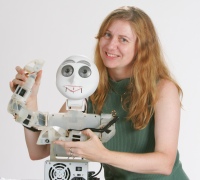 Maja Matarić is professor and Chan Soon-Shiong chair in Computer Science Department, Neuroscience Program, and the Department of Pediatrics at the University of Southern California, founding director of the USC Robotics and Autonomous Systems Center (RASC), co-director of the USC Robotics Research Lab and Vice Dean for Research in the USC Viterbi School of Engineering. She received her PhD in Computer Science and Artificial Intelligence from MIT, MS in Computer Science from MIT, and BS in Computer Science from the University of Kansas.