
Swarms of firefighting drones could one day be deployed to tackle hugely destructive megafires that are becoming increasingly frequent in the Mediterranean region because of climate change, arson and poor landscape management.
It’s one of a number of initiatives looking at how best to fight large fires from the air – a challenge that’s becoming more and more common.
A 2017 report on forest fires by the EU’s Joint Research Centre said that the year would ‘likely be remembered as one of the most devastating wildfire seasons in Europe since records began’, after the destruction of nearly 700,000 hectares of land in the EU by early September.
Such fires are dangerous not only for people who live in the area but also for the crews of people whose job it is to put the fires out. But using intelligent robots to scout the area and drop water can allow humans to stand further back from the danger zone, only looking at the drones’ data to make decisions from the safety of a command and control centre.
Because drones can fly day or night and gain rapid access to previously inaccessible urban or rural fires they can help to save both the lives of the public and first responders.
Torrential
Multiple autonomous drones dropping 600 litres of water every minute during the night while other unmanned vehicles refill to repeat the attack on a raging fire is the vision of Spanish company Drone Hopper. Despite this torrential approach, ‘we are not meant to be competitors with the airplanes and helicopters, we want to be complementary,’ Drone Hopper’s chief executive officer, Pablo Flores, said.
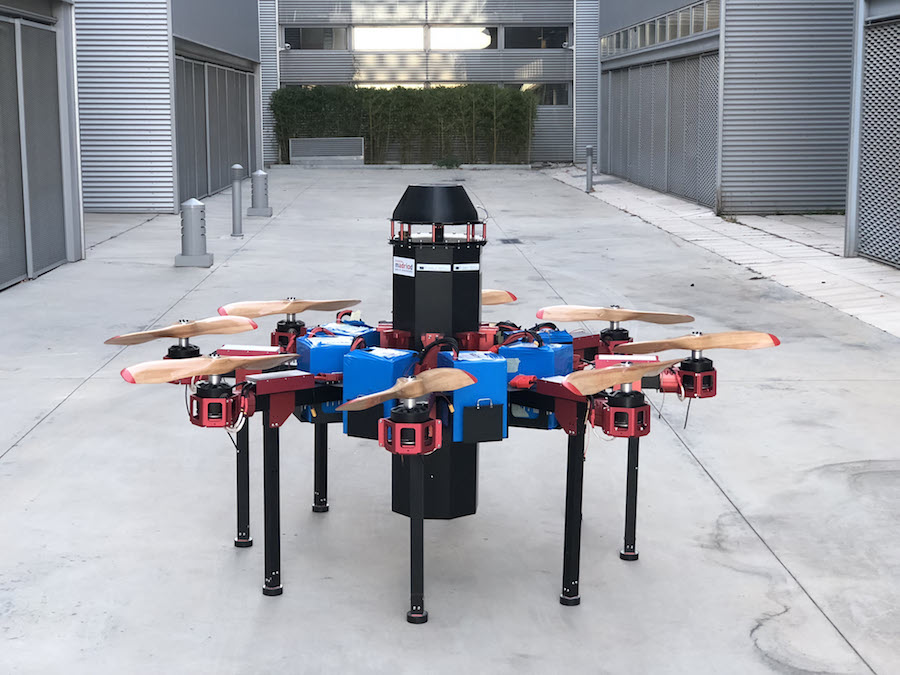
Their drone uses heat cameras to locate the fire, analyse it, send back the data, and identify what type of fire it is. At just over a metre and a half in length, it can be deployed from an aircraft, as well as a ground vehicle.
The drone is like a helicopter and can hover directly over a specific burning area, but it has many propellers. Once over its target it will release its liquid cargo as a mist designed specifically for the fire type identified.
A mist is good at fighting fire because it cools the area by evaporation and it blocks the transfer of heat to anything flammable nearby. To create the right type of mist, the Drone Hopper uses a proprietary magnetic system and the jet wash from its many propellers to direct the released water and nebulise it.
Flores wants to offer his drone, which is still in development, to local authorities for firefighting. ‘They can’t buy a $30 million airplane, but can have this platform and have their own means to (tackle a fire).’ He says that the Drone Hopper UAV costs five times less per litre than a water tanker aircraft.
But, there is a regulatory obstacle. At the moment, it hasn’t been proven that drones can reliably act autonomously, so national rules generally require each one to have a human remote pilot.
Dr Nazim Kemal Ure, an assistant professor in the aerospace department at Istanbul Technical University in Turkey, said: ‘With multiple autonomous systems many things can be achieved much more quickly.’
Swarming
He is developing a way of coordinating drones that he hopes could contribute to a change in regulation. By the end of the year, Dr Ure expects to be field testing autonomous drones and their swarming algorithms, developed under the DUF project.
Like Drone Hopper, ‘we are detecting the fire by using vision,’ Dr Ure explained. In initial testing the image processing will not be done by the drones, but eventually in real-world flight-testing the algorithms will be installed onboard.
His drones would fly over a burning area and, by examining the vegetation and wind direction and other factors, predict the fire’s spread and direction. With that information they would then precisely drop retardant to stop the fire.
Dr Ure added that further flight-testing may see cooperation with the Turkish government’s Ministry of Forestry and involve a controlled fire.
However, there is work yet to be done to improve the computer-generated fire images in the simulated environment they are using for training the artificial intelligence. ‘Our models are, in the graphical parts, not state-of-the-art,’ said Dr Ure. He wants to have ‘hyper-realistic’ fire for the drones’ vision analysis software to learn from. For him, that will help ensure the drones will operate well in the real world.
And in the real world, Dr Ure sees many other applications. ‘I would like to extend this algorithm to other scenarios such as search and rescue and planetary exploration,’ he said.
Types of forest fires
Ground fires occur 25 to 50 cm underground and move slowly, burning through peat and roots. They are notoriously difficult to put out and, if the conditions are right, they can smoulder through the winter and then move above ground in spring.
Surface fires move at a speed of between 3 and 300 metres per minute but burn only the lower vegetation and leave the trees unaffected. Of all the fires, they cause the least damage and are usually easy to put out.
Ladder fires climb up the taller trees and engulf smaller vegetation. Vines and invasive plants help the fire gain momentum.
Crown fires burn trees all the way to the canopy and are the hottest and most dangerous of wildfires. They can spread quickly and are very difficult to put out, partly due to the height of the flames. They can spread beyond natural firebreaks such as rivers through a process called spotting, where wind or hot air carries a piece of burning wood elsewhere and starts a new fire.
The research in this article is funded by the EU. If you liked this article, please consider sharing it on social media.
More info
Drone Hopper
DUF
 In this episode of


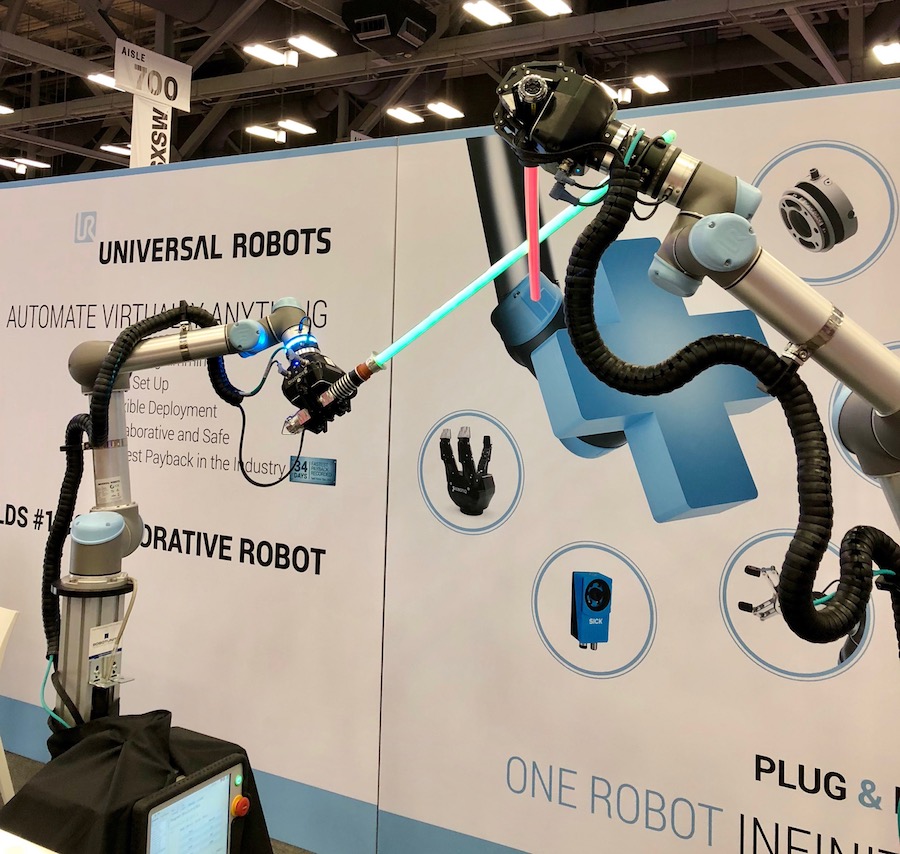



 Tencent, Alibaba, Baidu and JD.com from China are in a global competition with Google/Alphabet, Apple, Facebook, Walmart and Amazon from the USA and SoftBank from Japan. All are agressively searching for talent, intellectual property, market share, logistics and supply chain technology, and presence all around the world.
 Baidu (NASDAQ:BIDU) is China’s primary search source and also provides Internet-related services and products as well as targeted advertising, transaction services and a video platform. Baidu is heavily investing in researching deep learning, computer vision, speech recognition and synthesis, natural language understanding, data mining and knowledge discovery, business intelligence, artificial general intelligence, high performance computing, robotics and autonomous driving (at their new self-driving lab in Silicon Valley).
 Alibaba (NYSE:BABA) is a multi-national China-based e-commerce retailer, payment and technology conglomerate, cloud provider, whose two shopping malls (Tmall and Taobao) have over 1 billion combined active users and are supported by a budding logistics network. Alibaba’s AI-powered platform (which it uses internally for its shopping malls and logistics processing) was recently rolled out in Kuala Lumpur to support smart cities in their digital transformation. It analyzes large data volumes extracted from various sources in an urban environment, through video, image, and speech recognition. The system then uses machine learning to provide insights for city administrators to improve operational efficiencies and monitor security risks.
 Tencent (HKG:0700) is a Chinese provider of Internet and cloud-related services and products, entertainment, music services, AI, real estate and social media including WeChat (which recently hit 1 billion users). More than 35% of WeChat users spend over four hours a day on the service compared to the little more than an hour a day spent on Facebook, Instagram, Snapchat and Twitter combined. Tencent has set up AI labs in Shenzhen and Seattle and is researching voice and image recognition systems and transforming what they’ve learned into apps and algorithms to keep their users informed and attentive.
 JD.Com (NASDAQ:JD) is a Chinese e-commerce competitor with about half the user base of Alibaba yet with very progressive logistics and infrastructure programs. JD (Jingdong) is testing robotic delivery services, operating driverless delivery trucks and building drone delivery ports. JD operates 7 fulfillment centers and 405 warehouses in China. Last month it raised $2.5 billion for its JD Logistics subsidiary to build out and expand their logistics network.
 SoftBank (TYO:9984) is a Japanese telecom conglomerate. Softbank is also the instigator of the SoftBank Vision Fund which is investing massive amounts ($98 bn) in technologies and entrepreneurs pioneering the future through a wide range of sectors: IoT, AI, robotics, mobile applications and computing, and infrastructure, cloud technologies and software. SoftBank, with it’s funding partners Apple, Qualcomm and various sovereign wealth funds, wants to invest another $900 billion in 1,000 AI and robotics companies in the next decade. SoftBank is also a partner with Alibaba and Foxconn to produce and market Pepper and Nao robots.
 Google/Alphabet (NASDAQ:GOOG) is a Silicon Valley search engine and Internet products company with a stable of forthcoming AI ventures such as Waymo, Verb Surgical and Nest along with consumer products like Google Home, Android phones and Chromebook computers. Google is leveraging their data, processing power, and talent into an array of AI-based apps, processes and products. Their foray into robotics hardware has resulted in much valuable research but all of the units have either been sold off or closed (except for Boston Dynamics and Shaft which are held up from sale by government regulators). Although still a leader in machine learning, Google is finding much competition from their Chinese competitors.
 Apple (NASDAQ:AAPL) is Apple, a Silicon Valley designer, manufacturer and marketer of phones, media and hardware devices and provider of software, services and digital content. Apple is the world’s largest information technology company by revenue and the world’s second-largest mobile phone manufacturer after Samsung with annual revenue of $229 billion. Building out Siri from the virtual world into the consumer product world with their new Homepod is off to a late start.
 Facebook (NASDAQ:FB) is also a Silicon Valley-based Internet phenomena with products that include Facebook, Instagram, Messenger, WhatsApp and Oculus. Facebook has over 2.2 billion active users. Their investments in AI appear to be focused on developing a virtual (or physical) assistant. Their acquisition of Ozlo to help Messenger build out a more elaborate virtual assistant for users is an example.
 Walmart (NYSE:WMT) is a global retailer with wholesale facilities, logistics and distribution centers all around the world. Walmart operates over 11,000 stores under 59 names in 28 countries and e-commerce sites in 11 countries. It grosses over $480 billion annually and employs over 2.3 million workers. As Walmart increases its online e-commerce market share while simultaneously changing practices to provide better product transparency (particularly in and faster material handling at its stores and distribution centers, it too is on a talent hunt for roboticists and AI/machine learning people and providers.
 Amazon (NASDAQ:AMZN) Amazon is the leading e-commerce seller of products, supply chain services, AI, and cloud services that is copied and competed with around the world. Amazon accounts for ~4% of all retail and ~44% of all e-commerce spending in the US. Amazon’s supply chain and logistics facilities use more than 60,000 robots in its various warehouses and distribution centers, and its cloud services, which not only services Amazon, provides on-demand cloud computing platforms to companies and governments on a subscription basis. Amazon’s Echo/Alexa home assistant has started to include capabilities like a display, camera and alarm clock, security cameras, and even a fashion advisor. It is combining all these different incremental parts to build a smart home robot as they become viable and front-ended by the Alexa voice assistant.
 Infrastructure
 Maja Matarić is professor and Chan Soon-Shiong chair in Computer Science Department, Neuroscience Program, and the Department of Pediatrics at the University of Southern California, founding director of the USC Robotics and Autonomous Systems Center (RASC), co-director of the USC Robotics Research Lab and Vice Dean for Research in the USC Viterbi School of Engineering. She received her PhD in Computer Science and Artificial Intelligence from MIT, MS in Computer Science from MIT, and BS in Computer Science from the University of Kansas.