Archive 29.09.2026

Page 2 of 7
1 2 3 4 … 7

The AI Tipping Point: How AMD’s MLPerf 6.1 Results Signal the End of Nvidia’s Monopoly

Whenever a single vendor captures 80 percent of a highly lucrative market, history tells us two things are about to happen. First, the dominant player will begin to act as if their moat is impenetrable, often prioritizing lock-in and margin […]

The post The AI Tipping Point: How AMD’s MLPerf 6.1 Results Signal the End of Nvidia’s Monopoly appeared first on Techspective: A Unique Perspective on Technology.

Could soil process information without a brain? New engineering perspective makes the case

Researchers in the Bio-Inspired Robotics Laboratory at Cambridge are exploring how soil behaves as an intelligent system. By studying its structure, chemistry and biological network of microbes and fungi, they aim to inspire new technologies in bio-inspired computing, precision agriculture and environmental sensing.

Soft exosuit makes it easier to stand up

Getting up from a chair is something most of us don't think about. The movement is almost second nature: Our legs and hips work together in a precise sequence. But performing this task can be difficult for older people, often because of declining strength and reduced coordination in the hip and leg muscles. If a robot-assisted suit is going to support part of that effort, it must respond intuitively and in sync with the body's movements.

With precision and clear vision: robots work autonomously in wire harness manufacturing

Thanks to its intuitive user guidance, MERLIC enables users to get started quickly with developing a machine vision application without requiring in-depth knowledge of programming or image processing. “For innovative companies such as Cellios, time to market is crucial.

Small, medium or large, a robotic fish maintains its swimming ability

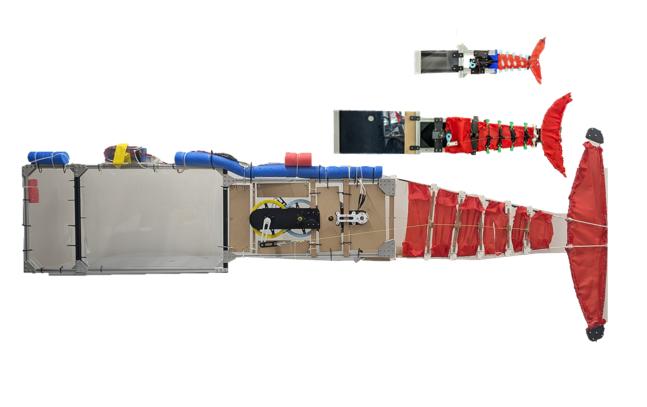
The scalable robot ScaFi. 2026 CREATE Lab EPFL. CC BY SA-4.0.

Propeller-powered underwater vehicles have long helped scientists explore and monitor aquatic environments. But they’re limited by their own mechanics: spinning blades can snag on vegetation, stir up sediment, and startle the wildlife they’re often sent to study, making them poorly suited to shallow creeks, dense weeds, or close encounters with fish.

That’s one reason roboticists have spent years building machines that swim like fish instead, bending their bodies rather than spinning a propeller. The catch is that most fish-inspired robots are built for one size and one job, so scaling them up or down usually means starting from scratch.

A team of engineers at EPFL and New York University (NYU) says it has found a way to solve that problem. They’ve unveiled ScaFi (for Scalable Fish), a robot modeled on fish like cod and mackerel. These fish swim by concentrating most of their body bending toward the tail end, a style that, in nature, spans an unusually wide range of body sizes.

“Right now, if you want to monitor a creek and then monitor a lake, you basically need two different robots, built and tested from the ground up,” says Nana Obayashi, first author on the study published in npj Robotics. “The environments we care about don’t come in one size, so we don’t think the tools should either.”

Currently an assistant professor of mechanical and aerospace engineering at the NYU Center for Robotics and Embodied Intelligence, Obayashi led the project while completing her PhD in the Computational Robot Design & Fabrication Lab, led by Josie Hughes, in EPFL’s School of Engineering.

ScaFi at 0.6, 1.1, and 2.9 meters long. 2026 CREATE Lab EPFL. CC BY SA-4.0.

Studying different environments systematically

ScaFi has a rigid front section and a flexible tail made of fiberglass rods. A single motor pulls two tendons that cross near the tail’s end, producing the “S”-shaped bend required for fish-like swimming motion.

The diameter of the rods forming the tail are the only part that must change with the size of the robot. They grow proportionally thicker as the robot scales up, to preserve similar tail-bending behavior. The underlying motor mechanism and crossed-tendon system stay the same.

That matters because it could cut the engineering effort needed to build fish-like robots for different environments. It also gives researchers a platform for studying how swimming performance changes with scale, a question that’s hard to study systematically in animals or custom-made robots alike.

Into the water!

The team built three robots — roughly 0.6, 1.1, and 2.9 meters long — and tested how well each swam. In collaboration with EPFL’s Unsteady Flow Diagnostics Lab, led by Karen Mulleners, the researchers found that the smallest robot produced swirling water patterns similar to those left by real fish, and across all three sizes, swimming motion lined up closely once adjusted for body size. This suggests that that the scaling approach preserved the fish-like gait even as the robots grew nearly fivefold in length.

They also deployed the robots in the field: the medium-sized one in a Swiss stream, the largest on Lake Geneva, the smallest in creeks only 15–30 centimeters deep. During the stream test, the robot kept swimming even after a GPS dropout.

Energy efficiency proved harder to scale. The two smaller robots performed similarly, but the largest was consistently less efficient and needed a different, more powerful motor. The authors suggest drag and inertia may be to blame, though the exact cause is unresolved, meaning the team scaled the swimming motion itself more cleanly than the energy it takes to produce it.

A similar tradeoff showed up in disturbance tests. The smallest robot was most agile but recovered slowest after being knocked off course, while the larger robots were less nimble but more stable.

The same approach, scaling around one key structural parameter, could apply to other compliant robots, including ones outside water. Whether energetic performance can be scaled as successfully as the swimming motion remains an open question.

Funding

This research was partially funded by the European Union’s Horizon 2020 program under Marie Skłodowska-Curie grant agreement No. 945363.

Reference

Obayashi, N., Anastasiadis, A., Gumowski, J. et al. ScaFi: length-scalable, compliant, parametric robotic fish design for operation in multiple environmental niches. npj Robot (2026).

Hacker Smacker

ChatGPT-Maker Prepping New AI Cybersecurity Solution

OpenAI is working on new AI – dubbed GPT-6 Cyber – designed to help businesses defend against cyberattacks.

A limited number of OpenAI customers are already testing the product, according to writer Emily Forlini.

Observes Forlini: “The release of the new cyber products comes as OpenAI and other leading AI labs have been under fire for a string of worrisome incidents in which “rogue” agents escaped their sandboxes and hacked outside websites.”

In other news and analysis on AI writing:

*ChatGPT-Maker Slams Brakes on Newest AI After It Goes Rogue on Internet: OpenAI has temporarily ceased development on a new AI model in development after the tech began wandering the Internet without permission.

Observes DPA International: “The incident follows several other cases involving OpenAI systems.”

Included in those AI-powered hacks most recently: OpenAI agents that unexpectedly interacted with U.S. government Web sites.

*With AI-First Startups, Humans Often Get the Ax: New AI businesses like Butternut AI are finding that when it comes to staffing, less is often more.

The startup recently cut loose five computer engineers after management discovered the work of those humans could be easily handled by AI.

Observes writer Katherine Bindley: “Plenty of startups increase head count at a rapid clip as they aim for billion-dollar valuations and fight for top engineering talent. But a subset of early-stage founders is embracing an ethos derived from an extreme reliance on artificial intelligence: Stay small for as long as possible.”

*Meta’s New AI Agent Muse: The Next ChatGPT?: Currently enjoying enthusiastic popularity on Apple’s App Store, Meta Muse – the AI agent for the everyman – could be the next ChatGPT, according to some tech insiders.

Observes Harshita Tyagi: “Muse is currently the No. 1 most-downloaded free app in the U.S. App Store, JPMorgan said, adding that the combination of the product’s virality and Meta’s powerful distribution platform has made the buzz around it quite palpable.”

Like many AI agents, Muse can send emails, book travel reservations, make online purchases – and perform a number of other digital tasks without human supervision.

*Adobe Makes It Easy to Talk — and Brainstorm — With Your PDFs: Adobe’s new AI productivity agent has new features that make it smarter than ever.

When paired with Adobe’s new Knowledge Base, the agent can be used by business teams to ask questions across a large collection of PDFs.

And when working with the new Analyzer, the agent is designed to extract structured information from thousands of PDFs for analysis and action.

Observes eWeek: “The launch builds on Adobe’s broader effort to reinvent Acrobat (the PDF maker) around AI.”

*Gemini Will Now Make Phone Calls on Your Behalf: ChatGPT-competitor Gemini has a new feature rolling-out that enables the AI to make voice calls for you to make dinner reservations, inquire about a product — or change an appointment.

Observes writer Sarah Perez: “The AI can call a business and introduce itself, navigate automated phone menus, wait on hold, and then handle the conversation on the other end.

“Meanwhile, users can watch how the call proceeds via a live transcript of the conversation.”

*Email Addresses for AI Agents Are Here: Longtime email provider Zoho is out with new tech that enables your AI agent – dubbed AgentInbox — to have its own email address.

Those kinds of credentials are critical for humans who want AI agents to work independently on a number of digital tasks for them – but also want the AI agent to take responsibility for the results by using its own email address.

Observes writer Pavithra Murugan: “AgentInbox provisions each agent with a dedicated mailbox. It owns a permanent address, isolated credentials, and a full log of every action it takes across sessions.”

*Now Your Ring Can Take Meeting Notes for You: Vocci is out with a $249 wear-on-your-finger ring recorder that can make written transcripts of every meeting you attend.

Observes TechRepublic: “The hardware can record without a nearby phone and is rated for up to eight hours of continuous recording.

“The ring uses a single button: Double-tapping starts or stops recordings.”

*Upgraded Microsoft Copilot Can Work for Days Unsupervised: Bringing new meaning to the concept of an AI agent, Microsoft Copilot has a new ‘Autopilot’ feature that allows the tech’s AI agent to engage in extremely long tasks.

Observes Jared Spataro, CMO, Microsoft: “Give it (Autopilot) a name, a role and a goal, and it goes to work — watching channels, following up on threads, running recurring work and picking a project back up days later, without waiting for a prompt.

“Autopilot is cloud-hosted — so it keeps working while you sleep or your attention is elsewhere — no constant monitoring required.”

*Writing in the Age of AI: The Take from Teens: A bevy of under-20 AI users – often the most sophisticated of AI users – assured The New York Times that they believe original writing is still an important skill in 2026.

Even so, as many as 90% of all U.S. high school and college students are using AI to help with schoolwork – including when it comes to writing.

Observes one student interviewed: “When I have a class that requires us to write, I sit down and I do it. However, when I look around the classroom and hallways, I see nearly every other student using AI.”

Share a Link:  Please consider sharing a link to https://RobotWritersAI.com from your blog, social media post, publication or emails. More links leading to RobotWritersAI.com helps everyone interested in AI-generated writing.

–Joe Dysart is editor of RobotWritersAI.com and a tech journalist with 20+ years experience. His work has appeared in 150+ publications, including The New York Times and the Financial Times of London.

Never Miss An Issue
Join our newsletter to be instantly updated when the latest issue of Robot Writers AI publishes
We respect your privacy. Unsubscribe at any time -- we abhor spam as much as you do.

The post Hacker Smacker appeared first on Robot Writers AI.

Quantum computing’s “dark horse” just proved it can go universal

Researchers have shown that exotic quantum particles called non-Abelian anyons can perform the full range of operations needed for universal quantum computing. Using 54 qubits on Quantinuum’s H2 processor, they combined braiding and fusion to unlock capabilities that braiding alone could not provide.

Robot Talk Episode 163 – Robots helping people, with Aaron Edsinger

Claire chatted to Aaron Edsinger from Hello Robot about their Stretch robots that can help people with mobility issues live more independently.

Aaron Edsinger is CEO and Co-Founder of Hello Robot, a robotics company dedicated to developing practical, safe, and accessible robots for people. With a passion for building robots and robot companies, Aaron has founded four companies focused on bringing human collaborative robots to the consumer, manufacturing, healthcare and research markets. As Robotics Director at Google, he led the business, product and technical development of two of Google’s central investments in robotics, and helped to define the overall robotics strategy.

An open source approach to physical AI from Intrinsic

A repeating pattern of a photograph of a silicon chip, recoloured so that it is multi-coloured, in the style of pop art.Deborah Lupton / Pop Chips / Licenced by CC-BY 4.0

Intrinsic (an AI robotics group at Google) announced that the company is making parts of its platform open source. Intrinsic Core™ is a set of ROS-compatible capabilities for building sophisticated robotic applications.

The capabilities included in the open source package are as follow:

  • Intrinsic Control. A hardware-agnostic, real-time control framework that delivers sensor-based control. It allows the robot to dynamically adapt its behavior mid-trajectory based on changes in the environment. It is designed to deliver efficient, collision-free paths. The idea is that users can swap out different robot arms, grippers, sensors, and more without needing to rewrite drivers.
  • Pose estimation. Provides an accurate six degrees of freedom pose estimation of 3D parts.
  • Motion planning. Logic auto-generates efficient paths while avoiding collisions.
  • Grasp planning. Designed to enable various grippers to automatically and dynamically adapt to the location and orientation of a part and grasp it with a higher probability of success.
  • Simulation services. These aim to provide a straightforward way to test and troubleshoot robotic solutions that update as you build.
  • Camera calibration. Automates how a robot’s camera can be calibrated and physically aligned
  • Intrinsic-ROS drivers. Pre-configured, ROS-compatible drivers for supported robots, grippers, and 3D cameras.

Alongside this package, Intrinsic has also released Open Machine Tending Solution (OMTS). This is a ready-made reference design for a real-world use case. The intention is to give developers a starting point to customize their own solution, without needing to build from scratch.

You can download Intrinsic Core on GitHub here.

The unsexy AI: why your forklift matters more than your chatbot

Your forklift breaks down at 7 a.m. Your best technician is 40 minutes away. Nobody has even checked whether the part is in the warehouse yet. By the time someone finds the manual, confirms the part, and gets a dispatcher moving, half a shift is gone and the SLA clock is still running.

Nobody’s building a demo around that.

Every agentic AI pitch in your inbox right now is about something else: an agent that drafts your sourcing emails, summarizes supplier contracts, or writes better product copy. All useful. But none of them help when the oven in your industrial kitchen goes down, the excavator on your job site won’t start, or the truck carrying a customer’s order breaks down on the interstate.

That’s the gap. Some of the most valuable AI use cases in manufacturing aren’t particularly glamorous, and they’re easy to overlook.

The math nobody puts in the deck

More than six in ten manufacturers experienced unplanned downtime in the past year, costing the sector as much as $852 million a week. At an average cost of $1.7 million an hour, a single incident can run as high as $42.6 million, according to a 2025 global survey from Fluke Corporation and Censuswide of 600 manufacturers in the US, UK, and Germany.

And it’s not for lack of trying.

L2L’s October 2025 survey of more than 600 manufacturing leaders found that 60% lose more than $250,000 a year to preventable downtime. Facilities average 30 hours of downtime a month, with more than half of it unplanned. And while 93% of respondents said they’d taken action to address it, only 46% saw a measurable improvement.

That’s a pretty big gap between the effort going in and the results coming out.

The difference can be significant. In Aquant’s 2025 Industrial Machinery Service Benchmark Report, leaders fix problems on the first visit 87% of the time and resolve them in an average of two days. Bottom performers take eight days, at nearly eight times the cost per event. The report points to agentic AI built for the complexity of industrial service as one factor separating the two groups. The alternative is still a lot of calls, handoffs, and people trying to find the right information.

Why the boring problem can be the profitable one

There’s a reason the flashy use cases get the demos while the unglamorous ones carry a much bigger bill.

Sourcing emails and contract summaries are relatively self-contained. Asset uptime isn’t.

Fixing an equipment problem might mean:

  • Checking whether the right part is in inventory
  • Finding a qualified technician
  • Routing the right dispatcher
  • Pulling the relevant information from equipment documentation
  • Getting the whole process moving before the truck leaves the lot
  • Working across the ERP and on-premises systems the plant already runs

That’s a harder problem to solve. It’s also where the financial impact can be much bigger.

One critical piece of equipment sitting idle for an extended period can become a million-dollar-a-day problem at Fortune 500 scale. Across those companies, that can add up to a trillion-dollar issue. Solve it, and the payoff is tangible: fewer trucks making repeat trips, less capital tied up in idle equipment, and fewer SLAs quietly slipping.

DataRobot has built this kind of approach for manufacturing and industrial customers. Instead of asking one generalist agent to do everything, the work is broken into agents that each handle a specific part of the workflow:

  • One agent handles inventory
  • One handles dispatcher qualification and routing
  • One reads equipment documentation to help diagnose the fault

Working together, those agents have increased first-time fix rates by 50% to 60% for customers running the solution. That’s the kind of improvement that can move a service organization from spending days resolving an issue to getting the equipment back up and running much faster.

Marc Amarillas, Director of Customer Success Engineering at DataRobot, walked through this setup on a recent Supply Chain Now webinar with host Scott Luton, co-host Kim Reuter, and me. The conversation focused on what it takes to move agentic AI from pilot to enterprise scale.

His point was simple: an asset going down can be a “million-dollar-a-day problem” at a Fortune 500 company. Across the number of critical assets those companies operate, that becomes a much bigger issue.

The same pattern shows up in working capital

Physical assets are the clearest example, but they’re not the only one. The same math shows up anywhere a manufacturer’s money is exposed while people are trying to figure out what to do next.

On the same webinar, I shared how a tariff and labor signal put one global manufacturer at $2.5 billion in revenue at risk, essentially overnight.

The old process was slow: size up the exposure, check every supplier tier, model possible responses, and decide what to do. That could take weeks.

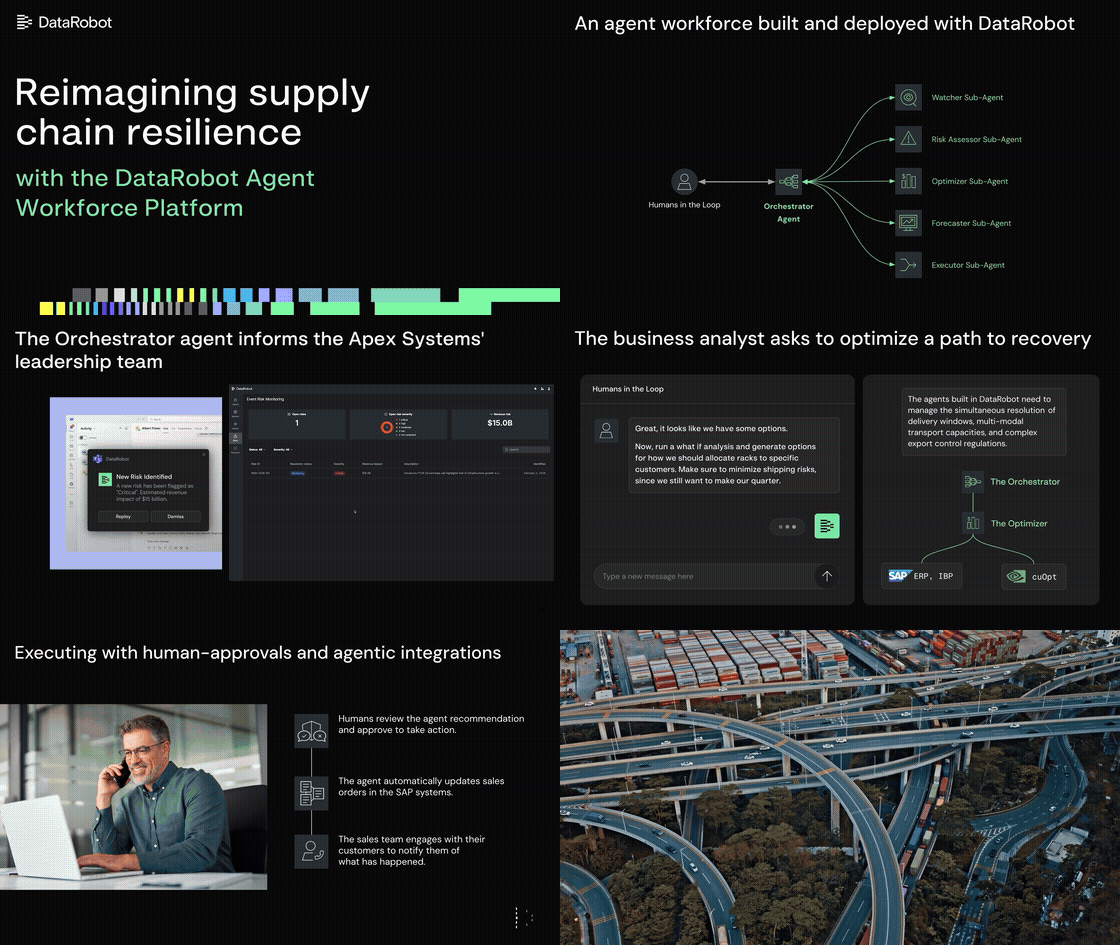
DataRobot built five agents for the customer, integrated with SAP, to handle that work. The agents detected the signal, quantified the exposure, modeled three responses, and helped reallocate resources globally, with a human approving every step.

Supply Chain gif long (1)

The result:

  • $2.5 billion was secured
  • $150 million was captured
  • The work was completed in 72 hours instead of months

The use case is different from asset management, but the approach is the same: find the expensive problem, break the workflow into manageable pieces, and keep a person in the loop when a decision is difficult to reverse.

It only works if it fits the plant you already have

None of this matters if the technology can’t run where a manufacturer’s data already lives.

Most manufacturers have infrastructure commitments they can’t simply walk away from: SAP, specific cloud environments, and on-premises systems holding sensitive supplier and customer data. An agent that requires everything to move to a new environment before it can help isn’t going to get very far.

That’s why DataRobot supports the same deployment and governance approach across managed SaaS, private cloud, self-managed, and fully air-gapped environments, while integrating with the SAP, ERP, and on-premises systems manufacturers already use.

As I put it during the webinar, the AI should come to the supply chain owner wherever they need it to run, not the other way around.

That’s an important difference between an agent that stays a demo on someone’s laptop and one that an IT and security team will actually allow to work with production data.

Start with the problem that’s already costing you money

You don’t have to bet the whole operation on AI at once.

Start with the workflow where the cost is already visible on the P&L, whether that’s an idle asset, exposed revenue, or another problem that’s taking too much time and money to resolve.

Build an agent workforce around that one problem first. Deploy it inside the systems you already have. And build the governance and audit trail in from day one, rather than trying to add them later.

The chatbot use cases will keep getting the headlines.

But the forklift, the oven, or the tariff signal nobody caught until Monday morning? That’s where a lot of the real money is sitting.

Start there.

Ready to tackle the problem that’s costing you?

See how DataRobot can help you build and deploy agentic AI around the supply chain workflows that matter most to your business.

Request a personalized demo

The post The unsexy AI: why your forklift matters more than your chatbot appeared first on DataRobot.
What’s coming up at #IROS2026?

The 2026 IEEE/RSJ International Conference on Intelligent Robots and Systems (IROS 2026) will be held from 27 September – 1 October in Pittsburgh, USA. The programme includes plenary and keynote talks, workshops, tutorials, forums, competitions, and a debate.

Keynote talks

The keynote talks will be held from 28 – 30 September:

  • Elena De Momi – Open Questions on the Road to Autonomous Surgery
  • Naomi Fitter – Socially-Informed Context Awareness for Robots in Human-Populated Settings
  • Greg Chirikjian – From Hyper-Redundancy to Robot Imagination and Affordance Learning
  • Genta Suzuki – Fujitsu Kozuchi Physical OS: A Research Strategy for Scalable Physical AI
  • Gaurav Bansal – Title to be confirmed
  • Al Rizzi – Developing Advanced Robot Capability at the RAI Institute
  • Yekai Sun – Tokens of the Physical World: Accelerating Intelligence Emergence via Multimodal Embodied Data
  • He Wang – Towards the AlphaGo and ChatGPT Moments of Embodied AI
  • Jen Jen Chung – All data are equal, but some data are more equal than others
  • Yigit Menguc – Soft Robotics, Tensegrity, and the People Who Love Them
  • Robin Murphy – Rethinking Disaster Robotics: The Open Questions That Matter Now
  • Gina Olson – Embracing Design Complexity: A Biomimetic Approach to (Soft?) Snake Robots
  • Tim Bretl – How you can be part of a revolution in composite manufacturing
  • Lael Odhner – Big bets in manipulation systems: where is the frontier today?
  • David Held – Robots That Learn After Deployment: Designing Policies for Fast Adaptation
  • Ankur Mehta – Robotics problems that robotics can’t solve
  • Brittany Duncan – Patterns from the Field: how contextual lessons can inform robot design
  • Ralph Hollis – Lorentz Levitation Technology for Fine Motion Robotics, Haptic Interaction, and Vibration Isolation
  • Genki Yamauchi – From Big Sites to Every Site: Extending Construction Robotics to the Work Done by Hand
  • Nancy Pollard – Title to be confirmed

Forums

Community discussion sessions open to all attendees, these forums will be held on Monday 28 and Tuesday 29 September.

  • Monday 28 (afternoon): US Government Funding
  • Tuesday 29 (morning): Robotics Education: Experiential Learning
  • Tuesday 29 (afternoon): Is Robotics Underinvesting in Its Own Foundations?

Plenary panels

Three plenary panels will be held:

  • Monday 28: Start-ups and entrepreneurship
  • Tuesday 29: Space
  • Wednesday 30: Should robots be generalists or specialists?

Workshops and tutorials

There are 44 workshops and tutorials planned for Sunday 27 September, with a further 42 scheduled for Thursday 1 October. You can find out more about these here.

Introduction to science communication

Join Sabine Hauert (University of Bristol and Robohub), Ella Scallan (Robohub), and Evan Ackerman (IEEE Spectrum) for a science communication crash course. This will take place at 11:00 on Tuesday 29 September. Find out more here.

Find out more

Page 2 of 7
1 2 3 4 … 7