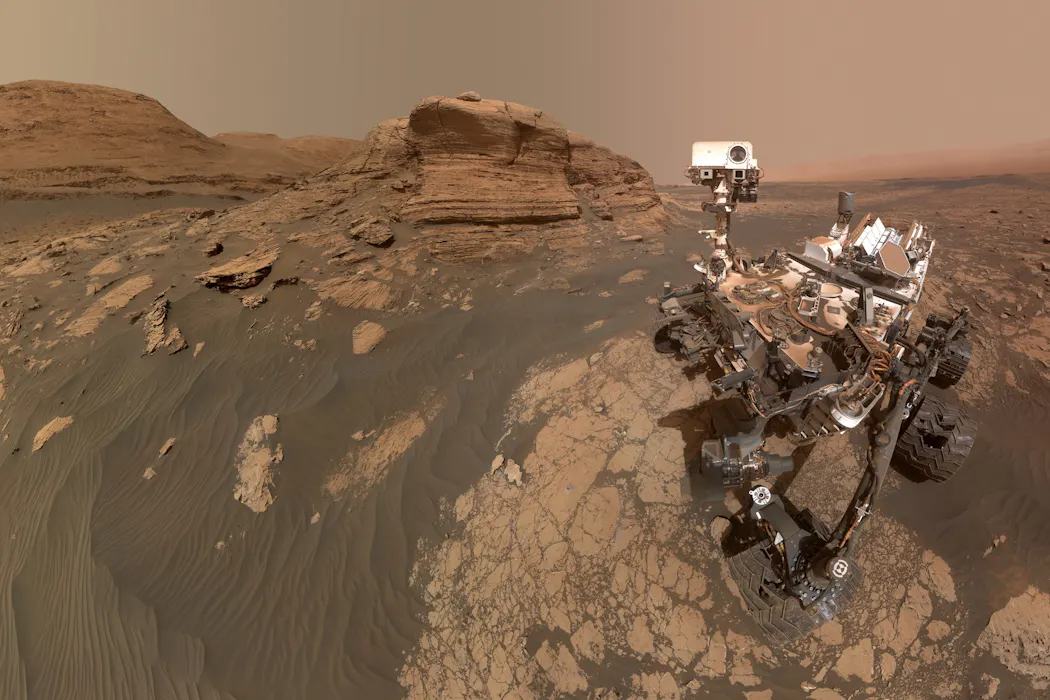
Mars rovers give scientists a ground-level view of the red planet – peek inside their NASA control room

By Ashwin R. Vasavada
Lights blink on as I enter the Rover Operations Center at NASA’s Jet Propulsion Laboratory in Pasadena, California, at 7:30 a.m. I’m the first to arrive, even though I already feel late.
Sometime during the night on Earth, the Curiosity rover finished its day exploring on Mars and beamed its latest collection of images and measurements to a Mars orbiter zooming by overhead. The orbiter relayed the data to Earth, where it now waits on servers here and at partner institutions around the globe.
Once our rover operations shift kicks off at 8:15 a.m., a few dozen engineers and scientists will have just three hours to check the health of the rover, analyze the new science data and agree on the next set of rover activities. Then we’ll spend another four hours turning those plans into rover commands for tomorrow, making sure they are safe and fit within the rover’s available time and energy. Not long after that, the Sun will rise on Mars, and Curiosity will look toward Earth, expecting its next instructions.
As Curiosity’s project scientist, it’s my job to ensure that what emerges from this rush is a set of measurements that advance the mission’s science objectives and keep it on track to achieve what our team promised NASA and, ultimately, the public. It’s a seemingly overwhelming task given everything that must happen in the next seven hours. But after repeating it over a thousand times since Curiosity landed in 2012, our team has gotten pretty good at it.
NASA Curiosity project scientist Ashwin Vasavada guides this tour of the rover’s view of the Martian surface.
Reading the rocks
NASA created Curiosity to search for evidence of ancient habitable environments, such as those with liquid water and the chemicals, nutrients and energy sources required for life. The investigation called for a long-lived, mobile spacecraft that would allow scientists on Earth to virtually explore a local area on Mars, select and acquire rock samples, and analyze them in onboard laboratories.
JPL responded with the car-size, drill-equipped Curiosity rover. NASA added a suite of scientific instruments and a science team from the United States and around the world.
NASA sent Curiosity to Mars’ Gale Crater to climb Aeolis Mons, a mountain whose 3 miles (5 kilometers) of sedimentary rock layers hold a record of environmental conditions from about 3.5 billion years ago. The evidence suggests that back then a thicker, ancient atmosphere sheltered flowing streams and sparkling lakes.
Curiosity has climbed through a vertical half-mile (1 kilometer) of rock layers so far, finding clay-rich, mudstone layers that give way at higher elevations to younger sandstones full of salty minerals. Our team determined that lakes persisted for millions of years before the climate became arid and sand dunes overtook the lakes, although groundwater occasionally breached the surface to produce streams that wove among the dunes.
Samples Curiosity drilled from the lake sediments contain small organic – meaning carbon-based – molecules, the raw materials for potential life. The association of wet environments, organic molecules and a mix of chemicals similar to those that microbes harness for energy on Earth allowed our team to conclude that conditions in Gale were once capable of supporting life. Determining conclusively whether life actually took hold will require bringing such rocks back to laboratories on Earth.
Preparing a plan
As my colleagues arrive in the building and online, I’m lost in the latest images. Curiosity is well into the higher and drier strata of Aeolis Mons, yet the rocks have salts, scours and other signs of ancient water. These images suggest that perhaps even Mars’ dry period provided habitats for life.
During our previous shift, I asked the engineers who plan the rover’s route to take it into an area that appears exceptionally smooth and flat on images taken from orbit. After years of rough offroad driving, they were excited to open up the throttle and let the rover drive 120 feet (37 meters) across this Martian “parking lot” – a pretty long distance for Curiosity.
Polygon fractures with honeycomblike textures, discovered by NASA’s Curiosity Mars rover. NASA/JPL-Caltech/MSSS
What I’m looking at now is taking my breath away. Instead of smooth slabs, every surface around the rover is textured by small polygons, each a few inches across, as if someone covered Mars in honeycomb wallpaper. Our geologists suspect that the polygons outline fractures that formed through drying, like cracks in mud do, or through thermal cycles, or compression.
My computer screen shows the area in front of Curiosity covered by dots, each one representing a candidate target for the rover to observe with its cameras, its laser spectrometer, or the sensors on its arm. There are way too many dots, which is not a bad problem to have. A science team member trained to moderate the day’s discussion begins to narrow the list. Distinguished faculty, postdocs and students from around the world take turns advocating for their target.
The debate centers on what set of images and chemical measurements will best help distinguish how the polygons formed. I’m the tiebreaker if our team can’t quickly reach consensus, but that’s rarely needed. It’s Friday, so the three days of activities we plan for the rover today will take place over the weekend, and the results will arrive for our next shift on Monday. Curiosity works weekends.
Engineering the uplink
Later on, I walk into the adjacent room where a robotics engineer visualizes in 3D how Curiosity’s five-jointed arm will reach the winning rock targets. I sit down next to another engineer who is simulating the rover’s next drive. We agree that the terrain ahead is rough: no more parking lot, all curbs. We discuss how she might steer the rover around the rock obstacles to reach the next science waypoint.
By noon, the science team’s role in operations is done, but my colleagues linger online to discuss the latest data in more detail. Meanwhile, the rover and instrument operators begin converting the day’s scientific requests into hundreds of commands that must be sent to NASA’s Deep Space Network in a few hours. There’s still a lot to do, but the team is in the homestretch for the day.
On Mars, the horizon is starting to brighten. Before too long, Curiosity will be expecting to hear from us.
This research was carried out at the Jet Propulsion Laboratory, California Institute of Technology, under a contract (80NM0018D0004) with the National Aeronautics and Space Administration.
Wildly Popular AI Agent Software Upgraded
OpenClaw – a viral software program that has captured the world’s imagination regarding the power of AI agents – is out with a major upgrade – OpenClaw 2.0.
The multi-tasking AI app can be used by writers, for example, to complete a number of steps in a highly complex research, writing and editing project – all without human intervention.
The free tool is considered revolutionary by many AI insiders – but needs to be used carefully, lest the app starts making too many decisions on its own.
There’s also a new demo/tutorial out on OpenClaw 2.0.
OpenClaw 2.0 is open source software (free for download) and can be run on an everyday laptop.
In other news and analysis on AI writing:
*ChatGPT Gets More Competition From Meta: Facebook parent Meta has rolled out an array of new paid AI tools designed to compete with ChatGPT, Gemini, Claude and similar.
Dubbed “Meta One,” the AI tools are designed to work with one or more Meta platforms – such as Facebook, WhatsApp and Instagram, starting at $2.99/month and scaling to $499/month.
Moreover, a special set of tools specifically designed for business-oriented creators is also available under the Meta One umbrella.
*Special-Use AI Models Take-Off: AI models trained for use by specific industries are growing in popularity, as increasing numbers of businesses gravitate to AI that ‘gets them.’
Thomson Reuters, for example, has developed its own AI model tweaked for law and tax professionals.
And Salesforce has released its own model Koa, designed for pros working in sales, marketing and customer support.
Meanwhile, Anthropic just rolled-out Claude for Financial Advisors.
*Script-to-Video-App – Complete With AI Spokesperson — Scores High on G2: AI video-maker Synthesia is a hit with G2 – a software rating site – where 2,000+ users have given the app 4.7 out of 5 stars.
Businesses use the app by selecting a photo-realistic AI spokesperson, adding a video script and watching Synthesia deliver the finished video in 20-minutes-or-less.
You can also go back and play with Synthesia’s editing tools if you want a more customized result.
*New Pew Study: Globally, Many People Equate AI With Job Loss: As the shadow of AI looms ever-larger across the globe, increasing numbers of people fear the spread of AI will lead to fewer jobs.
Observes lead writer Laura Silver: “In 34 of 37 countries Pew Research Center surveyed earlier this year, people tend to believe AI will lead to fewer jobs rather than more jobs.”
A real eye-opener from the study: An easy-to-read chart showing AI fear – expressed as a percentage – in each of the 37 countries surveyed.
*AI Marketing Conference Slated for Oct. 13-15: Sign-up for MAICON 2026 – an AI conference designed for marketers and business leaders – is open.
The meeting focuses on how enterprise and mid-market marketing teams are implementing AI across strategy, operations, content, analytics and customer experience.
Scheduled speakers include Andrew Yang, AI expert and former presidential candidate and Karen Hao, author, “Empire of AI.”
*HubSpot Drops New Guide on AI in Marketing: A new primer from HubSpot – “The Future of AI in Marketing” – is free for download for any marketer looking to make a quick study on AI and marketing.
Hubspot is known for putting out quality, extremely useful guides that are devoid of fluff.
*AI Chip Juggernaut Nvidia: Leave AI Safety to Us: Pushing back against growing calls for strict government regulation on the development of AI, Nvidia CEO Jensen Huang insists the AI industry can police itself.
Observes writer Julie Bort: “Huang sees little need for new laws at all. The free market, he argues, will be enough to pressure companies not to release unsafe products.”
*Microsoft AI Promises Self-Regulation: While AI titans like Google and OpenAI are begging U.S. legislators to regulate them, Microsoft is already promising to self-regulate.
A major player in AI, the software giant has published a draft code of conduct, featuring its own, self-imposed guardrails that will be used for the development of Microsoft AI.
Observes writer Jeffrey Dastin: “The code of conduct represents a constitution of sorts for future models made by the company.”
*China’s Response to AI Regulation: No Thanks: AI regulation advocates have received a ‘hard pass’ from China on the idea of imposing strict regulations to ensure the safe development of AI – at least the kind of regulation proposed by OpenAI, Anthropic and SpaceXAI.
For many, a China embrace of global AI regs is the only way such regulation will work.
Otherwise, a regulated U.S. and its allies would essentially be handing unregulated China the keys to the AI kingdom.
Observes an editorial in the “China Daily:” “The proposed coordination among the three companies (OpenAI, Antrhopic and SpaceXAI) sounds rather like a club whose membership rules have been drafted before the guest list is announced.
“Tellingly, David Sacks — who co-chairs the U.S. President’s Council of Advisors on Science and Technology — warned the three U.S. companies to stop pretending antitrust law has to be suspended so you can form a cartel.”

Share a Link: Please consider sharing a link to https://RobotWritersAI.com from your blog, social media post, publication or emails. More links leading to RobotWritersAI.com helps everyone interested in AI-generated writing.
–Joe Dysart is editor of RobotWritersAI.com and a tech journalist with 20+ years experience. His work has appeared in 150+ publications, including The New York Times and the Financial Times of London.
The post Wildly Popular AI Agent Software Upgraded appeared first on Robot Writers AI.
This tiny organism can shrink to one quarter its size in milliseconds
Your AI factory is running. What’s it producing?
Your AI factory can be fully operational while the business processes it was funded to improve remain unchanged. The infrastructure is in place, and your models are already running inference at volume. Yet when leadership asks which operating costs have fallen or which decisions are happening faster, the answer is “not yet.” And the cost of the infrastructure producing that answer is accumulating every quarter.
You made the case for this investment, and you stand by it. The board isn’t asking whether the investment made sense. It’s asking when it will produce the returns used to justify it. That question now requires a delivery date, not a status update.
The investment made sense, and it still does
You invested because your operating teams face problems that existing systems can’t solve. Decisions take too long. Assets underperform, and preventable disruptions remain expensive. Those problems still exist, and the reasoning behind the investment remains sound.
You’re also far from alone in struggling to turn AI investment into measurable results. BCG’s September 2025 report, The Widening AI Value Gap, found that 60% of companies reported minimal revenue and cost gains from AI. Substantial spending has not consistently translated into lower costs or new revenue.
The factory is producing. The question is what happens to that output once it leaves the model, and that is where most organizations are stuck.
The factory is ready. The business process is not.
The operationalization gap is the distance between the output your AI factory produces and an agent that can act within a live business process. Closing it requires a platform layer that builds, orchestrates, and governs agents connected to the people and systems responsible for acting on their output. That layer should handle three things the AI factory alone cannot:
- Building agents configured for specific business workflows
- Orchestrating how their output reaches the right people and systems
- Governing what each agent is authorized to do, including who controls the models, the data they touch, and the infrastructure they run on, with a complete record the business can audit and trust
For organizations where sovereign AI isn’t a preference but a condition of operating, particularly energy, public sector, and industrial, that governance layer must also remain inside the same perimeter as the infrastructure itself.
Consider a manufacturer whose factory already runs a model that flags maintenance issues before a production line goes down. It reliably identifies warning signs in equipment data, and those results support the case for intervening earlier to reduce unplanned outages.
Without the platform layer, however, the warning never reaches the technician responsible for the equipment. The team has no agreed criteria for when to inspect the equipment or escalate the warning, no fallback procedure when the sensor feed drops, and no record connecting the model’s recommendation to the action taken. The model may continue producing accurate results without changing how the business operates.
Your return window is narrowing
Getting the maintenance agent into daily use requires decisions from several teams. Infrastructure owns the hardware, while the AI and data team owns the model. Operations runs the production line and remains accountable for any action taken there. Security and legal also need to approve how the agent will operate.
Each team can complete its assigned work while the release remains stuck between them. Infrastructure is available, and the model is producing reliable output. Operations, however, is still waiting for something it can safely use. Without shared requirements and a release date, leadership has no reliable way to determine when the agent will enter the workflow.
Assigning someone to coordinate the effort won’t be enough if that person lacks authority. Whoever owns the deployment must be able to secure commitments across teams, resolve access questions, and move approvals forward. Otherwise, an open dependency can sit for months without counting as anyone’s missed deadline.
Every quarter of delay puts more pressure on the original business case. Whoever authorized the investment approved an expected return, with an assumption about how long that return would take to materialize. Costs continue accumulating while the expected benefits remain unrealized.
For the manufacturer, another quarter means continued exposure to the outages the agent was built to prevent. Savings lost during that period cannot be recovered simply by releasing the agent later. Meeting the original financial target will require greater returns in less time. If the timeline moves, the business case has to move with it.
The remaining work needs a delivery date
When leadership asks when the agent will enter daily use, “it takes time” is no longer a sufficient answer. The delivery team should be able to identify the remaining work, name who is responsible for it, and give leadership a release date.
For a well-scoped use case, roughly one quarter should be enough to move from a model producing accurate output to an agent operating within the business workflow, provided the necessary access and decision-makers are available. That period allows time to connect the agent to live systems, test its behavior, and obtain approval for daily use.
Introducing a maintenance agent on one production line is a small, well-defined job. The team should be able to describe what remains before release and how long each dependency will take to resolve.
After more than a quarter without a clear release date, leadership should require a review of the outstanding requirements and a dated plan for completing them. Every dependency needs an owner who has the authority to act. If the team needs more time, it should explain what will be finished during the extension and how that work changes the release date.
Put the investment to work
For the manufacturer, progress becomes tangible when technicians begin receiving warnings through their normal workflow and acting on them under agreed procedures. Someone must then track whether those interventions are reducing downtime and identify where the agent’s performance or workflow needs to improve.
That first deployment creates more than a result for one production line. It establishes a working path from the factory into the business that future agents can inherit. Each new use case builds on decisions the company has already made instead of solving the same deployment problems again.
For a practical look at what it takes to move agents into production and operate them at scale, read the Operating agentic AI at scale ebook.
The post Your AI factory is running. What’s it producing? appeared first on DataRobot.
Maple-seed-inspired robot flies more accurately with predictive control
Open-source benchmark tests whether AI agents can engineer working robots
The 5 Core Ways Plug-and-Play EOAT Solves the High-Mix Challenge
Bio-inspired whiskers enable tiny drones to navigate in darkness using touch
Reimagining robotics for sustainability
By Celia Luterbacher
Imagine a robot designed to install solar panels with much greater speed and precision than a human. The robot is made from expensive materials and powered by a heavy battery that must be recharged every few hours. If the costs of building and operating the robot outweigh the benefits of the clean energy it helps produce, can it really be considered sustainable?
In a 2025 article published in Science, Aude Billard, head of the Learning Algorithms and Systems Lab in EPFL’s School of Engineering and Academic director of the Robotics Center, gives precisely this example to illustrate the tension between robotic performance and sustainability. Roboticists, she argues, can no longer ignore the fact that robots use energy-intensive power systems and electronic components made from finite resources.
At the same time, robots have the potential to contribute to addressing some of society’s most pressing sustainability challenges, for example through environmental and biodiversity monitoring, precision agriculture, and the maintenance of critical infrastructure like bridges, buildings, and power grids.
“Our ambition is not to simply make robots more sustainable; they must actively contribute to solving sustainability challenges.”
– Mirko Kovač, Laboratory of Sustainability Robotics
Beyond sustainable robotics
Current research at the intersection of robotics and sustainability follows two main paths: developing robots that enable a more sustainable use of resources, and developing robots that are themselves more sustainable due to improved energy efficiency, biodegradability, or recyclability.
Mirko Kovač heads the joint Laboratory of Sustainability Robotics at Empa and EPFL’s School of Architecture, Civil and Environmental Engineering. In a cover article recently published in Nature Machine Intelligence, Kovač and his co-authors propose a manifesto that calls on academia, industry, and governments to extend and integrate these approaches within a broader framework that evaluates robots according to their overall contribution to sustainability goals. The manifesto defines a new discipline called Sustainability Robotics (not to be confused with sustainable robotics).
“Our ambition is not to simply make robots more sustainable; they must actively contribute to solving sustainability challenges,” Kovač says.
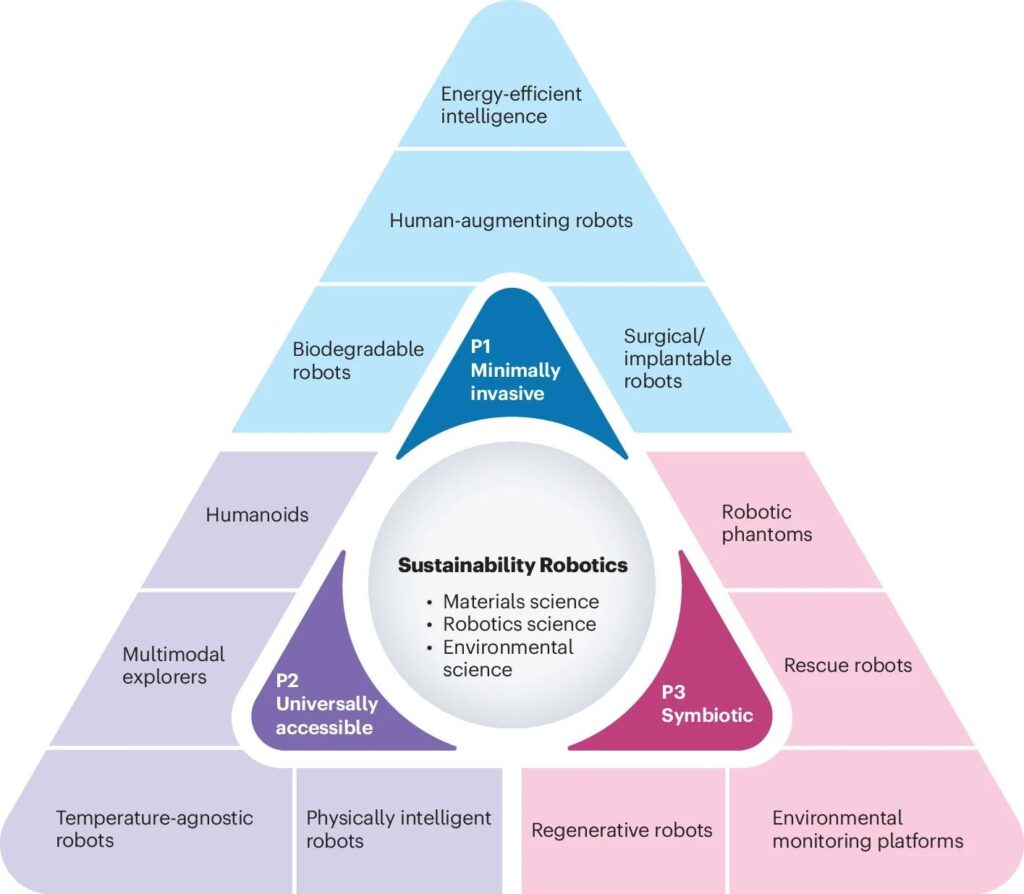
The three core principles of Sustainability Robotics. 2026 LSR/EPFL – CC BY SA 4.0
Minimally invasive, accessible…
In their article, the researchers argue that robots should no longer be evaluated solely based on technical performance. Instead, their environmental, social, and economic impacts should become part of the equation. To guide this transition, they propose three core principles: robotic systems should be minimally invasive, universally accessible, and symbiotic, creating value for people as well as economies and ecosystems.
Rather than viewing sustainability challenges like climate change, biodiversity loss, and resource scarcity as constraints on innovation, the authors argue that they can become opportunities to develop entirely new engineering solutions. Indeed, several EPFL laboratories are already exploring what Sustainability Robotics might look like in practice.
For example, the eel-inspired Envirobot, from Auke Ijspeert’s Biorobotics Lab, supports environmental research by targeting the autonomous monitoring of water quality. The project reflects the lab’s broader efforts to draw inspiration from animals to develop robots capable of operating in complex natural environments while improving our understanding of biological locomotion.
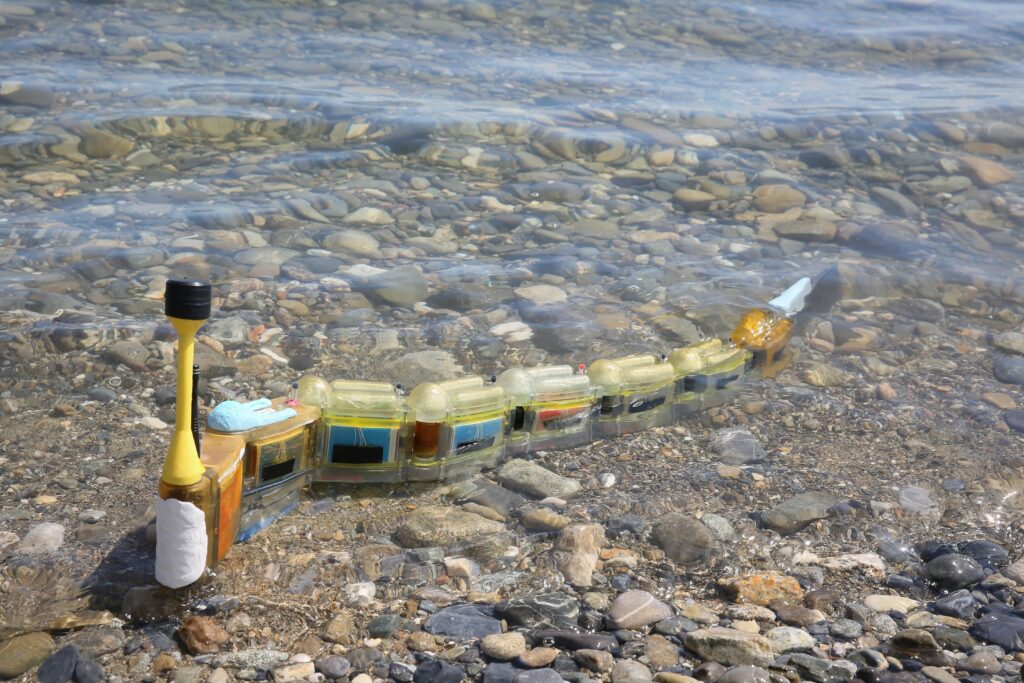
The eel-inspired Envirobot from the Biorobotics Lab supports environmental research by targeting the autonomous monitoring of water quality. 2017 Alain Herzog / EPFL – CC BY SA 4.0.
Engineers in the Laboratory of Intelligent Systems, led by Dario Floreano, have developed an aquatic robot made from fish food. Likewise designed for environmental monitoring, the device can be equipped with biodegradable sensors for collecting data like pH, temperature, and the presence of pollutants. At the end of its life, it can also feed aquatic organisms rather than becoming electronic waste.

This edible robot from the Laboratory for Intelligent Systems is an alternative to electronic environmental monitoring devices. EPFL – CC-BY-SA 4.0.
…and symbiotic
Sustainability Robotics’ concept of symbiosis also raises questions about how robots can create value across multiple domains. One example is the RoboFood initiative, coordinated by Floreano, which explores edible robots and roboticized food systems. Although food and robots are usually considered to be two separate worlds, Floreano argues that merging them could have advantages for healthcare, food production, and environmental sustainability.
“Edible robots could be used to deliver food to endangered areas, to deliver medicines in innovative ways to people who have difficulty swallowing or to animals, or even to monitor food and its freshness using sensors that can be eaten,” he says. “They could also help limit electronic and food waste.”
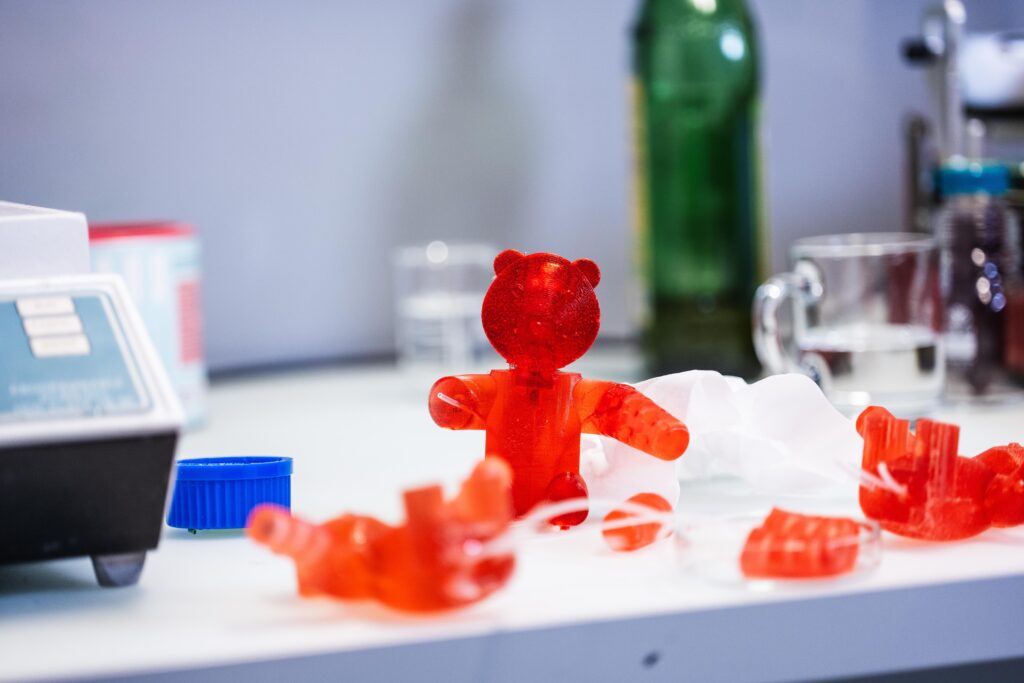
Edible robotic teddy bears, created by the LIS at EPFL – 2025 EPFL/Jamani Caillet – CC-BY-SA 4.0.
Another example comes from the built environment. In the Lab for Creative Computation, Stefana Parascho investigates how robotic workflows, which typically require uniform components and predefined plans, can be adapted to use irregular and reclaimed construction materials. Such approaches could help reduce waste while allowing architects to work with available materials instead of relying exclusively on standardized products. They could also inspire fabrication processes characterized by more adaptive and collaborative human-robot interactions.
In addition to materials and applications, research in the Computational Design and Fabrication (CREATE) Lab, led by Josie Hughes, shows how sustainability can be embedded directly into robot design from the beginning. One way to do this is through simplified, energy-efficient approaches to robotic control, as demonstrated by the quadruped robot PAWS. Once set in motion, the canine-inspired robot can run by itself using compliant materials and synergistic joints, without activating any motors. The project demonstrates how nature can inspire robust locomotion through mechanical design, rather than increasingly complex control systems.
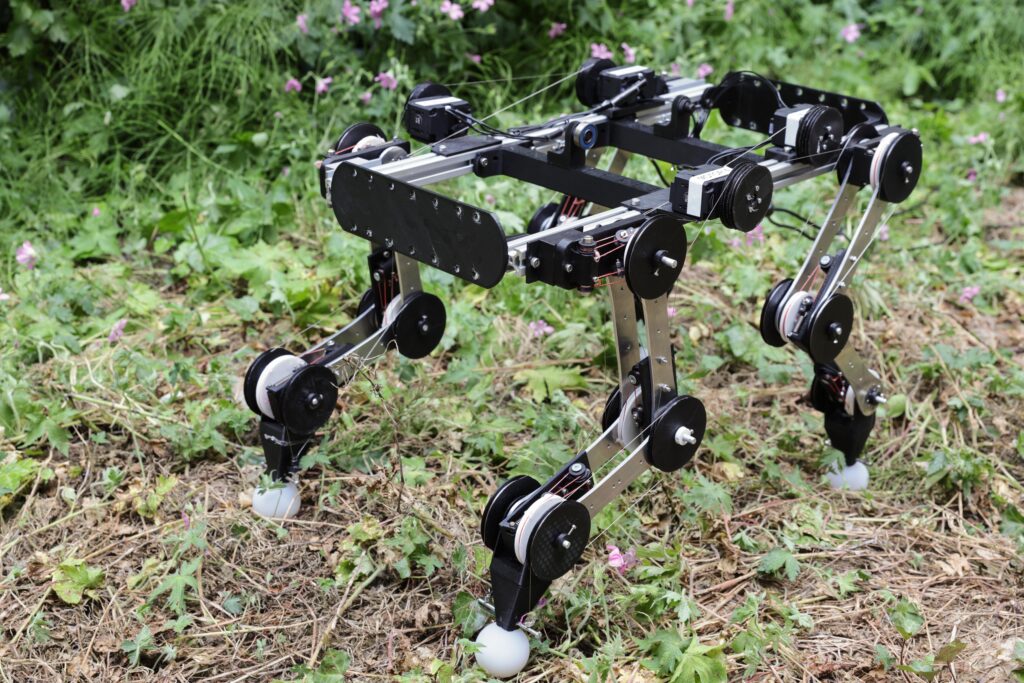
Once set in motion, the CREATE Lab’s canine-inspired PAWS robot can run by itself using compliant materials and synergistic joints, without activating any motors. 2023 Alain Herzog/EPFL CC BY SA -4.0.
A new measure of performance
Ultimately, Billard and Kovač both call for a broader definition of robotic success that accounts for social, economic, and environmental value alongside technical performance. Of course, this won’t be easy; robots designed with sustainability objectives in mind will still require energy and materials to build and operate, and their use will still carry inherent risks. However, as Kovač puts it: “the challenge is not to eliminate these trade-offs, but to make them visible, and account for them when evaluating a robot’s overall impact.”
Many of the projects already emerging from EPFL labs draw inspiration from biological systems that have been refining solutions to the trade-offs between locomotion, dexterity, efficiency, and adaptability for millions of years. In doing so, they suggest a vision of robotics that comes full circle: using lessons learned from nature to better understand and protect it.
In that sense, sustainability may become one of the most important performance metrics for the next generation of robots.
References
- Aude G. Billard. Designing and using robots for environmental sustainability. Science 388, eadx2444 (2025).
- Song, S., Mazzolai, B. & Kovač, M. A manifesto for Sustainability Robotics. Nature Machine Intelligence (2026).
- Empa press release
- Envirobot: A bio-inspired environmental monitoring platform. IEEE/OES Conference on Autonomous Underwater Vehicles (AUV), Tokyo, Japan (2016), pp. 1-6.
- RoboFood
- Skevaki, E., Duong, E., Yang, HB. et al. Crafting structural timber trusses from irregular offcuts via human–robot interaction. Construction Robotics 10, 20 (2026).
- Stefana Parascho. Construction Robotics: From Automation to Collaboration. Annual Review of Control, Robotics, and Autonomous Systems 6:183-204. 2023.
- Stella, F., Achkar, M.M., Della Santina, C. et al. Synergy-based robotic quadruped leveraging passivity for natural intelligence and behavioural diversity. Nature Machine Intelligence 7, 386–399 (2025).
- Zhang, S., Kwak, B., Zhu, R. et al. Edible aquatic robots with Marangoni propulsion. Nature Communications 16, 4238 (2025).