A genetically optimized fuzzy logic controller for robotic arms is described in the International Journal of Automation and Control. The system improves accuracy and resilience in simulations of a three-degree-of-freedom robotic arm. Moreover, it outperforms alternative control systems when the device is exposed to disturbances and changes in the system parameters.
Learn how Google Antigravity and our Cheminformatics Skills accelerate drug discovery workflows, search compounds, and propose novel rigidified macrocycles.
For more than a hundred years, quadcopters have been built according to the same basic principle. Four arms, each with a propeller, extend from a rigid central body. This design is ideal for precise, agile flight, but it has one major weakness—the drones are highly sensitive to unexpected contact with their surroundings. If they bump into a wall or another obstacle, they can become destabilized or even break apart.
Given the growing demand for AI computing, companies are beginning to explore orbital data centers, with players like Axiom Space already advancing plans for computing and data-processing capabilities in space.
A humanoid AI system has been developed that learns jointly from separately collected locomotion and object-manipulation data to perform multiple stages of a task in sequence.
People often take their muscles for granted. They pick up a bag, tighten a grip, climb a hill, hold a cup of coffee and the body quietly adjusts force, speed and position without the person ever thinking about it.
Muscle turns chemical energy into movement. It is able to produce force smoothly and reliably, even though it is built from huge numbers of tiny molecular components. When the load changes, muscles don’t simply wobble or fail. They adapt.
But the way that muscle works on a molecular level isn’t a settled issue. With colleagues, our team at the University of Bristol built a physical model using ordinary electric motors to try and simulate how muscles may perform its tasks.
The results, published in the Royal Society journal Interface, show that the coordination we see in real muscle may simply emerge as a property of their setup. It’s not something you have to programme and police continuously. The findings could even help improve the way that robots function.
If we were to zoom inside a muscle, we would find bundles of smaller and smaller structures. The sarcomere is the key force producing unit. It is made of protein filaments, called actin, and molecular motors called myosin. Together, they form the actomyosin system.
Tiny myosin motors repeatedly grab, pull and release actin cables, helping muscle fibres contract. When you hold a cup of tea, thousands of these motors have to work together to produce a steady force. But there are unanswered questions about this system.
Illustration showing the smallest functional unit of muscle: the sarcomere.
We first devised a mathematical model of muscle. Real muscle motors (myosin) run on a complex chemical cycle, but we didn’t try to reproduce that chemistry. Instead, we represented each force producing unit as something much simpler: a cycling “rotor” (or motor) that can contribute only when it is mechanically engaged to a physical “backbone”. When it is disengaged, it effectively drops out, and becomes isolated from the rest.
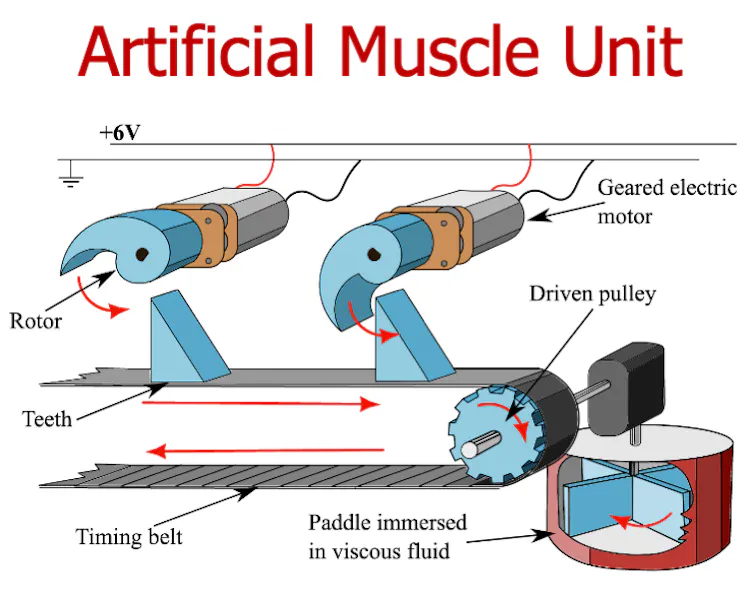
To test whether we could translate these ideas to a real physical system, we built a tabletop device: a line of simple electric motors interacting through a shared mechanical backbone. They pulled against a thick fluid, creating resistance similar to the viscous load experienced by biological motors inside muscle.
An illustration of the artificial muscle unit used in the study.
Our physical model produces force when supplied with current. We wanted to see whether, when many driving units were embedded in the right kind of mechanical setting, could the setting organise into coordinated muscle-like behaviour?
In both the mathematical model and the device, the motors don’t stay connected all the time. Instead, each motor briefly makes contact with a shared moving backbone, pushes on it, then lets go. As the backbone moves, it carries the mechanical effects of one motor to the next, allowing them to coordinate without ever communicating directly.
When they are not connected, each motor acts on its own. That single design choice makes the whole network of motors reorganise itself over time – much like biological motors do inside muscle, where motors attach and detach as part of their biochemical cycles.
In practical terms, the scaffold where the rotors live is doing a lot of the coordinating work, but it is hidden. It mediates how units can “feel” one another strongly enough for collective patterns to form.
Even in this stripped-down system, several muscle-like forms of behaviour spontaneously appear. As resistance increases, the motors collectively develop a load-speed relationship. Load refers to the mechanical tension and physical stress placed on the system.
More units end up contributing effectively as the load rises. Their participation increases under increasing loads. We also found that under certain conditions, motion can become jerky. For example, periods of coordinated pulling were interrupted by sudden slips. This echoes patterns seen in real actomyosin experiments.
Instead of everything working in unison, the system can self-organise into travelling waves of coordination, where the pattern moves along the array.
In a loose way, this “scales up” the core idea behind a sarcomere: many force units embedded in a shared structure that transmits forces from one unit to the next, allowing coordination to emerge spontaneously.
Coordinating without a conductor
Muscle isn’t the only place where nature has solved the problem of coordinating many tiny motors. Microscopic flagella are tail-like appendages seen on the cells of some eukaryotes – the group of organisms that includes animals and plants.
Examples of these flagella include the tail on human sperm. Cilia are microscopic, hair-like structures on many eukaryotic cells. Both flagella and cilia are powered by large numbers of molecular motors distributed along a long, slender scaffold.
Bending waves caused by motor contraction in sperm swimming.
Their internal core – the axoneme – is a beautifully organised structure that transmits forces along its length and turns local motor activity into bending waves. Those waves are essential: in sperm they underpin motility and fertility, and in cilia they help move fluids in the airways and other tissues, with clear links to health and disease.
In that sense, flagella are “muscle-like” systems in disguise. You again have drivers (motors that generate force) embedded in a coupling structure (a mechanical scaffold that transmits force and feedback). And the geometry determines how local activity adds up to a coherent, travelling wave.
If the structure and layout are doing some of the organising work, it speaks to a question that has long intrigued scientists: how evolution builds systems made up of a large number of individual motors that nevertheless coordinate themselves, remain reliable and adapt to changing conditions without a central control system?
Uses in robotics
Our results matter beyond biology. In robotics, getting many actuators (the “muscles” of a robot, which convert an energy source like electricity into motion) to cooperate is challenging and expensive. You add sensors, feedback loops, control algorithms, sometimes even mechanical ratchets or complex gearing to keep everything stable under loads. It works, but it can be fragile and prone to errors.
A compilation of task failures by Boston Dynamics’ Atlas robot (The Independent).
Our physical model of muscle, where coordination emerges as a property of the setup, suggests that simpler actuators for robotics are possible. This is exactly the kind of fundamental design that researchers have been chasing for soft robots (which use flexible materials) and artificial muscles for robotics.
Muscle may be an example of coordination without a conductor. Thousands of molecular motors working together, not because each one is individually controlled, but because the soft structure around them helps guide their collective behaviour.
Our findings suggest that robotics could begin to harness the same principle. In future, this could help bring robotics closer to biology, opening the way to more organic machines, whose bodies help shape how they move and adapt.
Preventive maintenance and diagnostics are crucial for preventing problems from worsening, and these strategies are appropriate responses to some of the early warning signs robotics professionals may encounter in daily operations.
Dozens of robots took on more than 3,000 steps up one of China's most famous peaks Monday, carrying eggs and watermelons in a race organizers billed as a test of real-world machine endurance, state media showed.
Observes writer Rowan Davies: The bill under consideration “could create new online safety measures applied across social media, games, apps and chatbots ‘to provide a safe online environment for all Australians,’ says the Labor party.”
If passed into law, the bill will force writing by many popular chatbots to become even-more-blander than what’s already being spit-out — and essentially establish the Australian government as the ‘emotional-risk-AI nanny’ for all its citizens – including adults.
In other news and analysis on AI writing:
*Writer-Friendly AI Gets an Upgrade: China-based AI provider Moonshot has rolled out a new version of its AI often preferred by writers: Kimi K3.1 Pro.
Already a leader among Chinese AI solutions, Kimi K3.1 ensures Moonshot’s status as one of the AI makers to beat from China.
Observes writer Carl Franzen: “Kimi K3.1 Pro dethrones Xiaomi’s MiMo-V2.6-Pro, DeepSeek V4.1-Flash-1017, Meta’s new Muse Wonder, and even OpenAI’s GPT-6 Astra on Artificial Analysis’s Intelligence Index.”
The move is part of Amazon’s decision to give heavier emphasis to audiobooks with its recent make-over of its Kindle books subscription service, which now goes for $12/month under the brand ‘Kindle+.’
Observes Maria Diaz: “Kindle+ remains a separate subscription from Prime — and users will still be able to borrow up to 20 titles at once.”
*Text Humanizer Now Free: Resea AI is offering to ‘humanize’ up to 10,000 words generated by AI absolutely free, every day.
Available for a number of years now, AI humanizers are designed to remove the ‘robot-like’ feel of text generated by AI and make it sound like something a warm-blooded human would write.
While humanizers are a good first step, the only way to really get the precise human voice you’re looking for is to use an Open Source solution from a Chinese AI provider like DeepSeek.
Specifically: They’re withholding their bylines during critical coverage of the U.S. midterm elections – through Nov. 11 – to protest what they see as USA Today’s callous disregard of editorial accuracy.
Observes Editor & Publisher: “The tool (known as DeeperDive) violates the company’s current standards of requiring a ‘human-in-the-loop’ prior to publishing computer generated content online or in print.”
HiFive’s “Survey 2.0” specializes in collecting employee feedback, analyzing what’s going on and spitting out reports that offer solutions to problems discovered.
You know: Work very similar to want journalists do.
Click here for the full detail on Soni’s step-by-step method.
*Microsoft’s Copilot Gets an Uptick in Users: The Microsoft Copilot chatbot – which features access to a number of popular AI models – is being used by a bit more people these days.
Currently about 53 million people now use Copilot – up from about 30 million at the close of Q2, 2026.
The reason: The U.S. and China are each forming their own AI blocs, strong-arming countries to choose AI either from the U.S. or China.
Observes lead writer Chan Ho-Him: “That could put many countries in a dilemma: Do they go with the U.S.’ most advanced chips and AI technologies — or join China’s more affordable, Open Source AI systems?”
The reason? “Anthropic sits atop a pyramid of business partners and suppliers, making it a barometer of the broader economy,” observes lead writer Erin Griffith.
“its initial public offering will have widespread implications,” Griffith adds.
Essentially: An IPO flop by Anthropic could sour sweet dreams of ever-improving AI that currently emerges at a breakneck pace.
Share a Link: Please consider sharing a link to https://RobotWritersAI.com from your blog, social media post, publication or emails. More links leading to RobotWritersAI.com helps everyone interested in AI-generated writing.
–Joe Dysart is editor of RobotWritersAI.com and a tech journalist with 20+ years experience. His work has appeared in 150+ publications, including The New York Times and the Financial Times of London.
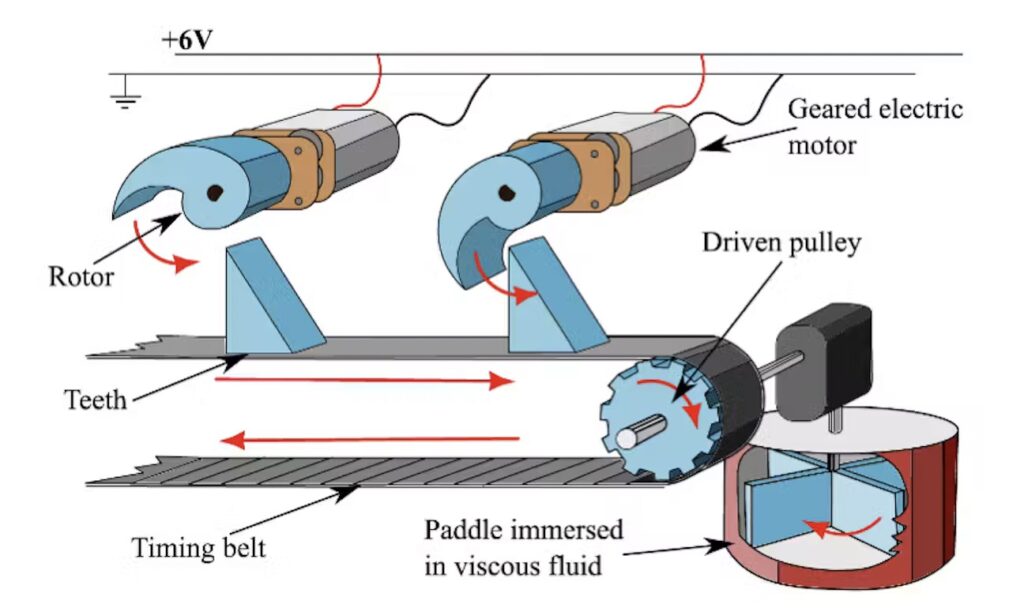
 Illustration showing the smallest functional unit of muscle: the sarcomere.
 An illustration of the artificial muscle unit used in


