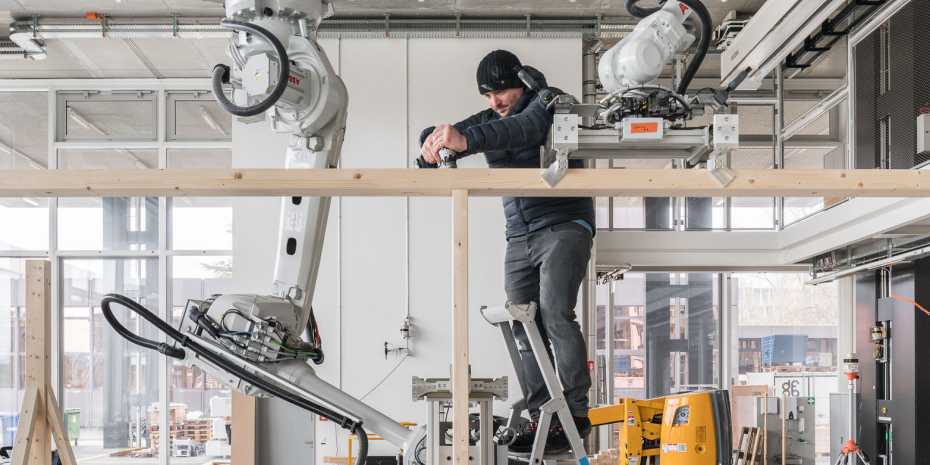
NCCR Researchers are using a new method for digital timber construction in a real project for the first time. The load-bearing timber modules, which are prefabricated by robots, will be assembled on the top two floors at the DFAB HOUSE construction site.
Digitalisation has found its way into timber construction, with entire elements already being fabricated by computer-aided systems. The raw material is cut to size by the machines, but in most cases it still has to be manually assembled to create a plane frame. In the past, this fabrication process came with many geometric restrictions.
Under the auspices of the National Centre of Competence in Research (NCCR) Digital Fabrication, researchers from ETH Zurich’s Chair of Architecture and Digital Fabrication have developed a new, digital timber construction method that expands the range of possibilities for traditional timber frame construction by enabling the efficient construction and assembly of geometrically complex timber modules. Spatial Timber Assemblies evolved from a close collaboration with Erne AG Holzbau and will be used for the first time in the DFAB HOUSE project at the Empa and Eawag
With robotic precision
The robot first takes a timber beam and guides it while it is sawed to size. After an automatic tool change, a second robot drills the required holes for connecting the beams. In the final step, the two robots work together and position the beams in the precise spatial arrangement based on the computer layout. To prevent collisions when positioning the individual timber beams, the researchers have developed an algorithm that constantly recalculates the path of motion for the robots according to the current state of construction. Workers then manually bolt the beams together.
Longer lasting, more individual construction
Unlike traditional timber frame construction, Spatial Timber Assemblies can manage without reinforcement plates because the required rigidity and load-bearing result from the geometric structure. Not only does this save material; it also opens up new creative possibilities. A total of six spatial, geometrically unique timber modules will be prefabricated in this way for the first time. Lorries will then transport them to the DFAB HOUSE construction site at the NEST in Dübendorf, where they will be joined to build a two-storey residential unit with more than 100 m2 of floor space. The complex geometry of the timber construction will remain visible behind a transparent membrane façade.
Integrated digital architecture
The robots use information from a computer-aided design model to cut and arrange the timber beams. This method was specially developed during the project and uses various input parameters to create a geometry consisting of 487 timber beams in total.
The fact that Spatial Timber Assemblies is being used for digital fabrication and also in design and planning offers a major advantage according to Matthias Kohler, Professor of Architecture and Digital Fabrication at ETH Zurich and the man spearheading the DFAB HOUSE project: “If any change is made to the project overall, the computer model can be constantly adjusted to meet the new requirements. This kind of integrated digital architecture is closing the gap between design, planning and execution.”
More Information in ETH Zurich Press Release
Detailed information about the building process, quotes as well as image and video material can be found in the extended press release by ETH Zurich.



 In this episode of





 Tencent, Alibaba, Baidu and JD.com from China are in a global competition with Google/Alphabet, Apple, Facebook, Walmart and Amazon from the USA and SoftBank from Japan. All are agressively searching for talent, intellectual property, market share, logistics and supply chain technology, and presence all around the world.
 Baidu (NASDAQ:BIDU) is China’s primary search source and also provides Internet-related services and products as well as targeted advertising, transaction services and a video platform. Baidu is heavily investing in researching deep learning, computer vision, speech recognition and synthesis, natural language understanding, data mining and knowledge discovery, business intelligence, artificial general intelligence, high performance computing, robotics and autonomous driving (at their new self-driving lab in Silicon Valley).
 Alibaba (NYSE:BABA) is a multi-national China-based e-commerce retailer, payment and technology conglomerate, cloud provider, whose two shopping malls (Tmall and Taobao) have over 1 billion combined active users and are supported by a budding logistics network. Alibaba’s AI-powered platform (which it uses internally for its shopping malls and logistics processing) was recently rolled out in Kuala Lumpur to support smart cities in their digital transformation. It analyzes large data volumes extracted from various sources in an urban environment, through video, image, and speech recognition. The system then uses machine learning to provide insights for city administrators to improve operational efficiencies and monitor security risks.
 Tencent (HKG:0700) is a Chinese provider of Internet and cloud-related services and products, entertainment, music services, AI, real estate and social media including WeChat (which recently hit 1 billion users). More than 35% of WeChat users spend over four hours a day on the service compared to the little more than an hour a day spent on Facebook, Instagram, Snapchat and Twitter combined. Tencent has set up AI labs in Shenzhen and Seattle and is researching voice and image recognition systems and transforming what they’ve learned into apps and algorithms to keep their users informed and attentive.
 JD.Com (NASDAQ:JD) is a Chinese e-commerce competitor with about half the user base of Alibaba yet with very progressive logistics and infrastructure programs. JD (Jingdong) is testing robotic delivery services, operating driverless delivery trucks and building drone delivery ports. JD operates 7 fulfillment centers and 405 warehouses in China. Last month it raised $2.5 billion for its JD Logistics subsidiary to build out and expand their logistics network.
 SoftBank (TYO:9984) is a Japanese telecom conglomerate. Softbank is also the instigator of the SoftBank Vision Fund which is investing massive amounts ($98 bn) in technologies and entrepreneurs pioneering the future through a wide range of sectors: IoT, AI, robotics, mobile applications and computing, and infrastructure, cloud technologies and software. SoftBank, with it’s funding partners Apple, Qualcomm and various sovereign wealth funds, wants to invest another $900 billion in 1,000 AI and robotics companies in the next decade. SoftBank is also a partner with Alibaba and Foxconn to produce and market Pepper and Nao robots.
 Google/Alphabet (NASDAQ:GOOG) is a Silicon Valley search engine and Internet products company with a stable of forthcoming AI ventures such as Waymo, Verb Surgical and Nest along with consumer products like Google Home, Android phones and Chromebook computers. Google is leveraging their data, processing power, and talent into an array of AI-based apps, processes and products. Their foray into robotics hardware has resulted in much valuable research but all of the units have either been sold off or closed (except for Boston Dynamics and Shaft which are held up from sale by government regulators). Although still a leader in machine learning, Google is finding much competition from their Chinese competitors.
 Apple (NASDAQ:AAPL) is Apple, a Silicon Valley designer, manufacturer and marketer of phones, media and hardware devices and provider of software, services and digital content. Apple is the world’s largest information technology company by revenue and the world’s second-largest mobile phone manufacturer after Samsung with annual revenue of $229 billion. Building out Siri from the virtual world into the consumer product world with their new Homepod is off to a late start.
 Facebook (NASDAQ:FB) is also a Silicon Valley-based Internet phenomena with products that include Facebook, Instagram, Messenger, WhatsApp and Oculus. Facebook has over 2.2 billion active users. Their investments in AI appear to be focused on developing a virtual (or physical) assistant. Their acquisition of Ozlo to help Messenger build out a more elaborate virtual assistant for users is an example.
 Walmart (NYSE:WMT) is a global retailer with wholesale facilities, logistics and distribution centers all around the world. Walmart operates over 11,000 stores under 59 names in 28 countries and e-commerce sites in 11 countries. It grosses over $480 billion annually and employs over 2.3 million workers. As Walmart increases its online e-commerce market share while simultaneously changing practices to provide better product transparency (particularly in and faster material handling at its stores and distribution centers, it too is on a talent hunt for roboticists and AI/machine learning people and providers.
 Amazon (NASDAQ:AMZN) Amazon is the leading e-commerce seller of products, supply chain services, AI, and cloud services that is copied and competed with around the world. Amazon accounts for ~4% of all retail and ~44% of all e-commerce spending in the US. Amazon’s supply chain and logistics facilities use more than 60,000 robots in its various warehouses and distribution centers, and its cloud services, which not only services Amazon, provides on-demand cloud computing platforms to companies and governments on a subscription basis. Amazon’s Echo/Alexa home assistant has started to include capabilities like a display, camera and alarm clock, security cameras, and even a fashion advisor. It is combining all these different incremental parts to build a smart home robot as they become viable and front-ended by the Alexa voice assistant.
 Infrastructure