Page 22 of 600
1 20 21 22 23 24 600

Robotic arm successfully learns 1,000 manipulation tasks in one day

Over the past decades, roboticists have introduced a wide range of systems that can effectively tackle some real-world problems. Most of these robots, however, often perform poorly on tasks that they were not trained on, particularly those that entail manipulating previously unseen objects or handling objects that were encountered before in new ways.

DataRobot Q4 update: driving success across the full agentic AI lifecycle

The shift from prototyping to having agents in production is the challenge for AI teams as we look toward 2026 and beyond. Building a cool prototype is easy: hook up an LLM, give it some tools, see if it looks like it’s working. The production system, now that’s hard. Brittle integrations. Governance nightmares. Infrastructure wasn’t built for the complexities and nuances of agents. 

For AI developers, the challenge has shifted from building an agent to orchestrating, governing, and scaling it in a production environment. DataRobot’s latest release introduces a robust suite of tools designed to streamline this lifecycle, offering granular control without sacrificing speed.

New capabilities accelerating AI agent production with DataRobot

New features in DataRobot 11.2 and 11.3 help you close the gap with dozens of updates spanning observability, developer experience, and infrastructure integrations.

Together, these updates focus on one goal: reducing the friction between building AI agents and running them reliably in production. 

The most impactful areas of these updates include:

  • Standardized connectivity through MCP on DataRobot
  • Secure agentic retrieval through Talk to My Docs (TTMDocs) 
  • Streamlined agent build and deploy through CLI tooling
  • Prompt version control through Prompt Management Studio
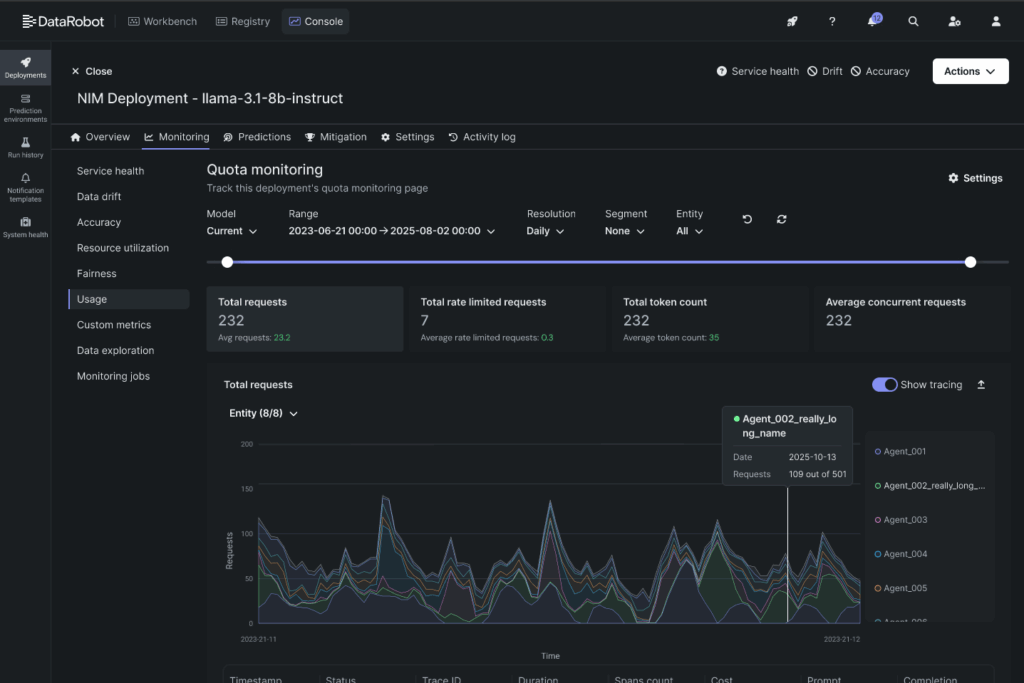
  • Enterprise governance and observability through resource monitoring
  • Multi-model access through the expanded LLM Gateway
  • Expanded ecosystem integrations for enterprise agents

The sections that follow focus on these capabilities in detail, starting with standardized connectivity, which underpins every production-grade agent system.

MCP on DataRobot: standardizing agent connectivity

Agents break when tools change. Custom integrations become technical debt. The Model Context Protocol (MCP) is emerging as the standard to solve this, and we’re making it production-ready. 

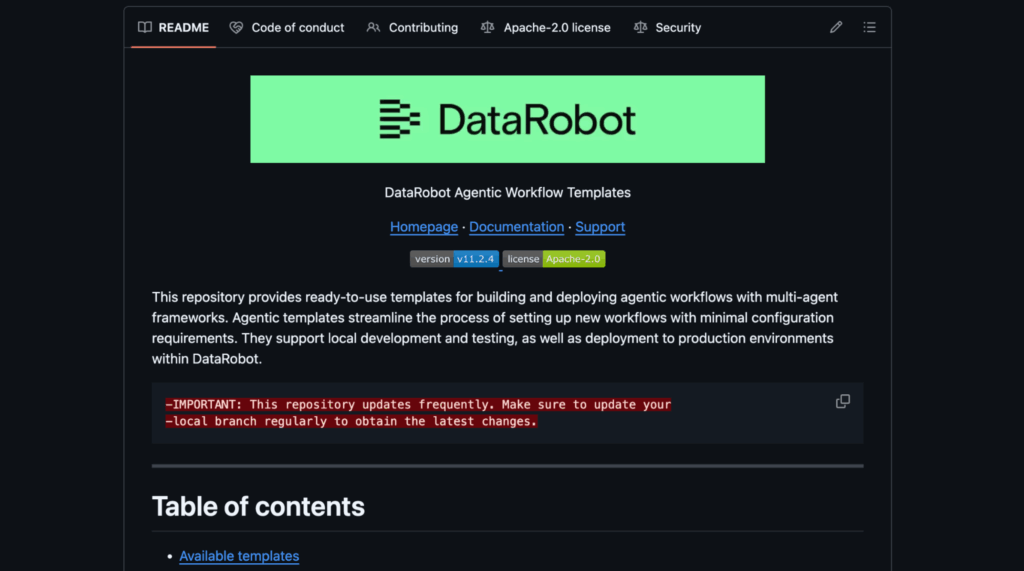
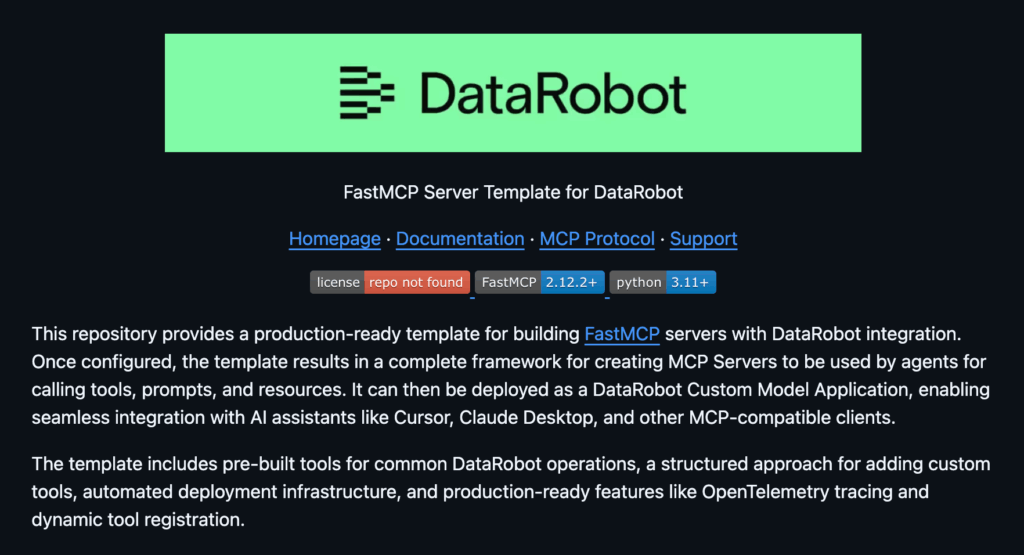
We’ve added an MCP server template to the DataRobot community GitHub.

  • What’s new: An MCP server template you can clone, test locally, and deploy directly to your DataRobot cluster. Your agents get reliable access to tools, prompts, and resources without reinventing the integration layer every time. Easily convert your predictive models as tools that are discoverable by agents.
  • Why it matters: With our MCP template, we’re giving you the open standard with enterprise guardrails already built in. Test on your laptop in the morning, deploy to production by afternoon.
MCP Server Template

Talk to My Docs: Secure, agentic knowledge retrieval

Everyone is building RAG. Almost nobody is building RAG with RBAC, audit trails, and the ability to swap models without rewriting code. 

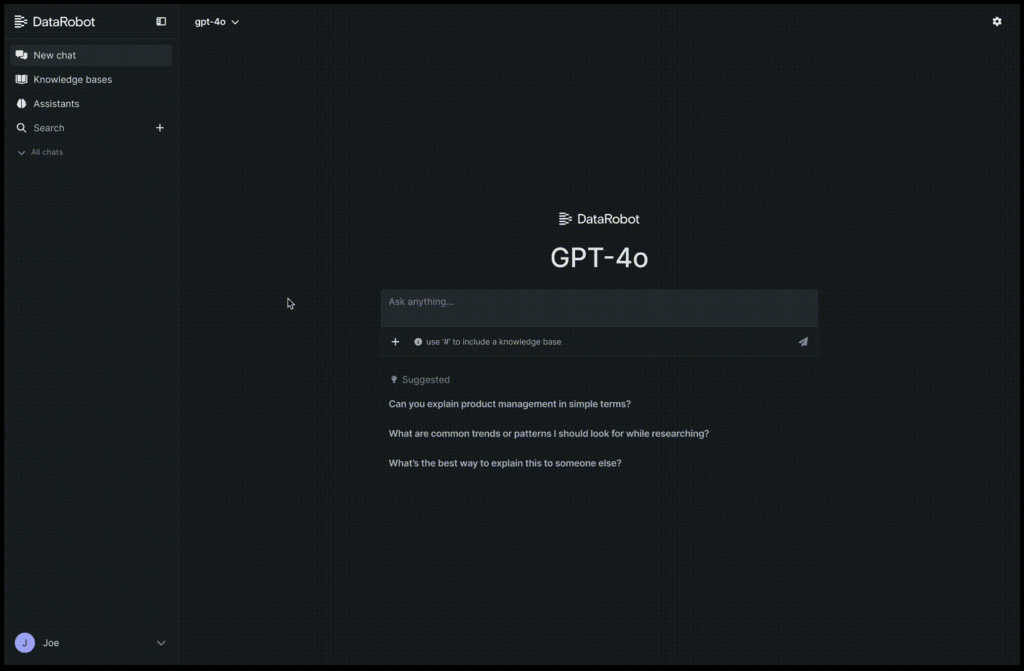
The “Talk to My Docs” application template brings natural language chat-style productivity across all your documents and is secured and governed for the enterprise.

  • What’s new: A secure, governed chat interface that connects to Google Drive, Box, SharePoint, and local files. Unlike basic RAG, it handles complex formats from tables, spreadsheets, multi-doc synthesis while maintaining enterprise-grade access control.
  • Why it matters: Your team needs ChatGPT-style productivity. Your security team needs proof that sensitive documents stay restricted. This does both, out of the box.
Talk to My Docs

Agentic application starter template and CLI: Streamlined build and deployment

Getting an agent into production should not require days of scaffolding, wiring services together, or rebuilding containers for every small change. Setup friction slows experimentation and turns simple iterations into heavyweight engineering work.

To address this, DataRobot is introducing an agentic application starter template and CLI, both designed to reduce setup overhead across both code-first and low-code workflows.

  • What’s new: An agentic application starter template and CLI that let developers configure agent components through a single interactive command. Out-of-the-box components include an MCP server, a FastAPI backend, and a React frontend. For teams that prefer a low-code approach, integration with NVIDIA’s NeMo Agent Toolkit enables agent logic and tools to be defined entirely through YAML. Runtime dependencies can now be added dynamically, eliminating the need to rebuild Docker images during iteration.
  • Why it matters: By minimizing setup and rebuild friction, teams can iterate faster and move agents into production more reliably. Developers can focus on agent logic rather than infrastructure, while platform teams maintain consistent, production-ready deployment patterns.
CLI

Prompt management studio: DevOps for prompts

As prompts move from experiments to production assets, ad hoc editing quickly becomes a liability. Without versioning and traceability, teams struggle to reproduce results or safely iterate.

To address this, DataRobot introduces the Prompt Management Studio, bringing software-style discipline to prompt engineering.

  • What’s new: A centralized registry that treats prompts as version-controlled assets. Teams can track changes, compare implementations, and revert to stable versions as prompts move through development and deployment.
  • Why it matters: By applying DevOps practices to prompts, teams gain reproducibility and control, making it easier to transition from prototyping to production without introducing hidden risk.

Multi-tenant governance and resource monitoring: Operational control at scale

As AI agents scale across teams and workloads, visibility and control become non-negotiable. Without clear insight into resource usage and enforceable limits, performance bottlenecks and cost overruns quickly follow.

  • What’s new: The enhanced Resource Monitoring tab provides detailed visibility into CPU and memory utilization, helping teams identify bottlenecks and manage trade-offs between performance and cost. In parallel, Multi-tenant AI Governance introduces token-based access with configurable rate limits to ensure fair resource consumption across users and agents.
  • Why it matters: Developers gain clear insight into how agent workloads behave in production, while platform teams can enforce guardrails that prevent noisy neighbors and uncontrolled resource usage as systems scale.
Governance and Resource Monitoring

Expanded LLM Gateway: Multi-model access without credential sprawl

As teams experiment with agent behavior and reasoning, access to multiple foundation models becomes essential. Managing separate credentials, rate limits, and integrations across providers quickly introduces operational overhead.

  • What’s new: The expanded LLM Gateway adds support for Cerebras and Together AI alongside Anthropic, providing access to models such as Gemma, Mistral, Qwen, and others through a single, governed interface. All models are accessed using DataRobot-managed credentials, eliminating the need to manage individual API keys.
  • Why it matters: Teams can evaluate and deploy agents across multiple model providers without increasing security risk or operational complexity. Platform teams maintain centralized control, while developers gain flexibility to choose the right model for each workload.

New supporting ecosystem integrations

Jira and Confluence connectors: To power your vector databases, DataRobot provides a cohesive ecosystem for building enterprise-ready, knowledge-aware agents.

NVIDIA NIM Integration: Deploy Llama 4, Nemotron, GPT-OSS, and 50+ GPU-optimized models without the MLOps complexity. Pre-built containers, production-ready from day one.

Milvus Vector Database: Direct integration with the leading open-source VDB, plus the ability to select distance metrics that actually matter for your classification and clustering tasks.

Azure Repos & Git Integration: Seamless version control for Codespaces development with Azure Repos or self-hosted Git providers. No manual authentication required. Your code stays centralized where your team already works.

Get hands-on with DataRobot’s Agentic AI 

If you’re already a customer, you can spin up the GenAI Test Drive in seconds. No new account. No sales call. Just 14 days of full access inside your existing SaaS environment to test these features with your actual data.  

Not a customer yet? Start a 14-day free trial and explore the full platform.

For more information, please visit our Version 11.2 and Version 11.3 release notes in the DataRobot docs.

The post DataRobot Q4 update: driving success across the full agentic AI lifecycle appeared first on DataRobot.

How U.S. Manufacturing VPs Can Close the Execution Gap — The New Playbook for Operational Excellence

Operational excellence used to mean efficiency. Now, it means consistency. In a volatile manufacturing environment, the winners aren’t those with the best machines or biggest budgets — they’re the ones who can execute the same playbook flawlessly, every day, on every line.

AI-powered robotic hands learn dexterity by mimicking human movements and anatomy

Step inside the Soft Robotics Lab at ETH Zurich, and you find yourself in a space that is part children's nursery, part high-tech workshop and part cabinet of curiosities. The lab benches are strewn with foam blocks, stuffed animals—including a cuddly squid—and other colorful toys used to train robotic dexterity. Piled up on every surface are sensors, cables and measurement devices. Skeletal fingers, on show in display cases or attached to powerful robotic arms, seem to reach out to grab you from every corner.

AI-powered robotic hands learn dexterity by mimicking human movements and anatomy

Step inside the Soft Robotics Lab at ETH Zurich, and you find yourself in a space that is part children's nursery, part high-tech workshop and part cabinet of curiosities. The lab benches are strewn with foam blocks, stuffed animals—including a cuddly squid—and other colorful toys used to train robotic dexterity. Piled up on every surface are sensors, cables and measurement devices. Skeletal fingers, on show in display cases or attached to powerful robotic arms, seem to reach out to grab you from every corner.

KNF – Automation Technology Requires Reliable and Durable Pumps

KNF vacuum pumps for automation applications are designed for a long service life, with micro gas pumps used as cobot pumps achieving more than 20,000 hours. The latest generation of KNF brushless DC motors has an innovative bearing design that withstands high mechanical loads. This technical strength protects the vacuum pump's longevity, especially with fast switching cycles.

UPS buys hundreds of robots to unload trucks in automation push

United Parcel Service Inc. will invest $120 million in 400 robots used to unload trucks, according to people familiar with the matter, revealing new details on the logistics giant's $9 billion automation plan that aims to boost profits by decreasing labor costs.

‘Robot, make me a chair’: AI-driven system designs, builds multicomponent objects from user prompts

Computer-aided design (CAD) systems are tried-and-true tools used to design many of the physical objects we use each day. But CAD software requires extensive expertise to master, and many tools incorporate such a high level of detail they don't lend themselves to brainstorming or rapid prototyping.

The Right 3D Vision Scanner for Robotic Programming: Laser Profilers vs Structured Light Scanners in Industrial Automation

By combining flexible vision technology with automated processing, manufacturers and system integrators can shorten deployment cycles, reduce reliance on fixtures, and achieve the adaptability needed for high-mix, high-precision production.

AI Software Development

AI Software Development: Why 95% of Enterprise Pilots Fail—and How Manufacturers Can Beat the Odds?

The manufacturing industry stands at a critical inflection point. While artificial intelligence promises to revolutionize operations, reduce costs, and create competitive advantage, a stark reality confronts enterprise leaders: 95% of generative AI pilot programs fail to deliver measurable impact on profits and revenue [1]. For manufacturing executives watching competitors announce AI initiatives, the pressure to act is immense, but the path forward is anything but clear.

The disconnect isn’t about AI’s potential. Global investment in AI software development reached $674.3 million in 2024 and is projected to surge to $15.7 billion by 2033, growing at a staggering 42.3% annually [2]. Manufacturing leaders recognize this transformation: 78% of organizations now use AI in at least one business function [3]. Yet between aspiration and execution lies a chasm filled with failed pilots, wasted budgets, and missed opportunities.

In this article, you’ll discover:

  • Why most AI software development projects stall before reaching production
  • The hidden barriers preventing manufacturers from scaling AI successfully
  • How custom AI development delivers 2-3x stronger ROI than off-the-shelf solutions
  • Proven implementation approaches that separate AI leaders from laggards
  • What distinguishes successful AI partnerships from costly vendor relationships

The Real Cost of AI Implementation Failure

Before exploring solutions, manufacturing executives must understand the true scope of the AI adoption challenge. The numbers paint a sobering picture:

Challenge Area Impact Source
Pilot Failure Rate 95% of enterprise AI solutions fail to achieve rapid revenue acceleration MIT NANDA Research [1]
Market Growth AI in software development projected to grow from $674.3M (2024) to $15.7B (2033) Grand View Research [2]
Manufacturing ROI 78% of executives report seeing returns from gen AI investments Google Cloud/National Research Group [4]
Productivity Gains Gen AI reduces software development time by up to 55% in early adoption Mission Cloud [5]
Top Barrier to Adoption Data accuracy and bias concerns (45% of organizations) IBM Research [6]
Cost Range Small to medium AI projects: $50K-$500K; large-scale initiatives: $5M+ Vention Teams [7]

The data reveals a paradox: while AI adoption accelerates and proven ROI emerges, the vast majority of implementations never escape pilot purgatory. For manufacturing organizations, this failure pattern carries particularly high stakes, production delays, quality control issues, and supply chain disruptions don’t tolerate prolonged experimentation.

Why AI Software Development Projects Stall?

The root causes of AI failure in manufacturing aren’t primarily technical. According to MIT research analyzing 150 enterprise AI deployments, the core issue is “the learning gap for both tools and organizations” [1]. Generic AI tools like ChatGPT excel for individual productivity because of their flexibility, but they stall in enterprise manufacturing environments because they don’t learn from or adapt to complex operational workflows.

The five critical failure points include:

  1. Strategic Misalignment

    Organizations treat AI as a technology purchase rather than a business transformation. Without clear alignment between AI capabilities and manufacturing pain points, whether predictive maintenance, quality control, or supply chain optimization, pilots generate impressive demos but no operational value.

  2. Data Infrastructure Deficits

    Manufacturing environments generate massive data volumes across sensors, IoT devices, ERPs, and legacy systems. However, 45% of organizations cite data accuracy and bias as their primary AI adoption barrier [6]. When training data is fragmented, incomplete, or poor quality, even sophisticated AI models produce unreliable outputs.

  3. The Build vs. Buy Dilemma

    The choice between purchasing specialized AI tools and building custom solutions isn’t about industry trends, it’s about your organization’s unique context. Success depends on factors like your internal technical capabilities, the specificity of your manufacturing processes, budget constraints, and long-term strategic goals. Some manufacturers thrive with vendor solutions that address common needs efficiently, while others require custom development to handle proprietary workflows or competitive differentiation. The key is honest assessment: Does your use case demand custom engineering, or are you building because that’s what you’ve always done?

  4. Cultural and Skills Barriers

    AI adoption challenges extend beyond technology to organizational culture. In risk-averse manufacturing environments, employees fear job displacement while leadership struggles to quantify intangible benefits like faster time-to-market or enhanced decision-making. The skills gap compounds this, finding professionals who grasp both AI technology and manufacturing operations proves exceptionally difficult.

  5. ROI Uncertainty

    Manufacturing executives accustomed to tangible ROI calculations struggle with AI’s multidimensional value. Traditional financial metrics miss improvements in decision speed, market agility, and competitive positioning. When leadership can’t confidently articulate expected returns, AI initiatives face perpetual budget scrutiny and eventual cancellation.

Custom vs. Off-the-Shelf: Choosing Your AI Development Path

For manufacturers navigating AI software development, the build-or-buy decision fundamentally shapes both short-term outcomes and long-term competitive advantage. Each approach carries distinct tradeoffs.

Off-the-Shelf AI Solutions:
Pre-built platforms deliver speed and lower upfront costs. Manufacturers can deploy chatbots, basic predictive analytics, or demand forecasting tools within weeks. These solutions work well for standardized processes where differentiation isn’t critical: customer support automation, basic inventory management, or routine reporting. However, data security introduces a critical trade-off. While these platforms may appear secure, your operational data flows through third-party infrastructure, raising concerns about proprietary information exposure, compliance requirements, and long-term data governance that many manufacturers underestimate during evaluation.

However, generic tools hit scalability limits quickly. They struggle with manufacturing-specific complexities: multi-site production coordination, proprietary quality control processes, or unique supply chain variables. More critically, when competitors access identical tools, no competitive advantage emerges.

Custom AI Development:
Purpose-built AI solutions designed around proprietary manufacturing data and workflows deliver 2-3x stronger ROI than generic vendor models [8]. Custom development enables manufacturers to:

  • Build predictive maintenance models trained on specific equipment and operating conditions
  • Create quality control systems that detect defects unique to proprietary production processes
  • Develop supply chain optimization engines accounting for specialized supplier networks and logistics constraints
  • Integrate seamlessly with existing ERP, MES, and IoT infrastructure

The tradeoffs are higher upfront investment ($50,000-$500,000 for moderate complexity projects [7]) and longer deployment timelines. Yet for manufacturers where operational excellence drives competitive positioning, custom AI becomes proprietary intellectual property that competitors cannot replicate.

The Hybrid Advantage:
Leading manufacturers increasingly adopt hybrid approaches, deploying off-the-shelf solutions for commodity functions while investing in custom AI for core differentiators. A mid-sized manufacturer might use a SaaS chatbot for customer inquiries while building a custom predictive quality system trained on decades of proprietary production data.

What Distinguishes Successful AI Implementation?

Manufacturing organizations that successfully scale AI share common characteristics that separate them from the 95% trapped in pilot purgatory [1]:

Executive Sponsorship:
Google Cloud’s research found that manufacturers with comprehensive C-level sponsorship are significantly more likely to see ROI (84%) compared to those without executive alignment (75%) [4]. Successful AI adoption requires cross-functional collaboration guided by top-level support that aligns initiatives with business goals.

Phased, Value-Driven Roadmaps:
Rather than attempting enterprise-wide AI transformation, successful manufacturers identify high-impact use cases that deliver quick wins. One manufacturer might start with predictive maintenance for critical production lines, prove ROI within six months, then expand to quality control and supply chain optimization.

Partnership Over Vendor Relationships:
The MIT research revealing that purchased solutions outperform internal builds by 2:1 [1] underscores the value of specialized expertise. However, the distinction matters: true partners bring manufacturing domain knowledge, understand operational constraints, and commit to long-term success—not just initial deployment.

Data-First Foundations:
Organizations that invest in data infrastructure before AI implementation see dramatically higher success rates. This means establishing data governance, integrating siloed systems, implementing quality controls, and creating feedback loops that enable models to learn and improve continuously.

The Manufacturing AI Opportunity: 2026 and Beyond

The manufacturing sector stands poised for AI acceleration. Recent research shows 56% of manufacturing executives report their organizations actively use AI agents, with 37% deploying more than ten autonomous systems [4]. These sophisticated, multi-agent systems independently plan, reason, and execute tasks across quality control (54%), production planning (48%), and supply chain logistics (47%).

For manufacturing leadership, the strategic question isn’t whether to adopt AI software development—competitors are already moving. The question is how to implement AI in ways that deliver measurable impact, not just impressive pilots.

Success requires strategic vision that connects AI capabilities to manufacturing pain points, technical excellence that bridges legacy systems and modern architectures, and implementation expertise that navigates the complexities separating concept from production deployment. Most critically, it requires partnership with specialists who understand that AI in manufacturing isn’t about technology for its own sake, it’s about operational transformation that drives efficiency, quality, and competitive advantage.

The 95% failure rate [1] reflects organizations treating AI as a vendor relationship rather than a strategic transformation. The 5% succeeding recognize that AI software development, done right, becomes a proprietary capability that compounds competitive advantage with every production run, every quality check, and every supply chain decision.

Ready to Move Beyond Pilot Purgatory?

The gap between AI aspiration and measurable manufacturing impact isn’t closing on its own. While your competitors experiment, your organization can execute, turning AI from a boardroom buzzword into a production floor reality that drives efficiency, quality, and growth.

[Schedule a Strategic AI Consultation]


Sources:

  1. MIT NANDA Initiative, “The GenAI Divide: State of AI in Business 2025”
  2. Grand View Research, “AI In Software Development Market | Industry Report, 2033”
  3. Google Cloud / National Research Group, “The ROI of AI in manufacturing” (2025)
  4. Mission Cloud, “AI Statistics 2025: Key Market Data and Trends”
  5. IBM Research, “The 5 biggest AI adoption challenges for 2025”
  6. Vention Teams, “AI Statistics 2025: Key Trends and Insights Shaping the Future”
  7. Fortune, “MIT report: 95% of generative AI pilots at companies are failing” (August 2025)
  8. RTS Labs, “Off-the-Shelf vs Custom AI Solutions: Which Fits Your Business?”
  9. McKinsey & Company, “The State of AI: Global Survey 2025”


References:

[1] MIT report: 95% of generative AI pilots at companies are …
[2] AI In Software Development Market | Industry Report, 2033
[3] The State of AI: Global Survey 2025
[4] The ROI of AI in manufacturing
[5] AI Statistics 2025: Key Market Data and Trends
[6] The 5 biggest AI adoption challenges for 2025
[7] AI Statistics 2025: Key Trends and Insights Shaping the Future
[8] Off-the-Shelf vs Custom AI Solutions: Which Fits Your …
Sub-millimeter-sized robots can sense, ‘think’ and act on their own

Robots small enough to travel autonomously through the human body to repair damaged sites may seem the stuff of science fiction dreams. But this vision of surgery on a microscale is a step closer to reality, with news that researchers from the University of Pennsylvania and the University of Michigan have built a robot smaller than a millimeter that has an onboard computer and sensors.
Page 22 of 600
1 20 21 22 23 24 600