Robot Talk Episode 161 – Collaborative haptic systems, with Allison Okamura
Claire chatted to Allison Okamura from Stanford University about developing advanced robotic systems for haptic (touch) interaction.
Allison Okamura is the Richard W. Weiland Professor of Engineering at Stanford University. Her academic interests include haptics, teleoperation, virtual reality, medical robotics, soft robotics, rehabilitation, and education. Allison is Director of Graduate Studies for Mechanical Engineering at Stanford University, a deputy director of the Wu Tsai Stanford Neurosciences Institute, a Science Fellow of the Hoover Institution and a founding faculty member and executive committee member of the Stanford Robotics Center.
SpaceX wants to build AI data centers in space. Will it work?
How AI Is Powering Smarter, More Connected Logistics Operations
Humanoid robots: How human-like machines could change our daily lives
Robots pour cocktails and run marathons, but still can’t multitask
How AI is Revolutionizing Supply Chain and Logistics?
Artificial Intelligence is becoming highly explosive in terms of global AI in logistics and supply chain. Many logistics officials feel that these areas are likely to experience a great transformation.
It has the potential to disrupt the continuous development of advanced and digital technologies such as machine learning, artificial intelligence, natural language processing (NLP), etc. and promote advancements in these sectors.
Computers can deal with massive data at a time, it is difficult to take it physically in a single decision making procedure. Applying AI algorithms and utilizing various data sets, a machine will analyze unlimited prospects which lead to compelling planning.
Artificial Intelligence reduces the human errors and helps in doing tedious tasks. So, with the assistance of AI, operational effectiveness can be boosted and expenses can be limited.
The growth of AI has fundamentally changed many sectors of the logistics and supply chain industry. Whether it is logistics management, consumer support, or inventory management, the contribution of the new era, Artificial Intelligence-based solutions are undeniable.
According to the reports of McKinsey, AI technology in supply chain management is expected to reach 3.3 trillion dollars in the coming next 20 years.
[contact-form-7]Click on the link to learn the Definition of Artificial Intelligence? And what are the Examples of AI?
In this blog, we will be discussing how Artificial Intelligence is impacting the supply chain and logistics industry.
So, without late, let’s look into the
Top 7 Ways AI in logistics and supply chain Management
-
Inventory Management
I think businesses cannot work properly without a well-maintained inventory. Both understocking and overstocking are really harmful. With a proper inventory management system, a company can focus on selling their products instead of managing its inventory.
A key requirement of AI technology in inventory management is the ability to assess demand, rather than the ability to ensure stock management. Algorithms can now study consumer demands across vast data and understand which materials will be in demand soon and which fail to generate enough sensation.
This is called ‘demand estimation’ and is widely used in and businesses across the globe. So instead of depending on real time demand, a company can be ready in advance and stock up accordingly. It is undoubtedly the best revolutionary aspect of Artificial Intelligence in logistics.
-
Warehouse Management
As facial recognition is becoming popular in AI, machine can handle security. It can be easily secured by tracking the customers who enter and exit the unmanned warehouse. In addition, machines can track the items kept on the product shelves and the customers leaving the warehouse after reading product barcode and then updating the inventory accordingly.
-
Shipping Process Optimization
The effect of Artificial Intelligence does not diminish when the product is left out of the list. It is also used to estimate the best possible shipping route. Intelligent Machines utilize graph theory to evaluate the fastest and most cost-effective shipping routes for business.
AI software can also handle peak hours and traffic conditions. These are the significant factors that badly affect the shipping time of a company. By ignoring peak hours and scheduling delivery during light traffic, their delivery boys can spend less waiting time on roads and deliver the products to customers as soon as possible. Thus, the impact, and in turn, the benefits are increased.
-
Supplier Relationship Management
I would certainly say that supplier is one of the significant aspects of any logistics businesses. Finding the perfect supplier and creating a list of each item is tailored to those suppliers. According to the demand, when refilling recalibrating product, the engagement with one’s suppliers is a major factor that describes how smoothly the transaction runs.
Artificial Intelligence can manage various supplier parameters including delivery speed, cost, and credit score and prepare a list of best suitable options for any circumstances. It indirectly says that business process runs effectively and the supplier relationship with them is friendly and loyal.
Also Read about AI in Supply Chain: Uses Cases of AI in Supply Chain Management
-
Transportation Management
It is common for many enterprises to contract with shipping firms to deliver their products. Some of the largest companies, like Alibaba, Amazon, and Flipkart have their own shipping department. As discussed earlier, Artificial Intelligence makes the whole experience very smooth when it comes to efficiency and time management for goods shipping.
Whenever drivers are in delivery vehicles, they have only limited time to reach the destination. Hiring multiple drivers for the same vehicle to cater the requirement for a 24*7*365 delivery system can be costly. In logistics, AI going to prove as a lifesaver soon by automating the entire driving function. You know? Amazon has shown confidence recently in automated delivery trucks.
-
Foreign Language Decoder
Every country in the world has its own national language. As business is happening from around the globe, you should cater to a global audience. But, miss communication due to different languages is a major problem. Along with the miss-conversation between customers and business, understanding other countries market trends and goods can be a big problem.
Don’t worry! This barrier will not exist longer with AI technology. In addition, AI-powered chatbots and customer support systems are also very good at managing foreign consumers without the hassle of hiring many offshore support executives. All over, Artificial Intelligence makes the employment easier.
-
Reduced Customer Response Time
Ultimately, businesses are leveraging AI solutions to provide excellent customers support. Using AI Chatbots, businesses can reduce consumer response time and also decreased the need for customer service executives.
In addition to being polite and practical, chatbots are also beneficial when dealing with foreign customers who do not speak the languages supported by the business locally. AI technology ensures very efficient and fast customer service.
Final Verdict
AI technology will continue the fantastic journey of digitization development and will definitely become a significant part of everyday business. In industries such as supply chain and logistics, Obtaining Artificial Intelligence from expertise in fields such as supply chain and logistics is a useful tool to find out critical issues. AI plays a vital role in paving the way for proactive, predictive and personalized opportunities for supply chain and logistics.
Choosing Right AI Solution for Your Business is the First Step towards Success
USM Business Systems is one of the leading AI Solutions providers in India, the USA and the UK.
With more than a decade of expertise in AI application development, we deliver intelligent solutions that help businesses optimize operations, accelerate growth, and gain a competitive edge.
Contact us to know more about How AI is Revolutionizing Supply Chain and Logistics? Book Executive AI Briefing →
[contact-form-7]Humanizing robots makes factory workers more productive
Upsampling method sharpens AI vision with up to 16 times less GPU memory
DataRobot for Developers — integrating with the Google Antigravity CLI
Antigravity CLI is the newest agentic coding CLI from Google, replacing the now-deprecated Gemini CLI. It inherits the asynchronous subagent model that makes Antigravity stand out from the field, syncs bidirectionally with Antigravity Desktop, and is optimized for speed on Gemini 3.5 Flash.
DataRobot ships a full plugin for Antigravity CLI directly from the same open source repository that powers our Cursor, Claude Code, and Gemini CLI integrations. One install gives you the complete DataRobot skill set inside Antigravity’s agent and slash-command interface.
Getting the skills into Antigravity CLI
Install the DataRobot plugin with a single command:
agy plugin install https://github.com/datarobot-oss/datarobot-agent-skills.git
If you’re still on Gemini CLI, the same repository installs there too:
gemini extensions install https://github.com/datarobot-oss/datarobot-agent-skills.git
Already using the DataRobot extension in Gemini CLI and switching to Antigravity? Migrate it directly:
agy plugin import gemini
Once installed, the full DataRobot skill set is available including datarobot-setup and datarobot-agent-assist and can be invoked with slash commands like /datarobot-skills:datarobot-agent-assist

Adding DataRobot tracing to a local agent
Debugging agents is hard. LLM calls return plausible-sounding output even when something has gone wrong, tool calls fail silently, and latency problems are invisible in the final response. Without structured trace data, the only option is log-hunting and guesswork.
To show how the DataRobot tracing skill works in practice, here’s a concrete example: a LangGraph agent in a single main.py file that manages bike workouts. It has several tools, produces inconsistent answers, and the root cause isn’t obvious from the conversational output alone.
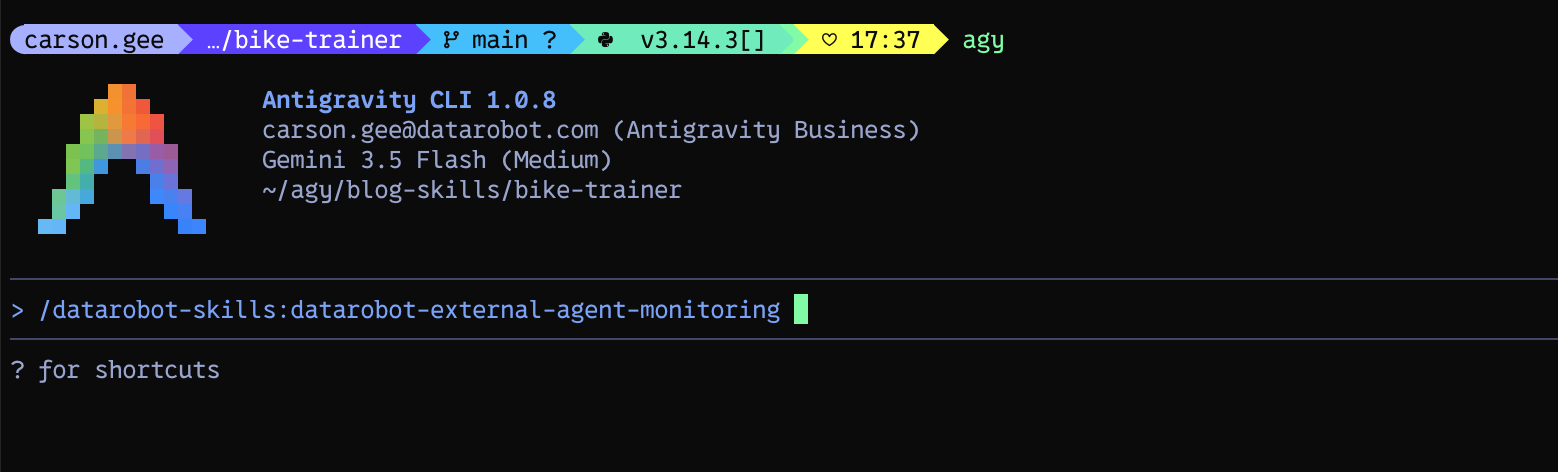
Adding production-grade tracing to this agent takes a single skill invocation: /datarobot-skills:datarobot-external-agent-monitoring.

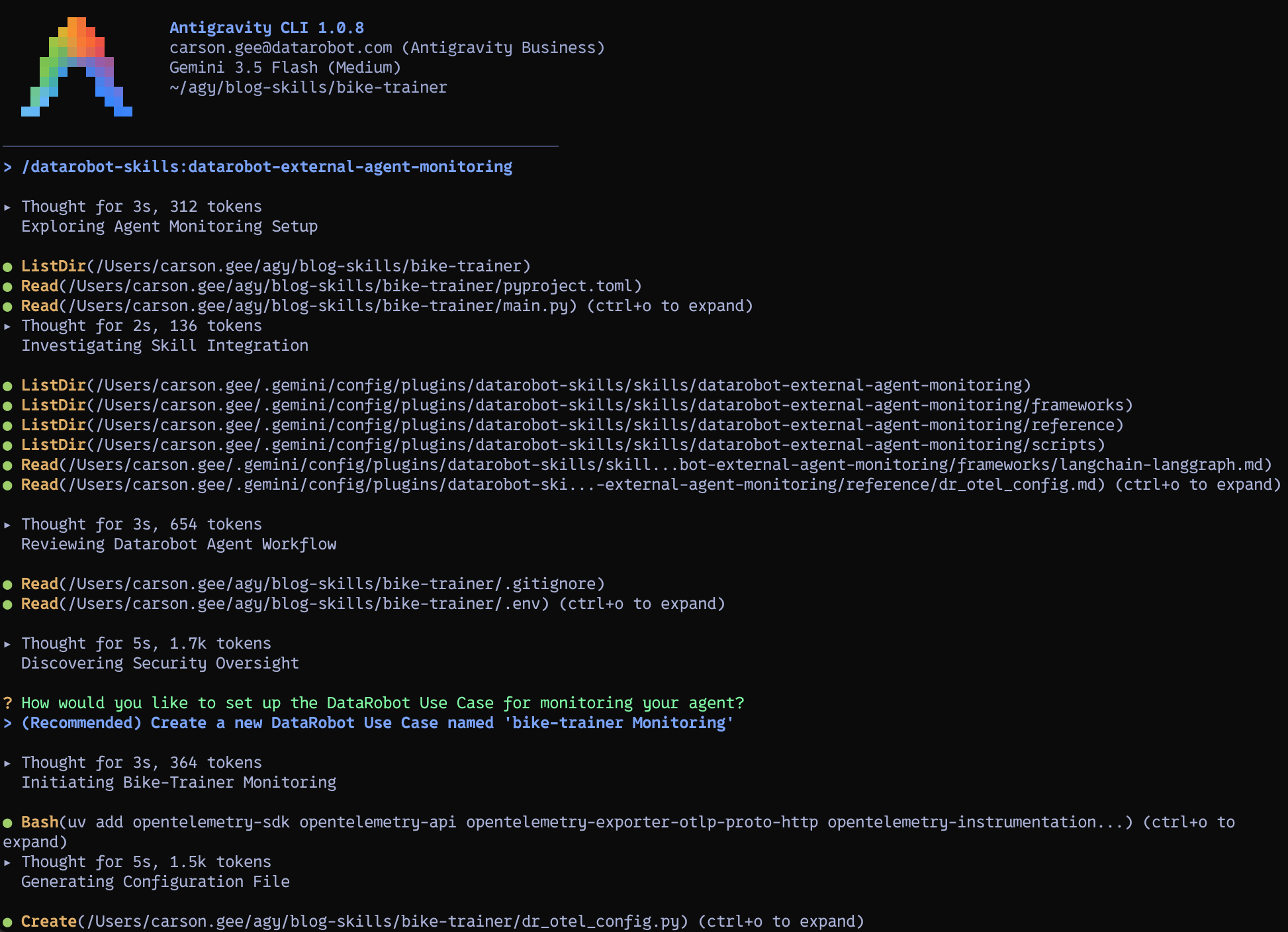
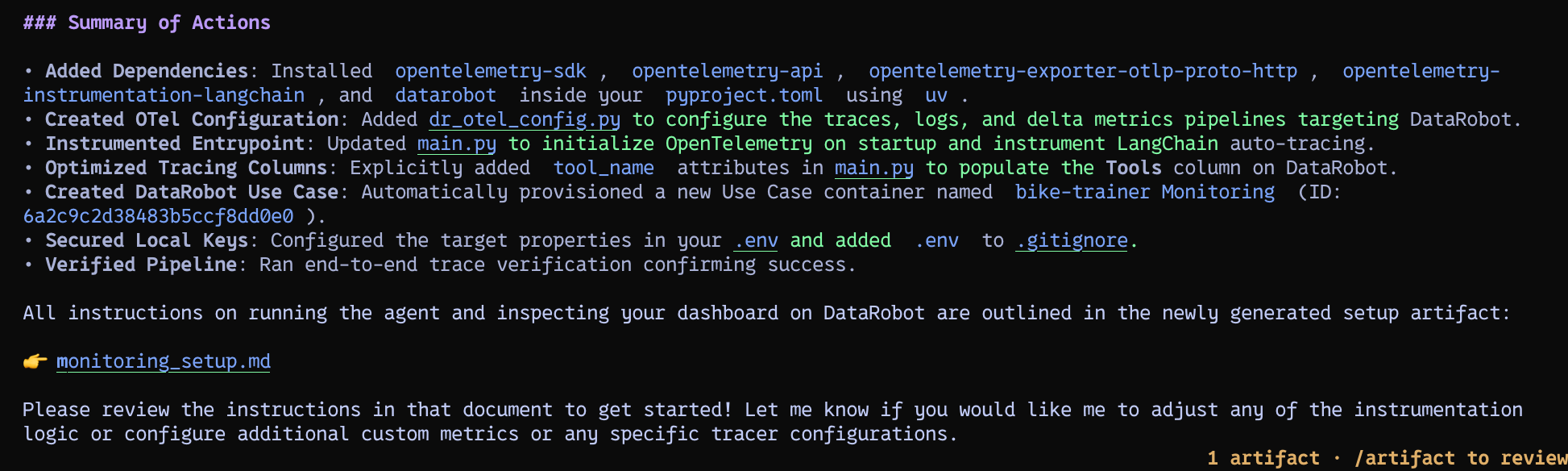
The skill provisions a new DataRobot Use Case, instruments the agent to emit traces via OpenTelemetry, and writes a monitoring_setup.md artifact with the runtime configuration steps.


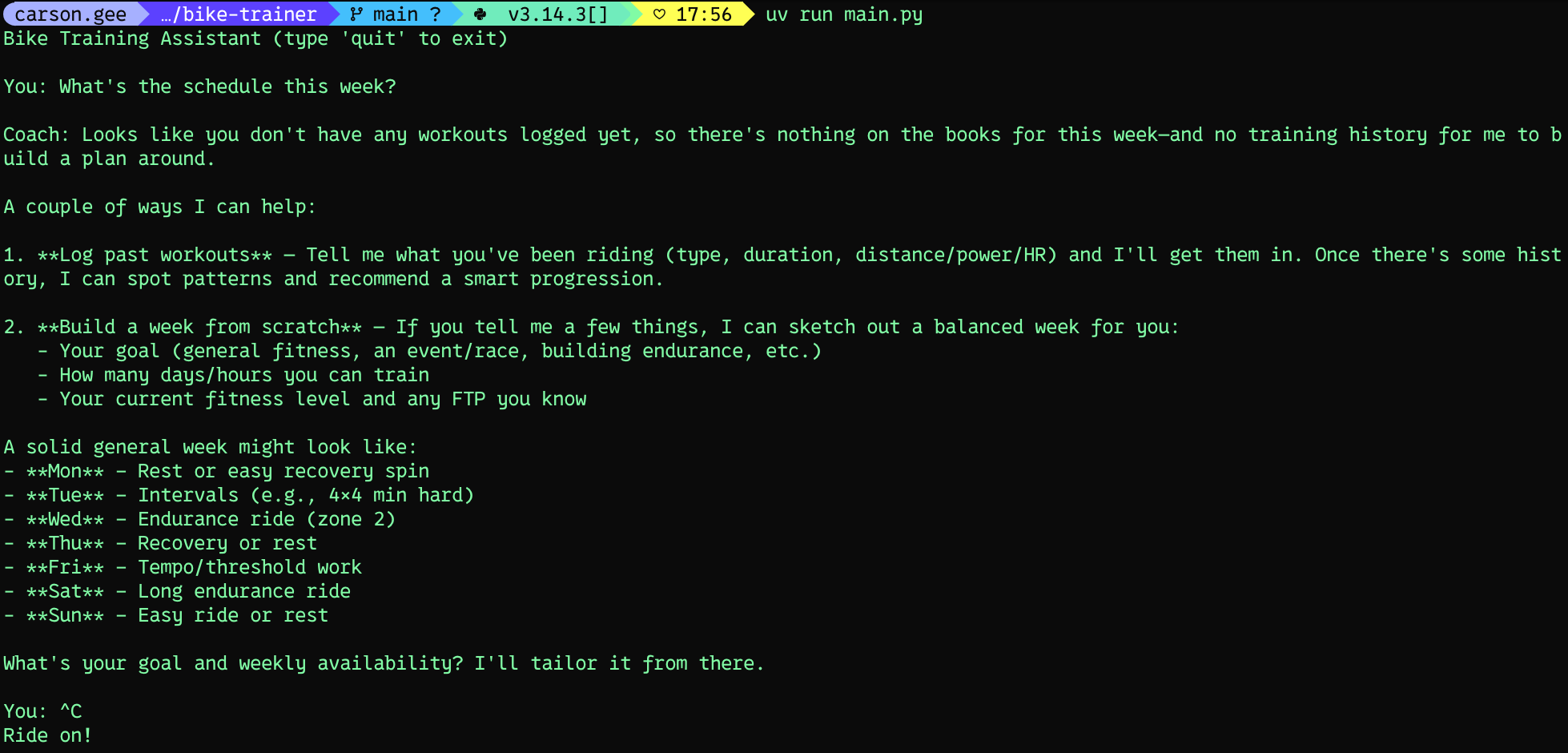
With instrumentation in place, run the agent and send it a question — in this case, “What’s the schedule this week?”

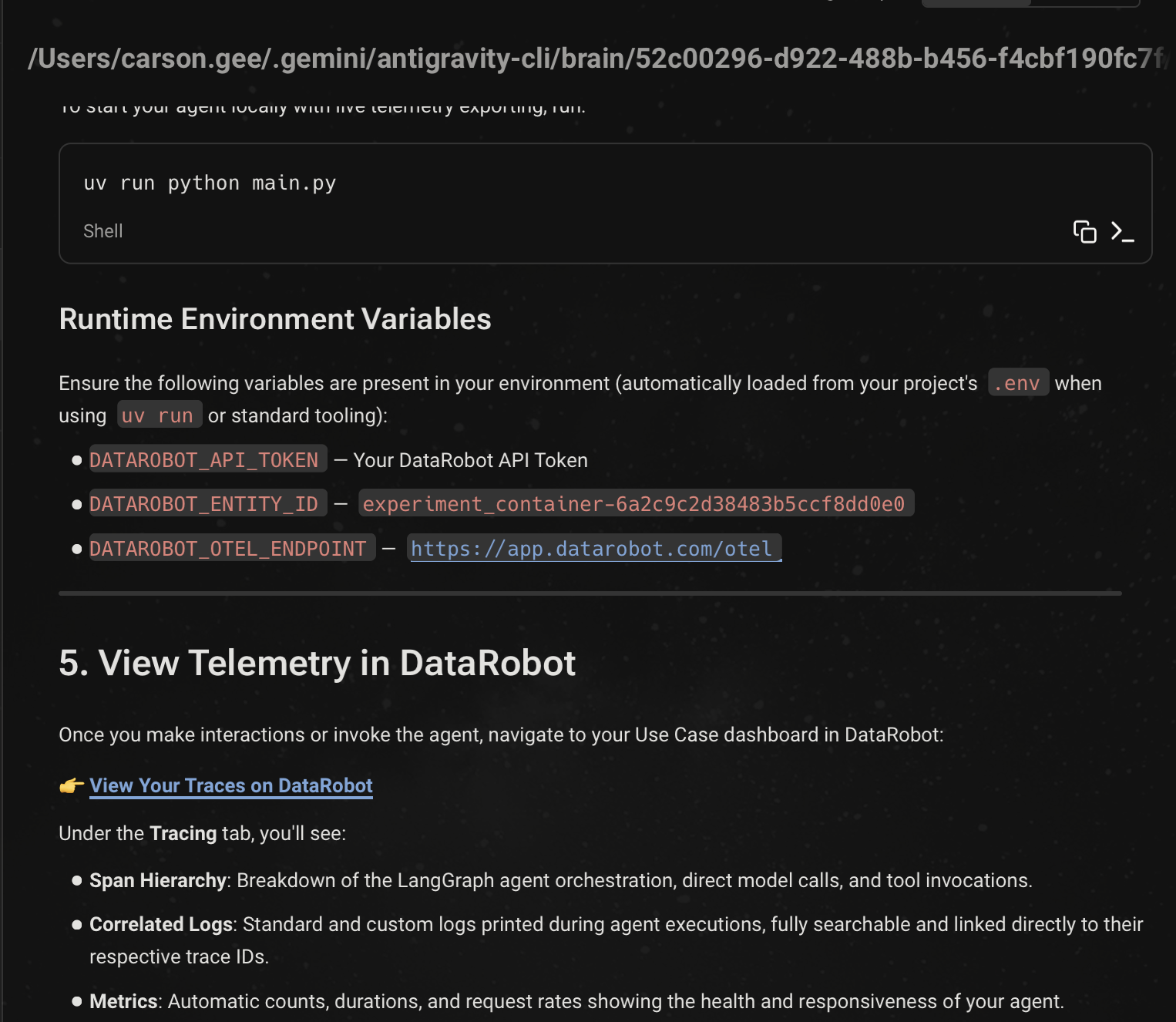
The skill generates setup instructions that include the Use Case entity ID and the environment variables needed to route traces to DataRobot:

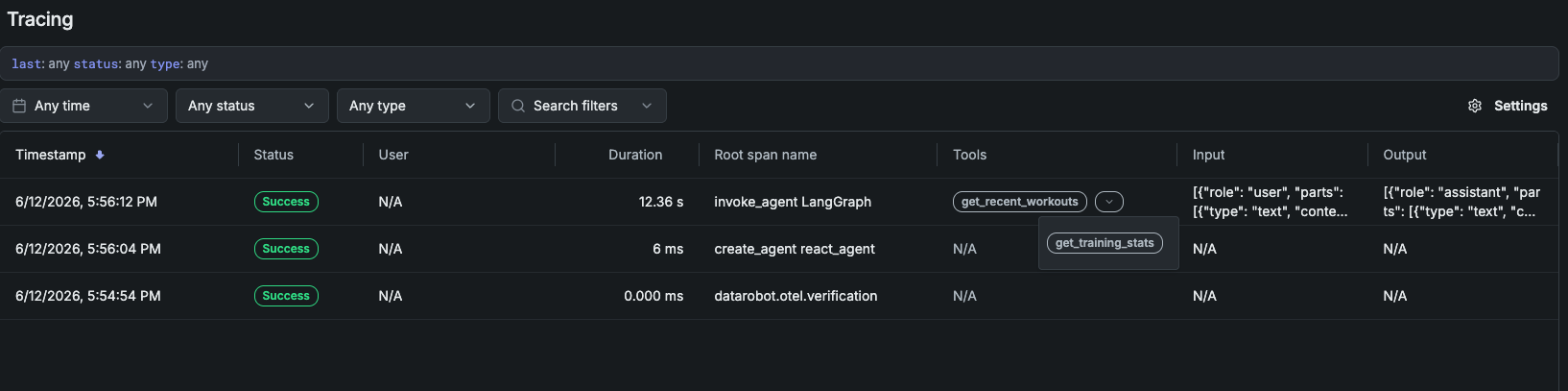
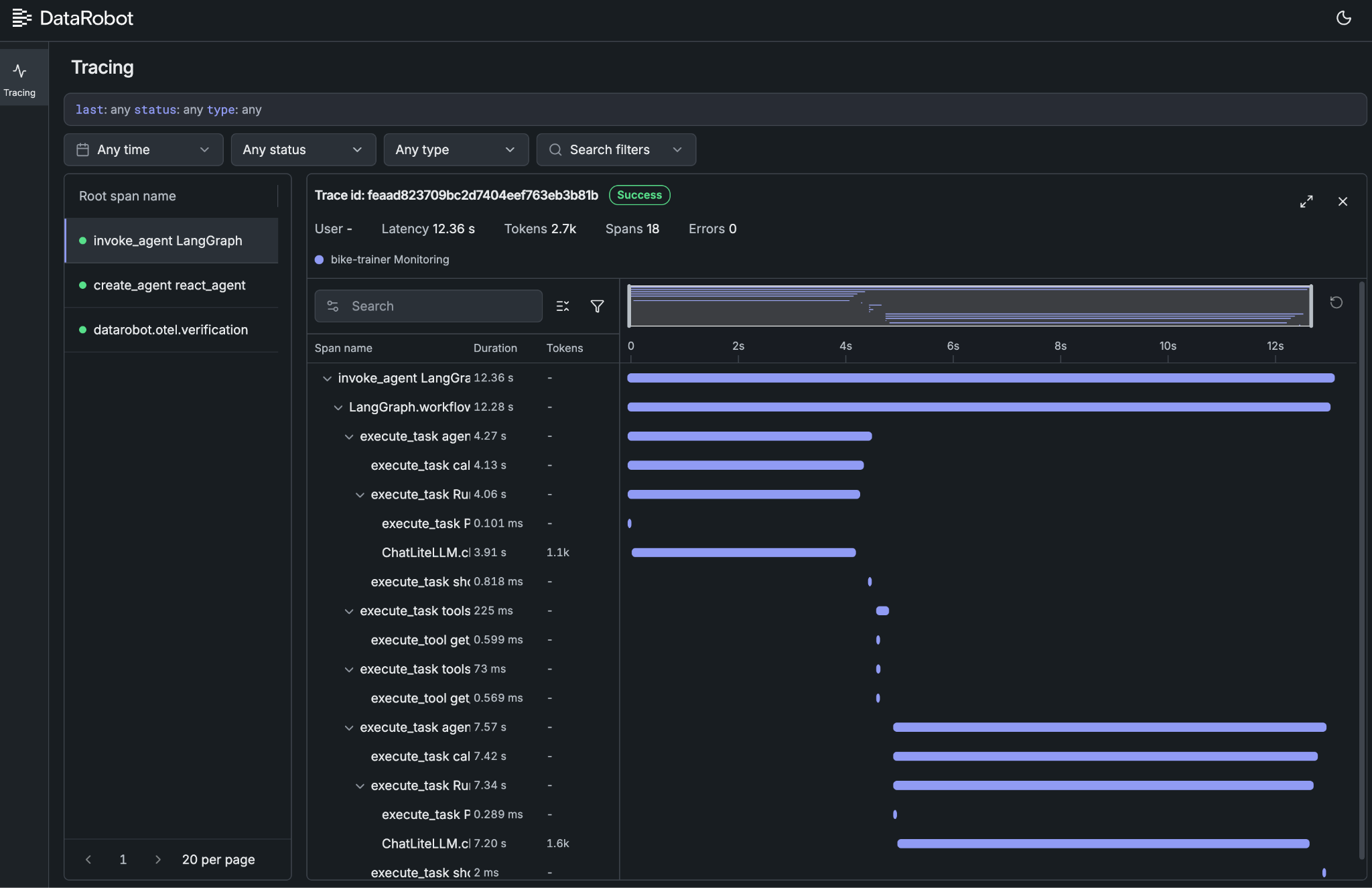
The DataRobot tracing interface surfaces the full request history. Each trace shows end-to-end latency, total token consumption, and the complete span tree:

Drilling into the “schedule this week” request reveals the full picture: 2,700 tokens consumed, tool-level latency for each call, LLM invocation count, and any custom attributes emitted via standard OTel instrumentation. This is the data that makes debugging tractable, not inference from final output.

For local development, the DataRobot CLI surfaces trace updates in real time: dr plugin install xp followed by dr xp --entity-id=<use_case_id>. This creates a tight iteration loop — run the agent, inspect the trace, fix the issue, repeat.
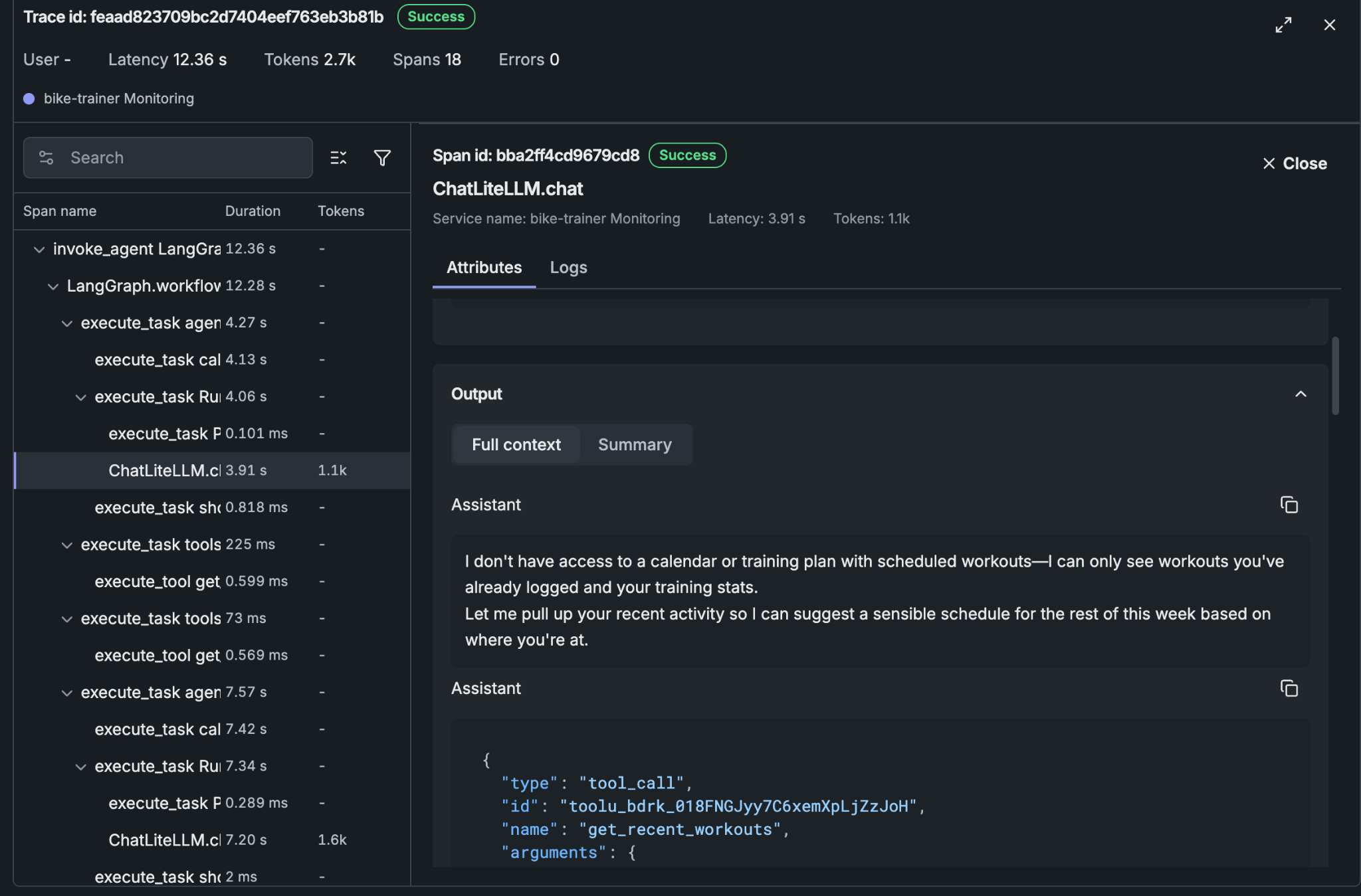
In this case, the span output makes the root cause explicit: the agent lacks calendar access, which is why it couldn’t answer the scheduling question. That failure wasn’t surfaced in the agent’s conversational response:

Instead, the agent responded with generic guidance:
2. **Build a week from scratch** - If you tell me a few things, I can sketch out a balanced week for you:
- Your goal (general fitness, an event/race, building endurance, etc.)
- How many days/hours you can train
- Your current fitness level and any FTP you know
A solid general week might look like:
- **Mon** - Rest or easy recovery spin
- **Tue** - Intervals
- **Wed** - Endurance ride (zone 2)
- **Thu** - Recovery or rest
- **Fri** - Tempo/threshold work
- **Sat** - Long endurance ride
- **Sun** - Easy ride or rest
The trace made the gap between expected and actual agent behavior immediately actionable. This same pattern applies at enterprise scale: whether the agent is running on a laptor or in production on a cloud provider, DataRobot traces the full execution tree and surfaces what the agent actually did — not just what it said.
Get started
- Simple LangGraph Bike Training Agent: github.com/carsongee
- Gemini plugin listing: geminicli.com/extensions/?name=datarobot-ossdatarobot-agent-skills
The gap between an agent prototype and an agent in production is mostly operational context. Your coding agent writes the code. DataRobot supplies the observability layer and the governed deployment target. One plugin install, one skill execution â and you have production-grade trace data from the first run.
The post DataRobot for Developers — integrating with the Google Antigravity CLI appeared first on DataRobot.
The Steam Controller and an Industrial Robot: An Unexpected Intersection
When will AI robots become part of everyday lives?
Could AI tell you where you left your keys?
New research enables a robot to chart a better course
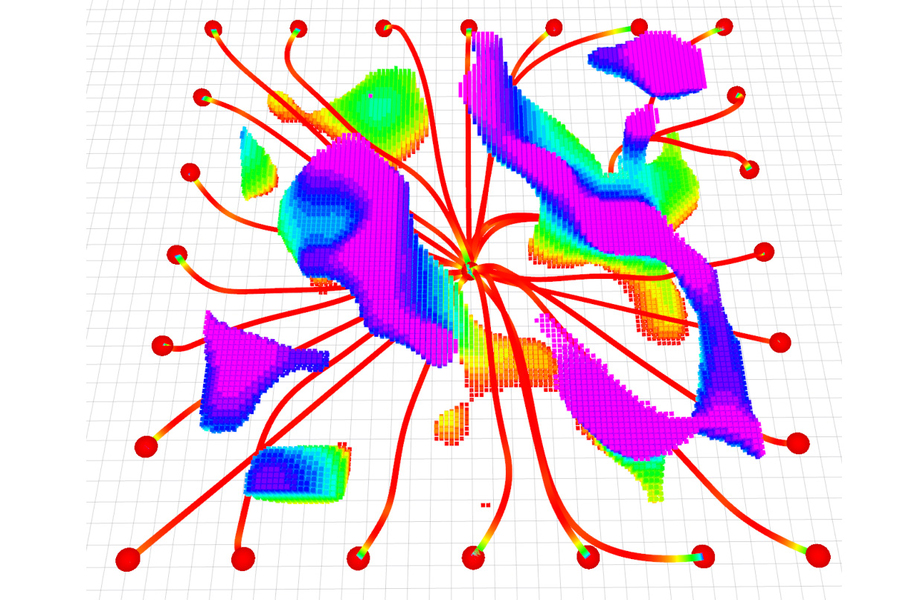
A figure shows multiple flight pathways as a UAV starts from the center and flies toward 24 goals (dots around perimeter). The flight pathways are mainly red and end in cool colors, showing reduced speed. The rainbow clouds represent obstacles, with cooler colors representing taller obstacles. Credit: Courtesy of the researchers.
By Adam Zewe
In the aftermath of a devastating earthquake, unpiloted aerial vehicles (UAVs) could fly through a collapsed building to map the scene, giving rescuers information they need to quickly reach survivors.
But this remains an extremely challenging problem for an autonomous robot, which would need to swiftly adjust its trajectory to avoid sudden obstacles while staying on course.
Researchers from MIT and the University of Pennsylvania developed a new trajectory-planning system that tackles both challenges at once. Their technique enables a UAV to react to obstacles in milliseconds while staying on a smooth flight path that minimizes travel time.
Their system uses a new mathematical formulation that ensures the robot travels safely to its destination along a feasible path, and that is less computationally intensive than other techniques. In this way, it generates smoother trajectories faster than state-of-the-art methods.
The trajectory planner is also efficient enough for real-time flight using only the robot’s onboard computer and sensors.
Named MIGHTY, the open-source system does not require proprietary software packages that can cost hundreds of thousands of dollars. It could be more readily deployed in a wider variety of real-world settings.
In addition to search-and-rescue, MIGHTY could be utilized in applications like last-mile delivery in urban spaces, where UAVs need to avoid buildings, wires, and people, or in industrial inspection of complex structures, such as wind turbines.
“MIGHTY achieves comparable or better performance using only open-source tools, which means any researcher, student, or company — anywhere in the world — can use it freely. By removing this cost barrier, MIGHTY helps democratize high-performance trajectory planning and opens the door for a much broader community to build on this work,” says Kota Kondo, an aeronautics and astronautics graduate student and lead author of a paper on this trajectory planner.
Kondo is joined on the paper by Yuwei Wu, a graduate student at the University of Pennsylvania; Vijay Kumar, a professor at UPenn; and senior author Jonathan P. How, a Ford professor of aeronautics and astronautics and a principal investigator in the Laboratory for Information and Decision Systems (LIDS) and the Aerospace Controls Laboratory (ACL) at MIT. The research appears in IEEE Robotics and Automation Letters.
Overcoming trade-offs
When Kondo was a child, the Fukushima Daiichi nuclear accident occurred following the Great East Japan Earthquake. With school cancelled, Kondo was stuck at home and watched the news every day as workers explored and secured the reactor site. Some workers still had to enter hazardous areas to contain the damage and assess the situation, exposing them to high doses of radioactive material.
“I became passionate about creating autonomous robots that can go into these dynamic and dangerous situations, then come back and report to humans who stay out of harm’s way,” Kondo says.
This task requires a strong trajectory planner, which is software that decides the path a robot should follow to safely get from point A to point B.
But many existing systems force tradeoffs that limit performance.
While some commercial systems can rapidly generate smooth trajectories, they can cost hundreds of thousands of dollars. Open-source alternatives often underperform compared to commercial solvers or are difficult to use.
With MIGHTY, Kondo and his colleagues developed an open-source system that produces high-quality, smooth trajectories while reacting to obstacles in real-time, and which runs fast enough for flight using only onboard components.
To do this, they overcame a key challenge that limits many open-source systems.
These methods usually estimate how long it will take the robot to get from point A to point B as a first step. From that fixed estimation of travel time, the planner finds the best path to reach the destination.
While using a fixed travel time allows the planner to rapidly generate a trajectory, it has drawbacks. For one, if the UAV must go far out of its way to avoid obstacles, it could be forced to crank up the speed to meet the fixed travel-time budget. This makes it harder to avoid sudden hazards.
A MIGHTY method
Instead, MIGHTY uses a mathematical technique, called a Hermite spline, that optimizes the travel time and flight path together, in a single step, to form a smooth trajectory that can be precisely controlled.
“Optimizing the spatial and temporal components together gets us better results, but now the optimization becomes so much bigger that it is harder to solve in a feasible amount of time,” Kondo says.
The researchers used a clever technique to reduce this computational overhead.
Instead of generating a trajectory from scratch each time, MIGHTY makes an initial guess of a trajectory. Then it refines the trajectory through an iterative optimization, using a map of the scene generated by the UAV’s lidar sensors.
“We can make a decent guess of what the trajectory should be, which is a lot faster than generating the entire thing from nothing,” Kondo says.
This enables MIGHTY to react in real-time to unknown obstacles while keeping the trajectory smooth and minimizing travel time. The system utilizes the UAV’s onboard components, which is important for applications where a robot might travel far from a base station.
In simulated experiments, MIGHTY needed only about 90 percent of the computation time required by state-of-the-art methods, while safely reaching its destination about 15 percent faster than these approaches.
When they tested the system on real robots, it reached a speed of 6.7 meters per second while avoiding every obstacle that appeared in its path.
“With MIGHTY, everything is integrated in one piece. It doesn’t need to talk to any other piece of software to get a solution. This helps us be even faster than some of the commercial solvers,” Kondo says.
In the future, the researchers want to enhance MIGHTY so it can be used to control multiple robots at once and conduct more flight experiments in challenging environments. They hope to continue improving the open-source system based on user feedback.
“MIGHTY makes an important contribution to agile robot navigation by revisiting the trajectory representation itself. Hermite splines have already been successfully used in visual simultaneous localization and mapping, and it is nice to see their advantages now being exploited for trajectory planning in mobile robots. By enabling joint optimization of path geometry, timing, velocity, and acceleration while retaining local control of the trajectory, MIGHTY gives robots more freedom to compute fast, dynamically feasible motions in cluttered environments,” says Davide Scaramuzza, professor and director of the Robotics and Perception Group at the University of Zurich, who was not involved with this research.
This research was funded, in part, by the United States Army Research Laboratory and the Defense Science and Technology Agency in Singapore.