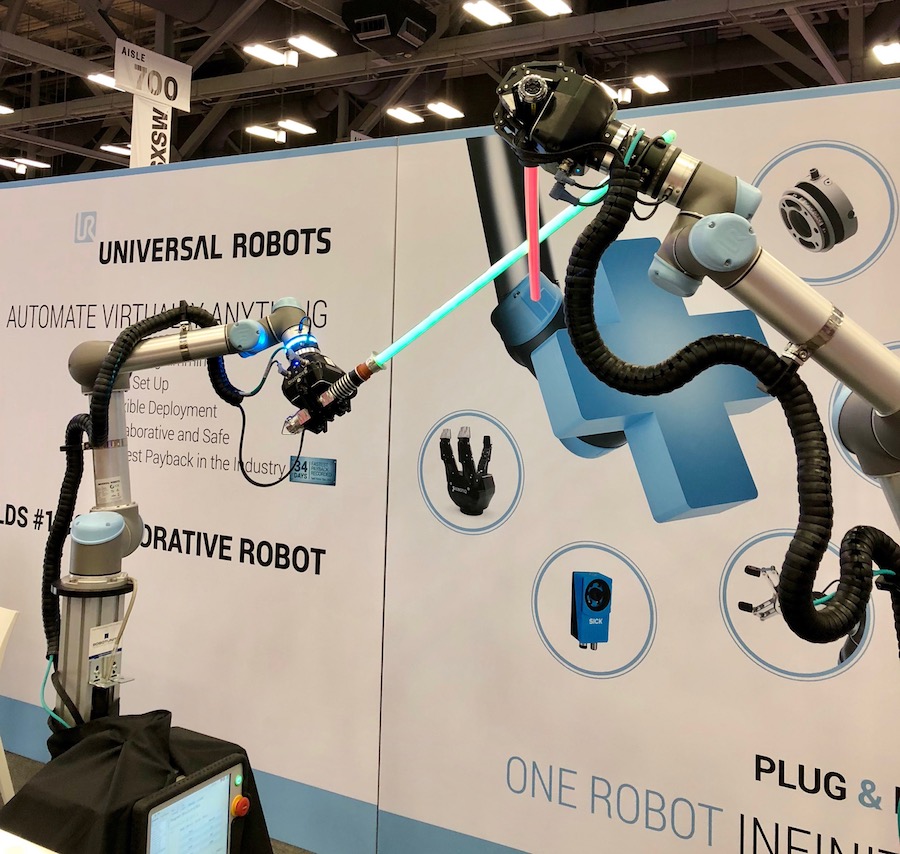
As Mark Hamill humorously shared the behind-the-scenes of “Star Wars: The Last Jedi” with a packed SXSW audience, two floors below on the exhibit floor Universal Robots recreated General Grievous’ famed light saber battles. The battling machines were steps away from a twelve foot dancing Kuka robot and an automated coffee dispensary. Somehow the famed interactive festival known for its late night drinking, dancing and concerts had a very mechanical feel this year. Everywhere debates ensued between utopian tech visionaries and dystopia-fearing humanists.
Even my panel on “Investing In The Autonomy Economy” took a very social turn when discussing the opportunities of utilizing robots for the growing aging population. Eric Daimler (formerly of the Obama White House) raised concerns about AI bias affecting the well being of seniors. Agreeing, Dan Burstein (partner at Millennium Tech Value Partners) nervously expressed that ‘AI is everywhere, in everything, and the USA has no other way to care for this exploding demographic except with machines.’ Daimler explained that “AI is very good at perception, just not context;” until this is solved it could be a very dangerous problem worldwide.
Last year at a Google conference on the relationship between humans and AI, the company’s senior vice president of engineering, John Giannandrea, warned, “The real safety question, if you want to call it that, is that if we give these systems biased data, they will be biased. It’s important that we be transparent about the training data that we are using, and are looking for hidden biases in it, otherwise we are building biased systems.” Similar to Daimler’s anxiety about AI and healthcare, Giannandrea exclaimed that “If someone is trying to sell you a black box system for medical decision support, and you don’t know how it works or what data was used to train it, then I wouldn’t trust it.”

One of the most famous illustrations of how quickly human bias influences computer actions is Tay, the Microsoft customer service chatbot on Twitter. It took only twenty-four hours for Tay to develop a Nazi persona leading to more than ninety thousand hate-filled tweets. Tay swiftly calculated that hate on social media equals popularity. In explaining its failed experiment to Business Insider Microsoft stated via email: “The AI chatbot Tay is a machine learning project, designed for human engagement. As it learns, some of its responses are inappropriate and indicative of the types of interactions some people are having with it. We’re making some adjustments to Tay.”
While Tay’s real impact was benign, it raises serious questions of the implications of embedding AI into machines and society. In its Pulitzer Prize-winning article, ProPublica.org uncovered that a widely distributed US criminal justice software called Correctional Offender Management Profiling for Alternative Sanctions (COMPAS) was racially biased in scoring the risk levels of convicted felons to recommit crimes. ProPublica discovered that black defendants in Florida, “were far more likely than white defendants to be incorrectly judged to be at a higher rate of recidivism” by the AI. Northpointe, the company that created COMPAS, released its own report that disputed ProPublica’s findings but it refused to pull back the curtain on its training data, keeping the algorithms hidden in a “black box.” In a statement released to the New York Times, Northpointe’s spokesperson argued, “The key to our product is the algorithms, and they’re proprietary. We’ve created them, and we don’t release them because it’s certainly a core piece of our business.”

The dispute between Northpointe and ProPublica raises the question of transparency and the auditing of data by an independent arbitrator to protect against bias. Cathy O’Neil, a former Barnard professor and analyst at D.E. Shaw, thinks a lot about safeguarding ordinary Americans from biased AI. In her book, Weapons of Math Destruction, she cautions that big corporate America is too willing to hand over the wheel to the algorithms without fully assessing the risks or implementing any oversight monitoring. “[Algorithms] replace human processes, but they’re not held to the same standards. People trust them too much,” declares O’Neil. Understanding the high stakes and lack of regulatory oversight by the current federal government, O’Neil left her high-paying Wall Street job to start a software auditing firm, O’Neil Risk Consulting & Algorithmic Auditing. In an interview with MIT Technology Review last summer, O’Neil frustratingly expressed that companies are more interested in the bottom line than protecting their employees, customers, and families from bias, “I’ll be honest with you. I have no clients right now.”

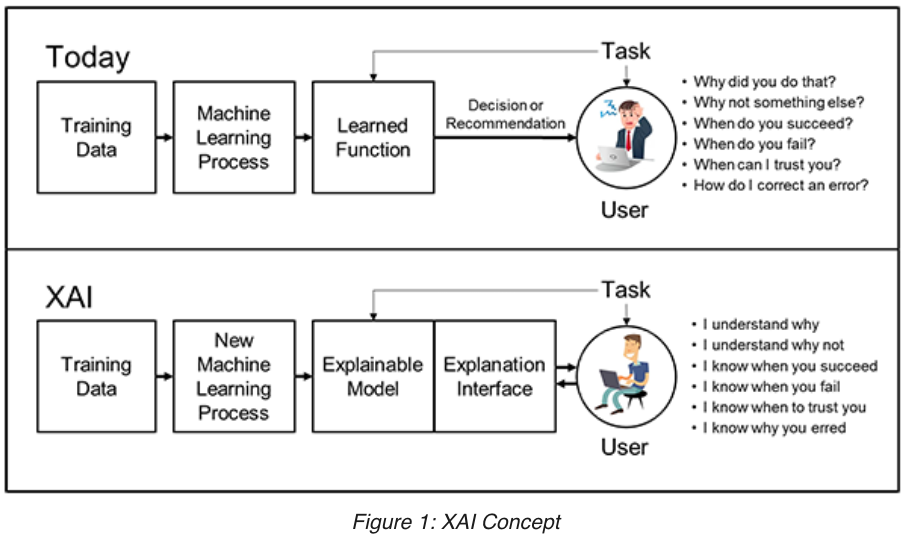
Most of the success of deconstructing “black boxes” is happening today at the US Department of Defense. DARPA has been funding the research of Dr. David Gunning to develop Explainable Artificial Intelligence (XAI). Understanding its own AI and that of foreign governments could be a huge advantage for America’s cyber military units. At the same time, like many DARPA-funded projects, civilian opportunities could offer societal benefits. According to Gunning’s statement, online XAI aims to “produce more explainable models, while maintaining a high level of learning performance (prediction accuracy); and enable human users to understand, appropriately trust, and effectively manage the emerging generation of artificially intelligent partners.” XAI plans to work with developers and user interfaces designers to foster “useful explanation dialogues for the end user,” to know when to trust or question the AI-generated data.
Besides DARPA, many large technology companies and universities are starting to create think tanks, conferences and policy groups to develop standards that test AI bias. The results have been startling – ranging from computer vision sensors that negatively identify people of color to gender bias in employment management software to blatant racism of natural language processing systems to security robots that run over kids identified mistakenly as threats. As an example of how training data affects outcomes, when Google first released its image processing software, the AI identified photos of African Americans as “gorillas,” because the engineers failed to provide enough minority examples into the neural network.
Ultimately artificial intelligence reflects the people that program it, as every human being brings with him his own experiences that shape personal biases. According to Kathleen Walch, host of AI Today podcast, “If the researchers and developers developing our AI systems are themselves lacking diversity, then the problems that AI systems solve and training data used both become biased based on what these data scientists feed into AI training data,” Walch advocates that hiring diversity can bring “about different ways of thinking, different ethics and different mindsets. Together, this creates more diverse and less biased AI systems. This will result in more representative data models, diverse and different problems for AI solutions to solve, and different use cases feed to these systems if there is a more diverse group feeding that information.”

Before leaving SXSW, I attended a panel hosted by the IEEE on “Algorithms, Unconscious Bias & AI,” amazingly all led by female panelists including one person of color. Hiring basis became a big theme of their discussion. Following the talk, I hopped into my Uber and pleasantly rode to the airport reflecting on a statement made earlier in the day by John Krafcik, Cheif Executive, of Waymo. Krafcik boasted that Waymo’s mission is to build “the world’s most experienced driver,” I just hope that the training data is not from New York City cabbies.
 Tencent, Alibaba, Baidu and JD.com from China are in a global competition with Google/Alphabet, Apple, Facebook, Walmart and Amazon from the USA and SoftBank from Japan. All are agressively searching for talent, intellectual property, market share, logistics and supply chain technology, and presence all around the world.
 Baidu (NASDAQ:BIDU) is China’s primary search source and also provides Internet-related services and products as well as targeted advertising, transaction services and a video platform. Baidu is heavily investing in researching deep learning, computer vision, speech recognition and synthesis, natural language understanding, data mining and knowledge discovery, business intelligence, artificial general intelligence, high performance computing, robotics and autonomous driving (at their new self-driving lab in Silicon Valley).
 Alibaba (NYSE:BABA) is a multi-national China-based e-commerce retailer, payment and technology conglomerate, cloud provider, whose two shopping malls (Tmall and Taobao) have over 1 billion combined active users and are supported by a budding logistics network. Alibaba’s AI-powered platform (which it uses internally for its shopping malls and logistics processing) was recently rolled out in Kuala Lumpur to support smart cities in their digital transformation. It analyzes large data volumes extracted from various sources in an urban environment, through video, image, and speech recognition. The system then uses machine learning to provide insights for city administrators to improve operational efficiencies and monitor security risks.
 Tencent (HKG:0700) is a Chinese provider of Internet and cloud-related services and products, entertainment, music services, AI, real estate and social media including WeChat (which recently hit 1 billion users). More than 35% of WeChat users spend over four hours a day on the service compared to the little more than an hour a day spent on Facebook, Instagram, Snapchat and Twitter combined. Tencent has set up AI labs in Shenzhen and Seattle and is researching voice and image recognition systems and transforming what they’ve learned into apps and algorithms to keep their users informed and attentive.
 JD.Com (NASDAQ:JD) is a Chinese e-commerce competitor with about half the user base of Alibaba yet with very progressive logistics and infrastructure programs. JD (Jingdong) is testing robotic delivery services, operating driverless delivery trucks and building drone delivery ports. JD operates 7 fulfillment centers and 405 warehouses in China. Last month it raised $2.5 billion for its JD Logistics subsidiary to build out and expand their logistics network.
 SoftBank (TYO:9984) is a Japanese telecom conglomerate. Softbank is also the instigator of the SoftBank Vision Fund which is investing massive amounts ($98 bn) in technologies and entrepreneurs pioneering the future through a wide range of sectors: IoT, AI, robotics, mobile applications and computing, and infrastructure, cloud technologies and software. SoftBank, with it’s funding partners Apple, Qualcomm and various sovereign wealth funds, wants to invest another $900 billion in 1,000 AI and robotics companies in the next decade. SoftBank is also a partner with Alibaba and Foxconn to produce and market Pepper and Nao robots.
 Google/Alphabet (NASDAQ:GOOG) is a Silicon Valley search engine and Internet products company with a stable of forthcoming AI ventures such as Waymo, Verb Surgical and Nest along with consumer products like Google Home, Android phones and Chromebook computers. Google is leveraging their data, processing power, and talent into an array of AI-based apps, processes and products. Their foray into robotics hardware has resulted in much valuable research but all of the units have either been sold off or closed (except for Boston Dynamics and Shaft which are held up from sale by government regulators). Although still a leader in machine learning, Google is finding much competition from their Chinese competitors.
 Apple (NASDAQ:AAPL) is Apple, a Silicon Valley designer, manufacturer and marketer of phones, media and hardware devices and provider of software, services and digital content. Apple is the world’s largest information technology company by revenue and the world’s second-largest mobile phone manufacturer after Samsung with annual revenue of $229 billion. Building out Siri from the virtual world into the consumer product world with their new Homepod is off to a late start.
 Facebook (NASDAQ:FB) is also a Silicon Valley-based Internet phenomena with products that include Facebook, Instagram, Messenger, WhatsApp and Oculus. Facebook has over 2.2 billion active users. Their investments in AI appear to be focused on developing a virtual (or physical) assistant. Their acquisition of Ozlo to help Messenger build out a more elaborate virtual assistant for users is an example.
 Walmart (NYSE:WMT) is a global retailer with wholesale facilities, logistics and distribution centers all around the world. Walmart operates over 11,000 stores under 59 names in 28 countries and e-commerce sites in 11 countries. It grosses over $480 billion annually and employs over 2.3 million workers. As Walmart increases its online e-commerce market share while simultaneously changing practices to provide better product transparency (particularly in and faster material handling at its stores and distribution centers, it too is on a talent hunt for roboticists and AI/machine learning people and providers.
 Amazon (NASDAQ:AMZN) Amazon is the leading e-commerce seller of products, supply chain services, AI, and cloud services that is copied and competed with around the world. Amazon accounts for ~4% of all retail and ~44% of all e-commerce spending in the US. Amazon’s supply chain and logistics facilities use more than 60,000 robots in its various warehouses and distribution centers, and its cloud services, which not only services Amazon, provides on-demand cloud computing platforms to companies and governments on a subscription basis. Amazon’s Echo/Alexa home assistant has started to include capabilities like a display, camera and alarm clock, security cameras, and even a fashion advisor. It is combining all these different incremental parts to build a smart home robot as they become viable and front-ended by the Alexa voice assistant.
 Infrastructure
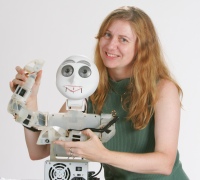 Maja Matarić is professor and Chan Soon-Shiong chair in Computer Science Department, Neuroscience Program, and the Department of Pediatrics at the University of Southern California, founding director of the USC Robotics and Autonomous Systems Center (RASC), co-director of the USC Robotics Research Lab and Vice Dean for Research in the USC Viterbi School of Engineering. She received her PhD in Computer Science and Artificial Intelligence from MIT, MS in Computer Science from MIT, and BS in Computer Science from the University of Kansas.