Most people think of coffee cups, bathroom tiles or flower pots when they hear the word "ceramic." Not so Frank Clemens. For the research group leader in Empa's Laboratory for High-Performance Ceramics, ceramics can conduct electricity, be intelligent, and even feel.
A new study from AI experts at the University of Oxford and University of Melbourne reveals that men are much more likely to support the idea of being cared for in their homes by a robot when they are infirm or elderly, than women.
New technology that enables robots to work stably in turbulent seas could make it cheaper, faster and safer to maintain offshore wind farms and tidal turbines, researchers say.
A multi-institutional trio of roboticists has designed and built a robot that mimics the abilities of the dung beetle. In their paper published in the journal Advanced Science, Binggwong Leung, Stanislav Gorb and Poramate Manoonpong outline their reasons for building it and describe how well it worked when tested.
Central to the functionality of AR devices are the optical components, which must meet stringent requirements to ensure clear, undistorted images and seamless digital overlays onto real-world environments
This month, IBM had a briefing on its Power platform for AI, which currently is in use by over 40K users. This may not seem like a lot, but with AI failures outnumbering AI successes, it is important to look […]
Researchers have developed a robot that identifies different plant species at various stages of growth by 'touching' their leaves with an electrode. The robot can measure properties such as surface texture and water content that cannot be determined using existing visual approaches. The robot identified ten different plant species with an average accuracy of 97.7% and identified leaves of the flowering bauhinia plant with 100% accuracy at various growth stages.
PwC describes today as the “age of continuous reinvention” in its 27th Annual Global CEO Survey report. One of the most startling findings is that 45% of CEOs do not believe their company will be viable in 10 years if it stays on the current path.
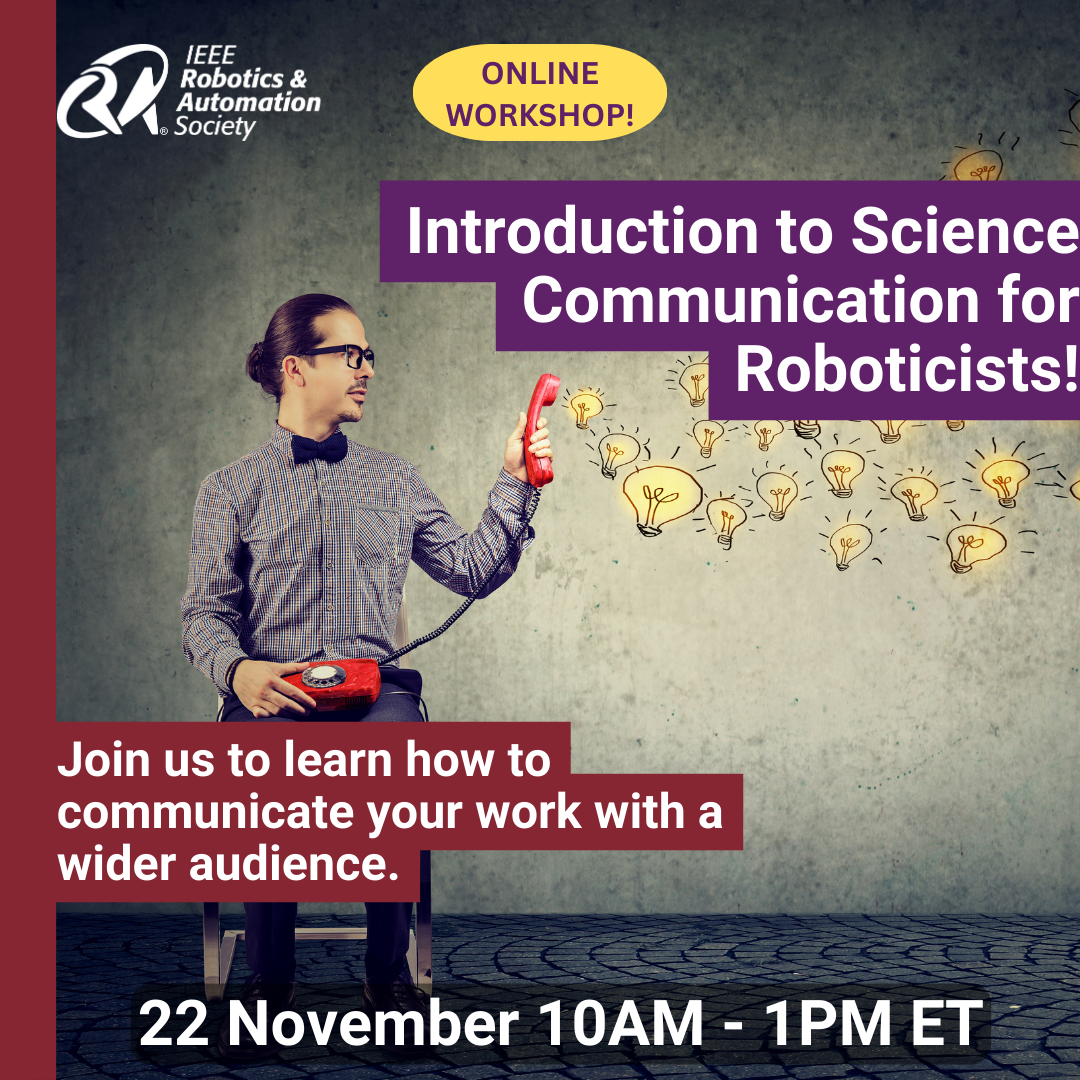
On Friday 22 November, IEEE Robotics and Automation Society will be hosting an online science communication training session for robotics and AI researchers. The tutorial will introduce you to science communication and help you create your own story through hands-on activities.
Science communication is essential. It helps demystify robotics and AI for a broad range of people including policy makers, business leaders, and the public. As a researcher, mastering this skill can not only enhance your communication abilities but also expand your network and increase the visibility and impact of your work.
In this three-hour session, leading science communicators in robotics and AI will teach you how to clearly and concisely explain your research to non-specialists. You’ll learn how to avoid hype, how to find suitable images and videos to illustrate your work, and where to start with social media. We’ll hear from a leading robotics journalist on how to deal with media and how to get your story out to a wider audience.
This is a hands-on session with exercises for you to take part in throughout the course. Therefore, please come prepared with an idea about a piece of research you’d like to communicate about.
Agenda
Part 1: How to communicate your work to a broader audience
The importance of science communication
How to produce a short summary of your research for communication via social media channels
How to expand your outline to write a complete blog post
How to find and use suitable images
How to avoid hype when communicating your research
Unconventional ways of doing science communication
Part 2: How to make videos about your robots
The value of video
Tips on making a video
Part 3: Working with media
Why bother talking to media anyway?
How media works and what it’s good and bad at
How to pitch media a story
How to work with your press office
Speakers:
Sabine Hauert, Professor of Swarm Engineering, Executive Trustee AIhub / Robohub
Lucy Smith, Senior Managing Editor AIhub / Robohub
Laura Bridgeman, Audience Development Manager IEEE Spectrum
Evan Ackerman, Senior Editor IEEE Spectrum
A team of roboticists and engineers at MIT CSAIL, Institute for AI and Fundamental Interactions, has developed a generative AI approach to teaching robots how to traverse terrain and move around objects in the real world.
Linguistics and computer science researchers have discovered some of the root causes of why AI large language models perform poorly in human-like conversations.
Researchers have developed PanoRadar, a new tool to give robots superhuman vision by transforming simple radio waves into detailed, 3D views of the environment.
In the race to develop robust perception systems for robots, one persistent challenge has been operating in bad weather and harsh conditions. For example, traditional, light-based vision sensors such as cameras or LiDAR (Light Detection And Ranging) fail in heavy smoke and fog.
Today is an exciting and historic day at DataRobot. As Debanjan shared, it’s time for a new approach to AI. One that is focused on business outcomes.
With the rapid advances in machine learning and generative AI, you’re likely seeing AI become essential to your strategy and bottom line. It’s more critical than ever to integrate AI into your business to stay competitive.
This requires an evolution in what we deliver with our enterprise AI suite and how we tell our story at DataRobot — carrying our history of innovation and impact forward in a new way that meets the AI needs of businesses today.
Our mission
At DataRobot, our mission is to deliver AI that maximizes impact and minimizes risk for your business.
And the way we do that is by focusing on what matters most to you — by making AI work for your business, not making your business work for AI.
We infuse AI into your business. We do this by helping organizations seamlessly integrate AI into their existing processes with an open platform, user-friendly tooling, and high-impact applications.
We secure your AI outcomes. We do this by enabling organizations to scale AI with confidence using built-in interoperability, governance, and observability capabilities.
We empower your AI teams. We do this by maximizing team impact with AI workflows, built-in collaboration, orchestration, and a rich array of capabilities that unite models, teams, and individual needs.
Our new look
While our mission is one component of the DataRobot story, how we show up every day is also key to who we are and our brand.
Today, we unveiled a new visual identity:
Our new logo is made up of building blocks that illustrate many meanings: simplifying AI complexity into actionable insights; weaving and infusing AI into your business; and the coming together of teams, processes, and technology that businesses want and need.
We’ve also introduced a new palette of bright, fresh colors that represent clarity and match the energy of market momentum and innovation at DataRobot.
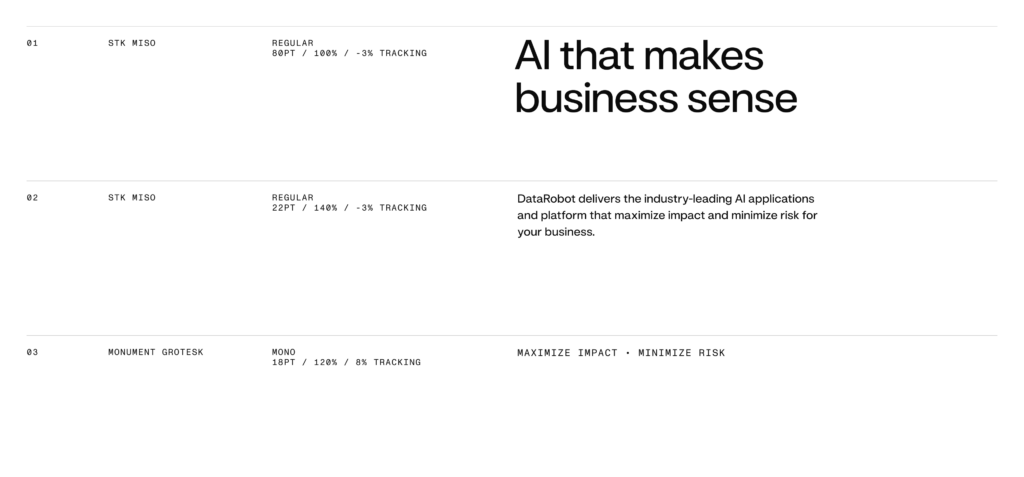
And a new typography system that balances technical innovation and approachability.
Our vision
DataRobot was founded to make AI useful and accessible to businesses in every industry.
For 12 years, we have spent each day working and learning from our customers and industry experts.
As we look ahead, our vision is to make business better with AI.
To our customers and partners, thank you for your partnership. We wouldn’t be here without you, and we’re thrilled to continue innovating together.
To our team, past and present, thank you for the contributions that continue to make DataRobot what it is today.