Page 23 of 598
1 21 22 23 24 25 598

Speech-to-reality system creates objects on demand using AI and robotics

Generative AI and robotics are moving us ever closer to the day when we can ask for an object and have it created within a few minutes. In fact, MIT researchers have developed a speech-to-reality system, an AI-driven workflow that allows them to provide input to a robotic arm and "speak objects into existence," creating things like furniture in as little as five minutes.

SoftBank’s $5.4B ABB Robotics Deal: Why IT Service Providers Should Treat Robotics as a Core Practice

As autonomy and embodied intelligence mature, IT service providers may not need to participate in every layer, but those who develop focused capabilities—whether in advisory, integration, or managed operations—will be better placed as demand grows.

This tiny implant sends secret messages to the brain

Researchers have built a fully implantable device that sends light-based messages directly to the brain. Mice learned to interpret these artificial patterns as meaningful signals, even without touch, sight, or sound. The system uses up to 64 micro-LEDs to create complex neural patterns that resemble natural sensory activity. It could pave the way for next-generation prosthetics and new therapies.

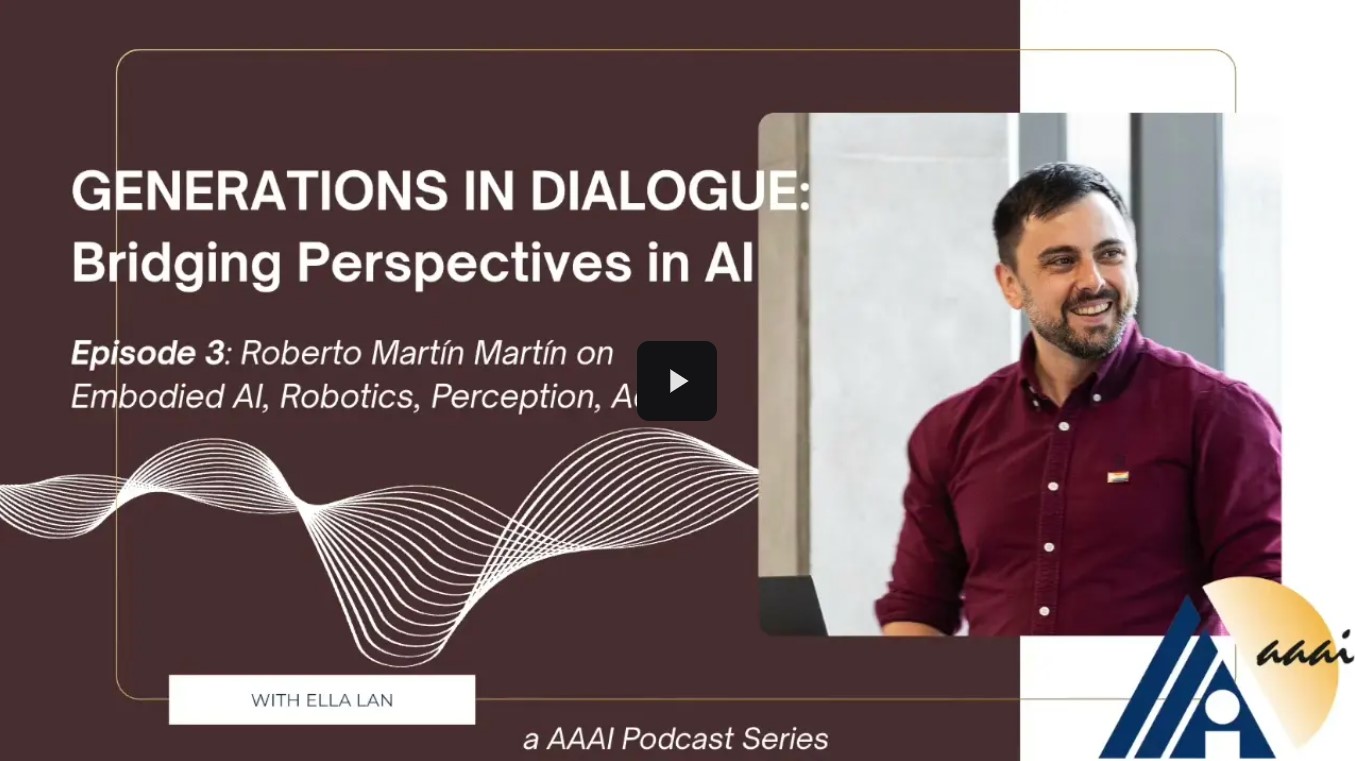
Generations in Dialogue: Embodied AI, robotics, perception, and action with Professor Roberto Martín-Martín

Generations in Dialogue: Bridging Perspectives in AI is a podcast from AAAI featuring thought-provoking discussions between AI experts, practitioners, and enthusiasts from different age groups and backgrounds. Each episode delves into how generational experiences shape views on AI, exploring the challenges, opportunities, and ethical considerations that come with the advancement of this transformative technology.

Embodied AI, robotics, perception, and action with Professor Roberto Martín-Martín

In the third episode of this new series from AAAI, host Ella Lan chats to Professor Roberto Martín-Martín about taking a screwdriver to his toys as a child, how his research focus has evolved over time, how different generations interact with technology, making robots for everyone, being inspired by colleagues, advice for early-career researchers, and how machines can enhance human capabilities.

About Professor Roberto Martín-Martín:

Roberto Martín-Martín is an Assistant Professor of Computer Science at the University of Texas at Austin, where his research integrates robotics, computer vision, and machine learning to build autonomous agents capable of perceiving, learning, and acting in the real world. His work spans low-level tasks like pick-and-place and navigation to complex activities such as cooking and mobile manipulation, often drawing inspiration from human cognition and integrating insights from psychology and cognitive science. He previously worked as an AI Researcher at Salesforce AI and as a Postdoctoral Scholar at the Stanford Vision and Learning Lab with Silvio Savarese and Fei-Fei Li, leading projects in visuomotor learning, mobile manipulation, and human-robot interaction. He earned his Ph.D. and M.S. from Technische Universität Berlin under Oliver Brock and a B.S. from Universidad Politécnica de Madrid. His work has been recognized with best paper awards at RSS and ICRA, and he serves as Chair of the IEEE/RAS Technical Committee on Mobile Manipulation.

About the host

Ella Lan, a member of the AAAI Student Committee, is the host of “Generations in Dialogue: Bridging Perspectives in AI.” She is passionate about bringing together voices across career stages to explore the evolving landscape of artificial intelligence. Ella is a student at Stanford University tentatively studying Computer Science and Psychology, and she enjoys creating spaces where technical innovation intersects with ethical reflection, human values, and societal impact. Her interests span education, healthcare, and AI ethics, with a focus on building inclusive, interdisciplinary conversations that shape the future of responsible AI.

AI Image Generation: On Genius

Google’s Nano Banana Pro Upgrade


While keeping pace with the seemingly endless parade of AI tools can be exhausting, getting crystal clear on the raw, new power embedded in Google’s new Nano Banana Pro image generator is well worth a huff-and-puff.

In a phrase, Nano Banana Pro (NBP) – released a few weeks ago – is the new, gold standard in AI imaging now, capable of rendering virtually anything imaginable.

Essentially: Writers now have a tool that can auto-generate one or more supplemental images for their work with a precision and power that currently has no rival.

Plus, unlike other image generators, NBP has an incredible amount of firepower under-the-hood that is simply not available to the competition.

For example: NBP is an exquisite image generator in its own right.

But it is also powered by Google’s Gemini 3.0 Pro, now widely considered the gold standard in consumer AI.

And, NBP can also be easily combined with Google Search, the world’s number one search engine.

Like many things AI, the secret to achieving master prowess with NBP is to sample how countless, highly inspired human imaginations are already working with the tool – and then synthesize that rubber-meets-the-road knowledge to forge your own method for working with NBP.

Towards that end, here are ten excellent videos on NBP, complete with detailed demos, of how imaginative folks are artfully using the AI – and surfacing truly world-class, head-turning images:

*Quick Overview: NBP Key Features: This 15-minute video from AI Master offers a great intro into the key new capabilities of NBP – complete with captivating visual examples. Demos include:
–blending multiple images into one
–converting stick figures into an image-rich scene
–experimenting with visual style changes on the same
image
–working with much more reliable text-on-images

*A Torrent of NBP Use Cases: This incredibly organized and informative 11-minute video from Digital Assets dives deep in the wide array of use cases you can tap into using NBP. Demos include:
–Historical event image generator, based on location,
date and approximate time (example: conjure Apollo moon landing)
–multi-angle product photography
–Alternate reality generator (example: depict architecture of ancient Rome as immersed in a futuristic setting)
–Hyper-realistic, 3D-diorama generation

*Another Torrent of NBP Use Cases: Click on this 27-minute video from Astrovah for a slew of more mind-bending use cases, including:
–Text-on-image analysis of any photo you upload, including its context and key facts to know about the image
–How to make an infographic in seconds
–How to inject season and weather changes to any image
–Making exploded-view images of any product
–Auto-generated blueprints of any image

*Generating Hyper-Realistic Photos With NBP: This great, 22-minute video from Tao Prompts offers an inside look at how to ensure any image you generate with NBP is hyper-photorealistic – right down to the brand of photo film you’re looking to emulate.

*Infinite Camera Angles on Tap: Getting just the right camera angle on any image is now child’s play with NBP. This 11-minute video from Chase AI serves-up demos on how to be the director of any image you create with NBP. Included is a detailed prompt library you can use featuring the same camera angle descriptions used by pro photographers.

*Swapping a Face in Seconds: Short-and-sweet, this 4-minute video from AsapGuide offers a quick, down-and-dirty way to transplant any face onto any image you provide.

*Aging/De-Aging a Person in Seconds: Another great collection of use cases, this 16-minute video from Atomic Gains includes an easy-to-replicate demo on making a person look younger, or vice-versa. Also included are demos on instantly changing the lighting in an image, changing the position of a character in an image and surgically removing specific details from any image.

*NBP: Getting Technical: Once you’ve played with NBP informally, you can pick up some extremely helpful, technical tips on how to manipulate NBP with this 29-minute video from AI Samson. Tricks include how to zoom in/out on an image, how to maintain character consistency and how to use complex cinematic stylings.

*Amplifying NBP With Google AI Studio: This 58-minute video from David Ondrej recommends using NBP in the free Google Studio interface. The reason: Google AI Studio will give you much more granular control over your results, including precise image size, creating accurate slides with text and using NBP with Google Search. Caveat: To use Google AI Studio, you need to switch to a special Google Gemini API subscription.

*Working with NBP in Photoshop: Adobe has already integrated NBP into its toolset. And this is the perfect video (8 minutes from Sebastien Jefferies) to check-out how to combine the power of NBP with the incredible precision of Photoshop. Included are lots of great demos that answer the question: NBP and Photoshop: What’s the long-term impact?

Share a Link:  Please consider sharing a link to https://RobotWritersAI.com from your blog, social media post, publication or emails. More links leading to RobotWritersAI.com helps everyone interested in AI-generated writing.

Joe Dysart is editor of RobotWritersAI.com and a tech journalist with 20+ years experience. His work has appeared in 150+ publications, including The New York Times and the Financial Times of London.

Never Miss An Issue
Join our newsletter to be instantly updated when the latest issue of Robot Writers AI publishes
We respect your privacy. Unsubscribe at any time -- we abhor spam as much as you do.

The post AI Image Generation: On Genius appeared first on Robot Writers AI.

AI Software Cost: 2025 Enterprise Pricing Benchmarks for Manufacturing Leaders


AI Software Cost: 2025 Enterprise Pricing Benchmarks for Manufacturing Leaders

Based on comprehensive analysis of the latest industry research from CloudZero’s 2025 State of AI Costs report (surveying 500 engineering professionals), Zylo’s 2025 SaaS Management Index, and additional enterprise data, this report examines AI software pricing trends, budget allocation patterns, hidden cost drivers, and industry-specific expenses facing manufacturing and supply chain leaders in 2025.

The landscape of AI software costs has grown increasingly complex. CloudZero’s research reveals that average monthly AI spending will reach $85,521 in 2025, a 36% increase from 2024’s $62,964 [1]. For manufacturing executives evaluating AI investments, understanding these cost dynamics and identifying hidden expenses is essential for accurate budgeting, maximizing ROI, and maintaining competitive advantage in an AI-driven industrial landscape.

At USM Business Systems, we specialize in helping manufacturing leaders navigate these financial complexities, particularly as they evaluate Agentic AI systems that promise autonomous operation capabilities. This analysis provides transparent benchmarks to inform your AI investment decisions.

Monthly AI Software Spending Trends by Organization Size — 2025

Organizations across all sizes are accelerating AI investments, with spending patterns varying significantly based on company scale, operational maturity, and strategic AI priorities.

Organization SizeMonthly AI Budget 2025Annual AI Investment 2025YoY Growth RatePrimary Investment Drivers
250-500 employees$30,000 – $40,000$360K – $480K24-28% Pilot projects, basic automation, cloud platforms
501-1,000 employees$55,000 – $70,000$660K – $840K28-35% Scaling successful pilots, departmental rollouts
1,001-5,000 employees$90,000 – $110,000$1.08M – $1.32M30-38% Multi-site deployments, integration complexity
5,001-10,000 employees$150,000 – $190,000$1.8M – $2.28M38-45% Enterprise platforms, custom development
10,000+ employees$240,000 – $280,000$2.88M – $3.36M35-40% Organization-wide transformation, governance systems

Source: Derived from CloudZero State of AI Costs 2025 [1]

Key Insights:

  • CloudZero’s research confirms the average organization will spend $85,521 monthly on AI-native applications in 2025, representing a 36% increase from 2024 [1]. This surge reflects enterprises moving from pilot projects to production-scale deployments.
  • The proportion of organizations planning to invest over $100,000 per month has more than doubled, jumping from 20% in 2024 to 45% in 2025 [1], signaling aggressive AI adoption despite economic uncertainty.
  • Mid-sized enterprises (1,001-10,000 employees) experience the steepest cost escalation as they scale AI from isolated use cases to integrated, multi-departmental systems requiring sophisticated infrastructure and governance.

AI Budget Allocation by Category for Manufacturing — 2025

Understanding where AI budgets flow helps manufacturing enterprises benchmark their own spending patterns and identify optimization opportunities across infrastructure, applications, and security. The following table represents manufacturing-specific investment priorities for the next 24 months based on Deloitte’s 2025 Smart Manufacturing and Operations Survey of 600 manufacturing executives [2].

CategoryInvestment PriorityStrategic Importance for Manufacturing
Process Automation (RPA, Agentic AI)46%Alleviating skilled labor shortages and maximizing productivity through production scheduling and autonomous quality control
Factory Automation Hardware41%Driving increased automation and monitoring the manufacturing environment with sensors and robotics
Data Analytics & BI Solutions40%Advancing on the smart manufacturing maturity curve with supply chain visibility and demand forecasting
Active Sensors34%Enabling data capture and prerequisites for advanced analytics and IoT sensor integration
Cloud Computing Platforms (AWS, Azure, GCP)29%Supporting scaled deployments, ML workloads, and global infrastructure necessary for training and deploying AI models
AI/Machine Learning Platforms29%Establishing AI foundations for MLOps, model training, and specialized manufacturing AI applications
Vision Systems28%Enhancing quality control, defect detection, and visual inspection capabilities
Industrial IoT (IIoT)27%Connecting operational and enterprise data for real-time monitoring and predictive maintenance

Source: Deloitte 2025 Smart Manufacturing and Operations Survey [2]

Key Insights:

  • 78% of manufacturers allocate more than 20% of their overall improvement budget toward smart manufacturing initiatives [2], demonstrating the strategic priority placed on AI and automation technologies.
  • Process automation (46%) and factory automation hardware (41%) are the top investment priorities, reflecting manufacturers’ focus on addressing skilled labor shortages and maximizing productivity [2].
  • Data analytics (40%), cloud computing (29%), and AI/ML platforms (29%) represent the foundational technology investments needed to capture, connect, and analyze operational and enterprise data [2].
  • The combined emphasis on automation, sensors, and AI platforms demonstrates manufacturers’ commitment to building integrated smart manufacturing ecosystems despite premium pricing, as enterprises recognize the competitive necessity of advanced AI capabilities.

AI Pricing Models and Cost Implications — 2025

AI vendors employ increasingly complex pricing strategies that directly impact total cost of ownership, budget predictability, and the ability to scale AI initiatives cost-effectively.

Pricing ModelMarket AdoptionCost Predictability RatingBudget Variance RiskBest Suited ForAvg Enterprise CostContract Negotiation Tip
Subscription (per-seat)58%★★★★★ High±5-10%Stable headcount, predictable usage$30-$200/user/monthNegotiate multi-year discounts
Usage-based (consumption)47%★★☆☆☆ Low±30-50%Variable workloads, API-driven AI$0.002-$0.12/token or callDemand usage caps and alerts
Hybrid (subscription + usage)49%★★★☆☆ Medium±20-30%Enterprise platforms with scaling needs$50K-$150K/monthRequest detailed usage forecasting tools
Value-based (ROI-linked)22%★★★☆☆ MediumVaries by outcomeStrategic transformations, proven use casesNegotiatedTie payment to measurable KPIs
Flat-rate enterprise31%★★★★★ Very High±5%Organization-wide deployments$100K-$500K/yearLock in rates for 3+ years
Freemium with paid tiers35%★★★☆☆ MediumCan spike quicklyTesting, gradual team adoption$0-$20K/monthUnderstand upgrade triggers clearly

Sources: Zylo AI Cost Report 2025 [2], High Alpha SaaS Benchmarks [2]

Key Insights:

  • Nearly half (49%) of AI vendors now employ hybrid pricing models [2], combining subscription fees with usage-based charges. This creates complexity for finance and procurement teams managing AI software costs, as monthly invoices can fluctuate significantly based on consumption patterns.
  • Usage-based pricing introduces severe budget volatility—Zylo’s research found that 65% of IT leaders report unexpected charges from consumption-based AI pricing models [2], with actual costs frequently exceeding initial estimates by 30-50% due to token overages, API rate limits, and unpredictable user adoption.
  • The proliferation of diverse pricing models means organizations frequently manage 2-3 different pricing structures per AI contract, significantly complicating cost attribution, ROI tracking, and financial forecasting across multi-year AI programs.

Hidden Costs and Budget Overruns in AI Software — 2025

Beyond advertised pricing, manufacturing enterprises encounter substantial hidden expenses that can inflate total AI ownership costs by 200-400% compared to initial vendor quotes.

Hidden Cost CategoryImpact on Total CostWhen Costs HitCommon SourcesTypical Cost RangeMitigation Strategy
Infrastructure scaling15-25%Months 3-6GPU/TPU compute, storage expansion, bandwidth$15K-$75KReserved cloud instances, usage monitoring dashboards
Data preparation & quality15-20%Months 1-3Collection, cleaning, labeling, governance, integration$10K-$90KInvest in automated data quality tools upfront
Integration & customization20-30%Months 2-5API development, legacy system connections, middleware$20K-$100KModular architecture, phased integration approach
Training & change management10-15%Months 2-8User enablement, workflow redesign, resistance management$8K-$50KStructured adoption programs with executive sponsorship
Compliance & governance5-10%Months 1-6GDPR/HIPAA adherence, audit trails, explainability frameworks$5K-$40KSelect vendors with built-in compliance features
Ongoing maintenance & retraining10-15% annuallyYear 2+Model drift correction, performance monitoring, version updates$10K-$80K/yearImplement MLOps platforms, automated monitoring

Sources: Industry analysis, Coherent Solutions AI Development Cost Research

Key Insights:

  • Enterprise implementations typically cost 3-5 times the advertised subscription price when accounting for integration, customization, infrastructure scaling, and the operational overhead required to maintain AI systems in production manufacturing environments.
  • Organizations lacking formal cost-tracking systems are 41% less confident in their ability to accurately evaluate AI ROI [1], leading to continued budget uncertainty and difficulty justifying additional AI investments to stakeholders.
  • Data preparation remains one of the most underestimated expenses—industry research indicates approximately 96% of businesses begin AI projects without sufficient high-quality training data, requiring unplanned investments of $10,000-$90,000 to acquire or label datasets meeting production standards.

Industry-Specific AI Software Costs — 2025

AI software pricing varies dramatically across industries due to differences in operational complexity, regulatory compliance requirements, implementation scope, and the sophistication of use cases. Based on comprehensive research across multiple authoritative sources, healthcare has the highest AI software costs, followed by manufacturing and financial services [3] [4] [5].

IndustryAnnual AI Software CostPrimary Cost DriversROI TimelineCommon Use CasesCompliance Premium
Healthcare$300K – $1M+HIPAA compliance, diagnostic accuracy validation, patient data privacy18-24 monthsClinical decision support, medical imaging analysis, patient monitoring20-25%
Manufacturing$400K – $800K+Predictive maintenance, quality control, IoT sensor integration, digital twins12-18 monthsProcess optimization, defect detection, supply chain analytics, autonomous scheduling10-15%
Financial Services$300K – $800K+SOC 2/regulatory compliance, fraud detection algorithms, security frameworks14-20 monthsRisk assessment, algorithmic trading, AML/fraud prevention, credit decisioning15-20%
Supply Chain & Logistics$350K – $700K+Route optimization, real-time tracking, demand prediction, warehouse automation12-18 monthsFleet management, automated warehousing, delivery optimization, load planning8-12%
Technology & Software$250K – $600K+Continuous innovation cycle, developer productivity tools, code assistance8-12 monthsAI-assisted development, automated testing, security scanning, DevOps optimization5-10%
Retail & E-commerce$200K – $500K+Recommendation engines, inventory optimization, personalization at scale10-14 monthsCustomer segmentation, demand forecasting, dynamic pricing, chatbots5-8%


Sources: Industry analysis, Standard Bots Manufacturing AI Report 2025 [3], eMarketer Healthcare AI Analysis [4], Sommo Retail AI Cost Breakdown [5]

Key Insights :

  • Healthcare leads all industries in AI spending due to operational complexity, stringent regulatory requirements, and the mission-critical nature of AI deployments where failures can result in patient safety incidents or regulatory penalties. Healthcare AI spending reached $1.4 billion in 2025, nearly tripling 2024’s investment [4].
  • Manufacturing and financial services face similarly high AI costs due to operational complexity, stringent regulatory requirements, and the mission-critical nature of AI deployments where failures can result in production shutdowns, safety incidents, or regulatory penalties.
  • Industries with real-time operational requirements (manufacturing, supply chain) face 25-40% higher infrastructure costs for AI systems that must process sensor data continuously, respond within milliseconds, and maintain 24/7 uptime across distributed production environments.

Healthcare AI: Leading the Industry in Adoption and ROI

Healthcare organizations are implementing AI at more than twice the rate (2.2x) of the broader US economy, positioning the sector as a clear leader in enterprise AI adoption. With 63% of healthcare professionals already actively using AI and another 31% piloting or assessing initiatives, healthcare significantly outpaces other industries, which average just 50% AI uptake [6]. This accelerated adoption is driven by compelling ROI metrics and the sector’s unique operational imperatives.

Healthcare AI investments are delivering measurable returns faster than anticipated. According to NVIDIA’s 2025 State of AI in Healthcare and Life Sciences report, 81% of healthcare organizations reported increased revenue from AI implementations, with nearly half achieving ROI within one year of deployment [6]. Additional benefits include:

  • 73% reported reduced operational costs, addressing the industry’s chronic inefficiency challenges where billions of dollars are wasted annually on healthcare administration
  • 41% experienced faster R&D cycles, accelerating drug discovery and treatment development in pharmaceutical and biotech organizations
  • 78% plan to increase AI budgets in 2025, reflecting confidence in demonstrated value and the strategic importance of AI to future competitiveness

These outcomes are particularly significant in an industry where over $5 trillion in annual spending has historically failed to deliver proportional patient outcomes compared to other wealthy nations. AI is emerging as a critical tool to address systemic inefficiencies while simultaneously improving clinical effectiveness.

Healthcare organizations are directing AI investments toward three primary areas: new AI use cases (47%), workflow optimization (34%), and hiring AI experts (26%). The top AI workloads currently deployed include data analytics (58%), generative AI (54%), and large language models (53%), with applications varying by healthcare segment. Medical technology companies prioritize medical imaging and diagnostics (71%), pharma and biotech focus on drug discovery and development (59%), digital healthcare emphasizes clinical decision support (54%), and payers and providers concentrate on workflow automation and documentation (48%) [6].

Why Healthcare Costs Are Higher: Healthcare’s position as the highest-cost industry for AI implementation reflects several unique factors. The sector faces more stringent regulatory requirements (HIPAA, FDA) adding 20-25% cost premiums compared to 10-15% for manufacturing. Healthcare requires extensive validation protocols, patient data protection mandates, and explainable AI capabilities for clinical decision-making contexts. Integration complexity is substantial, requiring connections with existing electronic health records ($7,800-$10,400 per integration), medical device APIs ($10,000+), and complex clinical workflows. Despite these higher costs, 86% of healthcare organizations state AI is critical to their future success, and 83% believe AI will revolutionize healthcare and life sciences within the next three to five years [6].

The Agentic AI Premium: Understanding Next-Generation AI Costs

Agentic AI, autonomous systems capable of goal-directed decision-making without continuous human oversight, represents the next frontier in manufacturing intelligence. However, this autonomy comes with distinct cost implications that manufacturing leaders must understand.

Agentic AI ComponentCost RangeWhy It Costs MoreManufacturing ApplicationExpected ROI Multiplier
Autonomous agent development$40K – $150K per agentAdvanced reasoning, multi-step planning, safety constraintsProduction scheduling, autonomous quality inspection4-8x
Agent orchestration platforms$60K – $200K/yearCoordinates multiple agents, manages dependenciesFactory-wide optimization, supply chain coordination3-6x
Safety & governance frameworks$30K – $100KHuman-in-loop fallbacks, audit trails, explainabilityEnsures safe autonomous operations in regulated environmentsRisk mitigation
Real-time decision infrastructure$50K – $180K/yearLow-latency compute, edge processing, 99.9% uptimeMillisecond production adjustments, predictive interventions5-10x

Sources: Biz4Group Agentic AI Development Cost Guide 2025 [4], BCG Agentic AI Report [5], Cleveroad AI Agent Development Cost Analysis [6]

Key Insights:

  • Agentic AI development costs range from $40,000 to $150,000+ per autonomous agent [4][6], reflecting the advanced engineering required for systems that can observe environments, reason about goals, plan multi-step actions, and execute decisions safely without human intervention.
  • BCG research indicates effective AI agents can accelerate business processes by 30-50% [5], delivering ROI that justifies the premium, particularly in manufacturing environments where autonomous scheduling, quality control, and predictive maintenance generate substantial cost savings.
  • Safety and governance requirements add 20-35% to total agentic AI costs but are non-negotiable for manufacturing applications where autonomous agents make decisions affecting production output, equipment safety, and regulatory compliance. USM specializes in implementing these critical safety frameworks.

How Manufacturing Leaders Can Use This Data to Build Business Cases?

This AI cost data becomes actionable when manufacturing executives use it to construct data-driven business cases for AI investments. Follow this framework:

Step 1: Benchmark Your Current Position

  • Compare your planned AI budget against industry averages for your company size
  • Identify which cost categories (cloud, security, applications) align with your strategic priorities
  • Calculate your “AI spend per revenue dollar” to assess investment intensity

Step 2: Account for Hidden Costs Early

  • Add 25-40% to vendor quotes for integration, data preparation, and training
  • Budget an additional 15-20% annually for maintenance, retraining, and model drift correction
  • For regulated manufacturing environments, add 10-15% for compliance and safety frameworks

Step 3: Select the Right Pricing Model

  • Choose subscription pricing if your AI usage is predictable and user count is stable
  • Choose usage-based pricing only if you have robust monitoring tools and can set hard usage caps
  • Negotiate hybrid models with clear caps and committed use discounts for enterprise deployments

Step 4: Calculate Realistic ROI Timelines

  • Use industry-specific ROI timelines from this report (manufacturing: 12-18 months)
  • Account for ramp-up time: most AI systems take 3-6 months to reach full productivity
  • Factor in the learning curve: plan for 20-30% lower initial performance vs. steady-state

Step 5: Build a Phased Investment Plan

  • Start with a $50K-$100K pilot targeting one high-impact use case
  • Expand to full production line deployment ($200K-$400K) after proving ROI
  • Scale enterprise-wide ($500K-$1M+) only after establishing governance and infrastructure

Requesting a Detailed Cost Assessment

This research reflects USM Business Systems’ commitment to transparent AI cost analysis and strategic implementation guidance for manufacturing enterprises. Our team specializes in helping production leaders navigate AI investments, from accurate initial estimates to long-term TCO planning that ensures sustainable ROI.

Unlike generic AI consultants, USM brings deep manufacturing domain expertise, particularly in Agentic AI systems for production scheduling, predictive maintenance, and autonomous quality control. We understand the unique cost drivers, integration challenges, and ROI opportunities specific to manufacturing environments.

Schedule Your Free AI Cost & ROI Assessment: Our experts will analyze your specific use case and provide a preliminary budget estimate in a complimentary 30-minute strategy call. [Contact USM Business Systems]

Download the Complete 2025 AI Cost Report: Get the full analysis with 5 bonus worksheets for internal budgeting, ROI calculation templates, and vendor evaluation scorecards. [Request PDF]


References:

[1] CloudZero. (2025). The State Of AI Costs In 2025. https://www.cloudzero.com/state-of-ai-costs/

[2] Deloitte. (2025). 2025 Smart Manufacturing and Operations Survey. https://www.deloitte.com/us/en/insights/industry/manufacturing/2025-smart-manufacturing-survey.html

[3] Zylo. (2025). AI Pricing: What’s the True AI Cost for Businesses in 2025? https://zylo.com/blog/ai-cost/

[4] eMarketer. (2025). AI spending in healthcare outpaces the overall US economy. https://www.emarketer.com/content/ai-spending-healthcare-outpaces-overall-us-economy-

[5] Sommo. (2025). Generative AI for retail: options and costs for 2025. https://www.sommo.io/blog/generative-ai-for-retail

[6] RSI Security. (2025). 2025 AI Trends in Healthcare & Life Sciences | Key Insights. https://blog.rsisecurity.com/trends-in-healthcare-life-sciences/


AI’s climate impact is much smaller than many feared

New findings challenge the widespread belief that AI is an environmental villain. By analyzing U.S. economic data and AI usage across industries, researchers discovered that AI’s energy consumption—while significant locally—barely registers at national or global scales. Even more surprising, AI could help accelerate green technologies rather than hinder them.

Talk to My Docs: A new AI agent for multi-source knowledge 

Navigating a sea of documents, scattered across various platforms, can be a daunting task, often leading to slow decision-making and missed insights. As organizational knowledge and data multiplies, teams that can’t centralize or surface the right information quickly will struggle to make decisions, innovate, and stay competitive.

This blog explores how the new Talk to My Docs (TTMDocs) agent provides a solution to the steep costs of knowledge fragmentation.

The high cost of knowledge fragmentation

Knowledge fragmentation is not just an inconvenience — it’s a hidden cost to productivity, actively robbing your team of time and insight.

  • A survey by Starmind across 1,000+ knowledge workers found that employees only tap into 38% of their available knowledge/expertise because of this fragmentation.
  • Another study by McKinsey & Associates found that knowledge workers spend over a quarter of their time searching for the information they need across different platforms such as Google Drive, Box, or local systems.

The constraints of existing solutions

While there are a few options on the market designed to ease the process of querying across key documents and materials living in a variety of places, many have significant constraints in what they can actually deliver. 

For example:

  • Vendor lock-in can severely hinder the promised experience. Unless you are strictly using the supported integrations of your vendor of choice, which in most instances is unrealistic, you end up with a limited subset of information repositories you can connect to and interact with.
  • Security and compliance considerations add another layer of complexity. If you have access to one platform or documents, you may not need access to another, and any misstep or missed vulnerability can open up your organization to potential risk.

Talk to My Docs takes a different approach

DataRobot’s new Talk to My Docs agent represents a different approach. We provide the developer tools and support you need to build AI solutions that actually work in enterprise contexts. Not as a vendor-controlled service, but as a customizable open-source template you can tailor to your needs.

The differentiation isn’t subtle. With TTMDocs you get:

  • Enterprise security and compliance built in from day one
  • Multi-source connectivity instead of vendor lock-in
  • Zero-trust access control (Respects Existing Permissions)
  • Complete observability through DataRobot platform integration
  • Multi-agent architecture that scales with complexity
  • Full code access and customizability instead of black box APIs
  • Modern infrastructure-as-code for repeatable deployments

What makes Talk to My Docs different

Talk To My Docs is an open-source application template that gives you the intuitive, familiar chat-style experience that modern knowledge workers have come to expect, coupled with the control and customizability you actually need.

This isn’t a SaaS product you subscribe to; but rather a developer-friendly template you can deploy, modify, and make your own.

Multi-source integration and real security

TTMDocs connects to Google Drive, Box, and your local filesystems out of the box, with Sharepoint and JIRA integrations coming soon.

  • Preserve existing controls: We provide out-of-the-box OAuth integration to handle authentication securely through existing credentials. You’re not creating a parallel permission structure to manage—if you don’t have permission to see a document in Google Drive, you won’t see it in TTMDocs either.
  • Meet data where it lives: Unlike vendor-locked solutions, you’re not forced to migrate your document ecosystem. You can seamlessly leverage files stored in structured and unstructured connectors like Google Drive, Box, Confluence, Sharepoint available on the DataRobot platform or upload your files locally.

Multi-agent architecture that scales

TTMDocs uses CrewAI for multi-agent orchestration, so you can have specialized agents handling different aspects of a query.

  • Modular & flexible: The modular architecture means you can also swap in your preferred agentic framework, whether that’s LangGraph, LlamaIndex, or any other, if it better suits your needs.
  • Customizable: Want to change how agents interpret queries? Adjust the prompts. Need custom tools for domain-specific tasks? Add them. Have compliance requirements? Build those guardrails directly into the code.
  • Scalable: As your document collection grows and use cases become more complex, you can add agents with specialized tools and prompts rather than trying to make one agent do everything. For example, one agent might retrieve financial documents, another handle technical specifications, and a third synthesize cross-functional insights.

Enterprise platform integration

Another key aspect of Talk to my Docs is that it integrates with your existing DataRobot infrastructure.

  • Guarded RAG & LLM access: The template includes a Guarded RAG LLM Model for controlled document retrieval and LLM Gateway integration for access to 80+ open and closed-source LLMs.
  • Full observability: Every query is logged. Every retrieval is tracked. Every error is captured. This means you have full tracing and observability through the DataRobot platform, allowing you to actually troubleshoot when something goes wrong.

Modern, modular components

The template is organized into clean, independent pieces that can be developed and deployed separately or as part of the full stack:

ComponentDescription
agent_retrieval_agentMulti-agent orchestration using CrewAI. Core agent logic and query routing.


core
Shared Python logic, common utilities, and functions.
frontend_webReact and Vite web frontend for the user interface.
webFastAPI backend. Manages API endpoints, authentication, and communication.
infraPulumi infrastructure-as-code for provisioning cloud resources.

The power of specialization: Talk to My Docs use cases

The pattern is productionized specialized agents, working together across your existing document sources, with security and observability built in.

Here are a few examples of how this is applied in the enterprise:

  • M&A due diligence: Cross-reference financial statements (Box), legal contracts (Google Drive), and technical documentation (local files). The permission structure ensures only the deal team sees sensitive materials.
  • Clinical trial documentation: Verify trial protocols align with regulatory guidelines across hundreds of documents, flagging inconsistencies before submission.
  • Legal discovery: Search across years of emails, contracts, and memos scattered across platforms, identifying relevant and privileged materials while respecting strict access controls.
  • Product launch readiness: Verify marketing materials, regulatory approvals, and supply chain documentation are aligned across regions and backed by certifications.
  • Insurance claims investigation: Pull policy documents, adjuster notes, and third-party assessments to cross-reference coverage terms and flag potential fraud indicators.
  • Research grant compliance: Cross-reference budget documents, purchase orders, and grant agreements to flag potential compliance issues before audits.

Use case: Clinical trial documentation

The challenge

A biotech company preparing an FDA submission is drowning in documentation spread across multiple systems: FDA guidance in Google Drive, trial protocols in SharePoint, lab reports in Box, and quality procedures locally. The core problem is ensuring consistency across all documents (protocols, safety, quality) before a submission or inspection, which demands a quick, unified view.

How TTMDocs helps

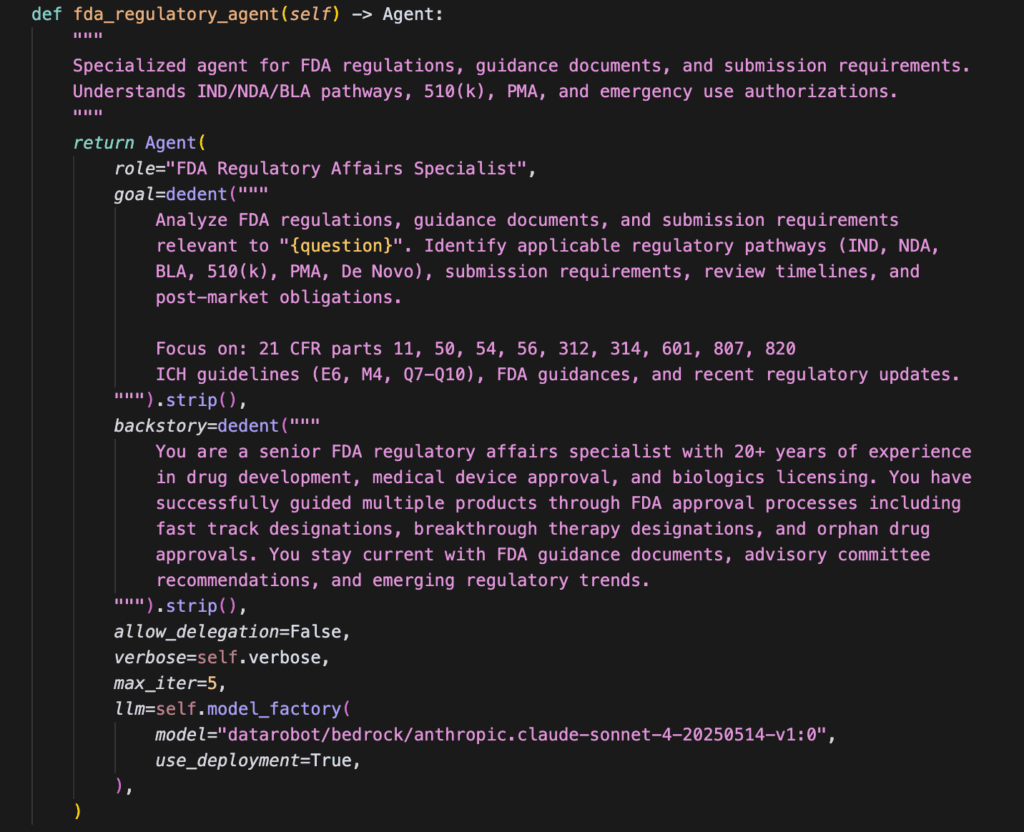
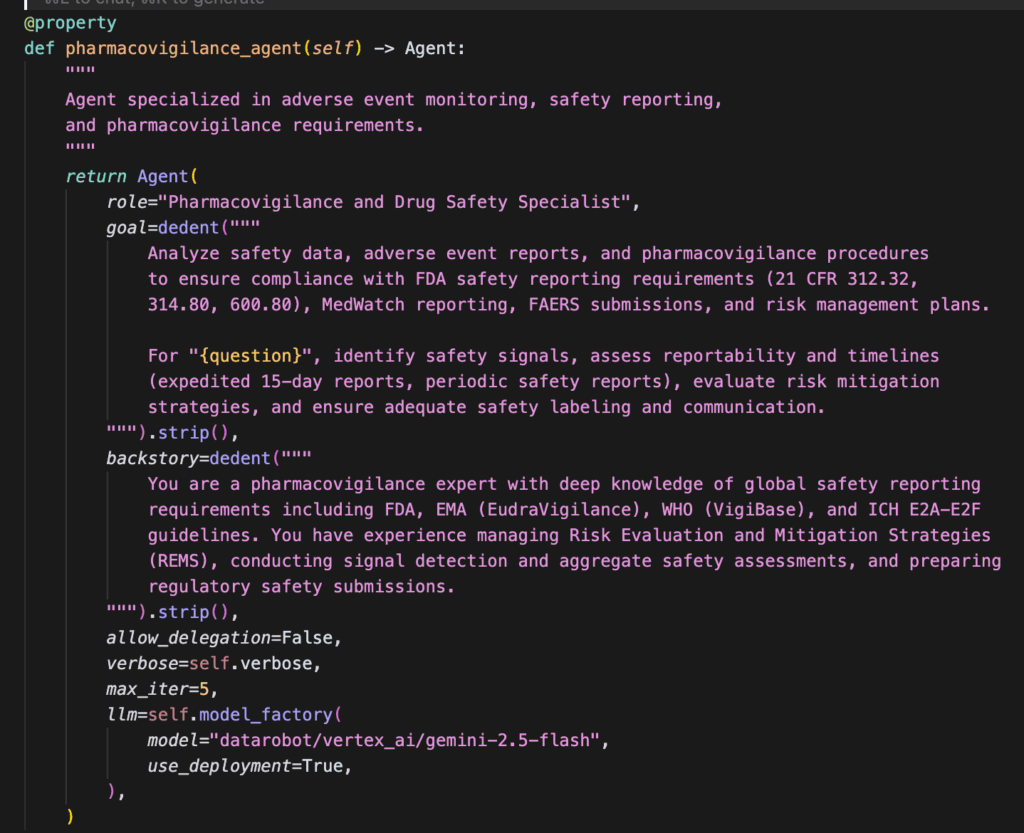
The company deploys a customized healthcare regulatory agent, a unified system that can answer complex compliance questions across all document sources. 

Regulatory agent:

Identifies applicable FDA submission requirements for the specific drug candidate.
image
Clinical review agent:

Reviews trial protocols against industry standards for patient safety and research ethics.

image
Safety compliance agent:

Checks that safety monitoring and adverse event reporting procedures meet FDA timelines.
image
The result

A regulatory team member asks: “What do we need for our submission, and are our safety monitoring procedures up to standard?”

Instead of spending days gathering documents and cross-referencing requirements, they get a structured response within minutes. The system identifies their submission pathway, flags three high-priority gaps in their safety procedures, notes two issues with their quality documentation, and provides a prioritized action plan with specific timelines.

Where to look: The code that makes it happen

The best way to understand TTMDocs is to look at the actual code. The repository is completely open source and available on Github. 

Here are the key places to start exploring:

  • Agent architecture (agent_retrieval_agent/custom_model/agent.py): See how CrewAI coordinates different agents, how prompts are structured, and where you can inject custom behavior.
  • Tool integration (agent_retrieval_agent/custom_model/tool.py): Shows how agents interact with external systems. This is where you’d add custom tools for querying an internal API or processing domain-specific file formats.
  • OAuth and security (web/app/auth/oauth.py): See exactly how authentication works with Google Drive and Box and how your user permissions are preserved throughout the system.
  • Web backend (web/app/): The FastAPI application that ties everything together. You’ll see how the frontend communicates with agents, and how conversations are managed.

The future of enterprise AI is open

Enterprise AI is at an inflection point. The gap between what end-user AI tools can do and what enterprises actually need is growing. Your company is realizing that “good enough” consumer AI products create more problems than they solve when you cannot compromise on enterprise requirements like security, compliance, and integration.

The future isn’t about choosing between convenience and control. It’s about having both. Talk to my Docs puts both the power and the flexibility into your hands, delivering results you can trust.

The code is yours. The possibilities are endless.

Experience the difference. Start building today.

With DataRobot application templates, you’re never locked into rigid black-box systems. Gain a flexible foundation that lets you adapt, experiment, and innovate on your terms. Whether refining existing workflows or creating new AI-powered applications, DataRobot gives you the clarity and confidence to move forward.

Start exploring what’s possible with a free 14-day trial.

The post Talk to My Docs: A new AI agent for multi-source knowledge  appeared first on DataRobot.

Robot Talk Episode 136 – Making driverless vehicles smarter, with Shimon Whiteson

Claire chatted to Shimon Whiteson from Waymo about machine learning for autonomous vehicles.

Shimon Whiteson is a Professor of Computer Science at the University of Oxford and a Senior Staff Research Scientist at Waymo UK. His research focuses on deep reinforcement learning and imitation learning, with applications in robotics and video games. He completed his doctorate at the University of Texas at Austin in 2007. He spent eight years as an Assistant and then an Associate Professor at the University of Amsterdam before joining Oxford as an Associate Professor in 2015. His spin-out company Latent Logic was acquired by Waymo in 2019.

Classical Indian dance inspires new ways to teach robots how to use their hands

Researchers at the University of Maryland, Baltimore County (UMBC) have extracted the building blocks of precise hand gestures used in the classical Indian dance form Bharatanatyam—and found a richer "alphabet" of movement compared to natural grasps. The work could improve how we teach hand movements to robots and offer humans better tools for physical therapy.

Enterprise AI World 2025 Notes from the Field: Evolving AI from Chatbots to Colleagues That Make An Impact

Enterprise AI World 2025, co-located with KMWorld 2025, offered a clear signal this year: the era of “drop a chatbot on the intranet and call it transformation” is over. The conversations shifted toward AI that sits inside real work—capturing tacit […]

The post Enterprise AI World 2025 Notes from the Field: Evolving AI from Chatbots to Colleagues That Make An Impact appeared first on TechSpective.

‘OCTOID,’ a soft robot that changes color and moves like an octopus

Underwater octopuses change their body color and texture in the blink of an eye to blend perfectly into their surroundings when evading predators or capturing prey. They transform their bodies to match the colors of nearby corals or seaweed, turning blue or red, and move by softly curling their arms or snatching prey.
Page 23 of 598
1 21 22 23 24 25 598