Since humanoids are most viable in environments where they can adapt to human-designed workflows without requiring extensive infrastructure changes. Still, successful deployment will hinge on meeting a set of practical operational constraints.
Ideally, that means you’ll be able to engage in multi-step edits in Word — and engage in multi-step uses of other apps like Excel and PowerPoint — from the get-go.
The downside: AI agents are not perfect, make mistakes – and according to a new Stanford study, are only 66% reliable.
Observes writer Igor Bonifacic: “OpenAI describes the new system as a ‘step change’ for image generation models, particularly when it comes to the tool’s ability to follow instructions in detail, render dense text and place and relate objects in a scene.”
It’s also even available to users of free ChatGPT – although users on paid tiers get access to more advanced outputs with the tool, according to Bonifacic.
Observes writer Eric Hal Schwartz: “Users asking the AI for help should be able to get what they want with much less back-and-forth refinement of their prompts.”
The system is expected to understand the intent of a request immediately — which should improve the reliability of how ChatGPT handles those tasks, according to Schwartz.
Instead, everyone else is cruising along on free AI.
That kind of stat can be stupefying to people who use higher-end AI throughout the day – at $20/month — to generally solve every major or minor challenge that comes their way.
Things may change in coming years if the big AI providers decide to scale back on lower-end – and not nearly as bright – free AI and start asking more users to pay up.
Observes writer Sarah Perez: “According to Google, this will allow Gmail users to ask questions in search using natural language — and then get concise answers without having to open and read different emails.”
Google says the AI Overviews in Gmail will be the default setting if you have Gemini for Workspace in Gmail enabled, or if your Workspace Intelligence access to Gmail is enabled, Perez adds.
Observes writer AJ Dellinger: “The company recently sent a memo to employees informing them of new tracking software that will be installed on their computers to track mouse movements and keystrokes in order to help train AI agents to perform specific work tasks.”
In a perfect world, it sure would be nice if mere fleshbag employees received bonuses for training their replacements.
But apparently, all that “AI Abundance” Silicon Valley has been gushing over will stay in the wallets of the AI titans after all.
Surprise, surprise.
Fortunately, Meta can use an already existing theme-song that’s custom-made for their new initiative — courtesy of the The Police.
Specifically, SelfPublishing.pro promises to consolidate pre-publishing services, including editing and formatting, distribution to major retailers, marketing campaign execution and royalty reporting into a unified platform where authors manage projects, communicate with the team, and track sales from a single dashboard.
With more than $600 billion targeted for investment during 2026, the dollars are headed toward high-performance chips, massive data centers and scores of additional networks, data storage and advanced cooling systems.
New powerhouse AI software from Anthropic has uncovered 271 security holes in the extremely popular browser, Firefox.
Full credit must be given to the maker of Firefox – Mozilla – which used Mythos to uncover the security problems and was completely transparent about the results.
Observes Bobby Holley, CTO, Mozilla: “Computers were completely incapable of doing this a few months ago — and now they excel at it.”
*AI Big Picture: Get Ready for a Slew of Software Security Patches: Wall Street Journal writer Nicole Nguyen advises that with the advent of powerful new AI programs like Anthropic Mythos – which can uncover security holes in software with alarming efficiency – we all need to triple-down on keeping up with security software patches.
Observes Nguyen: “Anthropic’s newest, as-yet-unreleased (to the general public) AI model is a hacker’s dream.”
Indeed, Mythos has apparently found thousands of high-severity vulnerabilities in every major operating system and Web browser, according to Nguyen.
Share a Link: Please consider sharing a link to https://RobotWritersAI.com from your blog, social media post, publication or emails. More links leading to RobotWritersAI.com helps everyone interested in AI-generated writing.
–Joe Dysart is editor of RobotWritersAI.com and a tech journalist with 20+ years experience. His work has appeared in 150+ publications, including The New York Times and the Financial Times of London.
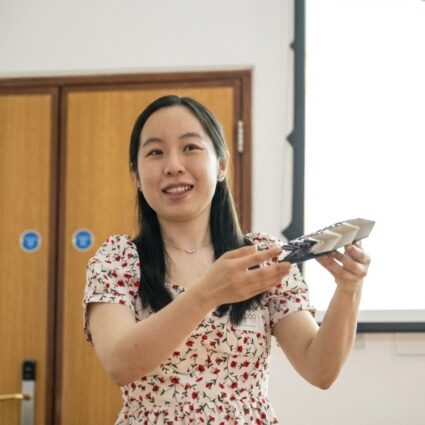
Claire chatted to Chenying Liu from University of Oxford about how a robot’s physical form can actively contribute to sensing, processing, decision-making, and movement.
Chenying Liu is a Junior Research Fellow and an Associate Member of Faculty in the Department of Engineering Science at the University of Oxford. She leads an independent research programme focused on embodied physical intelligence, exploring how robot design can integrate geometry, materials, and control to enhance autonomy and robustness. Her work aims to develop more efficient and resilient robotic systems by embedding intelligence directly into their physical structures.
Your agents are only as good as the knowledge they can access — and only as safe as the permissions they enforce.
We’re launching ACL Hydration (access control list hydration) to secure knowledge workflows in the DataRobot Agent Workforce Platform: a unified framework for ingesting unstructured enterprise content, preserving source-system access controls, and enforcing those permissions at query time — so your agents retrieve the right information for the right user, every time.
The problem: enterprise knowledge without enterprise security
Every organization building agentic AI runs into the same wall. Your agents need access to knowledge locked inside SharePoint, Google Drive, Confluence, Jira, Slack, and dozens of other systems. But connecting to those systems is only half the challenge. The harder problem is ensuring that when an agent retrieves a document to answer a question, it respects the same permissions that govern who can see that document in the source system.
Today, most RAG implementations ignore this entirely. Documents get chunked, embedded, and stored in a vector database with no record of who was — or wasn’t — supposed to access them. This can result in a system where a junior analyst’s query surfaces board-level financial documents, or where a contractor’s agent retrieves HR files meant only for internal leadership. The challenge isn’t just how to propagate permissions from the data sources during the population of the RAG system — those permissions need to be continuously refreshed as people are added to or removed from access groups. This is critical to keep synchronized controls over who can access various types of source content.
This isn’t a theoretical risk. It’s the reason security teams block GenAI rollouts, compliance officers hesitate to sign off, and promising agent pilots stall before reaching production. Enterprise customers have been explicit: without access-control-aware retrieval, agentic AI can’t move beyond sandboxed experiments.
Existing solutions don’t solve this well. Some can enforce permissions — but only within their own ecosystems. Others support connectors across platforms but lack native agent workflow integration. Vertical applications are restricted to internal search without platform extensibility. None of these options give enterprises what they actually need: a cross-platform, ACL-aware knowledge layer purpose-built for agentic AI.
What DataRobot provides
DataRobot’s secure knowledge workflows provide three foundational, interlinked capabilities in the Agent Workforce Platform for secure knowledge and context management.
1. Enterprise data connectors for unstructured content
Connect to the systems where your organization’s knowledge actually lives. At launch, we’re providing production-grade connectors for SharePoint, Google Drive, Confluence, Jira, OneDrive, and Box — with Slack, GitHub, Salesforce, ServiceNow, Dropbox, Microsoft Teams, Gmail, and Outlook following in subsequent releases.
Each connector supports full historical backfill for initial ingestion and scheduled incremental syncs to keep your vector databases current. You control access and manage connections through APIs or the DataRobot UI.
These aren’t lightweight integrations. They’re built to handle production-scale workloads — 100GB+ of unstructured data — with robust error handling, retries, and sync status monitoring.
2. ACL Hydration and metadata preservation
This is the core differentiator. When DataRobot ingests documents from a source system, it doesn’t just extract content — it captures and preserves the access control metadata (ACLs) that define who can see each document. User permissions, group memberships, role assignments — all of it is propagated to the vector database lookup so that retrieval is aware of the permissioning on the data being retrieved.
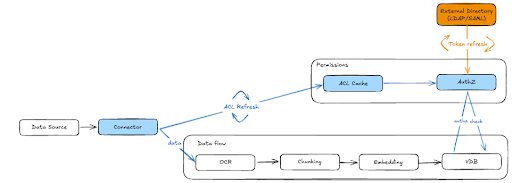
Here’s how it works (also illustrated in Figure 1 below):
During ingestion, document-level ACL metadata — including user, group, and role permissions — is extracted from the source system and persisted alongside the vectorized content.
ACLs are stored in a centralized cache, decoupled from the vector database itself. This is a critical architectural decision: when permissions change in the source system, we update the ACL cache without reindexing the entire VDB. Permission changes propagate to all downstream consumers automatically. This includes permissioning for locally uploaded files, which respect DataRobot RBAC.
Near real-time ACL refresh keeps the system in sync with source permissions. DataRobot continuously polls and refreshes ACLs within minutes. When someone’s access is revoked in SharePoint or a Google Drive folder is restructured, those changes are reflected in DataRobot on a scheduled basis — ensuring your agents never serve stale permissions.
External identity resolution maps users and groups from your enterprise directory (via LDAP/SAML) to the ACL metadata, so permission checks resolve correctly regardless of how identities are represented across different source systems.
3. Dynamic permission enforcement at query time
Storing ACLs is necessary but not sufficient. The real work happens at retrieval time.
When an agent queries the vector database on behalf of a user, DataRobot’s authorization layer evaluates the stored ACL metadata against the requesting user’s identity, group memberships, and roles — in real time. Only embeddings the user is authorized to access are returned. Everything else is filtered before it ever reaches the LLM.
This means two users can ask the same agent the same question and receive different answers — not because the agent is inconsistent, but because it’s correctly scoping its knowledge to what each user is permitted to see.
For documents ingested without external ACLs (such as locally uploaded files), DataRobot’s internal authorization system (AuthZ) handles access control, ensuring consistent permission enforcement regardless of how content enters the platform.
How it works: step by step
Step 1: Connect your data sources
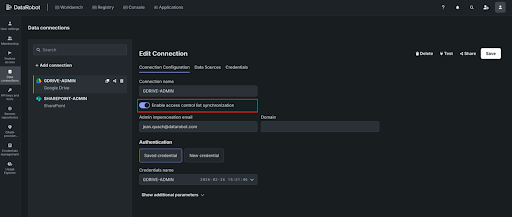
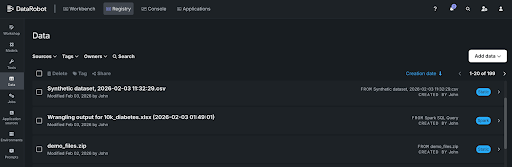
Register your enterprise data sources in DataRobot. Authenticate via OAuth, SAML, or service accounts depending on the source system. Configure what to ingest — specific folders, file types, metadata filters. DataRobot handles the initial backfill of historical content.
Step 2: Ingest content with ACL metadata
As documents are ingested, DataRobot extracts content for chunking and embedding while simultaneously capturing document-level ACL metadata from the source system. This metadata — including user permissions, group memberships, and role assignments — is stored in a centralized ACL cache.
The content flows through the standard RAG pipeline: OCR (if needed), chunking, embedding, and storage in your vector database of choice — whether DataRobot’s built-in FAISS-based solution or your own Elastic, Pinecone, or Milvus instance — with the ACLs following the data throughout the workflow.
Step 3: Map external identities
DataRobot resolves user and group information. This mapping ensures that ACL permissions from source systems — which may use different identity representations — can be accurately evaluated against the user making a query.
Group memberships, including external groups like Google Groups, are resolved and cached to support fast permission checks at retrieval time.
Step 4: Query with permission enforcement
When an agent or application queries the vector database, DataRobot’s AuthZ layer intercepts the request and evaluates it against the ACL cache. The system checks the requesting user’s identity and group memberships against the stored permissions for each candidate embedding.
Only authorized content is returned to the LLM for response generation. Unauthorized embeddings are filtered silently — the agent responds as if the restricted content doesn’t exist, preventing any information leakage.
Step 5: Monitor, audit, and govern
Every connector change, sync event, and ACL modification is logged for auditability. Administrators can track who connected which data sources, what data was ingested, and what permissions were applied — providing full data lineage and compliance traceability.
Permission changes in source systems are propagated through scheduled ACL refreshes, and all downstream consumers — across all VDBs built from that source — are automatically updated.
Why this matters for your agents
Secure knowledge workflows change what’s possible with agentic AI in the enterprise.
Agents get the context they need without compromising security. By propagating ACLs, agents have the context information they need to get the job done, while ensuring the data accessed by agents and end users honors the authentication and authorization privileges maintained in the enterprise. An agent doesn’t become a backdoor to enterprise information — while still having all the enterprise context needed to do its job.
Security teams can approve production deployments. With source-system permissions enforced end-to-end, the risk of unauthorized data exposure through GenAI isn’t just mitigated — it’s eliminated. Every retrieval respects the same access boundaries that govern the source system.
Builders can move faster. Instead of building custom permission logic for every data source, builders get ACL-aware retrieval out of the box. Connect a source, ingest the content, and the permissions come with it. This removes weeks of custom security engineering from every agent project.
End users can trust the system. When users know that the agent only surfaces information they’re authorized to see, adoption accelerates. Trust isn’t a feature you bolt on — it’s the result of an architecture that enforces permissions by design.
Get started
Secure knowledge workflows are available now in the DataRobot Agent Workforce Platform. If you’re building agents that need to reason over enterprise data — and you need those agents to respect who can see what — this is the capability that makes it possible. Try DataRobot or request a demo.
Operations underground, for example in underground stations, tunnels or mines, are risky and difficult for rescue teams. This is especially true if the technical infrastructure has collapsed due to explosions or fire, and there are no mobile phone signals, electricity, light, Wi-Fi or GNSS, while smoke, debris and damaged paths make orientation even more difficult.
When a knot lets go, it doesn't just fall apart. It snaps. That simple observation led Penn Engineers to rethink what a knot can do. Instead of treating it as something that holds tension, they asked a different question: what happens when you design a knot to release it? The answer is a tiny, soft robot capable of leaping meters into the air, flipping mid-flight, spinning like a propeller or even gliding back to where it started.
Physicists have taken a major step toward using AI not just to analyze data, but to uncover entirely new laws of nature. By combining a specially designed neural network with precise 3D tracking of particles in a dusty plasma—a strange “fourth state of matter” found from space to wildfires—the team revealed hidden patterns in how particles interact. Their model captured complex, one-way (non-reciprocal) forces with over 99% accuracy and even overturned long-held assumptions about how these forces behave.
Building AI systems that reliably manipulate objects in unstructured environments may be comparable in complexity to autonomous driving, a field that has absorbed over $100 billion in investment over the past fifteen years and is still not fully solved.
From Reactive to Ready: A 90-Day Supply Chain AI Roadmap for Mid-Market Ops Leaders
Most supply chain AI conversations stall in the same place. The ops leader knows the problem. The case for doing something is clear. The question that does not have a clean answer is: what does the first 90 days actually look like?
This is the roadmap USM Business Systems uses with mid-market manufacturing and logistics clients who are moving from interest to implementation. It is designed for organizations that do not have 18 months or a seven-figure platform budget. It is designed for teams that want to start, measure, and expand.
Before You Start: The Three Inputs That Determine Your Roadmap
A 90-day AI roadmap for supply chain is only as good as the three inputs that shape it. Get these clear before any build decision is made.
Input 1: The Problem With the Clearest Cost
Every mid-market supply chain operation has multiple AI opportunities. The teams that move fastest pick one. The one with the most direct and measurable cost attached.
Supplier lead time visibility. Inventory coverage calculation speed. Demand signal latency. Pick the one where someone can tell you what a miss costs in dollars, hours, or margin. That is where you start.
Input 2: Your Current Data Access Points
The roadmap is shaped by what you can connect the agent to. ERP API access. WMS data exports. Supplier EDI feeds. Order management integrations. You do not need all of these to start. You need the ones relevant to the problem you are solving.
A two-week scoping engagement with USM maps your data access reality and builds the agent architecture around what exists, not what would be ideal.
Input 3: The Success Metric
Before build begins, define what success looks like at 90 days. A number. Coverage calculation time reduced from 6 hours to 45 minutes. Near-misses surfaced with 72 hours of lead time instead of 24. Report generation recovered from Thursday manual build to automated Monday delivery.
That metric drives scope. It also drives the conversation about whether to expand.
Days 1-14: Scoping and Architecture
This is not a sales process. It is a working session.
Data environment mapping: what systems exist, what APIs are accessible, what exports are available
Problem prioritization: identify the one or two problems with the clearest ROI and the fastest measurement cycle
Agent architecture design: what the agent will connect to, what it will monitor, what it will surface
Success metric definition: specific, measurable, and agreed upon before build begins
At the end of day 14, you have an architecture document, a build scope, a timeline, and a defined metric.
Days 15-60: Build and Integration
The build phase runs in two tracks simultaneously.
Track one is data integration. The agent connects to your existing systems and begins ingesting live data. This phase surfaces the data quality issues that need to be addressed before the agent can produce reliable outputs. Those issues are resolved here, not discovered after go-live.
Track two is agent logic development. The monitoring rules, the exception thresholds, the scenario modeling logic, and the reporting templates are built and tested against real data from your operation.
By day 45, a test version of the agent is running against your data. The supply chain team begins evaluating outputs. Feedback shapes the final configuration before go-live.
Days 61-90: Go-Live and Measurement
Go-live is not a launch event. It is a transition. The agent moves from test to production. The team begins using it as the primary source for the problem it was built to solve.
The measurement cycle starts at day one of production. The success metric defined in scoping is tracked weekly. By the end of day 90, you have six weeks of live data showing the impact on decision time, report generation, near-miss visibility, or whatever metric was set.
That six weeks of measurement data is what drives the conversation about what to build next.
The Expansion Path
The teams that get the most out of supply chain AI do not deploy a platform across the entire operation on day one. They solve one problem, measure it, and expand.
After a successful first deployment, the common expansion paths are:
Adding supplier performance monitoring to an inventory visibility agent
Expanding from lead time tracking to landed cost scenario modeling
Connecting demand signal inputs from a second channel or geography
Integrating logistics lane performance data into coverage calculations
Each expansion is scoped and built with the same 8-12 week discipline. The architecture from the first deployment is designed to support expansion from the start.
The supply chain leaders who move fastest on AI do not have bigger budgets or cleaner data than their peers. They pick one problem, run a contained build, and measure it. That is the entire edge.
USM’s POC Commitment
For qualified supply chain and logistics engagements, USM fronts the proof-of-concept cost. You identify the problem. We scope and build the initial deployment. You measure the output before making a larger commitment.
The engagement starts with a scoping conversation. If the architecture is sound and the ROI case is clear, we move to build within two weeks.
Ready to scope your first supply chain AI deployment? Start with a 30-minute conversation at usmsystems.com. No pitch deck. Just the architecture conversation.
A breakthrough in brain-inspired computing could make today’s energy-hungry AI systems far more efficient. Researchers have engineered a new nanoelectronic device using a modified form of hafnium oxide that mimics how neurons process and store information at the same time. Unlike conventional chips that waste energy moving data back and forth, this device operates with ultra-low power—potentially slashing energy use by up to 70%.
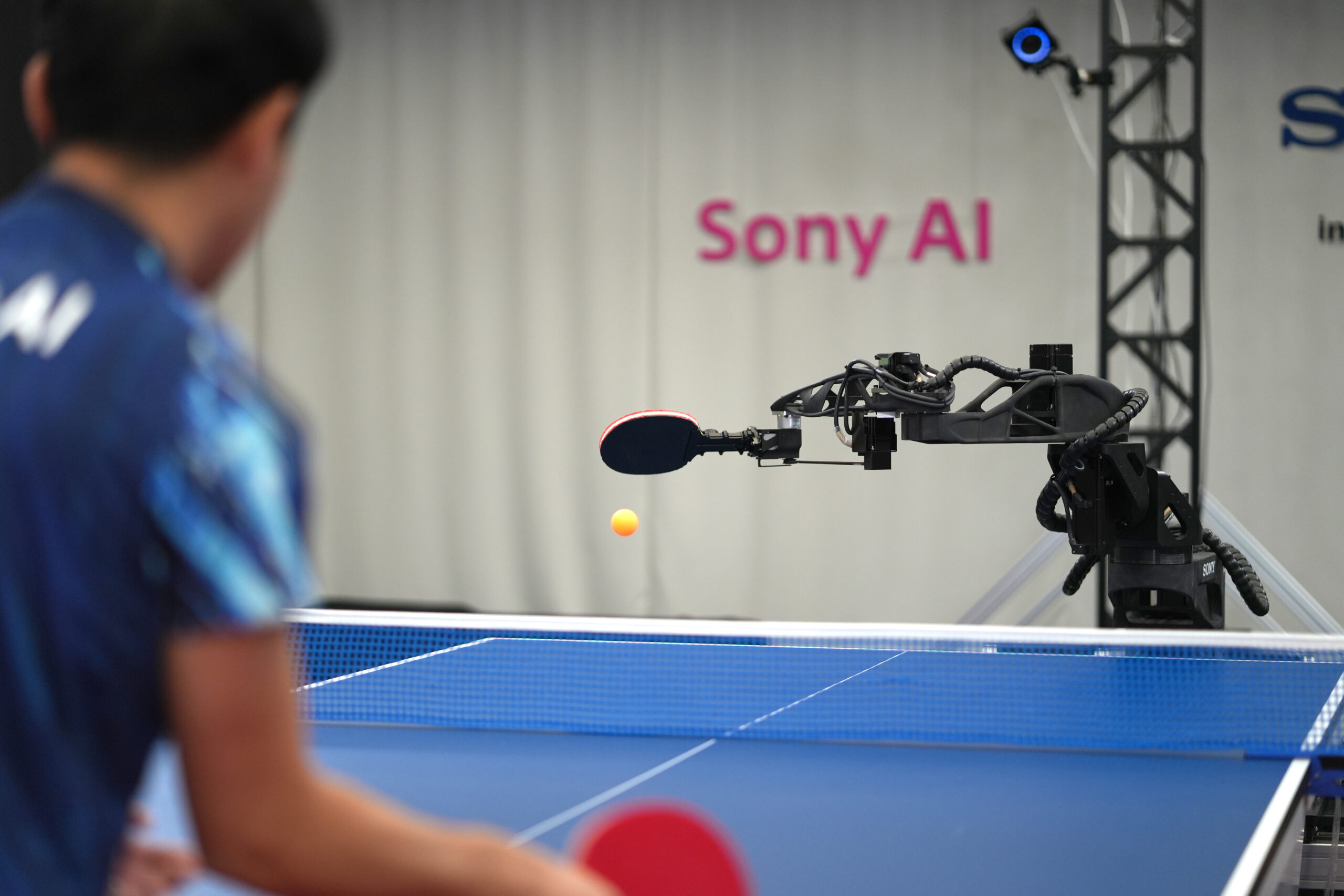
A paddle-wielding robot is so adept at playing table tennis that it is posing a tough challenge to elite human players and sometimes defeating them, according to a new study that shows how advances in artificial intelligence are making robots more agile.
Ace rotates its paddle as it prepares to return the ball back to its human opponent, Yamato Kawamata, during a match in December 2025. Credit: Sony AI.
In an article published today in Nature, Sony AI introduce Ace, the first robot to beat elite human players in competitive physical sport.
Although AI systems have shown advanced performance in digital domains and board games (such as complex video games, chess and Go), translating this to physical performance has remained a significant challenge. Such a feat requires perception, planning, and control to work in a high-speed domain on the scale of milliseconds. Table tennis is a demanding and complex real-world test for robotics, requiring rapid decision-making, precise physical execution, and continuous adaptation to an unpredictable opponent. The ball’s high speed, spin, and complex trajectories are central to competitive play.
Director of Sony AI in Zürich, and project lead for Ace, Peter Dürr said “this research has shown that an autonomous robot can, in fact, win at a competitive sport, matching or exceeding the reaction time and decision making of humans in a physical space. Table tennis is a game of enormous complexity that requires split-second decisions as well as speed and power. This research breakthrough highlights the potential of physical AI agents to perform real-time interactive tasks, and represents a significant step toward creating robots with broader applications in fast, precise, and real-time human interactions.”
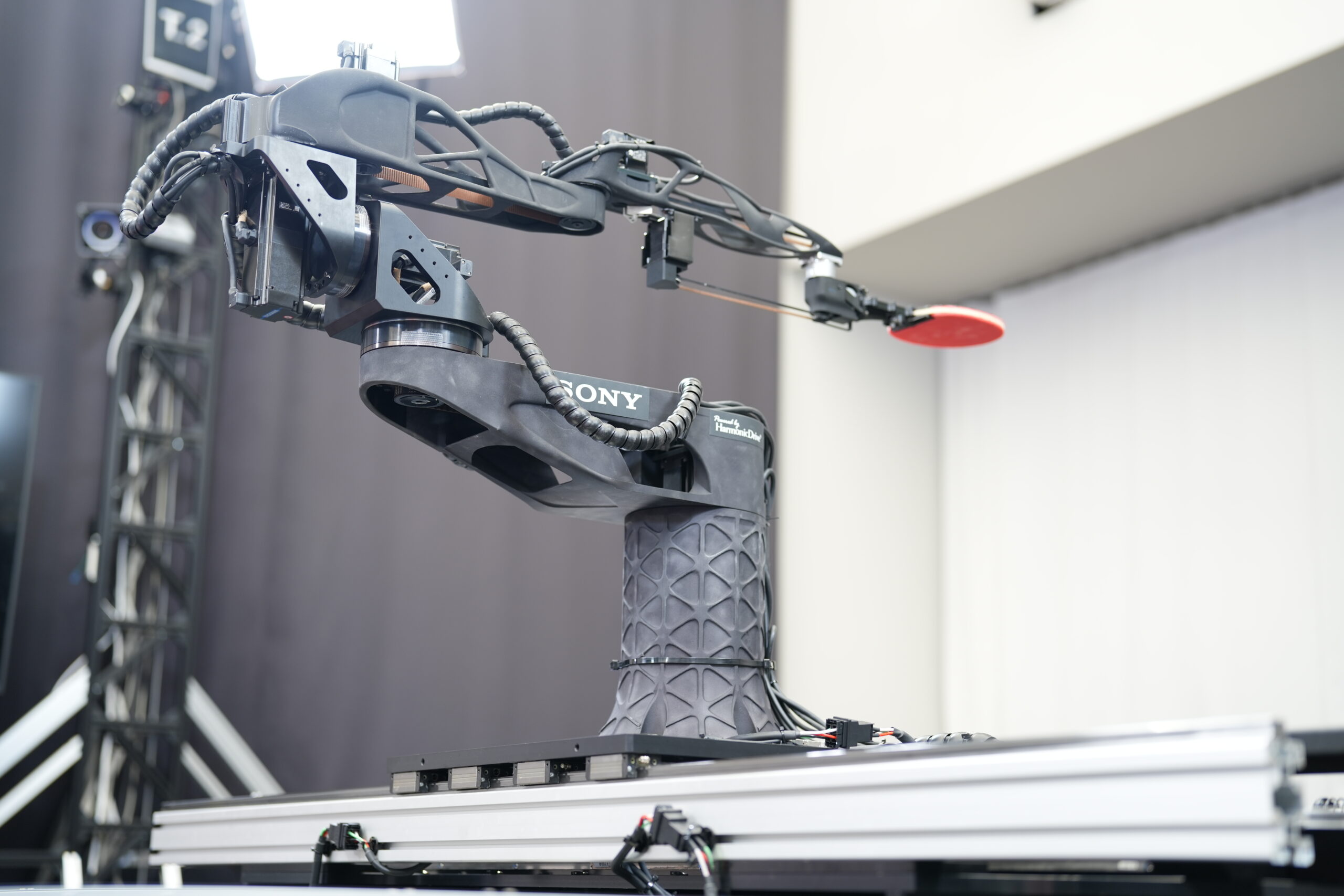
A complete view of table tennis robot, Ace, including arm and track. Credit: Sony AI.
What new components does Ace incorporate?
Ace combines event-based vision sensors and a control system based on model-free reinforcement learning, as well as state-of-the-art high-speed robot hardware. Ace was designed with three novel components:
A high speed perception system composed of nine active pixel sensor cameras to determine the ball’s precise 3D position, combined with three gaze control systems that use event-based vision sensor cameras, pan/tilt mirrors, and telephoto tunable lens to measure the ball’s angular velocity and spin in real time.
A novel control system based on model-free reinforcement learning to enable rapid adaptation and decision-making without reliance on pre-programmed models.
High-speed robotic hardware capable of executing precise, high-speed control for agile physical interaction.
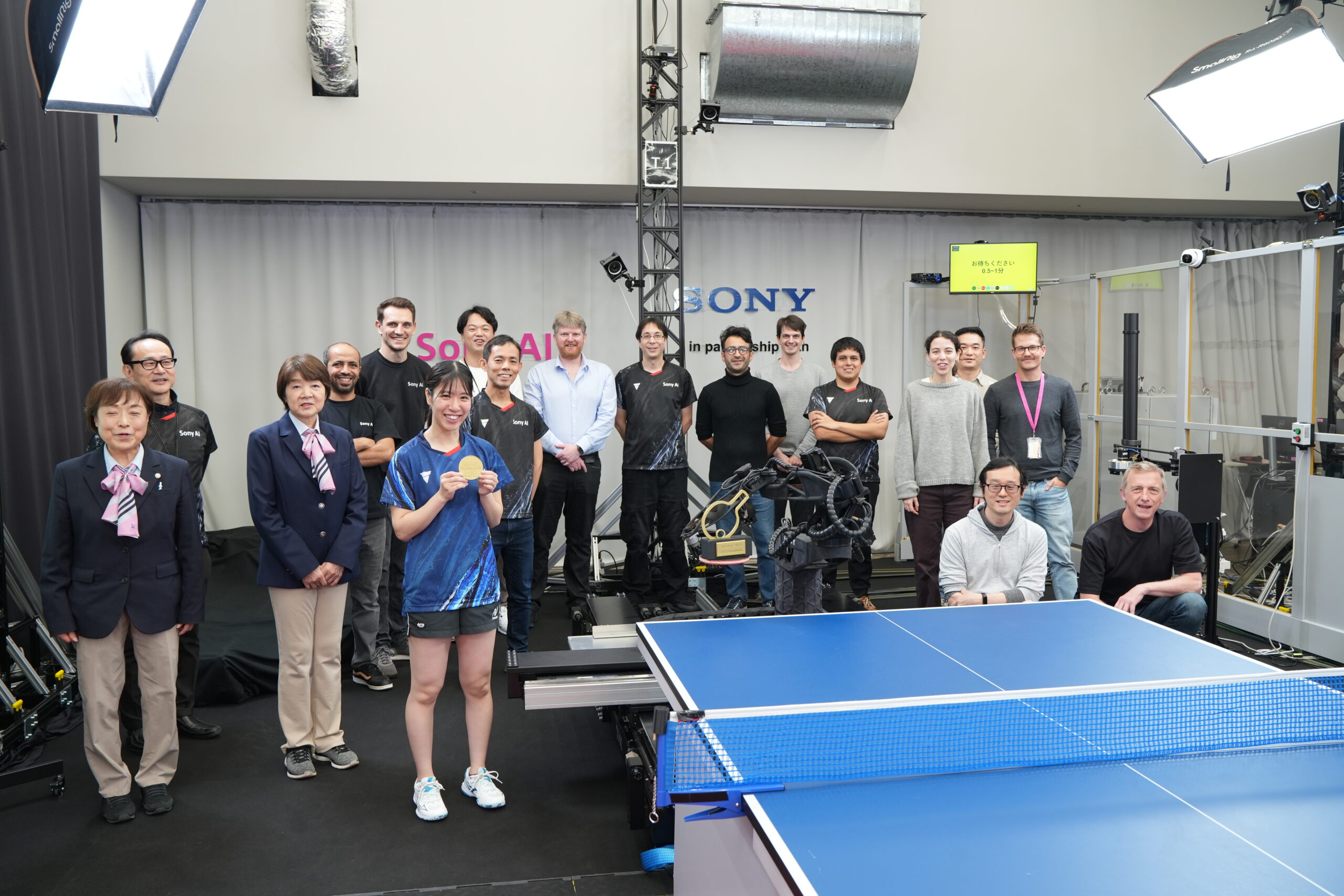
Members of the Ace research team and table tennis officials pose with the robot and its human opponent, Mayuka Taira, following an official match in December 2025.
From Figure 4 in the Nature manuscript “Outplaying elite table tennis players with an autonomous robot” this film shows the robot making a split section change to its trajectory when the ball hits the net. Credit: Sony AI and Nature.
Testing Ace against elite players
For the results reported in the Nature publication, Ace was evaluated in matches against five elite players and two professional table tennis players, under International Table Tennis Federation (ITTF) regulations. Ace achieved three victories in five matches against the elite players, along with competitive performances in the remaining matches.
There were some interesting results from the evaluations, including the fact that Ace was able to return a wide range of spins, consistently achieving over 75% return rate up to spins of 450 rad/s. The control systems behind Ace also allowed for quick reaction to unusual shots, such as balls bouncing off the net. This behavior illustrates the ability of the approach to generalize to situations that are both rare and hard to model in simulation.
Following submission of the Nature manuscript, the team conducted additional competitive matches in December 2025 and March 2026, beating professional players in the process. Compared with earlier evaluations, Ace demonstrated higher shot speeds, more aggressive placement closer to the table edge, and faster-paced rallies, reflecting continued performance gains under competitive conditions.
Find out more about the project in this video from Sony AI.
As autonomy moves from research labs into real-world environments, the role of design is shifting. It’s no longer just about usability — it’s about trust, safety, and human–machine collaboration.


 Ace rotates its paddle as it prepares to return the ball back to its human opponent, Yamato Kawamata, during a match in December 2025. Credit: Sony AI.
  A complete view of table tennis robot, Ace, including arm and track. Credit: Sony AI.
 Members of the Ace research team and table tennis officials pose with the robot and its human opponent, Mayuka Taira, following an official match in December 2025.