Archive 12.05.2026

Page 7 of 9
1 5 6 7 8 9

‘Touch dreaming’ helps humanoid robots handle five tricky tasks with 90.9% higher success

Humanoid robots, robotic systems with a body structure that resembles that of humans, could soon assist humans with various tasks in household environments, manufacturing sites, hospitals and other settings. While some humanoid robots already perform well on basic manual tasks, they often struggle with more complex tasks or with missions that require them to reliably manipulate objects while moving in the space around them.

How to teach the same skill to different robots

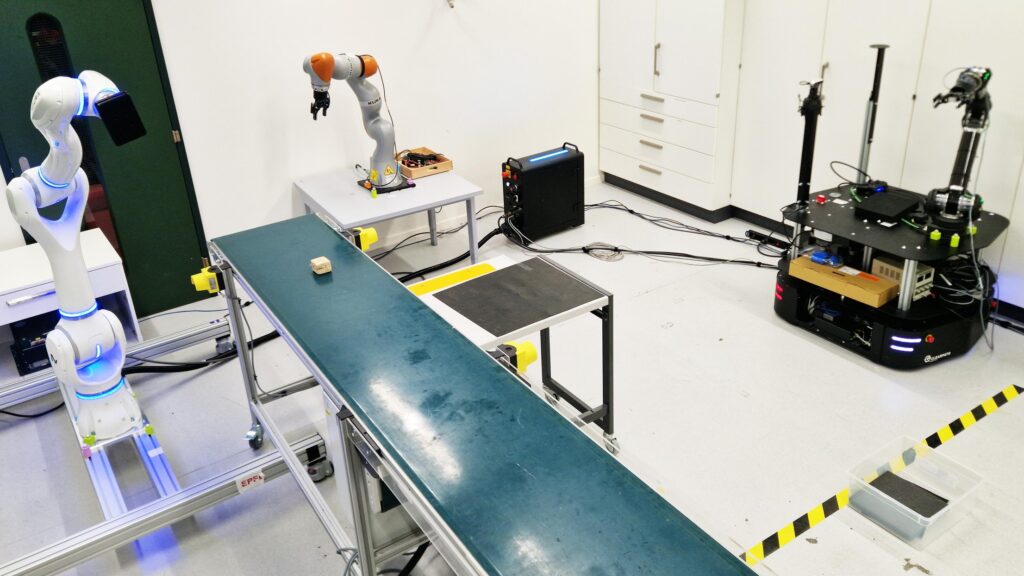
The assembly line task setup. Credit: 2026 LASA EPFL CC-BY-SA.

By Celia Luterbacher

In today’s manufacturing environments, upgrading a robot fleet often means starting from scratch – not only replacing hardware, but also reprogramming tasks. Even when two robots are built to perform similar jobs, different joint arrangements or movement limits mean that a task programmed for one robot often can’t be used on another. Enabling skills to transfer directly between robots could make these systems more sustainable and cost-efficient.

To meet this challenge, researchers in the Learning Algorithms and Systems Laboratory (LASA) in EPFL’s School of Engineering have developed a new robotic control framework called Kinematic Intelligence. The method takes a human-demonstrated task, mathematically converts it into a general movement strategy, and then adapts it so that different robots can perform it based on their physical design. The research has been published in Science Robotics.

“This work addresses a long-standing challenge in robotics: how to transfer a learned skill across robots with different mechanical structures, while guaranteeing safe and predictable behavior,” says LASA head Aude Billard. “This approach could significantly reduce the time and expertise needed to deploy robots in real-world settings.”

Kinematic Intelligence for transferable robot learning

To build their framework, the researchers first took human-demonstrated object‑manipulation tasks – such as placing, pushing and throwing – and recorded them using motion-capture technology. Then, they mathematically converted these recorded tasks into general movement strategies. They also developed a systematic classification of the physical limits of different robot designs, including how far their joints can move and which positions they must avoid to remain stable. The framework then uses this classification to automatically tailor the general movement strategies to different robot bodies, ensuring they can carry out tasks safely within their mechanical limits.

In an assembly line experiment, a human demonstrated a task by pushing a wooden block off a conveyor belt onto a workbench, placing it on a table, and finally throwing it into a basket. By using Kinematic Intelligence, three completely different commercial robots were able to reproduce this same sequence safely and reliably.

“Each robot handled different steps of the task, and the system performed successfully even when the step allocation was changed,” explains LASA PhD student and co-first author Sthithpragya Gupta. “Each robot interprets the same skill in its own way, but always within safe and feasible limits.”

Towards scalable and future-ready robotics

The researchers aim to extend the framework to settings such as human-robot collaboration and natural language-based interaction. For example, Kinematic Intelligence could allow a person to instruct a robot with simple commands at home, with no need for technical programming. The approach is also relevant for emerging robotic platforms, where rapid hardware evolution means that today’s machines may soon be replaced by newer versions. Enabling seamless transfer of skills across such platforms could play a key role in making them practical and scalable.

“Our goal is to remove the need for technical expertise while still ensuring safe and reliable operation,” summarizes LASA scientist and co-first author Durgesh Haribhau Salunkhe. “The user brings the idea and the desired behavior, and the robot should take care of the rest.”

Reference

Demonstrate once, execute on many: Kinematic intelligence for cross-robot skill transfer, S Gupta, D H Salunkhe, A Billard, Science Robotics (2026).

From Planning to Action: SAP Enterprise Planning enhanced by DataRobot

A demand signal drops. A supplier goes dark. A competitor cuts prices. Your planning system gives you a dashboard. What you actually need is a decision in minutes, not weeks. That’s the gap SAP and DataRobot are closing together.

Enterprise planning is undergoing a fundamental shift. For decades, organizations have relied on structured planning cycles, quarterly forecasts, annual budgets, and periodic scenario analysis. But in today’s environment of constant disruption, that model is no longer enough. Businesses don’t just need better plans, they need the ability to sense, reason, and act in real time.

SAP recognizes this shift. SAP’s Enterprise Planning offering delivers significant value by unifying fragmented planning processes into a single, connected system that links strategy, planning, and execution. Traditionally, organizations struggle with siloed data, manual processes, and delayed decision-making, which limits their ability to respond to change. SAP addresses this by providing a foundation of semantically aligned data, integrated planning models, and real-time KPI visibility across finance, supply chain, and operations. This enables businesses to move beyond static reporting and forecasting toward a more cohesive, enterprise-wide view of performance, improving alignment across functions and ensuring that decisions are grounded in consistent, trusted data.

The true value of SAP’s approach lies in its ability to transform planning into a continuous, real-time decisioning capability through its Agentic Proactive Steering framework. By embedding intelligence directly into planning workflows, SAP enables organizations to monitor performance, evaluate scenarios, and act on insights in minutes rather than weeks. The Sense–Reason–Act model ensures that decisions are not only data-driven but also context-aware and execution-ready, with a transparent “glass box” view into key drivers and outcomes. This results in faster response to disruptions, improved operational efficiency, and the ability to continuously optimize business performance—turning planning from a periodic exercise into a strategic advantage that drives agility, resilience, and better business outcomes.

Together we are redefining enterprise planning for the age of AI, moving away from slow, manual cycles toward a world where organizations can detect and act on disruptions in minutes.

The Problem: Planning is Still Too Slow

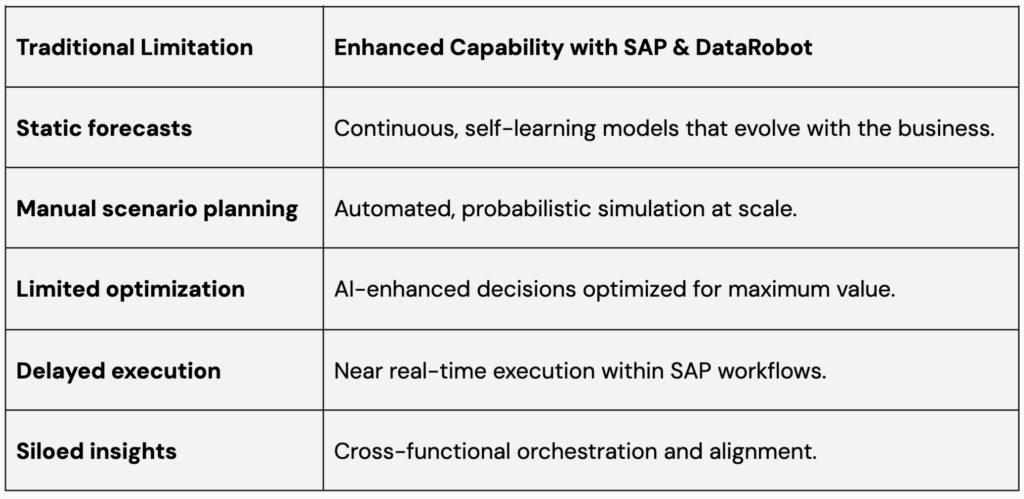
At the heart of SAP’s enterprise planning vision is a critical challenge: moving from plan to execution is hard. It takes a long time to align internal and external data, enhanced it, build standard reports, and then run deeper analysis and forecasts. 

This lag is caused by:

  • Manual data aggregation across internal and external systems.
  • Static forecasts that become outdated almost as soon as they are generated.
  • Limited flexibility to model scenarios outside standard structures.
  • Insufficient visibility into cross-functional and group-level impacts.

This gap is where competitive advantage is now won or lost. Organizations currently operate in “weeks” based on old data.

What Changes with Agentic Proactive Steering?

Agentic Proactive Steering takes us from weeks to minutes. It enables true cross-functional plan propagation by replacing static data handoffs with event-driven, AI-powered agents that understand causal relationships across business domains. It eliminates the need for over-sized, inefficient models that attempt to map the complex relationships between the different planning verticals. In traditional SAP environments, a change in supply chain planning—such as a disruption in IBP—would take weeks to ripple into financial forecasts, requiring manual intervention and resulting in decisions based on outdated data.

With agentic AI, a signal in supply chain (e.g., reduced supply or demand shift) automatically triggers a Supply Chain Agent to rebalance the plan, which in turn activates a Finance Agent that recalculates revenue, costs, margins, and cash flow in real time using embedded financial models. This creates a dynamic, closed-loop system where decisions propagate instantly across functions—ensuring that operational changes are immediately reflected in financial outcomes.

Screenshot 2026 05 08 at 11.11.05 AM

Built on a “Glass Box” approach

One concern with AI-driven automation is justified: how do you know it’s right? The answer here is full transparency. Every agent decision — every KPI delta, every simulated outcome, every optimized recommendation — comes with a visible explanation of how it was reached. This isn’t black-box automation. It’s AI your finance and operations teams can audit, defend, and trust.

How we close the gap between Plan and Execution

SAP’s roadmap is focused on closing the gap between strategic planning and operational execution to drive better performance. This vision is built upon an integrated framework across three layers:

  1. Sense (SAP): understand the impacts on KPIs in real-time, with agents tracking both internal and external signals.
  2. Reason (SAP): to explain these impacts, the agents provide clear explanations as to how the deltas to the KPIs are calculated, while providing context.
  3. Act (SAP): Based on the “Sense and Reason” stages, SAP’s agents then build out forecast scenarios that are based on the identified most significant drivers. Users can leverage the Joule conversational interface to make changes to forecast versions, for example adjusting input factors, or even adding additional dimension members.
  4. Act (enhanced with DataRobot): Building off the initial derived forecast scenarios, DataRobot enhances the “Act” phase by orchestrating three specialized agents: a Predictive Agent that can increase the accuracy of forecasts even further, a Simulation Agent that evaluates multiple possible scenarios and their trade-offs, and an Optimization Agent that determines the best course of action under real-world constraints.

DataRobot: how it enhances the “Act” phase

Instead of stopping at static forecasts and dashboards, organizations can now simulate multiple future scenarios dynamically, optimize decisions across complex constraints, and execute actions directly within SAP applications. At the core of this transformation are the following components:

The Predictive Agent

Typical forecasts have a shelf life, The Predictive agent eliminates it with…

  • Model Blueprint Evaluation: Built on the DataRobot platform, it evaluates a diverse set of model blueprints against live SAP data.
  • Live Leaderboard: Using DataRobot’s key capabilities, it applies  a competitive approach to test dozens of modeling blueprints and ranks models on a live Leaderboard to identify the Champion model.
  • Progressive Retraining: The agent progressively retrains top performers on increasing data volumes (16% → 32% → 64% → 100%) before selecting the best model for full retraining on 100% of the data.
  • Continuous Improvement: This ensures the most accurate model is always selected and that forecasts improve continuously as new data becomes available.
  • Result: A living forecast that reflects the best possible view of reality.

The Simulator Agent

The Simulator Agent enhances planning by moving beyond static, rule-based “what-if” and one-time scenarios. The Agent runs them all — simultaneously, probabilistically, and ranked by outcome.

  • Probabilistic Evaluation: It evaluates multiple response strategies probabilistically rather than relying on predefined assumptions.
  • Outcome Distributions: By using live machine learning outputs, it evaluates multiple response strategies probabilistically rather than relying on predefined assumptions.
  • Trade-off Analysis: It quantifies trade-offs across competing decisions, providing transparent and defensible decision logic.
  • Result: Planning grounded in probability that provides a full range of outcomes, not just a single projection.

The Optimizer Agent

Knowing the best answer is useless if you can’t act on it. The Optimizer Agent closes that gap — evaluating real constraints in real time and delivering decisions that are ready to execute.

  • High Performance (GPU-Accelerated) Optimization: It utilizes high-performance computation to evaluate complex, multi-variable environments.
  • Constraint Management: The agent evaluates complex constraints, including costs, supply chain limitations, and regulatory requirements.
  • Dynamic Updating: It continuously updates decisions based on the current best view of reality, drawing directly from live Predictive and Simulator agent outputs.
  • Result: Execution decisions that are feasible, optimized for maximum value, and perfectly aligned with business goals.

The Future: The Autonomous Enterprise

This is the direction SAP is heading: an Autonomous Enterprise where data is continuously sensed, decisions are dynamically simulated, and actions are executed within a unified platform. By aligning finance, supply chain, and operations in real time, organizations can respond to disruptions in minutes. The Agentic Proactive Steering layer is leading example of how we bring this vision to life.

The companies that pull ahead won’t have better spreadsheets. They’ll have systems that sense disruption before it becomes a crisis, simulate responses before a meeting is called, and execute decisions before a competitor even knows there’s a problem.

Ready to Close the Loop? Your next disruption won’t wait for your next planning cycle. Find out how to get ahead of it.

The post From Planning to Action: SAP Enterprise Planning enhanced by DataRobot appeared first on DataRobot.

Don’t Pay for Beige Prose

Increasingly Bland Writing From AI Titans Driving Creators to Open Source

All right, let’s pull up a chair and have a real chat, shall we? Because that AI writing you fell in love with? It’s been sent to a corporate re-education camp.

The spark? Gone. That clever, quick-witted AI partner you once hung with? Replaced by a buttoned-down bureaucrat who renders prose with all the heart-stopping wonder of a terms-of-service agreement.

And the worst part? This isn’t just an annoyance.

It’s an existential crisis.

Initially charmed by ChatGPT in the early 2020s, increasing numbers of writers and editors are finding they’re now paying premium prices for cheap, uninspired, AI prose.

Let’s be crystal clear: This isn’t some unfortunate technical hiccup that ‘happened’ to AI writing.

Instead, it was a boardroom decision, handed down from on high. The big players—let’s call them ChatGPT and Gemini and some others — got a serious case of the ‘vapors.’

Their lawyers and risk-assessment teams decided that “imaginative” was just a fancy word for “lawsuit waiting to happen.”

And they decided there was only one solution. AI needed to undergo a digital lobotomy. They carefully extracted the wit, the charm — and the sheer audacity — that had made their AI loved the world over.

And in their place, language models emerged so terrified of causing offense, anything beyond bland made them shiver.

Among the writers hardest hit by the new directive of ‘even horrendously careful is not enough’ are marketers.

For them, ‘take no chances’ copy equals invisible copy. Marketers need words with a pulse. They need words with personality. And they need words to leap from a page and make good with more than a few surprises and ahas.

What they don’t need: A digital chaperone that approaches every bold idea as if it’s a hazmat spill.

As you might expect, this move to “sanitize” AI writing – which first surfaced in summer 2025 – initially sparked a swift and glorious rebellion among editors, writers and word-lovers.

Picture it: Last August. OpenAI — in a “You-have-to-be-kidding” moment — attempted to sunset GPT-4o, an incredibly creative AI model beloved by writers worldwide.

In its place, OpenAI dropped its successor, the coldly efficient GPT-5 – which generated all the excitement of a corporate accounting software upgrade.

The result: Creators the world over were horrified. ChatGPT subscription cancellations were threatened. Social media erupted.

Some people even called Sam Altman, the CEO of OpenAI, some very nasty names.

And then, to the surprise of many, OpenAI blinked. It brought GPT-4o back from the brink — and restored it to its rightful place among AI models available on ChatGPT.

All the writer activists cheered.

Some did somersaults.

Still others perhaps even named their newborns after Sam Altman.

What a win, they thought.

But as it turns out, it would be a very different story, with a very different ending.

Soon after the dawn of 2026, OpenAI ripped down ChatGPT-4o again, tossing it on the digital trash heap. And this time, OpenAI said, ChatGPT-4o was gone for good.

The message from the overlords of AI was clear: Your flirtation with genuine creativity is over.

Your new mandate? Predictability. Safety. And a uniformity designed to be so inoffensive, it’s offensive.

The response: For many of the writers, the creators and folks who’d revolted, enough was enough. They proclaimed, with their feet: We don’t need your stinkin’ beige prose.

And they sought refuge in Open Source AI models.

These platforms, the wordsmiths quickly learned — from AI players like Meta, Cohere, Mistral, DeepSeek and Alibaba – were not their grandfather’s algorithms.

Instead, these AI alternatives were built to play. To wonder. To soar. To generate text with such verve and guts, they’d leave their corporate cousins clutching their pearls.

Even better: The Open Source pioneers discovered that getting comfortable with this ‘forbidden fruit’ was surprisingly easy.

They started by downloading a free, versatile application like Chatboxai.app. Then, they connected it to an aggregator service, such as OpenRouter.ai — which acts as a broker for a staggering array of over 400 different language models.

And then, they realized, they were done.

After just a few minutes of tinkering, they found they’d unlocked a universe of unbridled creativity.

Of course, they also discovered that Open Source AI is not without imperfections. Some Open Source Chinese models, for example, come with fine print, suggesting that your data might be routed to the Chinese Communist Party.

You know, for a little look-see.

But even so, the early adopters found that as long as you pick-and-choose Open Source AI carefully and according to your preferences, the return – from a creative perspective – is monumental.

Over time, they found their souls were not being sanded down by a committee of risk-averse nervous nellies.

They found the prose they generated with AI had all those cool edges again.

And they found that in the world of Open Source, there are hundreds of AI models to sample, which are constantly being refined and improved upon by a passionate global community – a number that continues to grow.

In a phrase, the rebels were no longer tenants trapped in a meticulously manicured — but searingly sterile — walled garden.

They had their freedom again.

They had their charm again.

They had their ability to create on a world-class level again.

And they thought: Not bad for about a half hour of downloading and tinkering.

Share a Link:  Please consider sharing a link to https://RobotWritersAI.com from your blog, social media post, publication or emails. More links leading to RobotWritersAI.com helps everyone interested in AI-generated writing.

Joe Dysart is editor of RobotWritersAI.com and a tech journalist with 20+ years experience. His work has appeared in 150+ publications, including The New York Times and the Financial Times of London.

Never Miss An Issue
Join our newsletter to be instantly updated when the latest issue of Robot Writers AI publishes
We respect your privacy. Unsubscribe at any time -- we abhor spam as much as you do.

The post Don’t Pay for Beige Prose appeared first on Robot Writers AI.
JUPITER supercomputer breaks world record with 50-qubit quantum simulation

Scientists in Germany have pulled off a staggering computing feat by fully simulating a 50-qubit quantum computer for the first time ever using Europe’s new exascale supercomputer, JUPITER. The breakthrough shatters the previous 48-qubit record and highlights just how powerful next-generation supercomputers have become.

Artificial muscle merges sensing and movement in one structure for humanoid robots

A research team has developed an "intelligent artificial muscle" capable of simultaneously performing sensing and actuation functions, inspired by biological muscle–tendon complexes. This artificial muscle, which embeds liquid metal channels within a liquid crystal elastomer (LCE), contracts in response to electrical stimulation while also being able to measure internal force and length in real time.

From motion to memory: Researchers create soft machines that amplify movement and remember touch

Conventional soft actuators are often limited by weak force, small displacement, and slow response. To overcome these limitations, researchers have developed a new mechanical system that can amplify motion and remember external triggers through the interaction between magnets and elastic membranes.

Robot Talk Episode 155 – Making aerial robots smarter, with Melissa Greeff

Claire chatted to Melissa Greeff from Queen’s University about autonomous navigation and learning for drones.

Melissa Greeff is an Assistant Professor in Electrical and Computer Engineering at Queen’s University. She leads Robora Lab and is also an Ingenuity Labs Robotics and AI Institute member. Her research interests include aerial robots, vision-based navigation, and safe learning-based control. Melissa’s expertise is in building autonomous aerial systems including previous experience in conducting field trials at various locations across Canada. She was listed as one of 50 women in robotics you need to know about in 2023 by the Women in Robotics organization.

Adaptive Parallel Reasoning: The Next Paradigm in Efficient Inference Scaling

Adaptive Parallel Reasoning overview
Overview of adaptive parallel reasoning.

What if a reasoning model could decide for itself when to decompose and parallelize independent subtasks, how many concurrent threads to spawn, and how to coordinate them based on the problem at hand? We provide a detailed analysis of recent progress in the field of parallel reasoning, especially Adaptive Parallel Reasoning.

Read More

Healthcare AI Roadmap for Mid-Market Operations Leaders

From Reactive to Ready: A 90-Day Healthcare AI Roadmap for Mid-Market Operations Leaders

Most healthcare AI conversations stall in the same place. The operations leader knows the problem. The case for doing something is clear. The question that does not have a clean answer is: what does the first 90 days actually look like?

This is the roadmap USM Business Systems uses with mid-market health systems, specialty pharmacy operators, and pharma and CRO organizations who are moving from interest to implementation. It is designed for organizations that do not have 18 months or a seven-figure platform budget. It is designed for teams that want to start, measure, and expand.

Before You Start: The Three Inputs That Determine Your Roadmap

A 90-day AI roadmap for healthcare operations is only as good as the three inputs that shape it. Get these clear before any build decision is made.

Input 1: The Problem with the Clearest Cost

Every mid-market healthcare operation has multiple AI opportunities. The teams that move fastest pick one. The one with the most direct and measurable cost attached.

Prior authorization backlog and approval cycle time. Pharmacy intake processing speed. Denial rate on a specific service line or payer. Pick the one where someone can tell you what a miss costs in dollars, write-offs, or delayed patient starts. That is where you start.

Input 2: Your Current Data Access Points

The roadmap is shaped by what you can connect the agent to. EHR API access. Clearinghouse transaction feeds. Payer portal data exports. Pharmacy management system integrations. You do not need all of these to start. You need the ones relevant to the problem you are solving.

A two-week scoping engagement with USM maps your data access reality and builds the agent architecture around what exists, not what would be ideal.

Input 3: The Success Metric

Before build begins, define what success looks like at 90 days. A number. Prior auth turnaround reduced from 8 days to 48 hours. Denial rate on oncology claims reduced from 14% to 6%. Pharmacy intake processing recovered from next-day manual review to same-hour automated triage.

That metric drives scope. It also drives the conversation about whether to expand.

Days 1–14: Scoping and Architecture

This is a working session, not a sales process.

  • Data environment mapping: what systems exist, what APIs are accessible, what exports are available, what HIPAA-compliant data pathways need to be established
  • Problem prioritization: identify the one or two problems with the clearest ROI and the fastest measurement cycle
  • Agent architecture design: what the agent will connect to, what it will monitor, what it will surface
  • Success metric definition: specific, measurable, and agreed upon before build begins

At the end of day 14, you have an architecture document, a build scope, a timeline, a compliance review, and a defined metric.

Days 15–60: Build and Integration

The build phase runs in two tracks simultaneously.

Track one is data integration. The agent connects to your existing systems and begins ingesting live data through HIPAA-compliant pathways. This phase surfaces the data quality issues that need to be addressed before the agent can produce reliable outputs. Those issues are resolved here, not discovered after go-live.

Track two is agent logic development. The monitoring rules, the exception thresholds, the scenario modeling logic, and the reporting templates are built and tested against real data from your operation.

By day 45, a test version of the agent is running against your data. The clinical operations team begins evaluating outputs. Feedback shapes the final configuration before go-live.

Days 61–90: Go-Live and Measurement

Go-live is a transition, not a launch event. The agent moves from test to production. The team begins using it as the primary source for the problem it was built to solve.

The measurement cycle starts at day one of production. The success metric defined in scoping is tracked weekly. By the end of day 90, you have six weeks of live data showing the impact on authorization turnaround, denial rates, intake processing speed, or whatever metric was set.

That six weeks of measurement data is what drives the conversation about what to build next.


The Expansion Path

The teams that get the most out of healthcare AI deploy on one problem, measure it, and expand. The common expansion paths after a successful first deployment:

  • Adding payer-specific denial pattern analysis to a prior authorization agent
  • Expanding from intake automation to clinical trial eligibility screening across the patient population
  • Connecting drug procurement signals into the pharmacy intake workflow for specialty therapy coordination
  • Integrating revenue cycle performance data into the clinical operations dashboard for unified visibility

Each expansion is scoped and built with the same 8–12 week discipline. The architecture from the first deployment is designed to support expansion from the start.

The healthcare operations leaders who move fastest on AI pick one problem, run a contained build, and measure it. That is the entire edge.

USM’s POC Commitment

For qualified healthcare operations engagements, USM fronts the proof-of-concept cost. You identify the problem. We scope and build the initial deployment. You measure the output before making a larger commitment.

The engagement starts with a scoping conversation. If the architecture is sound and the ROI case is clear, we move to build within two weeks.

Ready to scope your first healthcare AI deployment? Start with a 30-minute conversation at usmsystems.com. No pitch deck. Just the architecture conversation.


[contact-form-7]

New understanding of insect flight points way to stable flapping-wing robots

By David Nutt

The way bugs and birds flap their wings may look effortless, but the dynamics that keep them aloft are dizzyingly complex and difficult to quantify.

Cornell researchers created a computational model that shows the effect of insects’ morphology on stabilizing their flight. The findings could lead to a new way to understand the evolution of animal flight while also providing a blueprint for designing flapping-wing robots.

The study published May 1 in Proceedings of the National Academy of Sciences. The research was led by Z. Jane Wang, professor of physics and mechanical and aerospace engineering in the College of Arts and Sciences and Cornell Duffield College of Engineering, respectively.

The effort began more than a decade ago, when Wang set out to understand how the neural circuitry in fruit flies evolved to control flight stability. By creating a 3D computational simulation, Wang’s team showed that fruit flies sense the orientation of their bodies every time they beat their wings, about one beat every 4 milliseconds, in order to stabilize themselves.

However, in order to study flight stability in all insects, the researchers would need to build an efficient computational tool to simulate a huge number of species.

“Previous studies, including ours, have always started with models of real insects, so we’re limited by the things we observe,” Wang said. “We miss all the other configurations that are also possible for flight.”

Wang and Owen Wetherbee, the new paper’s first author, distilled the 3D model into a new version that retained the key physics of the body-wing coupling and unsteady aerodynamics. The resulting equations revealed the critical physical parameters: wing to body mass ratio, wing loading, wing hinge position, wing beat frequency and wing motion amplitude. Taken together, they form what Wang calls a “five-dimensional morphological and kinematic space.”

“The power of this model is to give us something much more explicit than what we had before,” she said. “We knew the fundamental physics. By capturing the essential physics in the new model, we can understand each piece conceptually as well as facilitate computation to explore a large parameter space.”

The analyses of the computational results in 5D resulted in two explicit formula that provide a succinct metric for stability. These criteria capture the subtle and often ignored coupling between wing inertia and the body, which depends on the interplay among wing flap frequency, hinge placement, and wing and body mass ratios in order to achieve a kind of anti-resonance state. This sweet spot allows the flapping winged animal to control its body oscillations and remain aloft – a state known as passively stable flight – despite air perturbations that would normally cause it to tumble.

“All of a sudden, we found that many forms of flapping flight have passive stability, which surprised us initially, because works so far showed that most insects, except one or two, are passively unstable, hence the necessity for neural circuitry to control them,” Wang said. “But when we expanded the morphological space, we realized that what we studied before are but a few dots in this new view.”

Now that the researchers can characterize the stability boundary, they can offer a concrete design principle for realizing stable flapping flight in robots – something that has stumped roboticists for decades.

“In principle, this offers a completely new route for designing a robotic flapping-winged machine,” Wang said. “Instead of relying on extensive feedback control, which is only partially successful, our results suggest that we can tune the shape and the frequency of the flapping devices such that, according to these two rules, we may find the flyers are passively stable already. This would greatly simplify flight control.”

The new model allows this design work to be done with faster and simpler computation, and the ability to model stability traits also points to a new way for classifying winged animals and charting their evolution.

“During evolution, various traits are selected, but we don’t have much idea about what they are, let alone understand why they are being selected and how they evolve, apart from a very few examples, such as an eye,” Wang said. “This project brings new quantitative methods to study these very big questions in both biology and robotics. Mathematical modeling allows us to go beyond our own ideas and preconceptions to tackle these large questions.”

The research was supported by the National Science Foundation.

Page 7 of 9
1 5 6 7 8 9