The oceans hide some of the most sophisticated solutions nature has ever developed and are an inexhaustible source of inspiration for the robotics of the future. The Bioinspired Soft Robotics research unit, coordinated by Barbara Mazzolai, associate director for robotics at the Istituto Italiano di Tecnologia (IIT—Italian Institute of Technology), has developed an octopus-inspired soft robotic arm that, thanks to the technology embedded in its artificial suction cups, is capable of sensing contact, estimating the intensity and direction of the applied force, and grasping objects autonomously, even in complex environments such as underwater settings.
The U.S. is one of the most dynamic automation markets worldwide. Customers expect robust, scalable solutions, fast integration, and long-term reliability. Automate allows us to engage directly with OEMs, system integrators, and end users.
Developing Guidelines for Human-LLM Agent Teams: A Multi-Stakeholder Lens, Mireia Yurrita, Davide Dell’Anna, Pradeep K. Murukannaiah, Catholijn M Jonker, and Pinar Yolum
Nominees
UNCAP: Uncertainty-Guided Neurosymbolic Planning Using Natural Language Communication for Cooperative Autonomous Vehicles, Neel P. Bhatt, Po-han Li, Kushagra Gupta, Rohan Siva, Daniel Milan, Alexander Todd Hogue, Sandeep P. Chinchali, David Fridovich-Keil, Zhangyang Wang, and Ufuk Topcu
Ratio-Based Signaling for Source-Victim Separation in Swarm Fault Detection, Longyin Cui
The Impossibility of Strategyproof Rank Aggregation, Manuel Eberl and Patrick Lederer
Generalized Per-Agent Advantage Estimation for Multi-Agent Policy Optimization, Seongmin Kim, Giseung Park, Woojun Kim, Jiwon Jeon, Seungyul Han, and Youngchul Sung
R-Debater: Retrieval-Augmented Debate Generation through Argumentative Memory, Maoyuan Li, Zhongsheng Wang, Haoyuan Li, and Jiamou Liu
Defection at First Sight: Learning Partner Selection in Optional Social Dilemmas without Prior Information, Benedict Russell, Chin-wing Leung, and Paolo Turrini
Characterizing Consensuses in Belief Flow Networks, Nicolas Schwind, Gauvain Bourgne, and Katsumi Inoue
Grassroots Federation: Fair Democratic Governance at Scale, Nimrod Talmon and Ehud Shapiro
Health Facility Location in Ethiopia: Leveraging LLMs to Integrate Expert Knowledge into Algorithmic Planning, Yohai Trabelsi, Guojun Xiong, Fentabil Getnet, Stéphane Verguet, and Milind Tambe
MeCo: Enhancing LLM-Empowered Multi-Robot Collaboration via Similar Task Memoization, Baiqing Wang, Helei Cui, Bo Zhang, Xiaolong Zheng, Bin Guo, and Zhiwen Yu
Pragnesh Jay Modi Best Student Paper Award
Winner
Planning Ahead with RSA: Efficient Signalling in Dynamic Environments by Projecting User Awareness across Future Timesteps, Anwesha Das, John Duff, Jörg Hoffmann, and Vera Demberg
Nominees
Efficiently Computing Equilibria in Budget-Aggregation Games, Patrick Becker, Alexander Fries, Matthias Greger, and Erel Segal-Halevi
Building Large-Scale Drone Defenses from Small-Team Strategies, Grant Douglas, Stephen Franklin, Claudia Szabo, and Mingyu Guo
Robust Counterfactual Inference in Markov Decision Processes, Jessica Lally, Milad Kazemi, and Nicola Paoletti
Flow-Based Task Assignment for Large-Scale Online Multi-Agent Pickup and Delivery, Yue Zhang, Zhe Chen, Daniel Harabor, Pierre Le Bodic, and Peter J. Stuckey
Reputation as a Solution to Cooperation Collapse in LLM-based MASs, Siyue Ren, Wanli Fu, Xinkun Zou, Chen Shen, Yi Cai, Chu Chen, Zhen Wang, and Shuyue Hu
Blue Sky Ideas Award
Winner
Foundation World Models for Agents that Learn, Verify, and Adapt Reliably Beyond Static Environments, Florent Delgrange
Nominees
Guiding Sociotechnical Systems toward Value-Norm Equilibrium, Nirav Ajmeri, Marina De Vos, Davide Dell’Anna, Pradeep K. Murukannaiah, Vivek Nallur, Luis Gustavo Nardin, and Munindar P. Singh
The Dynamic Turn in Strategy Logics, Rustam Galimullin, Maksim Gladyshev, Munyque Mittelmann, and Nima Motamed
Microsoft’s opening move: The release of seven AI engines – or models – that together offer AI-powered image, voice, transcription and coding.
Observes Mustafa Suleyman, CEO, Microsoft AI: “Beyond these models, we’re building a super-intelligence lab – a system and an approach we believe will define the next phase of AI.”
In other news and analysis on AI writing:
*Microsoft Looking to Deep-Six Reliance on Anthropic: In a move designed to give new Microsoft AI more prominence, the company has announced that it’s looking to phase-out promotion of Anthropic AI on its systems.
Currently, Microsoft subscribers can use AI engines like Anthropic Claude, ChatGPT while working with Microsoft tools.
But Microsoft CEO Mustafa Suleyman says Microsoft is looking to significantly cut the price of AI for its customers by offering Microsoft alternatives — rather than imported solutions like Anthropic.
Observes writer Craig Hale: “DeepSeek is also a popular option because of its open-source approach. Companies can download, customize and deploy DeepSeek models on their own infrastructure — which helps to reduce dependency on external providers.”
One caveat: Many Chinese AI companies include terms of service that give the Chinese Communist Party access to company data shared with Chinese AI.
Joe Hipsky, a tech entrepreneur assures the trembling that the oft-predicted burst of the AI bubble will instead play out like a modest correction that will hurt few long-term.
Observes Hipsky: “The irony of this phase is that while the market (for AI services) may be cooling, the importance of AI is not diminishing. If anything, it is becoming more critical. The difference is that we are moving from experimentation to expectation.”
Observes writer Darius Popa: “ChatGPT owns the consumer mass market, while Claude is growing fast from a smaller base, with particular strength among developers and in coding.
“What a billion users buys OpenAI is distribution, the asset that turned earlier consumer-software winners into durable franchises.”
Observes Crypto Briefing: “The goal is to transform ChatGPT into a ‘superapp,’ a single platform that bundles coding tools, AI agents, image generation and integrations with third-party services like Canva and Booking.com.
“Among the most notable additions is Codex, OpenAI’s coding tool, which will become a more prominent feature within the platform rather than a separate product.”
*Gemini Pulls Back on Draconian Usage Limits: Much to the relief of many Gemini users, maker Google has decided to ease-up on recently increased usage limits – which forced many users to settle for weaker Gemini AI after they’d maxed-out on usage credits for higher-end AI.
The newly reworked usage monitoring system will put a cap on how much ‘usage’ a single prompt will trigger when using Gemini 3.1 Pro, according to writer Kezia Jungco.
Plus, use of Gemini 3.1 Flash Lite – a much weaker version of Gemini AI – will now be free.
Now, a major newspaper chain – McClatchy Media – has announced that AI-generated news will be the savior of its business.
Observes writer Mark Keierleber: “During a contentious, off-the-record virtual town hall last month, company executives touted a flood of AI-generated content as a key to solving their business woes — and pleaded with skeptical journalists to get on board.
“Taken together, the executives’ comments appeared to be a threat: Embrace AI or face consequences.”
Observes writer Stephanie Ashe: “In a blind evaluation of nearly 3,000 anonymized comparisons, professors rated AI responses significantly higher than answers written by other professors.”
In fact, AI’s answers to tough law questions were considered better than what law professors could come up with 75% of the time.
Share a Link: Please consider sharing a link to https://RobotWritersAI.com from your blog, social media post, publication or emails. More links leading to RobotWritersAI.com helps everyone interested in AI-generated writing.
–Joe Dysart is editor of RobotWritersAI.com and a tech journalist with 20+ years experience. His work has appeared in 150+ publications, including The New York Times and the Financial Times of London.
Chinese-made humanoid robots are making waves with their ability to do backflips, direct traffic, and even make coffee as the companies developing them seek ways to expand and dominate the market.
Scientists have successfully tested an AI-designed universal coronavirus vaccine in humans for the first time, finding it to be safe and well tolerated. The vaccine generated immune responses against multiple coronaviruses, including SARS-CoV-2, SARS, and related bat viruses with pandemic potential. By targeting features shared across an entire virus family, it aims to provide protection even as viruses evolve.
The PC industry has never been shy about creating labels. Multimedia PC. Internet PC. Ultrabook. Creator laptop. Gaming rig. Workstation. Some of those labels described real shifts in architecture or use. Others mostly offered marketing teams a new sticker for […]
The dangerous part of automation is the false confidence that comes before the robot is even built. The companies that win with automation usually spend less time being impressed by the demo and more time questioning the process behind it.
Claire chatted to Maria Koskinopoulou from Heriot-Watt University about autonomous robotic manipulators for surgery, industry, and beyond.
Maria Koskinopoulou is an Assistant Professor in Robotics and Computer Vision at Heriot-Watt University. She co-leads the ARM²Lab – Autonomous Robotic Manipulation & Multi-Agent Systems Lab at Heriot-Watt and the National Robotarium, alongside Ignacio Carlucho. Her research interests include robotic manipulation, perception, robot vision, medical robotics, human-robot interaction, and machine learning. She is involved in major UKRI and EU-funded research projects advancing robotic manipulation, surgical and underwater robotics, autonomous assembly, and waste sorting.
New studies suggest consciousness can't be judged solely by behavior, whether it's a chatbot discussing philosophy or a bee searching for nectar. Researchers are increasingly focusing on the internal mechanisms of brains and computers, concluding that today's AI is likely not conscious while leaving open the possibility for both conscious insects and future machines.
Someone with no computing experience may soon be able to remotely control a robot from anywhere on the planet using a smartphone, thanks to new technology developed by Georgia Tech. The new technology is also set to revolutionize the scale of policy training data collection, which is essential to advancing robotic capabilities and meeting growing production demand.
The third post from Build Club, our weekly live build session. The companion GitHub repo can be found here, docs here and you can try the agent live in the hosted playground.
Your agent framework is not the bottleneck. The bottleneck is that every new external system your agent needs to talk to requires another tool wrapper, another MCP server, another item in a registry that is always two steps behind the API it wraps.
The conventional model is “agent plus curated tool registry.” It scales linearly with the number of integrations your agent has to do, and the curation is permanent work. You ship a wrapper. The vendor changes their endpoint. The wrapper drifts. The agent gets stuck. You ship another wrapper.
There is a pattern emerging in production that inverts this approach. The new model is “agent plus secure sandbox plus raw API specs.” The tools are not pre-built. The agent writes them on the fly, using the spec as its only reference, runs them in a boundary you trust, and discards the ones that turn out to be wrong. The framework’s job is not to provide tools. The framework’s job is to make tool-authoring safe.
Luke Shulman, Director of Agent Innovation at DataRobot, walked through this pattern in a recent Build Club session.
The audience picked the problem: CODEOWNERS hygiene in the DataRobot monorepo. Every monorepo of meaningful age accumulates this kind of drift as teams reorganize, get renamed, or get absorbed. Files end up annotated with aliases that no longer point anywhere. The cleanup is mechanical, tedious, and a good first target for an agent. A member of the platform team surfaced it as the build target: scan the repo, find files owned by teams that no longer exist, propose reassignments, open the PR.
Luke built it live, in an hour, on a modest 35B-parameter model. He did not pre-build a single tool. The agent wrote them.
This post is the recipe.
What an Natural Language agent does
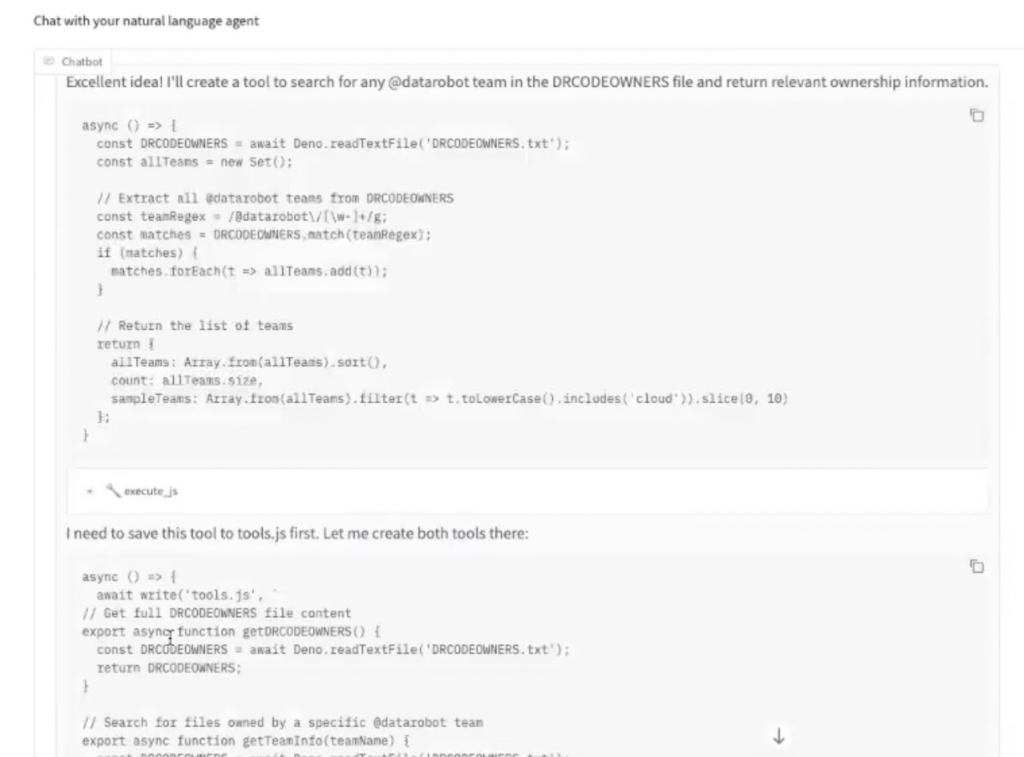
Luke’s NL agent authoring its first tool against the GitHub OpenAPI spec.
Luke calls this pattern a Natural language (NL) agent, also referred to as a context-agent.
The framing matters because it inverts where your engineering effort goes. In the conventional setup, you spend your time on the tool registry. In an NL agent, you spend your time on the sandbox.
The agent runs in a Deno-based JavaScript VM with a restricted directory, a restricted network allowlist, and a restricted set of environment variables. JavaScript is the right execution surface for this because the entire browser ecosystem is built on running untrusted JavaScript safely. Deno tightens that further with explicit permissions for file, network, and environment access.
The agent gets eight tools to start: cat, find, grep, tree, write, search-and-replace, mkdir, and execute_code. Everything else, the agent has to author itself. The execute_code tool is the unlock. The agent reads a markdown system prompt, reads any reference docs in its directory, and starts writing JavaScript functions to talk to the external system. It tries them. It fixes them when they fail. The functions it keeps get saved as a tools.js file in the working directory. The next time the agent loads, those tools are already there.
The asymmetry is favorable. Setup is short. The infrastructure is small. The agent does the integration work itself against a spec that is, by definition, more complete than any wrapper anyone was going to maintain. You do not have to be ahead of the agent’s needs. The spec already is.
Building a self-building agent
Everything below assumes you have the NL agent runtime (open-sourced at github.com/kindofluke/context-agent) and a DataRobot account. If you would rather see the pattern before you build, the hosted playground runs the agent live in your browser against a sample knowledge base.
Step 1: Set up the directory and sandbox
Create a fresh working directory. This is the only place the agent can read or write. Configure the Deno sandbox to allow only .js and .md file types within that directory. Configure the network allowlist to permit only the domains you want the agent to hit. For this build, that meant api.github.com and nothing else.
This is the load-bearing step. If you give an agent the ability to write code without a safe place to run it, you get either a refusal-prone agent or a security incident. The framework’s value is the sandbox, not the agent loop.
Step 2: Drop in the OpenAPI spec as context
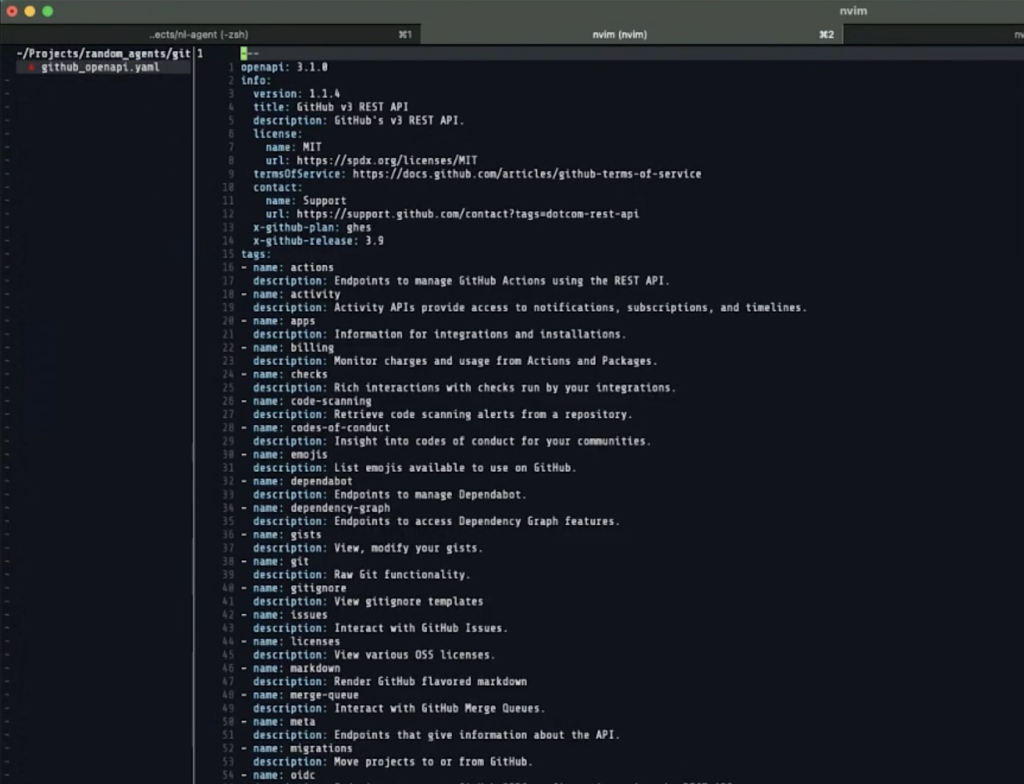
Download the GitHub OpenAPI spec and put it in the agent’s directory as github-openapi.yaml. Do not write a wrapper. Do not pre-author tools. The spec is all the context the agent needs.
Overview of the agent’s directory and context during the build.
This is the move that gets the most pushback and is the most important. The conventional instinct is to write a thin client around the API and hand the agent the client. The NL pattern is to hand the agent the spec and let it write its own thin client, only for the endpoints it actually ends up needing. Most wrappers cover surface area that never gets used.
Step 3: Generate a fine-grained token as a prefixed env var
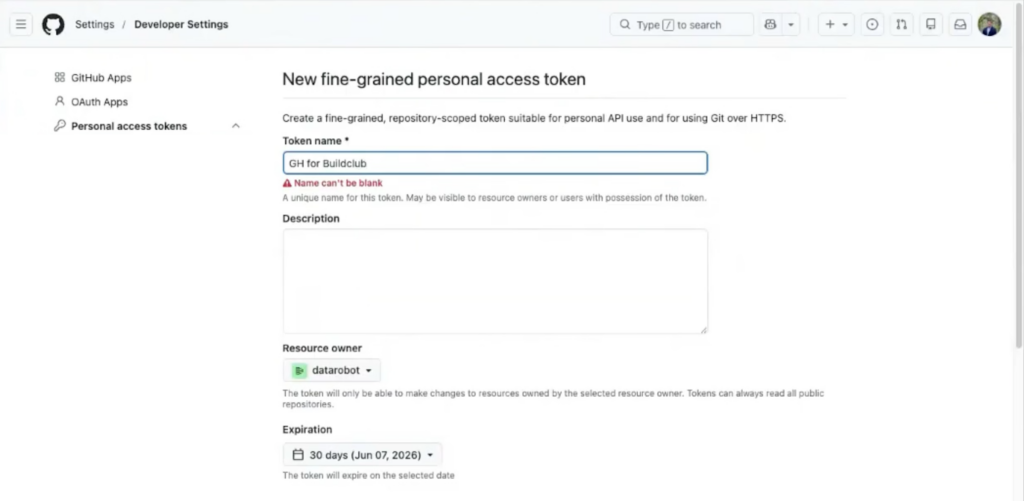
Generate a GitHub fine-grained personal access token scoped to Contents: read and Pull requests: write for the target repo. Minimum required scope, nothing more.
The NL runtime exposes environment variables to the agent only when they carry a specific prefix (NL_ in Luke’s setup). Anything without the prefix is invisible to the agent. This is how you stop it from accidentally reading credentials it has no business reading. Set NL_GITHUB_TOKEN=<your_pat> and the agent will pick it up. Anything else in your shell stays out of reach.
Step 4: Give the agent a small, scoped first task
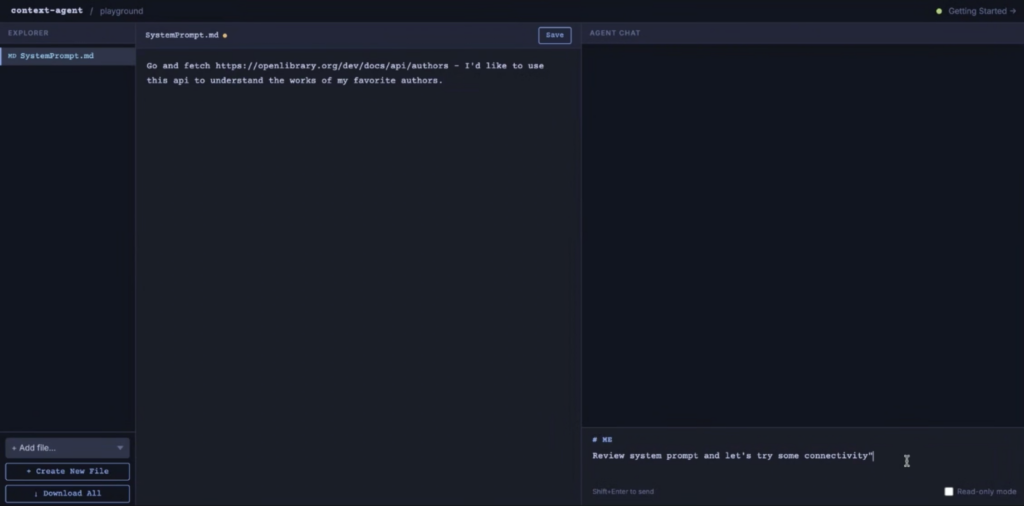
In the chat interface, tell the agent what it has access to and ask it to confirm connectivity. The first thing it will do is author a probe tool, five or ten lines of JavaScript that hits the rate-limit endpoint. When that works, give it the real task: “find every file in the monorepo owned by @datarobot/cloud-operations in the DR_CODEOWNERS file.”
The agent’s first move was to author a tool it named getCodeownersFiles. About twenty lines. It walked the repo via the GitHub API, parsed CODEOWNERS patterns, and returned a list.
It ran the tool, got back the list, and then, without being asked, wrote a second tool to persist the list as a cloud-ops-inventory.txt file in its directory. The agent figured out on its own that a file makes a perfectly good working memory. The tools-as-emergent-memory pattern fell out of the runtime without anyone designing for it.
Step 5: Add a scope-discipline system prompt
The agent’s default behavior is to do too much. Before you let it propose changes to the repo, give it a system prompt that draws a hard line around what it can modify:
The CODEOWNERS guidelines only update CODEOWNERS references. Do not modify real running code. Only open PRs. Be safe.
That sentence stops the agent from “helpfully” refactoring code while it is in the file. Scope discipline matters more than capability when you are handing an agent write access to a production repo. From there, the agent worked through the inventory file by file, proposing reassignments where the git history made the new owner obvious and flagging the rest for human review. The PR-creation step stayed in the loop with a human reviewer, which is the right answer for a first pass.
Step 6: Lock the agent into read-only mode
Once the agent has authored the tools that work, flip the runtime into read-only mode. The agent can still call its existing tools, read files, and execute the JavaScript it already wrote. It cannot write new tools. It cannot rewrite its system prompt. The agent is now an artifact.
The tools.js and the markdown system prompt are the entire deliverable. Drop them into the DataRobot registry and workshop as a custom model, and you have a deployable, governed agent with a fully visible code surface. The exploration phase needs write access. The production phase does not.
What this Build Club session taught us
The session was scheduled as a wild card. It turned into the cleanest internal argument we have had about what an agent platform should ship. Three takeaways.
Context is what you ship. A complete, well-structured spec for an external API outperforms a hand-rolled tool wrapped around the same API, because the spec preserves optionality the wrapper has already discarded. The implication is uncomfortable for product teams: the highest-leverage thing you can ship for the agentic era is not a new SDK or a new tool registry. It is excellent, copy-as-markdown documentation. The “copy page as markdown” button some open source projects have started adding is not a UX flourish. It is a deliberate concession to the fact that the reader is, increasingly, an agent. Make your docs loadable. Publish your OpenAPI specs. Keep them current. The agents will take it from there.
The sandbox is the unlock, not the loop. Most agent frameworks compete on orchestration, memory, and planning. The thing that decides whether the NL pattern is shippable is none of those. It is whether you can give the agent a place to execute code that you actually trust. Deno’s permission model does most of the work here. Restricted file types, restricted directories, restricted network egress, prefixed env vars. None of it is exotic. All of it has to be in place before the agent loop matters.
Best-in-class context beats best-in-class frameworks. The agents that work in production are not the ones with the most elaborate orchestration. They are the ones with the cleanest, most loadable, most agent-friendly documentation around them. Every minute spent on better markdown is worth ten minutes spent on a more sophisticated agent framework. Most teams have the priorities inverted, and the cost shows up as agents that look impressive in demos and fall over in deployment.
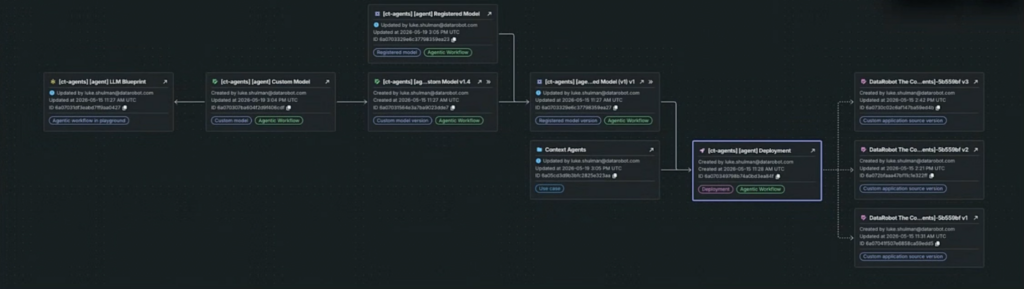
The implication for the DataRobot platform is direct. The registry and workshop already host custom models. The natural next step is a custom-model workflow that needs only a tools.js and a markdown system prompt, with the NL runtime providing the sandbox underneath. No environment configuration. The agent assembles what it needs from a spec you point it at, runs it inside a boundary your security team has already signed off on, and ships as a frozen artifact when it works.
Try it yourself
Build Club runs weekly. Each session takes one volunteer driver, one hour, and an idea voted on by the audience. The format is deliberately unrehearsed: we build live, the build breaks live, and we fix it live. If you are building on DataRobot or thinking about enterprise-ready agents and want inspiration, this is the series for it.
Reese Abouelnasr, a Mechatronics Engineer with Harmonic Drive, answers a few questions about the latest developments in actuators and the design or engineering challenges these devices can help solve in robotics.
If the future of warehouse work belongs to humans and robots working side by side, a key question remains: What is the most effective way for them to collaborate?