Intelligent transcription with Gemini 3.5 Transcribe
Now you can get more intelligent speech-to-text transcription with Gemini 3.5 Transcribe.
 Deborah Lupton / Servers in a Landscape / Licenced by CC-BY 4.0
By Emmet Cole
Robots clean rivers and sort waste, monitor ecosystems, and inspect renewable-energy infrastructure. But even the greenest robot has an environmental footprint.
If robotics is going to help build a more sustainable world, the robotics community has to answer some potentially awkward questions, starting with this one: How sustainable are robots themselves?
Across a full lifecycle, from rare earth mineral extraction and manufacturing to operation and end-of-life, robots have an environmental impact. But the robotics community has, until now, lacked dedicated tools for calculating it.
The Robotics Eco-Label project, led by Bram Vanderborght at Belgium’s Vrije Universiteit Brussel, is an attempt to address that gap with a lightweight, web-based Toolkit that provides roboticists with a way to quantify robot sustainability.
Separating a robot’s core technologies into materials, energy sources, sensors, processors, actuators, design, and recyclability, the Robotics Eco-Label Toolkit then evaluates each based on five metrics: resource conservation, lifecycle extension, carbon footprint, energy efficiency, and circularity. The numbers are combined in a weighted matrix to yield a 0–100 Eco-Score for Robots. The weights used are not currently fixed; that will be one of the targets of further research and collaboration. (For an indicative score on your robot, try the project’s interactive self-assessment tool here.)
A low score in one area might point to energy-hungry actuators, limited repairability, hard-to-recycle materials, or a lack of end-of-life planning. A higher score, by contrast, suggests that sustainability has been considered across the system. One of the project’s stated goals is to make environmental trade-offs visible early enough in the development process to shape sustainable robot design choices.
The project also includes educational content and community features so researchers and developers can compare approaches, share case studies, and turn broad sustainability goals into improved design decisions. For companies, Eco-Label could well turn out to be a way to achieve competitive advantage, while it could also help buyers make more informed decisions.
Robotics Eco-Label is just one of the IEEE RAS Sustainability Grant-funded projects showcased at ICRA in June. The grants are a key component of IEEE RAS’ broader effort to make sustainability a more visible part of robotics research, education, design, and deployment.
Sometimes, sustainable robotics starts with better purchasing decisions. This includes avoiding overspecification; that is, buying robots that are larger or more capable than necessary.
Matching robots to their intended workload can reduce unused capacity, avoid unnecessary material use, and cut wasted energy over a robot’s life cycle.
That principle underpins the work of an IEEE RAS-funded team, led by Antun Skuric, that has developed an open-source platform for assessing the sustainability of collaborative robots.
To use it, you define a required workspace, payload, and trajectory, and the platform identifies the minimum-mass robot that satisfies your application requirements.
The application features interactive tools that enable users to visualize and jog the robot, inspect task-related variables and requirements, view the reachable space, and observe important robot configurations. This enables robot performance to be calculated based on specific task conditions and requirements.
Energy poverty and inefficient solar energy utilization are major challenges in Nigeria, where more than 90 million people lack reliable electricity access.
The SolarPeer 360 project, led by Umar Adetola Abdulganiyy, a student at the Federal University of Technology, Minna, Nigeria, takes on this challenge through a combination of robotic solar tracking, AI-assisted optimization, and peer-to-peer energy distribution.
A timely reminder that robots can help support sustainability goals directly, SolarPeer addresses two connected problems, inefficient small solar installations and the lack of transparent, affordable mechanisms for sharing surplus renewable energy among households and small businesses.
According to the team, SolarPeer 360 is built on a sustainability logic in which “energy captured more efficiently can be shared more fairly, and energy shared more transparently can create local economic value while reducing waste and fossil-fuel dependence.”
SolarPeer links smart solar capture through tracking, controlled and metered distribution through embedded electronics, and behavior optimization through data, interfaces, and AI guidance.
Early results indicate meaningful gains: The team reported a 60.3 percent gain in average power in one tracked-versus-fixed solar comparison, with measured average power rising from 3.83 W to 6.14 W. Meanwhile, AI-guided energy advisory and optimization contributed to a ~25 percent reduction in energy wastage in the testing environment.
Beyond the lab, the team deployed five community mini-systems and ran a solar training and empowerment workshop that reached more than 500 students.
Sustainability in robotics is not just a technical challenge. It’s also a cultural and educational challenge for the next generation of engineers, researchers, teachers, and users.
That’s part of the reasoning behind the ‘Caretta’ project, led by Mustafa Kemal Ambar, which brought robotics and sustainability education to students aged 8 to 16 on the island of Cyprus.
Inspired by the Caretta sea turtle, the project produced a functional robot prototype designed to reduce coastal pollution. Two successful coastal clean-up events were held and more than 30 students were engaged in the project through seminars and hands-on learning.
Treating the beach as both a test site and a classroom, students saw how engineering connects to local environmental problems and community needs.
During a field exercise, one student pointed to plastic debris near the water and observed: “Maybe turtles won’t eat this anymore if Caretta works faster.”
Can the robotics community work faster to build sustainability into its foundations and practices? Early results from IEEE RAS Sustainability Grant projects suggest that work is already underway.
RAS University now has a free new class on Sustainable Robotics, you can learn more here.
You can also follow activities from the Sustainability and Climate Change Committee, including upcoming grant calls here.
This article originally appeared on IEEE RAS.
Inventory management has been one of the supply chain success secrets. Artificial Intelligence (AI), to date in 2025, is not a trend but an industry disruptor that’s changing the way businesses monitor inventories, forecast demand, remain shortage-free, and cut waste. Let’s look at how AI is transforming inventory management in 2025, AI benefits in inventory app development, its limitations, and where it is heading.
AI inventory management and tracking involves the use of machine learning, deep learning, natural language processing (NLP), and data analytics to best optimize the inventory’s entire life cycle, from purchasing, storage, monitoring, and forecasting to restocking.
Legacy systems are rule-based and information-static, whereas AI systems deal with massive volumes of real-time and historic data to generate dynamic decisions as well as predictions, which constantly improve in responsiveness as well as correctness. It helps companies to better predict demand, automate restocking, identify anomalies such as wastage or theft, and reduce overstocking or stockouts.
As companies aim to be data-driven, AI technologies are emerging as the bedrock of inventory management solutions. AI technology enables organizations to make demand forecasts, monitor stock in real-time, automate repetitive tasks, and react to changes in the market with unparalleled precision and speed. The following are a few leading AI technologies that are fueling innovation in inventory management app development:
Machine Learning is at the heart of predictive inventory management. ML algorithms can scan massive databases of historical sales, seasonality patterns, promotions, and external weather or economic factors to predict with precision future requirements for inventory. By detecting anomalies and recognizing patterns, ML allows organizations to avoid stockouts, reduce excess inventory, and improve customer satisfaction.
It is revolutionizing inventory monitoring in real-time. Through intelligent cameras, drones, and image recognition applications, inventory programs can be counted automatically, track defective items, and highlight order error placements across warehouses or within retail spaces. All of these steps do not require manual audit and considerably mitigate human errors. During app programming, Computer Vision can be infused to deliver in-life visual monitoring of inventory, automatic quality analysis, and even augmented reality for navigation across warehouse facilities.
Natural Language Processing makes simple, voice-based interaction with stock systems possible. Inventory managers or staff can retrieve quantities in stock, locate items, or order stock through simple voice commands or natural language queries. NLP also can analyze unstructured conversations, vendor emails or customer service call logs, to spot possible demand shifts or order modifications. NLP-based inventory applications bring processes nearer to end-users, especially non-technical ones, and facilitate faster, better decision-making.
Robotic Process Automation brings speed and efficiency to inventory operations through the automation of repetitive and rule-based activities. These include reconciliation of stock, reporting, matching invoices, processing orders, and communications with suppliers. With the integration of RPA into inventory management software, organizations can free manual effort, eliminate errors, and ensure consistent process execution. These bots can operate 24/7, improving response and freeing employees from tactical work to do strategic work.
Combined, these AI technologies and Internet of Things (IoT) are transforming the functionality of inventory management apps. These technologies not only improve visibility and accuracy but also build smart systems that learn and react to shifting demands in real time. As AI companies seek to expand operations and adopt digital transformation, the incorporation of these AI tools into inventory management software will be key to remaining competitive and resilient.

Artificial intelligence is transforming inventory management application development by implementing smart automation, real-time intelligence, and data-based decision-making. Through the implementation of technologies such as machine learning, computer vision, and IoT, organizations are able to become more accurate, efficient, and responsive in their inventory functions.
Step 1: Evaluate Your Existing Inventory System
Audit existing processes, software, and methods of data collection. Determine inefficiencies and gaps in data.
Step 2: Establish Business Goals
Establish specific goals, do you wish to enhance forecasting accuracy, minimize carrying costs, or automate replenishment?
Step 3: Gather and Consolidate Data
Quality of data is essential for AI success. Combine data from POS, ERP, CRM, and external sources into a single database to make data process seamless.
Step 4: Select Appropriate AI Tools
Use tools like TensorFlow, PyTorch, or Scikit-learn for forecasting, and OpenCV or Amazon Rekognition for visual tracking. For NLP and automation, integrate Dialogflow, UiPath, and IoT platforms like AWS IoT for real-time monitoring.
Step 5: Train the Model and Test
Begin with pilot projects in a single warehouse or product category. Iterate models according to real-world outcomes.
Step 6: Scale and Refine
Deploy the app across business units or product categories, and regularly monitor AI performance to fine-tune models as needed.
The AI wave will go on to change the supply chain and logistics industry. The combination of blockchain and AI will improve traceability and visibility of inventory processes, especially in industries such as luxury and pharmaceuticals where traceability of product origin and history is essential.
Digital twins are increasingly being developed as potent solutions, establishing digital copies of warehouses to allow advanced scenario planning, performance assessment, and operating efficiency. The virtual worlds allow organizations to try before they adopt in the real environment, reducing risk and enhancing decision-making.
Simultaneously, Autonomous Mobile Robots (AMRs) are becoming increasingly advanced with AI capability that allows them to navigate warehouse spaces with little human intervention. AMRs enhance productivity, lower labor expenses, and are able to adjust to changing conditions in real-time.
Moreover, voice-AI assistants are simplifying warehouse operations and reducing inventory management pressure on resources. It enhances accessibility and accelerates mundane tasks without the need for advanced training.
Finally, generative AI is being applied in logistics to mimic intricate supply chain reactions and create optimized reorder policies. Anticipating disruptions and simulating different scenarios, businesses can make more proactive, better-informed decisions. All these innovations collectively herald a more intelligent, agile, and responsive future for world supply chains.
Inventory management with AI is not something that exists in the future, it’s already here today. From forecast demand to automated replenishment to stockout prevention, AI results in unparalleled accuracy, efficiency, and responsiveness in managing stock.
Companies in 2025 that utilize AI most effectively are not merely streamlining their supply chain, they’re reshaping customer satisfaction, reducing expenses, and establishing strong, smart operations. As a small store or as an international maker, incorporating AI into your stock plan is a matter of becoming and surviving today’s marketplace.
Are you looking to develop AI-powered inventory management app? Get in touch.
[contact-form-7]
 The MICROBS Lab’s microfliers. 2026 EPFL/MICROBS – CC-BY-SA 4.0.
By Celia Luterbacher
When you blow air across the neck of a bottle, you’re not just producing a pleasant tone: you’re also demonstrating a phenomenon called Helmholtz resonance. This occurs when airflow passing across an opening causes air trapped inside a cavity (like a glass bottle) to oscillate back and forth. At certain frequencies, these oscillations become much stronger, producing the familiar humming sound.
Now, researchers in the MicroBioRobotic Systems (MICROBS) Lab in EPFL’s School of Engineering have harnessed the physics behind this phenomenon to build hollow structures that act as miniature, sound-powered machines. The innovation has been published in Science Advances.
“Instead of pushing devices around with sound waves, we have created acoustic resonators that are tuned to harness sound at specific frequencies to generate directional thrust and controlled motion,” says lab head Selman Sakar. “Our work shows the feasibility of transforming a simple, cleverly designed mechanical piece into robotic matter.”
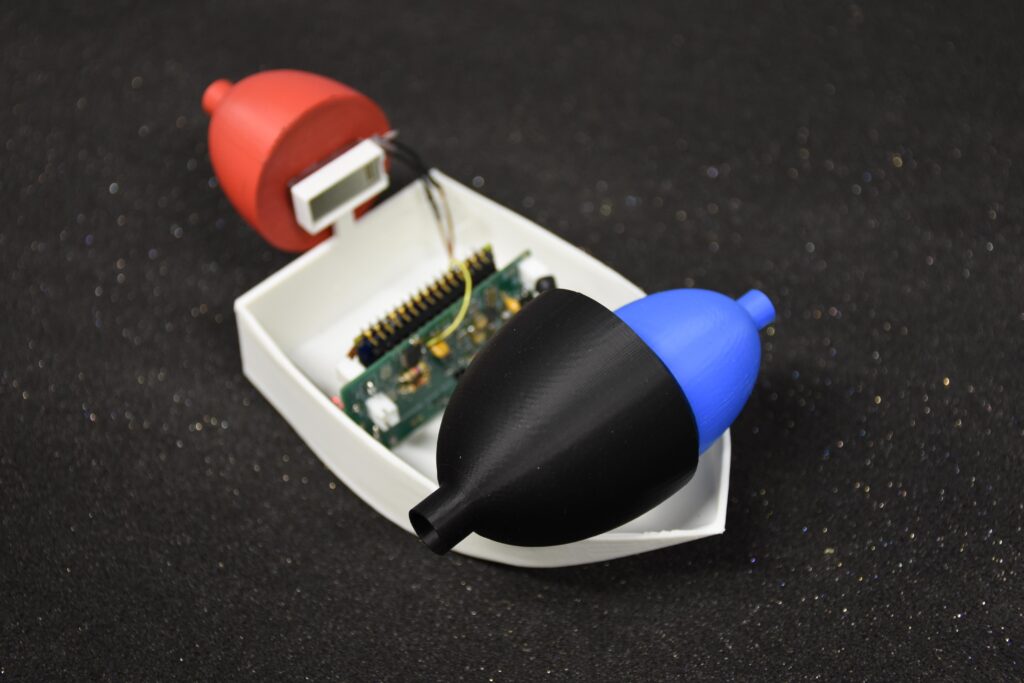 The MICROBS Lab’s sound-powered boat. 2026 EPFL/MICROBS – CC-BY-SA 4.0.
While previous approaches have used sound waves to levitate passive objects mid-air, the EPFL team designed devices that convert sound into their own propulsive force. Their innovation lies in the fabrication of hollow round or bell-shaped structures called cavities.
When sound waves excite the air inside these cavities, the oscillating air is forced out as a concentrated jet, while the incoming airflow is more diffuse. This imbalance generates thrust that can propel small vehicles. These sound-powered cavities can be made from a variety of materials, including common 3D-printing plastics, rubber-like polymers, and glass.
 The MICROBS Lab’s microflier. 2026 EPFL/MICROBS – CC-BY-SA 4.0.
At the centimeter scale, the team built miniature boats equipped with up to three cavities, each tuned to a different audible frequency and positioned to push the boat in a particular direction. By changing the frequency of sound waves from a speaker, the researchers could selectively activate different cavities to move the boats, steer them around obstacles, and even program them for autonomous navigation.
Using a 3D nanoprinting technique, the team built ‘microfliers’: ultralight flying vehicles with three microscopic cavities integrated directly into their polymer structures. In contrast to the boats, the microfliers were powered at ultrasonic frequencies inaudible to the human ear. One design weighing just 150 micrograms used its cavities to generate direct upward thrust like a rocket. Another microflier combined the cavities with tiny blades, which spun at speeds of up to 13,000 revolutions per minute, to generate stable, helicopter-like aerodynamic lift.
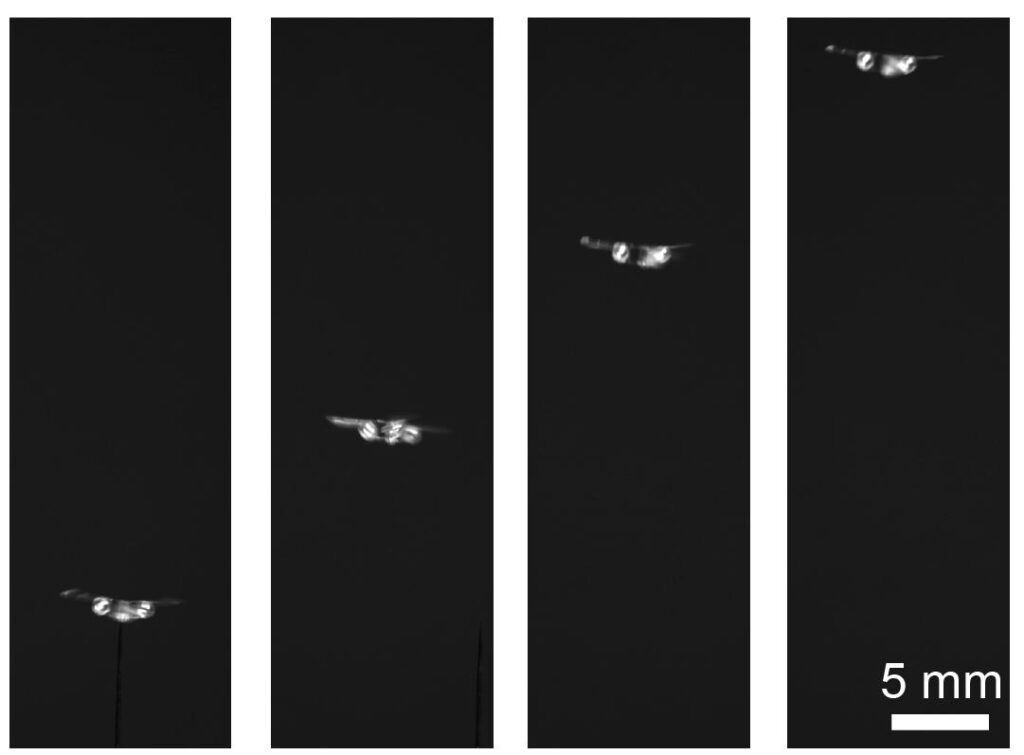 A microflier in flight. 2026 EPFL/MICROBS – CC-BY-SA 4.0.
Because the devices rely on hollow cavities rather than motors, gears, or magnetic components, they can be made extremely small and lightweight using a variety of 3D-printing methods.
“Our concept is compatible with even further miniaturization, enabling advanced designs that push the boundaries of robotics and aeronautics,” says first author and MICROBS Lab PhD student Junsun Hwang.
Sakar adds that in the future, several sound-responsive structures could be built into a single flexible device, with each one reacting to a different sound frequency. “This would allow specific parts of the device to move, bend or vibrate, potentially leading to aerodynamic robotic devices that can change shape in response to sound,” he says.
Acoustic resonators as wireless actuators in air for small-scale robots, Junsun Hwang et al., Science Advances (2026).
New Chinese AI – free for download – can be run on a consumer-grade laptop and is rated nearly as powerful as ChatGPT and similar ‘bleeding edge’ AI.

The development represents an incredible breakthrough for writers – many of whom are looking for AI that writes much more creatively than the currently bland, ‘corporate voice,’ cloud-based offerings like ChatGPT, Gemini and Claude.
Dubbed Qwen 3.8-27B, the new Open Source AI can be downloaded and run for free on a laptop that sports as little as 17GB RAM.
Essentially, writers with powerful laptops can try-out Qwen using their favorite prompts for creative writing – and then decide if Qwen makes the grade.
The long-term bonus: Even if this version of Qwen is not creative enough for you, the mere fact that AI of such power can now be run on a consumer-grade laptop indicates similarly powerful Open Source AI from other developers will soon be coming to powerful laptops.
Even better: Offering a highly creative writing alternative to corporate-voice AI is already child’s play for many AI developers.
The reason: ChatGPT-4o, released way back in May 2024 — but ‘retired’ by maker OpenAI in favor of AI that writes in a bland voice — is considered the pinnacle of AI creative writing by many writers.
Achieving that level of AI – available since May 2024 – is something most competitive, Open Source AI makers these days can whip-up in their sleep.
Bottom line: If you’re looking to download and try this version of Qwen on your laptop or similar, check-out LM Studio. Even if you’re a novice, you should be able to download the AI and get it running on your computer with just a bit of effort.
In other news and analysis on AI writing:
*Google Offers College Students the World Over Free Year of Premium AI: In the Age of AI, there apparently is such a thing as a free lunch.
Google has announced college students in 140 markets worldwide are eligible for free access to its premium AI for a year.
U.S. students get the best deal – 12 months of access to Google AI Pro – while students in other countries get free access to the less generous Google AI Plus.
*‘ChatGPT for Teens’ Rolls-Out: Responding to parental concerns that ChatGPT may be too intense for teenagers, maker OpenAI now has a special teen version of its AI.
Observes writer Cecilia Kang: “The chatbot will limit high-risk conversations that involve self-harm, violence, eating disorders and explicit sexual and graphic content.
“In some cases, ChatGPT will alert adults who have opted-in to parental controls and notifications. And the mode will strengthen protections that prevent the chatbot from suggesting it has personal feelings.”
*Now You Can Add Your Favorite News Sources to Google Search: Writers and others who use Google Search regularly can now instruct the tool to seek out their favorite news source on any search.
Dubbed ‘Preferred Sources,’ the new feature works when you look for a topic in the news, click on the ‘Top Stories’ icon, search for preferred news sources — then select the sources you want.
Observes writer Duncan Osborn: “Once you select your sources, they will appear more frequently in Top Stories or in a dedicated ‘From your sources’ section on the search results page.”
*Google Now Auto-Transcribes Face-to-Face Meetings: Gemini-powered Google Meet is now able to record, transcribe and summarize the kind of meetings people used to have before nternet, video cameras and Zoom became a thing.
Observes TechRepublic: “Gemini turns the conversation into a Google Doc, with a summary and action items.”
One caveat: The AI-generated summaries may not be entirely accurate.
*Google’s Open Source AI Passes One Billion Downloads: Google’s answer to free Chinese AI – Gemma – has been downloaded more than a billion times.
Equally eyebrow-raising: More than 100,000 versions of Gemma have been created by AI developers, who have tweaked the free-to-use AI to their personal specifications.
Not bad — but no cigar.
According to writer Ana Maria Constantin, a Chinese competitor to Google says its Qwen Open Source AI has been downloaded three billion times.
Ouch.
*Social Network Reddit Auto-Converting Text Posts to Videos: Reddit – known as the social network for thinking people – is testing the idea of transforming some posts on the network into YouTube-like videos.
Observes writer Amanda Yeo: “The feature hopes to capitalize on the popularity of videos that read Reddit posts aloud.
“The original text posts and comments will still be available in their usual format, allowing you to choose whether to read or listen to the content.”
*Nvidia Earmarks $6 Billion to Combat Chinese AI: Powerhouse AI chipmaker NVidia plans to drop $6 billion to develop Open Source AI to compete with similar AI made in China.
Ever since the advent of Chinese Open Source AI DeepSeek, the U.S. has been wary of the Open Source AI genre, which is free for download, free to use — and nearly as good as ‘bleeding edge’ U.S. AI.
Observes writer Robbie Whelan: “The failure of U.S. AI labs to give priority to open-source models has created concerns that businesses and countries around the world will turn to Chinese open-weight models instead.”
*U.S. to Allies: Choose Between U.S. AI – or Chinese AI – Now: In yet another indication of the gravity of who ultimately controls AI, the Trump Administration will soon ask 35 allies to choose between using its U.S. AI ecosystem – or its Chinese competitor.
Observes writer Ana-Maria Stanciuc: “Belonging to both is no longer an option.
“Roughly two dozen nations have joined so far, including Japan, Australia and South Korea.”
*AI Big Picture: ChatGPT-Maker Launches New Blog, ‘AI Futures:’ OpenAI is out with a new blog focusing exclusively on how a free society should adapt to the advent of AI.
Observes writer Dean Ball: “The structural challenge posed by advanced machine intelligence to free society is likely not the most radical decentralization of power imaginable.
“Instead, it is seeking to establish and preserve the right balance of power, such that no single actor, or small set of actors, can dominate the rest.”

Share a Link: Please consider sharing a link to https://RobotWritersAI.com from your blog, social media post, publication or emails. More links leading to RobotWritersAI.com helps everyone interested in AI-generated writing.

–Joe Dysart is editor of RobotWritersAI.com and a tech journalist with 20+ years experience. His work has appeared in 150+ publications, including The New York Times and the Financial Times of London.
The post Killer AI Comes to The Laptop appeared first on Robot Writers AI.