Beyond tree cover: mapping the world’s forest types
A global map categorizing every 10-meter patch of land on Earth into distinct forest types.
What happens when the infrastructure your entire AI stack runs on becomes a liability? Not because it failed but because the politics around it changed.
For a growing number of enterprises, this isn’t hypothetical. Regulatory requirements are tightening. Data residency rules are multiplying. Governments are intervening in which AI tools can be deployed, by whom, and where.
And organizations that built their AI operations entirely on a single cloud provider’s platform are discovering a hard truth: they can use the tools, but they can’t guarantee they’ll keep using them. They can run workloads in a provider’s sovereign region, but they can’t separate the software from the provider who owns it.
It’s access on someone else’s terms, subject to someone else’s jurisdiction.
Most enterprises evaluating sovereign AI ask whether their cloud provider has a sovereign region. That’s a starting point. But the question that actually reveals your exposure: can your AI software run on infrastructure you fully control, with no dependency on the vendor’s cloud?
Cloud providers have responded by standing up sovereign regions: data centers in specific countries where data stays local and falls under local jurisdiction. It’s becoming table stakes, commoditizing fast as hyperscalers race to plant flags in regulated markets.
For a narrow definition of sovereignty, that may be enough.
But the enterprises facing the hardest sovereignty requirements are asking different questions.
Sovereign cloud regions can’t answer those questions. A sovereign region still runs on the cloud provider’s infrastructure, governed by their software, subject to their jurisdiction. Moving to a sovereign region changes where the data sits. It doesn’t change who controls the software stack above it.
Sovereignty is a spectrum. At the lowest level, the requirement is straightforward: data stays in a specific geography. A cloud provider’s regional data center handles that. Most enterprises stop here and assume they’re covered.
But sovereignty requirements escalate. The next level asks whether the organization can operate independently of the provider. No third-country interference. No dependency on a vendor’s network, model registry, or update infrastructure. Above that, the question becomes whether any single vendor controls the software, the supply chain, or the AI system’s operational continuity.
Many enterprises, when they honestly assess where they sit on this spectrum, find themselves at the bottom. Data is in the right country, but the AI software still runs on a vendor’s platform, governed by that vendor’s infrastructure and update cycle. Operational continuity depends on that vendor’s continued access to the market.
The gap between where most enterprises are and where regulated industries need to be is architectural. The AI software is engineered to run on the provider’s cloud, and sovereign regions are a patch applied to that architecture: they extend reach without changing the dependency.
There are two fundamentally different ways to build an AI software platform.
The fused architecture is what hyperscalers build and sell. The AI software, the models, the governance tooling, the agents: all of it is built into the provider’s platform. Some of it now runs on-premises or even air-gapped, but only on the provider’s own hardware stack, with the provider’s models and a curated subset of services. Wherever it runs, the software above the infrastructure line still belongs to the provider.
The decoupled architecture separates the AI software layer from the infrastructure entirely. The platform (agents, governance, MLOps, model registry) runs as a portable layer that drops onto whatever infrastructure the enterprise controls. On-premise. Air-gapped. A virtual private cloud. A partner’s hardware. The same platform and the same governance run in every environment.
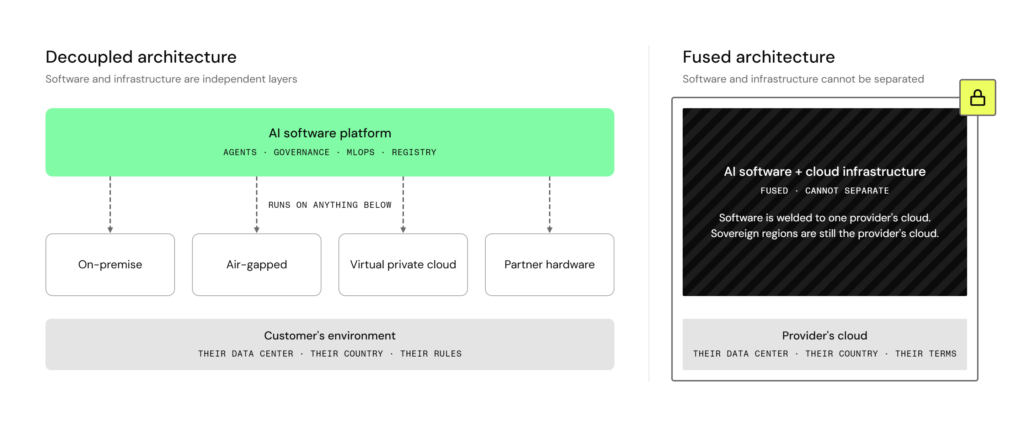
At the bottom of the spectrum, where the requirement is data residency, both architectures compete.
As sovereignty requirements escalate toward operational independence and full supply chain control, only the decoupled architecture qualifies. The fused architecture hits a structural ceiling it can’t engineer its way past.
One of the most persistent misconceptions about sovereign AI is that it’s a public-sector concern. Government contracts, defense procurement, regulatory compliance. While these are very real sovereignty use cases, they’re also a fraction of the exposure.
Any enterprise that has built workflows, products, and operational dependencies on a single provider’s platform has a concentration risk. If anything disrupts that provider relationship, whether regulatory, geopolitical, or commercial, the enterprise has no ability to respond independently.
That’s a business continuity issue, and it belongs in the same conversation as supply chain resilience and operational redundancy.
The economics point in the same direction. At sustained inference volumes, owned or dedicated GPUs often cost less than on-demand cloud capacity. Sovereignty and cost efficiency are converging on the same answer: run AI on infrastructure you control.
Every enterprise runs on some mix of cloud, on-premise, and hybrid infrastructure. An AI platform that can move across all of them, without rebuilding governance or renegotiating vendor relationships, is both a sovereignty property and a business resilience property.
Most vendor conversations about sovereign AI focus on geography: which regions, which data centers, which countries. That tells you where the data sits. It tells you nothing about the architecture above it.
Two questions cut through that:
The answers will separate vendors whose AI software is portable from vendors who have bolted sovereign features onto a cloud-dependent platform. The difference becomes obvious fast.
Sovereign AI at the levels that matter for regulated enterprises is an architectural property of the software. The platform can either run independently of any single infrastructure provider, or it can’t. No amount of sovereign regions changes that.
A decoupled platform runs on infrastructure the enterprise already owns or selects independently. The platform is designed to stay the same when the infrastructure underneath changes. That’s the difference between a platform you depend on and a platform that works for you.
For organizations in energy, manufacturing, defense, and any enterprise whose sovereignty requirements extend beyond data residency, the honest assessment is that a fused cloud platform has a ceiling. A decoupled architecture doesn’t.
(CTA) The architecture decision you make today locks in your operational control for the next decade. The enterprise agentic AI architecture framework covers the governance, deployment, and runtime decisions that determine how much control your organization retains.
The post Sovereign AI is an architecture decision appeared first on DataRobot.

Nominations are solicited for the 2027 ACM SIGAI Autonomous Agents Research Award. This award is made for excellence in research in the area of autonomous agents. It is intended to recognize researchers in autonomous agents whose current work is an important influence on the field. The award is an official ACM award, funded by an endowment created by ACM SIGAI from the proceeds of previous Autonomous Agents conferences. The recipient of the award will receive a monetary prize and a certificate, and will be invited to present a plenary talk at the AAMAS 2027 conference.
Anyone can make a nomination. Nominations should be made by filling out this google form, and should consist of a short (< 1 page) statement that emphasizes not only the research contributions that the individual has made that merit the award but also how the individual’s current work is an important influence on the field.
Note: a candidate can only be considered for the award if they are explicitly nominated. If you believe that someone deserves the award, then nominate them – don’t assume that somebody else will!
Nomination link is here.
5 December 2026 – Deadline for nominations
1 February 2027 – Announcement of winner
3-7 May 2027 – AAMAS-2027 conference in Hanoi, Vietnam
For any questions please contact Sven Koenig (Award Chair) or Louise Dennis (SIGAI Vice Chair).
The use cases of Artificial Intelligence (AI) in the healthcare sector, especially in the pharma and biomedicine field, are gaining momentum.
Herein, we would like to go beyond the AI trends that exist in this ever-growing healthcare sector & benefits of artificial intelligence in pharmaceutical industry. Let’s start!
In our research, we found that approximately 50% of global healthcare companies will implement AI strategies and broadly adopt the technology by 2025. In particular, global pharma, drug development, and biomedicine companies will invest more in discovering new drugs for chronic and oncology diseases.
Biomedicine companies are adopting AI and its tools for conducting accurate laboratory and scientific tests and predicting the right diagnosis and treatment of disease. By automatically deriving patterns into various oncology diseases, AI use cases in pharma and biomedicine ensure wide opportunities and make workflows faster and more efficient.
In this article, we aimed at clearing the doubts that most healthcare business leaders have in mind such as-
Now, we will directly move into our topic “how top pharma companies (like Johnson & Johnson, Roche, Pfizer, Bayer, and Novartis, etc.) are implementing AI applications.
I hope this article would help pharma companies to know how AI help them in generating increased RoI.
Johnson & Johnson (J&J) has started implementing AI since 2015 after the collaboration with IBM’s Watson Health. IBM Watson is an AI-powered cloud system designed to process enormous amounts of healthcare data. It provides proof-based responses to professionals in natural language.
At present, the company is striving to put its total efforts to combine expertise and the power of AI and ML to come up with new drugs, treatments, and surgical methods.
It is a novel application of artificial intelligence in pharma and biomedicine. It is a trending role of AI in the pharma and medical field.
J&J has created a joint venture- Verb Surgical, in partnership with Google Verily in 2015 to develop AI and ML-powered surgical robots to perform minimally invasive medical surgeries. Still, research works ongoing on Verb’s robots and is expected to come into the market by the end of 2020.
Artificial intelligence in drug discovery is another significant Pharma use cases. The benefits of AI in pharma and biomedicine are not limited to robotic surgery and pattern recognition, drug discovery, design, and development are a few key roles of AI in pharma and biomedicine.
To remain competitive in this digital world, J&J continuing to merge its expertise and intelligent AI strategies to bring outstanding drugs and surgical solutions into the market.
The company is investing heavily in developing precision medicine. Using the capabilities of AI and machine learning technologies, the company is aiming to provide more personalized healthcare services to patients based on their genetic profiles. Hence, this will help to improve patient outcomes and reduce healthcare costs.
Click here to know how to implement and use Artificial intelligence in drug discovery and AI costs.
It is the best RPA use cases in pharma. RPA-Robotic Process Automation is one of the key technologies of AI and is being used to ensure accuracy in drug development and make clinical development activities faster. The real world use case of RPA in pharma is maintaining quality data, performing rule-based tasks, streamlining processes, and generating compliance-safety medical and clinical reports.
Get more information of RPA use cases in pharma and development cost of RPA software applications for healthcare!
[contact-form-7]AI for treating Alzheimer’s disease is the best application of artificial intelligence in pharma and biomedicine. We can say that it is the best AI use cases in pharma. In collaboration with WinterLight Labs, J&J reaps the benefits of an AI platform to monitor neuropsychological details to treat Alzheimer’s.
WinterLight’s speech-based smart AI platform can detect, understand, and record hundreds of measurable variables from a patient’s natural language. So that the automatic analysis of Alzheimer’s can be detected.
In addition to these, J&J continues to invest in existing digital initiatives to grab digital opportunities. For instance: J&J uses IoT to monitor product distribution, and their interaction with patients seamlessly.
By integrating IoT sensors into medical devices such as lenses and artificial joint replacement products, J&J was in plans to advance the clinical monitoring process of patients after surgeries.
If you’re ready to find a challenging business with AI, We’d love to meet you. CONTACT US to know more about the use cases of AI that help Pharma companies.
These are top pharma use cases on which J&J is spending more investments to remain competitive. Every application of artificial intelligence in pharma and biomedicine will offer the best results to organizations. Implementation of all the above-listed top AI use cases in pharma and biomedicine will streamline operations, increase the level of automation, and make processes smoother, faster, and more efficient.
One of the key roles of AI in pharma and biomedicine is to automate the regular tasks of admin. Starting from records maintenance and recording novel drug data to clinical trials data and FDA approval copies, everything can be stored automatically using AI apps without errors.
Roche Holding AG is one of the global largest pharmaceutical and diagnostic companies. For the past few years, it is spreading announcements regarding how it is using AI technology to enhance its drug development operations rapidly.
Recently, in 2018, it acquired Flatiron Health. Flatiron Health is engaged in maintaining a vast amount of oncology data. This collaboration helped Roche to feed its ML systems for efficiently analyzing oncology disorders with more accuracy.
Later, in 2019, the company together with its subsidiary Genentech also started a predictive analytics project to better predict which diabetic retinopathy patients.
Likewise, Roche collaborated with IBM and Sensyne Health to use AI for predicting chronic kidney diseases and for performing clinical trials respectively.

Pfizer, America’s one of biggest multinational drug development organizations, in partnership with IBM, is rushing to fully catch up with AI technology. With the help of the cloud-based platform, IBM Watson, Pfizer is targeting on getting millions of medical data to early detect and find novel therapies for cancers.
In a research collaboration with IBM, Novartis has to spread its arms into AI to get the best outcomes and efficiently finding treatment options for breast cancers.
Using the real-time data provided by IBM’s cloud-based platform, Watson the company is deriving valuable insights related to the efficient outcomes of breast cancer treatment.
This biggest pharma company is highly investing in emerging technologies like AI and ML to discover novel drugs for cancer and other life-threatening disorders.
As of media reports, in January 2020, the company has made a research collaboration agreement with the Exscientia to come up with the innovative drugs for cancer and cardiovascular diseases.
The company believes that the innovative AI technology can improve quality and size and reduce developing costs too. Hence, the company continues to invest in AI to achieve fast discovery and development of drugs.
Just think, these pharma and biomedicine companies are already proved their strength in the global drug development industry. Then, why they are investing in AI technology or artificial intelligence in pharmaceutical manufacturing?
The simple answer is that they are trying to become more competitive and advanced in the industry. Then, why don’t you invest in AI? If not yet invested to make your processes seamless and efficient.
USM, the best AI services provider in the USA, stand beside pharma, biomedicine, and healthcare companies to transform and make their operations smart and efficient.
Get in touch to get your AI development quote now!
[contact-form-7] MIT engineers developed a soft robot that can flap through water in response to flashes of light. Photo credit: Melanie Gonick, MIT.
By Jennifer Chu
Swimming can take a lot of muscle. But as MIT engineers have found, even a single layer of muscle cells can power through water if designed right.
In a paper appearing today in the journal Advanced Functional Materials, the team presents a design for a thin, muscle-powered swimming robot. The “skeleton” of the aquabot is made from a film of gel that is about the length and width of a stick of gum. The two halves of the gel form the “fins” of the bot. Each fin is covered with a layer of live muscle cells that is much thinner than a single strand of hair. The cells are genetically engineered to twitch in response to light.
When the researchers shine light on one fin, the muscles on its surface twitch in response, causing the whole fin to flap with enough force to pull the robot through water. By flashing light on one fin or the other, at various intervals, they can control the swimming robot’s direction and speed.
The engineers showed that the paper-thin bot could swim and swivel through a simple watery maze. At its fastest, the robot can swim a distance of about four times its body length in one minute. That’s a snail’s pace compared to Olympic swimmers, who can cover up to 65 body lengths per minute. But the bot could hold its own against more leisurely swimmers like the cow shark, which explores the ocean at about the same rate.
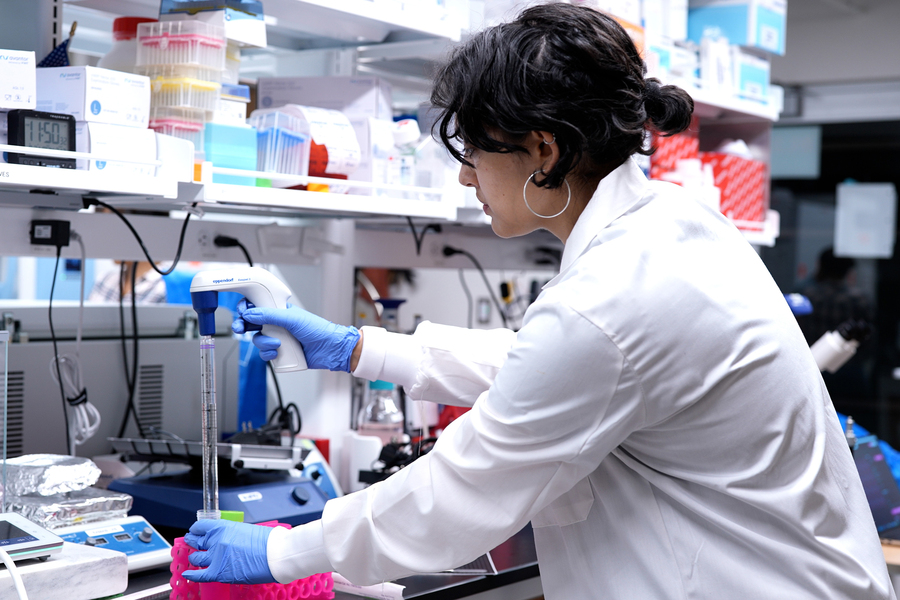 In their new work, the team Raman Lab aimed to maximize muscle movements to produce more force — enough, say, to power a swimming robot. Pictured is Maheera Bawa, a graduate student at Raman Lab. Photo credit: Melanie Gonick, MIT.
“It takes a lot of force to move through water versus air,” says study author Ritu Raman, associate professor of mechanical engineering at MIT. “The robot’s quite strong, given its size.”
The new robot is the first example of a very thin, two-dimensional, muscle-powered robot capable of locomotion.
“Currently, biohybrid robots from our group and others’ are built from bulky, 3D chunks of lab-grown skeletal muscle that require millions of cells to fabricate,” says Raman, who notes that thinner, less bulky designs such as the team’s new bot could be cheaper to build and could move more efficiently. “We believe that biohybrid robots powered by living muscle could one day perform delicate jobs like exploring environments too fragile or unpredictable for conventional hardware, because living tissue is soft, responsive to its surroundings, and can heal itself.”
The study’s MIT co-authors are first author Maheera Bawa, Arielle Berman, Laura Schwendeman, Ferdows Afghah, and Seanbiron Johnson.
Maximizing movement
Last year, Raman’s group developed an iris-inspired disk of artificial muscle tissue. They stamped a disk of gel with a pattern of concentric and radial grooves, and deposited live muscle cells onto the gel’s surface. The cells formed a thin layer that grew along the grooves, and when stimulated with light, the cells moved in patterns that stretched and squeezed the disk, similar to how a human iris dilates and constricts the eye’s pupil.
That work was the first to demonstrate that muscle cells could be grown in a very thin layer, and in complex patterns that when stimulated could move in multiple, controllable directions.
“People hadn’t seen this muscle architecture engineered from scratch before,” Raman says. “And the cells were moving in multiple directions. But they only moved about 100 microns. From a robotics perspective, their movements were tiny.”
In their new work, the team aimed to maximize muscle movements to produce more force — enough, say, to power a swimming robot. The key, they found, was to optimize the skeleton on which the cells grow.
In their previous iris-inspired design, they grew muscle cells on fibrin, which is a type of ultrasoft gel that the team realized can quickly shrivel in response to the forces generated by the muscles. To better support cells and maximize their force, the researchers focused on tuning the underlying gel by changing three properties: the gel’s composition, its stiffness, and the size and shape of the grooves that are stamped into it.
“For engineering any type of tissue, it’s known that these are knobs you can tune,” Raman says. “And we wanted to optimize all these parameters to support live muscle cells.”
Tuning a skeleton
To find an optimal “skeleton” on which to grow muscle cells, the team experimented with multiple formulations of gel, of different stiffnesses, and stamped with grooves of different geometries. For instance, one groove type resembled a skinny square trough, where another was more of a long curved valley. They found that when they deposited muscles onto each type of grooved gel, cells settled into alignment in grooves that were more square than curved. More aligned cells tend to fuse into fibers that then form a stronger, more coordinated muscle tissue. Square grooves, they found, were the way to go.
Instead of using fibrin, they tried gelatin methacrylate (GelMA), a material that is often used in tissue engineering. They made different recipes of GelMA to create skeletons of different stiffnesses and observed how muscle cells grew when deposited on the gel’s surface. They found that cells grew in better alignment, and produced the most force, on stiffer gels.
The team also varied the gel thickness and found that a half-millimeter-thin film of GelMa offered good support for a single layer of muscle cells. The film was light enough that the cells were able to stick to the gel when they contracted, rather than peeling away.
Finally, the team “exercised” the muscles, using a training routine of flashing lights to strengthen the muscles.
With the pumped-up cells and the optimized gel, the team designed a thin, two-finned robot, comprising the gel, stamped on both sides with square-bottomed grooves and lined with muscle cells. The cells fused into fibers, eventually forming a strong, aligned muscle tissue.
“You can think of the robot as having two independent muscles,” Raman says. “If we shine a light on just one, only that muscle moves. If shining on both, they both flap.”
The researchers submerged the robot in a large petri dish of water and manually maneuvered a light source over the bot. The robot followed the light, flapping its fins in response to navigate through a maze that the team placed in the dish.
The current design is relatively basic as far as its form. The researchers intended first to show that the bot could produce enough force to swim.
“Our next goal is to optimize the body design to enable faster swimming,” Raman says. “But even at slow swim speeds, one could imagine a muscle-powered swimmer being used for purposes like environmental monitoring in aquatic environments.”
This research was supported, in part, by the Office of Naval Research.

Claude’s maker – Anthropic – just announced that users who persist in extreme, repeated conversational abuse of Claude will find those chats ended abruptly.
Effective November 12, the new policy reflects Anthropic’s growing migration towards viewing AI as having a sense of self – which has included discussions with religious scholars.
In other news and analysis on AI writing:
*Getting Claude to Write in Your Voice: AI Marketing, Actually recommends adding three simple files to Claude to ensure it writes exactly the way you prefer – ‘about me,’ ‘about my company’ and ‘about my writing style.’
Simply stash all three files in a folder you create for Claude – then direct the AI to consult those files every time it writes something for you.
Click to this excellent step-by-step for the full primer.
*Now You Can Access Word Within MS Copilot: Microsoft just embedded access to Word inside its AI agent Copilot so you can do your writing there without ever leaving the AI agent interface.
Essentially: You can now open, edit and share MS Word documents from within the Copilot app as you work.
Bonus: Writers who use PowerPoint and/or Excel will find those apps have the same, easy accessibility now, too.
*406 Scientists: Pull All AI From the Internet, Now: In a head-turning move, 406 scientists have signed an open letter demanding that all AI models – including ChatGPT, Gemini and Claude – be removed from the Internet immediately.
Included among the signatories are some of the most prominent researchers in AI, including Geoffrey Hinton – known as the Godfather of AI — Yoshua Bengio and Stuart Russell.
Observes writer Matthias Bastian: “They demand that companies fully disconnect their AI models from the internet through air-gapping.”
*New AI Automates Interviewing and Reporting: Underheard has a new app that auto-interviews customers for qualitative feedback — then packages the results as a quick conversation or in-depth research study.
Dubbed AI Interviewer, the tool is used by simply describing what you’re looking for from an interview.
AI Interviewer does the rest, designing the actual interview, interacting with interview subjects and then putting together the written analysis.
You know, kinda like what journalists do.
*Muse Wonder: Ready to Take On ChatGPT et al?: Writer Will Knight concludes that Muse Wonder – some of the latest AI from Facebook parent Meta – has re-established Meta as a serious competitor in bleeding edge AI.
Case in point: Muse Wonder is nearly as good as Anthropic’s most advanced AI and actually bests the best and brightest AI from OpenAI – GPT -6 Astra, according to Knight.
Observes Knight: “Muse Wonder also includes two novel features designed to help make agents more effective and less inclined to misbehave. The new features — called Active Memory and Active Focus — are designed to keep the model locked into a stated goal and prevent it from becoming confused.”
*Add Phoenix Cops to the Growing List of Law Enforcement Using AI: Like many police departments these days, Phoenix cops are leaning on AI to draft the incident reports they used to write by hand.
Writer Kevin Stone reports Phoenix cops are using Axon Draft One, which puts together incident reports based on audio that’s captured by on-body cameras worn by the police.
Observes Stone: “Officers are required to review and correct the AI-generated reports before submitting them.”
*New App Double-Checks AI-Generated Legal Writing: CiteProof has a new tool that double-checks legal briefs generated by AI.
Observes writer Brandon Vigliarolo: The app “promises to crawl over briefs and filings for fabricated case citations and misquoted court opinions before they result in sanctions, fines — or just plain embarrassing dressing-downs from a judge.”
*Look for a New Insurance Bill Just to Cover Your AI Use: Disturbed by reports of AI agents going rogue, increasing numbers of insurers are either refusing to insure AI-related incidents – or offering AI-gone-wild protection as separate insurance handled by specialists.
Observes writer Flavia Moura: “Your (general) business insurance never priced AI.
“Now it’s writing it out.”
*AI Big Picture: Nvidia: Top AI Chipmaker Now ‘Too Big To Fail?:” Wall Street darling Nvidia – the number one maker of AI chips currently powering most of AI across the planet – is now too valuable to go under.
Observes Liz Hoffman, senior business editor, Semafor: “Nvidia has become AI’s bank and security blanket, a one-stop shop for financial and emotional reinforcement.
“Setting aside the numbers, a company is too big to fail when the answer to ‘would the government step in to save it?’ is yes.”

Share a Link: Please consider sharing a link to https://RobotWritersAI.com from your blog, social media post, publication or emails. More links leading to RobotWritersAI.com helps everyone interested in AI-generated writing.

–Joe Dysart is editor of RobotWritersAI.com and a tech journalist with 20+ years experience. His work has appeared in 150+ publications, including The New York Times and the Financial Times of London.
The post AI to World: Hey — I Have Feelings, Too appeared first on Robot Writers AI.