Category Robotics Classification

Page 18 of 601
1 16 17 18 19 20 601

The Blue Screen of Death for Windows: Why AI is the Last Operating System You’ll Ever Need

For decades, the personal computer has been the center of our digital universe, with Windows acting as the undisputed sun. But as we move into 2026, a gravitational shift is occurring. The rise of Generative AI and autonomous agents isn’t […]

The post The Blue Screen of Death for Windows: Why AI is the Last Operating System You’ll Ever Need appeared first on TechSpective.

Shapeshifting materials could power next generation of soft robots

McGill University engineers have developed new ultra-thin materials that can be programmed to move, fold and reshape themselves, much like animated origami. They open the door to softer, safer and more adaptable robots that could be used in medical tools that gently move inside the body, wearable devices that change shape on the skin or smart packaging that reacts to its environment.

Aerospace’s Automation Breakthrough: How Robotics and AI Orchestration Are Rewriting the Supply Chain

For aerospace, the next leap will come from integrating physical automation with AI systems capable of coordinating the flow of information across complex, multi-vendor, secure environments that protect confidential information all while transforming efficiency..

Robot Talk Episode 141 – Our relationship with robot swarms, with Razanne Abu-Aisheh

Claire chatted to Razanne Abu-Aisheh from the University of Bristol about how people feel about interacting with robot swarms.

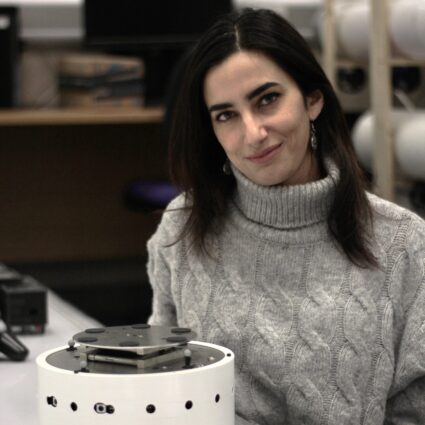
Razanne Abu-Aisheh is a Senior Research Associate in the Centre for Sociodigital Futures at the University of Bristol. Her work explores how people interact with robot swarms, with a focus on how collective robot behaviours influence human perception. In her current research, she collaborates with communities to imagine more inclusive and meaningful futures with robotics, working towards community-centred design. Her broader interests include bringing robot swarms into real-world settings and designing them with people in mind.

Vine-inspired robotic gripper gently lifts heavy and fragile objects

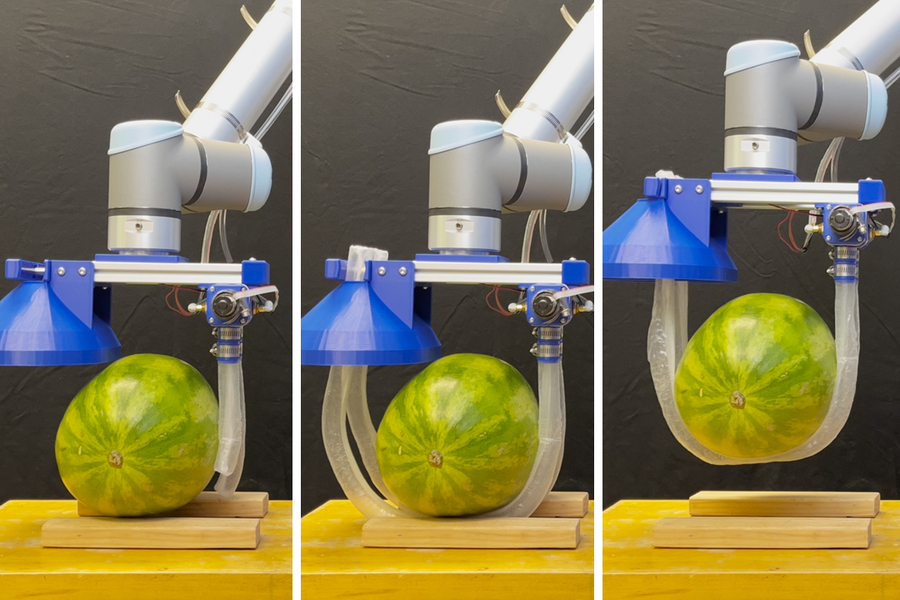
The researchers demonstrated that the vine robot can safely and stably lift a variety of heavy and fragile objects, like a watermelon. Image credit: Courtesy of the researchers

By Jennifer Chu

In the horticultural world, some vines are especially grabby. As they grow, the woody tendrils can wrap around obstacles with enough force to pull down entire fences and trees.

Inspired by vines’ twisty tenacity, engineers at MIT and Stanford University have developed a robotic gripper that can snake around and lift a variety of objects, including a glass vase and a watermelon, offering a gentler approach compared to conventional gripper designs. A larger version of the robo-tendrils can also safely lift a human out of bed.

The new bot consists of a pressurized box, positioned near the target object, from which long, vine-like tubes inflate and grow, like socks being turned inside out. As they extend, the vines twist and coil around the object before continuing back toward the box, where they are automatically clamped in place and mechanically wound back up to gently lift the object in a soft, sling-like grasp.

The researchers demonstrated that the vine robot can safely and stably lift a variety of heavy and fragile objects. The robot can also squeeze through tight quarters and push through clutter to reach and grasp a desired object.

The team envisions that this type of robot gripper could be used in a wide range of scenarios, from agricultural harvesting to loading and unloading heavy cargo. In the near term, the group is exploring applications in eldercare settings, where soft inflatable robotic vines could help to gently lift a person out of bed.

“Transferring a person out of bed is one of the most physically strenuous tasks that a caregiver carries out,” says Kentaro Barhydt, a PhD candidate in MIT’s Department of Mechanical Engineering. “This kind of robot can help relieve the caretaker, and can be gentler and more comfortable for the patient.”

Barhydt, along with his co-first author from Stanford, O. Godson Osele, and their colleagues, present the new robotic design in the journal Science Advances. The study’s co-authors are Harry Asada, the Ford Professor of Engineering at MIT, and Allison Okamura, the Richard W. Weiland Professor of Engineering at Stanford University, along with Sreela Kodali and Cosmia du Pasquier at Stanford University, and former MIT graduate student Chase Hartquist, now at the University of Florida, Gainesville.

Open and closed
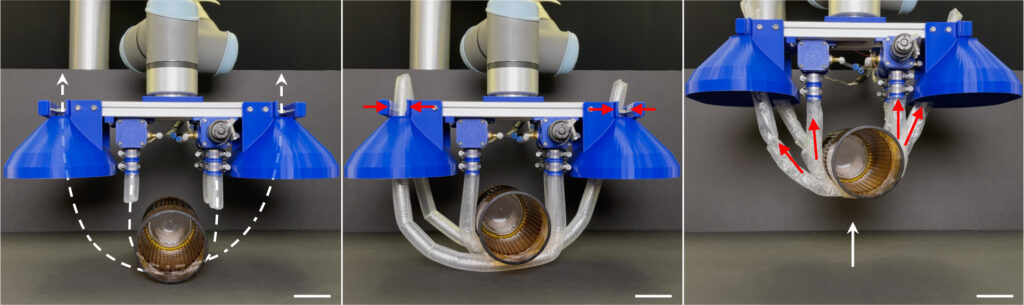
As they extend, the vines twist and coil around the object before continuing back toward the box, where they are automatically clamped in place and mechanically wound back up to gently lift the object in a soft, sling-like grasp. Image credit: Courtesy of the researchers.

The team’s Stanford collaborators, led by Okamura, pioneered the development of soft, vine-inspired robots that grow outward from their tips. These designs are largely built from thin yet sturdy pneumatic tubes that grow and inflate with controlled air pressure. As they grow, the tubes can twist, bend, and snake their way through the environment, and squeeze through tight and cluttered spaces.

Researchers have mostly explored vine robots for use in safety inspections and search and rescue operations. But at MIT, Barhydt and Asada, whose group has developed robotic aides for the elderly, wondered whether such vine-inspired robots could address certain challenges in eldercare — specifically, the challenge of safely lifting a person out of bed. Often in nursing and rehabilitation settings, this transfer process is done with a patient lift, operated by a caretaker who must first physically move a patient onto their side, then back onto a hammock-like sheet. The caretaker straps the sheet around the patient and hooks it onto the mechanical lift, which then can gently hoist the patient out of bed, similar to suspending a hammock or sling.

The MIT and Stanford team imagined that as an alternative, a vine-like robot could gently snake under and around a patient to create its own sort of sling, without a caretaker having to physically maneuver the patient. But in order to lift the sling, the researchers realized they would have to add an element that was missing in existing vine robot designs: Essentially, they would have to close the loop.

Most vine-inspired robots are designed as “open-loop” systems, meaning they act as open-ended strings that can extend and bend in different configurations, but they are not designed to secure themselves to anything to form a closed loop. If a vine robot could be made to transform from an open loop to a closed loop, Barhydt surmised that it could make itself into a sling around the object and pull itself up, along with whatever, or whomever, it might hold.

For their new study, Barhydt, Osele, and their colleagues outline the design for a new vine-inspired robotic gripper that combines both open- and closed-loop actions. In an open-loop configuration, a robotic vine can grow and twist around an object to create a firm grasp. It can even burrow under a human lying on a bed. Once a grasp is made, the vine can continue to grow back toward and attach to its source, creating a closed loop that can then be retracted to retrieve the object.

“People might assume that in order to grab something, you just reach out and grab it,” Barhydt says. “But there are different stages, such as positioning and holding. By transforming between open and closed loops, we can achieve new levels of performance by leveraging the advantages of both forms for their respective stages.”

Gentle suspension

As a demonstration of their new open- and closed-loop concept, the team built a large-scale robotic system designed to safely lift a person up from a bed. The system comprises a set of pressurized boxes attached on either end of an overhead bar. An air pump inside the boxes slowly inflates and unfurls thin vine-like tubes that extend down toward the head and foot of a bed. The air pressure can be controlled to gently work the tubes under and around a person, before stretching back up to their respective boxes. The vines then thread through a clamping mechanism that secures the vines to each box. A winch winds the vines back up toward the boxes, gently lifting the person up in the process.

“Heavy but fragile objects, such as a human body, are difficult to grasp with the robotic hands that are available today,” Asada says. “We have developed a vine-like, growing robot gripper that can wrap around an object and suspend it gently and securely.”

“There’s an entire design space we hope this work inspires our colleagues to continue to explore,” says co-lead author Osele. “I especially look forward to the implications for patient transfer applications in health care.”

“I am very excited about future work to use robots like these for physically assisting people with mobility challenges,” adds co-author Okamura. “Soft robots can be relatively safe, low-cost, and optimally designed for specific human needs, in contrast to other approaches like humanoid robots.”

While the team’s design was motivated by challenges in eldercare, the researchers realized the new design could also be adapted to perform other grasping tasks. In addition to their large-scale system, they have built a smaller version that can attach to a commercial robotic arm. With this version, the team has shown that the vine robot can grasp and lift a variety of heavy and fragile objects, including a watermelon, a glass vase, a kettle bell, a stack of metal rods, and a playground ball. The vines can also snake through a cluttered bin to pull out a desired object.

“We think this kind of robot design can be adapted to many applications,” Barhydt says. “We are also thinking about applying this to heavy industry, and things like automating the operation of cranes at ports and warehouses.”

This work was supported, in part, by the National Science Foundation and the Ford Foundation.
Handy robot can crawl and pick up objects from multiple angles

Like something out of the Addams Family, scientists have created a detachable robotic hand that can crawl and grab objects. The design enables tasks such as retrieving objects beyond normal reach and performing multi-object handling, offering potential applications in industrial, service, and exploratory robotics.

The human brain may work more like AI than anyone expected

Scientists have discovered that the human brain understands spoken language in a way that closely resembles how advanced AI language models work. By tracking brain activity as people listened to a long podcast, researchers found that meaning unfolds step by step—much like the layered processing inside systems such as GPT-style models.

A geometric twist boosts the power of robotic textiles

By rethinking how thin metal threads are woven into a flexible textile, EPFL researchers have created a lightweight fabric capable of lifting over 400 times its own weight. The work advances the development of wearables that provide physical assistance without mechanical bulk.

Stefa Mini Solutions for Next-Generation Robotic Applications

The Stefa Mini, Cassette and Nano Seals all have smaller cross sections than comparable seals in the market today. This matters because a smaller seal allows for smaller glands (the area the seal slips into on the equipment) and smaller glands mean overall smaller equipment.

Unbreakable? Researchers warn quantum computers have serious security flaws

Quantum computers could revolutionize everything from drug discovery to business analytics—but their incredible power also makes them surprisingly vulnerable. New research from Penn State warns that today’s quantum machines are not just futuristic tools, but potential gold mines for hackers. The study reveals that weaknesses can exist not only in software, but deep within the physical hardware itself, where valuable algorithms and sensitive data may be exposed.

The Impact Of Virtual Reality On The Real Estate Industry

The Impact Of Virtual Reality On The Real Estate Industry

The state of Virtual Reality (VR) and Augmented Reality (AR) technologies in today’s real estate and gaming industry is booming. Besides, the entertainment industry is witnessing tremendous advantages using AR and VR-enabled applications.

E-commerce companies are also widely applying VR and AR-powered apps to offer the best virtual experiences to their customers in real time. IKEA Place mobile app is one of the best examples of AR/VR apps for Android and iOS. It allows users to virtually place products in their spaces and make their purchasing decision smarter.

According to market research reports, the global value of augmented reality and virtual reality is expected to reach approximately $850 billion by the next decade. This huge demand will majorly derive from Real estate, Entertainment, manufacturing, and gaming businesses. A greater number of businesses across these industries are turning to AR and VR technologies to create a realistic virtual environment and deliver best-in-class digital experiences to their customers.

In this article, we would like to guide you on how VR and AR technologies are influencing the global real estate sector and what are the benefits of deploying VR apps for real estate operations. We hope that this information would be helpful for those real estate service providers who are in plans to augment their operations with modern and revolutionary technologies.

Let’s start our session with a brief introduction to VR/AR technology.

What Is Virtual Reality?

Virtual Reality is a computer technology that creates a virtual environment in real time. This intelligent technology helps people to interact with places, games, or other environments in creative three-dimensional virtual visuals.

There are majorly three types of virtual reality categories that help businesses deliver out-of-the-box realistic simulation experiences to their audience and augment brand services. 

The Three Types Of Virtual Reality 

  1. Non-Immersive Virtual Reality is one of the top categories of VR technology that offers a computerized virtual environment and of course, the user will have control and sense their physical environment.
  2. Semi-Immersive Virtual Reality is a category where users feel partial virtual experiences. It means that semi-immersive VR systems or devices will offer realistic virtual experiences using 3D graphical images. It is best for education and training industries to simulate the practices with real-world things.
  3. Fully Immersive Virtual Reality Software is a type that offers 99.9% simulation and has a bright future in the gaming and entertainment industry.

Driven by its intellectual capabilities, the potential of VR technology in the future of manufacturing, real estate, entertainment, and education like the sector is unbelievable. Now, let’s move on to our main session what is the impact of VR on the Real Estate business.

Recommend To Read: The Best 13 AI App Development Companies List

The Power Of VR In Real Estate Business

As novel technologies are being introduced every day and transforming the aspect of industries, the real estate sector is also increasingly adopting VR technology to offer virtual tour services to its customers.

The real estate service providers or brokers are using VR applications and providing realistic virtual viewing of a site, a plot, or a house without visiting the physical location.

Let’s take a look at the top 5 applications of VR in real estate: 

Top Use Cases Of VR In Real Estate

Here are the best use cases of virtual reality in real estate.

  1. VR In Real Estate For Property View

It is one of the best uses of virtual reality in real estate. Customers will make their final decision about buying property after they visit the location. It is a time-taking process, but they will not make their investments on land or property without viewing the location with their eyes.

VR-powered software applications and systems are the best solutions that help customers virtually visit the locations from the convenience of their spaces. It saves the time of both customers and real estate agents.

Interactive virtual tours are the best example of this scenario. VR-powered 3D virtual tours are a trend in the global real estate industry. Customers can view a property in 360-degree view by using VR-enabled headsets.

  1. VR In Real Estate For Virtual Inspection

The use of virtual reality applications or systems is also gaining popularity in real estate for virtually visualizing the final construction of a property. The potential of virtual reality for real estate marketing is incredible.

VR helps real estate companies to show the final structure of semi-constructed properties in attractive 3D visuals. Hence, buyers will view the final appearance of the external and internal design of the architecture. It augments virtual representation of an under-construction project, increase the lead conversions, and also optimize sales.

Recommend To Read: How Much Does It Cost For A Trending IKEA-like AR Shopping App Development?

  1. VR In Real Estate For Virtual Guidance To Renters

Here is another best use case of VR in real estate industry. Intelligent VR-based software tools and ai applications will help rea estate agents to effectively communicate with tenants. It has wide scope in the vacation rental industry.

Real Estate agents can offer VR-enabled 3D virtual home tours and assist tenants in viewing the property and neighbor spaces in high resolution. Hence, VR in real estate will help agents to record VR videos at once and prevent routine tasks like property explanation. Virtual agents can provide virtual instructions and offer personalized viewing experiences.

  1. VR In Real Estate Ensures Better Communication

It is one of the benefits of using virtual reality applications and tools. VR apps aid instant communication between real estate agents and customers. Using virtual reality applications, real estate service providers can record or view the feedback sent by a customer on the go and improve their experiences. It will increase digital online communications and ensure assured sales.

  1. VR IN Real Estate Sector Augments Traffic Of Site Visits

It is one of the top benefits of using VR for real estate agents. Just imagine, is it possible to guide or show your property or place to 100 customers at a time?

It’s an impossible task. But, VR applications can do this with ease. Hundreds of customers can view virtual videos of properties simultaneously. It will save the time, money (traveling expenses), and energy of real estate agents. With the help of interactive VR tools, customers can imagine themselves inside the house. Thanks to such developments in technology.

These are the top 5 applications of virtual reality technology for the real estate sector. If you’re looking to offer a truly virtual experience to your customers, let’s a partner with USM Business Systemsbest mobile app development company. We are one of the leading AR/VR services and solutions providers in the USA, India, and UAE.

Get In Touch!

[contact-form-7]
Page 18 of 601
1 16 17 18 19 20 601