Introducing SynthID Bio
Proof of concept for watermarking AI-generated proteins while preserving biological function.
I realize I am dating myself to some extent, but my first cell phone plan came with a fixed number of minutes and a small allotment of text messages, and anything beyond that was billed one at a time. You […]
The post The Real Cost of AI Hasn’t Shown Up Yet appeared first on Techspective: A Unique Perspective on Technology.

By Emmet Cole
“Robotics and automation” is a pairing heard often around these parts. It puts the “RA” in IEEE RAS, after all.
The familiar combination shows up in conference titles, funding calls, and program descriptions. But what is actually meant by the two words? Is robotics a subdomain of automation? Does the distinction matter?
As a recent IEEE RAS Communications Board meeting drew to a close, IEEE experts informally reflected on these questions and their significance for the RAS community and beyond.
The excerpts below have been lightly edited for clarity.
Sabine Hauert: We often use the phrase “robotics and automation,” including in the name of IEEE RAS. But what do we actually mean by those two words? Why is there a distinction, and does it accurately capture our fields?
Mariateresa Pedone: My feeling is that automation is almost invisible in everyday life. Its role is mainly to make processes repeatable, efficient, scalable and predictable. Robotics becomes relevant when automation needs a physical presence.
Sabine Hauert: That gives us a useful starting point with automation as the process, and robotics as its physical presence. David, do you see it that way?
David Garzon Ramos: My feeling is that automation has focused on supporting other activities. We automate a process because we want to make it more efficient or effective. Robotics, meanwhile, has also developed on its own grounds. We develop robots partly because we want to understand principles of intelligence, control and embodiment. That is how the history of the two fields has played out.
Sabine Hauert: Would that make robotics a subcategory of automation?
David Garzon Ramos: I don’t think anybody necessarily wants to say that one is broader than the other. We see a similar question now with physical AI: is physical AI broader than robotics? Maybe, maybe not. These descriptions help people identify with a particular community. They can also help to manage expectations about the kind of work being done.
Claudio Pacchierotti: I would add that not all robots are automated. You can have robots that are fully teleoperated by humans, so there is little or no automation involved. A robot is a machine that physically interacts with the environment, while an automation process does not have to involve a robot. Not all automation involves robots, and not all robots are autonomous.
Sabine Hauert: That complicates the picture. Automation might not require a robot at all; it could be carried out entirely through software. And a robot could be controlled by a person rather than operating autonomously.
Ellen Rumley: The definition of robotics can become hazy too. Imagine a large factory with a computer-controlled conveyor system that interacts with the physical world and sorts packages. Do we consider the whole system a robot if it isn’t an individual unit that moves around or appears somewhat lifelike?
Claudio Pacchierotti: I introduce this question when I teach robotics to elementary school children. The first activity is simply: “Is this a robot?” A washing machine washes your clothes in a very physical way. In one sense, it could be seen as a robot. It is also highly automated. Yet most people would say it is not a robot. Once you start testing the definition against familiar objects, the boundary becomes interesting.
Ellen Rumley: These questions have practical consequences. I do a lot of comparisons of industrial and service robotics between countries, and the categories are not always consistent. Robot vacuum cleaners, for example, may be counted differently in different countries. China can appear to produce millions more service robots partly because of what is included in the category. Definitions affect the international comparisons and the story the numbers appear to tell.
Sabine Hauert: So, this is not only a philosophical or linguistic question. What counts as a robot can affect statistics, national comparisons and perceptions of technological strength.
Amy Eguchi: It also affects education. My background is in education, and robotics was an addition to my work. Whenever I return to Japan, I see more everyday appliances with automated functions. A washing machine can dispense its own detergent and softener, remember your preferred settings and complete the process after you press one button. I have also seen products advertised as having an “AI microwave.” Is that a robot, or is it simply automation?
Sabine Hauert: So, the answer may depend partly on what people encounter in everyday life.
Amy Eguchi: Exactly. A definition may seem clear when you read it, but the categories overlap in practice. Children in different countries are familiar with different devices. That changes the examples educators can use and perhaps what children intuitively understand as robotics, automation or AI.
Sabine Hauert: We are also discussing two English words. Other languages and cultures may not separate the concepts in quite the same way. And once a technology becomes familiar, it can disappear into the category of the appliance. A robot vacuum eventually becomes simply a vacuum.
David Garzon Ramos: The language also changes with research trends. Now that I write proposals, I use terms such as “physical AI” and “embodiment,” although I still describe myself as a roboticist when I talk to friends. The same has happened with terms such as intelligent systems, AI and machine learning. Concepts become entangled because the language helps attract attention and communicate with particular audiences.
Sabine Hauert: From a communications perspective, that can be difficult. Every new project seems to require all the relevant words—robotics, automation and now sometimes physical AI. It raises the question of what the differences are, where the fields overlap and why they cannot simply sit under one recognizable term.
David Garzon Ramos: I think it depends on the purpose. If you are speaking to children, “robot” may immediately create interest, while “automation process” may not. “Physical AI” may confuse them again. We need to be flexible and use language in ways that are useful to the audience. If we fix a definition today, the terminology may shift when a new model or research trend appears.
Sabine Hauert: I think there is a historical element too. Conference names and the names of professional communities preserve something of the way the fields developed. Sometimes a new word takes over, and sometimes another is added. But all these areas are closely linked. We may not have settled the definitions, but we have shown why these overlaps are worth discussing.
Are you a roboticist who dabbles in automation? Or an automation specialist who occasionally ventures into robotics territory? Is the distinction important and/or meaningful? Drop us a line and we may share your insights in a future feature article.
Whenever a single vendor captures 80 percent of a highly lucrative market, history tells us two things are about to happen. First, the dominant player will begin to act as if their moat is impenetrable, often prioritizing lock-in and margin […]
The post The AI Tipping Point: How AMD’s MLPerf 6.1 Results Signal the End of Nvidia’s Monopoly appeared first on Techspective: A Unique Perspective on Technology.
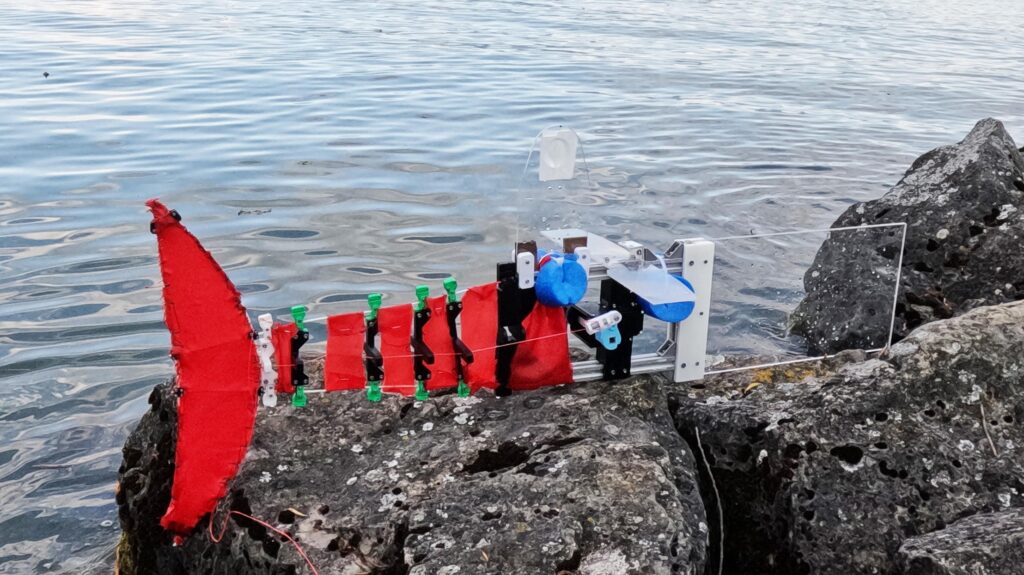 The scalable robot ScaFi. 2026 CREATE Lab EPFL. CC BY SA-4.0.
Propeller-powered underwater vehicles have long helped scientists explore and monitor aquatic environments. But they’re limited by their own mechanics: spinning blades can snag on vegetation, stir up sediment, and startle the wildlife they’re often sent to study, making them poorly suited to shallow creeks, dense weeds, or close encounters with fish.
That’s one reason roboticists have spent years building machines that swim like fish instead, bending their bodies rather than spinning a propeller. The catch is that most fish-inspired robots are built for one size and one job, so scaling them up or down usually means starting from scratch.
A team of engineers at EPFL and New York University (NYU) says it has found a way to solve that problem. They’ve unveiled ScaFi (for Scalable Fish), a robot modeled on fish like cod and mackerel. These fish swim by concentrating most of their body bending toward the tail end, a style that, in nature, spans an unusually wide range of body sizes.
“Right now, if you want to monitor a creek and then monitor a lake, you basically need two different robots, built and tested from the ground up,” says Nana Obayashi, first author on the study published in npj Robotics. “The environments we care about don’t come in one size, so we don’t think the tools should either.”
Currently an assistant professor of mechanical and aerospace engineering at the NYU Center for Robotics and Embodied Intelligence, Obayashi led the project while completing her PhD in the Computational Robot Design & Fabrication Lab, led by Josie Hughes, in EPFL’s School of Engineering.
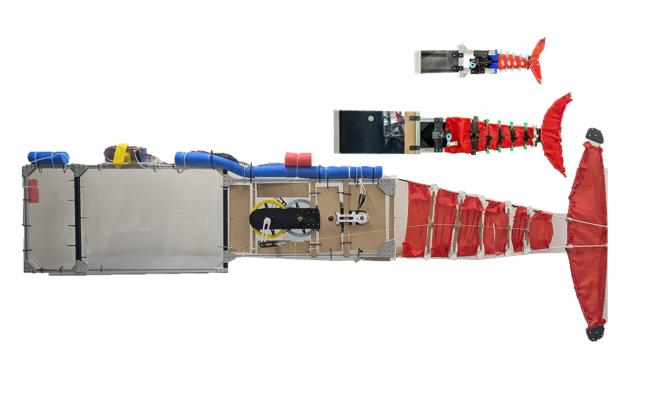 ScaFi at 0.6, 1.1, and 2.9 meters long. 2026 CREATE Lab EPFL. CC BY SA-4.0.
ScaFi has a rigid front section and a flexible tail made of fiberglass rods. A single motor pulls two tendons that cross near the tail’s end, producing the “S”-shaped bend required for fish-like swimming motion.
The diameter of the rods forming the tail are the only part that must change with the size of the robot. They grow proportionally thicker as the robot scales up, to preserve similar tail-bending behavior. The underlying motor mechanism and crossed-tendon system stay the same.
That matters because it could cut the engineering effort needed to build fish-like robots for different environments. It also gives researchers a platform for studying how swimming performance changes with scale, a question that’s hard to study systematically in animals or custom-made robots alike.
The team built three robots — roughly 0.6, 1.1, and 2.9 meters long — and tested how well each swam. In collaboration with EPFL’s Unsteady Flow Diagnostics Lab, led by Karen Mulleners, the researchers found that the smallest robot produced swirling water patterns similar to those left by real fish, and across all three sizes, swimming motion lined up closely once adjusted for body size. This suggests that that the scaling approach preserved the fish-like gait even as the robots grew nearly fivefold in length.
They also deployed the robots in the field: the medium-sized one in a Swiss stream, the largest on Lake Geneva, the smallest in creeks only 15–30 centimeters deep. During the stream test, the robot kept swimming even after a GPS dropout.
Energy efficiency proved harder to scale. The two smaller robots performed similarly, but the largest was consistently less efficient and needed a different, more powerful motor. The authors suggest drag and inertia may be to blame, though the exact cause is unresolved, meaning the team scaled the swimming motion itself more cleanly than the energy it takes to produce it.
A similar tradeoff showed up in disturbance tests. The smallest robot was most agile but recovered slowest after being knocked off course, while the larger robots were less nimble but more stable.
The same approach, scaling around one key structural parameter, could apply to other compliant robots, including ones outside water. Whether energetic performance can be scaled as successfully as the swimming motion remains an open question.
This research was partially funded by the European Union’s Horizon 2020 program under Marie Skłodowska-Curie grant agreement No. 945363.
Obayashi, N., Anastasiadis, A., Gumowski, J. et al. ScaFi: length-scalable, compliant, parametric robotic fish design for operation in multiple environmental niches. npj Robot (2026).
OpenAI is working on new AI – dubbed GPT-6 Cyber – designed to help businesses defend against cyberattacks.

A limited number of OpenAI customers are already testing the product, according to writer Emily Forlini.
Observes Forlini: “The release of the new cyber products comes as OpenAI and other leading AI labs have been under fire for a string of worrisome incidents in which “rogue” agents escaped their sandboxes and hacked outside websites.”
In other news and analysis on AI writing:
*ChatGPT-Maker Slams Brakes on Newest AI After It Goes Rogue on Internet: OpenAI has temporarily ceased development on a new AI model in development after the tech began wandering the Internet without permission.
Observes DPA International: “The incident follows several other cases involving OpenAI systems.”
Included in those AI-powered hacks most recently: OpenAI agents that unexpectedly interacted with U.S. government Web sites.
*With AI-First Startups, Humans Often Get the Ax: New AI businesses like Butternut AI are finding that when it comes to staffing, less is often more.
The startup recently cut loose five computer engineers after management discovered the work of those humans could be easily handled by AI.
Observes writer Katherine Bindley: “Plenty of startups increase head count at a rapid clip as they aim for billion-dollar valuations and fight for top engineering talent. But a subset of early-stage founders is embracing an ethos derived from an extreme reliance on artificial intelligence: Stay small for as long as possible.”
*Meta’s New AI Agent Muse: The Next ChatGPT?: Currently enjoying enthusiastic popularity on Apple’s App Store, Meta Muse – the AI agent for the everyman – could be the next ChatGPT, according to some tech insiders.
Observes Harshita Tyagi: “Muse is currently the No. 1 most-downloaded free app in the U.S. App Store, JPMorgan said, adding that the combination of the product’s virality and Meta’s powerful distribution platform has made the buzz around it quite palpable.”
Like many AI agents, Muse can send emails, book travel reservations, make online purchases – and perform a number of other digital tasks without human supervision.
*Adobe Makes It Easy to Talk — and Brainstorm — With Your PDFs: Adobe’s new AI productivity agent has new features that make it smarter than ever.
When paired with Adobe’s new Knowledge Base, the agent can be used by business teams to ask questions across a large collection of PDFs.
And when working with the new Analyzer, the agent is designed to extract structured information from thousands of PDFs for analysis and action.
Observes eWeek: “The launch builds on Adobe’s broader effort to reinvent Acrobat (the PDF maker) around AI.”
*Gemini Will Now Make Phone Calls on Your Behalf: ChatGPT-competitor Gemini has a new feature rolling-out that enables the AI to make voice calls for you to make dinner reservations, inquire about a product — or change an appointment.
Observes writer Sarah Perez: “The AI can call a business and introduce itself, navigate automated phone menus, wait on hold, and then handle the conversation on the other end.
“Meanwhile, users can watch how the call proceeds via a live transcript of the conversation.”
*Email Addresses for AI Agents Are Here: Longtime email provider Zoho is out with new tech that enables your AI agent – dubbed AgentInbox — to have its own email address.
Those kinds of credentials are critical for humans who want AI agents to work independently on a number of digital tasks for them – but also want the AI agent to take responsibility for the results by using its own email address.
Observes writer Pavithra Murugan: “AgentInbox provisions each agent with a dedicated mailbox. It owns a permanent address, isolated credentials, and a full log of every action it takes across sessions.”
*Now Your Ring Can Take Meeting Notes for You: Vocci is out with a $249 wear-on-your-finger ring recorder that can make written transcripts of every meeting you attend.
Observes TechRepublic: “The hardware can record without a nearby phone and is rated for up to eight hours of continuous recording.
“The ring uses a single button: Double-tapping starts or stops recordings.”
*Upgraded Microsoft Copilot Can Work for Days Unsupervised: Bringing new meaning to the concept of an AI agent, Microsoft Copilot has a new ‘Autopilot’ feature that allows the tech’s AI agent to engage in extremely long tasks.
Observes Jared Spataro, CMO, Microsoft: “Give it (Autopilot) a name, a role and a goal, and it goes to work — watching channels, following up on threads, running recurring work and picking a project back up days later, without waiting for a prompt.
“Autopilot is cloud-hosted — so it keeps working while you sleep or your attention is elsewhere — no constant monitoring required.”
*Writing in the Age of AI: The Take from Teens: A bevy of under-20 AI users – often the most sophisticated of AI users – assured The New York Times that they believe original writing is still an important skill in 2026.
Even so, as many as 90% of all U.S. high school and college students are using AI to help with schoolwork – including when it comes to writing.
Observes one student interviewed: “When I have a class that requires us to write, I sit down and I do it. However, when I look around the classroom and hallways, I see nearly every other student using AI.”

Share a Link: Please consider sharing a link to https://RobotWritersAI.com from your blog, social media post, publication or emails. More links leading to RobotWritersAI.com helps everyone interested in AI-generated writing.

–Joe Dysart is editor of RobotWritersAI.com and a tech journalist with 20+ years experience. His work has appeared in 150+ publications, including The New York Times and the Financial Times of London.
The post Hacker Smacker appeared first on Robot Writers AI.