Page 544 of 588
1 542 543 544 545 546 588

Albatross robot takes flight

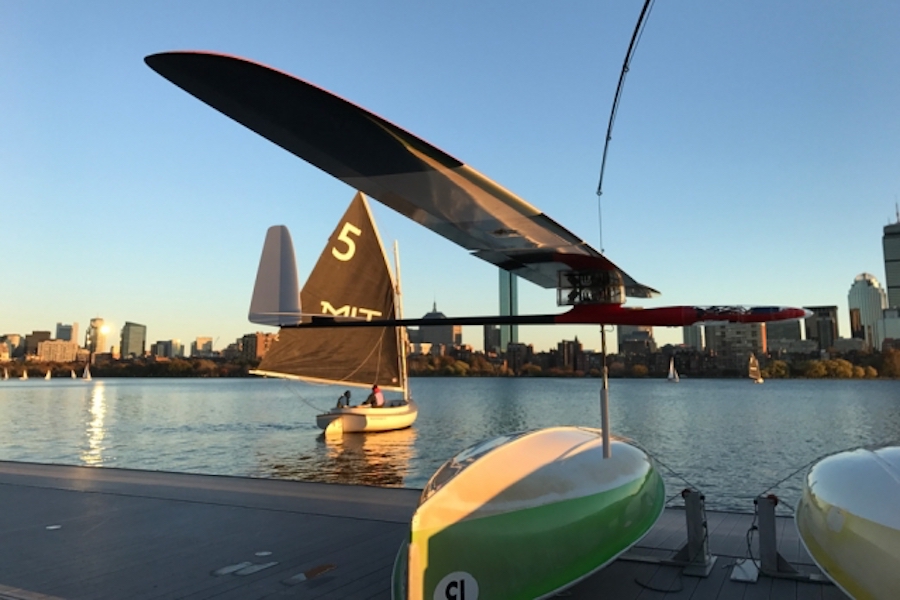
An albatross glider, designed by MIT engineers, skims the Charles River.
Photo: Gabriel Bousquet

By Jennifer Chu

MIT engineers have designed a robotic glider that can skim along the water’s surface, riding the wind like an albatross while also surfing the waves like a sailboat.

In regions of high wind, the robot is designed to stay aloft, much like its avian counterpart. Where there are calmer winds, the robot can dip a keel into the water to ride like a highly efficient sailboat instead.

The robotic system, which borrows from both nautical and biological designs, can cover a given distance using one-third as much wind as an albatross and traveling 10 times faster than a typical sailboat. The glider is also relatively lightweight, weighing about 6 pounds. The researchers hope that in the near future, such compact, speedy robotic water-skimmers may be deployed in teams to survey large swaths of the ocean.

“The oceans remain vastly undermonitored,” says Gabriel Bousquet, a former postdoc in MIT’s Department of Aeronautics and Astronautics, who led the design of the robot as part of his graduate thesis. “In particular, it’s very important to understand the Southern Ocean and how it is interacting with climate change. But it’s very hard to get there. We can now use the energy from the environment in an efficient way to do this long-distance travel, with a system that remains small-scale.”

Bousquet will present details of the robotic system this week at IEEE’s International Conference on Robotics and Automation, in Brisbane, Australia. His collaborators on the project are Jean-Jacques Slotine, professor of mechanical engineering and information sciences and of brain sciences; and Michael Triantafyllou, the Henry L. and Grace Doherty Professor in Ocean Science and Engineering.

The physics of speed

Last year, Bousquet, Slotine, and Triantafyllou published a study on the dynamics of albatross flight, in which they identified the mechanics that enable the tireless traveler to cover vast distances while expending minimal energy. The key to the bird’s marathon voyages is its ability to ride in and out of high- and low-speed layers of air.

Specifically, the researchers found the bird is able to perform a mechanical process called a “transfer of momentum,” in which it takes momentum from higher, faster layers of air, and by diving down transfers that momentum to lower, slower layers, propelling itself without having to continuously flap its wings.

Interestingly, Bousquet observed that the physics of albatross flight is very similar to that of sailboat travel. Both the albatross and the sailboat transfer momentum in order to keep moving. But in the case of the sailboat, that transfer occurs not between layers of air, but between the air and water.

“Sailboats take momentum from the wind with their sail, and inject it into the water by pushing back with their keel,” Bousquet explains. “That’s how energy is extracted for sailboats.”

An albatross glider, designed by MIT engineers, skims the Charles River.

Bousquet also realized that the speed at which both an albatross and a sailboat can travel depends upon the same general equation, related to the transfer of momentum. Essentially, both the bird and the boat can travel faster if they can either stay aloft easily or interact with two layers, or mediums, of very different speeds.

The albatross does well with the former, as its wings provide natural lift, though it flies between air layers with a relatively small difference in windspeeds. Meanwhile, the sailboat excels at the latter, traveling between two mediums of very different speeds — air versus water — though its hull creates a lot of friction and prevents it from getting much speed.  Bousquet wondered: What if a vehicle could be designed to perform well in both metrics, marrying the high-speed qualities of both the albatross and the sailboat?

“We thought, how could we take the best from both worlds?” Bousquet says.

Out on the water

The team drafted a design for such a hybrid vehicle, which ultimately resembled an autonomous glider with a 3-meter wingspan, similar to that of a typical albatross. They added a tall, triangular sail, as well as a slender, wing-like keel. They then performed some mathematical modeling to predict how such a design would travel.

According to their calculations, the wind-powered vehicle would only need relatively calm winds of about 5 knots to zip across waters at a velocity of about 20 knots, or 23 miles per hour.

“We found that in light winds you can travel about three to 10 times faster than a traditional sailboat, and you need about half as much wind as an albatross, to reach 20 knots,” Bousquet says. “It’s very efficient, and you can travel very fast, even if there is not too much wind.”

The team built a prototype of their design, using a glider airframe designed by Mark Drela, professor of aeronautics and astronautics at MIT. To the bottom of the glider they added a keel, along with various instruments, such as GPS, inertial measurement sensors, auto-pilot instrumentation, and ultrasound, to track the height of the glider above the water.

“The goal here was to show we can control very precisely how high we are above the water, and that we can have the robot fly above the water, then down to where the keel can go under the water to generate a force, and the plane can still fly,” Bousquet says.

The researchers decided to test this “critical maneuver” — the act of transitioning between flying in the air and dipping the keel down to sail in the water. Accomplishing this move doesn’t necessarily require a sail, so Bousquet and his colleagues decided not to include one in order to simplify preliminary experiments.

In the fall of 2016, the team put its design to the test, launching the robot from the MIT Sailing Pavilion out onto the Charles River. As the robot lacked a sail and any mechanism to get it started, the team hung it from a fishing rod attached to a whaler boat. With this setup, the boat towed the robot along the river until it reached about 20 miles per hour, at which point the robot autonomously “took off,” riding the wind on its own.

Once it was flying autonomously, Bousquet used a remote control to give the robot a “down” command, prompting it to dip low enough to submerge its keel in the river. Next, he adjusted the direction of the keel, and observed that the robot was able to steer away from the boat as expected. He then gave a command for the robot to fly back up, lifting the keel out of the water.

“We were flying very close to the surface, and there was very little margin for error — everything had to be in place,” Bousquet says. “So it was very high stress, but very exciting.”

The experiments, he says, prove that the team’s conceptual device can travel successfully, powered by the wind and the water. Eventually, he envisions fleets of such vehicles autonomously and efficiently monitoring large expanses of the ocean.

“Imagine you could fly like an albatross when it’s really windy, and then when there’s not enough wind, the keel allows you to sail like a sailboat,” Bousquet says. “This dramatically expands the kinds of regions where you can go.”

This research was supported, in part, by the Link Ocean Instrumentation fellowship.

#260: Hyundai’s Exoskeletons, with Sangin Park

In this interview, Audrow Nash speaks with Sangin Park, Senior Research Engineer at Hyundai, about exoskeletons. Park describes three exoskeleton prototypes: one for helping workers reduce back pain, one for assisting a person with paraplegia, and an exoskeleton for soldiers. Park discusses the sensors and actuators of each exoskeleton, as well as Hyundai’s exoskeleton ambitions.

Sangin Park

Sangin Park is a Senior Research Engineer at Hyundai.

Links

Robot transitions from soft to rigid

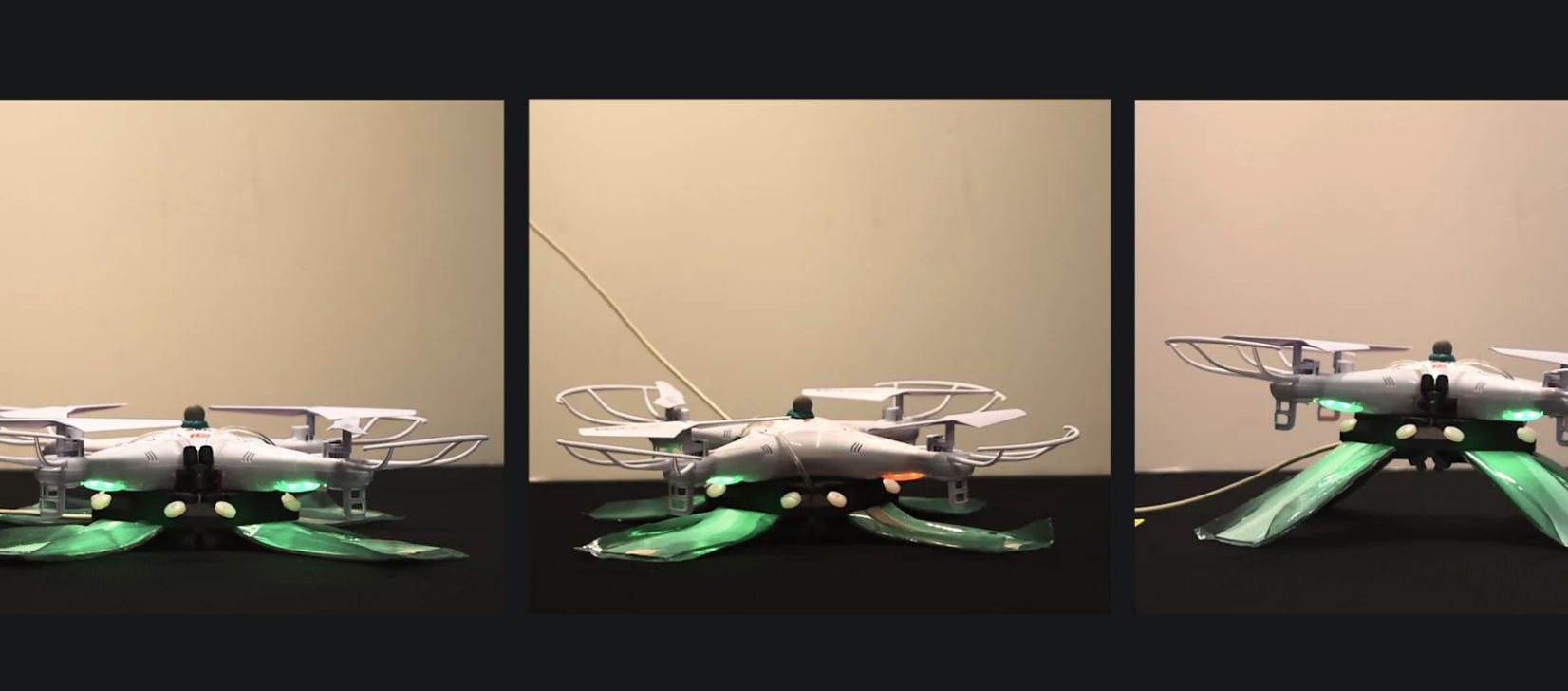
As the vacuum is applied to the flexible material, it becomes stiff and able to support the weight of the drone. Credit: Yashraj Narang

By Leah Burrows

Even octopuses understand the importance of elbows. When these squishy, loose-limbed cephalopods need to make a precise movement — such as guiding food into their mouth — the muscles in their tentacles contract to create a temporary revolute joint. These joints limit the wobbliness of the arm, enabling more controlled movements.

Now, researchers from the Wyss Institute for Biologically Inspired Engineering at Harvard University and the Harvard John A. Paulson School of Engineering and Applied Sciences (SEAS) have shown how a multi-layered structure can allow robots to mimic the octopus’ kinematics, creating and eliminating joints on command. The structure can also allow robots to rapidly change their stiffness, damping, and dynamics.

The research is published in two papers in Advanced Functional Materials and IEEE Robotics and Automation Letters.

“This research helps bridge the gap between soft robotics and traditional rigid robotics,” said Yashraj Narang, first author of both studies and graduate student at SEAS. “We believe that this class of technology may foster a new generation of machines and structures that cannot simply be classified as soft or rigid.”

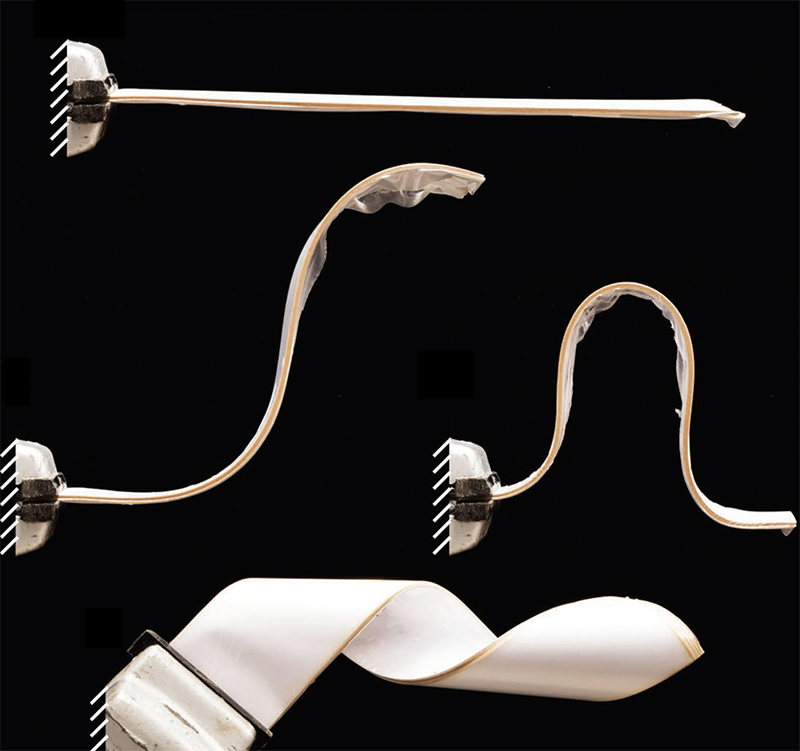
When a vacuum is applied, the layers of flexible material becomes stiff and can hold arbitrary shapes, and be molded into additional forms. Credit: Yashraj Narang/Harvard SEAS

The structure is surprisingly simple, consisting of multiple layers of flexible material wrapped in a plastic envelope and connected to a vacuum source. When the vacuum is off, the structure behaves exactly as you would expect, bending, twisting and flopping without holding shape. But when a vacuum is applied, it becomes stiff and can hold arbitrary shapes, and it can be molded into additional forms.

This transition is the result of a phenomenon called laminar jamming, in which the application of pressure creates friction that strongly couples a group of flexible materials.

“The frictional forces generated by the pressure act like glue,” said Narang. “We can control the stiffness, damping, kinematics, and dynamics of the structure by changing the number of layers, tuning the pressure applied to it, and adjusting the spacing between multiple stacks of layers.”

The research team, which included Wyss Associate Faculty member Robert Howe, Ph.D., the Abbott and James Lawrence Professor of Engineering at SEAS; Joost Vlassak, Ph.D., the Abbott and James Lawrence Professor of Materials Engineering at SEAS; and Alperen Degirmenci, a SEAS graduate student, extensively modeled the mechanical behavior of laminar jamming to better control its capabilities.

Next, they built real-world devices using the structures, including a two-fingered gripper that, without a vacuum, could wrap around and hold onto large objects and, with a vacuum, could pinch and hold onto small objects about the size of a marble.

The researchers also demonstrated the structure’s capabilities as shock absorbers by attaching them to a drone as a landing gear. The team tuned the stiffness and damping of the structures to absorb the impact of landing.

The structure is a proof-of-concept that could have many applications in the future, from surgical robots to wearable devices and flexible speakers.

“Our work has explained the phenomenon of laminar jamming and shown how it can provide robots with highly versatile mechanical behavior,” said Howe, who is the senior author of the paper. “We believe that this technology will eventually lead to robots that can change state between soft, continuous devices that can safely interact with humans, and rigid, discrete devices that can meet the demands of industrial automation.”

 This research was supported in part by the National Science Foundation.

Insight into a development process: The robotic fabrication of concrete facade mullions with smart dynamic casting

After the successful completion of the production of the material-optimised concrete façade mullions, Fabio Scotto and Ena Lloret-Frischti of the Gramazio Kohler Research Group at ETH Zurich and the Chair for Physical Chemistry of Building Materials, ETH Zurich take a look back at the experiments and prototypes which were necessary in the development of a final robotic fabrication process.

The integration of Smart Dynamic Casting (SDC) for the production of the façade mullions for the first floor of DFAB HOUSE has led us to the development of an adaptive robotic setup which allows us to produce custom-made reinforced concrete structures. Until the final development of a robust robotic process, we had to overcome several challenges during the experimental and prototypical phase.

Scaling down the production system and minimizing the friction forces
Our first main task was to scale down the production system to realise structures with a minimal cross section of 100×70 mm. This had a direct impact on the formwork system we were working with previously. We observed an increase in friction forces that resulted in accumulations of concrete along the inside walls of the formwork. This caused major issues during the casting process, specifically surface disruptions and, in some cases, a complete flow out of the fresh concrete.

To minimize the effects of the friction forces, we have defined strategies to optimize the overall process. Firstly, we engineered a much more self-compacting concrete mix with greater flowability and optimised setting times. Secondly, the formwork material was changed to stainless steel. Together with our capillary oiling concept, this ensures a significantly more frictionless casting process.

Integration of the reinforcement
Another issue we had to overcome in the research process was the integration of the reinforcement system. Although the mullions for DFAB HOUSE are not load-bearing, their structural performance is optimized for wind and self-weight load.

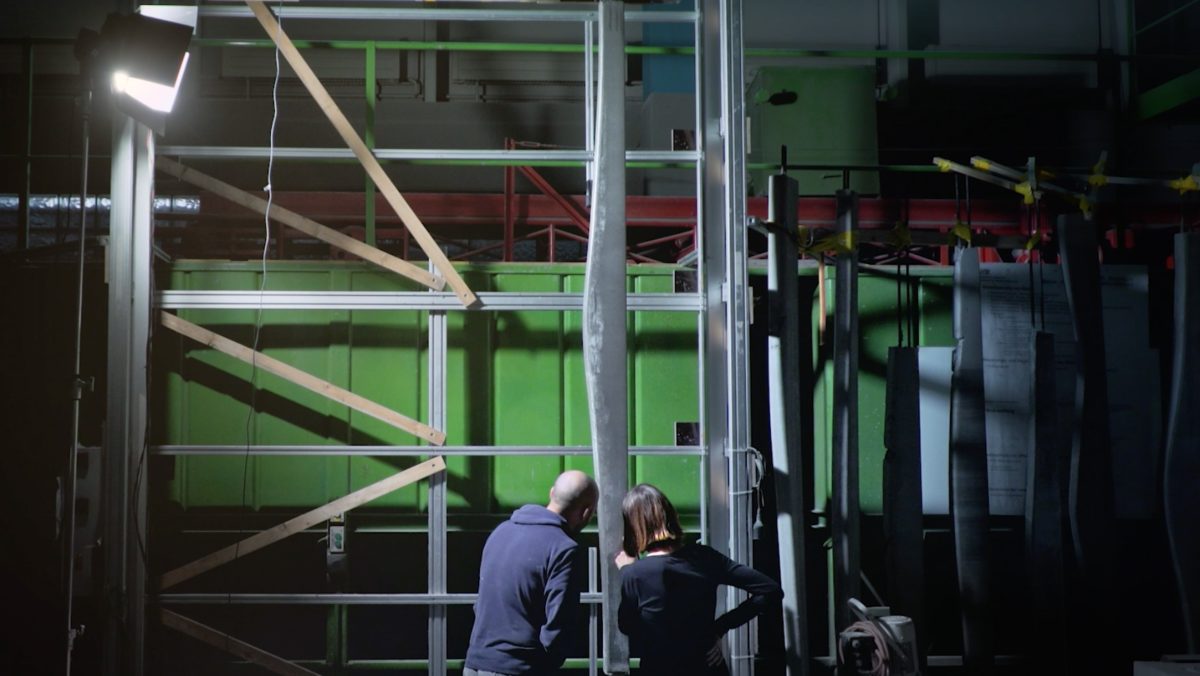
We developed a non-standard reinforcement system constrained within the small cross sections of the mullions. Two 12mm radius stainless steel bars, previously bent into the desired shape through CNC processes, are welded together through horizontal connection elements. The reinforcement is placed inside the formwork prior to initiating the fabrication process and fixed to lower and upper attachments. Due to the slender geometries of the mullions, the reinforcement had the tendency of bending under the effect of its own weight and the attachment system has been reviewed to avoid any deflection during the concrete casting. We devised a pulley system that allows us to fix the reinforcement in place by applying tension. In doing so, we ensure the reinforcement is held straight throughout the whole production, minimizing deflections along the entire height of the mullion.

A successful development process
After numerous experiments and prototypes, we have successfully overcome all the challenges that arose in the process and finalised an optimised fabrication procedure. The SDC mullions produced for the DFAB HOUSE display great surface quality while fulfilling the required structural criteria.

Page 544 of 588
1 542 543 544 545 546 588