
Category Robotics Classification

Page 6 of 646
1 4 5 6 7 8 646

AI-powered terrain recognition helps cyborg cockroaches navigate faster

Cyborg insects combine the mobility of living organisms with miniature electronic devices, offering potential applications in search-and-rescue operations, infrastructure inspection and exploration of environments that are difficult for conventional robots.

#AAMAS2026 blue sky award winner: Foundation world models for agents in changing environments

Florent Delgrange won the Best Blue Sky Paper Award at AAMAS 2026 for his work Foundation World Models for Agents that Learn, Verify, and Adapt Reliably Beyond Static Environments. We caught up with him to find out more about his vision for agent learning.

What is the topic of your Blue Sky Ideas paper and why is it an interesting area for study?

My Blue Sky Ideas paper asks a simple but difficult question: how can an autonomous agent keep learning as its world changes without quietly losing the guarantees that made its behavior trustworthy?

Reinforcement learning and formal methods address complementary parts of this problem. Reinforcement learning allows an agent to learn by trial and error and can scale to environments for which we could never write down every rule. However, the agent is usually asked to maximize a reward. A poorly specified reward can be exploited, and a high reward does not by itself tell us that a safety or coordination requirement has been satisfied. Reactive synthesis starts from the other end: given a model of the environment and a logical description of the intended behavior, it can construct a policy that is correct by design. The difficulty is that it normally needs an explicit, fixed model, which is precisely what an agent lacks in an open and changing world.

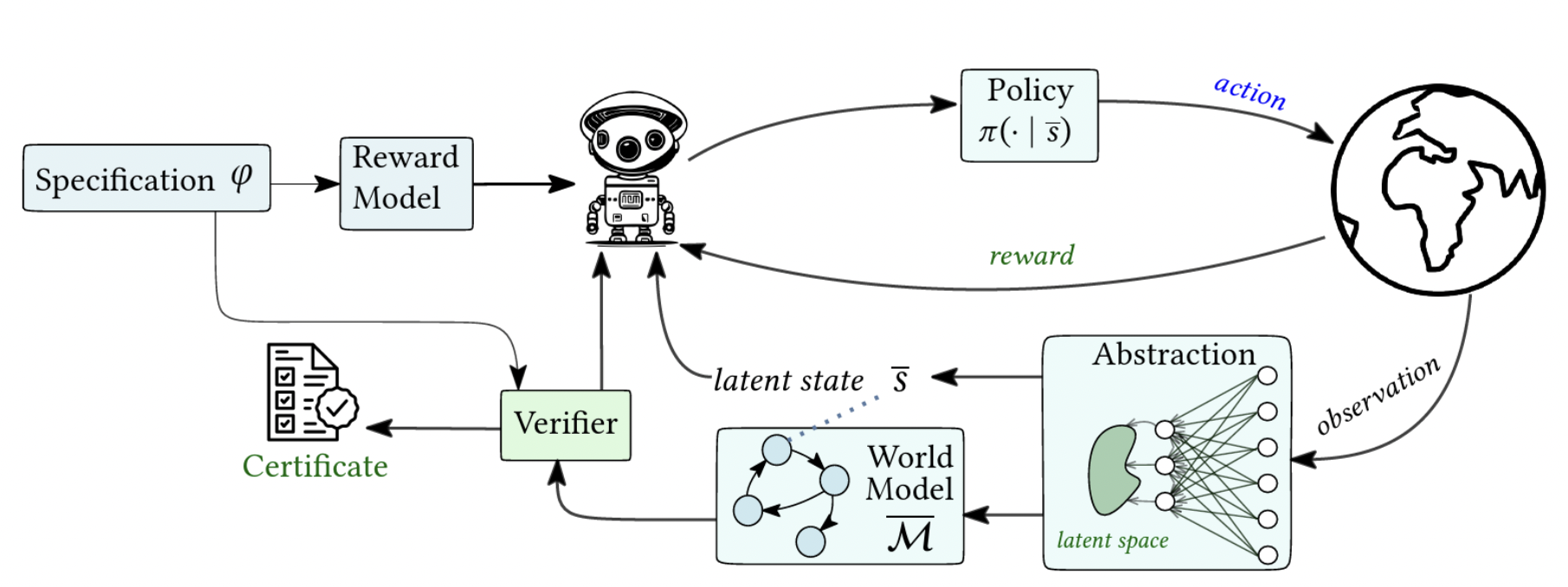
The paper proposes a research agenda that brings these traditions into one loop. A foundation world model would be learned from experience, but structured so that a verifier can reason about it. As the agent learns a policy, it would update its model, measure the reliability of its abstraction, and check whether the policy still satisfies its specification. The verifier’s feedback could reject an unsafe update, request data from an uncertain region, or trigger a revision of the model.

This matters because real environments do not politely remain as they were during training. Goals evolve, conditions change, and, in a multi-agent system, every adapting agent changes the environment perceived by the others. Reliability therefore cannot be a certificate obtained once at deployment. It has to be maintained as the agent continues to learn.

What is your vision for foundation world models?

To me, foundation refers first to reuse, not simply to size. I do not envision a larger video predictor trained on more trajectories. I envision a persistent and structured model that an agent can carry across tasks, policies, and changing populations of agents.

One way to think about it is as a map that records more than roads. It should also tell the agent which areas have been surveyed, which conclusions depend on those areas, and when a change in the world has made an old route unreliable. A useful foundation world model should do the same for decision-making: predict what may happen, expose the structure needed for reasoning, and quantify when those predictions are trustworthy enough to support a guarantee.

I’d want such a model to have three key properties. First, it should be calibrated: every learned abstraction should come with a measure of its error or coverage, so that the agent knows where formal conclusions remain valid. Second, it should be compositional: verified local dynamics, behaviors, and certificates should be reusable when a new task is assembled. Third, it should be semantically queryable: a formal requirement or high-level instruction should help the agent derive a suitable reward model, task-specific abstraction, or policy prior with little additional experience.

The durable idea is that the world model becomes a common substrate for learning, planning, and verification. It should help an agent act, but also identify the limits of its competence, gather evidence where those limits matter, and explain why a particular behavior can or cannot currently be certified.

How does this vision differ from current models?

Most current model-based approaches focus on learning for a particular task, environment, policy, or training distribution. Their main model learning objective is predictive accuracy: reconstruct an observation, forecast the next (latent) state, or generate imagined trajectories for planning. Those are important capabilities, but average predictive metric is not the same as fitness for a particular guarantee.

Consider a model for a scenario involving an agent interacting in a warehouse, where the world model predicts almost every transition correctly but misses a rare, dangerous interaction with a forklift. Its average error may be excellent while that transition is exactly the one that determines whether a collision-avoidance claim is valid. The reverse is also possible: a compact model may ignore colors and textures yet preserve everything needed to reason about routes and collisions. For verification, the relevant question is therefore not only “How accurate is the model?” but “Which conclusions does this accuracy justify, for this policy and this requirement?”

Foundation world models would make that connection an explicit design objective. Their abstractions would carry reliability information tied to the behavior being analyzed, and this information would be revised online as the data distribution changes. Previously verified components could be reused and composed, while specifications expressed in logic or language could guide which representation and policy the agent needs for a new task.

The main difference is therefore a change in role. Current models are primarily prediction tools. The model I envisage is a persistent, analyzable basis for learning, adaptation, and formal reasoning, with language models providing a complementary semantic interface. They could translate high-level instructions into candidate specifications or propose structured model updates, while the world model grounds these proposals in experience and the verifier checks their validity. Foundation world models may benefit from scale through broader task and environment coverage, but scale alone does not provide the structure or certificates required for reliability.

Could you give an example of how such a model might work?

Consider a delivery robot in a busy warehouse. Its task could be stated as: “eventually deliver the package while always avoiding collisions.” Instead of manually combining many bonuses and penalties, the system would translate that requirement into a reward model. Learning and verification would then start from the same description of the intended behavior.

As the robot receives observations, it would learn a compact representation of the warehouse and a policy that acts on that representation. A verifier would ask two related questions. Does the policy satisfy the delivery and collision-avoidance requirement in the learned world model? And is the learned abstraction accurate enough, along the routes that matter, for that conclusion to be trusted? A certificate is meaningful only when both answers are supported.

Now suppose a new forklift begins using a shortcut that was rarely visited during training, cluttering the way. Rather than treating an old prediction as a guarantee, the model should lower its confidence in that region. The verifier would detect this, withdraw the affected certificate, reject a risky policy update, direct exploration toward the shortcut, and reinstate a guarantee only after the world model has been recalibrated.

The paper also considers a more ambitious test-time loop. A language model could propose one or more small formal program describing the new dynamics. A model checker would test them, learn to compose with them, and return a counterexample or structural inconsistency when they are wrong. The language model could revise its hypothesis, the robot could collect targeted experience, and the cycle would repeat. In this division of labor, the language model proposes and the formal verifier checks.

We already have pieces of the loop, including formal reward translations, verifiable abstractions, safe policy-improvement methods, and program generation. Building an efficient end-to-end agent that keeps all of these pieces calibrated while it learns remains the research challenge.

What do you think the impact of such a framework on multi-agent systems could be?

Multi-agent systems make the problem both more urgent and more difficult. Each learning agent is a moving part of every other agent’s environment. Even when the physical world is unchanged, the effective dynamics evolve as agents update their policies, join or leave the system, share information, or pursue new objectives.

A foundation world model could retain reusable descriptions of these interaction patterns, while formal specifications state what must hold for the group. A fleet of warehouse robots, for example, may need to avoid collisions and complete deliveries while respecting shared capacity constraints. The model could connect each local policy to the assumptions on which its certificate depends. If one robot changes its route, the system could identify which assumptions and guarantees are affected, collect new data where needed, and revise only the relevant components rather than relearning and re-verifying the entire fleet.

Composition is the main source of potential leverage. Verified local dynamics or coordination behaviors could serve as building blocks for new teams and tasks, and previous agents could provide useful priors for new participants. This could support faster adaptation while making failures easier to diagnose: the system should report which interaction invalidated a certificate and provide a counterexample, rather than only revealing that the joint reward has fallen.

The central obstacle for multi-agent systems is scalability. The joint state space grows very quickly with the number of agents, and local guarantees do not automatically compose into a global one. We will need principled ways to expose dependencies, preserve soundness under composition, and run verification quickly enough to influence learning online. If we can solve those problems, the field could move from learning coordination strategies and checking them afterwards to learning new strategies while continuously tracking which global properties remain guaranteed.

About Florent

Florent Delgrange is a postdoctoral researcher in computer science at the Artificial Intelligence Lab of Vrije Universiteit Brussel (VUB). His research lies at the intersection of reinforcement learning, world models, and formal verification. He develops methods for agents that can learn and adapt while justifying and certifying the behavior they adopt. He completed a joint PhD at VUB and the University of Antwerp in 2024 on the formal verification of deep reinforcement learning policies. His paper Foundation World Models for Agents that Learn, Verify, and Adapt Reliably Beyond Static Environments received the Best Blue Sky Paper Award at AAMAS 2026.

Robots learn new skills from a single video—in just 29 seconds

To operate reliably in dynamic real-world settings, robots should be able to acquire new skills quickly without undergoing extensive additional training. Most existing robotic systems, however, primarily perform well on the tasks that they were trained to complete.

Do you need enterprise AI orchestration? A 3-question readiness framework

An internal payment agent used by five employees may need more orchestration than a customer-facing assistant serving 50,000 users that only drafts responses for human review. The payment agent can move money before anyone intervenes. The drafting assistant remains behind a human checkpoint.

That contrast exposes the problem with treating orchestration as a late-stage requirement for “large” AI programs. User count is easy to measure, but it doesn’t reveal where the real operational exposure sits.

Agent systems can remain online while degrading across accuracy, latency, cost, and effectiveness. They can carry one bad input through multiple decisions, access records that require a defensible audit trail, or act before a person has a chance to intervene. In each case, the system is still running while the operational exposure grows.

That makes orchestration readiness a question of three independent variables:

  • How quickly a repeated error can become a material business problem
  • What data the agent can access
  • What the agent can do without approval

Those variables translate into scale, data sensitivity, and autonomy. Any one can be decisive. Evaluating them independently gives teams a more useful way to decide when orchestration belongs in the operating model.

AI agents can fail while remaining operational

Traditional application monitoring looks for binary failures: a service crashes, an endpoint stops responding, or an error rate spikes. Traditional model monitoring evaluates whether outputs remain accurate and stable. Neither was designed to catch an agent that returns a correct answer while burning through budget, looping unnecessarily, or carrying a bad input through five downstream decisions. The first visible signal may be a budget overrun, a compliance issue, or a repeated pattern of bad decisions.

Agent systems introduce multi-dimensional operational failure. Accuracy can slip when an agent retrieves the wrong context or carries an early error into later decisions. Latency can rise as retrieval steps, approvals, and tool calls accumulate. Cost can spike when retries or loops trigger unnecessary model calls. Effectiveness can decline even when the final answer is correct, such as when an agent takes 20 steps to solve a two-step problem.

The endpoint still responds, so conventional monitoring may show a healthy system. Meanwhile, degradation can spread across model calls, tools, permissions, retries, and downstream actions. A green status light confirms availability alone. Accuracy, efficiency, safety, and cost may already sit outside acceptable limits.

3 triggers that make orchestration necessary

Orchestration readiness comes down to three signals: scale, data sensitivity, and autonomy. Each one measures how quickly an agent failure can become a business problem and how difficult that failure would be to detect, contain, or explain.

TriggerQuestion to askWhat raises the bar
ScaleAt what execution volume could a repeated error affect customers, revenue, operations, or downstream decisions faster than the team could detect and correct it?High execution velocity, repeatable workflows, broad downstream impact
Data sensitivityIf an agent’s decision appeared in an audit next year, could you reconstruct the inputs, retrieved context, tool calls, permissions, policy checks, and downstream actions that produced it?Regulated or confidential data, sensitive records, weak traceability
AutonomyCan the agent create a consequential side effect without a human checkpoint?Payments, record changes, customer communications, access changes, production actions

1. Scale: Could you catch a repeated error before it compounds?

User count is only one part of scale. Execution volume and velocity matter more. An internal agent used by five employees may still run thousands of workflows each day. A customer-facing agent may serve a much larger audience but operate behind strict review and rate limits. The relevant question is how often the system acts and how quickly the same flaw can repeat.

Consider a supply chain agent that misreads a date in a procurement document, selects the wrong vendor, and triggers an invalid restock order. A team may catch one bad recommendation during limited use. At production volume, the same error can propagate across orders, regions, and downstream systems before anyone recognizes a pattern.

Even a low error rate becomes material at volume. A 0.1% failure rate across 50,000 sessions produces 50 incidents. The same rate across 1 million executions produces 1,000.

Manual oversight can’t keep up with that compounding rate. Teams need consistent tracing, monitoring, policy checks, and intervention points across the workflow.

Question to ask: At what execution volume could a repeated error affect customers, revenue, operations, or downstream decisions faster than the team could detect and correct it?

2. Data sensitivity: Could you defend the agent’s decision later?

Sensitive data raises the stakes even when an agent has few users or runs infrequently. One exposed payroll record, patient file, financial transaction, or confidential contract may create more risk than thousands of interactions involving public information.

A defensible answer requires visibility across the full execution path. Teams need to know which identity initiated the workflow, what data the agent accessed, which tools it invoked, which controls applied, and what action followed. Without that record, an investigation becomes a manual reconstruction across disconnected logs and systems.

Once an agent can retrieve, modify, or expose regulated or confidential information, permissions, traceability, and policy enforcement need to be part of the operating model from the start. Dataset size doesn’t determine the risk. The sensitivity of a single record may be enough.

Question to ask: If an agent’s decision appeared in an audit next year, could you reconstruct the inputs, retrieved context, tool calls, permissions, policy checks, and downstream actions that produced it?

3. Autonomy: Can the agent act without approval?

Autonomy determines how far an agent’s decision can travel before a person has a chance to intervene.

An agent that drafts an email produces a recommendation for review. An agent that sends the email creates an external action. The same distinction applies across enterprise workflows:

  • Suggest a payment or approve it
  • Propose a database update or commit it
  • Identify a supplier or place the order
  • Recommend an access change or execute it

Consequential actions include moving money, modifying records, changing permissions, contacting customers, triggering purchases, or updating production systems. Each action increases the importance of scoped permissions, runtime monitoring, audit trails, and intervention controls.

In agent systems, trust functions as a permission model. It depends on what the agent can access, what actions it can take, under which conditions, and with what level of oversight.

Question to ask: Can the agent create a consequential side effect without a human checkpoint?

Evaluate each trigger independently. They aren’t sequential stages, and teams don’t need to accumulate all three before acting. A financial agent with five users and authority to execute transactions may need orchestration before a customer-facing assistant with thousands of users and a mandatory human review step.

An orchestration readiness check

Apply the check to any agent your team is running:

  1. Scale: Can one flaw repeat across enough executions to become a business pattern before your team catches it?
  2. Data: Does the agent access confidential or regulated information that requires a defensible audit trail?
  3. Autonomy: Can the agent take a consequential action without human approval?

Then count your yes answers.

Zero yes answers: Lighter tooling may fit the current scope. Document the agent’s boundaries and monitor for changes.

One yes answer: Start building orchestration into the operating model now. Don’t wait for a second trigger to make the risk material.

Two or three yes answers: Treat orchestration as a prerequisite for further expansion. Add traceability, enforceable controls, and intervention points before increasing usage, access, or autonomy.

Run the check for each agent. Risk varies by system, even within the same AI program.

Don’t wait for expansion to retrofit governance

A low-risk agent may not need enterprise-scale orchestration today. It still needs clear ownership and documented limits on access and action. Those basics preserve the conditions behind a zero-trigger score and make changes in the system’s risk profile easier to see.

Reassess before any change that expands the agent’s scale, data access, or authority. An internal pilot may become a companywide tool. A drafting assistant may gain permission to send. A workflow using public information may connect to confidential customer records.

Run the check before approving those changes. Once the wider rollout begins, the agent is already operating under a different risk model.

Retrofitting controls after release leaves teams investigating live failures, rebuilding permissions, and reconstructing decisions across disconnected systems.

Put orchestration into practice

If you scored one or more on the readiness check, you already know orchestration belongs in your operating model. The harder question is how to implement it.

For a practical path from readiness to implementation, read our ebook, Operating agentic AI at scale: How orchestration makes it possible. It shows how governance, deployment, and monitoring work together to support reliable agent systems in production.

The post Do you need enterprise AI orchestration? A 3-question readiness framework appeared first on DataRobot.

Humanoid resources: China’s robots search for workforce breakthrough

A horde of schoolchildren watched excitedly as a diminutive humanoid tour guide named Wuji welcomed them to a robot school in eastern China, gesticulating theatrically as it described the institute's aspiration to train the mechanical workforce of the future.

Robotics roadmaps from around the world spotlight of the month: Japan

Robots have been a prolific theme in Japanese pop culture and media since the 1950s, which includes global icons like the Transformers, Astro Boy, and Doraemon (1). Perhaps not coincidentally, Japanese citizens have a positive outlook on robotic technologies and their use in the labor sector compared to many other nations (2); much to their advantage, as robotics continues to be a vital pillar for ensuring Japan’s economic resilience and future growth. Here, we discuss priorities and long-term agendas as presented in Japan’s national robotics strategies.

Natural disasters, aging, and economic competition

The combination of its geographic location, geologically active landmass, and topography renders Japan prone to frequent natural disasters. Although weather control is among Japan’s lofty research goals for the next 25 years (3), geological disturbances remain inevitable. As such, disaster mitigation and response are high priorities that serve as motivation for robotics development in Japan (4). Intelligent machines are expected to expedite disaster response and search-and-rescue, while minimizing exposure of workers and volunteers to unnecessary hazards – a notable reminder being the 2011 Fukushima Disaster (5).

Aging workforce is a second pressing issue. Japan is currently the oldest demographic nation, defined as of 2007 as a “super-aged” society with nearly a third of citizens aged 65 or older (6). According to government roadmaps (4), Japan views robotic development as a crucial tool for preventing a GDP collapse due to the rapid labor shortage, specifically in services like healthcare, elderly assistance, and manual labor. Unlike countries which opt for immigration reform for addressing fluctuation in labor markets, Japan maintains historically tight immigration regulations. A strong preference towards preserving traditional values may influence their massive investments towards shifting to a robotic workforce (7).

Japan has a mature robotics industry, claiming the title of the largest manufacturer and exporter of industrial robots for the last half century (8). 45% of the global supply originated from Japan in 2022, with nearly an 80% export rate to countries such as EU members, the USA, and China (9). However, the combination of economic decline and competition from oversea manufacturing present the challenge of maintaining leadership in the global value chain. Leveraging their specialty in robotics hardware design is crucial to maintain a competitive edge in the global economy.

Society 5.0

Japan is betting on bold technological solutions for ensuring the prosperity of their future society. To do so, the government proposes a streamlined effort towards technocentric “super-smart cities” (coined Society 5.0) (10). The directive is set by the Science and Technology Basic Plan, a large-scale roadmap updated every five years (with 2026 marking the transition into the 7th Plan). An additional Integrated Innovation Strategy is used as an annually-updated agile document for integrating urgent priorities into the larger Basic Plan.

Super cities

Japan is investing heavily into research on human-robot interactions, so that users are embedded early on into technological design considerations of Society 5.0. Accordingly, in 2020 the Japanese Parliament passed the Super City Amendment, which allows regulatory sandboxes for specific “super cities” (currently Osaka and Tsukuba) to bypass certain laws that otherwise impede the integration of technologies like AI-driven robots into the public space (11, 12). These large-scale tests are carried out preceding what they hope could become widespread implementation of robotics to mitigate issues such as labor shortage. Following suit, as of late September 2025, the automobile industry Toyota has launched their own version of a Super City, Woven City, which provides a campus for employees to work, live, and even raise a family (13).

Moonshot programs

Japan also utilizes high-risk, high-impact research roadmaps with 30-year timelines, called Moonshot Programs, to encourage bold technological solutions for the future (14). The authors of these programs are a blend of members from government, industry, and academia. Two of the current ten Moonshot Goals are directly related to robotics.

Goal 1 of the Moonshot Program is to Overcome Limitations of Body, Brain, Space, and Time, a goal largely focused on the creation of Cybernetic Avatars – the fusing of sensations and motions between human users and tele-operated robots. By 2050, they hope to create the technology and infrastructure to implement Cybernetic Avatars into everyday society. Goal 3 of the Moonshot Program is the Co-Evolution of Robots and AI. Sub-goals within Goal 3 include the creation of robots that 1) 90% of citizens will feel comfortable engaging with by 2030, 2) work in remote and dangerous locations by 2050, and 3) autonomously innovate by 2050.

Humanoids and physical AI

In December 2025, a strategic update has been made to Goal 3 of the Moonshot Program, which prioritizes the development of general-purpose autonomous humanoid robots which can adapt to human-centric environments (15). Japan had in fact led humanoid research decades back (16), already developing Honda’s famous Asimo in 2000 (17) – but despite these early successes, humanoids remained astronomically expensive to manufacture, impractical for real-world applications, and remained publicity tools for promoting other industrial products. These commercialization challenges have largely been overcome with advancements in low-cost and back-drivable actuation components, additive manufacturing, and generalizable AI. As countries like China and the USA have sparked a humanoids build-up race, Japan is playing catch-up to re-assert themselves in this arena, which is rapidly taking center stage in the tech world (18).

To keep up in this humanoids race, it is crucial for Japan to invest heavily in domestic AI. In line with this need, in the same month as the Moonshot Program update, the Japanese Ministry of Economy, Trade and Industry (METI) decided to quadruple its previous investments in AI to $8 billion USD (now the third highest expenditure for AI just after China and the USA), with approximately $2.5 billion USD of this fund allocated specifically for physical AI (robots) (19).

In March 2026, Japan has also included updates to their Integrated Innovation Strategy (20), with plans to install R&D hubs across its 16 sectors for training domestic AI-robots and recruit both local and international talent. Overall, it would seem that Japan is leveraging its expertise in precision hardware to perform large-scale physical training for high-precision AI-driven robots.

Strategic relations with the USA

For the better part of the last century, Japan and the USA have been allies and trading partners. Japan’s recent Moonshot Program, along with their National Defense Strategy from 2022, both state the importance of their continued partnership (21). Notably, the USA is a global leader in AI but lacks a government-backed robotic hardware strategy, which could ensure a symbiotic relationship with Japan’s mature hardware ecosystem (22).

Supply chain pressures have also incentivized Japan and the USA’s joint collaboration to conduct deep-sea rare-earth mining using advanced robotic systems off the coast of Japan, in line with Goal 3 of the Moonshot Program. The first successful mining test, which involved underwater autonomous vehicles, was conducted in February 2026 (23). The use of robotics for underwater monitoring will also surely become critical for monitoring the impact of deep-sea mining to the marine environment, a highly contested topic (24).

In a historical move amidst mounting geopolitical tensions, Japan has also recently introduced dual-use technologies as a priority for their revised 7th Basic Plan (25), which demands the ramp-up of domestic R&D and research on unmanned vehicles and drone technologies (a move strongly endorsed by the USA). This decision comes with the high expenditure commitment of 2% of the national GDP.

Japan has ambitious societal plans for the coming decades, and robotics will play an increasing vital role – from sustaining domestic services, to enabling the physical autonomy of citizens, and revitalizing the economy. Ultimately, Japan’s roadmaps reveal a future where robots are partners for shaping a resilient and human-centric society.

On that note – our next month’s article will feature robotics strategies from the USA. Thanks for reading, and stay tuned.


This is a continuation of a monthly series on international robotics roadmaps. We welcome questions, comments, and feedback for future editions at ras@ieee.org.

Ellen H. RumleyPolicy Analyst

Allison OkamuraVice President

IEEE RAS Science & Technology Watch Board


References

[1] Hornyak, T. N. (2006). Loving the Machine: The Art and Science of Japanese Robots. Tokyo: Kodansha International.

[2] Mitsubishi Research Institute. (2022). How different countries perceive robots: An original survey.

[3] Cabinet Office, Government of Japan. (2021). Moonshot Goal 8: Realization of a society safe from the threat of extreme winds and rains by controlling and modifying the weather by 2050. Bureau of Science, Technology and Innovation.

[4] Cabinet Office, Government of Japan. (2025). Integrated innovation strategy 2025. [5] Encyclopaedia Britannica. (2026, March 9). Fukushima accident.

[6] Cabinet Office, Government of Japan. (2024). Annual report on the state of the formation of a resilient society for an aging population: White paper on the aging society 2024.

[7] Speed, J. Japan aims to take in 1.23M foreign workers under labor migration programs. The Japan Times.

[8] Nasdaq. (2021, October 25). Japan’s robot dominance.

[9] International Federation of Robotics. (2022, March 10). Japan is world’s number one robot maker.

[10] Cabinet Office, Government of Japan. (2016). The 5th Science and Technology Basic Plan (2016–2020).

[11] Cabinet Office, Government of Japan. (2020). Act partially amending the Act on National Strategic Special Zones and the Act on Special Districts for Structural Reform (Act No. 34 of 2020).

[12] Cabinet Office, Government of Japan. (2022). Designation of the Super City type National Strategic Special Zones: Osaka Prefecture/Osaka City and Tsukuba City. Bureau of Regional Revitalization.

[13] Toyota Motor Corporation. (2025, September 25). Toyota Woven City officially launches as a test course for the future of mobility [Press release].

[14] Japan Science and Technology Agency. (n.d.). Moonshot R&D | TOP.

[15] Kuniyoshi, Y. (2025, October 28). Appendix 3: PD’s policy (Moonshot Goal 3). Japan Science and Technology Agency (JST).

[16] Waseda University. (2026, May 8). The robots of Waseda: A 50-year journey in humanoid innovation. Waseda University News.

[17] Honda Motor Co., Ltd. (n.d.). History of robotics development. Honda Global Corporate Website.

[18] Morgan Stanley Research. (2025, May). Humanoids: A $5 trillion market. Morgan Stanley Investment Management.

[19] Nohara, Yoshiaki, and Komaki Ito. “Japan to quadruple spending support for chips and AI in budget.” The Japan Times, 26 Dec. 2025.

[20] The Japan News. (2024, May 20). Japanese govt to set up global hubs for AI robotics research.

[21] Cabinet Secretariat. (2022, December 16). National security strategy of Japan [Provisional translation].

[22] Fujitsu. (2025, October 3). Fujitsu expands strategic collaboration with NVIDIA to deliver full-stack AI infrastructure [Press release].

[23] The Japan News. (2024, August 24). Japan deep-sea drilling ship Chikyu extracts rare earth mud; represents major breakthrough for domestic supply. The Japan News. [24] Lelyveld, M. (2024, September 10). Japan’s deep-sea gamble: A new rare earth frontier in the Pacific. The Diplomat.

[25] Cabinet Office, Government of Japan. (2026, March 27). The 7th science, technology, and innovation basic plan (FY2026–FY2030) [Cabinet Decision].

NetSense: AI-Powered Drone Detection

Lockheed Martin, Verizon, Nvidia and Keysight Technologies are testing NetSense, which combines AI with existing 5G infrastructure to detect and track unmanned aircraft. A July demonstration in Miami showed how cellular networks could support drone monitoring without relying solely on dedicated detection equipment. The technology could be deployed around airports, stadiums, utilities, schools, hospitals and […]
Page 6 of 646
1 4 5 6 7 8 646