Automotive plants have had robots for 40 years and integrators on retainer. Many electronics teams don't have that depth yet, and they're being asked to automate more and at a faster pace.
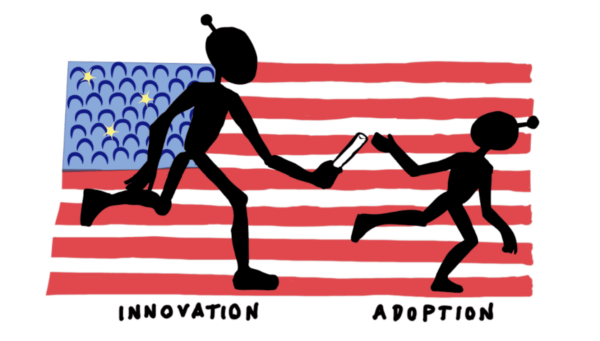
US robotics researchers and industry are looking for a cohesive national robotics strategy that will maintain basic research and innovation while improving domestic production and adoption of robots.
By Ellen H. Rumley and Allison Okamura
A leader in tech innovation
Robots are a crowd-pleasing example of American innovation and global technological leadership. The latest press release of Boston Dynamics’ Atlas executing the ‘Ghost Rabona’ soccer kick highlights the increasingly natural movements of humanoids (1). At the other end of the spectrum, academic researchers are redefining the limits of miniaturization and building robots at the micrometer scale (2). Private and government funding propel foundational research forward, leading to breakthroughs in both hardware and software across U.S. labs and corporations (3, 4). Such progress reaffirms the U.S. as an intellectual and innovative powerhouse, a reputation that carries large geopolitical weight.
But retaining a lead solely in the R&D phase yields diminishing returns if the U.S. fails to manufacture robotic hardware at scale within its own borders. Critics fear this dynamic prevents the U.S. from reaping the economic benefits of the very technology it pioneers (5, 6). Ramping up domestic production will require a heavily coordinated effort between government, industry, and academics – a pivot from traditional U.S. technology strategy.
Free market and military capital
Historically, the U.S. has maintained a laissez-faire approach to technological innovation, allowing corporate and private investors driven by the free market to shape the course of advancement. This innovation-first strategy is largely credited with fueling the growth of global tech giants and the rise of Silicon Valley, which altogether represents roughly 12% of the national GDP (7). America’s leadership in artificial intelligence can be largely attributed to this free-market engine, which prioritizes high projected profit margins and rapid scalability of software (8).
When it comes to U.S. robotics hardware, the Department of Defense/War (DoD/DoW) has stepped in as one of the primary catalysts for innovation and investment. The Pentagon’s fiscal year 2026 budget requested an unprecedented $13.4 billion for developing autonomous systems; a major increase from years prior. The DoD/DoW is requesting an additional $53.6 billion for autonomous systems and drones for 2027 (9). Private capital has quickly mirrored federal priorities; in the first quarter of 2026 alone, defense technology venture capital investments reached a record $19.8 billion. This surge is tightly bound to contemporary geopolitical conflicts, such as the hybrid warfare seen in Ukraine, where the U.S. plays a key role in funding drone production and in recent times deploying humanoids (10, 11). The significant role that autonomous systems have played in conflict zones like the Strait of Hormuz has also signaled the high dependency of strategic military operations on robotics (12).
A bottleneck for domestic manufacturing
While investment in robotic innovation does provide certain economic benefits, it does not support U.S. competitiveness in critical industries – specifically in physical manufacturing. Hardware inherently requires higher, long-term capital expenditures and yields lower short-term financial returns compared to software. Consequently, there could be less incentive to compete against other global manufacturing leaders. Furthermore, while the DoD funds early-stage R&D and specialized military platforms, its mandate stops short of supporting commercial scaling efforts necessary to implement technologies for broader civilian and industrial applications.
As a result, while the U.S. is the third-largest consumer of industrial robotics in the world (with industrial adoption surging by 11% just last year in sectors like logistics, packaging and automotive) (13), it lacks the infrastructure to build what it consumes. While a few prominent U.S. companies do manufacture application-specific robots (some examples being Intuitive Surgical, Amazon Robotics, and Agility), the U.S. mostly relies on foreign imports for baseline industrial robot installations (14). Contrast this with Japan, which relies on foreign imports for a mere 2% of its domestic installations (15).
The systemic under-development in domestic robotic manufacturing leaves the U.S. vulnerable to hardware dependencies and supply chain disruptions. While industrial leaders like Japan and Germany are reliable trade partners, the U.S. government increasingly views hardware dependencies as a national security vulnerability. In recent years, robots have been reclassified as a critical dual-use technology, considered central to 21st century technological sovereignty (16). This reality makes robotics manufacturing a target for foreign adversaries, since foreign supply chains introduce operational chokepoints.
Currently, the U.S. government responds to these vulnerabilities through aggressive export controls and protective procurement policies, which are designed to slow down adversary agendas by blocking their access to the U.S. IP and markets. As one example, in 2021 the President issued the NSPM-33 (a national security memorandum directed to executive agencies) mandating federally funded research institutions to establish strict internal compliance frameworks (17). While designed to allow the continued recruitment of international talent, it enforces rigid vetting protocols on researchers potentially associated with Malign Foreign Talent Recruitment Programs (MFTRP) or of dual national affiliation (18). As another example, in early 2026 lawmakers proposed the bipartisan American Security Robotics Act, a bill designed to ban the federal procurement and operation of unmanned ground vehicles and humanoids manufactured by foreign adversaries, specifically targeting China (19).
Getting by without a government-led national robotics strategy
Rising concerns over robotics supply chain vulnerabilities strongly echo the semiconductor anxieties that originally led to the CHIPS and Science Act of 2022, which marked a historical pivot for the U.S. towards an active state-supported industrial policy (20). Today, there is a similar pressure mounting for the federal government to coordinate a sovereign robotics pipeline via a unified national roadmap.
The challenge facing the U.S. does not seem to be a lack of federal funding, but rather how the funding is distributed across multiple agencies with different mandates (21). The National Science Foundation funds basic academic research; Department of Energy runs national research laboratories and funds external research programs developing robotics relating to energy infrastructure; National Institute of Health supports and conducts medical robotics research; NASA funds and develops robotics for space applications; the ARM Institute supports domestic manufacturing initiatives while satisfying dual-use funding criteria through the DoD/DoW; and DARPA funds robotic innovations relevant to national security. (The latter organizes the well-known DARPA Grand Challenges, robotics competitions for fueling research bridging fundamental science and military applications.) Because federal investments from these programs and agencies are confined to isolated, mission-specific niches, the U.S. remains one of the few leading industrial nations without a centralized robotics strategy.
This structural fragmentation may soon change as political attention shifts towards treating robotics as a critical sector (22). In 2025, four state representatives re-launched the bipartisan Congressional Robotics Caucus as a platform for members of Congress to stay informed over the diverse issues surrounding robotics policy (23). In June 2026, legislators formally introduced the bipartisan National Commission on Robotics Act, which calls for an independent commission of 18 robotics experts tasked with providing evidence-based policy to accelerate domestic development (24). This legislative momentum is reinforced by a series of recent Executive Orders (mandates from the US President) demanding a high-level federal coordination including the Unleashing American Drone Dominance Order (25), the Golden Dome for America Order (26), and the Launching the Genesis Mission Order (27).
Robotics strategies from non-government actors
In the absence of a centralized federal initiative, stakeholders in industry, NGOs, and academia are self-organizing and publishing their own robotics frameworks recommendations for the United States.
In 2025, A3 (Association for Advancing Automation) released their Vision for a U.S. National Robotics and Automation Strategy (28), which argues that the future of U.S. leadership in artificial intelligence is inextricably linked with its global robotics leadership. A3 provides actionable policy items, such as the formation of a governmental robotics office for coordinating federal robotics initiatives, the establishment new standards for nascent robotic hardware and software, and the introduction of tax incentives for rapid robotics adoption and creation of worker training programs.
Complementing these industry goals, in 2025 the nonpartisan thinktank, Special Competitive Studies Project (SCSP), has released their Memos to the President – National Robotics Strategy (29). This document couples the call for mass industrial robotics adoption with recommendations for more aggressive trade restrictions on Chinese technologies. Following this publication, SCSP launched its National Security Commission on Robotics for Advanced Manufacturing for implementing this comprehensive strategy; members include industry and academic players including GM, Boston Dynamics, Nvidia, AMD, the University of Michigan and MIT’s Industrial Performance Center (30).
Academics have similarly spearheaded their own national strategies. Once every four years, academics led by Professor Henrik Christensen (UC San Diego) publish a roadmap for U.S. robotics (31). Past editions directly catalyzed the creation of the National Robotics Initiative (NRI), a multi-agency federal program running from 2012 to 2022 that supported foundational research on robotics, specifically promoting collaborative robots for working alongside humans. (Christensen also recently published Global Robotics Technology Roadmap 2025–2035, an independent positions paper synthesizing government and industry strategies across Europe, Asia, and the United States (32).)
All three stakeholders share a common motivation for a national robotics strategy: the nation’s population and workforce are declining; There is a surplus of jobs fulfilling the 3 Ds (dull, dirty, dangerous); Robotics should become a national priority once more. In addition to funding and incentives, authors also discuss the need to consider the impact of technology on the workforce – a topic of large structural tension, with fear of robots displacing jobs and particularly outcompeting blue-collar and immigrant workers (33, 34). Christensen et al. delve deeper into the psychology of the workforce, and recommend a framework which balances technological growth with worker empowerment. They propose that prioritizing human-centered collaborative robots and wearable devices could shift the robotics narrative from a source of widening economic disparity towards heightening workplace satisfaction and production efficiency. However, recent mass layoffs amidst installations of collaborative robots reveal the complexity of this balancing act (35).
The U.S. is in the midst of a major shift regarding how it shapes robotics advancement. Because a formal federal strategy does not yet exist, private and academic stakeholders are proactively drafting the blueprints themselves. Consolidating these ideas into a unified national policy will have far-reaching consequences for national security, geopolitical influence, labor markets, and manufacturing sovereignty. The world watches carefully as this shift unfolds.
Thanks for reading. For our next article we will be delving into China’s national robotic strategies – stay tuned.
Ellen H. Rumley – Policy Analyst
Allison Okamura – Vice President
IEEE RAS Science & Technology Watch Board
References
Boston Dynamics and Hyundai. School of Football | The Ghost Rabona | Boston Dynamics x Hyundai. YouTube, 2026.
University of Pennsylvania School of Engineering and Applied Science. “Penn and UMich Create World’s Smallest Programmable Autonomous Robots.” Penn Engineering Today, 2024.
“7 Cool NSF-Funded Robots That Are Advancing Science and Helping Society.” S. National Science Foundation, 7 Apr. 2021.
“AI 50 List: Top Artificial Intelligence Companies.” Forbes, 2026.
Atkinson, Robert D. A Time to Act: Policies to Strengthen the US Robotics Industry. Information Technology and Innovation Foundation (ITIF), 2025.
Association for Advancing Automation (A3). Policy Recommendations and Advocacy Principles for the U.S. Automate.org, 2025.
Consumer Technology Association. “Tech Sector Supports 18 Million US Jobs, Represents 12% of GDP, Says CTA.” CTA Press Releases, 2026.
Brookings Institution. Hardware and Software: A New Perspective on the Past and Future of Economic Growth. Brookings, 2024.
United States Department of Defense. Comptroller Budget Materials: Fiscal Year 2026. 2025.
National Science and Technology Council. Guidance for Implementation of National Security Presidential Memorandum 33 (NSPM-33). Jan. 2022.
White House Office of Science and Technology Policy. Guidelines for Foreign Talent Recruitment Programs. Feb. 2024.
United States, Congress, House. American Security Robotics Act. 119th Congress, H.R. 8189. Government Publishing Office, 2026.
Center for Strategic and International Studies. Innovation Lightbulb: Tracking CHIPS Act Incentives. CSIS, 2025.
Center for Strategic and International Studies. “Why the United States Needs Robots to Rebuild.” CSIS Strategic Technologies Blog, 2025.
Politico Pro Staff. “White House and Congressional Frameworks Shift Toward AI and Robotics.” Politico, 3 Dec. 2025.
United States, Congress, House of Representatives. “McGovern, Latta, Stevens, Obernolte Announce Re-Launch of Congressional Robotics Caucus.” Office of Congressman Jim McGovern, May 2025.
United States, Congress, House. National Commission on Robotics Act. 119th Congress, June 2026, H.R. 7334.
S. Army News Service. “Drone Dominance Program Receives First Order; Gauntlet II Gets Underway.” Defense Department News, 2026.
Congressional Budget Office. Cost Estimate and Analysis of the Golden Dome Air Defense Framework. May 2026.
S. Department of Energy. “Energy Department Advances Investments in AI and Robotics for Scientific Discovery.” DOE News, 2025.
Association for Advancing Automation. “A3 Policy Recommendations and Advocacy Principles for the U.S.” April 2024.
Special Competitive Studies Project. Memos to the President: National Robot Strategy. SCSP, 2025.
“Boston Dynamics Joins U.S. Robot Strategy Think Tank Led by Ex-Google CEO.” Seoul Economic Daily, March 2026.
Christensen, Henrik, et al. Robotics for a Better Tomorrow: 2024 US National Robotics Roadmap. UC San Diego / Academic Coalition, 2024.
Christensen, Henrik. Global Robotics Technology Roadmap 2025–2035. Independent Position Paper, 2025.
Appelbaum, Binyamin. “What Replaces Deported Immigrant Workers? Not Americans.” The New York Times, Feb. 2026.
Pew Research Center. “Key Findings About How Americans View Artificial Intelligence and Automated Systems.” Pew Short Reads, 12 Mar. 2026.
“Unions Furious as GM Replaces 1,000 Factory Zero Workers with 50 Robots.” Yahoo News, June 2026.
A research group comprising Associate Professor Yoshihiro Nakata and Taisei Mogi from the Graduate School of Informatics and Engineering at The University of Electro-Communications (UEC), Japan, and Mari Saito of Sony Corporation has developed MOFU (MOrphing Fluffy Unit), a mobile robot capable of whole-body expansion and contraction. The group investigated how whole-body expansion-contraction affects perceived animacy, or the extent to which the robot is perceived as lifelike. In addition to expansion-contraction and locomotion, MOFU was designed with features including quiet operation and a soft, fluffy exterior. The study was published in PLOS ONE.
When an AI agent causes harm, leaders must be able to defend why it was allowed to act. To a board, auditor, or regulator, they need to show that the agent’s permissions, controls, and approvals were matched to the consequences of failure.
Treating guardrails as an on/off switch hides that decision. Guardrail risk tiering makes it explicit: every agent clears a common baseline, then receives stronger controls as its access, authority, and potential harm increase.
A read-only internal agent creates far less exposure than one that can access regulated data, invoke privileged tools, send external communications, or modify a system of record. The level of oversight applied to each should reflect that difference.
Key takeaways
Guardrail risk tiering matches oversight to business exposure. The strongest controls belong where an agent’s access and authority create consequences the organization would struggle to contain or reverse.
Every agent needs controls at its input and output boundaries. Inputs include user prompts and untrusted content introduced through retrieval, APIs, tools, and other agents.
An agent’s authority determines what leaders may have to defend. Sensitive data access, external communications, system changes, and financial transactions require closer oversight.
High-impact actions need hard stops outside the model. Transaction limits, permissions, approved recipients, and required approvals should be enforced before execution.
Guardrail risk tiering continues throughout the agent lifecycle. New tools, permissions, data sources, and autonomy can change an agent’s exposure after deployment.
Why your exposure should set the guardrail level
Your organization already makes proportional access decisions. Role-based access control (RBAC), OAuth, data classification, and access policies determine who can reach a system, what they can see, and what they can change. Agent guardrails extend that risk logic into runtime execution.
Guardrail risk tiering is the practice of matching the depth and placement of runtime controls to an agent’s data access, tool permissions, action authority, and potential consequences.
An agent’s exposure can change as a workflow unfolds. Reading an approved document carries one level of risk. Passing information into a tool that updates a customer record or initiates a transaction raises the stakes. Each new permission expands the set of outcomes the organization may have to explain after an incident.
Start with a common baseline. Add enforcement where the agent gains access to sensitive information or the authority to produce consequential outcomes. Guardrails reduce the probability and impact of unsafe behavior, but no set of controls can prevent every failure.
The leadership responsibility is to show that the level of oversight was deliberate, proportional, and approved before the agent acted.
Set the floor every agent has to clear
Every agent needs controls around information entering the workflow and consequential content leaving it.
The initial user request is only one input boundary. Once an agent begins retrieving documents, scraping pages, calling APIs, interacting with tools, or exchanging information with other agents, each result becomes another source of potentially untrusted input. A retrieved document or tool response can contain malicious or conflicting instructions just as a user prompt can. This is the indirect prompt injection surface that boundary controls need to cover.
Keeping unsafe instructions from shaping execution
Keeping sensitive information from leaving the workflow
Inspect user prompts, retrieved documents, scraped content, API responses, tool results, and other external context for prompt injection, prohibited content, sensitive information, and policy violations before that information influences execution.
Inspect consequential outputs for personally identifiable information (PII), toxic or biased content, sensitive data, and other policy violations before the response reaches a user or downstream system.
For a read-only internal agent working with approved information, these controls may cover most of the relevant exposure. Once an agent invokes privileged tools or takes action, boundary checks alone leave gaps between what the agent receives and what it ultimately does.
Leaders should know where those gaps begin because that is where the organization’s accountability expands.
What you’ll need to explain when something goes wrong
Once an agent moves beyond read-only tasks, its tools become one of the clearest indicators of business exposure. Write access to production databases, external communications, financial transactions, code execution, and sensitive personal data all increase the consequences of a bad decision.
For higher-risk tools, guardrails should evaluate proposed actions before execution. Failed checks need a defined response, such as blocking the action, using a safer fallback, or escalating to an authorized person.
The organization also needs a record of which tool was called, what permissions were active, which policy checks ran, and what changed downstream. Without that evidence, leaders may know that something went wrong without being able to explain how the agent was authorized to do it.
To determine how deep those controls should go, evaluate each agent against five questions:
What data can it access? Public or already-classified information creates a different exposure than customer, financial, HR, healthcare, or other sensitive data.
What can it write, execute, or trigger? Read access carries less operational authority than permission to modify a system of record, execute code, contact a customer, or initiate a transaction.
What authority does it operate under? Broader permissions and elevated access increase the range and severity of actions available to the agent.
How reversible are its actions? A generated summary can usually be discarded. A payment, deleted record, changed entitlement, or external communication can be far harder to unwind.
How far can a failure propagate? An isolated error carries a different risk profile from an action that affects downstream systems, customers, business processes, or other agents.
These questions turn a technical inventory into a leadership decision about the consequences the organization is willing to accept.
Decide which actions need a hard stop
Model-based checks work well when a control requires interpretation. They can identify prompt injection, unsafe content, off-topic behavior, or context-dependent policy violations.
Hard business constraints require deterministic enforcement outside the model. Before a high-impact tool executes, policy checks can validate permissions, transaction limits, approved recipients, required fields, data classifications, allowlists, and approval requirements.
The model can propose an action. A deterministic policy decides whether the action is permitted. When the consequences are difficult to reverse, an authorized person may need to make the final decision.
Spend oversight where failure costs the most
Every policy check consumes time, computing resources, or human attention. Leaders need to allocate that oversight according to exposure.
A low-risk summarization agent may need lightweight input and output checks. Multiple approval gates would consume review capacity while covering risks the agent does not create.
An agent that modifies customer records, communicates externally, or initiates transactions presents a different calculation. Validating permissions and proposed actions adds time, but the alternative may involve an unauthorized write, data exposure, investigation, remediation, or regulatory scrutiny.
Guardrail risk tiering makes that allocation explicit. The strongest enforcement belongs where a failure would be hardest to contain, reverse, or explain.
A practical way to allocate oversight
Enterprises don’t need to adopt a universal taxonomy. The objective is to connect an agent’s actual capabilities to a corresponding level of enforcement.
A practical guardrail risk tiering model might look like this:
Risk tier
Typical agent capabilities
Recommended guardrail depth
Baseline
Read-only access to approved or low-sensitivity data with no consequential actions
Input, retrieval, and final-output checks
Elevated
Sensitive data access, external communications, or tools that affect downstream workflows
Baseline controls plus tool-level policy enforcement, scoped permissions, and detailed tracing
High impact
Writes to systems of record, financial transactions, code execution, or difficult-to-reverse actions
Baseline and tool-level controls plus deterministic policy checks, explicit escalation paths, human approval where required, and complete auditability
Giving an existing agent write access, connecting a new Model Context Protocol (MCP) server, or expanding its data permissions can change its risk profile even when the model and prompt remain the same.
Guardrail risk tiering continues throughout the agent lifecycle. Each change in access, tools, or autonomy should trigger a decision about whether the organization can still defend the existing level of oversight.
Build a record you can defend
A risk tier has little value if nobody can show who assigned it, what controls it requires, or who can intervene. Before an agent reaches production, create a governance record that a board, auditor, regulator, or incident-response team could examine.
Name the accountable owner and approving authority. Identify who owns the agent’s performance and risk, who approved its operating scope, and who can change or revoke that approval.
Document what the agent is authorized to access and do. Record the data, tools, APIs, and downstream systems it can reach, along with what it can read, write, execute, or trigger.
Record the risk tier, controls, and rationale. State why the agent received its classification, which input, output, and tool-level controls apply, and who signed off on the decision.
Define hard stops and escalation authority. Specify which actions require deterministic enforcement or human approval. Name who can investigate, restrict permissions, initiate takeover, roll back a release, or suspend the agent.
Set review triggers and evidence requirements. Define what must be retained for audit and investigation. New tools, broader permissions, different data sources, and greater autonomy should trigger reassessment.
This record gives leaders more than proof that controls exist. It shows how the organization connected authority to oversight and who accepted responsibility for that decision.
Know whether the controls are working
Assigning a risk tier establishes the required controls. Leaders still need evidence that those controls operated as intended.
That evidence comes from tracing tool calls, identity and permission context, policy decisions, downstream actions, and escalation events. A tool call may satisfy a technical interface while violating a business rule. An action may execute under the wrong permission context. An agent may repeatedly encounter conditions that should trigger human review.
These patterns become visible when the organization can follow behavior across the execution path. The resulting record helps leaders answer specific questions: Which identity authorized the action? Which policy applied? Did the agent receive an exception? Who was notified? What changed downstream?
Leaders need evidence they can produce during an audit or after an incident — not a description of the controls that were supposed to run, but a record of what actually happened.
Guardrail risk tiering is a method for matching the depth and placement of runtime controls to the risk created by an AI agent’s data access, permissions, tools, actions, and downstream impact. Higher-risk capabilities receive additional controls closer to the point of execution.
What guardrails should every AI agent have?
Every agent should have a minimum set of controls around information entering the workflow and consequential content leaving it. Input controls should cover the original user request as well as retrieved documents, API responses, tool results, and other untrusted context introduced during execution.
When does an AI agent need tool-level guardrails?
Tool-level controls become increasingly important when an agent can access sensitive data, write to systems of record, communicate externally, execute code, initiate transactions, or trigger other consequential workflows. Higher-impact actions may also require deterministic policy enforcement or human approval before execution.
Do AI guardrails eliminate agent risk?
No. Guardrails reduce the likelihood and potential impact of unsafe or unauthorized behavior. Teams still need appropriate permissions, observability, testing, auditability, escalation procedures, and ongoing review to manage residual risk.
When should an agent’s guardrail risk tier be reassessed?
Reassess guardrail risk tiering whenever the agent gains new tools, permissions, data sources, workflows, or autonomy. Changes to connected systems can alter risk even when the model, prompts, and core agent logic remain the same.
Today’s solutions are designed to reduce the complexity of deployment with standardized, configurable automation platforms that warehouses can get up and running — sometimes in as little as a day — with little to no software engineering required.
Waving flags, "chanting" slogans and marching in circles, around 30 robots took to the streets of Warsaw on Monday to campaign for AI regulation in front of the Polish digital affairs ministry.
New BBC sitcom Ann Droid imagines a near future in which robots provide care and companionship to older people at home.
The series centres on Sue, a recent widow played by Sue Johnston, her hapless son Michael and Linda, an assistive care robot played by Diane Morgan. Linda is designed to provide daily support and companionship, with predictably comic results.
As researchers in social care, ageing and human-centred robotics, we obviously watched Ann Droid with a keen eye. Beneath the jokes are questions that researchers are already tackling.
Could robots help address loneliness among older people? Can a machine provide companionship without replacing human connection? While the series exaggerates what robots can currently do, some of the technology it depicts is already being tested.
The BBC’s Ann Droid sitcom.
A social enterprise in south-west England has been piloting Comfort Companions in partnership with Age UK South Gloucestershire. AI-generated personas offer conversation and guidance to older people living alone and at risk of loneliness.
It runs alongside Age UK’s volunteer programme, with befrienders helping older people learn how to use the app. The AI companions are intended to supplement the waiting list for human befrienders rather than replacing them.
Physical robots are being tested too. West Berkshire Council has been running a trial using robotic pets in its care homes.
Neither scheme offers robots who look like Linda. Current systems tend to be AI avatars on a screen or robotic cats or dogs, or speakers that provide a voice in the room. They do much less than Linda too. They can’t help someone up after a fall, wash them or get them dressed.
What technology does currently do best is monitoring and prompting. Systems that can detect a fall and alert another person are far more mature, while technology can also encourage someone to contact friends, make a phone call, or get out of the house.
Can a machine make you less lonely?
It’s worth considering this distinction because loneliness is not simply the same as being alone. It’s a personal feeling that our relationships are insufficient, accompanied by a desire for more or better social contact.
A robot companion, therefore, is unlikely to solve loneliness simply by being present. What matters is the quality of the interaction and whether technology can help someone maintain relationships with the people who matter to them.
This is one of the more interesting ideas in Ann Droid. Linda can sometimes strengthen Sue’s existing relationships rather than replace them, encouraging her to meet friends and plan activities outside the home. That’s potentially a more useful way to think about companion technology. The goal need not be to create an artificial friend who substitutes for a human one, but to help people remain connected to others.
The barriers are still substantial. Battery life is a limitation. Most humanoid robots manage between 90 minutes and five hours per charge when new. This is why an overnight camping trip featured in the sitcom is a fair test on the fantasy.
Robots are much better at some tasks than others. A machine may be able to play chess, for example, but picking up an unfamiliar household object in the real world remains surprisingly difficult.
The social barriers are even harder. Robots struggle with the social subtleties that people take for granted. Systems that learn by copying human behaviour can reproduce an action without understanding its intention. They also cannot reliably interpret facial expressions.
A review of systems designed to detect emotion from faces found that they performed worst when interpreting older faces, with anger and neutral expressions among the least reliably identified. This is important in care because recognising how someone is feeling can be crucial.
Would we trust a robot carer?
Ann Droid also plays on a more instinctive discomfort: should we trust a machine that’s designed to look after us? The sitcom playfully touches on public worries about interacting with robotic companions, including people’s distrust and worries about potential harms. For example, in one episode two robots enjoy a joke together about killing their human companions.
Research suggests that older people can see value in companion robots. But acceptance depends partly on whether people feel they remain in control. And appearance is a factor too.
In 1970, the roboticist Masahiro Mori proposed the idea of the “uncanny valley”. As machines become more human-like, we initially respond more positively to them. But when they look almost human without quite getting there, that warmth can turn into discomfort.
Ann Droid – dinner with the robot-in-law.
Robots have some obvious advantages. They don’t get bored, tired or impatient. They can handle dangerous tasks and they’re available at 3am. But they can’t provide something fundamental to care: a relationship in which both people choose to be there.
That’s the bond that no machine can supply. Robots may have a useful role in social care, but they’re worth having only when people want them, alongside human care and companionship. Otherwise, we risk finding an expensive technological answer to a much harder question: why do some older people have so little human contact in the first place?
Apparently, workers are hedging their bets with AI by drowning their colleagues in seas of text that are more often churned-out to impress and perplex – rather than to simply communicate an idea or message.
The problem has grown worse since the advent of ChatGPT-5, which was deliberately designed to spew-out bland, overly cautious prose.
In other news and analysis on AI writing:
*The Solution to Bloated AI Writing: Open Source AI: Increasing numbers of pros – especially those involved in marketing, sales, advertising and other roles requiring lots of text – are turning to Open Source AI.
The reason: Many of these AI models – available for use in the cloud or via download to a company’s IT system – can be prompted to produce extremely creative, captivating and compelling writing.
*Corporate America Getting Hooked on Open Source AI: Major U.S. companies – like AT&T, Airbnb and Deloitte – are increasingly turning to Open Source AI, given that it’s much less expensive than alternatives offered by U.S. titans.
Nvidia – the AI chipmaker often considered the epicenter of the AI revolution – thinks the trend is so important, it just purchased a well-known library of hundreds of Open Source AI alternatives for $12.9 billion.
Observes writer Eli Tan: “Many of the most popular open AI models are made by Chinese companies like Moonshot AI, DeepSeek and Alibaba.”
*OpenAI Rolling-Out ChatGPT-6 Upgrade This Week: ChatGPT’s latest version – also known as Astra – will be showing up this week in paid AI plans from OpenAI, including Pro, Plus, Enterprise and Business.
Businesses accessing the company’s AI by directly tapping into OpenAI servers will also see access this week.
Mythos 5.1, which can be used to uncover security holes in everyday software platforms, was released as a restricted-use product — currently available to only select cybersecurity firms and life-sciences organizations.
Observes writer Carl Franzen: “Anthropic is simultaneously changing the economics of running persistent agents — reducing the cost of cached context by 75%.”
*Facebook’s Parent Meta Releases Nearly As Good AI: Determined to be a contender among bleeding-edge AI titans like ChatGPT and Gemini, Meta has released its most sophisticated AI to date, Muse Spark 1.3.
Specifically, Alexandr Wang, Meta’s chief AI officer, rates Spark as competitive with Claude Fable 5.1 and better in some ways than ChatGPT-5.6 – although ChatGPT-6 has since been released.
The system does this by using smaller AI models — hosted on in-house computers of users — for work requiring company data, while sourcing cloud-based AI models for work requiring more intense AI thinking.
Observes writer Michael Nunez: “The company says it is the first time an AI agent can begin a task in the cloud and dynamically hand-off the confidential portions of that same task to a model running on the user’s own hardware, without restarting the job or losing context.”
*New York City Bans AI in Grades K-8: In a bold move designed to evaluate the impact of AI on education, New York City has banned use of the tech in grades K-8.
Observes writer Joseph De Avila: “The new policy bans student-facing AI usage from preschool through eighth grade, covering about 600,000 students in the nation’s largest public school system.
“The city is also developing AI literacy classes for high-school students to teach them how the technology works — and educate them on its risks, ethical considerations and how it could have an impact on careers.”
Observes Artificial Lawyer: “Moreover, 34% of the 500-plus lawyers surveyed said that they used AI tools for legal work every day, and 32% multiple times per week.”
“So: Around two-thirds of lawyers are really using AI frequently.”
*South Korea: Everyone Gets AI Free: In a move that will give the South Korean government more control over how AI is accessed in that country, everyone who lives in South Korea will be getting free access to government-hosted AI.
Observes writer Sky Jacobs: “The initiative is part of South Korea’s effort to build a stronger domestic AI industry and reduce its reliance on systems developed in the U.S. and China.”
Share a Link: Please consider sharing a link to https://RobotWritersAI.com from your blog, social media post, publication or emails. More links leading to RobotWritersAI.com helps everyone interested in AI-generated writing.
–Joe Dysart is editor of RobotWritersAI.com and a tech journalist with 20+ years experience. His work has appeared in 150+ publications, including The New York Times and the Financial Times of London.
Scientists have devised a new way to switch magnetic computer memory while using far less energy than today's leading technologies. By mathematically optimizing the pulses used to flip digital bits, the method could reduce energy consumption by several orders of magnitude. Simulations suggest it may bring future memory devices surprisingly close to the fundamental physical limit for processing information. The same idea could eventually work with electrical currents or ultrafast lasers.
Princeton researchers have tested an AI system that can monitor and control fusion plasma in milliseconds, reacting far faster than a human operator. In one experiment, it predicted a damaging instability about 200 milliseconds before it appeared and adjusted the plasma to stop it from forming.
Most coverage of this research treats the gap as evidence that governance is behind schedule. Fewer accounts explain what closing it actually requires once the AI in question is not summarizing a report but deciding whether a robot should act on what it just detected.
NASA is planning to send three small rovers to the Moon with a single instruction: Work out among yourselves how to explore a patch of ground.
The Cooperative Autonomous Distributed Robotic Exploration mission, or CADRE, will land on the side of the Moon facing Earth as part of NASA’s IM-3 launch, planned for late 2026. These rovers will spend roughly two weeks mapping the terrain as a self-guided team. No joystick will control them, and no human will approve each turn.
Engineers test whether the CADRE rovers can drive and coordinate on their own at NASA’s Jet Propulsion Laboratory in Pasadena, Calif. NASA/JPL-Caltech.
The rovers will elect a leader among themselves, assign their own tasks and redraw their plans as a group when one of them runs low on charge. If it succeeds, CADRE will be the first time NASA has operated multiple rovers beyond Earth as a single autonomous system.
That achievement will matter well beyond this mission, because NASA is scoping out future missions to the lunar South Pole, where water in the form of ice sits locked in craters that haven’t seen sunlight in billions of years. If researchers can chemically split that ice apart and turn it into propellant and breathable air, it could become the feedstock for a lunar economy built around fuel depots and life support made on the Moon.
Right now, the only demand for that ice comes from government contracts. And an operation that must be babysat from 239,000 miles (384,000 kilometers) away will not easily scale into a market. So, while a full-blown lunar economy is still far off, CADRE is testing whether robots can work unsupervised long enough, and in enough numbers, to keep a lunar operation running month after month.
I’m an aerospace engineering Ph.D. candidate researching guidance, navigation and control for spacecraft in-orbit servicing and active debris removal. I work on the same problem these rovers face: how a machine decides what to do next when it cannot call home for instructions.
Why Earth cannot drive
At the Moon’s South Pole, the terrain itself can cause communication disruptions. Commands reach a rover by way of relay satellites, and crater rims can block the line of sight to those relays. A rover that ventures down into a shadowed crater may lose contact for its entire trip.
Spotty communication doesn’t just make trying to drive annoying. It can cost the rover power it cannot recover.
A polar rover runs on a finite illumination budget. Solar panels charge the battery only while the Sun is up, and on the Moon sunrise is not a daily event. Night lasts about two Earth weeks, and at the poles, only a few ridges stay lit for long stretches. So for every minute a rover spends idle, awaiting new instructions, it is spending stored energy it cannot replace until the Sun comes back.
In the top image, a rover’s stored energy climbs while it charges in sunlight, then falls at the same rate whether it is working or waiting idly. In the bottom image, the gray bands are communication blackouts. A team waiting on commands from Earth stops until the link returns, while an autonomous team keeps assigning itself work, and the gap that opens between the two lines is work recovered from what would otherwise be dead time. Credit: Wanjiku Chebet Kanjumba.
Why the pole is the hard case
The lunar poles also come with unique challenges. Sunlight can swing from direct glare to absolute shadow as a rover drives down from a sunlit crater rim to the shadowed floor below, so a camera that worked at the top could go blind at the bottom.
The Moon also doesn’t have GPS satellites like Earth does, so rovers can’t know exactly where they are. They need to build their own maps from what their cameras and sensors see.
Temperatures inside permanently shadowed regions drop below minus 274 degrees Fahrenheit (minus 170 degrees Celsius). And the Moon’s dust is more dangerous than it sounds. An electric charge lifts it off the ground, and billions of years of tiny meteorite strikes have left every grain sharp and jagged.
That dust grinds at the wheel bearings and works past the seals. Keeping it out of the rover’s moving parts is still an unsolved problem. The dust can also film over the camera lenses that navigation depends on, leaving a rover unable to see where it is going or move safely.
Why one rover is not enough
Sending a single rover to check out a crater on the Moon is a risky mission. If it gets stuck, the campaign ends. If its instruments fail, no second machine can take the measurements. Multirobot teams distribute that risk and split up the jobs. One rover might carry the sensors and another the drill, while a lander positioned on a sunlit ridge acts as the power and communications hub.
Under a communications blackout, a rover team that waits for its commands from Earth has to stop. An autonomous team reassigns tasks among itself, selecting the next objective that it can reach and complete with the amount of power it has left. Dead time becomes work time.
In ground testing at NASA’s Jet Propulsion Laboratory, the CADRE rovers achieved this coordination. Faced with unexpected obstacles, they replanned paths as a group, and when one rover’s battery ran low, the whole team paused so they could continue together.
A prospecting team splits the work. A lander on the sunlit rim supplies power and relays communications, while a rover and a drill work the permanently shadowed crater floor below, where water ice may be trapped and no sunlight reaches. Once they drop past the rim’s radio horizon, they are out of contact and have to divide the tasks and manage their own power. Credit: Wanjiku Chebet Kanjumba.
What remains uncertain
A campaign at the lunar South Pole would need to run for months, and no robot team has yet worked that hard, for that long, that far from help. Engineers are developing ways for rovers to navigate without satellite positioning and to make decisions onboard, but that software still has to be tested on the surface.
Meanwhile, as of mid-August 2026, China’s Chang’e-7 mission is waiting at Wenchang, the launch site on Hainan Island in China, with liftoff expected by the end of the year. Its lander, rover and hopping probe are meant to work at the pole as a team, with the probe built to leap into permanently shadowed craters. If the U.S. wants to keep pace, it will need its own robots that coordinate without supervision.
Finally, there is no agreed way for a rover built by one company to hand a task to a tool built by another, or to decide which one works the crater floor first. As autonomous rover teams improve, the groups building them will have to work out those rules.
CADRE will tell scientists whether three small rovers can reason together on the Moon. The harder question is whether a dozen different machines from different builders can do the same thing, reliably, for years.
AI-powered robots briefly took over the European Parliament this week to showcase the continent's creators as the bloc races to compete in a field dominated by China and the United States.
 US robotics researchers and industry are looking for a cohesive national robotics strategy that will maintain basic research and innovation while improving domestic production and adoption of robots.