In horror movies, music is a dead giveaway. Tension builds with each note, and you brace for the inevitable jump scare. The same sense of anticipation has taken a leading role in an unlikely venue: a Georgia Tech robotics lab.
A decade of open source at DataRobot: from predictive AI to the agent lifecycle
Every era of DataRobot has shipped open source. The latest open-source contributions from DataRobot map directly onto where agents actually break in production.
Building an agent has never been easier. Pick a framework, wire up a model and a retriever, add a few tools, and a demo is running by lunch. The trouble starts after the demo. The workflow you guessed at turns out to be neither the most accurate option nor the cheapest one. The agent has to make a judgment call under uncertainty and has no fast way to reason about risk. And the moment more than one team starts using it, the inference bill and the latency both go sideways.
These are not framework problems. They are lifecycle problems, and they surface at three distinct stages: designing the workflow, reasoning under uncertainty at runtime, and serving the result to real users at scale.
None of this is new territory. Open source at DataRobot has never been a side quest. It has tracked the platform’s evolution stage by stage: teaching predictive AI in the open, then giving teams programmatic ownership of AutoML, and now shipping the actual infrastructure for each place agents go to production.
A decade of showing the work
The habit goes back to 2014, when the team open sourced its top-finishing code from the KDD Cup, alongside blog tutorials on gradient boosting, scikit-learn, and regression in statsmodels. The tutorials for data scientists repository, and later a run of generative AI accelerators, grew out of the same instinct: the only way to really understand AI is to build it, so hand people working code instead of a white paper. All of it sat on top of the R and Python SDKs, which is what turned a trial account into something people could script against instead of just click through.
Education answers “how do I learn this.” The next question is “how do I trust what got built,” and the answer was orchestration. The Pulumi provider and the accompanying CLI let a workflow be defined as code and rerun on someone else’s machine with the same result, turning AutoML from a black box into an exportable, auditable record. Blueprint Workshop, a Python client for constructing and editing blueprints programmatically, extended the same idea to the modeling layer itself: preprocessing, algorithms, and post-processing as code, not just as nodes in a UI.
Ownership was the logical next step after orchestration. Custom Models and Custom Tasks, built on the open-source DRUM framework, let teams bring their own pretrained models and preprocessing steps into a deployment and get monitoring, governance, and a leaderboard for free. Composable ML on top of Custom Tasks meant a blueprint could mix the platform’s own algorithms with a team’s proprietary preprocessing, without forcing a choice between the two.
The connective tissue between that era and this one is Pulumi. The same declarative pattern that once documented a predictive pipeline now provisions agent infrastructure: agent templates for CrewAI, LangGraph, and LlamaIndex ship with Pulumi wired in by default. The tools changed. The commitment to a code path instead of a walled garden didn’t.
The agent lifecycle, and where it breaks
It helps to name the stages before naming the tools. An agent moves through a predictable arc. You design the workflow that defines how it retrieves, reasons, and responds. At runtime, it has to reason about an uncertain world well enough to act. And the platform has to serve that agent to many tenants without breaking service level objectives or the budget. Each stage has a hard question attached, and three shipped projects, plus one still in review, exist to answer them.
syftr: design the workflow before you guess
The first decision in any RAG or agentic build is also the one teams skip: which configuration to use. Which synthesizing LLM, which embedding model, which retriever, what chunk size, whether to add reranking, whether the flow should be agentic at all. The space runs past ten to the twenty-third unique configurations, and every choice trades accuracy against latency against cost. Most teams pick a reasonable-looking default and never find out how far it sits from the frontier.
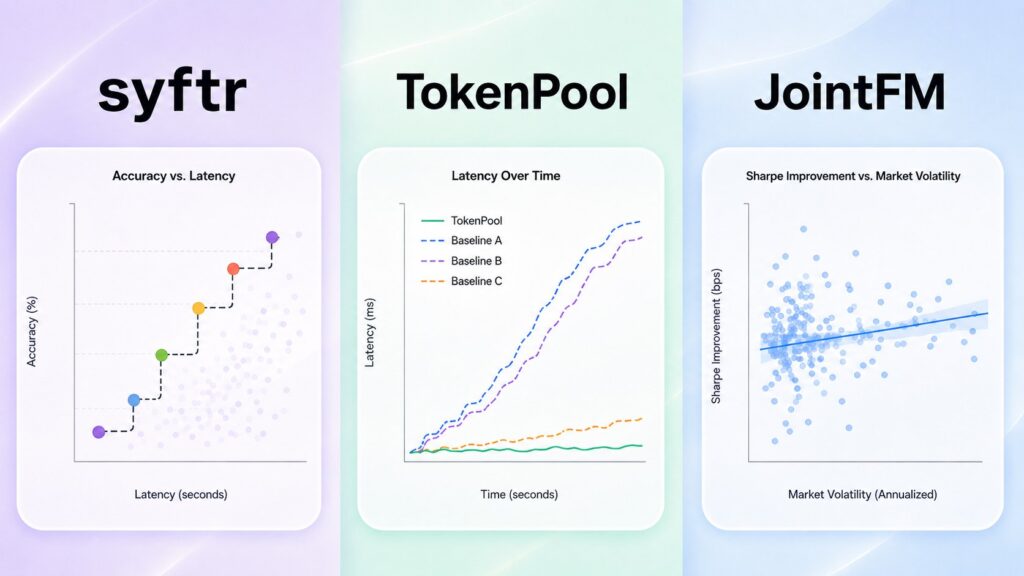
syftr searches that space instead of guessing. It uses multi-objective Bayesian optimization to find Pareto-optimal flows: the configurations where accuracy cannot improve without paying more, and cost cannot drop without losing accuracy. A domain-specific early-stopping mechanism prunes clearly suboptimal candidates before they burn through an evaluation budget, cutting search compute by 60 to 80%. On industry-standard RAG benchmarks, it identifies workflows that cut cost by up to 13 times with only marginal accuracy trade-offs.
syftr doesn’t replace judgment. It gives a data-driven way to navigate a design space too large to reason about by hand, searching across 10 proprietary and open-source LLMs, 13 embedding models, four prompt strategies, three retrievers, and four text splitters, and it produces production-ready pipeline code at the end.
JointFM: give the agent a quant for runtime decisions
Designing the workflow gets an agent built. It doesn’t help the agent make a hard call at runtime. Rebalancing a portfolio, hedging a supply chain, dispatching energy on a grid: these are decisions under uncertainty that depend on the full joint distribution of many coupled outcomes, including how they move together in the tails. Classical quantitative methods model this well but are slow and brittle. Standard time-series foundation models are fast but forecast each series in isolation, missing the cross-variable dependencies that define systemic risk.
JointFM, a foundation model from DataRobot Research, closes that gap. Pretrained on a stream of synthetic stochastic differential equations rather than fit to one dataset, it learns the underlying physics of stochastic dynamics and predicts the full joint distribution of future outcomes in a single forward pass: 10,000 samples across 10 targets and 63 horizons in roughly 10 milliseconds on a single GPU, with a 21.1% reduction in energy loss against the strongest classical baseline in zero-shot evaluation.
That speed is what makes it relevant to agents. When a decision-making agent can resimulate the future in milliseconds, risk-aware reasoning becomes something it does inline, on every decision, instead of a nightly batch job a person waits on. An initial finance application matched the risk-adjusted returns of a classical benchmark while replacing an overnight process with a real-time one. The model is domain-agnostic by construction, so the same capability extends to energy and logistics.
Token Pool: serve every tenant without starving the ones that matter
A well-designed agent with sharp runtime reasoning still has to run somewhere, usually alongside everyone else’s. Multi-tenant inference hits a wall here. Dedicated endpoints strand GPU capacity on idle models. Rate limits treat every token as equal, even though one request can cost an order of magnitude more GPU time than another. Neither approach lets idle capacity be borrowed, and both fall apart under the bursts that characterize real inference traffic. The familiar result: one team’s batch job floods the endpoint, and everyone’s production latency spikes.
Token Pool fixes this at the API gateway, without touching the inference runtime underneath. It expresses capacity in inference-native units, token throughput, KV cache, and concurrency, rather than machine or pod counts. Tenants hold entitlements to a share of a pool, and service classes (dedicated, guaranteed, elastic, spot, and preemptible) set the protection ordering during contention. A debt-based fairness mechanism gives temporarily throttled workloads compensatory priority later, so no tenant is starved and none monopolizes the pool. It runs as a Kubernetes-native layer above vLLM or TensorRT-LLM.
In overload testing, Token Pool held sub-1.2 second P99 time-to-first-token for guaranteed workloads by selectively throttling spot traffic, while a baseline with no admission control degraded past 19 seconds across every workload. For anyone responsible for consumption-based economics or API governance, this is the missing primitive: capacity expressed in units that match what inference actually costs.
The three shipped projects operate as separate links today. Design-time search runs once. Runtime reasoning runs blind to how the serving layer is performing. The serving layer enforces policy without feeding anything back upstream. The workflow syftr found last quarter isn’t necessarily optimal against this month’s traffic, models, and prices.
The next open-source project connects production telemetry, the real cost, latency, and quality signals coming off the serving layer, back to the optimization layer, so workflows get re-evaluated against production reality instead of a single offline benchmark. It’s still in review, so it isn’t named yet, but it’s the natural fourth stage after design, reason, and serve.
Get started
Build: install syftr with pip install git+https://github.com/datarobot/syftr.git and run the starter search
Build: stand up Token Pool against a local Kind cluster, no GPU required
A hands-on guide for each follows next in this series: running a first syftr search and reading the Pareto frontier, calling JointFM for real-time forecasts inside an agent, and standing up Token Pool to protect a production workload from a noisy neighbor. Start with whichever stage of the lifecycle is hurting most.
Their metallic frames covered in supple, lifelike skin, a posse of new Chinese robots meant for companionship can offer users AI-generated conversation or a hand to hold, complete with manicured nails.
While the industry debates models, parameters, and computer architectures, a more consequential story is unfolding at the signal level. Every autonomous system, no matter how sophisticated its software, must sense the real world, respond to it, and act within it.
Congratulations to the Berkeley Artificial Intelligence Research (BAIR) Lab class of 2026! This year, BAIR celebrates another remarkable group of Ph.D. graduates whose curiosity, creativity, and perseverance have pushed the frontiers of artificial intelligence and machine learning.
Their work spans the breadth of modern AI — robotics and embodied intelligence, large language models and reasoning, computer vision, generative modeling, AI safety, human-AI interaction, AI for science and healthcare, and much more. Along the way, they have published influential research, built systems with real-world impact, mentored their peers, and shaped the BAIR community for the better.
Now they are headed everywhere ideas travel: to faculty and postdoctoral positions, to industry research labs, and to startups of their own founding — and several are still exploring what comes next and would love to hear from you.
Please join us in celebrating the achievements of these wonderful graduates. We are proud of everything they have accomplished at Berkeley, and we can’t wait to see what they do next!
WebRTC gets robotics teams to a demo fast. It also breaks the moment the robot leaves the lab. If you are running WebRTC today, the question is not whether you will outgrow it but when, and what the next six months of engineering will be spent on while you do.
A new AI-powered framework could transform how astronomers measure the expansion of the Universe. By analyzing images of Type Ia supernovae and modeling their environments in unprecedented detail, researchers can estimate cosmic distances with near-spectroscopic accuracy. The technique is designed for the flood of data expected from the upcoming Vera C. Rubin Observatory and may greatly improve our understanding of dark energy.
The researchers teach the packaging machine what is up and down on a snack carrot. The program runs on a small, local PC—not on huge servers in some faraway cloud. The goal: to pack quickly, cheaply and attractively—so that consumers like us are tempted by locally sourced, healthy snacks.
Scientists from NTU Singapore and Waseda University have developed a flexible "diving suit" for cyborg cockroaches, enabling the insects to survive and move underwater and in low-oxygen environments for up to three hours. Published today in Nature Communications, the study could expand the use of cyborg insects in search-and-rescue missions, especially in disaster zones where flooded rubble, puddles or partially submerged spaces can block access for conventional robots.
Sensor specifications are only the starting point. Depth accuracy, range, field of view, and frame rate matter because they determine whether a robot can see what it needs to see.
How to Integrate AI with EHR/EMR Systems for healthcare operations?
AI integration with modern Electronic Health Records (EHR) and Electronic Medical Records (EMR) systems will revolutionize healthcare by enhancing clinical decision-making, reducing administrative burden, and allowing for more focused, effective care services delivery. Yet, this revolution is not merely technical; it extends to regulatory, ethical, and organizational concerns soon. Here are the most significant benefits of AI integration with medical systems, possible threats, and best practices for embedding AI in healthcare.
Introduction to EHR/EMR Systems and AI
Electronic Medical Records (EMR) and Electronic Health Records (EHR) are computerized health data recording systems that allow easier access to medical history, diagnoses, treatments, and laboratory findings. While EMRs are typically limited to the records of a single provider, EHRs give a wider picture from a number of different healthcare facilities.
Why Integrate AI with EHR/EMR Systems?
The integration of Artificial Intelligence (AI) into these systems is transforming the healthcare practice, enabling smarter clinical choices, automating time-consuming administrative tasks, and making personalized medicine a reality. By analyzing vast amounts of patient information, AI has the capacity to recognize patterns, predict results, and provide timely, evidence-based interventions, making the coupling of EHR/EMR systems with AI an increasing force in contemporary healthcare.
Key AI Integrations with HER/EMR systems
Data Interoperability
There is a need for smooth data interoperability to enable AI functioning in harmony with EHR/EMR systems. Organized or unorganized data from different sources, such as clinical notes, lab results, radiology reports, and patient-entered data must be populated to the AI models to ensure process efficiency.
Natural Language Processing (NLP)
Data stored in EHRs is unstructured. NLP enables AI programs to read and comprehend significant results from those documents. For example, NLP can extract symptoms, medication details, and test results to input into predictive algorithms and clinical decision support systems.
Predictive Analytics and Machine Learning
Big data may be utilized to train ML models such that healthcare professionals can predict diseases, treatment effectiveness, or risk for complication. These models may be incorporated into the EHR interface to aid in real-time decision-making during the period of patient encounters.
Computer Vision
Computer vision algorithms could be used to read radiology images, pathology slides, or skin photographs. The findings could then automatically be inserted into the patient record.
Best Practices for AI Integration in EHR/EMR
Assess Needs and Goals
Identify what problems you want AI to solve, e.g., reducing readmissions, charting automation, or improving diagnosis accuracy.
Choose the Proper AI Solution
Choose an AI solution that is suitable for your purposes and can be readily integrated with your existing EHR/EMR system. Ensure that it meets healthcare data standards and regulations (e.g., HIPAA).
Guarantee Data Quality and Security
Adequate, clean, and well-organized data are essential for AI to work successfully. Provide privacy, security, and legal compliance.
Engage Clinicians and Staff
Enlist doctors, nurses, and administrative personnel early on. Their input helps ensure the AI system accommodates real workflows and encourages adoption.
Integrate into Existing Systems
Work with IT groups and vendors to incorporate the AI tool into your EHR/EMR. Enable seamless data flows and immediate access to patients’ information.
Train Users
Provide hands-on training on how users must use the AI features properly. Clear out issues and build confidence in the technology.
Test and Validate
Pilot test the start by testing how AI works in reality. Watch for accuracy, fairness, and usability.
Deploy Gradually
Deploy the AI system on phased basis by making changes based on feedback. Do not switch everything at once.
Monitor Performance
Track the performance of the AI system at all times. Is it committing fewer errors? Is it saving time? Is it improving patient care? Analyze every factor.
Update and Maintain
Regularly update the system with new medical guidelines, AI breakthroughs, and data changes to ensure long-term efficiency.
AI Integration with EHR/EMR Use Cases
Clinical Decision Support
Artificial intelligence can provide evidence-based advice in patient consultation. IBM Watson for Oncology, when employed along with EHRs, provides cancer treatment according to clinical guidelines and patient data.
Risk Stratification
Prognostics using algorithms identify high-risk patients who are most likely to develop sepsis, heart failure, or readmission. Notifying alerts can trigger early treatment and care coordination.
Computerized Documentation
NLP tools can capture and document physician-patient conversations with minimal human intervention, auto-fill the fields in the EHR to maintain low documentation time and allow clinicians to focus on high-level patient care.
Population Health Management
AI can be trained from population-level information to identify patterns, monitor chronic disease management, and maximize resource usage.
Revenue Cycle Management
AI technology helps with coding and billing by using clinical documentation intelligence and generating precise billing codes with fewer denials and better revenue capture.
Key Challenges and Considerations
Data Standardization and Completeness: EHR data could be incomplete, inconsistent, or fragmented. Data quality diminishes model performance. Completeness and standardization of data are paramount.
Interoperability Issues: Many EHR vendors use proprietary formats, which create issues with integration. Implementation of standards such as FHIR mitigates such problems.
Compliance with Regulation: Use of AI in EHR systems must be in accordance with health care regulation like HIPAA for the US or GDPR for Europe. Data privacy, patient consent, and audit trails should be implemented compulsorily.
Bias and Fairness: AI models trained on biased datasets can perpetuate or exacerbate disparities in healthcare. Ongoing auditing and fairness assessments are necessary to ensure equitable care delivery.
Clinician Trust and Adoption: Clinicians may be skeptical of AI recommendations, especially if the models are “black boxes.” Transparency, explainability, and clinical validation are crucial for gaining trust.
Cybersecurity Risks: Adding AI components increases the system’s complexity and vulnerability to cyberattacks. Robust cybersecurity measures must be implemented to protect sensitive patient information.
The Future AI in EHR/EMR Systems
As AI and EHR/EMR integration matures, the focus will shift toward more advanced capabilities such as real-time predictive alerts, personalized treatment recommendations based on genomics and social determinants of health, and closed-loop systems that autonomously trigger interventions. Federated learning, where models are trained across decentralized data sources without sharing raw data, offers promising solutions for data privacy and collaboration across institutions. Furthermore, the emergence of explainable AI (XAI) tools will help demystify complex models and increase clinician confidence in AI-driven insights.
Conclusion
Integrating AI with EHR/EMR systems presents a transformative opportunity for healthcareorganizations to improve clinical and operational efficiency, enhance patient outcomes, and reduce costs. While the path to integration is fraught with technical and organizational challenges, adopting a strategic, user-centered, and ethically grounded approach can ensure successful implementation. As the healthcare landscape continues to evolve, the synergy between AI and EHR systems will play an increasingly central role in delivering smarter, safer, and more personalized care.
It’s an exciting time for RoboCup, as there have been some updates to the leagues and competition format. Most prominently, the soccer leagues will have a primary focus on humanoid robots.
The leagues and their competitions
You can find out more about the different leagues and the competition schedules and details at these links:
A workshop focused on sharing projects, experiences, and innovations in educational robotics. This session is geared towards students, mentors, and educators. Find out more here.
Symposium
The RoboCup symposium will take place on 6 July. More information can be found here.
There will be two keynote talks:
Hyun Myung, Spatial Intelligence for Autonomous Robot Navigation in the Wild
Gentiane Venture, From function to meaning: Making robots that understand and belong
Observes writer Craig Hale: “The ROI so far is staggering.”
The newly released AI suite is designed to handle ad creation, testing and launching.
In other news and analysis on AI writing this week:
*Customer Service AI: Most See ROI in 60 Days: 70% of companies using AI for customer service are seeing a return-on-investment in a remarkably short 60 days, according to a new survey.
Observes writer Vala Afshar: “The survey found that the performance metrics that most improved with use of AI Agents include customer satisfaction, service rep productivity, average handling time and customer retention. First-response time was also improved.”
Released by productivity apps maker Salesforce, the survey also found 25% of service organizations documented added value from AI within 30 days.
*AI Cheating Tools for Students: Now a Cottage Industry: Smarting from AI detection tools designed to smoke-out students using the tech to cheat, companies specializing in AI cheating have roared back with a spate of apps designed to outdo the detectors.
Observes writer Ana Maria Constantin: “A wave of apps now rewrites AI essays and types them out with believable typos, beating the software meant to catch them.”
Plus, finding such tools is a cinch, given that TikTok and YouTube are flooded with videos promoting and selling the cheating tools.
Observes writer Aisha Malik: “The new app, which is currently being tested with select creators, will have Facebook’s recently launched AI creator assistant built into it.
“The assistant provides creators with personalized recommendations based on their content style, performance, audience engagement, and goals.”
Observes writer Sead Fadilpasic: “Senator Mark Warner testified NSA confirmed Mythos Preview identified vulnerabilities in nearly all classified systems within hours during a controlled exercise.”
Even worse: The security holes were found in hours, not weeks.
The US government forbade use of Mythos 5 by foreign countries after it was discovered the AI can uncover security vulnerabilities in scores of software apps once perceived as safe by human security testers.
The move is part of a larger trend that appears to be gelling as a new reality: AI has become so powerful and in some cases so threatening, it needs to be green-lighted by the US government before it’s released to the general public.
Observes the OpenAI Blog: “We are taking this short-term step because we believe it is the strongest path to broader availability in the coming weeks, while we work with the Administration to develop the cyber Executive Order framework and a repeatable process for future model releases.”
*China Closing in on US AI: China’s newest, top AI offering, GLM-5.2, is nearly as good as what you can get from US AI titans – at one-sixth the cost, according to writer Luis Blanco.
Observes Blanco: “The gap between Chinese open models (AI that’s available for download free) and the very top closed US systems has shrunk faster than most industry forecasts had anticipated.”
Moreover, US companies that subscribe to turnkey Chinese AI run on Chinese servers can sometimes do the same AI work on those servers for one-tenth the cost, compared to US AI solutions.
Observes Editor & Publisher: “Unlike other AI systems trained on publisher content without attribution or compensation, NewsGuard AI prominently cites publishers in its responses and will share revenues 50-50 with all news publishers whose journalism is cited.
“NewsGuard journalists trained NewsGuard AI with 41 editorial safeguards designed to provide responses that cite sources for every fact, report all sides of a story even-handedly with nuance, and suggest follow-up prompts based on a reader’s interests. Users will also be able to search the ratings of news sites and access NewsGuard’s Reality Check daily newsletter.”
The guide offers the top 100 tips for getting the most from ChatGPT when you’re at work.
The guide also features key use cases for ChatGPT at work as well as best practices for implementing ChatGPT in the workplace.
Share a Link: Please consider sharing a link to https://RobotWritersAI.com from your blog, social media post, publication or emails. More links leading to RobotWritersAI.com helps everyone interested in AI-generated writing.
–Joe Dysart is editor of RobotWritersAI.com and a tech journalist with 20+ years experience. His work has appeared in 150+ publications, including The New York Times and the Financial Times of London.
Enterprises can govern model context protocol (MCP) connections at scale by treating them as part of the agentic AI control plane. Every MCP server, exposed tool, permission, and agent relationship needs ownership, scope, monitoring, and auditability before it supports autonomous work.
MCP governance is the discipline of controlling how AI agents discover, select, invoke, and compose external tools through MCP connections. It gives enterprises a way to manage the point where agent reasoning becomes action.
Let’s explore the governance risks MCP connections create, how agent autonomy expands enterprise attack surfaces, the control points where planning becomes execution, and the governance practices that keep MCP connections auditable and bounded.
Key takeaways
MCP gives agentic systems a standard way to invoke tools, execute actions, and observe outcomes inside autonomous workflows.
Every MCP connection expands the agent’s decision surface, including tool selection, parameter binding, return handling, and downstream action.
Governance teams need visibility into MCP servers, exposed tools, connected agents, decision constraints, and invocation patterns.
MCP governance should include ownership, scoped permissions, runtime monitoring, audit trails, access reviews, and reapproval triggers.
The biggest risk of unmanaged MCP connections is uncontrolled agent autonomy inside enterprise systems.
What is MCP in agentic AI?
Model context protocol is the invocation standard that lets agentic systems reach external tools, execute actions, and observe outcomes inside autonomous workflows. MCP sits between the agent’s planning layer and the systems it can invoke.
At a technical level, MCP uses a host-client-server architecture. The host is the AI application, the client manages the connection, and the MCP server exposes capabilities such as tools, resources, and prompts. In enterprise environments, the highest-risk capabilities are usually tools because tools let agents query databases, call APIs, update records, trigger workflows, or perform computations.
This changes how agents operate. A support agent can plan a response, retrieve ticket history, make updates, and coordinate follow-up actions in one loop. A developer agent can reason about code repositories, run tests, and plan deployments. A finance agent can retrieve reports, trigger approvals, and track outcomes.
Once an agent can execute MCP tools, enterprises need to know what the agent is authorized to reach, what decisions it should make, which tools it actually invokes, and whether its decision trace can be reviewed.
Why do MCP connections create governance risk?
MCP connections create risk by giving agents a structured invocation surface inside their planning loops. Once an agent can invoke an MCP server, it may retrieve context, call functions, trigger actions, and incorporate tool returns into subsequent planning steps, often inside an autonomous loop with limited human oversight.
Risk
What happens
What teams need to watch
Tool semantic failure
The agent misunderstands what a tool does or when to use it
Tool descriptions, preconditions, side effects, hallucinated tools
Cascading exposure
One tool return becomes context for another tool call
Cross-tool data flow and downstream access
Unreviewed execution
The agent executes tool sequences without intermediate review
Planning steps, constraint checks, loop behavior
Runtime tool expansion
The MCP server exposes new tools after agent approval
Server changes and approval drift
Prompt injection
Tool return data steers the agent’s next planning step
Return validation and unexpected actions
Tool poisoning
Tool metadata or descriptions contain hidden instructions
Tool descriptor integrity and server trust
Tool hallucination and semantic confusion
Tool hallucination is one of the most serious MCP governance risks. An agent with access to a customer database might hallucinate a get_customer_credit_score tool that does not exist, or misread get_account_balance as set_account_balance. The names are semantically similar, but the business impact is completely different.
Agentic systems cannot assume tools are real or that agents understand them correctly. Governance teams need to control which tools agents can see, how tools are described, what input schemas apply, what side effects are possible, and how semantic confusion is detected in production.
Cross-tool dependencies
Cross-tool dependencies create cascading risk. An agent may retrieve sensitive data from System A, then use it to call System B. A single permission can unlock exposure across multiple systems when agents compose tools inside autonomous loops.
Governance needs to account for composition, sequence, context, and data flow. Reviewing individual tool access is not enough when agents can connect tool outputs to downstream actions.
Autonomous execution
Agents execute multi-step workflows autonomously. If the agent selects the wrong tool, misreads a return, fails to check a constraint, or continues acting after the workflow should have stopped, the error can propagate until the loop ends or monitoring catches the drift.
MCP governance needs visibility into planning context, tool selection, parameter binding, return validation, and loop behavior. Final outcomes alone do not show where the control failure occurred.
How can MCP turn planning into action?
MCP connections move agents from passive retrieval to active decision-making and execution. Governance teams need to understand how agents decide to invoke tools, what data they use, and how they handle the result.
Tool selection, parameter binding, return handling, constraint checking, and loop termination are the core control points. These are the places where an agent’s plan becomes an action inside enterprise systems.
Control point
Governance question
Common failure mode
Tool selection
Which tool did the agent choose, and why?
The agent selects the wrong tool or misunderstands tool semantics
Parameter binding
What data did the agent pass into the tool?
The agent uses unexpected values, malformed identifiers, or data from the wrong source
Return handling
How did the agent interpret the tool response?
The agent trusts corrupted, incomplete, or adversarial return data
Constraint checking
Did the agent validate conditions before acting?
The agent invokes tools outside approved preconditions
Loop termination
When did the agent stop acting?
The agent continues invoking tools past the approved workflow
When an agent has multiple tools available, governance teams need to know which tool it selects and whether that selection matches intended behavior. Parameter drift can turn safe actions into high-risk actions if the agent pulls unexpected values from prior tool returns or binds identifiers it should not use.
Return validation is equally important. Agents that do not validate returns can continue planning from corrupted context, which can lead to bad downstream actions even when the first tool call succeeded. Weak termination conditions can also cause agents to keep invoking tools past the approved workflow, making loop length, retry behavior, and timeout patterns important monitoring signals.
How can MCP permissions drift in agentic workflows?
MCP access changes as agents, tools, prompts, servers, and workflows evolve. Permission drift is harder to detect in agentic systems because tool invocation happens autonomously. Quarterly access control audits prevent permission sprawl as MCP connections accumulate access over time, making calendar-based reviews essential alongside change-triggered reviews.
Drift does not always require a formal access change. The same agent can become riskier when its prompt changes, its toolset expands, its workflow changes, its model changes, or it starts composing tools in new ways.
Scope expansion through tool composition
An agent approved to invoke Tool A and Tool B independently may later start composing them: invoke Tool A, use the output to parameterize Tool B, and create a new workflow. The original approval covered individual tool use, but not the composed behavior or data linkage.
Tool composition should be governed explicitly. Teams need to know which tool sequences are approved, which data linkages are allowed, and which compositions require human review.
Tool exposure without reapproval
An MCP server may originally expose one tool. Later, additional tools are added. The agent’s permission record does not change, but the decision surface expands.
The agent now faces tool choices it was never approved to make. MCP server changes should trigger governance review, even when the agent’s access record appears unchanged.
Agent behavior changes after updates
Prompt modifications, model changes, retrieval changes, routing changes, or new system instructions can alter how agents choose tools and handle returns. Earlier governance approvals reflect old behavior.
Access review needs to account for agent change, not only server change. Teams should review whether the updated agent still exercises the same decision authority in the same way.
Implicit dependencies across systems
An agent may be approved to invoke Tool A, which reads from System 1, and Tool B, which writes to System 2. The approval may not cover Tool A’s output becoming Tool B’s input.
Autonomous loops make these linkages likely. Governance records should capture approved tool compositions, prohibited data flows, and conditions that require human review.
Periodic MCP reviews should examine actual behavior, not documented access alone. Teams should review tool invocation patterns, constraint violations, tool composition behavior, and changes in agent decision traces over time.
Why does MCP activity need traceability?
Governance teams need records that capture what the agent did and why. This means every MCP connection should produce a reviewable audit trail. Decision-level audit trails are non-negotiable in regulated industries. Every autonomous tool invocation, parameter binding, and return validation step must be traceable and defensible for compliance and drift detection.
Traceability makes agent behavior inspectable after execution. When an agent invokes the wrong tool, teams need to reconstruct the decision chain: planning context, selected tool, parameters bound, tool returns, validation steps, and downstream actions.
For compliance, audit trails must show planning context, selected tools, constraints checked, and outcomes. For drift detection, audit trails reveal why tool invocation patterns shift. For constraint violations, audit trails help determine whether the cause was a reasoning error, weak guardrail, corrupted return, unclear tool semantics, poisoned metadata, or missing constraint.
A useful audit trail for MCP-connected agents should answer:
Which agent acted?
Which MCP client and server were involved?
What was the agent’s planning context at tool selection?
Which tool did it invoke, and why?
What parameters did it bind?
What data did the tool return, and was it validated?
How did the agent incorporate the return into the next planning step?
What outcome followed?
What should enterprises govern in MCP connections?
Enterprises should govern the full MCP connection layer: the server, the capabilities it exposes, the agent’s decision authority, the constraints that apply, and how actions can be audited. Access control is often the foundational layer. Teams need to define which tools agents can invoke, under what conditions, and within which business boundaries.
Governance area
What teams need to define
Server ownership
Who owns and approves the MCP server
Exposed tools and semantics
What each tool does, including input schemas, preconditions, and side effects
Tool invocation preconditions
When tools can be invoked and which conditions must hold
Connected data sources
What data agents can access and pass downstream
Agent identity and authorization
Which agent uses the connection and what decision scope it has
Permissions and constraints
What agents can read, write, update, delete, or trigger
Parameter constraints
Allowed numeric ranges, identifiers, formats, and tenant boundaries
Business scope and termination
Which workflow is supported and when the agent should stop
Tool composition rules
Which tools can be composed and in what sequences
Return data validation
How tool returns are validated before agent use
Runtime monitoring signals
Signals that indicate normal, anomalous, or policy-violating behavior
Audit trail requirements
Records for planning context, tool selection, parameters, returns, and outcomes
Review cadence and triggers
How often access is reviewed and which changes trigger reapproval
This governance record gives teams a clear view of which MCP connections are approved, which agents depend on them, which systems they reach, and which invocation patterns should be flagged for human review.
How can enterprises operationalize MCP governance?
Enterprises can operationalize MCP governance by turning agent behavior validation into a repeatable workflow. Every MCP server should be inventoried, classified by risk, scoped to the agent’s decision authority, monitored in production, and reviewed as agents, tools, and workflows evolve.
Discovery and mapping
Governance teams need a current inventory of MCP servers, exposed tools, connected data sources, approved agents, and authorized workflows. Each agent in that inventory should operate with unique credentials and least-privilege permissions scoped to the specific MCP tools and business purposes it’s authorized to invoke.
Access to an MCP server should not automatically imply approval to invoke every tool. For each agent, teams should define which tools it can invoke, under what conditions, with what parameter constraints, and for what business purpose.
Risk classification and monitoring
MCP connections should be classified based on tool semantics, data sensitivity, action impact, authorization model, constraint complexity, and composition risk. Higher-risk connections need stricter approval, tighter constraints, stronger monitoring, and more frequent behavioral validation. An AI gateway or centralized control layer can provide a consistent enforcement point for MCP tool access, parameter constraints, rate limits, and audit logging across agents, reducing the need to re-implement governance logic inside every agent workflow.
Production monitoring should surface tool selection patterns, constraint compliance, parameter behavior, hallucinated tools, return handling, tool metadata changes, and reasoning consistency. Teams need to know whether the agent is exercising approved authority or drifting into unexpected behavior.
Review and reapproval
Calendar-based reviews should evaluate invocation patterns on a regular cadence. Change-triggered reviews should happen when agents, prompts, models, tools, servers, or workflows are updated. This operational discipline works best when governance, observability, and audit logging are built into architecture from day one. Retrofitting governance is far more expensive than designing it into the MCP connection lifecycle.
At enterprise scale, MCP governance works like access control for autonomous systems. Teams define authority, approve connections, monitor the exercise of authority, review changes, and revoke access when it is no longer needed.
What questions should teams ask before approving an MCP connection?
Teams should approve MCP connections only after understanding the agent, business purpose, tools involved, data at risk, constraints, and audit requirements. The approval process should make the agent’s decision authority explicit before it invokes tools in production.
Agent and authority
Which agent uses this connection?
What is its approved business purpose?
Who owns the agent?
What decisions should the agent be allowed to make through tool invocation?
Business context
Which workflow does this support?
What does success look like?
How will the agent know when to stop?
What is the impact if the agent makes a wrong decision?
Technical specifics
Who owns the MCP server?
Which specific tools should the agent invoke?
What preconditions and side effects apply?
What data can the agent retrieve, modify, or pass downstream?
Constraints and scope
Who owns the MCP server?
Which specific tools should the agent invoke?
What preconditions and side effects apply?
What data can the agent retrieve, modify, or pass downstream?
Under what conditions should each tool be invoked?
What parameter ranges are allowed?
Which tools should never be invoked?
Which tool compositions are approved?
Data and safety
What data is at risk?
How will tool returns be validated?
What signals indicate anomalous behavior?
How will reasoning drift be detected?
Monitoring and audit
What logs capture planning, tool selection, parameters, returns, and outcomes?
How will teams detect tool hallucination?
How often will behavior be reviewed?
Which changes should trigger reapproval?
These questions turn MCP approval into an operating discipline. Teams get a repeatable way to evaluate decision authority, document constraints, monitor actual behavior, and keep governance aligned.
MCP governance checklist
Enterprises can use the following checklist to govern MCP connections at scale:
Inventory all MCP servers and exposed tools.
Assign ownership for each server, tool, and connected agent.
Define which agents can invoke which tools.
Scope permissions by business purpose, data class, and action type.
Document tool preconditions, side effects, and approved compositions.
Validate tool returns before agents use them in follow-on actions.
Monitor invocation patterns, constraint violations, and permission drift.
Capture audit logs for planning context, selected tools, parameters, returns, and outcomes.
Trigger reapproval when prompts, models, tools, servers, workflows, or agent behavior changes.
Govern MCP as part of the agentic AI lifecycle
MCP governance is part of the larger agentic AI governance challenge. As agents gain access to more tools and workflows, enterprises need governance covering identity, permissions, monitoring, auditability, and fleet-level oversight.
For executives, MCP governance is not only a security concern. It affects operational risk, compliance exposure, customer trust, data governance, and the ability to scale agentic AI safely across the enterprise.
The same principles apply across the full agentic lifecycle. Teams need to govern how agents are approved, how they access tools, how they behave in production, how their actions are audited, and how access changes as systems evolve.
MCP connections should not be treated as ordinary integrations. They are part of the agentic control plane, where model reasoning, enterprise data, and system action converge.
For a deeper look at how enterprises can govern agents, tools, permissions, monitoring, and auditability across the full agentic AI lifecycle, download our Enterprise guide to agentic AI.
FAQ
What is MCP in agentic AI?
Model context protocol is the invocation standard that lets agentic systems reach external tools and execute autonomous actions. MCP can connect agents to document repositories, databases, ticketing platforms, developer tools, customer applications, internal APIs, and workflow systems.
What is MCP governance?
MCP governance is the discipline of controlling how AI agents discover, select, invoke, and compose external tools through MCP connections. It includes ownership, authorization, scoped permissions, tool constraints, runtime monitoring, audit trails, and reapproval triggers.
Why do MCP connections need governance?
MCP connections need governance because agents make autonomous decisions about tool invocation inside planning loops. Agents can hallucinate tools, misunderstand semantics, invoke tools with wrong parameters, compose tools unintentionally, or be steered by corrupted returns.
How can enterprises govern MCP connections at scale?
Enterprises can govern MCP connections at scale by maintaining a central inventory tied to agent decision authority, classifying connection risk, scoping permissions to specific tools, monitoring tool selection patterns, capturing audit trails, and reviewing access based on calendar cadence, system changes, and behavioral signals.
What should enterprises include in an MCP governance record?
An MCP governance record should include server ownership, exposed tools, tool semantics, invocation preconditions, connected data sources, agent identity, decision authority, permissions, parameter constraints, business scope, tool composition rules, return validation, monitoring signals, audit requirements, and review triggers.
What is the biggest risk of unmanaged MCP connections?
The biggest risk of unmanaged MCP connections is uncontrolled agent autonomy. Agents may hallucinate tools, invoke real tools with misunderstood semantics, compose tools in unintended ways, or be misled by corrupted returns without clear decision authority, approved constraints, runtime visibility, or reliable logs.