Page 9 of 715
1 … 7 8 9 10 11 … 715

Team develops embodied robotic arm ‘EmArm’ with human-like touch sensing

A research team at The Hong Kong University of Science and Technology (HKUST) has developed an Embodied Sensorimotor Robotic Arm (EmArm) capable of whole-arm tactile sensing and adaptive manipulation. By embedding a soft optical tactile skin directly into a robotic skeleton and integrating it with a real-time decision-making algorithm, EmArm can perceive and analyze contact information across its upper and lower arms, enabling human-like tactile perception and adaptive object manipulation. The system can also distinguish between different touch interactions, such as tickling and patting, respond in real time and avoid obstacles through tactile feedback, opening new possibilities for the development of embodied intelligent robots.

The Four Pillars of 100% Inventory Accuracy, and Where Most Automated Cycle Counting Systems Fall Short

Inventory accuracy breaks down at four distinct pillars: how often a warehouse counts, how much of the facility that count actually covers, how much the capture actually tells you about what is on the shelf and how quickly that data reaches the WMS.

Robot Talk Episode 166 – Evolving robot bodies and brains, with Rika Antonova

Claire chatted to Rika Antonova from the University of Cambridge about using artificial intelligence to develop complimentary robot hardware and algorithms.

Rika Antonova is an Associate Professor at the University of Cambridge. Her research interests include co-design, automated algorithm discovery, data-efficient reinforcement learning, exploration, active learning, and​ robotics. After completing a research Master’s degree at the Robotics Institute at Carnegie Mellon University and a PhD at KTH Royal Institute of Technology, Rika undertook a Computing Innovation Fellowship at Stanford University. Before that, she was a senior software engineer at Google.

Cleaning a giant ship: Roomba-like robots walk on magnetic feet to scrub giant ships

Timothy Wong didn't suspect it at the time, but his dives off the coast of Rockport and the hours he spent studying the wheels and gears of robotics were leading to one mission: figuring out a way to get unwanted sea matter off giant ships in need of cleaning.

How Much Does It Cost to Develop An AI based LMS App?

How Much Does It Cost to Develop An AI based LMS App?

How To Develop An AI-Based Learning Management System?

Artificial Intelligence (AI) in the education sector is playing a vital role in streamlining the entire education system. Of course, the impact of AI and other modern technologies across various industries is positive. The potential of AI’s automation capabilities in the development of intelligent and innovative Learning Management systems (LMS) is high then we predicted.

Artificial intelligence-powered learning platforms are enabling virtual teaching or learning experiences and taking educational services to new heights. Besides, the demand for LMS software from corporate companies is also high. Organizations have been increasing the use of LMS software for better tracking and managing their admin and employee skill training and onboarding activities.

How Much Does It Cost to Develop An AI based LMS App? 2


These two trends are significantly contributing to the popularity of LMS applications. During the COVID season, the demand for AI-based digital learning management platforms has experienced a sharp hike compared to the months before the pandemic.

The market size of AI learning management system is reached $14 billion in 2021. According to the market research reports, the market size of the global learning management system will further span its significance across the education sector and is anticipated to reach approximately $41 billion by 2029. Mobile education apps, e-learning platforms, and other interactive online learning applications are the major drivers for such massive growth.

How AI Is Used In LMS?

 AI can be used to improve the entire functionalities and performance of LMS solutions. Virtual assistants, voice recognition bots, facial recognition-based attendance trackers, intelligent analytics and reporting tools, automated knowledge testing modules, and in many ways AI technology can be used to augments the functionalities of LMS. 

Benefits Of Artificial Intelligence In LMS Development 

Benefits Of Artificial Intelligence In LMS DevelopmentAI-based LMS software development will provide numerous advantages to education service providers. In this session, we have curated a few of the top benefits of AI-powered learning management apps. Here we will learn the benefits of ai in LMS platforms or the benefits of artificial intelligence in LMS platforms or advantages of using AI in LMS or AI based learning management system.

  • AI-powered learning management platforms streamline the entire teaching and learning ways.
  • AI-based learning management applications for Android, iOS or web OS will assist educators or training institutes to deliver improved virtual learning experiences.
  • With the integration of audio and video-enabled open online classes, AI digital learning solutions enhance user personalization.
  • Content access and knowledge sharing will become seamless over secure cloud-enabled LMS platforms.
  • The use of AI in learning management apps development automated admin processes and augments documentation management functionalities
  • AI-based corporate LMS software will help companies to track and better manage their employee training and onboarding functionalities.
  • The use of Artificial intelligence in LMS solutions will monitor the user’s learning patterns and automatically customize the content for improving their abilities.
  • Using AI in LMS software development, users can view the content in their preferred languages and increase their learning experiences.
  • AI-enabled chatbot or virtual tutor module in LMS apps will interpret user voice commands or written text and automates the training process by giving accurate responses in seconds. As self-learning chatbots learn from previous experiences, they can provide instructor-like support to the trainees.

These are a few benefits of AI in LMS apps. AI-driven LMS applications automate and modernizes end-to-end training and learning procedures. Overall, AI-based LMS platforms will make learning ways more interactive and interesting.    

How Much Does It Cost to Develop An AI based LMS App? 4

How To Build An AI-Based Learning Management System?

If you are in plan to develop an advanced Artificial Intelligence powered LMS solution for organizations or training institutions, you must follow a few steps for the development of a robust software application. Being a top AI development company, we have curated our proven experience in the development of LMS software.

Key Steps To Follow For Developing AI-driven LMS Software: 

  • Step-1: Estimate the AI need for Your LMS Project

AI is a must-to integrate technology in e-learning mobile app development. Before commencing the software development process, you must evaluate the need for AI for your project.

Even though the technology is best at automating repetitive functionalities, one must also look into AI development and implementation costs.  Hence, according to the app requirements and business objectives of the end user, step forward to integrate AI features into LMS solutions.

  • Step-2: Gather and Be Ready With Data  

Data is key for training AI algorithms and meeting the app’s goal and vision. Until and unless you feed the AI algorithms with the appropriate datasets, never expect robust performance from the AI solutions.

Whether it is educational LMS software or corporate LMS software solution, data is a must. So, gather the required datasets from respective communities and customize the data as per your project needs. Rather than spending too much time collecting and categorizing the data, this process will save time and makes the development faster.

  • Step-3: Focus On Privacy and Security 

AI-powered LMS solution needs to store enormous user data and manage application content. Further, LMS apps offer content accessibility and sharing over digital platforms. Hence, enhancing the security levels and providing privacy to the user data is a key functionality of LMS software applications.

However, AI algorithms can identify irregular data patterns and prevent data threats seamlessly. Before starting the development process, be organized to ensure high-level encryption of the user data.

  • Step-4: Make a List Of Core Features

It is one of the significant phases of software development. Identifying and listing the features of applications is a core task for app developers.

As per the project requirements and client needs, pick the core features (like user profile, learning materials, knowledge testing, performance reports, notifications, audio/video online learning facility, download content for offline tracking, integrations, etc.) for learning management system development.

  • Step-5: Develop Module & Test Your Solution By Feeding Different Datasets   

Once a custom AI-powered LMS software module is developed, feed your AI solution with different datasets and monitor the outputs. Such thorough testing processes will assist you in measuring the performance and efficacy of your LMS applications.

Further, based on the type of LMS solution, mobile app developers also need to design the UX/UI to better engage users and increasing application quality. 

Hire the best LMS app development company!

  •  Step-6: Hire A Leading AI-based LMS Platform Development Company

Hiring a top custom mobile app development company for developing a flawless and interactive LMS solution is important. Hire USM, the best custom e-learning app development company in the USA and India. We have a team of full-stack app developers and creative designers who build best-in-class LMS platform with the most advanced AI features.

Get a free app quote for LMS development!

[contact-form-7]

How Much Does It Cost To Develop An LMS?

The cost to develop an e-learning app or LMS software will be approximately $35,000-$70,000. But, the final cost is analyzed based on the factors like app design complexity, features list, app development platform, app type (native, hybrid, or cross-platform), technology stack, and third-party integrations. If you want to know How to build an ai based learning management system or How much does it cost to develop LMS system or How much will it cost to develop a custom lms or any other queries related to cost you can reach us.

USM Business Systems is the best mobile app development company, and a top-ranked e-learning app development company in the USA and India. We create collaborative digital learning platforms for education and corporate sectors.

Get In Touch!


[contact-form-7]


Related Tags: How much does a learning management system cost, How much does it cost to develop an LMS, cost of Developing an ai based learning management system, How much does a learning management system platform cost, How much does it cost to develop LMS system  & custom LMS app development cost

AI drone outpaces former world champions using one camera and no GPS

What does it take for an autonomous robot to be faster around a course than human drone pilots? At these dizzying speeds, humans need lightning-fast reflexes. Researchers at Delft University of Technology (the Netherlands) have developed an AI system that enables a racing drone to navigate demanding courses at extreme speed using only a single camera. It outperformed even former world champion human drone pilots in a race.

Neurosymbolic planning using natural language communication for cooperative autonomous vehicles

Imagine you are driving toward an intersection. A truck parked on the corner blocks your view of a car speeding toward the intersection from the right. You can’t see it, but the car next to you can. What if that neighboring vehicle could simply tell your car,

“Vehicle merging from the right, about 15 meters away, moving quickly.”

Your car now knows something its own sensors could never observe.

This simple idea of cars helping each other by describing what they see in natural language motivates UNCAP, our new framework for cooperative autonomous driving. But there’s an important twist: not every neighboring vehicle is worth listening to, and not every message deserves the same level of trust.

UNCAP teaches autonomous vehicles both who to talk to as well as how much to trust what they hear.

Why should cars talk with language instead of sharing sensor data?

Researchers have since long envisioned fleets of autonomous vehicles cooperating to make driving safer. Blind corners, occlusions, and hidden pedestrians will become much less dangerous if nearby cars can share what they observe.

The traditional approach is straightforward: cars can exchange raw sensor data such as camera images, LiDAR point clouds, or radar measurements. However, this quickly becomes impractical to be implemented at scale for a variety of reasons. Raw sensor streams consume enormous bandwidth, require significant computation to process stream data, and assume that every vehicle has comparable sensing hardware. In reality, with the rise of autonomous driving, the roads are instead observing a mixture of manufacturers, sensor configurations, and heterogenous software stacks. Natural language offers an intriguing alternative to sensor data sharing. Instead of transmitting megabytes of images, a vehicle might simply say, “pedestrian crossing behind bus” or “motorcycle approaching from the left, fast-moving”. These messages are tiny, hardware-agnostic, and immediately understandable by modern vision-language models across the spectrum.

But language introduces a new problem. At a busy intersection, a vehicle might have ten or twenty neighbors. Should it listen to all of them? And if two vehicles disagree, whose description should it believe? UNCAP answers all these questions!

How UNCAP works

An appeal of UNCAP is that it works entirely in a zero-shot manner. Instead of training a new model (which is resource intensive), UNCAP has a “Bring-your-own-model” strategy. It builds on existing vision-language models and adds a communication strategy that allows vehicles to cooperate intelligently. The UNCAP framework includes four stages.
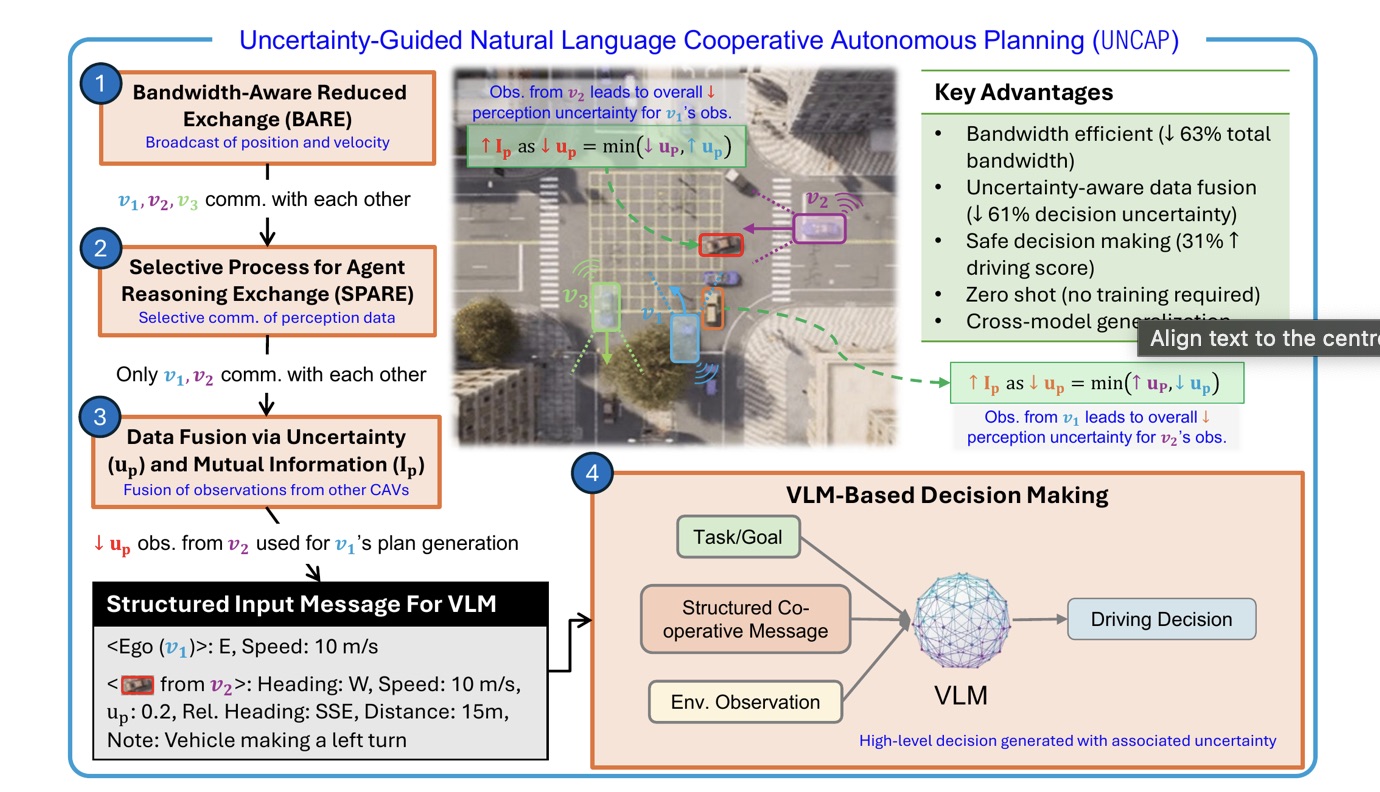
UNCAP helps each vehicle decide which neighbors matter. Those messages describe nearby vehicles, motion, and confidence, which UNCAP combines before making a driving decision.

1. Discover nearby vehicles

Each vehicle periodically broadcasts a tiny “heartbeat” of information containing only its position and direction of travel. This heartbeat consists of only a few bytes of data. The aim is to provide just enough context for nearby vehicles to understand who is around them.

2. Decide who matters

On the road, most nearby vehicles are irrelevant. A car traveling away from the intersection provides little useful information, whereas a vehicle approaching the same intersection may offer exactly the observations we need. UNCAP reasons about which neighbors are both close enough and likely to affect the vehicle’s future path. This is crucial as it dramatically reduces the bandwidth of unnecessary communication as well as the computation required by downstream stages. It enables UNCAP to scale to handle large teams.

3. Exchange observations and reason about trust

Relevant vehicles then describe what they see using natural language, accompanied by calibrated confidence estimates. Calibration is desirable as it produces reliable uncertainty estimates. UNCAP uses conformal prediction, which is a lightweight calibration method that ensures confidence values reflect the actual reliability of the information being received. Every vehicle then reasons about whether an incoming message actually reduces its uncertainty about the scenario. To answer this, UNCAP measures the mutual information contributed by each incoming observation. Mutual information ensures that the vehicle can give greater weightage to messages that make the scene clearer, while uninformative or potentially misleading observations are discounted. Rather than blindly treating every neighbor homogenously, each vehicle builds an uncertainty-aware understanding of the environment.

4. Make a driving decision

Finally, the scene description generated by reasoning about all incoming messages is passed to an off-the-shelf vision-language model, which produces a driving decision such as merge, wait, or yield, along with a corresponding confidence score.

What did this research teach us?

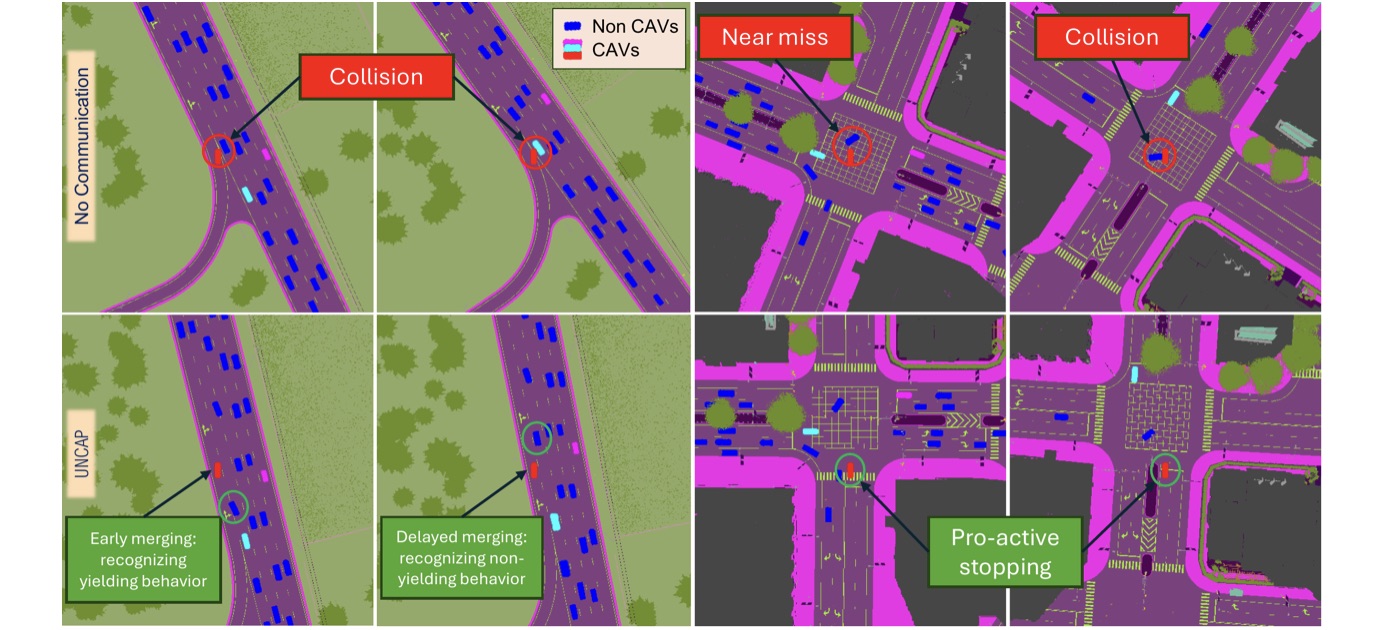
We evaluated UNCAP in the popular CARLA driving simulator using the OPV2V benchmark, which is a widely used benchmark by autonomous driving researchers. OPV2V includes highway merging, urban intersections, and other scenarios where vehicles frequently experience occlusions.

These bird’s-eye-view (BEV) examples compare driving with and without UNCAP. With selected helper messages, vehicles behave more proactively in merging and intersection scenes.

Compared with non-communicating vehicles, and compared with prior language-based approaches that blindly broadcast every observation to every other car, UNCAP consistently improved both efficiency and safety. Over various scenarios, our experiments yielded key qualitative gains of UNCAP over traditional cooperation schemes include:

  • 63% less communication bandwidth
  • 31% higher driving score
  • 61% lower decision uncertainty
  • 4× larger safety margins during near-miss events
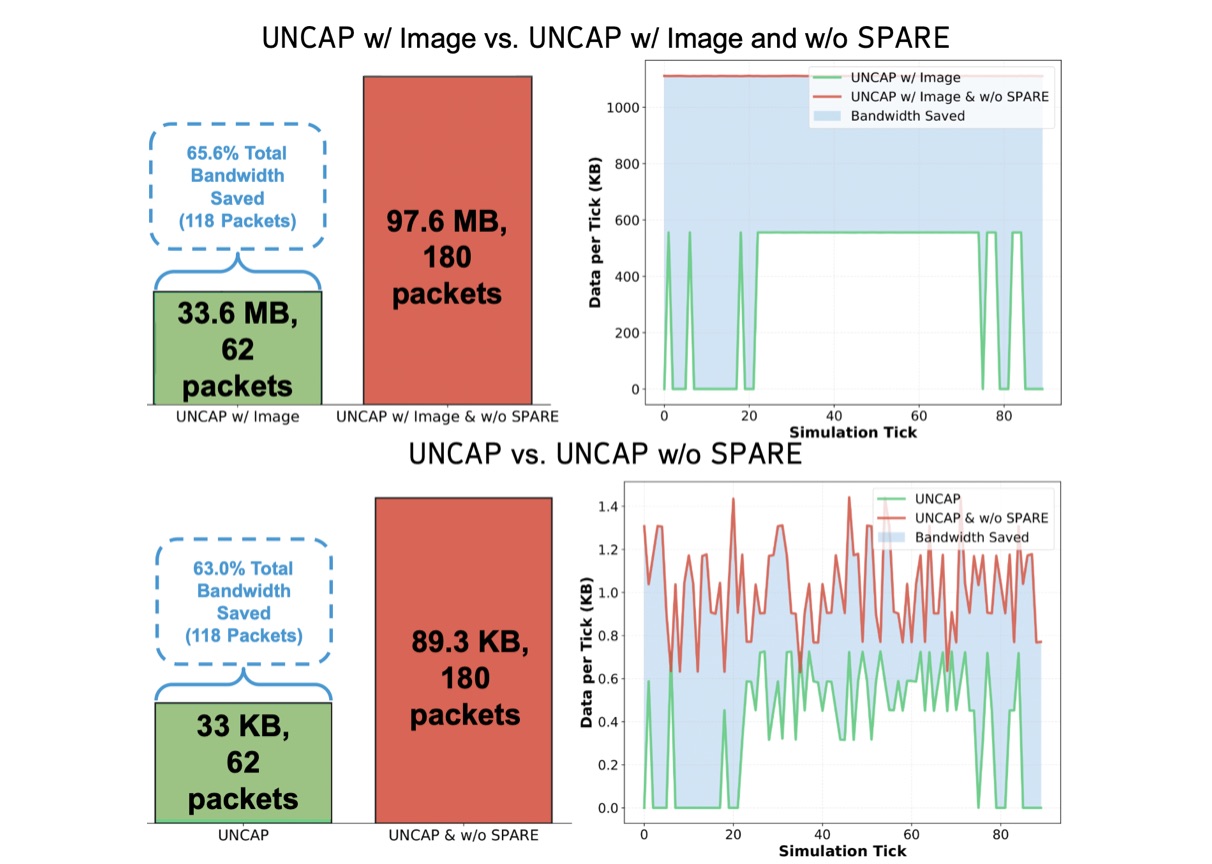
UNCAP avoids broadcasting every observation to every nearby vehicle. It sharply reduces bandwidth while preserving the information needed for a driving decision.

Perhaps the most surprising result was that sharing raw images actually performed worse than sharing language.

Modern vision-language models appear to struggle when jointly reasoning over multiple camera feeds captured from different viewpoints. Translating those observations into concise natural-language descriptions first seems to act as a form of structured reasoning, distilling the essential information before it reaches the decision-making model.

Equally encouraging, the improvements were consistent across several underlying vision-language models, including GPT-4o, GPT-4.1, GPT-4o-mini, and GPT-5. This suggests that the benefits stem from the communication strategy itself rather than from any particular model.

Looking ahead

UNCAP is an early step toward autonomous vehicles that cooperate more like human drivers.

Today’s implementation has important limitations. Our experiments are limited to simulation, so real-world constraints such as noisy sensing, unreliable wireless communication, network delays and packet losses remain to be explored. Finally, because querying today’s vision-language models takes roughly a second, decisions are made at key moments rather than continuously.

That being said, the broader message extends well beyond autonomous driving.

As AI systems increasingly operate in teams, whether fleets of robots, drones, or software agents, the challenge is no longer simply making each agent smarter. The critical need of the hour is to ensure that each agent in the team learns how to communicate efficiently, decide which information to trust, and build a shared understanding of the world.

In a nutshell, UNCAP suggests that natural language, paired with principled reasoning about uncertainty, can provide a surprisingly effective foundation for that future.

Read the paper in full

UNCAP: Uncertainty-Guided Neurosymbolic Planning Using Natural Language Communication for Cooperative Autonomous Vehicles, Neel P. Bhatt, Po-han Li, Kushagra Gupta, Rohan Siva, Daniel Milan, Alexander T. Hogue, Sandeep P. Chinchali, David Fridovich-Keil, Zhangyang Wang, Ufuk Topcu.


This work was nominated for the AAMAS 2026 best paper award.

AI can act exactly like a human, but we still don’t think it’s conscious

A new study reveals that people draw a surprisingly sharp line between human consciousness and artificial intelligence, even when both behave identically. Researchers found that participants considered even the most responsive AI less conscious than the least responsive human. Yet when asked about "awareness" instead, people judged humans and AI much more similarly.

Soft robotic fish combines high-speed swimming with 3D maneuverability

Researchers from the Shenyang Institute of Automation (SIA) of the Chinese Academy of Sciences have developed an electrohydraulically actuated soft robotic fish that can swim at high speeds and perform agile three-dimensional (3D) maneuvers. The soft robotic fish addresses a longstanding design challenge by combining a rigid–flexible coupled propulsion system with dynamic buoyancy regulation. This allows for fast propulsion without sacrificing maneuverability.
Page 9 of 715
1 … 7 8 9 10 11 … 715