Robot moth grows a UV sensor by using an artificial circulatory system
A moth-shaped robot used an artificial circulatory system to deliver chemical building blocks through its body and grow a light sensor where UV light struck.

Claire chatted to Zlatka Stoeva from DZP Technologies about flexible, stretchable and soft printed electronics for dexterous robots.
Zlatka Stoeva is a founder and managing director of DZP Technologies, a Cambridge-based company specialising in advanced materials and novel forms of electronics. Zlatka’s background is in materials chemistry, and she developed the innovative electronic materials which set the foundation for the company current portfolio of flexible, stretchable and soft electronics. DZP Technologies ventured into robotics during an ARIA-funded project, focused on printed electronics components for the dexterous robot.
The health care industry is also making a paradigm shift with the facilitation afforded by advancements in AI technology and health information systems. One-size-fits-all solutions are being relegated to the backseat with the emergence of personalized medicine, with treatment tailored using the power of enormous volumes of health data.
Predictive modelling anchored on Artificial Intelligence (AI) is at the center of this revolution, an elevated methodology consisting of Machine Learning (ML) applications, current patient information, and physician knowledge to forecast outcomes. The technology is revolutionizing digital health solutions by giving the capacity to diagnose sooner, enhance treatment planning, and attain improved long-term outcomes.
Predictive modeling in the health sector uses AI and ML algorithms to analyze massive quantities of genomic data, Electronic Health Records (EHRs), and real-time streaming sensor data from wearables to predict future health events. Conventional statistical models cannot learn from unstructured data (e.g., radiology images or clinical narrative), identify hidden patterns, or improve predictability over time.
Multi-source health data is the key for AI models, all from EHRs, medical images, genomics, and wearable sensor data. Advanced ML models search through all this rich data to build treatment insights specific to a given patient.
For example, deep learning algorithms can analyze MRI scans, gene mutations, and patient information and suggest individualized oncology treatment administrations. IBM Watson Health is the best example that demonstrates predictive analytics healthcare augmentation of clinician judgment with unparalleled accuracy.
AI and predictive analytics in digital health also perform well with real-time patient tracking. Real-time predictive algorithms match physicians and hospitals by monitoring physiological information such as heart rate, oxygen saturation, and blood pressure to identify anomalies and predict impending health emergencies.
With improvements in healthcare AI, transparency has never been more critical. Explainable AI provides clinicians immediate access to the reasoning behind the decision-making process, whether it’s the identification of the most important risk factors for disease or why one particular treatment is necessary. Such a trust-oriented focus is key to clinician adoption and regulatory approval of precision medicine AI technology.
Personal data privacy is of the highest value in healthcare. Federated learning allows one to train AI models across decentralized data silos without compromising patient confidentiality. This keeps it under data governance and adds more to the availability of AI in healthcare data analysis.
Early disease diagnosis is the biggest application of predictive modeling. The scope of AI prediction in detecting early signs of diseases like cancer, cardiovascular disease, and neurological disease from EHR processing, lab data, and imaging studies weeks or months before presentations is enormous.
For example:
Early diagnosis enhances prognosis, minimizes treatment stresses, and minimizes healthcare expenses.
Personalized treatment plans are now being prescribed by AI solutions based on individual patient’s profiles. They include:
As an example, in treating cancer, AI systems take into account the genetics of the cancer to recommend customized chemotherapy regimens. AI-powered clinical advice aids practitioners in choosing drugs that are best suited for a patient’s medical history, rather than doing it through trial and error.
Asthma, diabetes, and hypertension are conditions that must be continuously monitored. AI predictive models can:
Real-time data are accurate and come from smartphone applications and wearable sensors. This data is input into AI models to derive insights into treatment planning, improving quality care management.
There is also predictive modeling to identify high-risk readmission patients. This data is utilized by the hospital in developing post-discharge care plans, telemedicine follow-up, and patient-specific education, thus enhancing patient outcomes and minimizing readmission penalties.
Genomics is also taking us to personalized medicine. Genomic sequence screening can be combined with AI for:
For example, predictive modeling aids in the choice of immunotherapy with genetic biomarkers like expression of PD-L1 in lung cancer.
It will be a failure to enroll patients into clinical trials. AI makes it a success because:
Early detection and monitoring are made possible in neurology via AI by:
These are only some of the many ways machine learning in medicine allows physicians to respond preventively.
Predictive analytics is revolutionizing disease management of hypertension and diabetes. Some of the top applications are:
Predictive Oncology’s AI platform recently demonstrated improved survival prediction in ovarian cancer patients, supporting the potential of AI in personalized cancer therapy.
UC San Diego Health recorded its COMPOSER program decreasing sepsis mortality by 17%. Real-world testing vindicates the potential for life-saving predictive modeling in critical care.
Machine learning technology used for coronary artery disease has prevented side effects and hospitalizations by detecting risk patients earlier than ever before.
The AI algorithm developed in the UK is able to predict three years later the likelihood of lymphedema among breast cancer survivors, promising a new era of individualized post-treatment possibility.
From heart to kidneys to pregnancies, digital models of patients will eventually enable simulation of disease progression and treatment response.
Not only patients, but predictive analytics will forecast disease epidemics, streamline hospital resource use, and support value-based care models at scale.
Generative Artificial Intelligence is speeding up drug discovery through protein structure prediction and drug interaction modeling, driving hyper-personalized care.
Health technology will ultimately meet up with decentralized technologies to provide secure and transparent management of individual healthcare data.
Put digital health, predictive analytics, and artificial intelligence technology together, and personalized medicine is a reality. In oncology, cardiology, neurology, mental health, and chronic care, AI enables clinicians to deliver care according to the unique profile of each patient. Over the next coming years, AI for health will augment but also foretell, adapt to, and customize, rewiring the patient experience around every bend.
“Governance” has become a fixture in enterprise AI announcements. Identity, security, orchestration, infrastructure, and data platform vendors offer products for agent safety, governance, and control, bringing welcome attention to a problem enterprises need to solve. As the claims grow broader, CIOs and risk leaders need to get more precise about what they are buying.
Look closely at those offerings and the capabilities differ. Some restrict an agent’s access, test how an agent behaves before launch, or collect records for an audit. Your exposure depends on how those capabilities connect and where their coverage ends. A vendor evaluation needs to show whether the controls cover your agents, apply your business rules, and keep working as both change.
Controls within that stack test behavior, restrict access, stop activity, and document outcomes. Each serves a necessary purpose, and each has boundaries that a governance claim should make clear.
The pattern to watch for is one floor and no loop: a useful capability presented as complete governance, with little clarity about what happens after deployment. A stack without a lifecycle is incomplete. Buyers need evidence that the controls will remain effective as agents, rules, and environments change.
Two gaps deserve particular attention.
The lifecycle gap cuts both ways. A restriction introduced without testing can disrupt legitimate work, prompting a team to disable it to restore service. Governance must account for that pressure through testing, authorized changes, and checks that the protection still works.
The foundation begins with a registry: a live record of every agent and what it is made of, including its model, tools, accounts it acts through, and data it can reach. When a sales agent gains access to another customer database, its owner should see the change and review the permissions involved.
Each agent also needs a distinct identity so investigators can trace its actions separately from its builder’s activity. With that foundation in place, governance becomes a loop that runs for as long as the agent does.
The lifecycle connects five stages throughout the agent’s use:
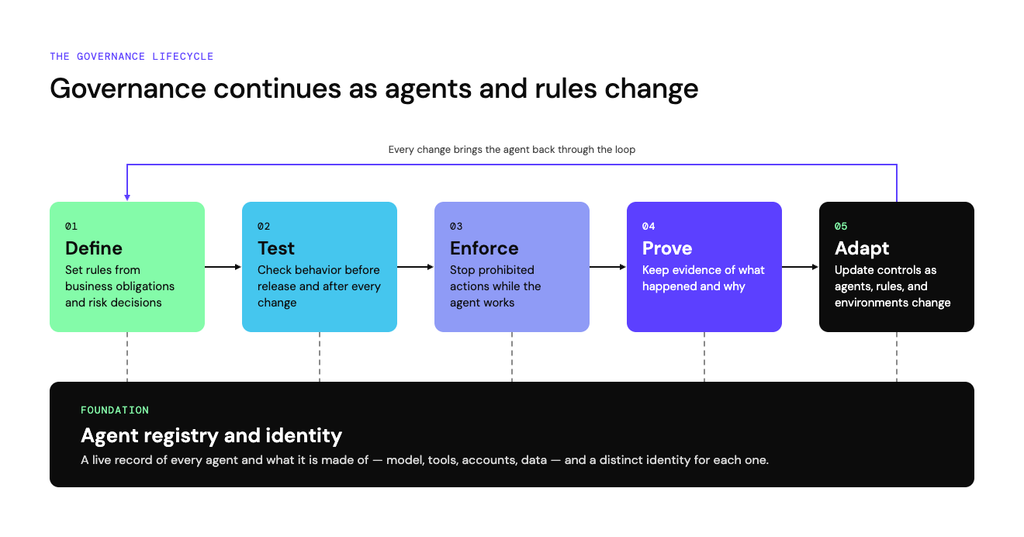
These questions cover the full governance lifecycle, from the foundation that makes agents visible to the process that keeps them governed. No single vendor answers all 15 today, and any vendor that claims to is defining governance narrowly or selling you a roadmap. Your job isn’t to find a perfect score. It’s to evaluate coverage, direction, and architectural fit against your operating requirements.
Use these questions with every vendor. Ground the answers in your workflows and operating environments. Record what works today, what requires additional tools, and what your team will own after deployment. The answers labeled “flag” identify claims that deserve a closer look.
An agent can gain access to sensitive customer data after its original approval, leaving the business exposed to a change nobody reviewed. Ask for a registry that tracks models, tools, data access, and accounts, with changes reported to the responsible owner. Buyers may hear the ingredient list called an AI bill of materials (AI-BOM). Ask how agents built elsewhere enter the registry and how unregistered agents are found.
Flag: The vendor claims visibility into all your agents but is only describing agents built on their own platform.
Agents that act through shared employee accounts leave investigators unable to distinguish an agent’s actions from a person’s decisions. Have the vendor show you how activity remains traceable when the builder changes roles or leaves.
Flag: Traceability depends on the builder’s account. If that person leaves or changes roles, the audit trail breaks.
Separate rulebooks can leave risk leaders approving one restriction while agents operate under another. Ask how existing obligations reach agent controls and how evidence returns to the team’s current systems.
Flag: Integration means manual copying between systems, with no process to keep rules and evidence in sync.
An audit can stall when activity records don’t answer a question about a specific requirement. Ask which obligations under the EU AI Act or recommendations in the NIST AI Risk Management Framework are supported. Request an example linking a requirement, its control, and supporting evidence.
Flag: The vendor claims logs are compliance-ready but can’t show which requirement a specific log entry satisfies.
Biased answers, invented information, or an agent manipulated through prompt injection can put customers at risk. Ask to see results from deliberate attempts to make the agent break its rules and whether a failed test blocks release.
Flag: The vendor shows passing results from standard tests but no evidence from deliberate attempts to break the agent.
A restriction meant to protect customer data can cause an outage if it also blocks approved work. Ask how quickly the previous state can be restored, who is notified, and what the vendor does to isolate the rule change from running agents. Then ask what steps the vendor takes to reduce that risk before enforcement: staging, scoping the change to a subset of agents, or testing against recorded traffic.
Flag: The vendor’s only answer is to apply the change and watch for problems.
An alert after the transfer leaves you managing a data incident. Request a demonstration of prevention and a clear account of transfers the product can only report. Ask which controls or additional tools are needed for the workflow you run.
Flag: The vendor claims full visibility but can’t show what prevents the transfer, only what reports it.
A blocked transfer through one connection can still become a data incident if the agent reaches the same destination through another route. Ask the vendor to document where each control’s authority ends and what protection the buyer is responsible for beyond that boundary.
Flag: The vendor claims all traffic is governed but can’t identify which connections pass through the controls and which don’t.
A failed control can expose data, while an unexplained shutdown can interrupt service. Ask whether the agent stops, continues, or seeks approval; who is notified; and how any override is authorized and recorded. Have the vendor explain what happens to work already in progress.
Flag: The vendor says an administrator can turn it off but can’t explain what happens to ongoing work or how that decision is recorded.
Boards and investigators need to understand why an action was permitted and who authorized exceptions. The record should identify the rule version and give reviewers enough context to judge whether the block was justified or interrupted legitimate work.
Flag: The log shows whether the action succeeded but not which rule applied or who approved the exception.
A team can believe it’s protected because alerts still fire, even when the blocking control behind them is down. Ask what evidence shows that prevention — not just detection — is still working, how a gap between the two reaches the responsible owner, and what the most recent verification looks like.
Flag: The vendor points to a green dashboard but can’t show evidence that prevention, not just monitoring, is operational.
A critical restriction can be delayed when every change requires downtime or redeployment. Ask which updates take effect during operation and which require a maintenance window. Have the vendor walk through a time-sensitive scenario, blocking a newly discovered data exposure, for example, and explain how long enforcement takes from the moment you decide.
Flag: The vendor can’t walk through the steps or timeline for applying an urgent restriction.
Unclear authority can leave sensitive access in place after the business need ends. Ask for the approval trail, how an authorized owner can withdraw access, and when that withdrawal takes effect.
Flag: The vendor says the owner can remove access but can’t show who holds that authority or how revocation is recorded.
Uneven protection can leave a data center or remote site exposed under a policy that works in the cloud. Follow the same workflow through each environment. Ask what enforces the rule when outside services are unavailable, where records are stored, and how they reach the risk team later. Include agents built outside the vendor’s platform. Have the vendor identify what works today and what needs additional controls or rebuilding.
Flag: The vendor claims full cloud support but puts other environments on the roadmap.
A platform change can interrupt enforcement or make historical evidence difficult to use during an audit. Ask which rules, approvals, and records remain usable elsewhere, and which controls need replacement. Request an example of what can be exported and what your team would need to do to use it. If you replace the model or the framework used to build the agent, which rules and evidence remain valid, and what needs retesting?
Flag: The vendor says you can export your data but can’t show whether policies and audit records remain usable outside their platform.
Ask every vendor to document what its product doesn’t cover. An explicit limitation is something you can plan for. An unanswered question is unresolved risk.
Governance built into the agent platform reduces integration work and keeps controls close to the agent. The question is how far that coverage reaches. Governance limited to one environment leaves your team responsible for protection beyond it.
Consider an insurer with a customer service agent in the cloud and claims data in its own data center. If it moves the agent into the data center or adds an agent built elsewhere, the test is whether the same rules, enforcement, and evidence follow. At disconnected sites, controls must work without outside services, with records kept locally until they can be transferred.
The insurer should set policy, own its evidence, and retain both when it changes infrastructure. Ask what remains usable and what needs rebuilding. Integrated governance should support your rules and your evidence across the environments where your agents run.
A governed agent should have an identifiable owner, a current registry entry, and a traceable set of rules. Your organization should be able to show how those rules are tested and enforced, explain recorded decisions, and keep the process working as the agent changes. That standard applies wherever the agent operates.
The checklist sets a minimum evaluation standard for the complete governance process. An unanswered question identifies work that needs an owner, a control that needs to be supplied, or a deployment decision that deserves review. Vendors should make their contribution and limits clear enough for your team to act on them.
Begin with one agent that handles consequential data or actions, and follow it through the full lifecycle in the environments where it runs. Reviewing the evidence at each stage will show where your governance works and where exposure remains. The gap between claiming governance and running it is where enterprise risk lives.
See how DataRobot defines policy once and enforces it across the agent lifecycle.
The post Everyone claims AI governance now. 15 questions to test the claim. appeared first on DataRobot.