Archive 28.10.2026

Page 2 of 56
1 2 3 4 … 56

Competing in RoboCup@Home and winning the 2026 best paper award: an interview with Raphael Memmesheimer

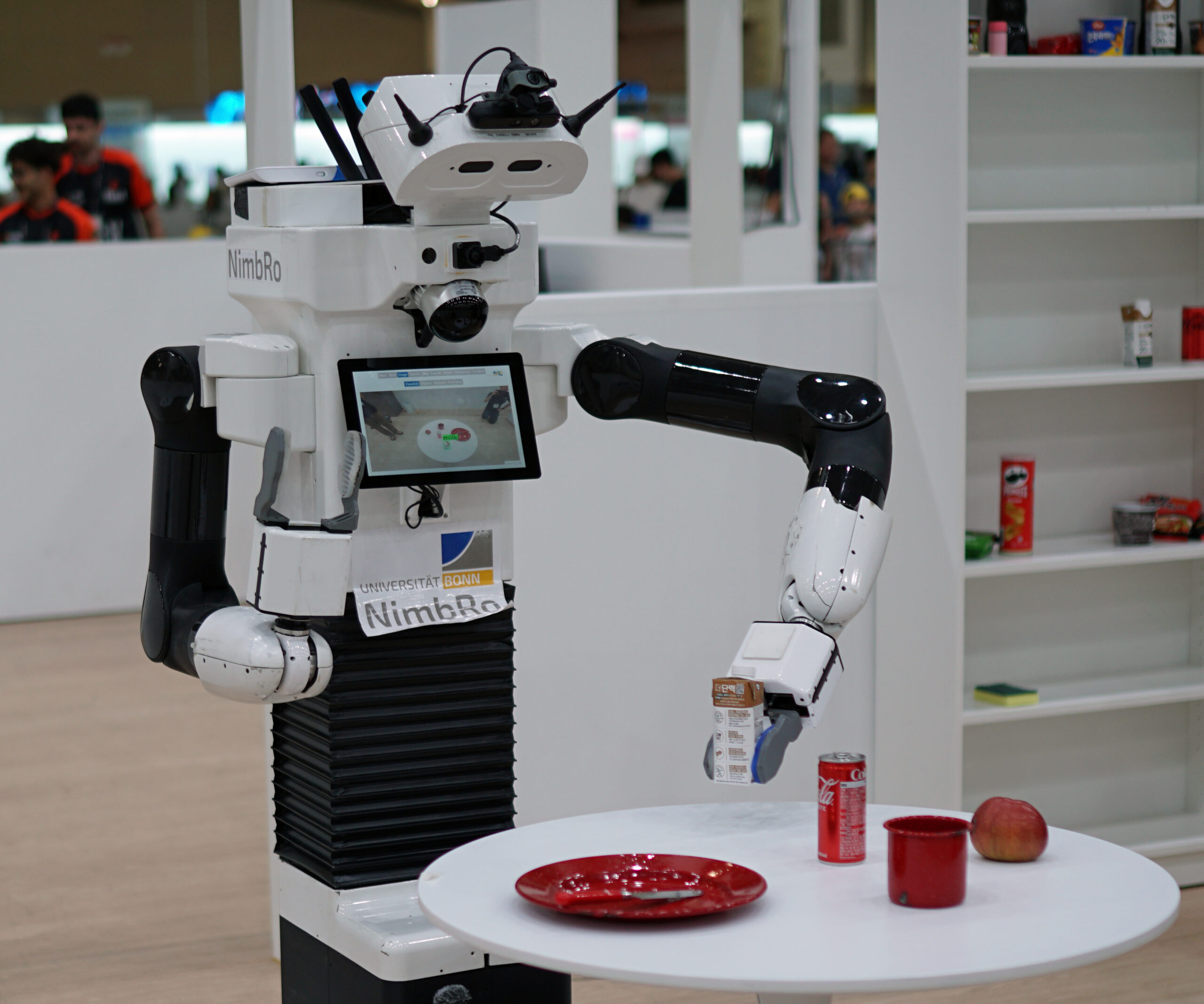
Team NimbRo’s robot in action during the RoboCup@Home competition at RoboCup 2026. Raphael leads the team.

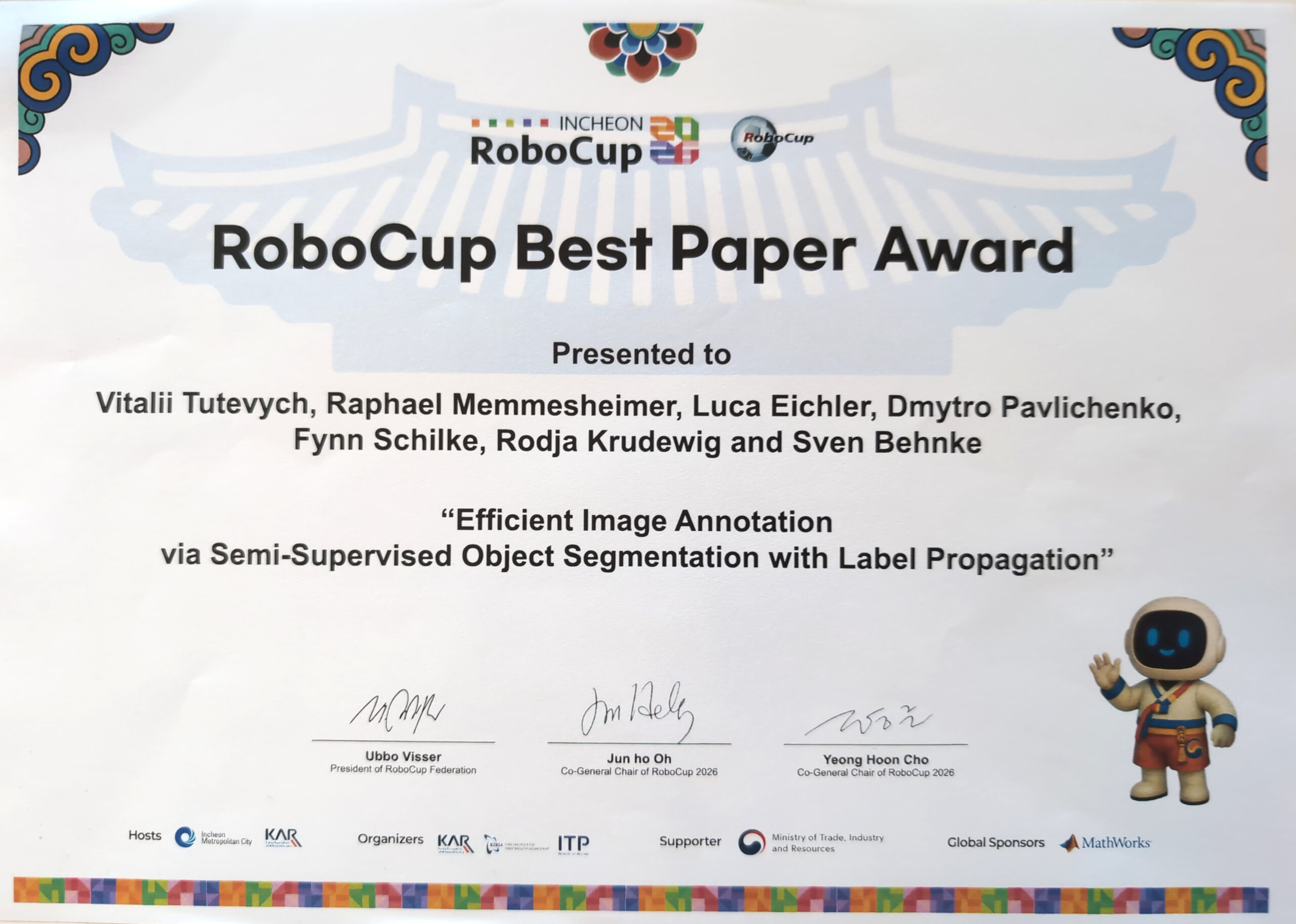
Raphael Memmesheimer has been successfully competing in the RoboCup@Home league winning the RoboCup@Home competition five times. He and his colleagues won the best paper award at RoboCup 2026 for their work “Efficient Image Annotation via Semi-Supervised Object Segmentation with Label Propagation”. We caught up with Raphael to find out more about this research, his history with RoboCup, and the challenges of the @Home competition.

Could you start by telling us how you got involved with RoboCup@Home?

I’ve actually been involved in the @Home league since I was a student, and my first time going to a World Cup for @Home was in 2013. That competition motivated me to do a PhD and infected me in a way that meant I basically aligned my academic career to it. I always return to robot competitions because this is one of the rare places where you can benchmark robots in a real environment and have a real competition. Commonly in research you tune your approaches on data sets and show that they perform in a one-shot video. In robot competitions, you basically have to roll out your robot, it enters the arena, and then it operates autonomously on its own. It is always interesting to see how new developments make the robots perform better.

You and your co-authors won the best paper award at the RoboCup symposium this year. Congratulations! Could you give us a quick introduction to the paper?

The motivation for this work is that we only have two preparation days at the RoboCup competitions. So we arrive there, we have to assemble our robots, and the robots need to get used to the new environment [a model apartment] that we haven’t seen before. Also, the robots don’t have a clue about anything in this apartment. And within the two preparation days, the robots need to learn the objects they are interacting with. For example, they have to recognise what a spoon is, or a specific drink.

Our paper basically supports us in very efficiently generating this data such that the robots can more quickly learn models for the objects that are involved in this competition. And the interesting thing is it’s not just a few objects that we can distinguish between; there can be up to 50 different objects that we haven’t seen before. Our approach basically optimizes the process so that we can quickly get a good vision model for the robot. We are aware of open-vocabulary approaches but found them to have issues distinguishing between objects of a category like drinks.
Is it possible to do some pre-training to anticipate objects that might be used in the competition?

Partially that’s possible, but most objects cannot really be anticipated. We know that there are drinks, there are snacks, that there are cutlery items in the apartment. But what cannot be anticipated is the details because objects come from different areas in the world. The organisers will usually go to a shopping mall and just get local groceries there. Those objects are then distributed in the apartment. Part of the object set comes from the publicly available YCB Dataset, for those we can gather data beforehand, and of course pre-training with large general object sets.

Could you talk about your methodology?

We use a multi-stage approach. Firstly, we segment, such that we learn what an object actually is on a segmentation level. We look at all the objects that robots saw in the past editions of these competitions, and we train one model that just says, “oh, there is something which might be an object”. And then we get reference images of the actual objects and we semi-supervised or semi-automatically label those objects. The idea is that we combine identifying something as an object with a reference of what could actually be there. That allows us to simplify the labeling approach. Around 60% of the data is automatically labeled based on our approach. That would take a lot of hours by human annotation.
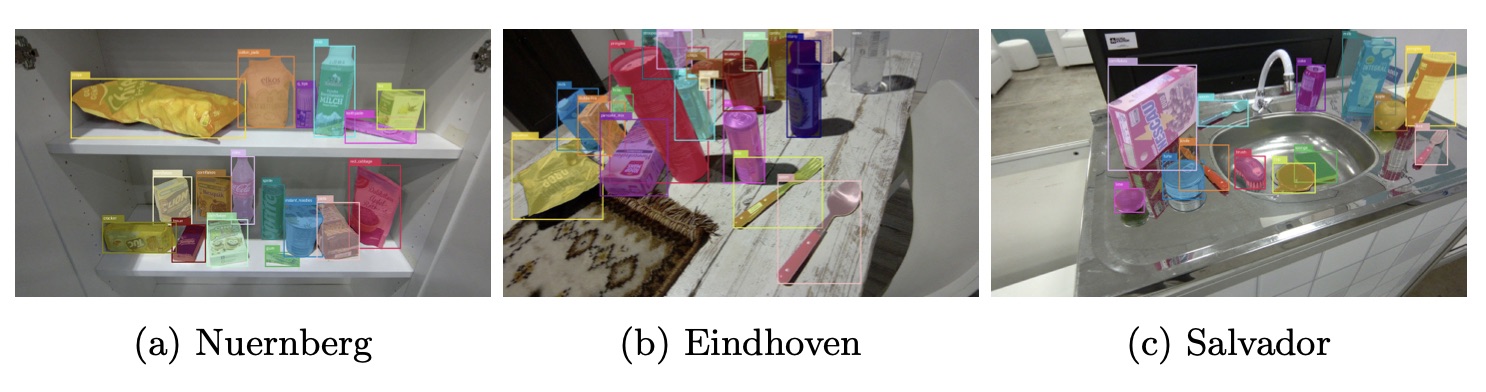
Labeled example images from different competition venues. Figure from “Efficient Image Annotation via Semi-Supervised Object Segmentation with Label Propagation”.

Have you been able to use the method already in RoboCup competitions?

Yes, we used it in Brazil for RoboCup 2025 and at RoboCup GermanOpen for the local RoboCup competitions. The method is continuously evolving. Now that we have this very good vision model, it means that we save a lot of time during the two preparation days and we can concentrate more on testing and achieving the actual tasks instead of just focusing on the vision element. One side note: nowadays there are promptable object detection or segmentation methods, but we found that they don’t scale yet to the number of classes that are involved in this competition. They work fine with 5 to 10 different classes, but we had issues distinguishing all 50 classes just by prompting them.

In this year’s World Cup (in Korea) we used an evolved approach where we used videos to generate even more data.
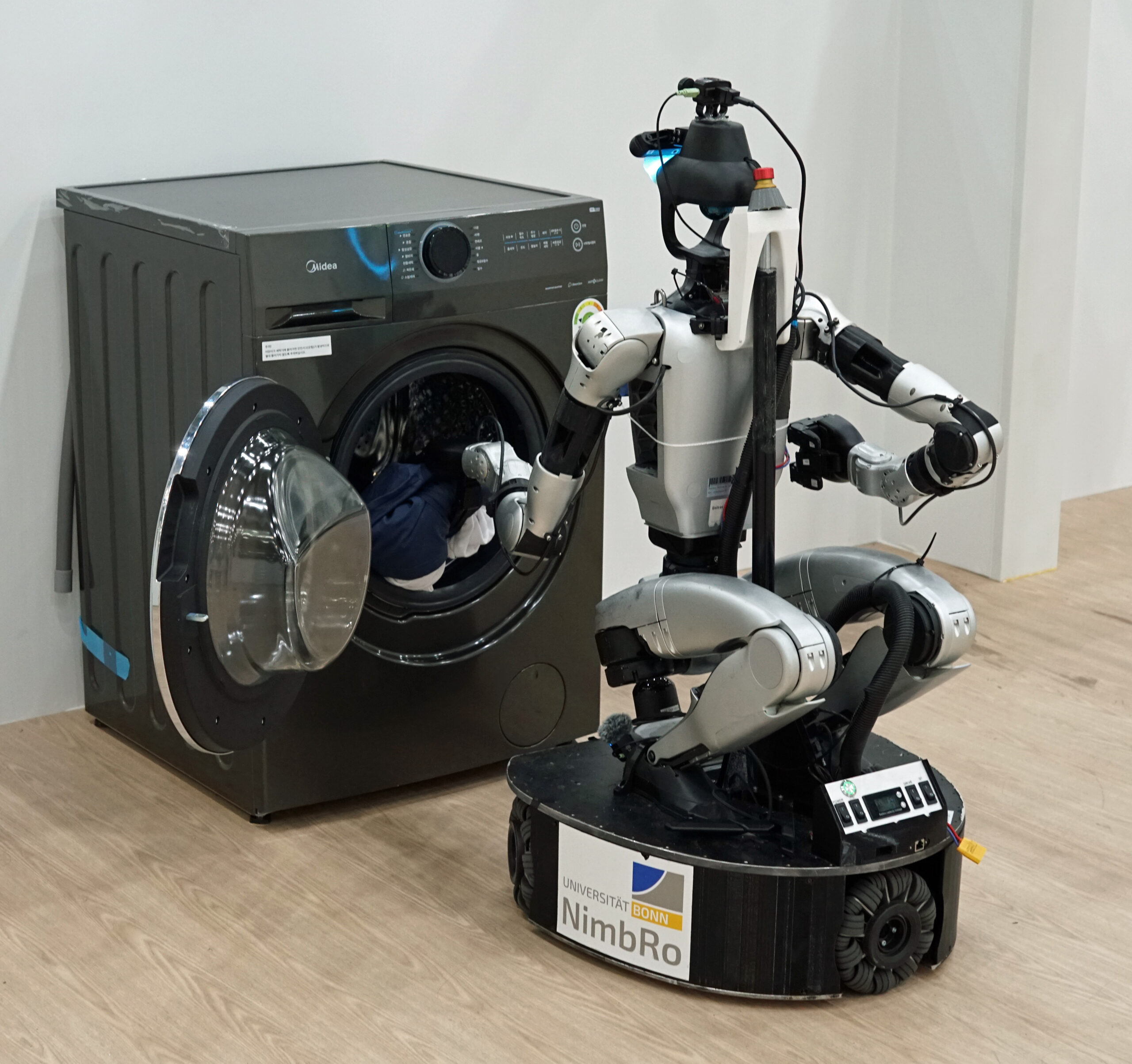
Team NimbRo’s robot picking laundry from the washing machine.

How did your team get on in the competition this time?

It went well. We had issues, as always during competitions, but we ended up in 3rd place. There was a new “Doing Laundry” task introduced this year. The robot had to carry a laundry basket from a washing machine to a folding table and open the washing machine. It had to detect the washing machine door, then find the specific point to grasp the handle to open the machine door. Then it had to pull out t-shirts and fold them.

Our robot performed the best in this task. It was able to open the washing machine and start folding the laundry. And this was possible because we used these semi-automatic labeling approaches.

What were the other tasks that teams needed to carry out?

The first big hurdle at the competition is to make the robot pass the initial inspection. Robots must satisfy certain safety and interactive capabilities and if they fail they are not allowed to take part in the competition.

In the competition itself there are five main tasks.

One is human-robot interaction. The robots have to open the door for party guests and greet them. Here, the robot has to go to the door, find the handle, align the end-effector to the handle, open the door, let the human enter, speak with the guest while holding eye-contact, guide them to the living room, find them a free seat, and introduce this guest to any other guests. This process continues on repeat as long as there are new guests arriving.
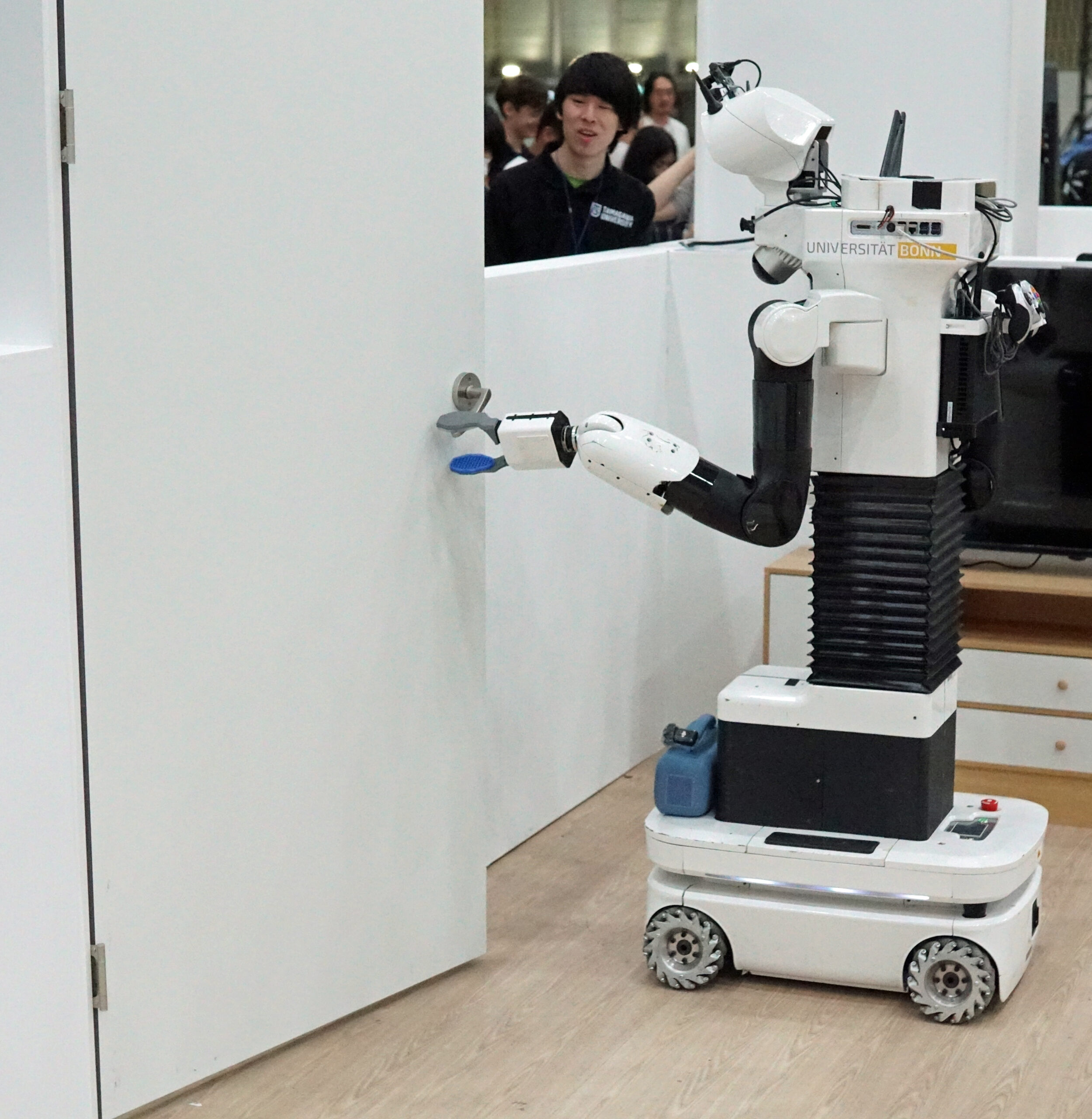
Team NimbRo’s robot opening the door.

Another task is a pick and place task, and this time we had to clear a table after breakfast. So the robot had to bring the cutlery to the dishwasher, put a dishwasher tablet into the dishwasher, close the dishwasher, and then prepare the table ready for the next meal. That’s a very manipulation intensive task.

There is also a general-purpose service robot task. This task is undefined because the robot has to deal with a random natural language command that can incorporate all elements of the apartment. For example it might be asked to go and fetch a particular drink or snack and hand it to someone. In the past there were people from the audience called into the arena and asked to give a command. It’s interesting to see how good these robots are at interacting with a new person and not someone they are used to receiving commands from.

Another interesting task is the restaurant task. Here, the robots are not in the known environment that we trained them in for two days, instead they are taken to an unknown restaurant location. The robot is placed there and needs to serve naturally. Only the menu is known to the teams in advance. The robots need to scan the restaurant to autonomously operate and find waving customers. The order is then given by voice, and usually these restaurant environments are very noisy. This is a very interesting task for the audience because it’s in the wild and people gather around it to watch it.

Then, of course, there’s the new laundry task that I described above. To add to what I said before, this is a very hard task because the robot cannot see into the washing machine. So it has to feel if it has a T-shirt in its hand and take the t-shirt out of the machine. Then the robot has to go to a table and start folding other t-shirts.
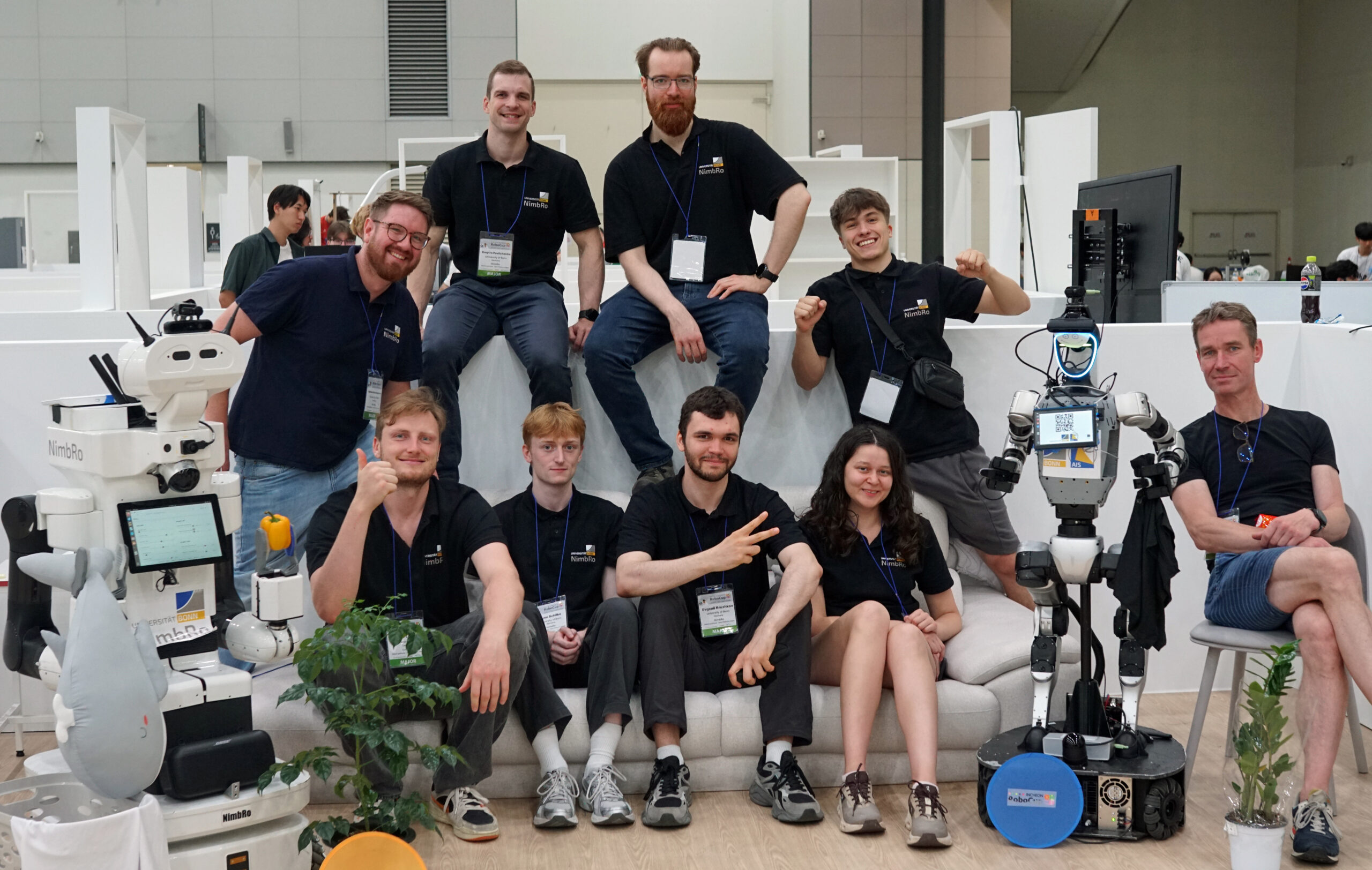
Team NimbRo

Interesting. I was at RoboCup in Eindhoven and I found the @Home competition fascinating.

We actually won the competition that year!

The league was more divided then, with three different leagues: two standard platforms and an open platform league. It was the open platform league that we won.

Now, all of those leagues have been merged. This year there were 24 teams from all over the world participating in just one league, which is amazing. It also drives competition a lot.

How much of an improvement have you seen over the years that you’ve been doing RoboCup@Home?

There are always phases of improvement, as I would describe them. I started pre-deep learning, and there were no vision robust models for seeing objects in unknown environments. What was working well was mapping and navigation. When I started in the league, the robots were already talking, but often, instead of talking to a human like they were supposed to, they might talk to a potted plant or a coat hanger because they had a shape similar to a human. This is no longer the case – nowadays we perceive humans quite well. We can also recognize speech quite well. Task planning is still a challenge, but it has improved. Then there are things that appear and push the boundaries, such as large language models, open vocabulary approaches and, most recently, agentic systems. But every now and then there’s stagnation because teams are just overwhelmed by the wide amount of different challenges that this competition throws at you. Basically your robot has to do everything. It needs to navigate in an apartment, it needs to be able to interact with humans, it has to manipulate items, and it has to do task planning. And all of those are very intensive research areas that are challenging in themselves. In addition the implementations must be very robust, as there are only a few trials.

How are you and the team planning to improve the robot for the next competition?

We are working on improving manipulation capabilities so that the robot can more quickly pick various objects. We are also continuously testing our robots’ performance to make our robots more human-like, and using two arms for manipulation is something we want to improve.

About Raphael

Raphael Memmesheimer’s long-term research goal is to develop autonomous service robots that assist people in everyday environments: robots that perceive, understand, and learn from human behavior using multi-modal sensory information and that prove themselves outside the lab. He is currently a postdoctoral researcher with the Autonomous Intelligent Systems (AIS) group at the University of Bonn, where he re-established and leads the domestic service robot team NimbRo@Home. He is also a founding member of the Center for Robotics at the University of Bonn.

Raphael Memmesheimer has extensive experience in benchmark robotics competitions, having led teams at two universities to multiple international titles. Notably, he has won the RoboCup@Home World Championship five times (including three consecutive titles), along with multiple victories at the RoboCup German Open and top placements in the European Robotics League and the World Robot Summit.

Artificial skin helps robots grasp pencil lead and pull away from needles

Researchers have covered robotic fingers with a new artificial skin that allows the hand to grasp fragile pencil lead and pull away from a needle before it punctures the covering. Both actions depend on more than sensitive sensors. The robot must also receive and interpret their signals quickly enough to respond.

Robots in Society, Business and Culture: September 2026

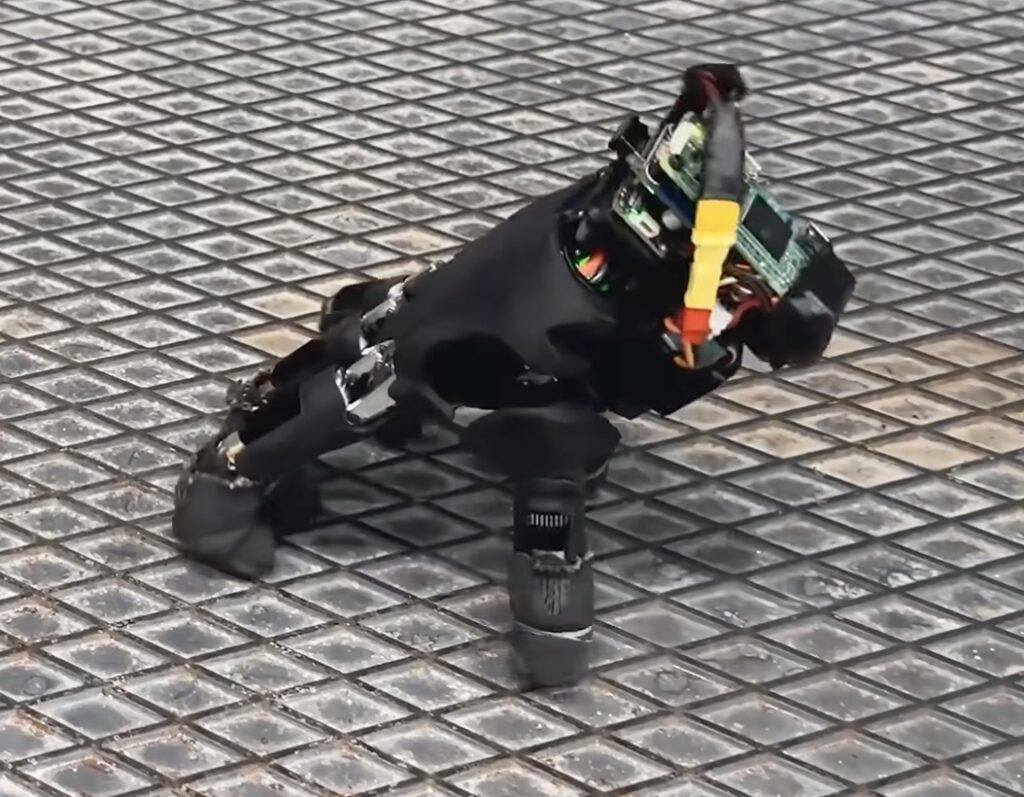
A walking robotic hand, from Fingers as Legs: Learning Self-Supported Locomotion and Manipulation with an Anthropomorphic Hand, Amirhossein Kazemipour, Hehui Zheng, Robert Katzschmann.

By Emmet Cole

In our monthly series, we showcase a selection of robotics stories from society, business, research and culture, as we track the field’s ongoing journey from specialized industrial machines to an increasingly visible social phenomenon.


Five million and counting

More than five million industrial robots are now operating in factories worldwide, according to the International Federation of Robotics’ newly released World Robotics 2026 report.

Factories installed more than 600,000 industrial robots during 2025, an increase of 11% on the previous year. The global operational stock grew by 9%.

China continued to pull away from the rest of the world. Its factories installed 354,000 robots, accounting for 59% of the global total. Chinese manufacturers supplied 55% of their domestic market.

The United States overtook Japan to become the world’s second-largest market, with almost 38,500 installations. India installed nearly 10,500 robots, an increase of 15%. Europe moved in the opposite direction: installations fell by 8% in Germany, 11% in Italy, 8% in France and 15% in Spain.

IFR forecasts that worldwide installations will reach 655,000 units in 2026 and 806,000 in 2029.

Separately, Toyota told investors that modernizing factories operated by the company, its group businesses and major suppliers could require around 400,000 robots. The estimate includes replacement machines, new industrial robots, automated logistics systems and possible future humanoid deployments. Toyota said the programme could cost ¥1 trillion, or approximately $6.4 billion, annually from 2028, although it has not made a firm spending commitment.

Elsewhere, Universal Robots used the IMTS trade show in Chicago to launch Gen 7, a redesigned cobot platform built around greater computing power, tool-flange connectivity, sensor integration and support for AI-assisted applications.

The hands behind the robots

In Rajasthan, India, women are being paid to record household activities from cameras worn on their heads, according to an investigation by Decode. Their footage captures everyday tasks such as cooking, cleaning and folding clothes from the worker’s point of view.

The recordings can be divided into individual actions and used to teach robots how people manipulate objects in real homes. This kind of data is especially valuable because household environments contain clutter, variation and improvised behaviour that are difficult to reproduce in a robotics laboratory.

Decode estimates that between 20,000 and 30,000 people may be doing this work in India, although that figure is an extrapolation rather than an official count. The article also stops short of establishing which robot companies ultimately receive the featured workers’ recordings.

Lethal autonomous robots

International efforts to regulate autonomous weapons reached a significant point in September. Three years of discussions by the United Nations Group of Governmental Experts ended with growing support for formal negotiations on new international rules.

Human Rights Watch says 76 states now support negotiations on legally binding measures governing autonomous weapons systems. However, the group’s final report was weakened during negotiations. References to ethical concerns and to the design and development of the weapons were among the passages removed or reduced following objections from states including Russia and the United States.

The issue will now move to the Convention on Certain Conventional Weapons Review Conference in November, where states may decide whether to establish a negotiating mandate.

The Stop Killer Robots campaign argues that further discussion is no longer enough and that states should begin negotiating prohibitions and regulations.

Computer scientist Stuart Russell also entered the debate in a short UC Berkeley video. Russell called for a ban on small autonomous anti-personnel weapons, warning that machines capable of selecting and attacking people could become cheap, scalable weapons of mass destruction.

His intervention is more specific than a call to prohibit every military application of AI. It focuses on systems that can independently identify human targets and apply lethal force at scale.

Does the robot play fair?

A study published in the International Journal of Human–Computer Interaction examined whether perceptions of fairness can reduce conflict between people and security robots.

Xin Ye and Lionel Robert considered two forms of fairness. Distributive fairness concerns whether the robot’s decision or its consequences appear fair. Informational fairness concerns whether the robot provides an adequate explanation for that decision.

The researchers found that both can help reduce conflict and improve acceptance. The broader implication is that security robots may need to justify their actions as well as perform their assigned tasks effectively.

The results come from controlled human–robot interaction research, so they should not be treated as evidence from robots exercising authority in operational policing environments. Nevertheless, the study raises a question that will become more pressing as autonomous systems move into security roles: what does it mean for a machine’s exercise of authority to be regarded as legitimate?

Give us a hand

Finally, researchers at ETH Zurich have taught an anthropomorphic robotic hand to walk on its fingertips.

The self-contained hand uses reinforcement-learning policies to crawl, steer and recover after falling. It can also support its own weight while pressing successive keyboard commands, and it can push an object towards targets using overhead visual feedback.

The work is currently an eight-page arXiv preprint, and separate policies are used for different tasks. Even so, it offers an inventive demonstration of a robot repurposing the same hardware for movement, balance and manipulation.

Tiny magnetic vortices could help computers work more like your brain

Scientists have filmed tiny magnetic vortices called skyrmions melting out of an organized lattice for the first time, revealing new ways to manipulate these unusual structures. The breakthrough could help make brain-like computers a reality, potentially enabling dramatically smaller and more energy-efficient technology.

AI detects “invisible” signs of pancreatic cancer years before diagnosis

A powerful new AI system could help doctors detect pancreatic cancer years before it becomes visible on conventional scans. The technology, called REDMOD, identified hidden warning signs an average of 475 days before diagnosis and was nearly twice as sensitive as experienced radiologists. By spotting cancer-related changes at their earliest stages, it could dramatically improve the chances of successful treatment for one of the deadliest forms of cancer.

Muse — Meta’s New AI Agent — a Hit

Introduced only a few weeks ago, Muse – an AI agent that can perform multiple tasks on a project without human supervision – has already been downloaded 10 million times.

Observes writer Asa Fitch: “Meta is already monetizing Muse’s growth, with subscription tiers costing $20 or $100 a month for heavier users.”

In other news and analysis on AI writing:

*ChatGPT to Challenge Meta Muse with AI Agent ‘Dots:’ Smarting from the meteoric rise in popularity of Meta’s new AI agent Muse, ChatGPT is rolling out a new AI agent to compete with Muse – ChatGPT Dots.

Like Muse, Dots is designed to work independently on a multi-step project – such as researching an article by visiting multiple Web sites, analyzing the results, creating an article outline and then writing the article.

The downside: So far, Dots will only be available on ChatGPT’s Pro Plan, which starts at $100/month.

*Anthropic Readies Limited Release of Its Competition to Muse: ‘Claude Duet:‘ Anthropic’s answer to the new AI agents Muse and Dots – Claude Duet – is being released as a ‘research preview’ for Claude subscribers on the Pro or Max plans.

Observes writer Megan Cerullo: “Each morning, Claude Duet sends its user a daily brief outlining the day’s most important items. For the agent to have context, it must be connected to a person’s apps, like their email accounts and calendars.”

You can sign up for a wait list to be among the first to use Claude here.

*400+ Publications Now Feeding Google’s AI Generated News: Add CNN and the Financial Times to the growing list of publications allowing Google to rewrite their news for use in Google news features, summaries and audio podcasts.

One of the benefits of the deal for the publishers: The original news stories may show up higher in Google search engine returns such as AI Overviews and AI Mode.

*DeepSeek Backlash: Banned for Use by Civilian Federal Agencies: Fearing that U.S. data could be forwarded along to the Chinese government, the U.S. has banned use of Chinese phenom AI model DeepSeek by civilian federal agencies.

The ban also covers use of third-party tools that have been built on DeepSeek models.

DeepSeek has been a major disrupter in the AI space, often offering pricing much less expensive than AI pricing offered by U.S. titans like OpenAI, Anthropic and Google.

*China Maintains Ban on Major AI Models from Google, Anthropic and OpenAI: While China has been angered by the U.S.’ decision to expand a ban on the use of DeepSeek, the fact is that the Chinese government has banned major AI from the U.S. for years.

Observes writer Maximilian Schreiner: “ChatGPT, Claude, and Gemini aren’t approved there.”

Plus, that ban applies to the entire Chinese market – not just Chinese government users.

*Digital Design Platform Canva Releases Its Own AI Image-Maker: Writers who regularly use Canva for article layouts will want to check-out the platform’s new AI image-maker, Canva Craft.

Observes writer Ivan Mehta: “Canva has used a bunch of image models for generation in its platform, so it’s likely that the new models will help save API costs for the company. It said that besides costs, the new model also allows the platform to have better quality and speed control.”

Currently, approximately 265 million digital creators use Canva.

*Amazon Launches $75 AI Note-Taker: Add Amazon to the growing list of manufacturers offering wearable tech that records, analyzes and summarizes conversations.

Dubbed “Bee Frontier,” the tech can be worn on the wrist or clothing and offers an optional, $11.99 monthly subscription that comes with longer-term memory, app integrations and more.

Other companies competing in the same space include Plaud, SwitchBot, Omi and Vocci.

*New AI Plugins Customize AI for 501 Occupations: Complete AI Training is out with a new plugin that customizes popular AI for hundreds of highly specific occupations.

Dubbed “The AI Coach,” the plugin offers news, suggestions and short AI lessons that target the user’s job description.

So far, AI Coach is designed to work with ChatGPT, Claude, Microsoft 365 Copilot, Codex, Cursor and Grok.

*AI BIG PICTURE: Microsoft’s Bill Gates on AI: “This Is by Far the Most Dangerous Technology Ever Invented:” Microsoft co-founder Bill Gates has joined the ranks of Geoffrey Hinton – the godfather of AI – who believe society needs to get a handle on the development of AI right now.

Essentially, Gates – in this extremely in-depth interview with The Verge – warns that things could easily spin-out-of-control if we allow AI leaders to simply develop AI at breakneck speed.

Observes Gates: “The people close to this (AI researchers) are very concerned about misuse, job impacts, social relationship impacts — and I’d say it’s impressive to have an industry that’s speaking out as vividly as they are. Some outsiders say, ‘get better PR companies.’ But that ignores the fact that these warnings are the truth.”

Share a Link:  Please consider sharing a link to https://RobotWritersAI.com from your blog, social media post, publication or emails. More links leading to RobotWritersAI.com helps everyone interested in AI-generated writing.

–Joe Dysart is editor of RobotWritersAI.com and a tech journalist with 20+ years experience. His work has appeared in 150+ publications, including The New York Times and the Financial Times of London.

Never Miss An Issue
Join our newsletter to be instantly updated when the latest issue of Robot Writers AI publishes
We respect your privacy. Unsubscribe at any time -- we abhor spam as much as you do.

The post Muse — Meta’s New AI Agent — a Hit appeared first on Robot Writers AI.

Scientists overcome a hidden obstacle to more powerful quantum computers

Scientists have discovered a way to operate multiple silicon qubits simultaneously with remarkable accuracy, overcoming a major challenge in scaling up quantum computers. Their new technique maintained accuracy of approximately 99.9% even when all five qubits were running at once, opening the door to larger and more powerful quantum processors.

Wearable system captures human activity data for robot training

Humanoid robots, robotic systems with a body shape that resembles that of humans, could tackle various chores and everyday manual tasks. To successfully complete these tasks, however, the robots should be able to reliably coordinate their movements, posture and how they touch or grasp different objects.

Flexible robot arms learn to predict their next move

A robot arm that bends like an elephant's trunk can slip into tight spaces and handle fragile objects. Controlling it is harder because its smooth bending makes its next move hard to predict. Researchers have now developed a method that keeps computer predictions of the arm's motion on track, even when the arm moves faster than the model was trained for.

From Robot Demo to Real Deployment – Seven questions buyers should ask before investing in humanoid robots

The central purchasing mistake is to treat a capability demonstration as if it were a deployment record. A sound evaluation starts with a narrower question: can this particular system perform our defined task, in our actual environment.

Robot Talk Episode 167 – Automating construction, with Jan Petrš

Claire chatted to Jan Petrš from École Polytechnique Fédérale de Lausanne (EPFL) and Déploya Robotics about novel robot designs for construction and architecture.

Jan Petrš is a roboticist, architect, and entrepreneur working at the intersection of robotics and construction. He is currently the co-founder of Déploya Robotics, an EPFL spin-off developing deployable robotic systems for automated façade installation. Previously, he was a Postdoctoral Researcher at EPFL’s Laboratory of Intelligent Systems, where he focused on tensegrity robotics. His PhD research at the Czech Technical University focused on developing a robotic system combining reconfigurable and soft robotics for architectural and construction applications.

MIT scientists build a tiny robot that swims using living muscle cells

MIT engineers have built a paper-thin swimming robot powered by living muscle cells that respond to flashes of light, allowing it to swim and steer through water. The breakthrough could pave the way for tiny, self-healing biological robots capable of exploring fragile environments that ordinary machines cannot safely navigate.
Page 2 of 56
1 2 3 4 … 56