Humanoid resources: China’s robots search for workforce breakthrough
Shares in Chinese humanoid robot maker Unitree soar in its Shanghai trading debut
Robotics roadmaps from around the world spotlight of the month: Japan
Robots have been a prolific theme in Japanese pop culture and media since the 1950s, which includes global icons like the Transformers, Astro Boy, and Doraemon (1). Perhaps not coincidentally, Japanese citizens have a positive outlook on robotic technologies and their use in the labor sector compared to many other nations (2); much to their advantage, as robotics continues to be a vital pillar for ensuring Japan’s economic resilience and future growth. Here, we discuss priorities and long-term agendas as presented in Japan’s national robotics strategies.
Natural disasters, aging, and economic competition
The combination of its geographic location, geologically active landmass, and topography renders Japan prone to frequent natural disasters. Although weather control is among Japan’s lofty research goals for the next 25 years (3), geological disturbances remain inevitable. As such, disaster mitigation and response are high priorities that serve as motivation for robotics development in Japan (4). Intelligent machines are expected to expedite disaster response and search-and-rescue, while minimizing exposure of workers and volunteers to unnecessary hazards – a notable reminder being the 2011 Fukushima Disaster (5).
Aging workforce is a second pressing issue. Japan is currently the oldest demographic nation, defined as of 2007 as a “super-aged” society with nearly a third of citizens aged 65 or older (6). According to government roadmaps (4), Japan views robotic development as a crucial tool for preventing a GDP collapse due to the rapid labor shortage, specifically in services like healthcare, elderly assistance, and manual labor. Unlike countries which opt for immigration reform for addressing fluctuation in labor markets, Japan maintains historically tight immigration regulations. A strong preference towards preserving traditional values may influence their massive investments towards shifting to a robotic workforce (7).
Japan has a mature robotics industry, claiming the title of the largest manufacturer and exporter of industrial robots for the last half century (8). 45% of the global supply originated from Japan in 2022, with nearly an 80% export rate to countries such as EU members, the USA, and China (9). However, the combination of economic decline and competition from oversea manufacturing present the challenge of maintaining leadership in the global value chain. Leveraging their specialty in robotics hardware design is crucial to maintain a competitive edge in the global economy.
Society 5.0
Japan is betting on bold technological solutions for ensuring the prosperity of their future society. To do so, the government proposes a streamlined effort towards technocentric “super-smart cities” (coined Society 5.0) (10). The directive is set by the Science and Technology Basic Plan, a large-scale roadmap updated every five years (with 2026 marking the transition into the 7th Plan). An additional Integrated Innovation Strategy is used as an annually-updated agile document for integrating urgent priorities into the larger Basic Plan.
Super cities
Japan is investing heavily into research on human-robot interactions, so that users are embedded early on into technological design considerations of Society 5.0. Accordingly, in 2020 the Japanese Parliament passed the Super City Amendment, which allows regulatory sandboxes for specific “super cities” (currently Osaka and Tsukuba) to bypass certain laws that otherwise impede the integration of technologies like AI-driven robots into the public space (11, 12). These large-scale tests are carried out preceding what they hope could become widespread implementation of robotics to mitigate issues such as labor shortage. Following suit, as of late September 2025, the automobile industry Toyota has launched their own version of a Super City, Woven City, which provides a campus for employees to work, live, and even raise a family (13).
Moonshot programs
Japan also utilizes high-risk, high-impact research roadmaps with 30-year timelines, called Moonshot Programs, to encourage bold technological solutions for the future (14). The authors of these programs are a blend of members from government, industry, and academia. Two of the current ten Moonshot Goals are directly related to robotics.
Goal 1 of the Moonshot Program is to Overcome Limitations of Body, Brain, Space, and Time, a goal largely focused on the creation of Cybernetic Avatars – the fusing of sensations and motions between human users and tele-operated robots. By 2050, they hope to create the technology and infrastructure to implement Cybernetic Avatars into everyday society. Goal 3 of the Moonshot Program is the Co-Evolution of Robots and AI. Sub-goals within Goal 3 include the creation of robots that 1) 90% of citizens will feel comfortable engaging with by 2030, 2) work in remote and dangerous locations by 2050, and 3) autonomously innovate by 2050.
Humanoids and physical AI
In December 2025, a strategic update has been made to Goal 3 of the Moonshot Program, which prioritizes the development of general-purpose autonomous humanoid robots which can adapt to human-centric environments (15). Japan had in fact led humanoid research decades back (16), already developing Honda’s famous Asimo in 2000 (17) – but despite these early successes, humanoids remained astronomically expensive to manufacture, impractical for real-world applications, and remained publicity tools for promoting other industrial products. These commercialization challenges have largely been overcome with advancements in low-cost and back-drivable actuation components, additive manufacturing, and generalizable AI. As countries like China and the USA have sparked a humanoids build-up race, Japan is playing catch-up to re-assert themselves in this arena, which is rapidly taking center stage in the tech world (18).
To keep up in this humanoids race, it is crucial for Japan to invest heavily in domestic AI. In line with this need, in the same month as the Moonshot Program update, the Japanese Ministry of Economy, Trade and Industry (METI) decided to quadruple its previous investments in AI to $8 billion USD (now the third highest expenditure for AI just after China and the USA), with approximately $2.5 billion USD of this fund allocated specifically for physical AI (robots) (19).
In March 2026, Japan has also included updates to their Integrated Innovation Strategy (20), with plans to install R&D hubs across its 16 sectors for training domestic AI-robots and recruit both local and international talent. Overall, it would seem that Japan is leveraging its expertise in precision hardware to perform large-scale physical training for high-precision AI-driven robots.
Strategic relations with the USA
For the better part of the last century, Japan and the USA have been allies and trading partners. Japan’s recent Moonshot Program, along with their National Defense Strategy from 2022, both state the importance of their continued partnership (21). Notably, the USA is a global leader in AI but lacks a government-backed robotic hardware strategy, which could ensure a symbiotic relationship with Japan’s mature hardware ecosystem (22).
Supply chain pressures have also incentivized Japan and the USA’s joint collaboration to conduct deep-sea rare-earth mining using advanced robotic systems off the coast of Japan, in line with Goal 3 of the Moonshot Program. The first successful mining test, which involved underwater autonomous vehicles, was conducted in February 2026 (23). The use of robotics for underwater monitoring will also surely become critical for monitoring the impact of deep-sea mining to the marine environment, a highly contested topic (24).
In a historical move amidst mounting geopolitical tensions, Japan has also recently introduced dual-use technologies as a priority for their revised 7th Basic Plan (25), which demands the ramp-up of domestic R&D and research on unmanned vehicles and drone technologies (a move strongly endorsed by the USA). This decision comes with the high expenditure commitment of 2% of the national GDP.
Japan has ambitious societal plans for the coming decades, and robotics will play an increasing vital role – from sustaining domestic services, to enabling the physical autonomy of citizens, and revitalizing the economy. Ultimately, Japan’s roadmaps reveal a future where robots are partners for shaping a resilient and human-centric society.
On that note – our next month’s article will feature robotics strategies from the USA. Thanks for reading, and stay tuned.
This is a continuation of a monthly series on international robotics roadmaps. We welcome questions, comments, and feedback for future editions at ras@ieee.org.
Ellen H. Rumley – Policy Analyst
Allison Okamura – Vice President
IEEE RAS Science & Technology Watch Board
References
[1] Hornyak, T. N. (2006). Loving the Machine: The Art and Science of Japanese Robots. Tokyo: Kodansha International.
[2] Mitsubishi Research Institute. (2022). How different countries perceive robots: An original survey.
[3] Cabinet Office, Government of Japan. (2021). Moonshot Goal 8: Realization of a society safe from the threat of extreme winds and rains by controlling and modifying the weather by 2050. Bureau of Science, Technology and Innovation.
[4] Cabinet Office, Government of Japan. (2025). Integrated innovation strategy 2025. [5] Encyclopaedia Britannica. (2026, March 9). Fukushima accident.
[6] Cabinet Office, Government of Japan. (2024). Annual report on the state of the formation of a resilient society for an aging population: White paper on the aging society 2024.
[7] Speed, J. Japan aims to take in 1.23M foreign workers under labor migration programs. The Japan Times.
[8] Nasdaq. (2021, October 25). Japan’s robot dominance.
[9] International Federation of Robotics. (2022, March 10). Japan is world’s number one robot maker.
[10] Cabinet Office, Government of Japan. (2016). The 5th Science and Technology Basic Plan (2016–2020).
[11] Cabinet Office, Government of Japan. (2020). Act partially amending the Act on National Strategic Special Zones and the Act on Special Districts for Structural Reform (Act No. 34 of 2020).
[12] Cabinet Office, Government of Japan. (2022). Designation of the Super City type National Strategic Special Zones: Osaka Prefecture/Osaka City and Tsukuba City. Bureau of Regional Revitalization.
[13] Toyota Motor Corporation. (2025, September 25). Toyota Woven City officially launches as a test course for the future of mobility [Press release].
[14] Japan Science and Technology Agency. (n.d.). Moonshot R&D | TOP.
[15] Kuniyoshi, Y. (2025, October 28). Appendix 3: PD’s policy (Moonshot Goal 3). Japan Science and Technology Agency (JST).
[16] Waseda University. (2026, May 8). The robots of Waseda: A 50-year journey in humanoid innovation. Waseda University News.
[17] Honda Motor Co., Ltd. (n.d.). History of robotics development. Honda Global Corporate Website.
[18] Morgan Stanley Research. (2025, May). Humanoids: A $5 trillion market. Morgan Stanley Investment Management.
[19] Nohara, Yoshiaki, and Komaki Ito. “Japan to quadruple spending support for chips and AI in budget.” The Japan Times, 26 Dec. 2025.
[20] The Japan News. (2024, May 20). Japanese govt to set up global hubs for AI robotics research.
[21] Cabinet Secretariat. (2022, December 16). National security strategy of Japan [Provisional translation].
[22] Fujitsu. (2025, October 3). Fujitsu expands strategic collaboration with NVIDIA to deliver full-stack AI infrastructure [Press release].
[23] The Japan News. (2024, August 24). Japan deep-sea drilling ship Chikyu extracts rare earth mud; represents major breakthrough for domestic supply. The Japan News. [24] Lelyveld, M. (2024, September 10). Japan’s deep-sea gamble: A new rare earth frontier in the Pacific. The Diplomat.
[25] Cabinet Office, Government of Japan. (2026, March 27). The 7th science, technology, and innovation basic plan (FY2026–FY2030) [Cabinet Decision].

Tiny robots powered by light can hunt down and collect bacteria
NetSense: AI-Powered Drone Detection
Bee-inspired algorithm helps robot swarms reach consensus
Stop Managing Infrastructure: A New Way to Deploy AI Agents and Models
Standing up an agent as a production service on Kubernetes means five YAML files, a few hundred lines between them, and (in most enterprises) a ticket in someone else’s queue. On the Workload API it means one spec file, one command, and about five minutes to a live URL. No manifests, no kubectl, no namespace, nobody else in the loop.
AI workloads increasingly look like long-running services, not request/response models. Agents are the clearest example: they hold state, call tools, wait on LLM responses, and run for minutes or hours at a time. The same is true of inference servers, RAG pipelines, and the frontends that sit on top of them. In most enterprises, turning any of these into a production service means Kubernetes: namespaces, Deployments, Ingress rules, autoscaling policies, health probes, and a platform team in the loop for every change.
Today we’re announcing the general availability of the Workload API: a single layer for deploying and governing AI services on DataRobot. Bring a container image that serves HTTP; you get a stable URL with autoscaling, monitoring, and sharing, with a lifecycle you drive end to end through one API. For you, that means no Kubernetes manifests, no kubectl, and no platform ticket. The governance underneath is what buys you that: because every workload is a governed object by default, your platform team never has to choose between reviewing your deployment and handing you cluster credentials.
What stands between a working service and a production one
Shipping a long-running AI service on self-managed infrastructure typically requires:
- A cluster, a namespace, and permissions to use them
- Deployment manifests, Services, and Ingress configuration
- Autoscaler tuning and node pool planning for GPUs
- Liveness and readiness probes, wired up correctly
- Log aggregation, metrics, and tracing, assembled from separate tools
- A platform engineer involved in every version rollout
None of this is the service itself, and every item lands on someone. Either the AI developer learns Kubernetes, or a platform team fields the ticket. At enterprise scale, IT ends up choosing between two bad options: become the bottleneck for every AI deployment in the organization, or hand out cluster permissions to teams whose job is building agents, not operating infrastructure.
Generic serverless container platforms remove part of the setup, but they stop at the URL. What they don’t hand you is an identity: a governed object that carries sharing, monitoring, and an immutable production version, and that survives the trip from the thing you were iterating on to the thing your company depends on. They also don’t give you AI-native observability, an answer when a compliance team asks who can invoke a service and what it has been doing, or an autoscaler that understands KV-cache pressure instead of CPU. The Workload API keeps the one-command experience and adds the part that makes a service shippable inside a company.
Artifacts, workloads, and protons
A deployment layer is only useful if its model is small enough to hold in your head. The Workload API reduces the infrastructure surface to three objects:
- Artifact → what to run (image, port, entrypoint, env vars, probes)
- Workload → the governed identity (stable URL, sharing, monitoring)
- Protons → the running instance(s) backing the workload
The artifact describes what to run. The workload is the governed identity you hand to consumers. Protons are the execution. Scaling is a replica count. GPU selection is a bundle name rather than node pools and taints. The Workload concepts and Artifact concepts pages cover the full model.
The API is container-shaped by design. Agent services built on LangGraph, CrewAI, or custom orchestration run alongside model inference servers (NVIDIA NIM, vLLM), RAG pipelines, MCP servers, vector databases, and Streamlit or Gradio frontends. Any service that listens on HTTP fits, so an application and the services it depends on can run on one platform with one lifecycle.
Deploy in one command
Describe the workload in a spec file (YAML or JSON), then create it with the DataRobot CLI. One command creates the workload, schedules the container, and returns a stable endpoint URL.
# spec.yaml
name: support-agent
artifact:
name: support-agent-artifact
type: service
spec:
containerGroups:
- name: default
containers:
- name: agent
imageUri: your-registry/support-agent:1.0.0
port: 8080
primary: true
readinessProbe: {path: /health, port: 8080, initialDelaySeconds: 5}
environmentVars:
- name: LOG_LEVEL
value: info
- source: dr-credential # injected from the DataRobot credential store
name: OPENAI_API_KEY
drCredentialId: <credential-id>
key: apiToken
runtime:
containerGroups:
- name: default
replicaCount: 1
containers:
- name: agent
resourceAllocation: {cpu: 1, memory: "512MB"}
dr workload create --spec-file spec.yaml
The spec has two halves. The artifact half carries everything that travels with the image: port, entrypoint, environment variables, probes. The runtime half carries what varies per deployment: replicas, CPU, memory. Note the environmentVars block: plain values are passed as-is, and secrets are injected by reference from the DataRobot credential store. The API key never appears in the spec, the image, or version control. Check progress and grab the URL:
dr workload status ${WORKLOAD_ID} # submitted → launching → running
dr workload endpoint ${WORKLOAD_ID} # the stable URL
dr workload logs ${WORKLOAD_ID} # container logs
Once the status reaches running, the service is live on a stable URL. What you’ve created is a draft workload: a real endpoint with full monitoring, free to iterate on, and cleaned up automatically after 8 hours of inactivity. Production is one call away and this is the part with no equivalent on a generic container platform: promoting doesn’t redeploy anything. The workload ID, the endpoint URL, and everyone you shared it with all stay exactly as they are, and the artifact locks so production runs the bytes you tested. The thing you iterate on and the thing your company depends on are the same object.
There are other ways to run the same flow. Everything the CLI does maps to REST calls, so plain curl works. The DataRobot Pulumi provider and Terraform provider expose artifacts and workloads as native resources, so workloads can be managed as code: diffable, reviewable, and reproducible across environments. Code-to-Workload builds the container from source, with no Dockerfile or registry push. And the DataRobot Agent Skills plugin lets you create, scale, and debug workloads conversationally from Claude Code and Cowork.
Serve the models behind your agents, too
An agent is only as good as the model endpoint it calls. The Workload API runs generative AI models alongside your agent through two primary paths: seamless integration with NVIDIA NIM, and deploying open models directly from Hugging Face.
For NVIDIA NIM, microservices deploy as a first-class artifact type using the NIM Operator (currently available on self-managed DataRobot on OpenShift). Any model in the NGC catalog—such as Nemotron 3 Nano Omni—can be served with optimized GPU performance and managed weight caching. Alternatively, you can host open-source models directly from Hugging Face using inference servers like vLLM. In both cases, model weights are cached efficiently on persistent volumes, credentials are injected securely from the DataRobot store, and models run on identical GPU bundles with full autoscaling.
The result: your agent and the models powering it run side by side as governed, independent endpoints with unified observability and security.
Day-two operations through the same API
Deployment is one command. The operations that usually require Kubernetes expertise go through the same API::
- Promoting to production. The agent starts as a draft: iterate freely while it behaves like a real service. When it’s ready, one call promotes it: the artifact locks (immutable and versioned, so production runs exactly what you tested), the draft TTL is removed, and the workload ID, endpoint, and sharing all stay the same. No redeployment, no environment migration.
- Diagnosing a workload that won’t start. Every workload exposes a lifecycle event log and per-replica status, including container readiness, restart counts, and a log tail. Image pull failures and crash loops are visible through the API and CLI.
- Observing what the service is doing. Container logs are collected out of the box, with no instrumentation required. For traces and metrics, instrument the container with OpenTelemetry: standard OTel instrumentation ships traces, metrics, and structured logs to DataRobot. For an agent, that means seeing individual LLM calls and tool invocations inside each request.
- Monitoring health and utilization. Service health, resource utilization, and quota consumption are tracked per workload with no instrumentation, in the same panes as the rest of the platform. In practice: you can see whether a replica is saturated or idle, whether a restart count is climbing, and whether you are about to hit an org-level scaling cap — before any of it becomes an incident.
- Moderating traffic in real time. Guards from the DataRobot evaluation and moderation library attach to a workload and run in the request path, scoring quality, tracking token cost per call, and blocking unsafe or non-compliant responses before they reach a user. Same configuration surface as the guards on a DataRobot deployment, so an agent running as a workload is governed the same way a model is.
- Shipping a new version. Replacing the artifact in a running workload rolls out the new container without dropping the endpoint. The URL stays the same.
- Controlling access. Sharing is a property of the workload. Services deployed through the Workload API appear in the same governance and monitoring plane as an organization’s models and applications, and the platform runs wherever DataRobot runs, including VPC and on-premise environments. That’s the trade the Workload API makes possible: IT gets one governed surface for every AI service in the organization, and developers never touch a namespace.
Get started
A first workload takes about five minutes: one spec file, one command, and your container is live. Start with Tutorial: Hello, Workload!, then take a real service to production with sharing and monitoring.
The post Stop Managing Infrastructure: A New Way to Deploy AI Agents and Models appeared first on DataRobot.
Virtual rewards train evading drones to outmaneuver pursuers and reach base in high-speed game of tag
When the material changes, the machine must change
Intermittent swimming promotes the energy efficiency of fish-like robot movements

Image credits: Xiangxiao Liu, Francois A. Longchamp, and Louis GeverBiorobotics Laboratory, EPFL
Improving energy performance can effectively extend the time a robot can operate and reduce battery load, enabling lighter, more flexible, and more durable robotic systems. Nature has evolved optimal energy-saving locomotion strategies through billions of years of natural selection, providing unparalleled blueprints for robotic optimization. Among diverse modes of aquatic locomotion, intermittent swimming, also called bout-and-glide swimming, is a widespread adaptive behavior in aquatic organisms of a wide range of sizes, including larval zebrafish, red-nose tetra, koi carp, and even whales.
This natural bout-and-glide gait features alternating motion phases: short periods of active body and tail undulation for propulsion, followed by passive gliding with a streamlined, straight body posture. It is widely recognized that this intermittent swimming gait is closely associated with optimizing biological energy, making it of great research value to transplant and explore such natural motion mechanisms into robotic control systems.
In this study, an international joint team comprising researchers from EPFL (Switzerland), Duke University (USA), and Instituto Superior Tecnico (Portugal) developed a larval zebrafish-inspired robotic platform (ZBot) to systematically investigate the intrinsic characteristics and performance advantages of bout-and-glide intermittent swimming compared to continuous swimming.
This research focused on four scientific questions:
1. Which neural control mechanism underlies intermittent swimming locomotion?
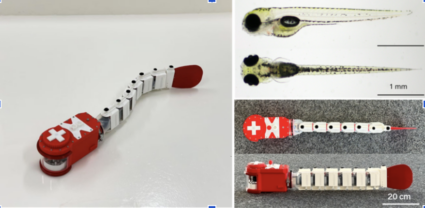
To validate the bioinspired energy-saving mechanism of fish intermittent swimming, the team developed a biomimetic robot, ZBot (Figure 1), scaled up 200 times from a larval zebrafish, with a body length of 80 cm and a weight of 2.8 kg. The ZBot replicates the larval zebrafish’s morphological features, segmented body structure, and center-of-mass distribution. Its flexible tail consists of six servomotor-driven segments to simulate natural fish undulation, while the head integrates core devices, including a central controller that serves as its nervous system, high-precision cameras, and real-time power meters. Equipped with expandable sensor interfaces, ZBot supports diverse experimental needs, including visual-motor processing [2] and vestibular system research.

Figure 1. ZBot and real larval zebrafish.
2. Can intermittent bout-and-glide swimming achieve higher energy efficiency than continuous tail-beating swimming, and if so, under which conditions?
The team from EPFL and Duke University collaborated to build a neurocomputational model simulating zebrafish neural circuits, centered on Central Pattern Generators (CPGs), bout-gate modules, and ventral spinal projection neurons (vSPNs). The CPGs generate continuous rhythmic oscillation signals to generate basic swimming undulations, with the bout gate acting as a core switching unit: it accumulates input signals via a leaky integrator and triggers CPG-driven tail undulation only when reaching a fixed threshold, forming the natural intermittent “active bout + passive glide” swimming rhythm. The simulated vSPNs further adjust tail deflection angle, enabling flexible maneuver swimming direction..
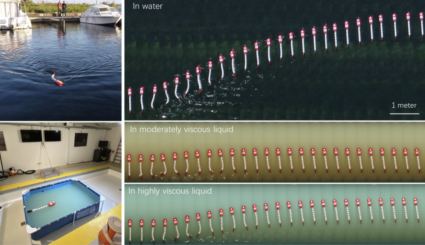
By adjusting parameters such as tail oscillation frequency, amplitude, and bout gate threshold, ZBot can accurately replicate multiple swimming gaits of larval zebrafish, including slow straight swims, routine turns, and J-turns (Figure 2). The EPFL-Duke team extended the model to construct an end-to-end framework for the larval zebrafish’s visually guided optomotor response, transforming the retinal input into motor output. This framework successfully reproduced the optomotor response in both ZBot and a digital twin simulation, simZFish.

Figure 2. Top view of ZBot bout-and-glide swimming in water (1 cP, 64000 ≤ Re ≤160000), moderately viscous liquid (213.9 cP, 37.4 ≤ Re ≤ 448.8, intermediate flow regime), and highly viscous liquids (457.0 cP, 1.0 ≤ Re ≤ 87.5, close to viscous flow regime). Recorded at 5 frames per second.
3. Are the energy-saving advantages of intermittent swimming constant in viscous fluid regimes, e.g., with low Reynolds number, as seen for tiny larval zebrafish and microbionic swimming robots?
Reynolds number is a dimensionless quantity that quantifies the relative magnitude of inertial forces and viscous forces acting on a fluid flow or a solid object moving through fluid. A lower Reynold number (<1000) indicates the fluid dynamics in viscous regime, where the moving object experiences the viscous force to a high degree. A higher Reynolds number (>1000) indicates the fluid dynamics in inertial-dominated regime, where inertial forces overwhelm viscous forces.
Large creatures, such as whales, swim in turbulent flow regimes with a high Reynolds (Re) number. Small creatures, such as tiny larval zebrafish, swim in an intermediate flow regime that is more strongly influenced by viscous drag. Thus, it is interesting to examine the effects of different flow regimes on dynamic behavior during intermittent swimming gaits. Leveraging the inverse relationship between Reynolds number (Re) and fluid viscosity, the team changed the fluid environments to mimic aquatic organisms of varying sizes by adjusting liquid viscosity (Figure 2 and Video 1). The moderately viscous fluid has a viscosity of 213.9 cP, comparable to fruit topping syrup; the highly viscous liquid has a viscosity of 457.0 cP, comparable to the standard makeup cleansing oil. Increased viscosity significantly shortens ZBot’s traveling distance, with the displacement in highly viscous fluid (473.0 cP, 1.0 < Re < 87.5) only 1/30 of that in normal water (1 CP, 64000 < Re < 16000. Intriguingly, viscosity has minimal impact on turning performance: ZBot’s turning angle per bout is approximately 60 degrees in normal water and remains at 45 degrees in highly viscous fluid.
Video 1. ZBot was tested in fluids of different viscosities (by mixing water with carboxymethyl cellulose sodium salt)
4. What mechanisms lead to the energy efficiency of intermittent swimming?
A well-known hypothesis on the benefits of intermittent swimming is that it improves energy efficiency during swimming. Through experiments, the team confirmed that intermittent swimming reduces energy consumption across all achievable velocities compared to continuous tail-beating swimming, in both high- and low-Reynolds-number regimes. However, due to the limited bout and glide cycle, the maximum velocity when using intermittent swimming is only about 60% of that when using continuous tail-beating swimming.
A popular reason for this energy saving is that intermittent swimming enhances the transfer of energy from kinematic tail movements to the body’s dynamic displacement in the liquid. This “fluid dynamics” hypothesis has several variants, but essentially proposes that the straight-tail posture during gliding phases reduces drag force and thus saves energy. In this study, the team proposed and explored another hypothesis, the “actuator efficiency” hypothesis. Bout-and-glide swimming enhances the transfer of energy from electricity (or chemical energy in fishes) to kinematic tail movements. In other words, intermittent swimming allows the robot (or fish) to use their actuators (or muscles) in more energy-efficient regimes than continuous swimming.
Both robotic servomotors and biological fish muscles follow an inverted U-shaped efficiency curve, achieving optimal energy conversion only under moderate load conditions. At lower swimming velocities, where intermittent swimming occurs, continuous tail-beating causes actuators to operate persistently in underloaded, inefficient states, resulting in wasted energy. In contrast, the bout-glide cycle modulates actuator working conditions: the short bout phase keeps motors within the high-efficiency load range, and the glide phase minimizes the inefficient operation. This cyclic regulation promotes the overall actuator energy conversion efficiency.
Importance of this research
This study takes natural animal movement as its core inspiration, successfully translating evolutionary biological advantages into improvements in robotic engineering performance, with value in both the life sciences and robotic engineering. For biological research, the bioinspired robot platform enables mechanistic decoding of neural-motor-energy correlations, shifting biological observation from correlational observations to causal verification and providing a new tool for vertebrate neural circuit research. For the robotics industry, this research verifies and provides a strategy for robotic control to lower energy consumption.
By learning from natural intermittent locomotion strategies, underwater robots can adopt adaptive gait switching, intermittent bout-and-glide mode for improved energy-saving endurance during low- and medium-speed cruising, and continuous driving mode for high-speed emergency maneuvering.
Charging Is the AMR Decision Nobody Models Until It’s Too Late: How to Get Fleet Charging Right Before It Costs You
How AI Consulting Can Help You Identify Opportunities for Automation?
With the age of fast-paced technology development and decision-making based on data, automation is arguably the most essential driver of operational scalability, efficiency, and innovation. Figuring out what to automate and how to do it right requires skills that most organizations may not have. It is where AI consulting shines through.
AI consultants offer not only technology recommendations but also strategic recommendations on how artificial intelligence can be leveraged to automate, reduce costs, and generate new revenue streams. In this article, we will describe how AI development companies allow organizations to unlock unseen opportunities in automation, how it is done by AI consultants, and what real benefits are achieved.
What Is AI Consulting and What It Covers?
AI consulting assists organizations in assessing, designing, and implementing artificial intelligence technology suitable for their requirements. It would typically involve
- Audit of current workflows and data pipeline
- Automating repetitive and rule-based tasks
- Suggesting AI-powered tools and platforms
- Creating proof of concepts (PoCs)
- Successful AI solutions scaled across departments
The AI consulting companies typically employ data scientists, Machine Learning engineers, business analysts, and process optimization experts who collaborate to deliver customized automation solutions.
Why Businesses Struggle to Identify Automation Opportunities?
Prior to proceeding with what an AI development company does, it is important to know why companies often overlook automation opportunities:
- Insufficiency of AI talent: Most organizations are deficient in-house AI talent.
- Limited visibility: Teams are often separated and ignorant of duplicate manual tasks.
- Fear of disruption: People are afraid to disturb existing processes.
- Cost issues: Companies feel that AI is too costly or difficult to adopt.
But, AI development companies can bridge the gaps by bringing in an outside-in perspective and the capability to discover the hidden inefficiencies.
How AI Consulting Identifies Automation Opportunities?
The below is a step-by-step process on how AI consultants establish where automation will be of greatest benefit:
- Business Process Evaluation
AI app development companies start with a thorough examination of your existing procedures. Consultants trace flows to trace:
- Repetitive work
- Low-complexity, high-frequency tasks
- Inefficient hand movements
With the help of stakeholder interviews and process mining software, they can view where automation will provide the most ROI
- Data Audit and Readiness Check
AI automation depends on information. AI consultants consider
- Availability and nature of unstructured and structured data
- System integration points (ERP, CRM, HRMS, etc.)
- Data privacy and data governance law
A readiness audit ensures the business is prepared to automate efficiently and safely.
- Use Case Identification
From facts, there are specific applications where automation is preferable in terms of cost, speed, and accuracy. Common locations are
- Customer service bots
- Invoice processing
- Inventory control
- Predictive maintenance
- HR onboarding
- Targeted marketing
All the application areas are prioritized based on impact and feasibility. This helps AI application development companies analyze your industry and build tailored solutions.
- Technology Recommendation
AI software development consultants evaluate and suggest the most suitable tool and platform. They can be:
- Robotic Process Automation (RPA) for rule-based work
- Natural Language Processing (NLP) for speech and text
- Machine learning predictive analytics
- Computer vision for video and image data
- Integrations with AI-driven CRM or ERP
This process guarantees that chosen technologies are in line with business goals and meets IT infrastructure automation needs.
- Proof of Concept (PoC) and Pilots
AI solution experts create pilot rollouts, or PoCs, prior to mass rollout, ensuring the project meets industry standards as well as ensures security and innovation across organization. Experts assist companies to:
- Test pilots in a low-risk environment
- Report on KPIs
- Gain internal stakeholders’ support.
It is an important stage of risk management and strategy formulation prior to mass rollouts.
- Change Management and Training
Change management in IT is common. AI development companies build solutions that can scale with your future business needs. Automating is not a technology revolution it’s culture. Consultants help company businesses:
- Trained staff for new workflow
- Provide training in AI tools.
- Oversee job loss fears
- Develop an innovation culture.
Successful change management creates future success.
Real-World Applications of AI-Based Automation
- Customer Support Automation
One major e-commerce company retained an artificial intelligence consulting firm to lower the call center volumes.
- Employed AI chatbots for FAQs
- Applied NLP for distribution of tickets wisely.
- Employed sentiment analysis for angry customer labelling
Outcome: 40% reduction in response time and 30% fewer support tickets.
- Accounts Payable Automation
The accounts receivable of a manufacturing firm can be automated with AI software solutions. Manufacturing units can reduce invoice processing by 70% and achieve accuracy up to 90% with AI automation. AI applications in manufacturing are
- Digitalized and scanned paper bills
- Imported relevant domains through ML
- Used by ERP to facilitate automated approval cycles
- HR and Recruitment Optimization
AI recruitment solutions help organizations completely automate hiring processes, from resume screening to interview scheduling and grade analysis.
Implementation of an AI-powered recruitment platform and HR processes automating solutions can decrease 50% of process times and improve operational efficiencies of the departments. AI can automate:
- Parsing of resumes by NLP.
- List the candidates’ work availability in order
- Bot is scheduling interviews
Top Benefits of AI Consulting for Automation
- Objective Assessment
AI consultants offer a fresh perspective that identifies inefficiencies that homegrown teams might miss.
- Faster ROI
Concentrating on high-impact opportunities through automation offers quicker value realization.
- Custom Solutions
AI development companies in India and USA can create automation plans tailored to your business, company size, and objectives, ensuring that the custom AI solutions meet your future needs.
- Technology Skills
They stay up to date with all the new trends, hardware, and platforms that AI is using in an attempt to provide the best possible suggestions that they can.
- Risk Mitigation
With rollouts sequenced and pilots to showcase applications, implementation risk decreases by consultants.
How to Choose the Right AI Consulting Firm?
To achieve the best possible automation, choose AI consultancy services that:
- Is solidly based in your field
- Provides turnkey solutions from design to installation
- acquainted with business processes and AI technologies
- Provides training and change management assistance
- Departmental and geographic scalability solutions
- Verify AI partner environment (i.e., Microsoft, AWS, Google Cloud), customer success stories, and case studies.
Future-Proofing Your Business Through AI Automation
AI automation is no longer about saving human effort it’s a question of business model transformation, customer experience, and competitiveness. Your best guides on this transformation are AI consultants, who will guide you to unlock and capitalize on AI opportunities that help you drive automation and innovation across processes. Whether you are just starting to explore test automation or need to accelerate what you are already doing, AI consulting firms provides you with the strategy, tools, and confidence to make the transition.
What Could Be The cost of AI development in 2026?
The cost of AI development depends on the project’s size, complexity, and specific technology and integration requirements. Basic projects, such as AI chatbots or simple automation tools that use standard AI models and limited integration, typically range from $10,000 to $50,000.
On the other side, mid-level AI projects, like fraud detection systems or AI recommendation engines, cost between $50,000 and $250,000. These AI initiatives involve more sophisticated algorithms, data, cloud deployment, and multiple integrations.
Enterprise-level AI solutions, such as generative AI models, large-scale predictive analytics, or computer vision systems, can cost anywhere from $250,000 to over $2 million. Because, these AI projects needs custom development, data infrastructure, and continuous monitoring and updates.
Other factors that influence overall costs include data acquisition and cleaning, the use of cloud platforms like AWS or Azure, the availability and cost of experienced AI developers and data scientists, regulatory compliance needs, and long-term maintenance and model retraining.
AI consulting helps organizations identify where automation will have the greatest impact by combining process analysis, data readiness assessment, and technology recommendations. Rather than starting with a tool, consultants start by auditing existing workflows and data pipelines to find repetitive, rule-based tasks that are good automation candidates.
Why businesses miss automation opportunities on their own:
- Lack of in-house AI talent
- Siloed teams unaware of duplicate manual work across departments
- Fear of disrupting existing processes
- Perception that AI is too costly or complex to adopt
How AI consultants identify opportunities — a typical process:
- Business process evaluation — mapping workflows to find repetitive, high-frequency, low-complexity tasks
- Data audit and readiness check — assessing data quality, system integrations, and governance/privacy requirements
- Use case identification — prioritizing candidates like customer service bots, invoice processing, inventory control, predictive maintenance, and HR onboarding by impact and feasibility
- Technology recommendation — matching use cases to RPA, NLP, machine learning, or computer vision as appropriate
- Proof of concept and pilots — testing in a low-risk environment before full rollout
- Change management and training — preparing staff and addressing concerns about job impact
Example outcomes cited: a 40% cut in response time and 30% fewer support tickets from AI-driven customer support; up to 70% faster invoice processing with 90% accuracy in accounts payable automation; and roughly 50% faster hiring cycles through AI-assisted recruitment.
Typical costs (2026): basic automation projects run $10K–$50K; mid-complexity projects (e.g., fraud detection, recommendation engines) run $50K–$250K; enterprise-scale AI (generative AI, large predictive systems) can exceed $250K–$2M+.
Conclusion
Artificial intelligence–based automation is changing how companies operate but unlocking its full value is about something more than tech. It is a thoughtful, evidence-based response that AI consultants are best placed to give. Through identifying the appropriate opportunities, developing intelligent workflows, and pushing organizational change, AI consulting allows you not only to improve operations but also to build enduring strategic value.
[contact-form-7]