How Robots Learn to Walk Like Humans Humanoid robot walking is one of the most challenging problems in robotics. A humanoid must coordinate many joints, maintain balance on two relatively small feet, respond to sensor feedback, and adapt its movements as conditions change. Unlike a wheeled robot, a humanoid cannot simply move its body forward. […]
Here AGV system specialists, Aerocom, take a look at what it takes to integrate AGVs successfully into hospitals by looking at the planning, the importance of staff buy-in, and the benefits and constraints of this essential technology.
AI in Inventory Management Development: Detailed Guide 2026
Inventory management has been one of the supply chain success secrets. Artificial Intelligence (AI), to date in 2025, is not a trend but an industry disruptor that’s changing the way businesses monitor inventories, forecast demand, remain shortage-free, and cut waste. Let’s look at how AI is transforming inventory management in 2025, AI benefits in inventory app development, its limitations, and where it is heading.
What is AI in Inventory Management?
AI inventory management and tracking involves the use of machine learning, deep learning, natural language processing (NLP), and data analytics to best optimize the inventory’s entire life cycle, from purchasing, storage, monitoring, and forecasting to restocking.
Legacy systems are rule-based and information-static, whereas AI systems deal with massive volumes of real-time and historic data to generate dynamic decisions as well as predictions, which constantly improve in responsiveness as well as correctness. It helps companies to better predict demand, automate restocking, identify anomalies such as wastage or theft, and reduce overstocking or stockouts.
Top AI Technologies Used for Inventory App Development
As companies aim to be data-driven, AI technologies are emerging as the bedrock of inventory management solutions. AI technology enables organizations to make demand forecasts, monitor stock in real-time, automate repetitive tasks, and react to changes in the market with unparalleled precision and speed. The following are a few leading AI technologies that are fueling innovation in inventory management app development:
Machine Learning (ML)
Machine Learning is at the heart of predictive inventory management. ML algorithms can scan massive databases of historical sales, seasonality patterns, promotions, and external weather or economic factors to predict with precision future requirements for inventory. By detecting anomalies and recognizing patterns, ML allows organizations to avoid stockouts, reduce excess inventory, and improve customer satisfaction.
Computer Vision
It is revolutionizing inventory monitoring in real-time. Through intelligent cameras, drones, and image recognition applications, inventory programs can be counted automatically, track defective items, and highlight order error placements across warehouses or within retail spaces. All of these steps do not require manual audit and considerably mitigate human errors. During app programming, Computer Vision can be infused to deliver in-life visual monitoring of inventory, automatic quality analysis, and even augmented reality for navigation across warehouse facilities.
Natural Language Processing (NLP)
Natural Language Processing makes simple, voice-based interaction with stock systems possible. Inventory managers or staff can retrieve quantities in stock, locate items, or order stock through simple voice commands or natural language queries. NLP also can analyze unstructured conversations, vendor emails or customer service call logs, to spot possible demand shifts or order modifications. NLP-based inventory applications bring processes nearer to end-users, especially non-technical ones, and facilitate faster, better decision-making.
Robotic Process Automation (RPA)
Robotic Process Automation brings speed and efficiency to inventory operations through the automation of repetitive and rule-based activities. These include reconciliation of stock, reporting, matching invoices, processing orders, and communications with suppliers. With the integration of RPA into inventory management software, organizations can free manual effort, eliminate errors, and ensure consistent process execution. These bots can operate 24/7, improving response and freeing employees from tactical work to do strategic work.
Internet of Things (IoT) and AI
Combined, these AI technologies and Internet of Things (IoT) are transforming the functionality of inventory management apps. These technologies not only improve visibility and accuracy but also build smart systems that learn and react to shifting demands in real time. As AI companies seek to expand operations and adopt digital transformation, the incorporation of these AI tools into inventory management software will be key to remaining competitive and resilient.
AI-Powered Inventory Management Use Cases
Demand Forecasting–Artificial Intelligencemodels have the ability to process multi-sourced data (news, social media trends, previous sales) and forecast peak or trough demands with greater accuracy than human planners.
Inventory Optimization-AI dictates optimum stock quantities, minimizing stockouts or overstocking. AI allows just-in-time stocking, keeping minimum holding costs but ensuring customer needs.
Automated Refill-Automated restock orders can be triggered by AI systems when the stock reaches set limits. Complementing such systems with lead times from the supplier prevents stockouts.
Warehouse Automation-AI manages robots and drones in intelligent warehouses for picking, sorting, and storing. It optimizes storage and minimizes manual labor.
Dynamic Pricing and Promotions-AI is able to shift pricing models according to inventory levels and demand in the market. Overstocked products can be dynamically discounted to sell off inventory.
Fraud and Anomaly Detection-AI algorithms track inventory data to identify anomalies, like sudden loss of merchandise or record discrepancies and actual stock, which could be signs of theft or system malfunction.
Top Benefits of AI in Inventory Management App Development
Artificial intelligence is transforming inventory management application development by implementing smart automation, real-time intelligence, and data-based decision-making. Through the implementation of technologies such as machine learning, computer vision, and IoT, organizations are able to become more accurate, efficient, and responsive in their inventory functions.
Increased Accuracy: AI inventory software enhance accuracy with the help of real-time data and predictive algorithms to forecast demand and track stock levels with precision.
Reduced Cost: AI inventory applications save costs by lowering overstock and stockouts due to accurate demand prediction.
Improved Customer Satisfaction: Shorter delivery times and accurate order fulfillment result in higher customer retention and satisfaction.
Improved Visibility: AI-powered dashboards offer real-time visibility into warehouse operations, supply chain performance, and inventory levels.
Sustainability: Minimizing waste, especially in perishables, supports environmental sustainability and ESG targets.
AI Inventory Management Development Implementation Steps
Step 1: Evaluate Your Existing Inventory System
Audit existing processes, software, and methods of data collection. Determine inefficiencies and gaps in data.
Step 2: Establish Business Goals
Establish specific goals, do you wish to enhance forecasting accuracy, minimize carrying costs, or automate replenishment?
Step 3: Gather and Consolidate Data
Quality of data is essential for AI success. Combine data from POS, ERP, CRM, and external sources into a single database to make data process seamless.
Step 4: Select Appropriate AI Tools
Use tools like TensorFlow, PyTorch, or Scikit-learn for forecasting, and OpenCV or Amazon Rekognition for visual tracking. For NLP and automation, integrate Dialogflow, UiPath, and IoT platforms like AWS IoT for real-time monitoring.
Step 5: Train the Model and Test
Begin with pilot projects in a single warehouse or product category. Iterate models according to real-world outcomes.
Step 6: Scale and Refine
Deploy the app across business units or product categories, and regularly monitor AI performance to fine-tune models as needed.
The Future of AI in Inventory Management App Development
The AI wave will go on to change the supply chain and logistics industry. The combination of blockchain and AI will improve traceability and visibility of inventory processes, especially in industries such as luxury and pharmaceuticals where traceability of product origin and history is essential.
Digital twins are increasingly being developed as potent solutions, establishing digital copies of warehouses to allow advanced scenario planning, performance assessment, and operating efficiency. The virtual worlds allow organizations to try before they adopt in the real environment, reducing risk and enhancing decision-making.
Simultaneously, Autonomous Mobile Robots (AMRs) are becoming increasingly advanced with AI capability that allows them to navigate warehouse spaces with little human intervention. AMRs enhance productivity, lower labor expenses, and are able to adjust to changing conditions in real-time.
Moreover, voice-AI assistants are simplifying warehouse operations and reducing inventory management pressure on resources. It enhances accessibility and accelerates mundane tasks without the need for advanced training.
Finally, generative AI is being applied in logistics to mimic intricate supply chain reactions and create optimized reorder policies. Anticipating disruptions and simulating different scenarios, businesses can make more proactive, better-informed decisions. All these innovations collectively herald a more intelligent, agile, and responsive future for world supply chains.
Conclusion
Inventory management with AI is not something that exists in the future, it’s already here today. From forecast demand to automated replenishment to stockout prevention, AI results in unparalleled accuracy, efficiency, and responsiveness in managing stock.
Companies in 2025 that utilize AI most effectively are not merely streamlining their supply chain, they’re reshaping customer satisfaction, reducing expenses, and establishing strong, smart operations. As a small store or as an international maker, incorporating AI into your stock plan is a matter of becoming and surviving today’s marketplace.
The MICROBS Lab’s microfliers. 2026 EPFL/MICROBS – CC-BY-SA 4.0.
By Celia Luterbacher
When you blow air across the neck of a bottle, you’re not just producing a pleasant tone: you’re also demonstrating a phenomenon called Helmholtz resonance. This occurs when airflow passing across an opening causes air trapped inside a cavity (like a glass bottle) to oscillate back and forth. At certain frequencies, these oscillations become much stronger, producing the familiar humming sound.
Now, researchers in the MicroBioRobotic Systems (MICROBS) Lab in EPFL’s School of Engineering have harnessed the physics behind this phenomenon to build hollow structures that act as miniature, sound-powered machines. The innovation has been published in Science Advances.
“Instead of pushing devices around with sound waves, we have created acoustic resonators that are tuned to harness sound at specific frequencies to generate directional thrust and controlled motion,” says lab head Selman Sakar. “Our work shows the feasibility of transforming a simple, cleverly designed mechanical piece into robotic matter.”
The MICROBS Lab’s sound-powered boat. 2026 EPFL/MICROBS – CC-BY-SA 4.0.
Miniature boats and microfliers
While previous approaches have used sound waves to levitate passive objects mid-air, the EPFL team designed devices that convert sound into their own propulsive force. Their innovation lies in the fabrication of hollow round or bell-shaped structures called cavities.
When sound waves excite the air inside these cavities, the oscillating air is forced out as a concentrated jet, while the incoming airflow is more diffuse. This imbalance generates thrust that can propel small vehicles. These sound-powered cavities can be made from a variety of materials, including common 3D-printing plastics, rubber-like polymers, and glass.
The MICROBS Lab’s microflier. 2026 EPFL/MICROBS – CC-BY-SA 4.0.
At the centimeter scale, the team built miniature boats equipped with up to three cavities, each tuned to a different audible frequency and positioned to push the boat in a particular direction. By changing the frequency of sound waves from a speaker, the researchers could selectively activate different cavities to move the boats, steer them around obstacles, and even program them for autonomous navigation.
Using a 3D nanoprinting technique, the team built ‘microfliers’: ultralight flying vehicles with three microscopic cavities integrated directly into their polymer structures. In contrast to the boats, the microfliers were powered at ultrasonic frequencies inaudible to the human ear. One design weighing just 150 micrograms used its cavities to generate direct upward thrust like a rocket. Another microflier combined the cavities with tiny blades, which spun at speeds of up to 13,000 revolutions per minute, to generate stable, helicopter-like aerodynamic lift.
A microflier in flight. 2026 EPFL/MICROBS – CC-BY-SA 4.0.
Toward sound-responsive robotics
Because the devices rely on hollow cavities rather than motors, gears, or magnetic components, they can be made extremely small and lightweight using a variety of 3D-printing methods.
“Our concept is compatible with even further miniaturization, enabling advanced designs that push the boundaries of robotics and aeronautics,” says first author and MICROBS Lab PhD student Junsun Hwang.
Sakar adds that in the future, several sound-responsive structures could be built into a single flexible device, with each one reacting to a different sound frequency. “This would allow specific parts of the device to move, bend or vibrate, potentially leading to aerodynamic robotic devices that can change shape in response to sound,” he says.
The development represents an incredible breakthrough for writers – many of whom are looking for AI that writes much more creatively than the currently bland, ‘corporate voice,’ cloud-based offerings like ChatGPT, Gemini and Claude.
Dubbed Qwen 3.8-27B, the new Open Source AI can be downloaded and run for free on a laptop that sports as little as 17GB RAM.
Essentially, writers with powerful laptops can try-out Qwen using their favorite prompts for creative writing – and then decide if Qwen makes the grade.
The long-term bonus: Even if this version of Qwen is not creative enough for you, the mere fact that AI of such power can now be run on a consumer-grade laptop indicates similarly powerful Open Source AI from other developers will soon be coming to powerful laptops.
Even better: Offering a highly creative writing alternative to corporate-voice AI is already child’s play for many AI developers.
The reason: ChatGPT-4o, released way back in May 2024 — but ‘retired’ by maker OpenAI in favor of AI that writes in a bland voice — is considered the pinnacle of AI creative writing by many writers.
Achieving that level of AI – available since May 2024 – is something most competitive, Open Source AI makers these days can whip-up in their sleep.
Bottom line: If you’re looking to download and try this version of Qwen on your laptop or similar, check-out LM Studio. Even if you’re a novice, you should be able to download the AI and get it running on your computer with just a bit of effort.
Google has announced college students in 140 markets worldwide are eligible for free access to its premium AI for a year.
U.S. students get the best deal – 12 months of access to Google AI Pro – while students in other countries get free access to the less generous Google AI Plus.
*‘ChatGPT for Teens’ Rolls-Out: Responding to parental concerns that ChatGPT may be too intense for teenagers, maker OpenAI now has a special teen version of its AI.
Observes writer Cecilia Kang: “The chatbot will limit high-risk conversations that involve self-harm, violence, eating disorders and explicit sexual and graphic content.
“In some cases, ChatGPT will alert adults who have opted-in to parental controls and notifications. And the mode will strengthen protections that prevent the chatbot from suggesting it has personal feelings.”
Dubbed ‘Preferred Sources,’ the new feature works when you look for a topic in the news, click on the ‘Top Stories’ icon, search for preferred news sources — then select the sources you want.
Observes writer Duncan Osborn: “Once you select your sources, they will appear more frequently in Top Stories or in a dedicated ‘From your sources’ section on the search results page.”
*Google Now Auto-Transcribes Face-to-Face Meetings: Gemini-powered Google Meet is now able to record, transcribe and summarize the kind of meetings people used to have before nternet, video cameras and Zoom became a thing.
Observes TechRepublic: “Gemini turns the conversation into a Google Doc, with a summary and action items.”
One caveat: The AI-generated summaries may not be entirely accurate.
Equally eyebrow-raising: More than 100,000 versions of Gemma have been created by AI developers, who have tweaked the free-to-use AI to their personal specifications.
Not bad — but no cigar.
According to writer Ana Maria Constantin, a Chinese competitor to Google says its Qwen Open Source AI has been downloaded three billion times.
Ever since the advent of Chinese Open Source AI DeepSeek, the U.S. has been wary of the Open Source AI genre, which is free for download, free to use — and nearly as good as ‘bleeding edge’ U.S. AI.
Observes writer Robbie Whelan: “The failure of U.S. AI labs to give priority to open-source models has created concerns that businesses and countries around the world will turn to Chinese open-weight models instead.”
*U.S. to Allies: Choose Between U.S. AI – or Chinese AI – Now: In yet another indication of the gravity of who ultimately controls AI, the Trump Administration will soon ask 35 allies to choose between using its U.S. AI ecosystem – or its Chinese competitor.
Observes writer Ana-Maria Stanciuc: “Belonging to both is no longer an option.
“Roughly two dozen nations have joined so far, including Japan, Australia and South Korea.”
Observes writer Dean Ball: “The structural challenge posed by advanced machine intelligence to free society is likely not the most radical decentralization of power imaginable.
“Instead, it is seeking to establish and preserve the right balance of power, such that no single actor, or small set of actors, can dominate the rest.”
Share a Link: Please consider sharing a link to https://RobotWritersAI.com from your blog, social media post, publication or emails. More links leading to RobotWritersAI.com helps everyone interested in AI-generated writing.
–Joe Dysart is editor of RobotWritersAI.com and a tech journalist with 20+ years experience. His work has appeared in 150+ publications, including The New York Times and the Financial Times of London.
Researchers have used AI to uncover the DNA signature of a key genetic “switch” involved in turning genes on. After analyzing about 500,000 DNA sequences, the model identified the initiator in roughly 60% of human genes. The breakthrough could help predict the effects of harmful mutations and eventually contribute to decoding the broader genetic instructions that control gene activity throughout the body.
Chinese humanoid robots broke records set by humans, including beating Usain Bolt's 100-meter sprint world record, on the opening day of the Olympics-like World Humanoid Robot Games in Beijing on Saturday.
Cyborg insects combine the mobility of living organisms with miniature electronic devices, offering potential applications in search-and-rescue operations, infrastructure inspection and exploration of environments that are difficult for conventional robots.
The prototype uses a rigid base, four soft air-tight pads, a continuous piezoresistive layer, and 32 boundary electrodes. Its parts were produced through 3D printing and spray coating.
What is the topic of your Blue Sky Ideas paper and why is it an interesting area for study?
My Blue Sky Ideas paper asks a simple but difficult question: how can an autonomous agent keep learning as its world changes without quietly losing the guarantees that made its behavior trustworthy?
Reinforcement learning and formal methods address complementary parts of this problem. Reinforcement learning allows an agent to learn by trial and error and can scale to environments for which we could never write down every rule. However, the agent is usually asked to maximize a reward. A poorly specified reward can be exploited, and a high reward does not by itself tell us that a safety or coordination requirement has been satisfied. Reactive synthesis starts from the other end: given a model of the environment and a logical description of the intended behavior, it can construct a policy that is correct by design. The difficulty is that it normally needs an explicit, fixed model, which is precisely what an agent lacks in an open and changing world.
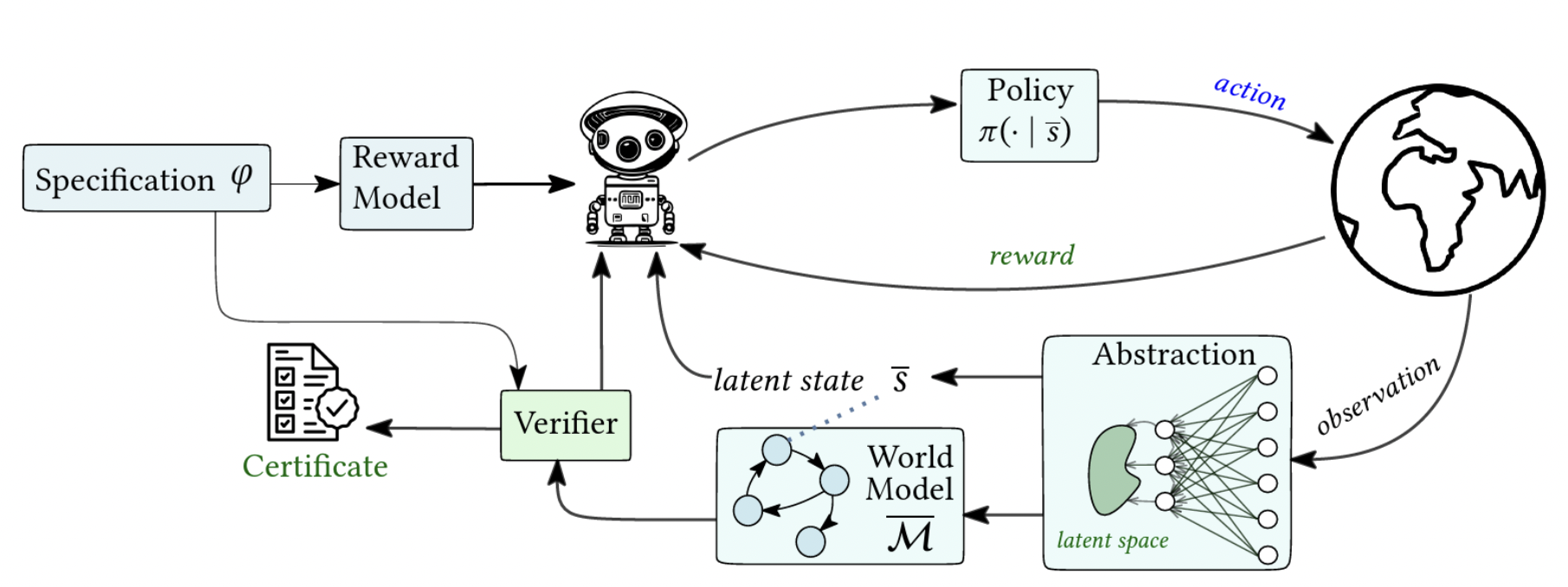
The paper proposes a research agenda that brings these traditions into one loop. A foundation world model would be learned from experience, but structured so that a verifier can reason about it. As the agent learns a policy, it would update its model, measure the reliability of its abstraction, and check whether the policy still satisfies its specification. The verifier’s feedback could reject an unsafe update, request data from an uncertain region, or trigger a revision of the model.
This matters because real environments do not politely remain as they were during training. Goals evolve, conditions change, and, in a multi-agent system, every adapting agent changes the environment perceived by the others. Reliability therefore cannot be a certificate obtained once at deployment. It has to be maintained as the agent continues to learn.
What is your vision for foundation world models?
To me, foundation refers first to reuse, not simply to size. I do not envision a larger video predictor trained on more trajectories. I envision a persistent and structured model that an agent can carry across tasks, policies, and changing populations of agents.
One way to think about it is as a map that records more than roads. It should also tell the agent which areas have been surveyed, which conclusions depend on those areas, and when a change in the world has made an old route unreliable. A useful foundation world model should do the same for decision-making: predict what may happen, expose the structure needed for reasoning, and quantify when those predictions are trustworthy enough to support a guarantee.
I’d want such a model to have three key properties. First, it should be calibrated: every learned abstraction should come with a measure of its error or coverage, so that the agent knows where formal conclusions remain valid. Second, it should be compositional: verified local dynamics, behaviors, and certificates should be reusable when a new task is assembled. Third, it should be semantically queryable: a formal requirement or high-level instruction should help the agent derive a suitable reward model, task-specific abstraction, or policy prior with little additional experience.
The durable idea is that the world model becomes a common substrate for learning, planning, and verification. It should help an agent act, but also identify the limits of its competence, gather evidence where those limits matter, and explain why a particular behavior can or cannot currently be certified.
How does this vision differ from current models?
Most current model-based approaches focus on learning for a particular task, environment, policy, or training distribution. Their main model learning objective is predictive accuracy: reconstruct an observation, forecast the next (latent) state, or generate imagined trajectories for planning. Those are important capabilities, but average predictive metric is not the same as fitness for a particular guarantee.
Consider a model for a scenario involving an agent interacting in a warehouse, where the world model predicts almost every transition correctly but misses a rare, dangerous interaction with a forklift. Its average error may be excellent while that transition is exactly the one that determines whether a collision-avoidance claim is valid. The reverse is also possible: a compact model may ignore colors and textures yet preserve everything needed to reason about routes and collisions. For verification, the relevant question is therefore not only “How accurate is the model?” but “Which conclusions does this accuracy justify, for this policy and this requirement?”
Foundation world models would make that connection an explicit design objective. Their abstractions would carry reliability information tied to the behavior being analyzed, and this information would be revised online as the data distribution changes. Previously verified components could be reused and composed, while specifications expressed in logic or language could guide which representation and policy the agent needs for a new task.
The main difference is therefore a change in role. Current models are primarily prediction tools. The model I envisage is a persistent, analyzable basis for learning, adaptation, and formal reasoning, with language models providing a complementary semantic interface. They could translate high-level instructions into candidate specifications or propose structured model updates, while the world model grounds these proposals in experience and the verifier checks their validity. Foundation world models may benefit from scale through broader task and environment coverage, but scale alone does not provide the structure or certificates required for reliability.
Could you give an example of how such a model might work?
Consider a delivery robot in a busy warehouse. Its task could be stated as: “eventually deliver the package while always avoiding collisions.” Instead of manually combining many bonuses and penalties, the system would translate that requirement into a reward model. Learning and verification would then start from the same description of the intended behavior.
As the robot receives observations, it would learn a compact representation of the warehouse and a policy that acts on that representation. A verifier would ask two related questions. Does the policy satisfy the delivery and collision-avoidance requirement in the learned world model? And is the learned abstraction accurate enough, along the routes that matter, for that conclusion to be trusted? A certificate is meaningful only when both answers are supported.
Now suppose a new forklift begins using a shortcut that was rarely visited during training, cluttering the way. Rather than treating an old prediction as a guarantee, the model should lower its confidence in that region. The verifier would detect this, withdraw the affected certificate, reject a risky policy update, direct exploration toward the shortcut, and reinstate a guarantee only after the world model has been recalibrated.
The paper also considers a more ambitious test-time loop. A language model could propose one or more small formal program describing the new dynamics. A model checker would test them, learn to compose with them, and return a counterexample or structural inconsistency when they are wrong. The language model could revise its hypothesis, the robot could collect targeted experience, and the cycle would repeat. In this division of labor, the language model proposes and the formal verifier checks.
We already have pieces of the loop, including formal reward translations, verifiable abstractions, safe policy-improvement methods, and program generation. Building an efficient end-to-end agent that keeps all of these pieces calibrated while it learns remains the research challenge.
What do you think the impact of such a framework on multi-agent systems could be?
Multi-agent systems make the problem both more urgent and more difficult. Each learning agent is a moving part of every other agent’s environment. Even when the physical world is unchanged, the effective dynamics evolve as agents update their policies, join or leave the system, share information, or pursue new objectives.
A foundation world model could retain reusable descriptions of these interaction patterns, while formal specifications state what must hold for the group. A fleet of warehouse robots, for example, may need to avoid collisions and complete deliveries while respecting shared capacity constraints. The model could connect each local policy to the assumptions on which its certificate depends. If one robot changes its route, the system could identify which assumptions and guarantees are affected, collect new data where needed, and revise only the relevant components rather than relearning and re-verifying the entire fleet.
Composition is the main source of potential leverage. Verified local dynamics or coordination behaviors could serve as building blocks for new teams and tasks, and previous agents could provide useful priors for new participants. This could support faster adaptation while making failures easier to diagnose: the system should report which interaction invalidated a certificate and provide a counterexample, rather than only revealing that the joint reward has fallen.
The central obstacle for multi-agent systems is scalability. The joint state space grows very quickly with the number of agents, and local guarantees do not automatically compose into a global one. We will need principled ways to expose dependencies, preserve soundness under composition, and run verification quickly enough to influence learning online. If we can solve those problems, the field could move from learning coordination strategies and checking them afterwards to learning new strategies while continuously tracking which global properties remain guaranteed.
About Florent
Florent Delgrange is a postdoctoral researcher in computer science at the Artificial Intelligence Lab of Vrije Universiteit Brussel (VUB). His research lies at the intersection of reinforcement learning, world models, and formal verification. He develops methods for agents that can learn and adapt while justifying and certifying the behavior they adopt. He completed a joint PhD at VUB and the University of Antwerp in 2024 on the formal verification of deep reinforcement learning policies. His paper Foundation World Models for Agents that Learn, Verify, and Adapt Reliably Beyond Static Environments received the Best Blue Sky Paper Award at AAMAS 2026.
We asked TI experts to explain how semiconductor technologies could enable humanoid robots to move from specialized applications to scalable real-world systems, and what it will take to scale them for deployment.
To operate reliably in dynamic real-world settings, robots should be able to acquire new skills quickly without undergoing extensive additional training. Most existing robotic systems, however, primarily perform well on the tasks that they were trained to complete.
An internal payment agent used by five employees may need more orchestration than a customer-facing assistant serving 50,000 users that only drafts responses for human review. The payment agent can move money before anyone intervenes. The drafting assistant remains behind a human checkpoint.
That contrast exposes the problem with treating orchestration as a late-stage requirement for “large” AI programs. User count is easy to measure, but it doesn’t reveal where the real operational exposure sits.
Agent systems can remain online while degrading across accuracy, latency, cost, and effectiveness. They can carry one bad input through multiple decisions, access records that require a defensible audit trail, or act before a person has a chance to intervene. In each case, the system is still running while the operational exposure grows.
That makes orchestration readiness a question of three independent variables:
How quickly a repeated error can become a material business problem
What data the agent can access
What the agent can do without approval
Those variables translate into scale, data sensitivity, and autonomy. Any one can be decisive. Evaluating them independently gives teams a more useful way to decide when orchestration belongs in the operating model.
AI agents can fail while remaining operational
Traditional application monitoring looks for binary failures: a service crashes, an endpoint stops responding, or an error rate spikes. Traditional model monitoring evaluates whether outputs remain accurate and stable. Neither was designed to catch an agent that returns a correct answer while burning through budget, looping unnecessarily, or carrying a bad input through five downstream decisions. The first visible signal may be a budget overrun, a compliance issue, or a repeated pattern of bad decisions.
Agent systems introduce multi-dimensional operational failure. Accuracy can slip when an agent retrieves the wrong context or carries an early error into later decisions. Latency can rise as retrieval steps, approvals, and tool calls accumulate. Cost can spike when retries or loops trigger unnecessary model calls. Effectiveness can decline even when the final answer is correct, such as when an agent takes 20 steps to solve a two-step problem.
The endpoint still responds, so conventional monitoring may show a healthy system. Meanwhile, degradation can spread across model calls, tools, permissions, retries, and downstream actions. A green status light confirms availability alone. Accuracy, efficiency, safety, and cost may already sit outside acceptable limits.
3 triggers that make orchestration necessary
Orchestration readiness comes down to three signals: scale, data sensitivity, and autonomy. Each one measures how quickly an agent failure can become a business problem and how difficult that failure would be to detect, contain, or explain.
Trigger
Question to ask
What raises the bar
Scale
At what execution volume could a repeated error affect customers, revenue, operations, or downstream decisions faster than the team could detect and correct it?
High execution velocity, repeatable workflows, broad downstream impact
Data sensitivity
If an agent’s decision appeared in an audit next year, could you reconstruct the inputs, retrieved context, tool calls, permissions, policy checks, and downstream actions that produced it?
Regulated or confidential data, sensitive records, weak traceability
Autonomy
Can the agent create a consequential side effect without a human checkpoint?
Payments, record changes, customer communications, access changes, production actions
1. Scale: Could you catch a repeated error before it compounds?
User count is only one part of scale. Execution volume and velocity matter more. An internal agent used by five employees may still run thousands of workflows each day. A customer-facing agent may serve a much larger audience but operate behind strict review and rate limits. The relevant question is how often the system acts and how quickly the same flaw can repeat.
Consider a supply chain agent that misreads a date in a procurement document, selects the wrong vendor, and triggers an invalid restock order. A team may catch one bad recommendation during limited use. At production volume, the same error can propagate across orders, regions, and downstream systems before anyone recognizes a pattern.
Even a low error rate becomes material at volume. A 0.1% failure rate across 50,000 sessions produces 50 incidents. The same rate across 1 million executions produces 1,000.
Manual oversight can’t keep up with that compounding rate. Teams need consistent tracing, monitoring, policy checks, and intervention points across the workflow.
Question to ask: At what execution volume could a repeated error affect customers, revenue, operations, or downstream decisions faster than the team could detect and correct it?
2. Data sensitivity: Could you defend the agent’s decision later?
Sensitive data raises the stakes even when an agent has few users or runs infrequently. One exposed payroll record, patient file, financial transaction, or confidential contract may create more risk than thousands of interactions involving public information.
A defensible answer requires visibility across the full execution path. Teams need to know which identity initiated the workflow, what data the agent accessed, which tools it invoked, which controls applied, and what action followed. Without that record, an investigation becomes a manual reconstruction across disconnected logs and systems.
Once an agent can retrieve, modify, or expose regulated or confidential information, permissions, traceability, and policy enforcement need to be part of the operating model from the start. Dataset size doesn’t determine the risk. The sensitivity of a single record may be enough.
Question to ask: If an agent’s decision appeared in an audit next year, could you reconstruct the inputs, retrieved context, tool calls, permissions, policy checks, and downstream actions that produced it?
3. Autonomy: Can the agent act without approval?
Autonomy determines how far an agent’s decision can travel before a person has a chance to intervene.
An agent that drafts an email produces a recommendation for review. An agent that sends the email creates an external action. The same distinction applies across enterprise workflows:
Suggest a payment or approve it
Propose a database update or commit it
Identify a supplier or place the order
Recommend an access change or execute it
Consequential actions include moving money, modifying records, changing permissions, contacting customers, triggering purchases, or updating production systems. Each action increases the importance of scoped permissions, runtime monitoring, audit trails, and intervention controls.
In agent systems, trust functions as a permission model. It depends on what the agent can access, what actions it can take, under which conditions, and with what level of oversight.
Question to ask: Can the agent create a consequential side effect without a human checkpoint?
Evaluate each trigger independently. They aren’t sequential stages, and teams don’t need to accumulate all three before acting. A financial agent with five users and authority to execute transactions may need orchestration before a customer-facing assistant with thousands of users and a mandatory human review step.
An orchestration readiness check
Apply the check to any agent your team is running:
Scale: Can one flaw repeat across enough executions to become a business pattern before your team catches it?
Data: Does the agent access confidential or regulated information that requires a defensible audit trail?
Autonomy: Can the agent take a consequential action without human approval?
Then count your yes answers.
Zero yes answers: Lighter tooling may fit the current scope. Document the agent’s boundaries and monitor for changes.
One yes answer: Start building orchestration into the operating model now. Don’t wait for a second trigger to make the risk material.
Two or three yes answers: Treat orchestration as a prerequisite for further expansion. Add traceability, enforceable controls, and intervention points before increasing usage, access, or autonomy.
Run the check for each agent. Risk varies by system, even within the same AI program.
Don’t wait for expansion to retrofit governance
A low-risk agent may not need enterprise-scale orchestration today. It still needs clear ownership and documented limits on access and action. Those basics preserve the conditions behind a zero-trigger score and make changes in the system’s risk profile easier to see.
Reassess before any change that expands the agent’s scale, data access, or authority. An internal pilot may become a companywide tool. A drafting assistant may gain permission to send. A workflow using public information may connect to confidential customer records.
Run the check before approving those changes. Once the wider rollout begins, the agent is already operating under a different risk model.
Retrofitting controls after release leaves teams investigating live failures, rebuilding permissions, and reconstructing decisions across disconnected systems.
Put orchestration into practice
If you scored one or more on the readiness check, you already know orchestration belongs in your operating model. The harder question is how to implement it.
Robots sorting parcels and serving fried chicken enthralled visitors at a robotics expo in Beijing on Wednesday, where hundreds of companies set out their pitches for a future labor market transformed by artificial intelligence.

 The MICROBS Lab’s microfliers. 2026 EPFL/MICROBS – CC-BY-SA 4.0.
 The MICROBS Lab’s sound-powered boat. 2026 EPFL/MICROBS – CC-BY-SA 4.0.
 The MICROBS Lab’s microflier. 2026 EPFL/MICROBS – CC-BY-SA 4.0.
 A microflier in flight. 2026 EPFL/MICROBS – CC-BY-SA 4.0.