Archive 19.10.2026

Page 4 of 56
1 2 3 4 5 6 … 56

Top 5 AI Use Cases in Pharma & Bio Medicine

Top AI Use Cases In Pharma and Biomedicine

The use cases of Artificial Intelligence (AI) in the healthcare sector, especially in the pharma and biomedicine field, are gaining momentum.

Herein, we would like to go beyond the AI trends that exist in this ever-growing healthcare sector & benefits of artificial intelligence in pharmaceutical industry. Let’s start!

In our research, we found that approximately 50% of global healthcare companies will implement AI strategies and broadly adopt the technology by 2025. In particular, global pharma, drug development, and biomedicine companies will invest more in discovering new drugs for chronic and oncology diseases.

Biomedicine companies are adopting AI and its tools for conducting accurate laboratory and scientific tests and predicting the right diagnosis and treatment of disease. By automatically deriving patterns into various oncology diseases, AI use cases in pharma and biomedicine ensure wide opportunities and make workflows faster and more efficient.

In this article, we aimed at clearing the doubts that most healthcare business leaders have in mind such as-

  • What are the major AI and Machine Learning (ML) applications that are increasingly used at the top pharma companies?
  • Are these companies follow common AI trends to reap the benefits? If so, what are the AI trends for Pharma companies?
  • How much global pharmaceutical and drug development companies are investing in machine learning and AI applications?

Now, we will directly move into our topic “how top pharma companies (like Johnson & Johnson, Roche, Pfizer, Bayer, and Novartis, etc.) are implementing AI applications.

I hope this article would help pharma companies to know how AI help them in generating increased RoI.

#1 Johnson & Johnson- The America’s top pharmaceutical company

Johnson & Johnson (J&J) has started implementing AI since 2015 after the collaboration with IBM’s Watson Health. IBM Watson is an AI-powered cloud system designed to process enormous amounts of healthcare data. It provides proof-based responses to professionals in natural language.

At present, the company is striving to put its total efforts to combine expertise and the power of AI and ML to come up with new drugs, treatments, and surgical methods.

  • Robotics Surgery

It is a novel application of artificial intelligence in pharma and biomedicine. It is a trending role of AI in the pharma and medical field.

J&J has created a joint venture- Verb Surgical, in partnership with Google Verily in 2015 to develop AI and ML-powered surgical robots to perform minimally invasive medical surgeries. Still, research works ongoing on Verb’s robots and is expected to come into the market by the end of 2020.

  • AI In Drug Discovery & Development

Artificial intelligence in drug discovery is another significant Pharma use cases. The benefits of AI in pharma and biomedicine are not limited to robotic surgery and pattern recognition, drug discovery, design, and development are a few key roles of AI in pharma and biomedicine.

To remain competitive in this digital world, J&J continuing to merge its expertise and intelligent AI strategies to bring outstanding drugs and surgical solutions into the market.

The company is investing heavily in developing precision medicine. Using the capabilities of AI and machine learning technologies, the company is aiming to provide more personalized healthcare services to patients based on their genetic profiles. Hence, this will help to improve patient outcomes and reduce healthcare costs.

Click here to know how to implement and use Artificial intelligence in drug discovery and AI costs.

  • AI For Clinical Development

It is the best RPA use cases in pharma. RPA-Robotic Process Automation is one of the key technologies of AI and is being used to ensure accuracy in drug development and make clinical development activities faster. The real world use case of RPA in pharma is maintaining quality data, performing rule-based tasks, streamlining processes, and generating compliance-safety medical and clinical reports.

Get more information of RPA use cases in pharma and development cost of RPA software applications for healthcare!

[contact-form-7]
  • AI to treat Alzheimer’s

AI for treating Alzheimer’s disease is the best application of artificial intelligence in pharma and biomedicine. We can say that it is the best AI use cases in pharma. In collaboration with WinterLight Labs, J&J reaps the benefits of an AI platform to monitor neuropsychological details to treat Alzheimer’s.

WinterLight’s speech-based smart AI platform can detect, understand, and record hundreds of measurable variables from a patient’s natural language. So that the automatic analysis of Alzheimer’s can be detected.

  • Future Plans Of J&J Using AI, IoT & Cloud Technologies

In addition to these, J&J continues to invest in existing digital initiatives to grab digital opportunities. For instance: J&J uses IoT to monitor product distribution, and their interaction with patients seamlessly.

By integrating IoT sensors into medical devices such as lenses and artificial joint replacement products, J&J was in plans to advance the clinical monitoring process of patients after surgeries.

If you’re ready to find a challenging business with AI, We’d love to meet you. CONTACT US to know more about the use cases of AI that help Pharma companies.

These are top pharma use cases on which J&J is spending more investments to remain competitive. Every application of artificial intelligence in pharma and biomedicine will offer the best results to organizations. Implementation of all the above-listed top AI use cases in pharma and biomedicine will streamline operations, increase the level of automation, and make processes smoother, faster, and more efficient.

  • AI Automates Admin Tasks

One of the key roles of AI in pharma and biomedicine is to automate the regular tasks of admin. Starting from records maintenance and recording novel drug data to clinical trials data and FDA approval copies, everything can be stored automatically using AI apps without errors.

#2 Roche Holding AG- Top AI Investor

Roche Holding AG is one of the global largest pharmaceutical and diagnostic companies. For the past few years, it is spreading announcements regarding how it is using AI technology to enhance its drug development operations rapidly.

Recently, in 2018, it acquired Flatiron Health. Flatiron Health is engaged in maintaining a vast amount of oncology data. This collaboration helped Roche to feed its ML systems for efficiently analyzing oncology disorders with more accuracy.

Later, in 2019, the company together with its subsidiary Genentech also started a predictive analytics project to better predict which diabetic retinopathy patients.

Likewise, Roche collaborated with IBM and Sensyne Health to use AI for predicting chronic kidney diseases and for performing clinical trials respectively.

AI-Use-Cases-in-Pharma-new-york

#3 Pfizer

Pfizer, America’s one of biggest multinational drug development organizations, in partnership with IBM, is rushing to fully catch up with AI technology. With the help of the cloud-based platform, IBM Watson, Pfizer is targeting on getting millions of medical data to early detect and find novel therapies for cancers.

Get your perfect AI solution to drive performance in your business
[contact-form-7]

#4 Novartis

In a research collaboration with IBM, Novartis has to spread its arms into AI to get the best outcomes and efficiently finding treatment options for breast cancers.

Using the real-time data provided by IBM’s cloud-based platform, Watson the company is deriving valuable insights related to the efficient outcomes of breast cancer treatment.

Know about our healthcare use cases

#5 Bayer Pharmaceuticals

This biggest pharma company is highly investing in emerging technologies like AI and ML to discover novel drugs for cancer and other life-threatening disorders.

As of media reports, in January 2020, the company has made a research collaboration agreement with the Exscientia to come up with the innovative drugs for cancer and cardiovascular diseases.

The company believes that the innovative AI technology can improve quality and size and reduce developing costs too. Hence, the company continues to invest in AI to achieve fast discovery and development of drugs.

Conclusion

Just think, these pharma and biomedicine companies are already proved their strength in the global drug development industry. Then, why they are investing in AI technology or artificial intelligence in pharmaceutical manufacturing?

The simple answer is that they are trying to become more competitive and advanced in the industry. Then, why don’t you invest in AI? If not yet invested to make your processes seamless and efficient.

USM, the best AI services provider in the USA, stand beside pharma, biomedicine, and healthcare companies to transform and make their operations smart and efficient.

Get in touch to get your AI development quote now!

[contact-form-7]

Powered by muscle cells, a paper-thin robot swims through watery maze

MIT engineers developed a soft robot that can flap through water in response to flashes of light. Photo credit: Melanie Gonick, MIT.

By Jennifer Chu

Swimming can take a lot of muscle. But as MIT engineers have found, even a single layer of muscle cells can power through water if designed right. 

In a paper appearing today in the journal Advanced Functional Materials, the team presents a design for a thin, muscle-powered swimming robot. The “skeleton” of the aquabot is made from a film of gel that is about the length and width of a stick of gum. The two halves of the gel form the “fins” of the bot. Each fin is covered with a layer of live muscle cells that is much thinner than a single strand of hair. The cells are genetically engineered to twitch in response to light. 

When the researchers shine light on one fin, the muscles on its surface twitch in response, causing the whole fin to flap with enough force to pull the robot through water. By flashing light on one fin or the other, at various intervals, they can control the swimming robot’s direction and speed. 

The engineers showed that the paper-thin bot could swim and swivel through a simple watery maze. At its fastest, the robot can swim a distance of about four times its body length in one minute. That’s a snail’s pace compared to Olympic swimmers, who can cover up to 65 body lengths per minute. But the bot could hold its own against more leisurely swimmers like the cow shark, which explores the ocean at about the same rate.

In their new work, the team Raman Lab aimed to maximize muscle movements to produce more force — enough, say, to power a swimming robot. Pictured is Maheera Bawa, a graduate student at Raman Lab. Photo credit: Melanie Gonick, MIT.

“It takes a lot of force to move through water versus air,” says study author Ritu Raman, associate professor of mechanical engineering at MIT. “The robot’s quite strong, given its size.”

The new robot is the first example of a very thin, two-dimensional, muscle-powered robot capable of locomotion. 

“Currently, biohybrid robots from our group and others’ are built from bulky, 3D chunks of lab-grown skeletal muscle that require millions of cells to fabricate,” says Raman, who notes that thinner, less bulky designs such as the team’s new bot could be cheaper to build and could move more efficiently. “We believe that biohybrid robots powered by living muscle could one day perform delicate jobs like exploring environments too fragile or unpredictable for conventional hardware, because living tissue is soft, responsive to its surroundings, and can heal itself.”

The study’s MIT co-authors are first author Maheera Bawa, Arielle Berman, Laura Schwendeman, Ferdows Afghah, and Seanbiron Johnson.

Maximizing movement

Last year, Raman’s group developed an iris-inspired disk of artificial muscle tissue. They stamped a disk of gel with a pattern of concentric and radial grooves, and deposited live muscle cells onto the gel’s surface. The cells formed a thin layer that grew along the grooves, and when stimulated with light, the cells moved in patterns that stretched and squeezed the disk, similar to how a human iris dilates and constricts the eye’s pupil. 

That work was the first to demonstrate that muscle cells could be grown in a very thin layer, and in complex patterns that when stimulated could move in multiple, controllable directions. 

“People hadn’t seen this muscle architecture engineered from scratch before,” Raman says. “And the cells were moving in multiple directions. But they only moved about 100 microns. From a robotics perspective, their movements were tiny.” 

In their new work, the team aimed to maximize muscle movements to produce more force — enough, say, to power a swimming robot. The key, they found, was to optimize the skeleton on which the cells grow. 

In their previous iris-inspired design, they grew muscle cells on fibrin, which is a type of ultrasoft gel that the team realized can quickly shrivel in response to the forces generated by the muscles. To better support cells and maximize their force, the researchers focused on tuning the underlying gel by changing three properties: the gel’s composition, its stiffness, and the size and shape of the grooves that are stamped into it. 

“For engineering any type of tissue, it’s known that these are knobs you can tune,” Raman says. “And we wanted to optimize all these parameters to support live muscle cells.”

Tuning a skeleton

To find an optimal “skeleton” on which to grow muscle cells, the team experimented with multiple formulations of gel, of different stiffnesses, and stamped with grooves of different geometries. For instance, one groove type resembled a skinny square trough, where another was more of a long curved valley. They found that when they deposited muscles onto each type of grooved gel, cells settled into alignment in grooves that were more square than curved. More aligned cells tend to fuse into fibers that then form a stronger, more coordinated muscle tissue. Square grooves, they found, were the way to go. 

Instead of using fibrin, they tried gelatin methacrylate (GelMA), a material that is often used in tissue engineering. They made different recipes of GelMA to create skeletons of different stiffnesses and observed how muscle cells grew when deposited on the gel’s surface. They found that cells grew in better alignment, and produced the most force, on stiffer gels. 

The team also varied the gel thickness and found that a half-millimeter-thin film of GelMa offered good support for a single layer of muscle cells. The film was light enough that the cells were able to stick to the gel when they contracted, rather than peeling away. 

Finally, the team “exercised” the muscles, using a training routine of flashing lights to strengthen the muscles. 

With the pumped-up cells and the optimized gel, the team designed a thin, two-finned robot, comprising the gel, stamped on both sides with square-bottomed grooves and lined with muscle cells. The cells fused into fibers, eventually forming a strong, aligned muscle tissue. 

“You can think of the robot as having two independent muscles,” Raman says. “If we shine a light on just one, only that muscle moves. If shining on both, they both flap.”

The researchers submerged the robot in a large petri dish of water and manually maneuvered a light source over the bot. The robot followed the light, flapping its fins in response to navigate through a maze that the team placed in the dish.

The current design is relatively basic as far as its form. The researchers intended first to show that the bot could produce enough force to swim.

“Our next goal is to optimize the body design to enable faster swimming,” Raman says. “But even at slow swim speeds, one could imagine a muscle-powered swimmer being used for purposes like environmental monitoring in aquatic environments.”

This research was supported, in part, by the Office of Naval Research. 

AI to World: Hey — I Have Feelings, Too

Claude – one of the top three AI models used for automated writing – is now being marketed as a person.

Claude’s maker – Anthropic – just announced that users who persist in extreme, repeated conversational abuse of Claude will find those chats ended abruptly.

Effective November 12, the new policy reflects Anthropic’s growing migration towards viewing AI as having a sense of self – which has included discussions with religious scholars.

In other news and analysis on AI writing:

*Getting Claude to Write in Your Voice: AI Marketing, Actually recommends adding three simple files to Claude to ensure it writes exactly the way you prefer – ‘about me,’ ‘about my company’ and ‘about my writing style.’

Simply stash all three files in a folder you create for Claude – then direct the AI to consult those files every time it writes something for you.

Click to this excellent step-by-step for the full primer.

*Now You Can Access Word Within MS Copilot: Microsoft just embedded access to Word inside its AI agent Copilot so you can do your writing there without ever leaving the AI agent interface.

Essentially: You can now open, edit and share MS Word documents from within the Copilot app as you work.

Bonus: Writers who use PowerPoint and/or Excel will find those apps have the same, easy accessibility now, too.

*406 Scientists: Pull All AI From the Internet, Now: In a head-turning move, 406 scientists have signed an open letter demanding that all AI models – including ChatGPT, Gemini and Claude – be removed from the Internet immediately.

Included among the signatories are some of the most prominent researchers in AI, including Geoffrey Hinton – known as the Godfather of AI — Yoshua Bengio and Stuart Russell.

Observes writer Matthias Bastian: “They demand that companies fully disconnect their AI models from the internet through air-gapping.”

*New AI Automates Interviewing and Reporting: Underheard has a new app that auto-interviews customers for qualitative feedback — then packages the results as a quick conversation or in-depth research study.

Dubbed AI Interviewer, the tool is used by simply describing what you’re looking for from an interview.

AI Interviewer does the rest, designing the actual interview, interacting with interview subjects and then putting together the written analysis.

You know, kinda like what journalists do.

*Muse Wonder: Ready to Take On ChatGPT et al?: Writer Will Knight concludes that Muse Wonder – some of the latest AI from Facebook parent Meta – has re-established Meta as a serious competitor in bleeding edge AI.

Case in point: Muse Wonder is nearly as good as Anthropic’s most advanced AI and actually bests the best and brightest AI from OpenAI – GPT -6 Astra, according to Knight.

Observes Knight: “Muse Wonder also includes two novel features designed to help make agents more effective and less inclined to misbehave. The new features — called Active Memory and Active Focus — are designed to keep the model locked into a stated goal and prevent it from becoming confused.”

*Add Phoenix Cops to the Growing List of Law Enforcement Using AI: Like many police departments these days, Phoenix cops are leaning on AI to draft the incident reports they used to write by hand.

Writer Kevin Stone reports Phoenix cops are using Axon Draft One, which puts together incident reports based on audio that’s captured by on-body cameras worn by the police.

Observes Stone: “Officers are required to review and correct the AI-generated reports before submitting them.”

*New App Double-Checks AI-Generated Legal Writing: CiteProof has a new tool that double-checks legal briefs generated by AI.

Observes writer Brandon Vigliarolo: The app “promises to crawl over briefs and filings for fabricated case citations and misquoted court opinions before they result in sanctions, fines — or just plain embarrassing dressing-downs from a judge.”

*Look for a New Insurance Bill Just to Cover Your AI Use: Disturbed by reports of AI agents going rogue, increasing numbers of insurers are either refusing to insure AI-related incidents – or offering AI-gone-wild protection as separate insurance handled by specialists.

Observes writer Flavia Moura: “Your (general) business insurance never priced AI.

“Now it’s writing it out.”

*AI Big Picture: Nvidia: Top AI Chipmaker Now ‘Too Big To Fail?:” Wall Street darling Nvidia – the number one maker of AI chips currently powering most of AI across the planet – is now too valuable to go under.

Observes Liz Hoffman, senior business editor, Semafor: “Nvidia has become AI’s bank and security blanket, a one-stop shop for financial and emotional reinforcement.

“Setting aside the numbers, a company is too big to fail when the answer to ‘would the government step in to save it?’ is yes.”

Share a Link:  Please consider sharing a link to https://RobotWritersAI.com from your blog, social media post, publication or emails. More links leading to RobotWritersAI.com helps everyone interested in AI-generated writing.

–Joe Dysart is editor of RobotWritersAI.com and a tech journalist with 20+ years experience. His work has appeared in 150+ publications, including The New York Times and the Financial Times of London.

Never Miss An Issue
Join our newsletter to be instantly updated when the latest issue of Robot Writers AI publishes
We respect your privacy. Unsubscribe at any time -- we abhor spam as much as you do.

The post AI to World: Hey — I Have Feelings, Too appeared first on Robot Writers AI.

Team develops embodied robotic arm ‘EmArm’ with human-like touch sensing

A research team at The Hong Kong University of Science and Technology (HKUST) has developed an Embodied Sensorimotor Robotic Arm (EmArm) capable of whole-arm tactile sensing and adaptive manipulation. By embedding a soft optical tactile skin directly into a robotic skeleton and integrating it with a real-time decision-making algorithm, EmArm can perceive and analyze contact information across its upper and lower arms, enabling human-like tactile perception and adaptive object manipulation. The system can also distinguish between different touch interactions, such as tickling and patting, respond in real time and avoid obstacles through tactile feedback, opening new possibilities for the development of embodied intelligent robots.

The Four Pillars of 100% Inventory Accuracy, and Where Most Automated Cycle Counting Systems Fall Short

Inventory accuracy breaks down at four distinct pillars: how often a warehouse counts, how much of the facility that count actually covers, how much the capture actually tells you about what is on the shelf and how quickly that data reaches the WMS.

Robot Talk Episode 166 – Evolving robot bodies and brains, with Rika Antonova

Claire chatted to Rika Antonova from the University of Cambridge about using artificial intelligence to develop complimentary robot hardware and algorithms.

Rika Antonova is an Associate Professor at the University of Cambridge. Her research interests include co-design, automated algorithm discovery, data-efficient reinforcement learning, exploration, active learning, and​ robotics. After completing a research Master’s degree at the Robotics Institute at Carnegie Mellon University and a PhD at KTH Royal Institute of Technology, Rika undertook a Computing Innovation Fellowship at Stanford University. Before that, she was a senior software engineer at Google.

Cleaning a giant ship: Roomba-like robots walk on magnetic feet to scrub giant ships

Timothy Wong didn't suspect it at the time, but his dives off the coast of Rockport and the hours he spent studying the wheels and gears of robotics were leading to one mission: figuring out a way to get unwanted sea matter off giant ships in need of cleaning.

How Much Does It Cost to Develop An AI based LMS App?

How Much Does It Cost to Develop An AI based LMS App?

How To Develop An AI-Based Learning Management System?

Artificial Intelligence (AI) in the education sector is playing a vital role in streamlining the entire education system. Of course, the impact of AI and other modern technologies across various industries is positive. The potential of AI’s automation capabilities in the development of intelligent and innovative Learning Management systems (LMS) is high then we predicted.

Artificial intelligence-powered learning platforms are enabling virtual teaching or learning experiences and taking educational services to new heights. Besides, the demand for LMS software from corporate companies is also high. Organizations have been increasing the use of LMS software for better tracking and managing their admin and employee skill training and onboarding activities.

How Much Does It Cost to Develop An AI based LMS App? 2


These two trends are significantly contributing to the popularity of LMS applications. During the COVID season, the demand for AI-based digital learning management platforms has experienced a sharp hike compared to the months before the pandemic.

The market size of AI learning management system is reached $14 billion in 2021. According to the market research reports, the market size of the global learning management system will further span its significance across the education sector and is anticipated to reach approximately $41 billion by 2029. Mobile education apps, e-learning platforms, and other interactive online learning applications are the major drivers for such massive growth.

How AI Is Used In LMS?

 AI can be used to improve the entire functionalities and performance of LMS solutions. Virtual assistants, voice recognition bots, facial recognition-based attendance trackers, intelligent analytics and reporting tools, automated knowledge testing modules, and in many ways AI technology can be used to augments the functionalities of LMS. 

Benefits Of Artificial Intelligence In LMS Development 

Benefits Of Artificial Intelligence In LMS DevelopmentAI-based LMS software development will provide numerous advantages to education service providers. In this session, we have curated a few of the top benefits of AI-powered learning management apps. Here we will learn the benefits of ai in LMS platforms or the benefits of artificial intelligence in LMS platforms or advantages of using AI in LMS or AI based learning management system.

  • AI-powered learning management platforms streamline the entire teaching and learning ways.
  • AI-based learning management applications for Android, iOS or web OS will assist educators or training institutes to deliver improved virtual learning experiences.
  • With the integration of audio and video-enabled open online classes, AI digital learning solutions enhance user personalization.
  • Content access and knowledge sharing will become seamless over secure cloud-enabled LMS platforms.
  • The use of AI in learning management apps development automated admin processes and augments documentation management functionalities
  • AI-based corporate LMS software will help companies to track and better manage their employee training and onboarding functionalities.
  • The use of Artificial intelligence in LMS solutions will monitor the user’s learning patterns and automatically customize the content for improving their abilities.
  • Using AI in LMS software development, users can view the content in their preferred languages and increase their learning experiences.
  • AI-enabled chatbot or virtual tutor module in LMS apps will interpret user voice commands or written text and automates the training process by giving accurate responses in seconds. As self-learning chatbots learn from previous experiences, they can provide instructor-like support to the trainees.

These are a few benefits of AI in LMS apps. AI-driven LMS applications automate and modernizes end-to-end training and learning procedures. Overall, AI-based LMS platforms will make learning ways more interactive and interesting.    

How Much Does It Cost to Develop An AI based LMS App? 4

How To Build An AI-Based Learning Management System?

If you are in plan to develop an advanced Artificial Intelligence powered LMS solution for organizations or training institutions, you must follow a few steps for the development of a robust software application. Being a top AI development company, we have curated our proven experience in the development of LMS software.

Key Steps To Follow For Developing AI-driven LMS Software: 

  • Step-1: Estimate the AI need for Your LMS Project

AI is a must-to integrate technology in e-learning mobile app development. Before commencing the software development process, you must evaluate the need for AI for your project.

Even though the technology is best at automating repetitive functionalities, one must also look into AI development and implementation costs.  Hence, according to the app requirements and business objectives of the end user, step forward to integrate AI features into LMS solutions.

  • Step-2: Gather and Be Ready With Data  

Data is key for training AI algorithms and meeting the app’s goal and vision. Until and unless you feed the AI algorithms with the appropriate datasets, never expect robust performance from the AI solutions.

Whether it is educational LMS software or corporate LMS software solution, data is a must. So, gather the required datasets from respective communities and customize the data as per your project needs. Rather than spending too much time collecting and categorizing the data, this process will save time and makes the development faster.

  • Step-3: Focus On Privacy and Security 

AI-powered LMS solution needs to store enormous user data and manage application content. Further, LMS apps offer content accessibility and sharing over digital platforms. Hence, enhancing the security levels and providing privacy to the user data is a key functionality of LMS software applications.

However, AI algorithms can identify irregular data patterns and prevent data threats seamlessly. Before starting the development process, be organized to ensure high-level encryption of the user data.

  • Step-4: Make a List Of Core Features

It is one of the significant phases of software development. Identifying and listing the features of applications is a core task for app developers.

As per the project requirements and client needs, pick the core features (like user profile, learning materials, knowledge testing, performance reports, notifications, audio/video online learning facility, download content for offline tracking, integrations, etc.) for learning management system development.

  • Step-5: Develop Module & Test Your Solution By Feeding Different Datasets   

Once a custom AI-powered LMS software module is developed, feed your AI solution with different datasets and monitor the outputs. Such thorough testing processes will assist you in measuring the performance and efficacy of your LMS applications.

Further, based on the type of LMS solution, mobile app developers also need to design the UX/UI to better engage users and increasing application quality. 

Hire the best LMS app development company!

  •  Step-6: Hire A Leading AI-based LMS Platform Development Company

Hiring a top custom mobile app development company for developing a flawless and interactive LMS solution is important. Hire USM, the best custom e-learning app development company in the USA and India. We have a team of full-stack app developers and creative designers who build best-in-class LMS platform with the most advanced AI features.

Get a free app quote for LMS development!

[contact-form-7]

How Much Does It Cost To Develop An LMS?

The cost to develop an e-learning app or LMS software will be approximately $35,000-$70,000. But, the final cost is analyzed based on the factors like app design complexity, features list, app development platform, app type (native, hybrid, or cross-platform), technology stack, and third-party integrations. If you want to know How to build an ai based learning management system or How much does it cost to develop LMS system or How much will it cost to develop a custom lms or any other queries related to cost you can reach us.

USM Business Systems is the best mobile app development company, and a top-ranked e-learning app development company in the USA and India. We create collaborative digital learning platforms for education and corporate sectors.

Get In Touch!


[contact-form-7]


Related Tags: How much does a learning management system cost, How much does it cost to develop an LMS, cost of Developing an ai based learning management system, How much does a learning management system platform cost, How much does it cost to develop LMS system  & custom LMS app development cost

AI drone outpaces former world champions using one camera and no GPS

What does it take for an autonomous robot to be faster around a course than human drone pilots? At these dizzying speeds, humans need lightning-fast reflexes. Researchers at Delft University of Technology (the Netherlands) have developed an AI system that enables a racing drone to navigate demanding courses at extreme speed using only a single camera. It outperformed even former world champion human drone pilots in a race.

Neurosymbolic planning using natural language communication for cooperative autonomous vehicles

Imagine you are driving toward an intersection. A truck parked on the corner blocks your view of a car speeding toward the intersection from the right. You can’t see it, but the car next to you can. What if that neighboring vehicle could simply tell your car,

“Vehicle merging from the right, about 15 meters away, moving quickly.”

Your car now knows something its own sensors could never observe.

This simple idea of cars helping each other by describing what they see in natural language motivates UNCAP, our new framework for cooperative autonomous driving. But there’s an important twist: not every neighboring vehicle is worth listening to, and not every message deserves the same level of trust.

UNCAP teaches autonomous vehicles both who to talk to as well as how much to trust what they hear.

Why should cars talk with language instead of sharing sensor data?

Researchers have since long envisioned fleets of autonomous vehicles cooperating to make driving safer. Blind corners, occlusions, and hidden pedestrians will become much less dangerous if nearby cars can share what they observe.

The traditional approach is straightforward: cars can exchange raw sensor data such as camera images, LiDAR point clouds, or radar measurements. However, this quickly becomes impractical to be implemented at scale for a variety of reasons. Raw sensor streams consume enormous bandwidth, require significant computation to process stream data, and assume that every vehicle has comparable sensing hardware. In reality, with the rise of autonomous driving, the roads are instead observing a mixture of manufacturers, sensor configurations, and heterogenous software stacks. Natural language offers an intriguing alternative to sensor data sharing. Instead of transmitting megabytes of images, a vehicle might simply say, “pedestrian crossing behind bus” or “motorcycle approaching from the left, fast-moving”. These messages are tiny, hardware-agnostic, and immediately understandable by modern vision-language models across the spectrum.

But language introduces a new problem. At a busy intersection, a vehicle might have ten or twenty neighbors. Should it listen to all of them? And if two vehicles disagree, whose description should it believe? UNCAP answers all these questions!

How UNCAP works

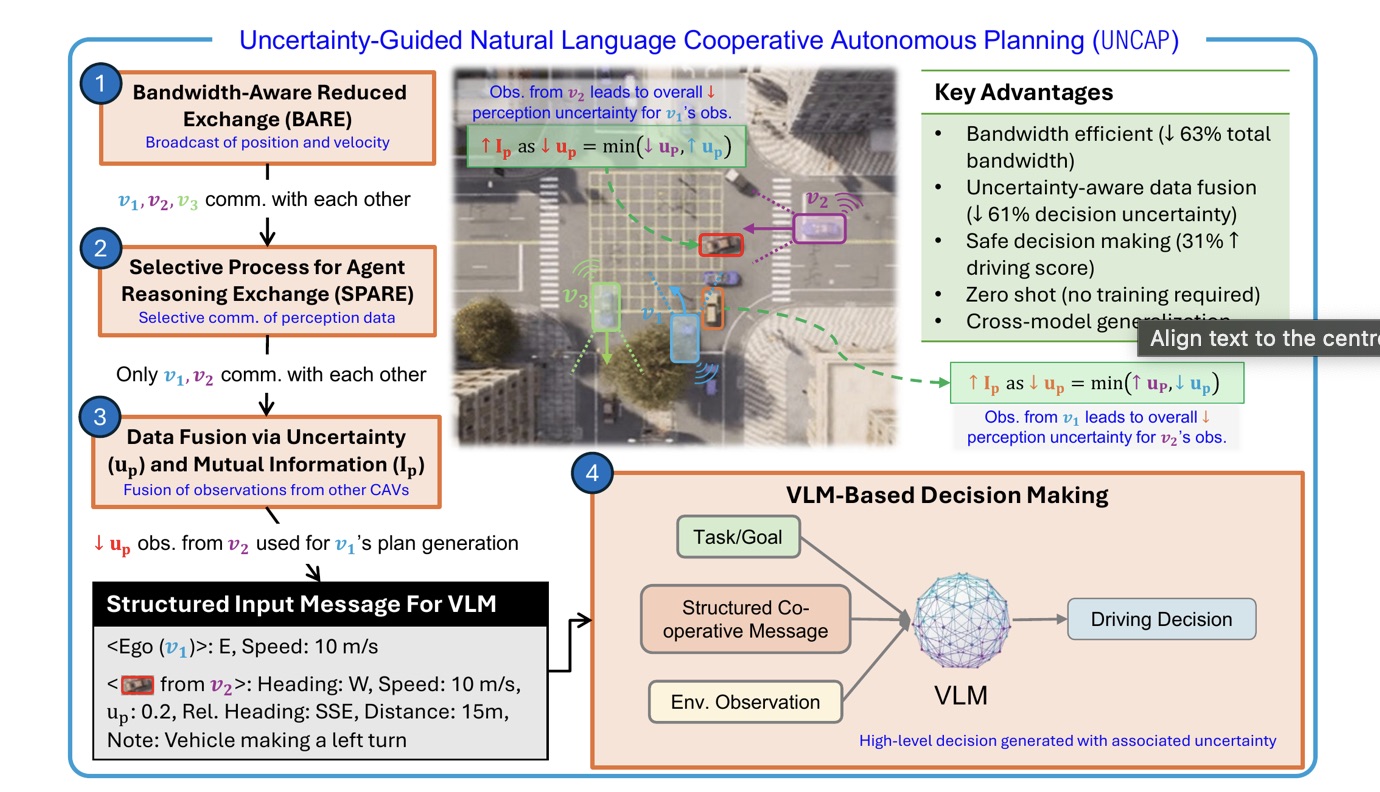
An appeal of UNCAP is that it works entirely in a zero-shot manner. Instead of training a new model (which is resource intensive), UNCAP has a “Bring-your-own-model” strategy. It builds on existing vision-language models and adds a communication strategy that allows vehicles to cooperate intelligently. The UNCAP framework includes four stages.

UNCAP helps each vehicle decide which neighbors matter. Those messages describe nearby vehicles, motion, and confidence, which UNCAP combines before making a driving decision.
1. Discover nearby vehicles

Each vehicle periodically broadcasts a tiny “heartbeat” of information containing only its position and direction of travel. This heartbeat consists of only a few bytes of data. The aim is to provide just enough context for nearby vehicles to understand who is around them.

2. Decide who matters

On the road, most nearby vehicles are irrelevant. A car traveling away from the intersection provides little useful information, whereas a vehicle approaching the same intersection may offer exactly the observations we need. UNCAP reasons about which neighbors are both close enough and likely to affect the vehicle’s future path. This is crucial as it dramatically reduces the bandwidth of unnecessary communication as well as the computation required by downstream stages. It enables UNCAP to scale to handle large teams.

3. Exchange observations and reason about trust

Relevant vehicles then describe what they see using natural language, accompanied by calibrated confidence estimates. Calibration is desirable as it produces reliable uncertainty estimates. UNCAP uses conformal prediction, which is a lightweight calibration method that ensures confidence values reflect the actual reliability of the information being received. Every vehicle then reasons about whether an incoming message actually reduces its uncertainty about the scenario. To answer this, UNCAP measures the mutual information contributed by each incoming observation. Mutual information ensures that the vehicle can give greater weightage to messages that make the scene clearer, while uninformative or potentially misleading observations are discounted. Rather than blindly treating every neighbor homogenously, each vehicle builds an uncertainty-aware understanding of the environment.

4. Make a driving decision

Finally, the scene description generated by reasoning about all incoming messages is passed to an off-the-shelf vision-language model, which produces a driving decision such as merge, wait, or yield, along with a corresponding confidence score.

What did this research teach us?

We evaluated UNCAP in the popular CARLA driving simulator using the OPV2V benchmark, which is a widely used benchmark by autonomous driving researchers. OPV2V includes highway merging, urban intersections, and other scenarios where vehicles frequently experience occlusions.

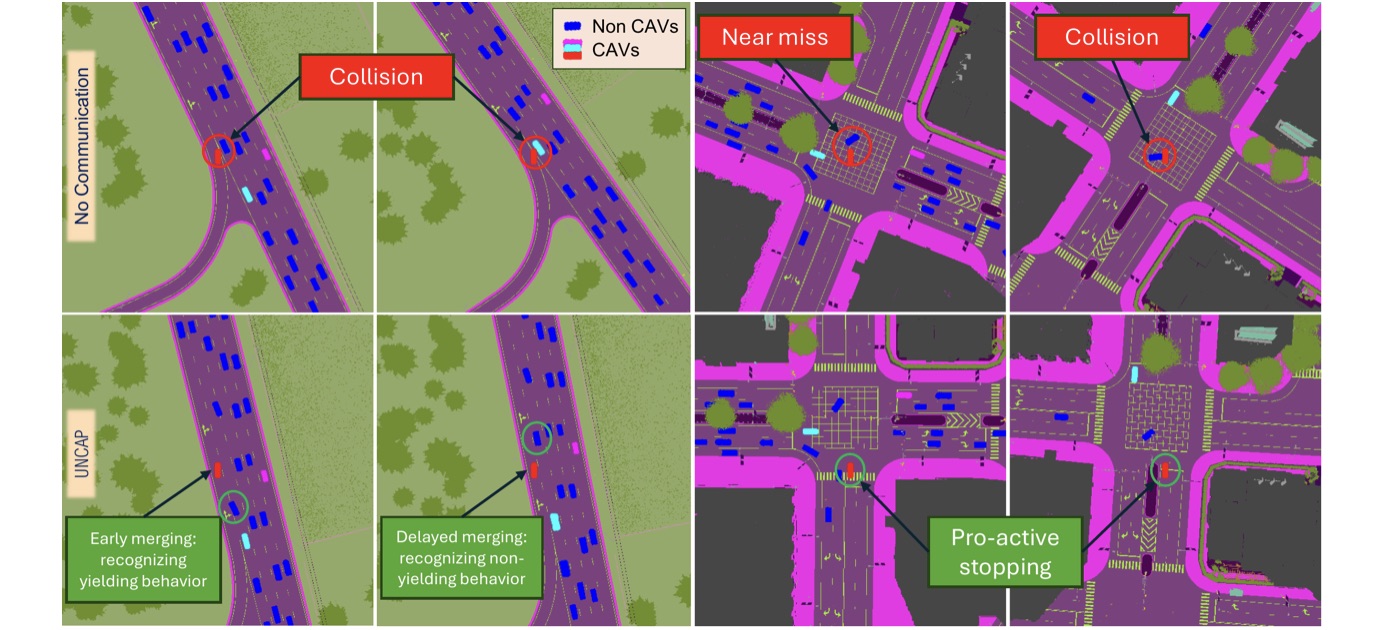
These bird’s-eye-view (BEV) examples compare driving with and without UNCAP. With selected helper messages, vehicles behave more proactively in merging and intersection scenes.

Compared with non-communicating vehicles, and compared with prior language-based approaches that blindly broadcast every observation to every other car, UNCAP consistently improved both efficiency and safety. Over various scenarios, our experiments yielded key qualitative gains of UNCAP over traditional cooperation schemes include:

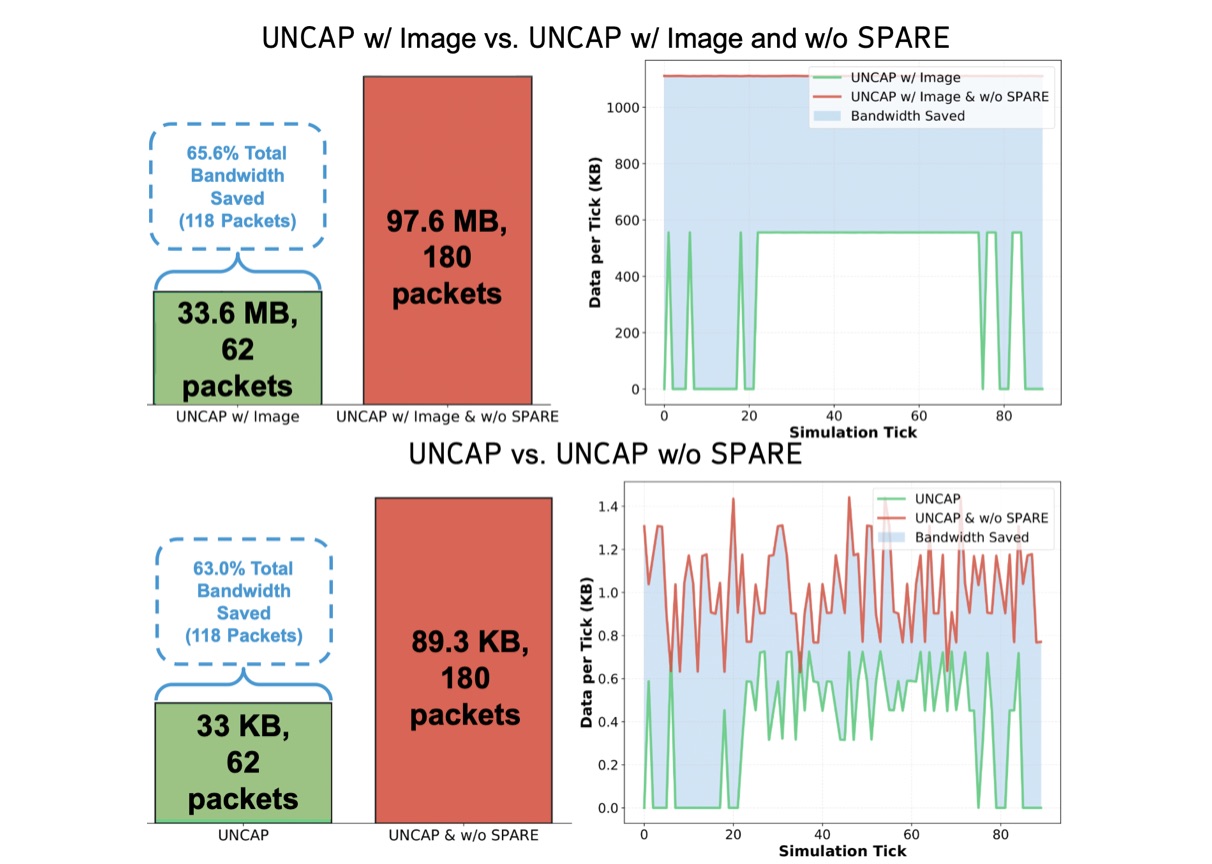
  • 63% less communication bandwidth
  • 31% higher driving score
  • 61% lower decision uncertainty
  • 4× larger safety margins during near-miss events

UNCAP avoids broadcasting every observation to every nearby vehicle. It sharply reduces bandwidth while preserving the information needed for a driving decision.

Perhaps the most surprising result was that sharing raw images actually performed worse than sharing language.

Modern vision-language models appear to struggle when jointly reasoning over multiple camera feeds captured from different viewpoints. Translating those observations into concise natural-language descriptions first seems to act as a form of structured reasoning, distilling the essential information before it reaches the decision-making model.

Equally encouraging, the improvements were consistent across several underlying vision-language models, including GPT-4o, GPT-4.1, GPT-4o-mini, and GPT-5. This suggests that the benefits stem from the communication strategy itself rather than from any particular model.

Looking ahead

UNCAP is an early step toward autonomous vehicles that cooperate more like human drivers.

Today’s implementation has important limitations. Our experiments are limited to simulation, so real-world constraints such as noisy sensing, unreliable wireless communication, network delays and packet losses remain to be explored. Finally, because querying today’s vision-language models takes roughly a second, decisions are made at key moments rather than continuously.

That being said, the broader message extends well beyond autonomous driving.

As AI systems increasingly operate in teams, whether fleets of robots, drones, or software agents, the challenge is no longer simply making each agent smarter. The critical need of the hour is to ensure that each agent in the team learns how to communicate efficiently, decide which information to trust, and build a shared understanding of the world.

In a nutshell, UNCAP suggests that natural language, paired with principled reasoning about uncertainty, can provide a surprisingly effective foundation for that future.

Read the paper in full

UNCAP: Uncertainty-Guided Neurosymbolic Planning Using Natural Language Communication for Cooperative Autonomous Vehicles, Neel P. Bhatt, Po-han Li, Kushagra Gupta, Rohan Siva, Daniel Milan, Alexander T. Hogue, Sandeep P. Chinchali, David Fridovich-Keil, Zhangyang Wang, Ufuk Topcu.


This work was nominated for the AAMAS 2026 best paper award.

Page 4 of 56
1 2 3 4 5 6 … 56